


Somewhere in the halcyon years of internet writing, I read — or, at least, I remember reading — a piece titled “Holden Caulfield was the first millennial dipsh*t.” I’m almost positive this piece existed, and the fact that I couldn’t find any mention of it in the sad, hollowed-out husk of the 2026 internet offers no proof that it didn’t. What did turn up are a newer generation’s takes on Holden, many of them unexpectedly harsh: He’s “the most insufferable character ever written,” “an entitled brat,” the “original ‘needs to touch grass’ guy,” a “clueless rich kid who’s never had to try,” a “self-important, spoiled and worthless little sh*t,” and “an emo narcissist with an inflated sense of his own self-worth.”
Millennials were the first generation to anoint old Holden as “problematic” — a 2009 New York Times piece titled “Get a life, Holden Caulfield,” quoted educators who still taught “The Catcher in the Rye,” a book that turns 75 this year, and was once a standard in the English curriculum for grades 9–11. One educator said that, when she taught at a public charter school, “I had a lot of students comment, ‘I can’t really feel bad for this rich kid with a weekend free in New York City.’” A teacher who taught the book over 3 decades noted that “Holden’s passivity is especially galling and perplexing to many present-day students . . . “[T]hey do not have much sympathy for alienated antiheroes.” And one recalled a boy telling her, “We just wanted to tell him, ‘Shut up and take your Prozac.’”
One of the timeworn accusations against Holden Caulfield is hypocrisy: This guy calls everyone else phony, but he’s just as phony!
Reddit threads and Goodreads reviews suggest that Gen Z has similar smoke for Holden, which makes sense when you consider that for these kids, active-shooter drills are as much a part of grade school as multiplication tables, and creepy full-grown adults are sliding into their DMs asking for nudes. You can’t really blame them if their response to the self-absorbed internal monologues of an unreliable narrator is, Oh, boo hoo. Get some real problems.
But they’ve got another bone to pick with Holden Caulfield: He is being used as a prop by performative men to impress those around him. “Among Gen Z, books have become a symbol not of intelligence but of ‘hotness,’ an accessory to be worn with a good outfit, wedged in the bottom of a designer bag or pretentious tote,” wrote one young woman in a piece for the Times of London. And she has some pitiless words for the callow young men toting “The Catcher in the Rye” pretentiously around: The book, she writes, “has become a go-to summer read for incel types who overly identify with the petulant protagonist Holden Caulfield . . . [W]henever [my friend] sees a man with J. D. Salinger in hand, she assumes he must still be at school: ‘It screams English literature A-level.’” Another piece, this one written by two Gen-Z women, posits that Holden himself is “the ultimate performative male.”
This take is ungenerous but not surprising, given that one of the timeworn accusations against Holden Caulfield is hypocrisy: This guy calls everyone else phony, but he’s just as phony! It did make me wonder, though, whether Gen-Z readers who are assigned “The Catcher in the Rye” still get the same decontextualized introduction to the book as I and the rest of Gen X did. I don’t remember how old I was the first time I read the book, but each time I’ve returned to it as an adult, and there have been a few, I reach the end thoroughly baffled. Are students still introduced to “Catcher” as a novel about disaffection and anomie rather than one about grief, trauma and other things that were absolutely not talked about in Salinger’s day and rarely talked about in mine? And if so, why?
Want more from culture than just the latest trend? The Swell highlights art made to last.
Sign up here
The idea that the art can be separated from the artist has never made sense to me — and the way it was foregrounded within the cultural discourse of #MeToo too often felt like a disingenuous avoidance of the clear reality that great art has been made by people who cause profound harm to others. “The Catcher in the Rye” is a text that is flatly impossible to decouple from its author: A book about trauma written in the midst of trauma by a traumatized man. This doesn’t mean that anyone reading the book needs to know Salinger’s whole deal, but both its creation (much of it was written during World War II, when Salinger served as a counterintelligence agent and was one of the first G.I.s to see the human toll at Dachau) and its wild commercial success (which repelled the author and led to his withdrawal from public life.)
Are students still introduced to “Catcher” as a novel about disaffection and anomie rather than one about grief, trauma and other things that were absolutely not talked about in Salinger’s day and rarely talked about in mine? And if so, why?
As Mikki Halpin noted in these virtual pages following his death in 2010 at the age of 91, Salinger’s quasi-hermithood, among other things, gave cover to his relationships with inappropriately young women; his desire for privacy was inflated into mythology by a “literary establishment,” Halpin wrote, whose collective investment “in the fictional, reclusive Salinger . . . is a convenient cudgel with which to silence any discussion of Salinger’s personal life, particularly any revelation of unsavory truths.”
I would add that the Salinger myth also delayed a reckoning with his most famous character’s mental health. Gen Z men are not the first to use “The Catcher in the Rye” as a prop, after all: Years before I read it, I knew it only as the book Mark David Chapman was carrying when he assassinated John Lennon in 1980 and that, in 1981, was left in the hotel room of John Hinckley Jr. shortly before he attempted to assassinate Ronald Reagan. (In 1989, it resurfaced in another high-profile shooting when Robert John Bardo murdered actor Rebecca Schaeffer, dropping his copy as he fled her Hollywood home.) There’s been plenty of skepticism about whether the latter two were Chapman copycats rather than murders actually inspired by the book. Either way, reluctance to associate either Salinger or his most indelible creation with crazed murderers meant keeping their own wounds at arms’ length.
We need your help to stay independent.
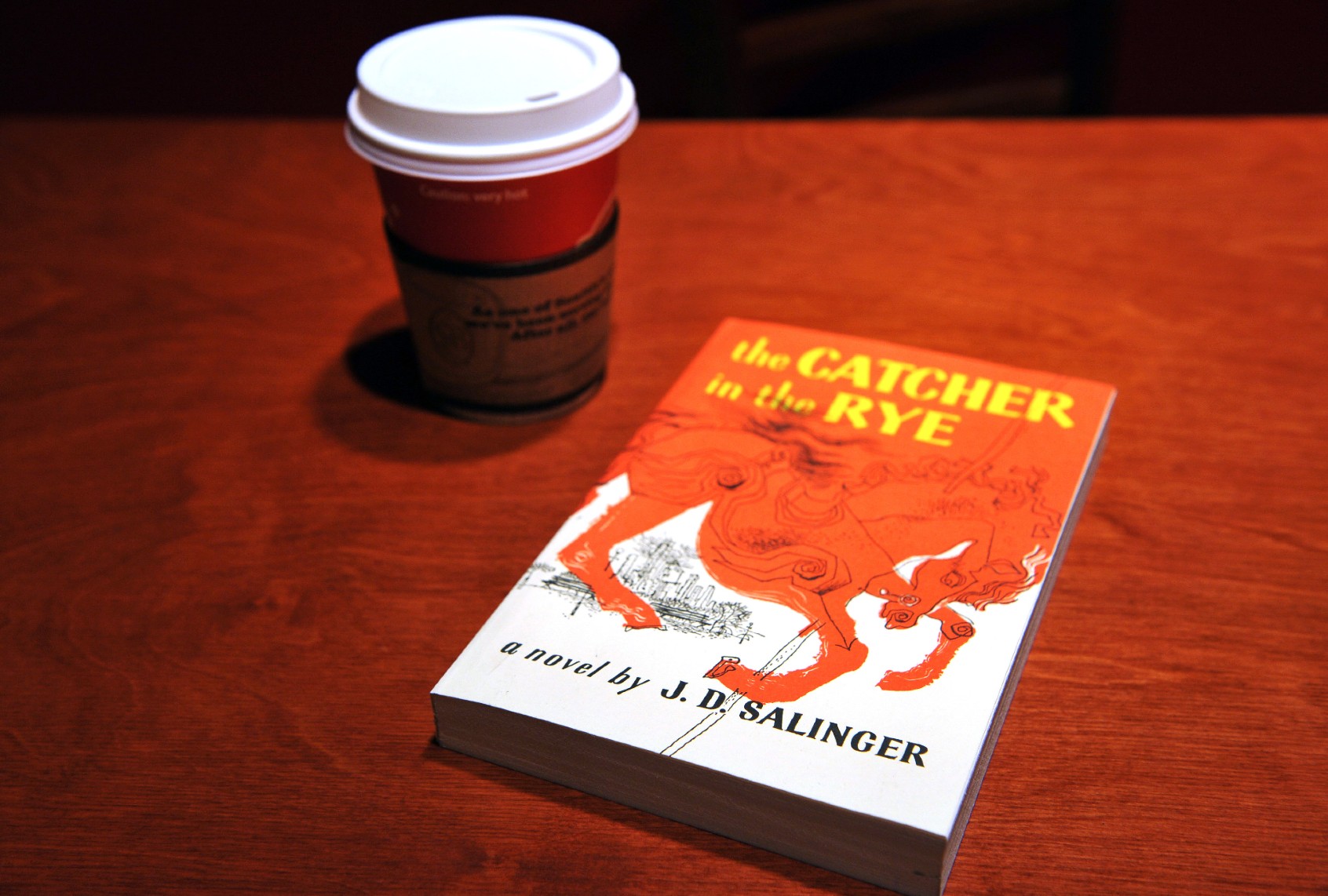
(MANDEL NGAN/AFP via Getty Images) “The Catcher in the Rye”
This is, in part, why I’m surprised at Gen Z’s dismissal of Holden Caulfield as a whiny white rich-kid hypocrite. This cohort has come of age having open conversations about mental health that were unthinkable as recently as 4 decades ago; they understand the way formative traumas burrow into the minds and bodies of those affected and eventually grow unmanageable. I can definitely understand why there might not be, let’s say, a surplus of empathy for a privileged young man carelessly and repeatedly squandering his expensive education. But brushing by consequential facts of Holden’s life — parents who treat him as an out-of-sight-out-of-mind problem, the death of his brother, the suicide of his classmate, a history of being molested by older men — to call him performative feels awfully heartless for a generation this conversant with how trauma works.
Listen, I don’t know anyone who liked Holden Caulfield the first time they read the book, probably because he is not supposed to be particularly likable; Salinger wrote the book for adults, not teens. But reading “The Catcher in the Rye” as an adult, and again as the parent of a Holden-aged boy, has made me realize that if the circumstances in which young readers meet the character have been slow to change, and the lens on him informed largely by a calcified reputation of youth in revolt, that’s on the adults in the room who, like the adults in his life, can’t hear everything he’s telling us.
Read more
about reconsidering novels
