

The ancient Greeks had three distinct words for anger. Until “Furious,” I had no idea this was the case – but then, I’m not a “nut about mythology,” as FBI agent Nora Washington (Quincy Tyler Bernstine) describes herself.
Nora explains to the counselor running a workplace mental health seminar that the Greeks viewed anger as a kind of insanity, but with different diagnostic profiles. There’s Mênis, which Nora defines as the anger of a society or a people. Thumos is the hero’s anger, goading a person to fight or kill.
Then, she says with special relish, there’s Orge, pronounced or-gay. “That’s the slow, quiet anger that builds up in you, until you finally decide to do something about it,” she says. Orge, you can tell from Nora’s viperish grin as she stares down her unctuous supervisor, Ed George (Danny McCarthy), is her favorite.
It’s rare in these days of the Netflix exposition dump for a show to explain what it’s all about in concise moments like this. “Furious,” created by Liz Meriwether, is full of them. Every time we see Nora, we get a sense of how long she’s been carrying her anger without her saying so. She’s more than a little too partial to hard liquor, but if her orge started as cheap wine, it is now a richly aged vinegar eating away at her stomach lining.
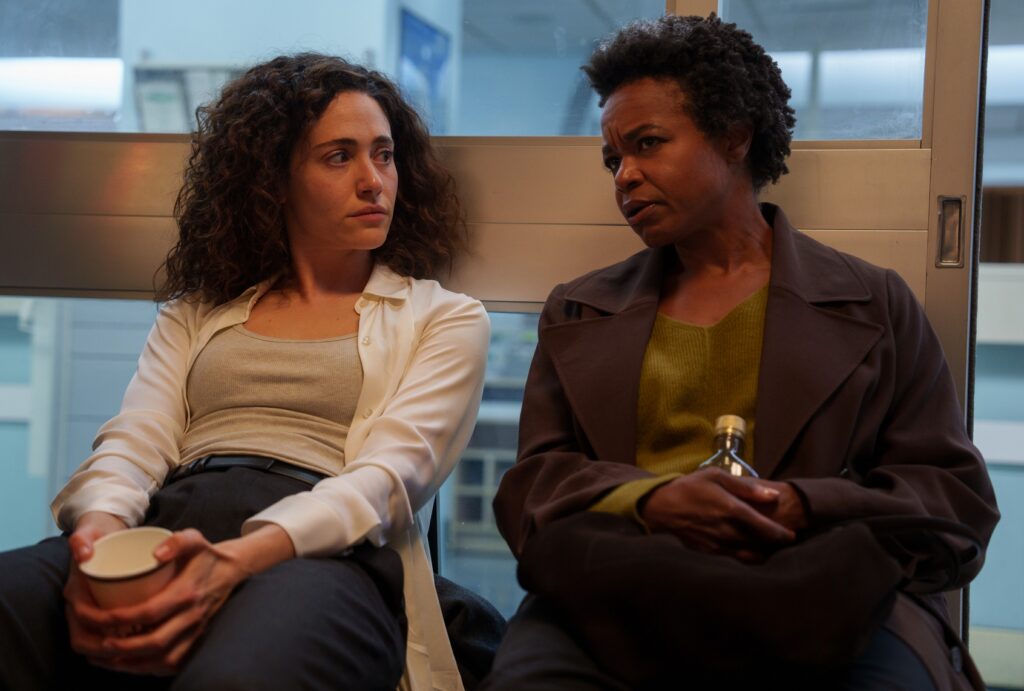
(Disney/Sarah Shatz) Emily Rossum and Quincy Tyler Bernstine in “Furious”
Nora is the tertiary protagonist of “Furious.” Emmy Rossum’s Alice Black is its main hero, a recently arrived FBI employee dismissed by her more experienced male peers as a “baby agent.” But Alice was once a detective for the NYPD, yanked back there when her former partner Danny Kelly (Scoot McNairy) calls her to consult on the murder of a powerful man’s son. Soon Alice and Danny connect the victim’s father to a conspiracy akin to the one that made Jeffrey Epstein a household name.
By then we’ve also met the killer: Catherine Grace (Lola Petticrew), a girlish waif who carries her mortal devices inside a sparkly purse. Catherine is a damaged creature, but so is Alice, whose boyfriend, a fellow cop (played by Jake Lacy), used to drag her out of the shower to pummel her unconscious. A common trait of trauma survivors is being stuck in a behavioral loop associated with their mistreatment. Alice works to be unreadable, a gray rock who in her free time finds guys on dating apps to beat her up as sexual foreplay. Catherine is a chimeric contortion of an ice-cold seductress and a deceitful teenage cherub, which is around the age she got lost.
Add in Nora, an emotionally ground-down FBI veteran who wrangles Alice onto her team, which investigates horror acts nobody else wants to look at — sex crimes and crimes against children — and you have an accurate, modern rendering of the Erinyes, a triune team older than the gods themselves. The poet Virgil named them as Alecto, Megaera and Tisiphone. The Romans dubbed them the Furies.
The recently concluded “Furious,” which was picked up for a second season, comes to us nine years after Harvey Weinstein’s downfall kicked #MeToo into overdrive, and 10 since a woman was denied the White House by a known philanderer and con man. It is a fictionalized ode to womankind’s Mênis, and a gateway to a fall TV season promising more re-examinations of complicated female characters long discounted as madwomen. In two weeks, Netflix will debut “Monster: The Lizzie Borden Story,” the latest of many adaptations of the accused ax murderer’s tale. Shortly after that, the streamer rolls out its updated version of “East of Eden,” through which its creator Zoe Kazan and star Florence Pugh reconsider a woman author John Steinbeck envisioned as a born monster.
Prime Video will soon bring us “Carrie,” the fifth screen retelling of Stephen King’s story of a teen wallflower bullied into murdering most of her class using supernatural powers. It’s not accidental that one sequel is subtitled “The Rage.”
But the real understanding of women’s anger can be found in much earlier sources—ones possibly forgotten, if not for the runaway success of “The Odyssey.”
“The Odyssey” and all its accompanying discourse remain omnipresent, but we have been talking about it since Christopher Nolan’s casting of Lupita Nyong’o as Helen of Troy was revealed months ago. She also plays Clytemnestra, Helen’s twin and Agamemnon’s wife who murders him as payback for sacrificing their daughter, Iphigenia.
Agamemnon’s brother Menelaus (Jon Bernthal), the husband Helen spurned for the love of Paris and Troy, relates this tale to Odysseus’ son Telemachus (Tom Holland), assuring him that Clytemnestra got hers: her son Orestes killed her. Telemachus is horrified that a boy would murder his own mother, but Menelaus sets him straight. No, he says, a dutiful son avenged his father.
We need your help to stay independent.
This goes some distance in explaining why Nolan’s writing of the women in “The Odyssey” left so many people unsettled, and perhaps why it took weeks for “Furious” to build word-of-mouth momentum. Clytemnestra’s revenge, an afterthought in this hero’s journey, is central to Greek drama and classical art as an example of unequal justice. A husband can kill his daughter for the right reasons, but that girl’s mother avenging her is wrong. Of course, as so many 19th-century paintings capture, left out of this telling is that Orestes’ crimes incur the Furies’ wrath. Some righteous crusades can only be won by angry women.

(Disney/Sarah Shatz) Lola Petticrew in “Furious”
“Furious” ended with a mysterious smile people are still talking about. I won’t spoil that experience if you haven’t seen it, but it relates to a late-season moment in which Catherine describes the rush she gets from watching the light extinguish from her victim’s eyes. “It’s like I’m eating him, like I’m swallowing him, like everything he’s ever done is disappearing inside me,” she tells Alice. We’re meant to understand this as a kind of replenishing. Restored power.
The unfaithful Clytemnestra and Helen are supposed to be contrasting forces to Anne Hathaway’s loyal Penelope. But by thinly writing all the women in “The Odyssey,” that’s probably lost on most who saw it, along with the fact that nearly all the obstacles preventing Odysseus’ swift return to his dear wife are either women or known to be female. Samantha Morton’s Circe is the most obvious, along with Charlize Theron’s Calypso. But so are the sirens, in many tellings, along with the sea monsters Scylla and Charybdis.
Even the god with the most presence in Odysseus’ wayfaring, Athena (Zendaya), shows up as a slight spirit who is either his guide or the ghost of his guilt. Maybe she was just something else he’d rather not remember.
Want more from culture than just the latest trend? The Swell highlights art made to last.
Sign up here
Athena is a complicated god, though. She sprang from Zeus’ skull fully formed; her embryonic development reduced to a male deity’s headache. There’s a not-so-subtle message in that genesis myth explaining the compulsion for men to dismiss a woman’s anger, however the Greeks might define it, even if you don’t interpret it as such.
Nora gets it. In the first “Furious” episode, she explains how Medusa, the snake-haired demon who turns men to stone, got that way. Poseidon raped her in Athena’s temple, and instead of taking pity on the woman, Athena cursed her. “She’s a victim,” Nora concludes. “But that doesn’t make her a good person. It turns her into a monster.” We don’t have to forgive Medusa’s murders. But maybe these days we understand better how she felt.
All episodes of “Furious” streaming on Hulu.
Read more
about tales of Mênis
