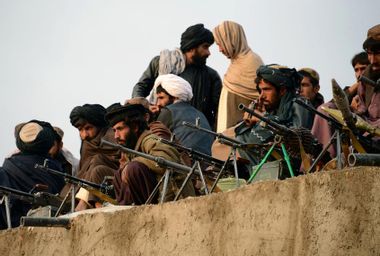
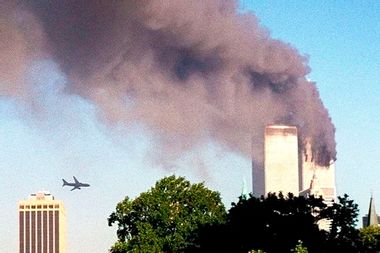
Gen. Stanley McChrystal has admitted that there is no significant al-Qaida presence in Afghanistan. He implies that al-Qaida does maintain some links to the guerrillas fighting the Karzai government. But McChrystal's statement rather undermines the hawkish argument of Lindsey Graham, John McCain and Joe Lieberman that the Afghanistan war is being fought against al-Qaida presence in Afghanistan and only needs more troops and firepower to succeed. In my own view, the Afghanistan training camps were not that important to al-Qaida's 9/11 plot. The key had been recruiting an Egyptian and a Lebanese engineer in Hamburg, Germany, and getting them flight training in the U.S.
Meanwhile, the real al-Qaida is threatening a war of attritition against U.S. troops in the Middle East. The message was far more oriented toward the Israeli-Palestinian issue than toward Afghanistan, which seems to be positioned as the place where U.S. troops are punished for alleged American misdeeds elsewhere. Whenever al-Qaida foregrounds the Israeli-Palestinian issue, it is a sign of the organization's weakness. Everyone knows that they haven't done anything practical for the Palestinians, and that the Palestinian leadership doesn't want them grandstanding on the backs of the Palestinians. Bin Laden is increasingly irrelevant. In the new audiotape (note: not videotape) attributed to him, he accuses Obama of failing to honor his pledge to end the wars. But in fact Obama only pledged to get out of Iraq, and there is every reason to believe that he will do so. Al-Qaida knows that that step will virtually drain its support and recruiting ability (only 4 percent of Arabs say they care deeply about Afghanistan).
In an ominous development for Afghanistan, presidential candidate Abdullah Abdullah has accused incumbent President Hamid Karzai of using state resources to engineer the stealing of the Aug. 20 presidential election, accusing Karzai of treason. Abdullah said that Karzai bribed tribal elders between $4,000 and $8,000 each to throw the election to Karzai. Abdullah is likely stealing a page from Mir Husain Mousavi and Mehdi Karroubi, the losers in the Iranian presidential elections, who refused to accept the officially announced results and who alleged that the election was fixed in favor of incumbent Mahmoud Ahmadinejad. Whereas the result of this dispute in Iran was that hundreds of thousands of mostly peaceful demonstrators repeatedly gathered in the streets until brutally repressed, in Afghanistan protests are likely to be rather more violent.
I think it just got substantially less likely that the West will be able to get Karzai and Abdullah to form some sort of national unity government together.
Abdullah wants there to be a runoff election, which likely will not be necessary by current rules, which require it only if no candidate receives at least 50 precent of the vote. But Abdullah believes that the votes that put Karzai up to 54 percent were at least in part fraudulent and the result of vote-buying with state monies. A runoff is also becoming difficult to hold unless it is scheduled very soon, because winter snows will limit the mobility of much of the population until the spring. But the Independent Electoral Commission is warning that a complete count of the first round may still be weeks away. For Afghanistan to be without a president all winter and spring could be disastrous, not only for the country but also for the Obama administration's military strategy.
CBS has video on the ongoing electoral crisis:
Even generally pro-Western Pakistani newspaper editors are accusing Western politicians who are defending the legitimacy of the election process in Afghanistan of living in another universe.
Meanwhile, Deirdre Tynan at Eurasia.net argues that the increasing dependence of the U.S. and NATO on supply routes coming down from Central Asia into northern Afghanistan has helped destabilize the north, especially Kunduz province, which earlier had been relatively calm. The hijacking of fuel trucks and the subsequent German-ordered U.S. airstrike on the trucks in Kunduz all stemmed from the turn of the U.S. to the northern supply routes. I am alarmed by her suggestion that for the U.S. to depend ever more heavily on Central Asian routes for supplies could impel the anti-government militants to begin hitting Tajikistan, Uzbekistan, etc. That is, the Afghanistan war effort could eventually create a new silk road, in the form of a highway of death that destabilizes the whole region.
Omar Fawza can't find a wife. The 20-something Yemeni reveals his bachelor status with a sigh that suggests it's the most painful experience of his life -- worse even than the five years he spent in U.S. captivity at Guantánamo Bay and in Afghanistan, where he says he was treated "like a dog."
For Fawza, thwarted marital bliss has become the symbol of his rotten existence since U.S. forces scooped him up in Pakistan shortly after the Sept. 11 attacks. Fawza, who had gone to Afghanistan to fight with the Taliban against their domestic rivals long before 9/11 but never saw combat, was locked up by the Americans as part of "the worst of the worst," and then abruptly sent back to Yemen in 2006. Like most of the 14 Yemenis shipped home from Guantánamo so far, he's been stigmatized in his own country as a terrorist ever since, though he was never charged with a crime.
"Guantánamo has destroyed a big part of my life," he told me in a soft voice over cups of syrupy tea in an office in Yemen. (I have given Fawza a pseudonym and kept our exact meeting place secret to spare him additional grief.) "But I have done nothing wrong."
As soon as the U.S. deposited Fawza back in his homeland, Yemeni security agents threw him in prison for another six weeks. Once again, he was never charged. Since his release, security agents have kept him under constant surveillance. Barred from leaving Yemen, he can't travel outside his hometown without government permission. Old friends and relatives treat him like toxic waste. No one will give him a job, and as for the girl he'd like to marry, "I can't ask her father for her hand because I don't have bride money or a way to support her."
Unless President Obama and Yemeni President Ali Abdullah Saleh agree on a humane repatriation plan for an estimated 100 Yemenis still stuck at Guantánamo, many of them could end up dumped with no help in Yemen like Fawza, or worse -- detained indefinitely without charge under the guise of rehabilitation.
The largest remaining group among Guantánamo's approximately 241 detainees, the Yemenis also are the main obstacle to Obama's pledge to close the notorious prison by next January. A few Yemenis are believed to have committed terrorist acts and probably won't ever leave U.S. custody -- men like Ramzi bin al-Shibh, who openly boasted to a military panel at Guantánamo of helping plan the Sept. 11 attacks. Others may be tried for crimes in Yemen. But the vast majority of Yemenis have never been charged with anything, and some were cleared for release as far back as 2005.
Even though they say that most of the Yemenis should be sent home, U.S. and Yemeni officials appear deadlocked on how to address concerns that they might "join the fight" once they get there. The fears don't come in a vacuum. Al-Qaida is growing in Yemen, a rugged, dirt-poor, politically unstable country on the tip of the Arabian Peninsula where guns outnumber people 3-to-1. Too much has been made about the fact that Yemen is Osama bin Laden's ancestral homeland, but there is no denying that a rite of passage for many young Yemenis has been a stint with the Taliban in Afghanistan or with Sunni insurgents in Iraq. Al-Qaida recently announced it intends to make Yemen a regional base. It doesn't help that Yemen is a stone's throw across the pirate-infested Gulf of Aden from Somalia, a country mired in humanitarian crisis and civil war.
Earlier this month, an al-Qaida suicide bomber blew up four Korean tourists and their Yemeni driver while they visited the ancient, walled Yemeni city of Shibam. Last September, the group claimed responsibility for a double-suicide bombing at the gates of the U.S. Embassy in the capital of Sanaa that killed 18 people.
When I visited Yemen in December, the U.S. Embassy complex looked like a fortress -- encircled with sandbags, concertina wire and hordes of Marines and Yemeni security agents. A clean-cut U.S. Embassy official who met with me was blunt. The Yemeni detainees, he said, must be repatriated in a way that "the threat that they pose has been mitigated to the largest extent possible." That will require rehabilitation, he said, but preferably in "a prison-like facility with a programmatic aspect."
American officials caution that any detention must be in accordance with Yemeni law. But as Murad Zafir, the deputy head of the Yemeni office of the National Democratic Institute, observed over lunch in Sanaa, "Laws in Yemen are like Arabian horses: Good to look at but not to ride."
Most decisions in Yemen are made by President Saleh, whose official portraits adorn every public square and office building, usually with rays of light bouncing off his giant jambiya, the ornate, curved dagger that juts from a Yemeni man's embroidered belt in a potent symbol of status and virility. In vast swaths of territory outside Saleh's grasp, powerful tribal leaders call the shots. Reputable Yemeni human rights groups like the National Organization for Defending Rights and Freedom, or HOOD, say Saleh and sheiks hold hundreds of terror suspects, political rivals and just plain unlucky folk without charge, sometimes for years.
One of the agencies that HOOD and others accuse of abusive roundups is the National Security Bureau, whose deputy chief is Col. Amar Saleh, the president's nephew. A tall man with bulging biceps who looked used to having his way, Amar Saleh tsk-tsked allegations of abuse. Any Yemenis the United States sends home from Guantánamo will receive "red-carpet treatment," he said, adding: "The Americans want us to keep some of them in jail but unfortunately we don't have the [U.S.] files with any of the evidence. That is why we have refused."
Watching guards snap to attention at Amar Saleh's every move, I thought of Fahmi Muhammad, another Yemeni repatriated from Guantánamo. All 14 men were imprisoned in Yemen for some time upon their return, most without charge, and then released with no money, no counseling, no nothing. But Muhammad -- not his real name -- appears to have received the worst treatment by far. Held without charge for two years, often in a dungeon, he said he was routinely beaten by security agents who accused him of being sent home to spy for the United States.
"I told them, if you're going to torture me, it won't be anything new," Muhammad recalled. "The Americans already put me through torture."
If the United States foots most of the bill, the colonel said, Yemen will place future Guantánamo returnees in a rehabilitation camp where they will be provided with sports and cultural activities, counseling, medical care, skills like woodworking, and religious dialogue designed to dissuade them of violence. Relatives will be welcome to visit, and once participants are "rehabilitated," the government will free them and, "give them jobs."
But the "camp" would be locked. Asked who would decide when the men were "rehabilitated," and how long might that take, Amar Saleh provided scant detail, but revealed that "some people could spend a couple of months, others could spend a year or more."
On the drive back from Saleh's gleaming offices, I passed the Political Security Organization, the scene of a spectacular jailbreak in 2006 by 23 al-Qaida members and suspected affiliates -- including two men on the FBI's most-wanted list of terrorists. The prisoners allegedly tunneled into the women's room of a nearby mosque. Many Yemen political experts suspect the inmates had inside help. Both of the men wanted by the FBI subsequently resurfaced and roamed freely for months until the U.S. demanded they be rejailed. Last fall, a Yemeni judge halved on of the two men's 10-year sentences on terrorism related charges.
The jailbreak comes up almost invariably in conversations with U.S. officials. The implication: Even a "prison-like facility with a programmatic aspect" might not be enough to assuage U.S. concerns about sending Yemenis home from Guantánamo.
The prevailing theory is that President Saleh is deliberately engaged in a balancing act between Islamic militants and the so-called Global War on Terror: While occasionally rounding up the usual terrorist suspects to appease Washington, he also gives al-Qaida occasional leeway because he has enlisted many Yemenis who fought in Afghanistan and other foreign jihads in his domestic military adventures. Moreover, many al-Qaida members belong to influential tribes whose loyalty Saleh needs to retain power. But the balance may be tipping toward al-Qaida, which sees Yemen as a potential regional headquarters. Earlier this year, Yemeni al-Qaida leaders announced they were expanding their franchise to include Saudi militants, and named a Saudi who had been released from Guantánamo as their new deputy.
If the Obama administration can't find a way to repatriate the Yemenis that assuages security concerns, it may try to send some of the men to an existing, locked-door rehabilitation center in Saudi Arabia, or move them and the Guantánamo-like system of detention without charge to the U.S. mainland. Though Saleh insists he wants the detainees back, there is widespread suspicion that he would be relieved if the United States finds someplace else to put them.
Many Yemenis wish the men would remain elsewhere as well. "The Guantánamo detainees, you can have them," said a dapper Yemeni engineer named Amir. He suggested, without evidence, that the detainees were probably guilty of something. Amir shared his views at a khat chew, a gathering where Yemenis munch on leaves and stems of the indigenous khat plant until they form a wad in one cheek and release a mild stimulant. Khat is controversial but legal and wildly popular in Yemen, and chews are often the scene of lively and wide-ranging discussions.
"Why are you even concerned about a small detail like the Guantánamo detainees when there are huge human rights problems all across this country?" Amir persisted. Between chomps, Amir and several journalists, human rights workers and scholars lounging on low, brocade couches listed the violations -- civilian deaths and injury from the civil armed conflict in the north, child marriage, zealous application of the death penalty, persecution of journalists and political opponents.
The detainees' fate may not be a big deal for Yemen, I told Amir, but it should be a big deal for President Obama, who has pledged to regain the moral authority the United States lost by having locked up hundreds of men for years without charge at Guantánamo. Any so-called solution that ends up prolonging the detainees' mistreatment will risk fueling anti-American sentiment and giving groups like al-Qaida a powerful tool to persuade disaffected youths to join their cause.
If the detainees are to have a chance of any kind of normal life after Guantánamo, the United States will have to spearhead a long-term, comprehensive rehabilitation program of counseling, job training and other help. Authorities may need to monitor some of the men to allay security concerns, but they shouldn't do so in ways that are functionally equivalent to punishments imposed on convicted criminals and that increase the stigma of Guantánamo.
The U.S. should foot most of the reintegration costs. It's the least it can do after locking up many of these men for more than seven years without charge -- men like Fawza, who still shivers when he talks about how his guards at Guantánamo locked him in a room for hours with the air conditioning on full blast when he refused to answer questions he'd already answered dozens of times before.
Fawza told U.S. military authorities he had traveled to Afghanistan in early 2001 to fight with the Taliban, and that U.S. forces were not even in the country then. He fled to Pakistan and surrendered soon after the United States invaded Afghanistan. His dreams are simple: to attend college, find a good job, and find a way to win that bride.
"All I want is to rebuild my life," he said. "I don't want what happened to me to happen to the others when they come back from Guantánamo."
In Sunday's interview with "60 Minutes," President-elect Barack Obama reaffirmed that "it is a top priority for us to stamp out al-Qaida once and for all," adding, "and I think capturing or killing bin Laden is a critical aspect of stamping out al-Qaida." Obama argued that the Saudi terrorist "is not just a symbol" but is rather "the operational leader" of the organization, which he said is still planning attacks against U.S. targets.
Obama's quiet seriousness of purpose is a welcome contrast with George W. Bush's swaggering pronouncements about bin Laden being "wanted dead or alive," or his darkly comic standard answer to the question of why bin Laden has not yet been caught. "He's hiding," Bush likes to say.
And for those who believe Bush, obsessed with Iraq, has either not tried very hard or has secretly avoided capturing bin Laden, Obama's words are probably reassuring. Now American attention will return to the real author of 9/11, and a more determined effort might yield fruit. But the question is whether the new president should really focus his attention on bin Laden, and spend his political capital in a renewed attempt to bring him to justice. There are many reasons why a stepped-up and publicized pursuit of bin Laden may prove costly to Barack Obama.
The first is the danger of failing, just like his predecessor. After the bravado of the early post-9/11 period, and vows to catch his quarry, Bush came up empty. An enemy who struck at the beginning of his first term is still at loose in the Pakistani-Afghan borderlands at the end of his second.
Some in the region believe that Bush never caught his nemesis on purpose. A secular-minded newspaper in Afghanistan said in October that French troops in that country as part of the NATO contingent had for some time alleged that they were on the verge of capturing bin Laden when their American counterparts stopped them from doing so. The paper referred to a French documentary that featured interviews with the troops and that maintained that the Bush administration needed bin Laden to be at large in order to justify its military expansion into the region.
This theory is a more sinister variant of the view that capturing Osama was simply not very high on Bush's list of priorities, and that he put all his resources instead into destroying Saddam Hussein. Already in spring of 2002, as his administration geared up for what was supposed to be a swift and stunning victory in Iraq, Bush was trying to deflect attention from his failure to capture the author of 9/11. Bush downplayed bin Laden's importance, and said he didn't seem to be at the center of any command structure. He decried the supposed fallacy of focusing on "one person" and admitted, "I truly am not that concerned about him."
Should the next president now be playing up bin Laden's importance? Does bin Laden merit such attention? In a speech at the Atlantic Council last week, the head of the Central Intelligence Agency, Michael Hayden, largely concurred with the points Obama has been making about the continued centrality of al-Qaida in its Pakistani haunts to U.S. security concerns. Contrary to Republican politicians who still speak of Iraq as the central front in the "war on terror," Hayden forthrightly announced, "Al-Qaida in Iraq is on the verge of strategic defeat."
In contrast, Hayden said, nowadays "all the threats we have to the West have a thread that takes them back to the tribal region along the Af-Pak border." He also underlined that he considers capturing the organization's leader a top priority.
But Hayden stressed bin Laden's symbolic importance more than his operational role, observing, "Because of his iconic stature, his death or capture clearly would have a significant impact on the confidence of his followers." Unlike Obama, Hayden said that bin Laden "appears to be largely isolated from the day-to-day operations of the organization he nominally heads."
Rumors swirl in the region about the whereabouts and activities of Osama bin Laden. It is held by some observers that the world's most wanted man is no longer with us. In September of 2006, a French newspaper carried a leak from that country's General Directorate for External Security to the effect that Osama bin Laden had died that summer of typhoid fever. French intelligence had received the report from Saudi intelligence, which should have good sources on al-Qaida. The Saudis backed off the assertion, apparently because they could not locate the grave site. But it should be underlined that the puritan Wahhabi creed of Saudi Arabia forbids headstones and stipulates that the body should be wrapped in a shroud and buried by sunset of the day of death, so that a Saudi grave in a wilderness might never be discovered.
The speculation about bin Laden's demise has been fueled by his failure to issue any further videotapes after his intervention in the 2004 presidential election. Audiotapes would be easier to forge or to splice together. Even his recent audiotapes, such as the one last May threatening Europe, may have been recorded much earlier. Obviously, Obama will not be able to catch his man if he is in an unmarked grave in South Waziristan.
More recently, however, the Pakistani Geo satellite television station has reported that its sources say bin Laden is still alive. According to a report from late October, he is hard at work on a book about al-Qaida. He is said to blame the United States for the world's present financial crisis and to be exercised about what he calls U.S. "atrocities" against Muslims.
If bin Laden does remain healthy and active, it still won't be easy to find the terrorist mastermind. Saddam Hussein was only found because one of his own associates informed on him to the Americans. Bin Laden, in contrast, appears to retain the loyalty of his own retinue. The Saudi terrorist is widely thought to be hiding in one of the tribal agencies in the mountainous wilderness that stretches along the border of Afghanistan and Pakistan. The Pakistani government estimates that 60 percent of the land area in these Federally Administered Tribal Areas (FATA), which are analogous to the Native American reservations in America's Southwest, are administratively inaccessible. Others have sometimes argued that bin Laden is inside Afghanistan itself, where he built safe bunkers over the decades.
Terrorism experts differ on whether the remnants of al-Qaida in Pakistan's tribal agencies pose a dire threat to the U.S. Even Hayden admitted last week, "The truth is, it's not all that easy to build a worldwide terrorist network and manage a global fight from an isolated outpost in northwestern Pakistan." It is not clear what exactly the few hundred Arab expatriates in places such as South Waziristan could do from there to the United States. The attacks on Sept. 11 were largely planned by European-trained engineers resident in Europe, and all they got from al-Qaida was ideological direction, training in camps in Afghanistan, money and some extra muscle. Despite Hayden's fears that training camps are being reestablished in Waziristan, it is not plausible that nowadays well-educated fanatics based in the West could come to them for high-powered training, be provided with money and colleagues, and leave them to come attack the United States. The militants are besieged by the Pakistani, Afghan and NATO militaries. The old al-Qaida seems to have little or no command and control structure left (as Bush admitted already in 2002). Terrorism analyst Marc Sageman, who was a CIA field officer in Pakistan in the late 1980s, maintains that the old al-Qaida organization is gone. What is left is loose networks of wannabes and hobbyists around the Muslim world, mainly linked by the Internet. Sageman's interpretation is challenged by Bruce Hoffman, who insists that al-Qaida survives as an organization that can make things happen. If Sageman is right, then a further siege of the FATA regions is a fool's errand.
Part of the reason for this debate is that the term "al-Qaida," like the label "Taliban," is used inexactly by many analysts. The technical definition of al-Qaida is the fighters, mainly Arabs, who pledged fealty to bin Laden and undertook an operation for him. Few such individuals have not either been killed, captured or forced to retire from the field. But the label is still being applied to militants whose links to bin Laden are either distant or nonexistent.
The Pakistani military attacked some clans of the Mamund tribe in Bajaur recently, on the grounds that they had melded with the Pakistani Taliban. A general breathlessly announced that he had found al-Qaida elements with the defeated tribesmen. Then it turned out that they were Tajiks and Uzbeks, probably fundamentalists persecuted in their own Central Asian countries by post-Soviet commissars, who had taken refuge with the Mamund. They were not what most Americans would think of as al-Qaida, exactly, but that is what the Pakistani military called them.
The practical question of how the United States would get at Osama bin Laden if he is in the FATA regions of Pakistan is hard to answer. Certainly, no American troops will be allowed to operate there. Pakistan was born in the struggle to escape British colonialism, and is all about not having foreign troops on its soil. There is already an extensive intelligence cooperation between the U.S. and Pakistan, with CIA and FBI field officers covertly on the ground.
The Bush administration has been targeting Arab fighters with predator strikes. Occasionally, however, they have killed Pakistani civilians in these attacks, and the Pakistani public is increasingly angry about this violation of their country's sovereignty. There is some danger that the democratically elected Pakistani government, which came to power in February, will be undermined if the public views it as authorizing or allowing the U.S. to attack their country at will.
It is risky for Obama to focus so much on killing or capturing Osama bin Laden. If he does not succeed soon, his critics will constantly throw it in his face. If such domestic criticism begins to sting, it could impel him to rash actions. The danger of mounting a major U.S. military campaign to kill or capture Osama bin Laden and destroy al-Qaida is that it risks alienating further the local Pashtun tribes who suffer collateral damage, as well as the Pakistani public in general. Gaining the trust and friendship of the Pakistani public and political elite is far more important in the long term to the struggle against al-Qaida than any limited military operational success could be.
It was more ramble than rumble on the red rug as John McCain and Barack Obama met for their second debate on a day when the stock market continued its plunge down a seemingly bottomless pit. Maybe it was the stilted format of an ersatz town hall, maybe it was the gravity of the economic crisis, maybe it was the fuzziness of many of the audience questions, but the result was a surprisingly civil debate devoid of the gotcha moments and zingers likely to be immortalized in the YouTube hall of fame.
Never before in the 48-year history of presidential debates has a candidate begun his substantive remarks, as Obama did, by starkly declaring, "I think everybody knows now we are in the worst financial crisis since the Great Depression." Yet as a first-term senator -- a candidate whose meteoric rise has been fueled by his opposition to the Iraq war, his charisma and his life story -- Obama did a masterly job of coming across as the candidate of economic reassurance.
McCain came across as solid and competent (though his incessant talk of "earmarks" was enough to prompt viewers to reach for their earmuffs). But with four weeks left before the election and with his poll numbers collapsing along with the Dow Jones Average, McCain needed a debate performance that would support a domestic surge in his fading electoral prospects. Such a stirring comeback was not on the calendar for Tuesday night -- and now McCain has to gamble on a breakthrough when the two candidates meet for the final time at Hofstra University on Oct. 15.
To the credit of both candidates, no time was wasted on phony issues like Obama's arm's-length association with 1960s radical bomb-maker Bill Ayers or McCain's long-ago entanglement in the Keating Five scandal. Instead, there was a welcome gravity to the debate that was reflected by McCain declaring in answer to a question, "Americans are angry, they're upset and they're a little fearful." Minutes later, Obama told another undecided voter in the audience, "I understand your frustration and your cynicism."
Bill Clinton -- who overwhelmed George H.W. Bush in the first town-meeting debate in 1992 -- was the unquestioned master at feeling (or feigning) the pain of an individual voter. But Obama and McCain had the much more difficult challenge of feeling the pain of an entire economy. In one of his strongest moments -- even though it was unlikely to make the morning-after highlight reels -- Obama explained the credit crunch in a way that even the most economically unsophisticated voter could understand:
"The credit markets are frozen up and what that means ... is that small businesses and some large business just can’t get loans. If they can't get a loan, that means that they can't make payroll ... If you imagine just one company trying to deal with that, now imagine a million companies all across the country."
Looking at the debate purely in political terms obscures the reality that much of what both candidates are saying about the economy is only tangentially connected to the worldwide financial crisis. Middle-class tax cuts, Obama's favorite balm, would not lift America out of a deep recession or do much to restore retirement accounts devastated by the stock-market dive. McCain was even further off the mark with his proposal for an "across-the-board freeze" on government spending -- defense, of course, excluded. McCain's green-eyeshade approach to economic calamity suggests that he lives in an alternative universe where the economic-stimulus lessons of John Maynard Keynes have never been demonstrated.
Both McCain and Obama seemed almost relieved when moderator Tom Brokaw began to call on audience members in Nashville who had been primed with foreign-policy questions. There was something familiar and comforting in returning to the practice-perfect arguments over the Iraq war, with McCain claiming yet again that "Sen. Obama would have brought our troops home in defeat." Obama -- in a passage that clearly had been honed in debate-prep sessions -- went after his Republican rival by saying with mock puzzlement in his voice, "I don't understand how we ended up invading a country that had nothing to do with 9/11, while Osama bin Laden and al-Qaida are setting up base camps and safe havens to train terrorists to attack us. That was Sen. McCain's judgment and it was the wrong judgment."
Every debate wrap-up story should come with a warning label that reads something like this: "Public opinion takes time to harden, which is why instantaneous dial reactions of focus groups and snap polls regarding who won can be misleading. Television pundits often have no better handle than, say, Uncle Morty from Cincinnati about whether votes were swayed by a debate. So treat all morning-after verdicts with healthy skepticism."
Still, the suspicion here is that Tuesday night in Nashville will be remembered mostly as the neglected middle child of the 2008 debate family. It was neither the first time that McCain and Obama faced off (though it was the first time that the 72-year-old Arizona senator looked directly at his younger rival), nor will it be the last. As hard as it may have been for both Sarah Palin's ardent fans and acid foes to accept, this was a debate that had nothing to do with Alaska, lipstick on pigs, a purported media conspiracy or the questionable moral superiority of small-town life.
At a time when the world economy is teetering on the brink of the abyss, both Obama and McCain rose to the occasion with a serious -- if sometimes ill-focused -- debate that reflected the enormity of the crisis. Obama got it right early in the evening when he flickered away a McCain critique by saying to an audience member, "You're not interested in hearing politicians pointing fingers." What is difficult to determine is how swing voters will react in going from watching this sober Nashville town meeting to being subjected to the impossible-to-justify exaggerations and distortions of the campaign ads on TV. Maybe, just maybe, yet another frightening drop in the Dow will have proven enough to raise the tenor of what was fast becoming a down-and-dirty campaign.
For almost three years now, the Bush administration has insisted that the nation's security depends on keeping secret a part of its war on terror that was first exposed in the media back in 2005: its extralegal spying inside the United States. Bush lawyers have relied on the state secrets privilege to block numerous lawsuits challenging the administration's reported spying on Americans and others without warrants, claiming that even to acknowledge such allegations would put the country's security in jeopardy.
A cornerstone case in this legal battle is that of the Al-Haramain Islamic Foundation Inc., an Oregon-based charity group, in which there appears to be the most known evidence of such spying. And, as it turns out, one need look no further than the FBI's official Web site to find irrefutable evidence that surveillance of the group occurred -- and that the government's persistent claims of maintaining secrecy about it have been spurious.
I am an attorney on the legal team representing Al-Haramain and two lawyers, Wendell Belew and Asim Ghafoor, who represented Al-Haramain in 2004 when the FBI was investigating the charity to determine whether it should be declared a terrorist organization. Al-Haramain, Belew and Ghafoor have sued the Bush administration for warrantless electronic surveillance of telephone conversations between Belew and Ghafoor and one of Al-Haramain's directors during March and April 2004.

As I recounted in Salon in July, lawyers for the Bush administration have gone to extreme and even bizarre lengths in their attempts to prevent the federal courts from determining the legality of the president's warrantless electronic surveillance program. A key problem for them is a top-secret document that the Treasury Department accidentally disclosed to Al-Haramain's lawyers in 2004. The document confirmed the surveillance of our clients, and thus, we contend, their legal standing to sue as victims of the program.
The government lawyers want to prevent our legal team from using the document as evidence in the case -- in fact, they want to erase the document from all memory. Belew and Ghafoor had to return their copies of the document to the FBI, and the Bush lawyers have urged the courts not to allow us even to describe its contents in confidential court filings. Again, they have argued that U.S. national security hangs in the balance.
In the most recent ruling in the case, on July 2, U.S. District Court Judge Vaughn Walker said we could not use the document until we first made a preliminary showing of electronic surveillance using only nonclassified information. Judge Walker gave us 30 days to restructure our complaint in an attempt to make that preliminary showing.
Now, we have done exactly that. For many months, we had been gathering public information about the warrantless surveillance program in general and the 2004 investigation of Al-Haramain in particular, including congressional testimony and speeches by various public officials in which, bit by bit, they have revealed key information in surprising detail. By the time of Judge Walker's July 2 ruling, we had assembled the following timeline, based solely on public information and Belew's and Ghafoor's recollections of the 2004 telephone conversations:
In February 2004, upon the Treasury Department's preliminary designation of Al-Haramain as a terrorist organization, the FBI began investigating Al-Haramain, ostensibly for currency and tax law violations. During the following weeks, Belew and Ghafoor had numerous telephone conversations with an Al-Haramain director in which they discussed, among other things, Ghafoor's representation of three persons -- a brother-in-law of Osama bin Laden's and two clerics whom bin Laden claimed had inspired him -- in a lawsuit filed by victims of the 9/11 terrorist attacks. In September 2004, upon formally declaring Al-Haramain to be a terrorist organization, the Treasury Department issued a press release claiming, for the first time, that Al-Haramain had "direct links" with Osama bin Laden. The obvious inference is that the government had relied on electronic surveillance of the telephone conversations -- as confirmed by the top-secret document later accidentally disclosed -- to tie Al-Haramain to Osama bin Laden.
But since the July 2 ruling, we have discovered additional evidence of surveillance of our clients. In fall 2007, FBI deputy director John Pistole gave a speech at a conference of bankers and lawyers in which Pistole thanked the bankers for their cooperation in giving the FBI financial records for terrorist financing investigations, and then went on to describe the FBI's 2004 investigation of Al-Haramain. In the text of the speech -- which is posted on the FBI's Web site -- Pistole explicitly admitted that the FBI had used "surveillance" among other "investigative tools" in the Al-Haramain investigation, noting that "it was the financial evidence that provided justification for the initial [terrorist] designation" in February 2004.
Remarkably, Pistole made these public statements months after Bush's lawyers had told the 9th Circuit Court of Appeals (in mid-2007) that whether Al-Haramain was surveilled in 2004 -- with wiretapping or in any other way -- is a state secret that the government can neither confirm nor deny. As defense counsel Thomas Bondy put it then: "It is absolutely clear and undisputed that the world at large, the whole world, does not know whether or not any of the plaintiffs were surveilled."
Pistole's speech tells us not only that the government surveilled Al-Haramain but that the government relied on financial information for Al-Haramain's initial terrorist designation in February 2004 and then relied on surveillance -- undoubtedly including the telephone conversations intercepted by the National Security Agency in March and April -- later to issue the formal terrorist designation purporting to tie Al-Haramain to bin Laden.
Judge Walker will next decide, in a hearing scheduled for Friday, what procedures he will follow in deciding whether we have presented enough nonclassified information to go forward with the lawsuit. For purposes of that decision, Pistole's speech certainly makes it difficult for Bush's lawyers to claim with any credibility that it remains a secret vital to U.S. national security whether Al-Haramain was surveilled under Bush's warrantless wiretapping program.
Where the hell are Osama bin Laden and Ayman al-Zawahiri? And why does virtually no one ask anymore? What's changed since the days when any suburban soccer mom would have strangled either of them with her bare hands if given the chance? And what happened to President Bush's declaration to a joint session of Congress nine days after 9/11 that "any nation that continues to harbor or support terrorism will be regarded by the United States as a hostile regime." Doesn't that apply to Pakistan?
These are things that I wonder as I watch from my perch in Philadelphia, where I'm a talk show host, columnist and MSNBC talking head. I have also spoken and written about them incessantly, so much so that I've exhausted my welcome with many conservative members of my own talk radio audience. My editors at the Philadelphia Daily News and the Philadelphia Inquirer have made it clear that I've published my last column on this issue because I have written seven to date. On the day after the Pennsylvania primary, I told Chris Matthews on "Hardball" that this was an issue that could help Barack Obama win support among white male voters; he recognized that it was "[my] issue," before adding, "And I agree with you completely."
I can't help myself. So strong is my belief that we've failed in our responsibility to 3,000 dead Americans that I am contemplating voting for a Democratic presidential candidate for the first time in my life. It's the chronology I find so compelling.
We're at the seven-year anniversary of 9/11, lacking not only closure with regard to the two top al-Qaida leaders but also public discourse about any plan to bring them to justice. To me, that suggests a continuation of what I perceive to be the Bush administration's outsourcing of this responsibility at great cost to a government with limited motivation to get the job done. Of course, I may be wrong; I have no inside information. And I'd love to be proven in error by breaking news of their capture or execution. But published accounts paint an intriguing and frustrating picture.
To begin, bin Laden is presumed to have been in Afghanistan on 9/11 and to have fled that nation during the battle at Tora Bora in December of 2001. Gary Berntsen, who was the CIA officer in charge on the ground, told me that his request for Army Rangers to prevent bin Laden's escape into Pakistan was denied, and sure enough, that's where bin Laden went. Then came a period when the Bush administration was supposed to be pressing the search through means it couldn't share publicly. But as time went by with no capture, the signs became more troubling.
We now know that in late 2005, the CIA disbanded Alec Station, the FBI-CIA unit dedicated to finding bin Laden, something that was reported on July 4, 2006, by the New York Times. At the time, I hoped we'd closed the bin Laden unit because Pakistani President Pervez Musharraf was fully engaged in the hunt in his country's northwest territories, where the duo were supposedly hiding. In September 2006, however, Musharraf reached an accord with tribal leaders there, notorious for their refusal to hand over a guest. In doing so, he agreed to give them continued free rein.
The following month, in October of 2006, I participated in a week-long, Pentagon-sponsored military immersion program called the Joint Civilian Orientation Conference. This was a unique opportunity for 45 civilians who were invited to play military tourist and learn firsthand about the United States Central Command (CENTCOM). We traveled 15,000 miles and spent time in four nations. Our days began at 5 or 6 a.m. and didn't end until 10 or 11 p.m. Along the way, we boarded the USS Iwo Jima by helicopter in the Persian Gulf, fired the best of the Army's weaponry in the Kuwait desert (just 10 miles from Iraq), drove an 11-kilometer Humvee obstacle course (designed to teach about IEDs), boarded the Air Force's most sophisticated surveillance aircraft in Qatar, and even took a tour of a military humanitarian outpost in the Horn of Africa. In addition to Secretary Rumsfeld, we were briefed by the vice chairman of the Joint Chiefs of Staff, the vice admiral of CENTCOM and other high-ranking war commanders.
I came home with the utmost respect for the men and women throughout the ranks of all five branches of the service committed to eradicating the forces of radical Islam. But there was one thing noticeably absent: the search for bin Laden and al-Zawahiri. It was not part of our otherwise comprehensive agenda, and when I did ask specific questions, there was no information forthcoming except a generic assertion that, indeed, the hunt continued.
When we were briefed at Andrews Air Force Base by Vice Adm. David Nichols, the No. 2 to Army Gen. John Abizaid, I asked him whether the hunt for bin Laden was, at that stage, completely dependent upon Pakistani President Pervez Musharraf. He told me we respect national sovereignty, and described the search as "difficult and nuanced." I took that as a confirmation of my concern about outsourcing.
When in Bahrain, I put the same question to Marine Brig. Gen. Anthony Jackson. He told me that the search was the equivalent of finding one man in the Rockies, an analogy that I heard repeatedly from men I met overseas. He also said that "no one is giving up," and that my question was better put to the guys in special ops.
So, when we got to the special ops headquarters in Qatar, I raised the matter yet again, this time with Col. Patrick Pihana, the chief of staff to the Combined Forces Special Operations Component Command. He offered nothing substantive on the issue.
No one told me the search was over, but I came home worried that the days of aggressively hunting bin Laden and al-Zawahiri had ended. Of course, I could fully appreciate that an aggressive pursuit was under way but that I, a blowhard from Philadelphia, was simply deemed unworthy of any information. That would have been fine.
But there was another consideration. More than one individual with whom I spoke -- and no one that I have named here -- raised with me the question of what would happen to public support for the war against radical Islam if we were to find and kill bin Laden and al-Zawahiri. They wanted to know: Would the American people then expect the military to pack up and go home? No one ever told me that we're not hunting bin Laden because killing him would cause Americans to want to close up shop in Iraq and Afghanistan, but it was absolutely on the minds of our warriors as support for the war in Iraq dissipated.
A few months before my return, there was news of our response to the accord reached between Musharraf and the tribal warlords. The agreement, which was effected on Sept. 5, 2006, stipulated that the Pakistani army would pull back from the tribal areas. A report from the BBC detailed what the tribal leaders would grant the army for withdrawing: "Local Taleban supporters, in turn, have pledged not to harbor foreign militants, launch cross-border raids or attack Pakistani government troops or facilities."
Meanwhile, there was no demand for accountability by our government. The White House and the Pentagon consistently played down the significance of capturing bin Laden and al-Zawahiri, and President Bush offered only superficial responses to the few questions raised on the status of the search. On Feb. 23, 2007, the Army's highest-ranking officer, Gen. Peter Schoomaker, said he didn't know whether we would find bin Laden, and "I don't know that it's all that important, frankly."
At a May 24, 2007, White House news conference, when asked why Osama was still at large, President Bush offered his usual refrain: "Because we haven't got him yet ... That's why. And he's hiding, and we're looking, and we will continue to look until we bring him to justice." For me, somewhere between two and four years removed from 9/11, it had all begun to wear thin -- especially because it seemed bin Laden remained active. Unfortunately, the president's standard line has long been accepted by the media and American people.
Then, On May 20, 2007, the Times reported that we were paying $80 million a month to Pakistan for its supposed counterterrorism efforts, for a total of $5.6 billion.
In July 2007, a National Security Estimate concluded that the failure of Musharraf's accord with warlords in Pakistan's tribal areas had allowed bin Laden's thugs to regroup there. On July 22, National Intelligence director Adm. Mike McConnell said on "Meet the Press" that he believed bin Laden was in Pakistan in the very region Musharraf had ceded to the warlords.
I hoped that the presidential campaign would move the issue to the front burner, but despite the campaign's 24/7 nature it failed to stir up a discussion about the failure to capture or kill those who pushed us down such a perilous path. In the first seven presidential-primary debates -- four for the D's, three for the R's -- there was only one question in 15 hours of discourse that touched on the subject of finding bin Laden in Pakistan, and it came from the audience. Though I did not keep count thereafter, I know that the issue never gained resonance in any subsequent debate.
Things changed somewhat on Aug. 1, 2007, when Barack Obama delivered a speech at the Woodrow Wilson International Center for Scholars: "If we have actionable intelligence about high-value terrorist targets, and President Musharraf won't act, we will," he said.
"We can't send millions and millions of dollars to Pakistan for military aid, and be a constant ally to them, and yet not see more aggressive action in dealing with al-Qaida."
Finally, I thought, a presidential candidate saying something about this foreign-policy failure.
The reaction? Ridicule.
Then presidential candidates Joe Biden and Chris Dodd responded derisively. Pakistani foreign ministers did likewise. Across the aisle, John McCain pounded Obama for a perceived lack of seasoning in the realm of foreign relations: "The best idea is to not broadcast what you're going to do," McCain said in February. "That's naive." (More recently, McCain has grown fond of saying that he'll "follow bin Laden to the gates of hell.") Not to be left out, Hillary Clinton said, "You can think big, but, remember, you shouldn't always say everything you think when you're running for president because it could have consequences across the world, and we don't need that right now."
Of course, that didn't stop Sen. Clinton from including bin Laden's image -- along with reminders of the attack on Pearl Harbor -- in a television commercial that aired in the final days before the Pennsylvania primary election. After scolding her opponent for advocating a specific course of action in Pakistan, the world's most infamous terrorist became a bankable issue for the junior senator from New York when her back was against the wall.
To his credit, Obama refused to back away from his insistence on reasserting American control over the hunt for bin Laden. I interviewed him on March 21, 2008, and he admitted that a resurgence of the Taliban had occurred in Pakistan.
"What's clear from ... what I've learned from talking to troops on the ground is that unless we can really pin down some of these Taliban leaders who flee into the Pakistan territories, we're going to continue to have instability, and al-Qaida's going to continue to have a safe haven, and that's not acceptable."
I was pleased by what he had to say about the issue, and asked about it again on April 18, 2008, when I interviewed him for a second time. He told me that Musharraf, despite being flush with billions in American aid, was not taking counterterrorism seriously.
"That's part of the reason that I've been a critic from the start of the war in Iraq," Obama told me. "It's not that I was opposed to war. It's that I felt we had a war that we had not finished."
"And al-Qaida is stronger now than at any time since 2001, and we've got to do something about that because those guys have a safe haven there and they are still planning to do Americans harm."
He also pointed out that the Bush administration had actually shown signs of following his lead. Obama reminded me that a late-January airstrike killed a senior al-Qaida commander in Pakistan, calling it an example of the type of action he'd been recommending since August. The CIA, it was reported a few weeks after the strike, acted without the direct approval of Musharraf.
Soon after I spoke with Sen. Obama, the nonpartisan Government Accountability Office, the investigative arm of the United States Congress, issued a report dated April 17, 2008, with a title requiring no interpretation: "Combating Terrorism: The United States Lacks Comprehensive Plan to Destroy the Terrorist Threat and Close the Safe Haven in Pakistan's Federally Administered Tribal Areas."
The report, undertaken at the bipartisan request of U.S House and Senate members, minced no words in issuing a conclusion that should have made Americans' blood boil: Six years after Sept. 11, the United States had failed to destroy the terrorist havens in Pakistan's federally administered tribal areas (known in the report as FATA). The GAO confirmed prior reports that al-Qaida was revitalized and poised to launch an attack, and said that no comprehensive U.S. plan existed to combat terrorism on its most central front.
In the days that followed its release, I spoke to Charles Johnson, under whose signature the GAO report was issued. He told me: "With respect to establishing a comprehensive plan, we found that there were some individual plans that had been prepared by the various entities I mentioned earlier [the Department of Defense, Department of State, U.S. Agency for International Development, among others]."
"But yet there was no comprehensive plan that integrated all of the key elements of national power that was called for by the 9/11 Commission, by the National Security Strategy for Combating Terrorism and the United States Congress. And those elements I'm referring to are: the use of military, economic and development assistance; law enforcement support; intelligence support; as well as political and diplomatic means by which we would want to address the root cause of terrorism in a particular region."
From there the headlines continued to defy the GAO recommendations. "Pakistan Asserts It Is Near a Deal With Militants," read the front page of the April 25 edition of the New York Times. Pakistan's newly elected government was again on the verge of an accord with the militants running amok in the FATA -- despite the new government's previously stated desires to move away from Musharraf's policies in those regions. Less than a week later, under the headline "Pakistan's Planned Accord With Militants Alarms U.S.," the New York Times reported that the Bush administration expressed concern that the new agreement could contribute to "further unraveling of security" in the region.
The arrangement was tailor made for bin Laden. It permitted the local Taliban group, Tehrik-e-Taliban, to assist in keeping law and order in the area known as Swat in the northwest frontier province -- while not attacking the existing security forces -- in return for an exchange of prisoners between the Pakistani army and the Taliban. The army also agreed to withdraw forces from parts of Swat. According to a report from the May 22 edition of the New York Times, the Bush administration was concerned that the deal would "give the Taliban and Al Qaeda the latitude to carry out attacks against American and NATO forces in Afghanistan." Some U.S. officials even went so far as to call it a "victory" for bin Laden, as reported by ABC News. What else are we to assume, except that the climate in Pakistan may grow even more hospitable to al-Qaida?
In a refreshing opportunity free from the stock answers so often given by politicians, I was offered the chance to interview Marcus Luttrell as part of my radio book club series in May 2008. He was the only survivor of Operation Red Wing, a mission that would result in the worst loss in Naval SEAL history. He earned a Navy Cross for his valor and wrote about his harrowing story in the New York Times' bestseller "Lone Survivor." Unlike most of the bureaucrats from Washington, who have only been able to offer me talking points from a failed policy, Luttrell gave a brutally honest account of the time he spent in the Hindu Kush, a mountainous area located just a few miles from the northwestern border of Pakistan. Luttrell described how his efforts were too often constricted by red tape.
"Yeah, we've got some problems with that border ... because we'd be chasing the bad guys in there and they had a lot of security set up and we have to stop what we're doing while they just run across and if we don't, we'll get engaged by the Paki border guards and that's an international incident."
Luttrell couldn't delve into the details of the prickly international problem that was created by the tension with the border guard, but when I asked him if the Pakistan issue was a problem in general, he wholeheartedly agreed.
"Hell, yeah, it's a problem. Heck, they're harboring the enemy. It's such a joke, it's so stupid. [T]hey come over and do their business, whatever is, and if it gets them into trouble, all they have to do is sink back into Pakistan and stay there. They say, 'We're good here, we're good here' ... It's frustrating."
Americans may be uncertain about which talking point of the day to believe on this issue, but I'm taking the word of a guy who saw the conditions firsthand. Marcus Luttrell and thousands of other men and women in uniform serve their country valiantly. Don't we owe it to them to aggressively pursue and kill the enemies that seek to destroy them?
Supporting the account of Marcus Luttrell is a chilling report released by the RAND Corp., a think tank, on June 9, 2008. The report warned that the "United States and its NATO allies will face crippling long-term consequences in their effort to stabilize and rebuild Afghanistan" if it does not eliminate Taliban strongholds in Pakistan.
All of this while the presidential contenders and the Americans headed to the polls were mostly silent in the face of a seven-year timeline moving in the wrong direction. For his part, Ayman al-Zawahiri was apparently so comfortable that he spent time logging into jihad chat rooms and attracting thousands of questions from the peon terrorists prepared to do his dirty work.
All of this drives me bat-shit, and it just might drive me into the Obama camp. That'd be quite a departure. I've been active in the Republican Party since I turned 18 and registered to vote for Ronald Reagan in 1980. While a college undergraduate at Lehigh University, I did advance work for then Vice President George H.W. Bush. And soon after I graduated from law school at the University of Pennsylvania, he appointed me, at age 29, to run the Department of Housing and Urban Development in five states under the direction of Secretary Jack Kemp. I supported Bush 43 in both of his campaigns. Hell, in 2004, I emceed his final Pennsylvania rally with 20,000 people in a suburban cornfield.
My frustration is so apparent that a fellow journalist from the Philadelphia Daily News has labeled me "fixated" with 9/11. At least I'm consistent. In 2004, I donated all of my proceeds from my first book, "Flying Blind: How Political Correctness Continues to Compromise Airline Safety Post 9/11," to a memorial in Bucks County, Pa., called the Garden of Reflection for ground zero victims. Many of my radio listeners bought that book. Now some of them pound out vitriolic e-mails to my Web site because, on the strength of this issue, I said Barack Obama was the better of the two Democrats in the Pennsylvania primary.
But, frankly, I don't care.
The Bush administration's failure to orchestrate a successful counterterrorism plan -- one topped off with justice for Osama bin Laden and Ayman al-Zawahiri -- has left me embarrassed of my party and angry. The oft-repeated explanations of the search being nuanced or covering difficult terrain should have worn thin long ago.
Unfortunately, even after dangling my vote in front of Sen. John McCain, the nominee from my own party, he only offered a continuation of the Bush administration's policy. In a conversation I had with the senator on June 13, 2008, he first attempted to say that our counterterrorism efforts were working and that remaining on good terms with Pakistan was imperative to our safety.
"There has been progress in those areas. Pakistan is a sovereign nation and we have to have the cooperation of Pakistan in order to have these operations succeed. I don't have any classified information, but I do know that there are activities taking place that are intended to counter some of these activities, so all I want to say to you is that if you alienate Pakistan and it turns into an anti-American government, then you will have much greater difficulties."
Even when the senator attempted to remind me of the fact that the United States also gives a great deal of money to Egypt, which, like Pakistan, could be more helpful in assisting the U.S. in the war on terror, I pointed out to him that these guys aren't hiding in Cairo. The people responsible for the atrocities of 9/11 are concentrated in an area of northwestern Pakistan, a fact that I repeated to the senator. He then pointed out the historic difficulty with the region.
"I have promised that I will get Osama bin Laden when I am president of the United States, but ... you can go on the Internet, and look at that countryside, and there's a reason why it hasn't been governed since the days of Alexander the Great. They're ruled by about, it's my understanding, 13 tribal entities, and nobody has ever governed them, not the Pakistani government, not the British -- nobody, and so it's a very, very difficult part of the world." He added, "I agree with you that we should've gotten Osama bin Laden, but I can't put all of it at the doorstep of the Pakistani government."
I have a great deal of respect for John McCain, but I have a serious disagreement with him over this issue, which I let him know would dramatically influence my vote in November. For the entirety of my interview, I tried to keep the senator focused on Pakistan, and though he answered all of my questions, at the end of the interview, he tried to insert his message of the day, which was about the Supreme Court ruling that granted habeas corpus rights to enemy combatants. When he did, I responded, "I hear you, and all I think is that the guys who sent those guys over here are still on the lam and we're writing a big check, and I'm unhappy about it." To my disappointment, McCain said the following, "Yes, sir, and I understand that, and if you let KSM, Khalid Sheikh Mohammad, and others go, they'll join them over there. Thirty guys who have been released have gone back to the battlefield."
It wasn't the fact that he once again dodged my dissatisfaction with the Pakistan issue that left me dismayed -- I've become quite used to it at this point; it was the fact that I clearly heard an aide mutter the line to him before he delivered it before me and my captive audience. The campaign had a stock answer for me, an answer that I've heard before and have rejected.
Put quite simply, the support for this failed policy is driving me to the edge of my long Republican career. And despite never pulling a lever for a Democratic presidential candidate, I believe the election this November will present the chance to relieve this country of the conventional wisdom that President Bush has offered for seven years and Sen. McCain appears resigned to advance: that President Musharraf was a friend who did what he could to prevent Pakistan from defaulting toward further extremism; that the hunt for Osama bin Laden is nuanced and U.S. forces are doing everything they can to find him; and that the war in Iraq is a necessary one that hasn't distracted from the fight against those who perpetrated and planned 9/11.
That wisdom has been proven unequivocally wrong.
The kicker? We, the taxpayers, are footing the bill for this negligence. According to a June 25, 2008, article in the Philadelphia Inquirer, a GAO report showed that nearly $2 billion given in aid to Pakistan was spent improperly. The article states:
"'For a large number of claims, Defense did not obtain sufficient documentation from Pakistan to verify that claimed costs were incremental, actually incurred or correctly calculated,' the report concluded. 'It seems as though the Pakistani military went on a spending spree with American taxpayers' wallets and no one bothered to investigate the charges,' said Sen. Tom Harkin (D., Iowa), a member of the Senate Appropriations Committee. 'How hard would it have been to confirm that a road we paid $15 million for was ever built?'"
The leaks about our Pakistani misadventures continued. It was reported in the New York Times on June 30, 2008, that the Bush administration had created a secret plan in late 2007 to settle disagreements between counterterrorism agencies that were blocking the path of special ops forces into Pakistan. Months after the plan was developed, however, the special ops are still waiting, entangled in bureaucratic red tape. As these highly trained soldiers, who should be on the prowl for Osama bin Laden, sit with their hands tied, al Qaida's presence has grown. According to the Times:
"After the Sept. 11 attacks, President Bush committed the nation to a 'war on terrorism' and made the destruction of Mr. bin Laden's network the top priority of his presidency. But it is increasingly clear that the Bush administration will leave office with Al Qaeda having successfully relocated its base from Afghanistan to Pakistan's tribal areas, where it has rebuilt much of its ability to attack from the region and broadcast its messages to militants across the world."
My ranting and raving on this issue seems to have caught the attention of the national campaigns. In June 2008, the Obama campaign used my praise of the candidate to supplement its fact-check section of the Web site on the senator's quest to catch bin Laden.
It became apparent that the Obama campaign wasn't the only one to take notice; the interview I had done with Sen. McCain in June 2008, and general ire with the Republican establishment on this issue, had obviously raised some red flags over at the campaign. On July 24, 2008, former Mayor Rudy Giuliani appeared on the program at his own request. Though I was thrilled to have Rudy back to the show, as he was my first choice out of the Republican presidential candidates, it was clear that he was sent as a surrogate of the McCain camp. Realizing this, I told Rudy exactly what was keeping me from enthusiastically supporting McCain. Specifically, I referenced a story that had run in the New York Times that morning, describing the Bush administration's plan to divert $230 billion in aid to Pakistan, which was intended to be used for a variety of military purposes. According to the Times, the money would be used for everything, "from counterterrorism programs to upgrading that country's aging F-16 attack planes, which Pakistan prizes more for their contribution to its military rivalry with India than for fighting insurgents along its Afghan border."
In my opinion, it looked like we were continuing to fund a country that had already grossly mismanaged the effort to find bin Laden, and doing so while knowing that the funds would be used to embolden the Pakistani army with regard to the age-old conflict with India. When I asked the former mayor how he, the leader most defined by the 9/11 attacks, could tolerate this sort of negligence, I ended my question by telling him that I thought we were getting "rolled." He agreed with my analysis at face value, but qualified his comments, "I don't know what the background of this one is. On the face of it, it makes no sense. Pakistan does not face an imminent threat from India. India is becoming a closer and closer ally. I think one of the good things the Bush administration has done is really turned it to a very positive one, particularly with this deal regarding the use of fuel that can be used for nuclear reactors, but the only way this would make sense, is if it's part of an overall deal to get them to allow us the leeway [to get bin Laden] we were just talking about."
I agreed with his analysis of this one instance, but after a long train of abuses involving Pakistan, it's difficult to keep an open mind. No campaign will ever be able to convince me that we haven't dropped the ball in Pakistan, and have disgraced the memories of the 9/11 victims in doing so.
While candidates talk, the dismaying story continues. A recent report from the New York Times in July 2008 suggested that the CIA might not even be receiving proper intelligence on the al-Qaida problem in Pakistan: "The C.I.A. has depended heavily on the ISI for information about militants in Pakistan, despite longstanding concerns about divided loyalties within the Pakistani spy service, which had close relations with the Taliban in Afghanistan before the Sept. 11 attacks. That ISI officers have maintained important ties to anti-American militants has been the subject of previous reports in The New York Times. But the C.I.A. and the Bush administration have generally sought to avoid criticism of Pakistan, which they regard as a crucial ally in the fight against terrorism." It was reported two days later that officers from this same intelligence service played a role in the bombing of the Indian embassy in Kabul, Afghanistan, on July 7, 2008, which left 54 people dead.
Still not convinced that Pakistan is knowingly harboring the people working full-time to attack us? On Aug. 12, 2008, Abu Saeed al-Masri, a senior al-Qaida commander, was killed in an American airstrike. Where? The border between Afghanistan and Pakistan, of course.
When President Musharaff resigned in August 2008 due to political pressure from lingering doubts as to his legitimacy from the previous election, President Bush offered undue praise for the former president. A statement said, "President Bush appreciates President Musharraf's efforts in the democratic transition of Pakistan as well as his commitment to fighting al Qaeda and extremist groups." Commitment? What a farce.
I say that because the weeks following Musharraf's resignation have already brought incremental changes in policy and faint reasons for optimism. The Pakistani military spent most of August launching airstrikes against the Taliban militants attacking American forces from the fence straddling the Afghan-Pakistan border -- an effort that resulted in more than 400 Taliban casualties and a shallow retreat by the terrorists. It's "shallow" because the Pakistani government followed up those airstrikes by declaring a cease-fire to coincide with the Muslim holy month of Ramadan. Legislators from the tribal areas promised political support for the top candidate in Pakistan's presidential election in exchange for the truce, which was announced in the days leading up to the country's vote.
Less than a week later, though, American forces finally showed signs of taking the matter of the central front of the war on terror into their own hands. A New York Times report indicated that U.S. special ops forces attacked al-Qaida militants gathered in a Pakistani village called Jalal Khel. U.S. officials said the move might represent the early stages of a more dedicated and aggressive American presence in Pakistan in the wake of Gen. Musharraf's resignation.
Don't get me wrong, a more sustained United States assault against the terrorists squatting in Pakistan is welcome news, and it signifies a more urgent effort to hunt down and snuff out the greatest threat to Americans' safety on our own shores.
But it's about 2,555 days late and $11 billion short. Seven years after 9/11, the country is stoking what was supposed to be a complete and consuming "war on terror" with faint signs of a sustained operation in the country where the bad guys have been hiding for years.
How appalling. I doubt the families of the 3,000 innocents murdered on 9/11 -- and of the 4,000 Americans killed in Iraq -- are content with it. After all, it's seven years, thousands of troops and billions of dollars later, and our country has failed to deliver on what we really owe them: justice.
Nor have we answered the most important question pertaining to our nation's future: Can we really win this war with Islamic extremism? Because if we don't have the fire in our belly to defend the American troops stonewalled by the Afghan-Pakistani border; to hunt down and destroy the Taliban and al-Qaida militants camping out on the other side of that border; and do everything we possibly can to capture and kill Osama bin Laden and Ayman al-Zawahiri, I fear we'll be left to deal with another fire -- one raging in another building, burning a hole in another American city.