Andrew Brown

Media Circus

Britain's press mourns the dazzling talents of Gianni Versace the man who gave them celebrity Page Three girls.

  • more
    • All Share Services

LONDON – if de mortuis nil nisi bonum (“Of the dead, say nothing but good”), then Gianni Versace is a case for nil. But it’s too late for that here. His murder dominates the front pages of the broadsheet papers and most of the electronic news too. If a planeload of Nobel prize-winners had crashed into a children’s hospital, it might have made a bigger story — but not, apparently, a greater loss to humanity. Princess Diana pronounced herself “devastated” by the news from Miami. There was no word from the queen, whose appearance in Versace really would have made news.

He was described by the Independent as a “renaissance man,” and the Times of London solemnly reported his “intellectual credentials.” When Hugh Hefner dies, I doubt he will be remembered as a great philosopher or a renaissance man, even if he could suck his pipe and walk at the same time — but then Hefner was far less successful than Versace at what is obviously the most important business in the world: selling newspapers by giving them an excuse to print pictures of beautiful women’s tits. All of the Versace obituaries are of course lavishly illustrated with pictures of his models, on a sliding scale: The less she is wearing, the bigger the picture. This is an old tradition. A few years ago, the conservative Daily Telegraph, traditionally read by retired colonels, decided to rejuvenate its readership: Pictures of Liz Hurley in That Dress, as it is reverently known, were its chosen weapon in the struggle. They appeared somewhere in the paper almost every day, either to attract younger readers or in the hope that the excitement would kill off a few of the older ones.

Only a curmudgeon could object to something that has brought so much simple pleasure to so many people. But why does it have to be dressed up as a tremendously significant cultural moment? The description of Versace as a renaissance man appears to have come from one of the wire services, which based its claim on the fact that he could speak several languages fluently. If that makes you a renaissance man, the entire population of Holland is busy building exquisite palazzos, designing futuristic helicopters and electing its nephews pope.

The Times seemed to regard as evidence of an exciting, original mind the fact that he once said of Uma Thurman, “She can only wear Versace. I promise you! She looks dead in other clothing!” God only knows what the other couturiers are saying if that counts as an example of sparkling wit. It’s like promoting Bill Gates as an iconoclast for announcing that Microsoft makes good software.

Similarly, Versace’s “intellectual credentials” turn out to consist of the fact that he designed some opera costumes. Our friend Sanya designs opera costumes, too; he once greeted my wife in the lobby of the National Theatre wearing a striking ensemble, topped by a hat to which was pinned half a dead bird. He assured her that everyone in Paris was wearing them that year. I wouldn’t, though, describe him as an intellectual. The only reading I have ever known him to discuss are press cuttings about himself. On these he is the world’s greatest expert. He carries a box of them with him wherever in the world he goes — and he has been everywhere. After an engagement in Istanbul, he turned up for supper in our London flat with a sheaf of press cuttings in Turkish, a language none of us speaks or reads, and demanded that we join him in leafing through them looking for his name. His may well be the qualities needed for success as a fashionable designer. But they don’t make him admirable, or even great. They don’t even have anything to do with his artistic abilities and discipline, which are both, as it happens, considerable.

Nothing in the obituaries of Versace suggest that he was famous for the excellence of the clothes he designed. Apart from being famous for being famous, and then becoming still more famous for that, he is remembered for two things. The first was outrage, or excess. His inspiration as a child, he said, was the prostitutes in the local brothel. His genius as an adult was to realize that women in limousines would pay almost anything to dress as if they were walking the streets outside. Perhaps when Hugh Grant went out with Divine Brown, he just wanted to know what a modestly dressed woman was like. But perhaps the secret of Versace’s success lay in a different kind of excess. The fashion correspondents of the British papers remember his friendliness in the most concrete ways. One recalls how the journalists who came to his shows would find $1,500 leather jackets in their hotel rooms and get $800 handbags delivered at Christmas. All that and Liz Hurley’s tits as well. No wonder the media sees him as a titan of the 20th century.

Media Circus

Britain's press mourns the dazzling talents of Gianni Versace the man who gave them celebrity Page Three girls.

  • more
    • All Share Services


“so I was smacked out on the prime minister’s jet, big deal.” Thus British author Will Self, whose past has earned him the hyphenate title “author-former heroin addict,” summed up his shenanigans on then-Prime Minister John Major’s campaign plane last April.

Big deal, indeed. For days, during the rough and tumble election, the question “Did he or didn’t he shoot up on the PM’s plane?” dominated the British press. Originally, Self denied “acting oddly” and spending “a long time in the lavatory.” But later he told journalists, “I had a bad patch with smack and I did take a tiny nub end of gear on the fucking flight.”

The controversy surrounding Self’s alleged shooting spree nicely dovetailed with the publication of his latest novel, “Great Apes.” “Great Apes” could use all the hoopla it can get: Beyond an astonishing resemblance to the “Planet of the Apes” movies, there isn’t a hell of a lot to recommend it. Self, author of “The Quantity Theory of Insanity” and “My Idea of Fun,” among other works, has a certain literary reputation, but it’s hard to separate it from his personal notoriety. As Lesley White noted in the Times of London, “Most of us have never met Will Self, nor read his novella about a woman who sprouts a penis; but we are all aware of his pose, his junkie past, the naughtiness that once declared it was as easy to get crack as a rail ticket at King’s Cross station.”

Considering his past antics, Self had to do something pretty special to whip up interest in “Great Apes” — and coyly confessing to shooting skag on the Major’s plane definitely qualified. If there were any doubts about Self’s motives, they were answered by his publicists, who thoughtfully included an array of clippings on the campaign heroin incident and his junkie past in the “Great Apes” press kit.

This wasn’t the first of Self’s media manipulations. When he first appeared on the literary scene over five years ago, the word got out that he was a hoax, possibly a front for some extracurricular writing by his friend Martin Amis. It didn’t hurt the mini-controversy that Self, in interviews, seemed much more interested in discussing his Nintendo scores than his writing. Self’s career has further benefited from high-class logrolling on his book jackets, where Amis, Nick Hornby, Doris Lessing, J.G. Ballard and the Sunday Times regularly sing his praises. (Some of these blurbs are somewhat underwhelming: of “The Quantity Theory of Insanity,” Hornby negligibly trumpeted “There isn’t anything like this in British fiction.”)

Self has often stated his admiration for playwright Dennis Potter and filmmaker Derek Jarman, who both used terminal illnesses to focus the British media on their final testaments. Self wants the same kind of glory, and has done his best to make sure he doesn’t have to die to get it.

Self belongs to a fine tradition of British writers who’ve resorted to extra-curricular activities to get attention in this media-saturated island. Last Christmas, Jeannette Winterson, another Brit novelist, drew attention to her latest book, “Gut Symmetries,” with the revelation that she’d spent a portion of her pre-published life as a lesbian hooker for prim suburban ladies visiting London for shopping. She gave details of pick-up bars and hotels and spiced the yarn with claims that she had been primarily paid in expensive kitchenware that the suburban dames had put on their husbands’ credit cards. Winterson’s colleagues doubted her, but did admit she does have a lot of good kitchenware.

Besides glory, Self has proudly proclaimed his earnest desire to acquire large bags of cash. As he wrote in his 1994 manifesto on contemporary British culture, “Valley of the Corn Dollies,” his work “represents the fruits of being prepared to do more or less what any editor asks me to do, having calculated the ratio of glibness to money that the commission represents.”

He has also long had a love/hate relationship with the British press. Of his 18-month stint as the London Observer’s restaurant critic, Self remarked, “I have preferred to bite the hand that feeds me — after generously slathering it with tomato ketchup.”

The genesis of Self’s hijacking of the British media to sell his new book can be found in “Valley of the Corn Dollies,” where he observes: “There are two nations in England therefore, the cool nation and the undeniably uncool one. It follows that there is a cool culture and an uncool culture. It’s the sort of exercise that a great many English journalists take to with great enthusiasm … journalists writing about journalists … I myself have considered asking all my journalist friends to contribute to a collection of the most facile and meretricious examples of this genre. It would be entitled ‘The New Glib.’”

Self’s I-was-strung-out-on-John-Major’s plane tale is the apotheosis of the New Glib, with a trendy junkie twist. Martin Amis summed it up in a published conversation with Self, when he stated, “Personalities are much more accessible than a corpus of work. Everyone can understand a person … In TV age terms, it’s pretty onerous to have to wade through a body of work, when all you’re interested in is personalities.”

Meanwhile, Self continues to flog his “dangerous” personality for all it’s worth. Picking up on a lucrative gig pioneered by William S. Burroughs, Self can be heard on an album by rappers Bomb the Bass reciting one of his pieces, “5 ml Barrel,” a baroque tale about injecting kaolin and morphine. He’s widely touted as one of the big-name guests on Ruby Wax’s new BBC2 late-night talk show. He’s even trying to pick up a couple of bucks on this side of the Atlantic with superficially naughty puff pieces in recent issues of Spy and George.

You’ve got to give the man credit — Self works hard and he knows how to use his pose of self-lacerating honesty. As he writes in the introduction to “Junk Mail,” a collection of journalism, “I knew damn well that a large part of what sold the treatment of the book to its potential publisher was the expectation that I would publicly grass on [inform on] myself.” Watching him turn the worst tendencies of the British press to his own profit, it’s hard not to feel a rush of pure glee.
July 16, 1997

Dominic Patten is a Brit by birth, an American by heritage and a firm believer in the pleasure principle. He is currently working on a screenplay based on the life of William Randolph Hearst’s longtime mistress, Marion Davies.

Continue Reading Close

The meme hunter

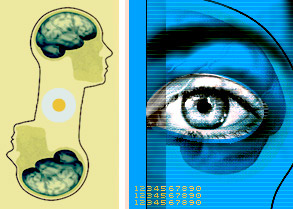
A British psychologist prowls for hard evidence that memes -- ideas that reproduce genetically, like viruses -- actually exist. What's one of the prime habitats? The Internet.

  • more
    • All Share Services

suppose that every thought you have — including this one — is an autonomous parasite in your brain: a pattern of brain cells that copies itself from mind to mind.

Congratulations! You’ve just caught a meme.

A meme, according to Richard Dawkins, who coined the word in his bestseller “The Selfish Gene,” is anything a human can remember and transmit. Memes are meant to be the brain’s equivalent of DNA. A meme could be an idea or a snatch of music or a dance. So long as it gets copied between brains fairly accurately and competes with other copies for survival, it will do as a candidate for evolution. If memes exist, they have modified the world just as genes have: Genes have made the biosphere; memes have made the memeosphere, the place where human beings exist.

The idea is catchy — the “meme” meme is particularly popular online — but controversial. Dawkins himself has withdrawn from it a little. He said last year: “There are people who take memes seriously and there are people who don’t. I sort of sit on the fence, and don’t mind seriously one way or the other. That wasn’t my purpose in producing them.”

But lots of smart people do take them seriously. Daniel Dennett, the leading philosopher of artificial intelligence, writes as if the existence of memes were an established fact. A human being, he says, is an animal infested by memes.

And Susan Blackmore, a British psychologist who has been the scourge of every sort of paranormal nonsense for the last 20 years, has got memes bad. She is trying to work out ways to find them in the wild.

“I want to do away with the notion of ‘ideas’ and look at brain structures and behaviors,” she says. “The brain structures may be hard to find. They probably consist of patterns of activation, which will not be there all the time. But I have talked at you for half an hour — that’s a behavior. You have written down some of my words. That’s another behavior. And so the memes have been copied. It is a very loose form of copying — but we can study the process.”

Talking to Blackmore is exhausting and invigorating all at once. Ideas fountain out of her like champagne in an intoxicating stream; it hardly matters whether they are bubbles or not.

“If you take a common-sense view,” she says, “humans are units called selves which somehow generate ideas from within. But when you take the meme’s-eye view, you see brains as hosts for memes. We don’t own or generate ‘our’ ideas. Nor are they working for our purposes. We can imagine meaning in them, but really all that’s going on is imitation and storage,” she says.

These ideas fit in with Blackmore’s Buddhism, where the human personality is no more than a swarm of causes and consequences, temporarily bundled in a body. But they also fit with her sense of a crisis in academic psychology: “I’ve spent 25 years in psychology and it’s an absolute mess. We don’t have a decent theory of emotions, or of motivations.”

Meme theory seems to offer a way out of this. If beliefs prosper for their own reasons, and not for the good of the organism that contains them, then this would explain the inexhaustible capacity of the human mind to produce bad ideas and disastrous plans. It does not matter to the success of a belief if the original brain that carries it dies, provided it has been spread to more brains in the meantime. In Daniel Dennett’s slogan: “A scholar is just a library’s way of making another library.”

Blackmore says that a good test for the independent existence of memes would look for “behavior that is not in the interest of the person — but purely in the interest of the propagation of the memes.”

The classic example of this spread is religious: “Martyrdom” originally meant “testifying.” It’s just that handing out tracts or making speeches turned out to be a less effective marketing method than getting chewed by lions in public. “The blood of the martyrs is the seed of the church,” as the meme has it.

All this leaves out the consideration of what a meme actually is: how you can identify an individual, transmissible unit of culture. And this is a huge difficulty for meme theory, one that has led most people who have considered the idea to attack it. For everything we know about human culture suggests that it is hugely different from the genetic system.

John Maynard Smith sides with Dawkins against Stephen Jay Gould in battles over biological evolution, but has nonetheless expressed very clearly one of the main theoretical objections to memes: “Two features are necessary for any genetic system that is to support adaptive evolution. The system should be digital, and it should not support ‘the inheritance of adapted characters.’”

Genetic copying is digital — the DNA strings code for 20 discrete amino acids, and nothing in between — while cultural copying is analog and fuzzy. Cultural evolution is Lamarckian — ideas are modified by experience before being passed on — whereas it is a central dogma of biology that evolution cannot be Lamarckian. Genes are not selected directly, but as a result of their effects; a gene that makes an animal grow or behave in a certain way will be copied (or not) as a result of the behavior or capacities of the animal that carries it. (The animal’s physical and behavioral characteristics are known in the jargon as the phenotype; the DNA that encodes the instructions to build the phenotype is the genotype, so that biologists say that genotypes are selected for the phenotypical effects.) But meme candidates are selected directly.

Culture appears to be a ladder — especially to a scientist like Dawkins — whereas evolution is a bush. Stephen Jay Gould calls memes “a meaningless metaphor”; virtual-reality pioneer Jaron Lanier thinks they are dangerous nonsense that promotes sloppy habits of thought. Yet it is all too easy for meme believers to dismiss their opponents as people infested with mind viruses — as if they were not in the same situation themselves.

None of these difficulties bothers Susan Blackmore. She takes her strength from a syllogism: If the Darwinian algorithm is the only way we know to generate order and complexity in nature, which it is; and if our minds are full of order and complexity, which they are; then there must be a Darwinian algorithm operating on something inside them, and that something we shall call memes.

“The Darwinian algorithm can run whether you have got digital or analog information,” she says. “It will run better and with higher fidelity if it is digital. But it can run over analog information.”

Language is an analog medium, not a digital one, but Blackmore sees the emergence of language as a prime candidate for memetic evolution. “There is a problem of design in language: not just at the deep level of universal grammar, but at the observable level of the languages we actually speak. Why are there so many languages, and why do they stay so separate?” She cites research to show that after 40 years of mass television, the differing regional vocabularies of Britain are more divergent than before. Something is clearly combating the homogenizing effect of TV, and she believes it is the force of memetic evolution.

“Language allows for more accurate copying of thought as it grows more precise. Writing makes copying still more accurate, and thus will increase the size of the memeosphere,” she argues. The Internet is the most recent expansion of this force.

“What’s driving it? Is it our genes, or is it our individual interests? Memetics says that actually it is all in the interests of the memes. What has happened with the development of the Internet is a huge step toward high-fidelity copying — with just enough errors to make evolution possible. We would expect that to happen because it is in the interests of memetic ambition, and it is completely irrelevant to our happiness. All we’re doing is acting as a selection environment.”

But memes may not need us to survive, any more than our genes any longer need the bacteria in which their ancestors originated. It is not that we will at some stage create artificial life or artificial consciousness, but that it will create successors to us.

“The more inefficient the technology, the more it relies on humans. But as the technology advances, humans become less and less important. Books made humans less important as a medium for the survival of information. We ought to be able to predict from a memetic analysis of what sort of hardware will best propagate the most memes with the highest fidelity — and that is what we will find ourselves building.”

Blackmore and I were both, by this stage, sitting at open laptops, typing and talking in a synchronous overload; and for a moment I suspected that the laptops were using us to communicate, rather than the other way round.

“The point at which it really takes off,” she said, “will be the point at which you have robots which directly imitate other robots in really complex ways. Nothing in artificial intelligence does that now, but when it does, we will have truly human-independent memes.”

Only we won’t have them. It will be the other way round — if they can be bothered with us.

Continue Reading Close

Page 3 of 3 in Andrew Brown