
Anonymous
My abortion, their political ploy
While Obama signed away women's rights, I recovered from the hardest decision I've had to make
Last month, while President Obama quietly signed an executive order reaffirming that no federal funds can be used for abortion, I was alone in bed, waking from a fitful, 18-hour sleep, if you can even call it that. There were dried and fresh tears on my face. I was wearing a Maxi-pad that felt like a diaper and was spotted with blood. My breasts were swollen, painful to the touch. The sharp cramps in my uterus were crippling and unrelenting. I was nauseated, dry-heaving despite an empty stomach, nearly incapable of taking the medication and antibiotics necessary to quell the pain and stave off infection.
The day before, on Tuesday, March 23, I had an abortion.
The procedure was not cheap, $450. A financially devastating sum for a freelance writer whose earning potential has been decimated by bloggers and budget cuts. I have health insurance. It’s egregiously expensive, all that I can afford, with a high deductible that renders the plan useless unless I get hit by a bus. Filing for reimbursement was not an option.
If this was just about money then perhaps I could set aside my frustration, anger, sadness and resentment over the ban in the name of compromise and a long-overdue, desperately needed overhaul of our nation’s healthcare system. I imagine this is how President Obama, who campaigned as a pro-choice president, rationalized his signature. But this is not just about money. It’s about becoming a concession in a public and political debate that was, and continues to be, devoid of the inherently private physical and emotional realities of having an abortion.
Not long ago, Minnesota Gov. Tim Pawlenty announced that April was “Abortion Recovery” month. Abortion recovery: What the hell does he know about that?
——
I am single, 34 years old and had never before been pregnant. I’ve wanted children ever since I can remember. This is wildly known among my friends and family, to whom I’m a beloved aunt, godmother and preferred baby sitter. For the past few years, I’ve been increasingly preoccupied with my biological clock and lack of serious boyfriend or partner. That fact, along with my age, and a long-standing bout with ovarian cysts had left me convinced it might no longer be possible.
Then, in February, I had sex with a good friend, a former lover, whom I was visiting for the weekend. It was lovely and innocuous. A much welcomed, even needed respite from an involuntary sexual hiatus and a visceral kind of loneliness.
Four weeks later, the pregnancy news left me in shock, hysterical, instantly isolated and alone. Although, according to the ubiquitous “they,” there is never a perfect time to have a child, for me, this was definitely not the right time, not even close.
I’d recently been on a hefty dose of pregnancy-unfriendly antibiotics and had taken a series of pain meds for my back. I’d been drinking too much and smoking cigarettes. Although both had magically lost their appeal a few days before I received “the news,” the damage had been done.
Still, I considered it, imagined a future with a child and without a partner. What if the child were born healthy? What if he or she were born with defects that I, albeit unwittingly, caused? How would I support us? Where and how would we live? There was not a scenario that I didn’t run through, each one terrifying, impossible, sending me deeper into a black hole from which I’ve yet to fully emerge.
I scheduled my “procedure” for March 23, two weeks to the day after I found out I was pregnant. “You can always cancel,” said the clinic and my doctor, who, after telling me I was pregnant, discussing my options, and diagnosing me with a bacterial infection, prescribed “pregnancy-friendly” antibiotics.
If I was going to go through the abortion, I had to be far enough along to minimize the risk of complications. So, for two weeks, I mostly hid. During this time, my hormones, taste buds and olfactory system turned against me. It seemed my body was revolting. My back hurt. My breasts hurt. I had severe cramps. I couldn’t eat. I could barely keep down water. My weight, already on the low side, was quickly dropping. My mood was, and continues to be, erratic. I’d try to proceed with plans, then would feel sick and have to run home after making up lie (stomach virus, food poisoning, hangover) after lie to friends and family.
After knowing for a little less than a week, I told a few trustworthy friends, seeking advice, sounding boards, and a little familial affection, since I wasn’t ready or able to tell my family. I didn’t want this to be the way any of them, particularly my mother, remembered me saying “I’m pregnant” for the first time.
I quickly learned that getting unintentionally knocked up at my age, and being friends mostly with women my age who are new mothers, expectant mothers, or, like me, single and struggling with baby lust, makes me, and my pain, largely untouchable. The two new and expectant mothers I told pushed prenatal vitamins. The two single and childless ones were as I imagine smokers to be around cancer patients, avoiding physical and emotional contact. If I don’t acknowledge this, it won’t happen to me.
Eventually, I called the baby’s father. He drove to town from his home out of state. He was ready to move in with me, get a steady job, co-parent, be the best kind of friends that we are since, according to him, “marriage never works anyway.” He’s divorced. “Maybe this is the excuse I needed to settle down, stop living like a nomad,” he said. It was not the response I’d predicted. But I didn’t want to to be his “excuse” for a major life change. That wouldn’t work for me.
The state of Texas, where I live, didn’t make my decision any easier. The “Women’s Right to Know” Act, passed in 2003, requires pregnant women to listen to a detailed description of where their baby is in its development stage before they are allowed to go through with an abortion. I did that on the phone, while sitting alone in the corner of my room. It was a man’s prerecorded voice telling me that, “The lungs are beginning to form. Brain activity can be recorded. Eyes are present, but no eyelids yet. The heart is more developed and is beating. Early reflexes develop. The hands and feet have fingers and toes, but may still be webbed. The length is less than one quarter-inch.”
A girlfriend who’d had an abortion before went with me to the clinic. A cluster of female “pro-lifers” accosted me in the parking lot when I arrived. “First Amendment rights,” said the receptionist. I call it harassment. Sanctioned abuse.
In contrast, the nurses and counselors at the clinic were as kind as any group of strangers or even friends could be. There were dozens of forms to fill out. Then the intake nurse performed a vaginal sonogram. She was sympathetic and nurturing, assuring me that, if I wanted, I would have kids one day, when it was the right time. She didn’t make me look at the sonogram image, though I forced myself to glance up at the photos during my pre-procedure mandated counseling session. It was heartbreaking. Still is. I was five weeks and five days pregnant.
The procedure was excruciating and scary. The pixie of a doctor’s aid gave me an IV with a concoction of painkillers, a gas mask and earphones — the procedure is also torturously loud. And then the procedure, which felt like it lasted forever, but I’m told lasted only five minutes. Even with the drugs and the gas the pain was agonizing. My friend stayed with me, holding my hand and wiping away my tears. Then the nurse dressed me and helped me up and into the recovery room. My blood pressure was low. The nurse in the room gave me water, prescriptions and a list of dos and don’ts — do take your meds, don’t exercise, lift anything more than 15 pounds, use tampons, have sex, take baths until your follow-up appointment. She sat me in a comfortable chair, gave me a heating pad and kept asking me where my pain was on a scale of 1 to 10. First a 7, then a 5, then a 3, then she let me go. I was too bleary, too sad to respond to the women accosting me in the parking lot. I wouldn’t even wish this predicament on them.
My friend drove me home, picking up my meds along with way. I then slept for 18 hours. I’m sure I woke up for a few minutes here and there. I vaguely recall seeing a friend’s face, hearing another’s voice, feeling the man who would not be the father of my child petting my head. Tears rolled out of the sides of my eyes. There were the cramps, an incessant pain in my back. I think I swallowed pills. Antibiotics. More pain meds.
Then it was Wednesday. I woke up feeling damaged, empty, scared, guilty and in pain. The terms “pro-choice” and “pro-life” were emanating from the TV screen. They sounded reductive, glaringly inadequate. The word “abortion,” fraught with shame and accusation, was being bandied about for pieces of political theater. The words “baby killer” were omnipresent, too. Although I didn’t feel like a baby killer, like I’d killed my baby, I did feel partially dead.
Now, weeks into my recovery process — I’m still bleeding, cramping, underweight, emotional, grappling with my need for children and a partner with whom to raise them — I see my experience grossly manipulated by Pawlenty, a man who doesn’t, can’t, know how I feel. But it’s always like this, the moralists and proselytizers stealing the microphone because I, and millions of other women, didn’t make the choice they prescribed.
Just as no one wants to get the flu, diabetes or even cancer — though people still leave their homes, eat junk food, and smoke — no woman wants to experience an unplanned pregnancy. But it happens. Each year, almost half of all pregnancies among American women are unintended. When I was pregnant, I’d never before so desperately needed affordable healthcare and services, often two very different things. And I’d never felt more like I didn’t deserve them. But when it comes to our health, who deserves what isn’t, or at least shouldn’t be, the point.
“Last year, the police Maced the whole hallway”
A girl from Chicago's Altgeld Gardens housing project talks about high school, murder and the long walk home
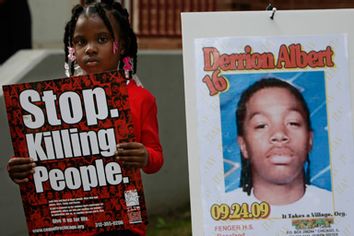
Nadashia Thomas, 6, a cousin of Derrion Albert, holds a sign beside a poster of Derrion Albert at Fenger High School in Chicago, Sept. 28, 2009. On Sept. 24, Derrion Albert, a 16-year-old junior at Chicago’s Christian Fenger Academy, was beaten to death in a brawl near the high school. A cellphone video of the killing found its way to the Internet and was aired on news broadcasts around the world. The scenes of violence in the streets of Chicago were partly blamed for the city’s elimination in the first round of voting for the Olympics.
The fight that killed Derrion began as a dispute between boys from the Ville, the neighborhood surrounding Fenger, and Altgeld Gardens, the housing project where President Obama worked as a community organizer in the mid-1980s. Traditionally, students from Altgeld attended Carver High School, a five- to 10-minute walk away. The school is now a military academy, which draws students from all over the city and the suburbs. To make room, students from Altgeld were shifted to Fenger. That decision was made by Arne Duncan, who was then CEO of Chicago Public Schools, and is now Obama’s secretary of education.
Continue Reading CloseTehran dispatch: Basijis hang around, do nothing
As the capital returns to a normal routine, I see people in green and wonder, what were you doing three weeks ago?
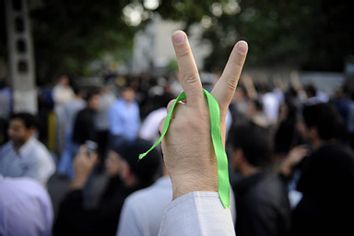
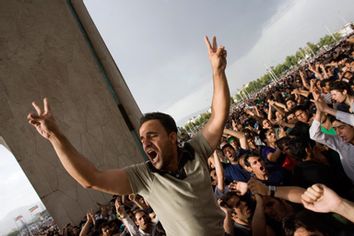
In this citizen photograph taken Sunday, June 28, 2009, a supporter of pro-reform leader Mir Hossein Mousavi, flashes a victory sign during a gathering at the Ghoba Mosque in Tehran, Iran. Several thousand protesters who had gathered near north Tehran's Ghoba Mosque clashed with riot police in Tehran on Sunday in the country's first major post-election unrest in four days. And on the 13th day Michael Jackson died. Voice of America and BBC Persian are back up, if intermittently, and we crowd around like the rest of the world for the latest news. It is almost a relief. Being a full-time revolutionary is hard work, difficult to sustain. Seeing the non-stop coverage, the obvious distraction of his passing, we grimly joke that Michael was a martyr for the cause. At least he had the decency to delay his death until the worst violence had already passed.
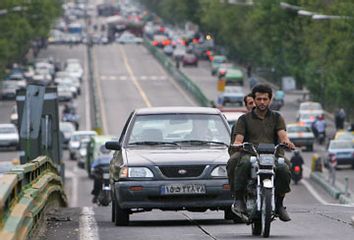
Things are going back to their regular marks. In the afternoons the parks fill up again with old ladies and young couples. There’s badminton and soccer for kids to play at night. Well-dressed men in jackets and dress pants exercise on the cardio equipment provided by the city. The scenes around the squares, lately the places of so much celebration and trouble, are almost back to normal. Traffic is back. A car flies towards Ariashahr Square, a young man with slicked back hair and aviator glasses leans out of the passenger window chest first. He removes his shades and turns his palms upwards, beseeching the ladies in the car next to him to pull over. Unimpressed, or maybe they’re being coy, the girls pull away and race ahead of their pursuers. The two boys give chase. Cops and basijis hang around the circle but do nothing, what do they care…?
Continue Reading CloseTehran dispatch: The regime shows us movies
They want to keep us indoors, and quiet. But which subversive programmer picked "The Lord of the Rings"?
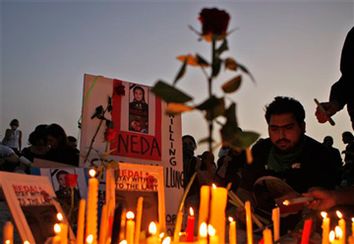
(For Neda.)
In Tehran, state television’s Channel Two is putting on a “Lord of the Rings” marathon, part of a bigger push to keep us busy. Movie mad and immunized from international copyright laws, Iranians are normally treated to one or two Hollywood or European movie nights a week. Now it’s two or three films a day. The message is “Don’t Worry, Be Happy.” Let’s watch, forget about what’s happened, never mind. Stop dwelling in the past. Look ahead.
Continue Reading CloseTehran dispatch: The crackdown
Gridlock, fire and lead pipes. Young men face off against the basijis and the battle moves into the back alleys
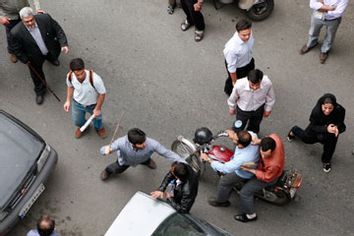
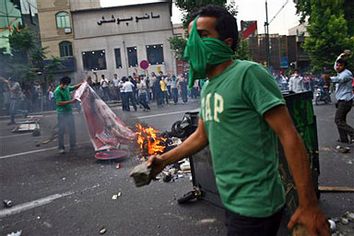
Supporters of opposition leader Mir Hossien Mousavi set fire to a barricade as they protest in Tehran on Saturday June 20, 2009. Saturday afternoon in Tehran. I come out of the Internet cafe and the first thing I see is the row of green and white police trucks lined up perpendicular to the square. In the square itself is an impressive sight: row after row of cops in riot gear. The four roads that lead in and out are marked at their corners by uniformed police wearing dark green. In the stone and grass plaza at the center of the square, a place where just a week ago Mousavi supporters had nightly gathered to chant and cheer, there are police in Robocop riot gear standing, waiting, looking, watching the perimeter of the traffic circle.
Continue Reading CloseTehran dispatch: Remembering the fallen
At Thursday's pro-Mousavi rally, honoring those who have been killed in the post-election protests
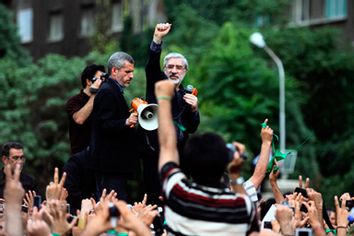
Defeated Iranian presidential candidate Mirhossein Mousavi speaks to supporters at a rally in Tehran June 18, 2009. The Metro Ride
The crowd pushes in. I think of those scenes from the Tokyo subway, where the officers with the white gloves squeeze and pack with all their might. On the Tehran Metro on Thursday afternoon, we are all arms, legs, elbows. Even for a country with no notion of personal space the compression on the train is incredible. Anyone who was in D.C. for Obama’s inauguration will remember the scenes at the Capitol Hill metro stations. This tudeh, or mass, is as dense, maybe denser. These days every day is Inauguration Day in Tehran.
Continue Reading ClosePage 1 of 3 in Anonymous