AP/Salon
Three Yemeni military leaders defect to opposition
Support for Yemen's embattled government deteriorates amid calls for president's removal
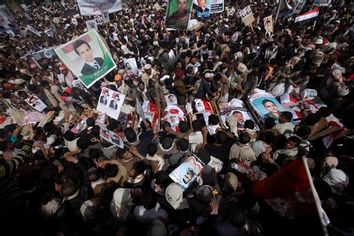
Anti-government protestors gather by the bodies of the demonstrators who were killed on Friday's clashes with Yemeni security forces, during their funeral procession in Sanaa,Yemen, Sunday, March 20, 2011. The Yemeni president's own tribe has called on him to step down after a deadly crackdown on protesters, robbing the embattled U.S.-backed leader of vital support in a society dominated by blood ties. (AP Photo/Muhammed Muheisen)(Credit: AP) Three Yemeni army commanders, including a top general, defected Monday to the opposition calling for an end to President Ali Abdullah Saleh’s rule — a camp that also now reportedly includes French Foreign Minister Alain Juppe — as army tanks and armored vehicles deployed in support of thousands protesting in the capital.
With the defection, it appeared Saleh’s support was eroding from every power base in the nation — his own tribe called on him to step down, he fired his entire Cabinet ahead of what one government official said was a planned mass resignation, and his ambassador to the U.N. and human rights minister quit.
All three officers who defected Monday belong to Saleh’s Hashid tribe. A Hashid leader said the tribe, eager to keep the president’s job for one of its own, was rallying behind one of the men, Maj. Gen. Ali Mohsen al-Ahmar, as a possible replacement for Saleh.
The leader spoke on condition of anonymity because of the sensitivity of the subject.
Al-Ahmar, the most senior of the three officers, is a longtime confidant of Saleh and commander of the army’s powerful 1st Armored Division. Units of the division deployed Monday in a major square in Sanaa where protesters have been camping out to call for Saleh to step down.
Saleh’s crackdown on a monthlong uprising against his rule has grown increasingly violent in recent days — suggesting he is becoming more fearful that the unprecedented street protests could unravel his three-decade grip on power in this volatile and impoverished nation.
He also tried unsuccesfully to calm the protest by pulling back riot police.
The two other officers are Mohammed Ali Mohsen and Hameed al-Qusaibi, who both have the rank of brigadier. Yemen’s ambassadors to Jordan, Syria and parliament’s deputy speaker also announced Monday they were supporting the opposition, further undermining Saleh’s weakening authority.
Tanks and armored personnel carriers belonging to the Republican Guards, an elite force led by Saleh’s son and one-time heir apparent, Ahmed, were deployed outside the presidential palace on Sanaa’s southern outskirts, according to witnesses. The deployment appeared designed to counter the presence on the streets elsewhere in the city of elements of the 1st Armored Division.
News of the defections came one day after crowds flooded cities and towns across Yemen to mourn dozens of protesters killed Friday when Saleh’s security forces opened fire from rooftops on a demonstration in Sanaa.
Saleh and his weak government have faced down many serious challenges, often forging fragile alliances with restive tribes to extend power beyond the capital, Sanaa. Most recently, he has battled a seven-year armed rebellion in the north, a secessionist movement in the south, and an al-Qaida offshoot that is of great concern to the U.S.
Al-Qaida in the Arabian Peninsula, which formed in January 2009, has moved beyond regional aims and attacked the West, including sending a suicide bomber who came tried to down a U.S.-bound airliner with a bomb sewn into his underwear. The device failed to detonate properly.
Yemen is also home to U.S.-born radical cleric Anwar al-Awlaki, who is believed to have offered inspiration to those attacking the U.S., including Army Maj. Nidal Hasan, who is accused of killing 13 people and wounding dozens in a 2009 shootout at Fort Hood, Texas.
Al-Ahmar has been close to Saleh for most of the 32 years the Yemeni president has been in power. He is a veteran of the 1994 civil war that saw Saleh’s army suppress an attempt by southern Yemen to secede. Al-Ahmar also fought in recent years against Shiite rebels in the north of the country.
Al-Ahmar announced his defection in a message delivered by a close aide to the protest leaders at the Sanaa square that has for weeks been the epicenter of their movement.
U.S. to target Libyan military with cruise missile strikes
United States and western allies set out to protect Libyan rebels in Benghazi from Gadhafi's brutal incursions
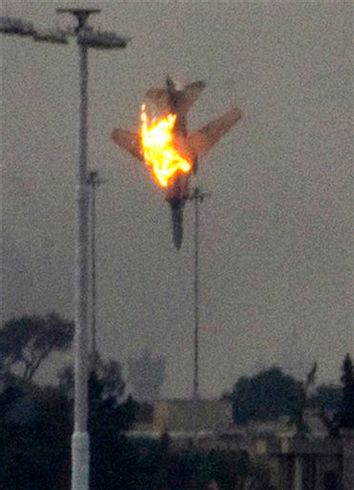
ALTERNATIVE CROP - A doomed warplane plummets towards earth after it was shot down by anti-Gadhafi forces over the outskirts of Benghazi, eastern Libya, Saturday, March 19, 2011. An object, thought to be the pilot, was seen to eject from the cockpit shortly before impact. Explosions shook the Libyan city of Benghazi early on Saturday while a fighter jet was heard flying overhead, and residents said the eastern rebel stronghold was under attack from forces loyal to Libyan leader Moammar Gadhafi. (AP Photo/Anja Niedringhaus)(Credit: AP) American military vessels in the Mediterranean are prepared to launch cruise missiles against the Libyan government’s air defenses, according to CNN:
Continue Reading CloseA U.S. defense official said the United States is poised to launch cruise missiles from warships in the Mediterranean Sea, and that these strikes would target Moammar Gadhafi’s air defenses. The United States is prepared to “defend its allies flying over Libyan airspace and enforce the no-fly zone,” the official said.
Libyan foreign minister announces cease-fire, rebels dismiss cease-fire declaration
Libyan forces called a cease-fire ahead of the UN enforcing a no-fly zone. Rebels say they're still being attacked
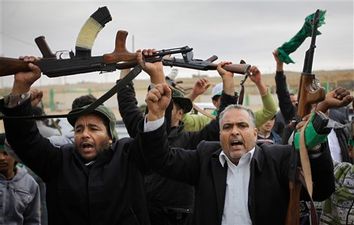
Pro-Gadhafi fighters raise their weapons as they are pictured during a government-organized visit for foreign media in Bin Jawwad, 350 miles (560 kilometers) southeast of the capital Tripoli, in Libya Saturday, March 12, 2011. The world moved a step closer to a decision on imposing a no-fly zone over Libya but Moammar Gadhafi was swiftly advancing Saturday on the poorly equipped and loosely organized rebels who have seized much of the country. (AP Photo/Ben Curtis)(Credit: AP) Libya’s Foreign Minister Moussa Koussa declared an immediate cease-fire this morning and announced the government would stop military operations. This came hours after the deputy foreign minister announced that the government would move toward a cease-fire as a response to the UN resolution to enforce a no-fly zone; CNN reports that seasoned observers might say this is just a ploy by the Gadhafi regime to buy time.
But a Libyan rebel spokesman has dismissed the cease-fire announcement, claiming Moammar Gadhafi’s forces are still attacking key cities in the east and the west.
Continue Reading CloseObama shows little hope for Libya no-fly zone resolution at UN
The administration believes that no-fly zone would have little impact in Libya as Gadhafi nears rebel stronghold
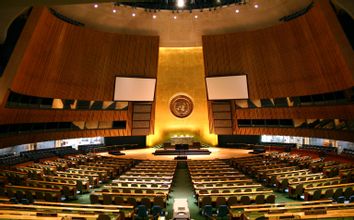
France's Foreign Minister Alain Juppe, left, welcomes, EU foreign policy chief Catherine Ashton, right, for a Group of Eight Foreign Ministers meeting in Paris, Tuesday, March 15, 2011.(AP Photo/Michel Euler)(Credit: Picasa 2.6) Security Council supporters of a no-fly zone over Libya were working Wednesday to persuade the group’s more reluctant members to back a U.N. resolution aimed at stopping Moammar Gadhafi’s planes from bombing civilians.
The Obama administration said it wouldn’t block other nations from building support for the vote. However, there is a growing consensus in the White House that it’s too late for a no-fly zone to have an effect in hampering Gadhafi, according to The New York Times, as the dictator’s forces prepare to launch an assault on the rebel capital of Benghazi.
Continue Reading Close9,500 missing in one Japanese town day after earthquake
About half of Minamisanriku's population is unaccounted for day after cataclysmic earthquake
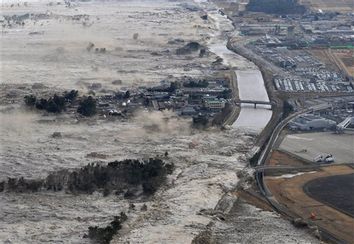
CORRECT YEAR - Earthquake-triggered tsumanis sweep shores along Iwanuma in northern Japan on Friday March 11, 2011. The magnitude 8.9 earthquake slammed Japan's eastern coast Friday, unleashing a 13-foot (4-meter) tsunami that swept boats, cars, buildings and tons of debris miles inland. (AP Photo/Kyodo News) JAPAN OUT, MANDATORY CREDIT, FOR COMMERCIAL USE ONLY IN NORTH AMERICA(Credit: AP) The news out of Japan is increasingly grim the day after one of the largest earthquakes in recorded history occurred off of the country’s northeast coast. NHK, a Japanese public broadcaster, estimated that 900 are dead, while 700 are officially missing. However, the actual figure is, in all probability, significantly higher. Kyodo News Agency reports that 9,500 are missing in just one city, Minamisanriku. The coastal town was one of the hardest hit by the earthquake and ensuing tsunami yesterday.
Continue Reading CloseHigh water from tsunami hits California coast
Despite warnings from officials, surfers showed up for the dangerous surf as boats capsized in Santa Cruz marinas
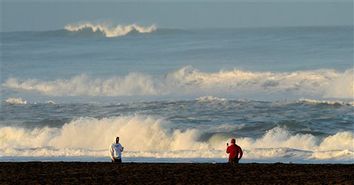
With a tsunami warning in effect for Northern California, two men watch the waves at San Francisco's Ocean Beach on Friday, March 11, 2011. The tsunami warnings came after a 8.9-magnitude earthquake struck Japan. (AP Photo/Noah Berger)(Credit: AP) Waves surged along California’s coast from a tsunami triggered by the massive earthquake in Japan.
The tide began rising shortly after 7:30 a.m. along beaches in Crescent City, where the tsunami was expected to hit the hardest in California. Officials predicted that waves could reach as high as 7 feet.
Local officials activated tsunami warning sirens along the coast and have urged residents in low-lying areas to seek higher ground.
At Santa Cruz, some surfers ventured out on the water to take advantage of decent waves ahead of the tidal wave — and stayed in the water until the level plunged when the tsunami hit and caused several surges.
Continue Reading ClosePage 1 of 9 in AP/Salon