Dan Kois

Films of the decade: “Spirited Away”

Miyazaki's fable of a girl trapped in the spirit world is full of visual delights -- and painful insights

A still from "Spirited Away"

“I think we should let our children watch animation only once or twice a year,” director Hiyao Miyazaki told an interviewer in 2001, the year “Spirited Away,” one of the most wonderful films of the decade, was first released in Japan. “There are too many things around us to relieve our unsatisfied hearts and boredom. This is the fault of adults; it’s adults who are in the wrong shape. Children are just mirrors, so no wonder they are in the wrong shape.”

Chihiro, the heroine of “Spirited Away,” is in the wrong shape. Grumpy and sour, 10-year-old Chihiro whines at her parents about their move to a new town; timid and apprehensive, she clings so that her mother, irritated, shakes her off. Trapped in the spirit world in which the film takes place, Chihiro is belittled by the staff of the bathhouse where she gets a job. “What a dope!” one character says. “You’re the most pathetic little girl I’ve ever seen,” another says, laughing, “a stinking, useless weakling.”

It’s a lot of abuse for a 10-year-old girl to take, but the wonder of “Spirited Away” is that Chihiro believably transforms from “a lazy spoiled crybaby” to a tough, resilient little girl whose determination suggests the strong woman she will one day become. It’s easy to praise Miyazaki’s movie for its visual delights — the radish spirits and river gods, the ancient bathhouse floating on the sea, the scenes of flight (as in most every Miyazaki film) so thrillingly realized — but it’s also easy to forget how touching a portrait it is of a modern child learning to live within herself, learning to be the right shape. Chihiro faces her fears and overcomes them, and finds within herself a strength she’d previously been unaware she had. And she does it so subtly that only afterward do you realize how profound that transition has been.

Late in the film, Chihiro takes a ride on a train through the cities and neighborhoods of this spirit world, the cars gliding swiftly across the endless sea, Joe Hisaishi’s lovely score a counterpoint as day turns to dusk outside. Shadowy riders disembark, and the train slips past another little girl, waiting patiently on a platform in the pale evening. Chihiro’s going to return something her friend Haku stole, and to apologize on his behalf, but she’s also headed out of childhood and into adolescence. It’s not a trip to be embarked upon lightly, and that’s what makes the sequence so moving, not only for children but also for adults. For I remember a time in my life when I yearned to be grown-up even as I reveled in childhood, never realizing what would be lost when I moved on. “The train used to run in both directions,” Kamaji the boilerman warns Chihiro as he hands her the delicate paper tickets. “But these days, it’s a one-way ride.”

Film Salon has invited a group of special guests to write about their favorite film(s) of the 2000s. To read the entire series, go here.

Curse of Alfonso Soriano

Will the Yankees ever win the World Series again?

Will this be the year the long-suffering fans of the Bronx Yankees finally celebrate a World Series championship? Or will this season end as the last 103 have, with disappointment in Monument Valley? Will the Curse of the Soriano once again take its toll?

The Yankees are set to begin their North American League Divisional Sub-Sectional Playoff series against the Rangers tonight at Torre Field (11:59 p.m., The Network), and for the first time in a long while, the surging Yankees are favored over their fierce rivals from Texas. The Yanks defeated the Rangers in 13 of 19 games this season, and with the addition of Randy Johnson Award winner Reza Sirizi, the Yankees look unbeatable in a short 11-game series.

The Yankees swear to a man that they don’t pay attention to the Curse. But as every baseball fan knows, it’s been a long, long time since the Yankees won a World Series. The last time the Yanks won it all, the Bronx was part of New York City; Bill Clinton wasn’t on the $2,000,000 bill but he was in the White House; and the White House wasn’t even on the moon!

It was back in 2000 that the Yankees defeated the New York Mets (now the Brooklyn Hipsters), 4 games to 1, to win their last World Series. The Yanks got to the Series twice more in the next three years and appeared to be a contender for years to come … but then came The Trade. The team’s owner, George Steinbrenner — a name forever accompanied, in the Bronx, by a ceremonial spitting on the ground — traded second baseman Alfonso Soriano to the Texas Rangers for shortstop Alex Rodriguez.

Think about it! The Yankees traded away the greatest player in the history of baseball: the all-time home run and batting average champ; the only man ever to hit .500 in a season; the man who revolutionized fielding so much that most fans have no idea there haven’t always been three infielders; the three-term U.S. senator from Texas; the president (thanks to the Schwarzenegger Amendment of 2011, of course) who brought peace to the Middle East. And who did they get in return? Alex Rodriguez.

Don’t get me wrong. Rodriguez was an excellent third baseman with good pop. But on his first year with the Yankees, his celebrated bungle — the A-Rod Chop, which snuffed out the Yankees’ rally in Game Six of the 2004 American League Championship Series — became legendary in Curse of the Yankees lore and Rodriguez never lived it down. Desperate to get out of New York but stuck there because no other team could absorb his then-astronomical salary of $22 million, Rodriguez retired in 2006.

Every time despondent members of Yankee Nation get their hopes up, a hanging spitter or a malfunctioning umpire will send the Yanks home yet again. From 2008 to 2022, the Yankees finished second to the Rangers in the American League East-Central race every year. In 2064, the Yankees reached the World Series, only to lose Game 7 to the Milwaukee Brewers when Tim Raines III let a fly ball bounce off his glove over the 650 mark on the center field wall. Mention any of these names to a gloomy Yankees fan and watch him burst into tears: Lucky Kent (2078), Jill Ruckner (2086), BooneClone X-14 (2103).

Could 2104 be the year? Could the Yankees finally overcome their foolish mistakes, the weight of history, and the desperation of their fans to win it all? They’re due; in fact, they’re overdue. The two teams with the next-longest World Series droughts are the Cubs and the Red Sox, who of course jointly won it all in the famed World Series Tie of 2042. Despite tonight’s presidential debate and worldwide Alfonso Soriano Day festivities, the eyes of the world’s sports fans will be on Torre Field tonight as a new Yankees team tries to find a way to Reverse the Curse.

Will they pull it off? As they used to say before all air came in pill form, don’t hold your breath.

Continue Reading Close

Everything you were afraid to ask about “The Wire”

Need a primer for quite possibly the best show on television?

“It’s a novel,” David Simon likes to say about the show he created, HBO’s “The Wire.” Which is a good way of explaining the show’s distinctively long plot arcs, dense webs of characters and grand scope — but an intimidating message to new viewers who, tempted by the show’s wild critical acclaim, are trying to tune in now, early into the program’s third season. After all, you wouldn’t start reading a novel on page 201, would you?

But getting a handle on the third season of “The Wire” doesn’t necessarily require watching 25 hours of back story. Though I heartily recommend the Season 1 DVD set (out Oct. 12), I’m happy to present a guide to HBO’s acclaimed, and extremely intricate, series.

I’ll answer a few select questions about the show’s aims and methods, to give new viewers an idea of what kind of show to expect. I’ll briefly synopsize Seasons 1 and 2, and let you know where the series stands at the top of Season 3. And I’ll present “The Wire’s” rogues’ gallery: bios of the major players in David Simon’s Baltimore. You can read that straight through for a deeper understanding of the Season 1 and 2 synopses, or simply use it as a reference work, dipping into it when an unfamiliar face appears onscreen.

I don’t even like cop shows. Why should I watch “The Wire”?
“The Wire” wears the trappings of a simple police show, but, as Simon notes in his commentary on the Season 1 DVD, the show is “really about the American city, and about how we live together. It’s about how institutions have an effect on individuals, and how, regardless of what you are committed to, whether you’re a cop, a longshoremen, a drug dealer, a politician, a judge, a lawyer, you are ultimately compromised and must contend with whatever institution you’ve committed to.”

Big talk for a cop show. But “The Wire” backs Simon up in its choice of subject matter from season to season. Season 1 focused on Baltimore’s mostly black West Side housing projects and the drug trade eating them from within. The Baltimore Police Department was shown to be just as compromising to its members as any other institution — including a high-level drug organization. Season 2 shifted from the ghetto to the waterfront, focusing on corruption and desperation in the mostly white Baltimore’s dockworkers’ unions. And Season 3 seems to be focusing on the genteel-yet-mean world of Baltimore politics, showing once again how all involved are forced to play “the game.”

True, the spine of each season is a Baltimore police investigation, one that leads inevitably to electronic surveillance — “the wire.” But those police — good and bad police, drunks and womanizers, brutes and thinking men, careerists and self-destructors — dig up the ways that legal and illegal Baltimore talk to each other every day, and their stories make powerful arguments about the war on drugs and the failure of the American dream.

Look, that’s great and all, but is the show actually fun to watch?
Absolutely, and this is where Simon’s declaration in his introduction to the book “The Wire: Truth Be Told” — that character and plot in “The Wire” come second to “picking a fight” — seems a little suspect. “The Wire” is not compulsively watchable because of its powerful arguments about the war on drugs and the failure of the American dream. It’s compulsively watchable despite those arguments, and because it offers rich, deep characters; believable, funny scenes; and complex, innovative plots. Characters like Omar, the stick-up “homothug” who’s dead-set on avenging the death of his lover, who’s never pointed his gun at a “citizen” but won’t hesitate to blow away a drug dealer, while whistling “The Farmer in the Dell.” Scenes like the one in this Sunday’s episode that captured the awkwardness when co-workers run into each other outside the office — only in this case, the “co-workers” are two West Side drug dealers and two narcotics cops, all with dates on their arms, coming face-to-face in the lobby of a Baltimore movie theater. And plots like Season 2′s, in which Frank Sobotka got his hands dirty in an attempt to save his dying union — and realized what a small part of the world of crime his operation was, just as his union’s place in the world of working Baltimore was shrinking to nothing. The unraveling of this union boss’s plans as the cops closed in on one side, and the thugs closed in on the other, was painful to watch, but it also offered viewers the crackerjack thrill of tangled plots coming to full heads of steam at the same time.

Is the show really about wiretapping? The opening credits show a bunch of shots of, like, people sitting around wearing headphones. That seems boring.
The wiretap promised by the show’s title and credits didn’t even get set up until the seventh episode of the 13-episode first season. So no, the show isn’t specifically about wiretaps, any more than it’s specifically about drugs or housing projects or dockworkers. But wiretaps do serve as a useful metaphor for what the show hopes to do: As wiretaps provide the cops in “The Wire” a look into a secret world, so does “The Wire” offer us that same look into places most television viewers never see.

Do you need to know all about Baltimore to understand what’s going on in “The Wire”?
Though native Marylanders will enjoy the references to Chesapeake Bay crabs, Natty Bo and obscure Orioles catchers, background knowledge of the history of Baltimore is not necessary to follow the day-to-day events of “The Wire.” As Simon notes, the woes the series describes are happening in pretty much every city in America.

Do the mostly white, middle-class writers and producers of “The Wire” have the right to tell these inner-city stories?
That’s a touchy question, and one the show’s staff faces head-on. In addition to Simon and a few others who have been with the show for a while, “The Wire’s” writing staff includes a number of acclaimed crime writers — Washington’s George Pelecanos, New Jersey’s Richard Price and Boston’s Dennis Lehane. To a person, the writers of “The Wire” have spent their careers researching and writing about the lives of those entrenched in America’s cities, black and white, scraping by and falling through the cracks, cops and robbers, citizens and soldiers. Simon gives thanks that his show is not a Hollywood vision of the inner city — his staff are mostly city guys, tough guys, who know the turf pretty well — but he recognizes that there’s always going to be a disconnect. “We are professional writers and paid as such,” he writes, “and it is one thing to echo the voices of longshoremen and addicts, detectives and dealers, quite another to claim those voices as your own.”

So the answer? Maybe they don’t have that right. But they’re doing it anyway, and the stories that result are really, really good.

So what happened so far?
SEASON 1
Season 1 focused on an investigation into Avon Barksdale’s drug empire in the housing projects of West Baltimore. It all begins when a homicide detective named Jimmy McNulty mouths off to a Baltimore judge about the inadequacy of the department’s efforts against the violence inherent in the West Baltimore drug trade. The judge raises a stink, and soon McNulty, on his boss’s bad side, finds himself stuck in a poorly supported investigative unit headed by Lt. Cedric Daniels, looking into the Barksdale ring.

While at first the unit, buried in the courthouse basement, seems staffed by drunks and also-rans, Daniels manages to weed out the bad cops, install a few good ones, and make real progress. Three narcotics cops, Herc, Carver and Kima, make great progress in identifying the street-level operators in the crew, thanks in large part to information provided by a street informant, Bubbles. And back in the basement, Prez and Freamon, two cops long since given up for useless, expertly decipher an array of payphone wiretaps and pager clones to learn more and more about the nuts and bolts of the Barksdale crew.

Meanwhile, McNulty has reached out to a lone wolf named Omar who makes his money robbing drug dealers, one of the show’s great, almost mythic creations. Because his lover has been tortured and killed by Barksdale soldiers in retaliation for an especially bold heist, Omar wants revenge, and he gives McNulty information on the Barksdale inner circle. He also pays the head of the West Side drug cartel, Proposition Joe, for Avon Barksdale’s pager number, and nearly succeeds in killing Avon.

Within the Barksdale crew, disbelief reigns that the police are on to the crew’s modes of communication — until a major stash house is hit, at which point Avon’s second-in-command, Stringer Bell, declares all pagers and pay phones off-limits. He distributes new cellphones to everyone, including Avon’s nephew, D’Angelo, the soft-hearted head of the trade in the low-rise projects. As the net closes in, Avon sends D’Angelo on a run to New York for a new stash, unaware that Daniels’ unit has placed a camera in the wall of Avon’s office.

Pressure from above to wrap up the case — which, in the eyes of Daniels’ superior, Ervin Burrell, has grown unwieldy, including probing campaign contributions to Baltimore politicians — forces the unit to make arrests and file charges. A disgruntled D’Angelo, upset because young Wallace, who wasn’t cut out for the life, has been killed on Stringer Bell’s order, accepts a deal from McNulty and Asst. State Attorney Rhonda Pearlman, but then backs out under pressure from his family. Without Wallace, a prominent witness, and without D’Angelo, the case accomplishes much less than the unit hoped: D’Angelo gets saddled with most of the resulting jail time, while Avon gets off with a light sentence, and Stringer Bell gets off completely. Only one Barksdale lieutenant gets saddled with any murders — because he cops to every single one, taking a hit for the organization. The season ends with Omar on a bus to Philly; Avon and D’Angelo, plus several others, in jail; Stringer running the drug business, same as ever; and McNulty busted down to a crap gig on a police boat.

SEASON 2
Season 2 continued many of Season 1′s stories while opening up a new front: the stevedores’ union at the Baltimore docks, where union boss Frank Sobotka, his nephew Nick, and his son Ziggy have been misdirecting shipping containers to smugglers. When one of the cans turns up with 13 suffocated Eastern European prostitutes inside, the law comes crashing down on Sobotka and his union. Daniels, looking to work his way back up from the evidence room he was exiled to after challenging his higher-ups in the Barksdale case, reassembles his investigative team, including a desperate-for-dry-land McNulty.

Their wiretaps reveal a connection between the union and an international smuggling ring led by a mysterious figure named “The Greek” — the same ring responsible for bringing in most of the dope distributed to the East Side, Proposition Joe’s territory. But this isn’t just graft for profit on the part of the dockworkers; Frank Sobotka is using the money he earns from his dirty deeds for campaign contributions and consultants in a last-ditch attempt to revitalize the Baltimore docks. But he overplays his hand with The Greek, and faces a tragic end. And due once again to institutional foolishness, the case ends in frustration for Daniels’ unit; they determine that the man responsible for the “dead girls in the can” has been killed by higher-ups, who have then skipped town, tipped off by the FBI that the investigation is closing in.

Meanwhile, on the West Side, Stringer Bell finds his methods at odds with the wishes of his boss in the slammer, and goes behind Avon’s back to have D’Angelo killed — making it look convincingly like a suicide. Stringer also, unknown to Avon, allows Prop Joe’s West Siders to make inroads on Barksdale territory in exchange for much-needed product.

The season ends with the granary pier, so coveted by Sobotka for the ships it could bring to a revitalized port, converted to condominiums; Daniels allowed to make his investigative unit a permanent fixture; Avon upset with his right-hand man; and Proposition Joe’s East Side dealers encroaching on Barksdale territory.

SEASON 3
At the opening of Season 3, the project towers come down, shaking up business in Baltimore. Stringer Bell uses his business school training to bring “Robert’s Rules of Order” to Barksdale meetings; Omar is still sticking up the Barksdale crew; and Daniels’ investigative team is focusing on Prop Joe, hoping to get at him through one of his dealers, Cheese. Meanwhile, a young City Councilman, Tommy Carcetti, is stirring up trouble in the corridors of power, and some legendary muscle, Cutty, has just returned from the joint.

Hey, who the hell are all those people?
Good question. Those synopses should give you enough background to jump into Season 3. But there’ll come a time when you want to know more detail about these characters — especially because “The Wire” isn’t big on exposition. Here’s a character-by-character breakdown of “The Wire,” getting you up to speed on who’s who to help you make the connections as you start on Season 3. You can read the list straight through, or use it as a reference when someone new shows up on your TV screen.

This character list doesn’t include some of the characters from Season 2, because it’s become clear in interviews with Simon and others involved in the show that the events on the docks were a standalone story, and few of those characters will make return visits. It’s a shame to lose those great characters; the Sobotkas, The Greek, and especially Beatrice “Beadie” Russell (Amy Ryan), the soft-spoken port officer who, against all her expectations, learned how to be “real police.” But their reappearance anytime soon is unlikely, and so I’m leaving them out.

Likewise, corpses don’t make the list. The deaths of Wallace and D’Angelo will likely affect “The Wire” for some time to come, but on a show whose creator has disavowed flashbacks ever since HBO pushed him to include one in the pilot, it’s unlikely you’re ever going to need to know what they looked like.

The character intros below are helpfully divided into five groups: Police, the West Side, the East Side, the Free Agents, and the Pols.

POLICE
Deputy Commissioner Rawls (John Doman)
Pugnacious and demanding, Rawls oversees Homicide and, at the beginning of the third season, has been elevated to deputy commissioner. Rawls’ longest-standing grudge is against Jimmy McNulty, who first raised Rawls’ ire by failing to keep his mouth shut about Homicide’s inability to go after the big players in West Baltimore’s drug trade, and has never lived it down. It was Rawls who sent McNulty to boat duty after the Barksdale case at the end of Season 1, and who did everything he could to keep McNulty off Daniels’ team during the investigation of the docks (Season 2). Now Rawls spends his days bawling out cops who can’t connect the dots.

Major Bunny Colvin (Robert Wisdom)
An extremely minor character in Season 2, Colvin appears to be shaping up as one of the primaries in Season 3. His officers, including Herc and Carver, cover the Western District. As the season opens, Colvin, fed up with the never-ending battle against low-level drug dealers, announces to his police that they’re going to go about things a different way.

Major Valchek (Al Brown)
A stubborn crank who instigated Season 2′s investigation of the docks in order to gain an advantage over Frank Sobotka in a petty debate over who — his police union or Sobotka’s longshoreman’s union — could finance a bigger church window. That the investigation ruined Sobotka’s life seemed to bother Valchek not at all. Valchek also managed to alienate his son-in-law, Prez, to such a degree that Prez hauled off and slugged him in front of the entire team. As Season 3 begins, Valchek sets up a private meeting between Commissioner Burrell and Councilman Tommy Carcetti.

Lt. Cedric Daniels (Lance Reddick)
Clean-cut, hard-assed and intelligent, Daniels got placed by Burrell on the Barksdale case with strict instructions: Keep the case small, come in with a few arrests, and you’ll be on your way to major. Instead, Daniels oversaw the investigation’s growth, incurring the wrath of his superiors and the politicians — including State Sen. Clay Davis — whose campaign contributions his staff checked out. His reward for the Barksdale case was a demotion to the evidence room, and it looked like his path was clear: resign, take the bar, and become a big-firm lawyer, the path pushed by his ambitious wife, Marla Daniels, whose own political ambitions may soon conflict with his interoffice politics. But he was drawn into Season 2′s dockworker investigation, spearheading that for Valchek in hopes of bringing himself “up from the basement,” much to his wife’s annoyance. Season 3 sees him leading a new unit specializing in large-scale investigations, but estranged from his wife, leasing a small apartment, and sleeping with Rhonda Pearlman.

Asst. State Attorney Rhonda Pearlman (Deirdre Lovejoy)
Though she’s officially a state’s attorney, Pearlman is in the police section because she spends her time coordinating the legal side of the various police investigations. It’s she who got D’Angelo Barksdale to agree to testify against his uncle (before his mother convinced him otherwise), and who worked out deals with Frank and Nick Sobotka as well. A long-running on-and-off affair with Jimmy McNulty (she was at least one of the reasons his marriage fell apart) seems currently off, as at the beginning of Season 3, she seduced Daniels.

Herc & Carver (Domeneck Lombardozzi and Seth Gilliam)
Always seen as a pair, Herc and Carver have worked together for years, in Narcotics, on Daniels’ special investigative units, and now under Bunny Colvin in the Western District. Working with Daniels taught them that busting heads wasn’t the only way to work a case, but both officers got frustrated when they felt they were being used for simple-minded busywork and left Daniels’ unit at the end of Season 2. (Carver’s relationship with Daniels is especially fraught; Daniels caught him snitching to Burrell during the initial Barksdale investigation.) The two are not above a little healthy corruption; they’ve been known to pocket wads of cash found in stash houses and fabricate informants to justify unauthorized wiretaps. They are given showpiece girlfriends from time to time, but basically function as a funny, bickering married couple.

Jimmy McNulty (Dominic West)
The heart, soul and oft-impaired nervous system of “The Wire” is McNulty, the fiercely smart, stupidly fierce investigator whose ill-thought-out bitching to Judge Phelan set the events of Season 1 into motion. While he seems to fail at most things in his life, he’s a cop who gets his teeth in a case and shakes it until something real falls out. His passion for the Barksdale case pushed the investigative unit to greater heights and pushed Daniels to care about what seemed like a career dead-end. Exiled to the marine unit after the Barksdale case, he found a way back into the building at Homicide by bringing in Omar as a witness on an old case going to trial. From there, he wreaked havoc on his old partners, sticking Rawls with 14 Jane Does by proving that the dead prostitutes belonged in his jurisdiction; then, with Daniels’ help, he returned to the investigative team. The scene that perfectly encapsulates Jimmy McNulty occurred late in Season 2: fresh off drunk-dialing ex-wife Elena from a bar, McNulty misjudges a turn in the rain and hits a bridge abutment, smashing off his side-view mirror. He stumbles from the car, maps out the turn he knew he made with his hand, gets back in the car, backs up, and, radio blaring, careens through the turn again, this time ripping up the car’s entire right side. It’s that stubbornness, that refusal to be wrong, that makes Jimmy McNulty good police. Sure, he cares about the lives ruined by every homicide — a little. But it’s ego that drives the best detectives, as “The Wire” is one of the few shows to make clear.

Bunk (Wendell Pierce)
Based on a real Baltimore detective, Bunk is a cigar-chomping, affable, hardworking homicide cop who rarely serves as a check on McNulty’s worse impulses. Though he has his devilish side, Bunk, unlike McNulty, has managed to stay on the brass’s good side — in no small part by steering clear, whenever possible, of Daniels’ investigative units. But when Bunk got stuck with the Jane Does in Season 2, he found himself working alongside the wiretap crew, trying to crack the case of the dead girls in the can. He cleared the cases — the man responsible had himself been killed — and headed back to Homicide, which is where we find him at the beginning of Season 3. Bunk is married to a wife we’ve never met, but we have seen him make plays for a number of women in bars; in one memorable moment, McNulty had to coax Bunk out of a woman’s bathroom where, clad only in her robe, Bunk was carefully setting fire to his own clothes in a drunken effort to destroy any evidence that he’d been there.

Det. Kima Greggs (Sonja Sohn)
“Greggs seemed almost too admirable in the early going,” writes acclaimed crime writer Laura Lippman in an essay in “The Wire: Truth Be Told.” “It’s a bird, it’s a plane, it’s Super-Lesbian!” (Side note: it’s hard to imagine any other series’ coffee-table book offering six pages to the creator’s girlfriend to smack down the series’ treatment of its female characters.) Indeed, Simon has ruefully referred to the women he writes as “men with tits,” and in the opening episodes of “The Wire,” ballsy Kima was no different. But her character deepened when, unexpectedly, she was forced into a position of weakness: in a blown buy-and-bust, Kima (ironically dressed in frilly civilianwear) got shot twice, prompting a fight for her life and, for a time, the end of her work on the street. Her partner, Cheryl, terrified of losing Kima, insisted on the move to desk work. But through the dockworkers case, with Cheryl pregnant and angry at Kima’s return to action, Kima’s dissatisfaction with the trappings of domesticity increased; life at home couldn’t compare to the excitement and fulfillment of working a case in Daniels’ special investigation unit, of which Kima is a critical member. Now, in Season 3, Kima’s work life is peaking. But life with a baby isn’t for her — she can’t even remember the word “fontanel” — and ditches Cheryl and the baby late one night for a trip to a local bar and the temptation inside.

Detective Lester Freamon (Clarke Peters)
“You’re real police,” a surprised McNulty said to Lester Freamon in the middle of the Barksdale case, after the pawnshop cop revealed that he’d snagged D’Angelo’s pager number. Up until then, the soft-spoken Freamon had spent his time sitting at his desk, sanding antique dollhouse miniatures, but it turns out that the man was once a McNulty-like loose cannon — exiled 13 years ago to the crappiest crap job in the department. But he proved himself on the Barksdale case, finding the only known photo of Avon Barksdale on an old Golden Gloves poster, and coaxing a sweet-natured dancer at Avon’s strip club to help the investigation — and into a relationship as well. Over the course of the unit’s first two cases, Freamon also served as Daniels’ conscience, letting him know when politics were getting in the way of good police work, and as Prez’s mentor, helping the young screw-up realize his strengths as an officer lie in the details.

Detective Roland “Prez” Pryzbylewski (Jim True-Frost)
Only because he’s Valchek’s son-in-law did Prez keep his badge after an unfortunate incident in which he shot up his own car. As punishment, though, he was sent down to the Barksdale investigation, where he promptly drunkenly beat on a project kid so hard the kid went blind in one eye. From there on out, Prez was sentenced to life underground, logging the pager calls, listening to the wiretaps, and keeping the records for the case. But it turned out that this kind of detective work was what Prez did best, and after he cracked the code the Barksdale gang used on their pagers, the rest of the unit began to offer him some grudging respect. Prez soon became the organizational master of the team, and in both the Barksdale case and the dockworkers case, showed a flair for wiretapping, record-keeping, and code-cracking that made him proud to be a police for the first time in a long time. That pride crossed swords with his father-in-law’s dismissive attitude toward the end of Season 2, when Valchek pushed the unit to a quick and unhappy bust, and Prez’s fist met his father-in-law’s nose. As Season 3 begins, Prez’s handwritten apology has gotten him back on Daniels’ team.

THE WEST SIDE
Avon Barksdale (Wood Harris)
Avon Barksdale is a different kind of TV kingpin: the quiet kind. “It’s not a rap video,” says Simon on his DVD commentary. “Flash brings police. The guys who are the most serious, moving-weight drug dealers in Baltimore … they would roll up on a corner and you wouldn’t be able to tell them from the other five or six guys standing with them.” But Barksdale’s cover got blown when his nephew D’Angelo got off a murder rap thanks to a last-second change of heart from a witness. McNulty, pissed to see a slam-dunk case end in acquittal, mouthed off to the judge about Avon, and the next thing Avon knew, his phones were tapped, his lieutenants were getting hauled in, and his second-in-command, Stringer Bell, could barely keep his street business, with Omar robbing his stash all the time. Avon’s revenge — the torture and death of Omar’s lover — came back to bite him when Omar killed one of his men, dimed another for a murder, and came within seconds of killing Avon himself. Wiretaps and hidden cameras eventually caught up with Avon, and though the cops never pinned a murder rap on him, they did lock him up for a few years on drug charges. In Season 2, Avon ran his prison, ate KFC whenever he wanted, and got his sentence lowered for cooperation in the investigation of a crime he himself instigated. Throughout his term, Barksdale reached out to his nephew D’Angelo, and was heartbroken when D’Angelo apparently hanged himself in the prison library. When news came through that Proposition Joe was making a move on Barksdale turf, Avon called down from NYC the scary Brother Mouzone to crack some heads — unaware Prop Joe’s people were in the West Side on Stringer’s invitation, since Stringer had all the territory but none of the good dope. As Season 3 begins, Avon is happily counting the days until his release, unaware of the extent to which Stringer has changed the way his organization works.

Russell “Stringer” Bell (Idris Elba)
Charismatic, ruthless, and Six Sigma certified, Stringer Bell runs the Barksdale gang with a combination of murderous rage and MBA theory. Despite being responsible for the deaths of many, Stringer escaped prosecution in the initial Barksdale raids when the witness who could tie him to Omar’s lover’s death, young Wallace, was killed. In Season 2, Bell made a number of moves without Avon’s knowledge: Facing a severe shortage of product, he reached out to Proposition Joe, offering him a few project towers in exchange for access to his high-quality supply. He told Omar that Brother Mouzone was responsible for his lover’s murder in an attempt to light Avon’s man up. And, most damning of all, when he believed that D’Angelo was drawing away from the family and the organization, Stringer had D’Angelo killed — and had the death made to look like a suicide.

Maurice Levy (Michael Kostroff)
“I’ll probably have my B’nai B’rith membership revoked,” over the character of Levy, Simon jokes in his DVD commentary. But Levy, the venal, complicit attorney for the Barksdale clan, is based on several drug lawyers Simon and his frequent writing partner (and former BPD cop) Ed Burns knew in the 1980s and 1990s. Levy is a masterful defense attorney who feigns ignorance of his clients’ dirty deeds while keeping the organization as street-legal as possible.

Bodie (J.D. Williams)
We’ve watched Bodie grow up through the first two seasons of “The Wire,” going from an anonymous foot soldier in the Barksdale army — the kind of kid who, on his first trip out of town, didn’t understand why his favorite Baltimore radio station was fading out and some other station was fading in — to a trusted corner man. Originally stationed to the low-rises to which D’Angelo got exiled after his initial acquittal, Bodie became a project legend when he slugged a cop during a bust, walked out of juvenile detention, and hitched back to Baltimore. When it became clear that Wallace was a liability to the crew, Stringer Bell gave Bodie the responsibility of rubbing the boy out. But things started going awry for Bodie in Season 2; his crew got into a turf battle with another, and when a bystander was killed, the police cracked down on the corners. Then Bodie failed to adequately dispose of the guns. Now, in Season 3, Bodie, who is much more comfortable busting shit up than making business propositions, is having trouble brokering a relationship with Marlo.

Poot (Tray Chaney)
Poot is Bodie’s right hand. He was Wallace’s best friend, and the scene in which Bodie and Poot shot Wallace was one of the hardest to watch in the whole series. As Bodie pointed the gun at a crying Wallace, and told him to “be a man,” but couldn’t pull the trigger, it was Poot’s cry of “Do it!” that finally got Bodie to fire. Then Poot silently took the gun and, with tears in his eyes, finished the job.

Marlo (Jamie Hector)
We don’t know much about Marlo yet; he’s a corner man for another drug crew near Barksdale territory. He rejected Bodie’s overtures for a business partnership in no uncertain terms — his words were cool, but the golf club he likes to swing around drove the point home.

THE EAST SIDE
Proposition Joe (Robert Chew)
We first met Prop Joe during Season 1, at the annual East Side-West Side basketball game, where his squad faced off against Avon Barksdale’s West Side team. Prop Joe had better ringers and won a hotly contested (and six-figure wagered) game. For the most part, Prop Joe is happy to coexist with the Barksdale crew, but his relationship with them became more complicated when Stringer Bell’s supply went south. Joe agreed to let Stringer in on his good shit — some of which, incidentally, came from the Sobotka-led connection at the docks — in exchange for four of the high-rise towers. As Season 3 opens, the towers are gone, and relations are still uneasy between the East Side and the West.

Cheese (Method Man)
Just one level below Prop Joe, Cheese recently became the target of Daniels’ unit when a tapped phone call revealed him crying into the phone about having to shoot his “dawg.” Unfortunately, it turned out he was talking about a beloved pit bull he put down for acting cur in a dogfight, and his resultant arrest gave the unit no more than a bunch of dead wiretaps.

THE FREE AGENTS
Omar (Michael Williams)
Charismatic, daring, and murderous, Omar first showed up when he and his lover, Brandon, robbed a Barksdale stash. The resultant revenge torture and killing of Brandon drove Omar on a vendetta against all those in the Barksdale crew responsible — from the triggermen to the generals at the top, Avon and Stringer Bell. While pursuing revenge against the Barksdales the old-fashioned way, Omar also contacted McNulty, offering his help in pinning some old murders on Barksdale soldiers. In Season 2, Omar took the stand in one of those cases, offering up his personal philosophy as justification for testifying: “I ain’t never pointed my gun at no citizen.” He robs drug dealers, not civilians, and sticks to that code of honor. When Stringer told him that Brother Mouzone was responsible for Brandon’s torture, Omar found the previously invincible Mouzone and put a bullet in his stomach. But when Mouzone calmly explained that Omar had been misled, Omar, recognizing the truth in his words, called 911 and left Mouzone alive. As Season 3 begins, Omar is still sticking up Barksdale men, employing a number of disguises and a couple of female accomplices as well.

Bubbles (Andre Royo)
Based on a real Baltimore junkie, scammer and informant for whom David Simon wrote a unique obituary in the late 1980s, Bubbles has made a life providing on-target information for cops — especially his buddies Kima and McNulty, whom Bubbles calls “McNutty.” He was driven to snitch on Barksdale crew members when his HIV-positive partner-in-crime, Johnny, got badly beaten for running a scam. As Season 3 opens, Bubbles and Johnny seem to be close to rock-bottom, with Bubbles especially despairing. Bubbles has flirted with going straight before, but it’s never panned out.

Cutty (Chad Coleman)
Just released after a 14-year stretch in prison, Dennis “Cutty” Wise seems to be a major character in Season 3, though all we’ve seen him do thus far is drift aimlessly from job to job — some legit, some not. It is as yet unclear whether his allegiances lie with Avon Barksdale, who offered to hook him up, or somewhere else.

THE POLS
Commissioner Burrell (Frankie Faison)
Just ascended to the Commissioner’s desk, Burrell functions as one of the heavies of the story, though, he isn’t a particularly evil man — he just looks out for himself, at the expense of, at times, the department he’s meant to head. Burrell has a history with Daniels in particular: it was he who gave Daniels the initial mandate to keep the Barksdale investigation small, and he who stuck Daniels in the evidence control room when the probe got unwieldy. Now he’s overseeing a police department in crisis, and a recently arranged meeting with Councilman Tommy Carcetti has shown Burrell what a little under-the-table dealing — behind the mayor’s back — can accomplish for his department.

Tommy Carcetti (Aidan Gillen)
An ambitious young city councilman who realizes that a white politician doesn’t have much future in Baltimore politics unless he makes some noise, Carcetti began Season 3 by approaching Commissioner Burrell and offering him some behind-the-scenes help with his department.

Clay Davis (Isiah Whitlock Jr.)
State Sen. Davis first showed up in “The Wire” when one of his aides was picked up by Daniels’ unit carrying $20,000 in Barksdale drug money. Burrell made the problem go away, but Davis later had an angry encounter with Daniels in which he demanded to know why the Barksdale investigators were looking into campaign contributions. A steadfast Daniels told Davis that if he wasn’t doing anything illegal, he had nothing to worry about. In Season 2, we saw Davis accepting contributions from Frank Sobotka’s stevedores’ union.

Marla Daniels (Maria Broom)
Cedric Daniels’ wife is embarking on her own political career as Season 3 begins, taking on an incumbent for a City Council spot. But her annoyance with what she views as her husband’s lack of ambition has driven them apart, and he now shows up at political events for her benefit but sleeps in a bachelor apartment alone.

Continue Reading Close

Lenny’s children

40 years after Lenny Bruce began his dark descent, here are the top 10 true heirs to his outlaw legacy.

Forty years ago, Lenny Bruce sat down and wrote a letter. Having just fired his attorney, Ephraim London, at the conclusion of his 43-day trial on obscenity charges in the New York courts, the comedian whipped off a multipage missive to Justice John Murtagh, the head of the three-justice panel deciding his case.

“Dear Judge Murtaugh,” the letter began, and after that initial misspelling, went downhill from there. Bruce asked that he be named the attorney of record for the trial. He asserted that London had withheld important evidence from the court. And then, as Ronald Collins and David Skover note in their exhaustive chronicle, “The Trials of Lenny Bruce,” he “proceeded to take the justice on a magical mystery tour through the Webster’s Third New International Dictionary.”

Bruce was at the end of his rope. The cops and the courts seemed to be on a vendetta against him. No nightclub would book him. He would soon be convicted of obscenity by the New York justices, a conviction that would stand until last December, when Bruce was pardoned by New York Gov. George Pataki. By then, of course, Bruce was long dead, driven by prosecutors, paranoia and his own heroin addiction to an overdose in August 1966.

We remember Bruce today for his struggles with the courts of California, Illinois and New York, and for his ugly death. His First Amendment battles paved the way for comedians like Richard Pryor, Bill Hicks and George Carlin to address the most taboo of subjects in their own routines. But with the release of “Let the Buyer Beware,” a deluxe six-CD box set produced by Hal Willner, Bruce’s own louche comedy routines are back in the spotlight.

Much of Bruce’s act was deliberately not funny, especially late in his career, when his courthouse misadventures took over his nightclub shows. (“The Lenny Bruce Performance Film,” the only widely available video of his work, is a painful chronicle of one of his final performances, spent on a point-by-point rant against Murtagh’s opinion.) But his early routines, as captured on “Let the Buyer Beware,” reveal a rapid-fire performer who combined outrageous ad-libbing with carefully honed bits and shtick. Bruce was tireless in pointing out hypocrisy — in religion, in sex, in race relations. He cursed a blue streak, eager to exploit four-letter (and 12-letter) words for their shock value while simultaneously trying to “liberate” those words from their gutter status.

And listening to him today raises the inevitable question: Who is fighting the battles — for good and ill — that Lenny Bruce fought 40 years ago? Bruce’s trials helped assure that anyone can say “cocksucker” on a nightclub stage, but who among contemporary artists is pushing the boundaries of correctness, making people angry, and exposing hypocrisy? Here’s a list of the 10 best that are out there now, and a guide to where you can catch their incendiary humor.

10. The Upright Citizens Brigade (Matt Besser/Amy Poehler/Ian Roberts/Matt Walsh)
In their Comedy Central sketch show, the Chicago-trained quartet combined a healthy distrust of authority with a taste for unlikely juxtapositions, calling to mind Bruce’s riffs on cops, judges and polite society. But it’s with the opening of their own comedy theater in New York (where, full disclosure, I occasionally perform) that the UCB has demonstrated their debt to Bruce most clearly, by making the theater a summer haven for protesters and protest comedy. The theater offered water and shelter to RNC protesters last month, and recent shows like “The Real Real World: The White House” and Adam McKay’s satire “George Bush Is a Motherfucker” obscenely skewered public figures with a vigor Bruce would’ve appreciated. (For a show schedule, go here.)

9. Louis CK
A former writer for “Late Night With Conan O’Brien” and “The Chris Rock Show,” CK’s stand-up comedy focuses on the darker sides of sex, family and society. In this way he’s reminiscent of Bruce, whose comedy sought out the darker side in almost any issue — and often went way over the line separating dark from pitch black. Plus, one would never suspect from CK’s fringe of unruly red hair and goatee that he’s the crackpot behind “Pootie Tang.” For a taste of the shifty ferocity of CK’s humor, listen as he talks about how easy it is for people to make fun of “white trash” — “Everybody laughs at them. Do you know why everybody laughs at them? Because they’re poor, that’s why. What’s funny about them is that they’re starving to death” — and hear the audience howling with laughter. Are they laughing at the sheer meanness of his humor? Or is he slyly turning the audience into the very people he’s really making fun of? (For a show schedule and humor tracks, click here.)

8. Chris Rock
Bruce didn’t shy away from race relations; several of his most plangent bits, including “How to Relax Your Colored Friends at Parties,” assailed white liberal racial guilt. Years later, Chris Rock would call to mind Bruce’s race talk with this riff: “There ain’t a white man in this room that would change places with me! And I’m rich! That’s how good it is to be white. There’s a one-legged busboy in here right now saying, ‘I don’t want to change. I’m gonna ride this white thing out, see where it takes me.’” (Rock’s fourth HBO special, is out now on DVD.)

7. Eddie Izzard
In 1999, Izzard — best known as the manic stand-up behind the shows “Dress to Kill” and “Glorious” — played Bruce in a revival of Julian Barry’s 1970 play “Lenny” in London. Reviewers praised Izzard in the role — particularly for undercutting his own lighter spirits and injecting the role with the darkness and desperation Bruce himself brought to the stage. While Izzard’s own jokes are far more innocuous than Bruce’s (for a sample, go here to listen to his riff on “chickens”), their coming out of the mouth of a burly transvestite gives them a bit more zing. (For upcoming tours and appearances, go here.)

6. Sacha Baron Cohen
On HBO’s “Da Ali G Show,” British comedian Cohen combines Lenny Bruce’s willingness to deliver discomfort with Andy Kaufman’s devilish persona-swapping. As Ali G, a clueless British rapper, or as Borat Sagdiyev, Kazakh journalist, Cohen interviews unwitting subjects like Buzz Aldrin, Jim Baker and Boutros Boutros-Ghali, forcing them into rhetorical corners by force of cluelessness. In doing so Cohen’s not afraid to make himself look bad and his targets look worse: Witness the wince-inducing recent episode in which Borat got the patrons of a Tucson, Ariz., bar to enthusiastically sing along with him: “Throw the Jew down the well/ So my country can be free/ You must grab him by the horns/ And then we have a big party,” which sparked an investigation by the British FCC and raised the ire of the ADL against Cohen (who happens to be Jewish). Lenny Bruce — who noted that not only did Jews kill Christ but “we’ll kill Him again when He comes back” — would surely have approved. (HBO is airing reruns of the recent season of “Da Ali G Show” at various times; check schedules, or HBO’s Ali G home page.)

5. David Cross
One-half of the team behind HBO’s “Mr. Show” and a cast member on FOX’s “Arrested Development,” Cross brings to his stand-up a jittery energy and an impatience with hypocrisy that easily call Bruce to mind. A 1999 bit in which he railed against airlines’ Miles for Kids program — in which customers donate their frequent-flier miles so that sick children can take one last trip — is Brucean in its fury. Cross imagines a holding pen of terminally ill children inside the airport and plays a smiling idiot of a gate agent who refuses to board most of them: “Oh, there are empty seats on the plane, but you’d have to pay for those tickets, because nobody donated his miles. I’m sorry. Airline policy.” (“Arrested Development” airs Sundays at 9:30 p.m. on Fox. For Cross’ schedule and information on his comedy recordings, including the recent “It’s Not Funny,” click here.)

4. Sarah Silverman
“Relations between black and white would be greatly improved if we were more accepting of our fears and our feelings and more vocal about it,” Silverman said in interview in the Forward last year. “When my comic friends who are black [and I] joke about race and say racist shit to each other, it makes it silly, and easy to laugh at.” To that end, Silverman — one of the creators and stars of Trio’s new “Pilot Season” — wryly spouts material that, in the hands of a less sure comic, would seem truly offensive. No, screw that — even in Silverman’s hands, her jokes are truly offensive, and that’s what would make Lenny Bruce proud. Among her many Brucean moments was the one that earned her the ire of Asian-American media watchdog groups in 2001. Called to jury duty, Silverman asks a friend how to get out of it. “My friend said, ‘Why don’t you write something inappropriate on the form, like ‘I hate chinks’? But I don’t want people to think I was racist, so I just filled out the form and I wrote ‘I love chinks.’” (“Pilot Season” will rerun in its entirety Sept. 25 and 26 on Trio.)

3. Aaron McGruder
McGruder’s comic strip, “The Boondocks,” appears in about 300 newspapers every day, and as Bruce did with stand-up comedy, McGruder is reinventing a staid pop-culture medium as a forum for rabble rousing. And just as Bruce’s anger eventually took over his act, so has McGruder’s taken over the strip; in recent months, “The Boondocks” has been so vitriolic toward the current administration as to barely qualify as entertainment. When McGruder is funny, he’s hilarious, but even when he isn’t, he’s mad as hell. Particularly reminiscent of Bruce in its mixture of the personal and the political was last October’s series in which Caesar and Huey developed a plan to save the world: Get Condoleezza Rice a boyfriend. “Maybe if there was a man in the world who Condoleezza truly loved, she wouldn’t be so hell-bent to destroy it.” (Read “The Boondocks” here.)

2. Rick Shapiro
Of all the comics on this list, Shapiro is the one whose style most overtly apes Bruce’s; the wiry, black-clad New York comedian/performance artist unleashes stream-of-consciousness rants reminiscent of Bruce’s most wired gigs. A former junkie and prostitute — he sells bumper stickers at his shows that read “I Sucked Dick for Heroin” — Shapiro is as famous for his breakdowns on the doorstep of fame as he is for his years of success at some of the best comedy clubs in L.A. and New York. In his latest brush with fame, a plan to reenact Lenny Bruce’s 1961 Carnegie Hall show off-Broadway fell apart due to lack of financing; his manager quit the business the same week. Like Lenny Bruce, Rick Shapiro knows what it feels like when it all falls to shit. (For performance schedules click here.)

1. Howard Stern
Sure, Stern hardly makes the pop-culture meter move these days. Sure, his show has become a parody of itself, with a constant parade of saline-enhanced dim bulbs lining up for a cheap Web site plug in exchange for a few slaps on the ass from the King of All Media. Sure, Stern’s barely even funny. But remember what Lenny Bruce said: “I’m not a comedian. I’m Lenny Bruce.” Similarly, Howard Stern is no longer a shock jock. He’s Howard Stern. Howard Stern, the man who cost Clear Channel $1.75 million this spring; Howard Stern, the man who openly rips both George W. Bush and Oprah Winfrey on the air; Howard Stern, just about the only celebrity actively fighting the FCC’s new indecency rules, the contemporary equivalent of those New York vice cops furiously scribbling in their notebooks at Lenny Bruce’s Cafe Au Go-Go shows more than 40 years ago. Like him or hate him — and I myself can’t stand to listen to more than three minutes of his show — you have to admit that, more than any other public figure out there, Stern is following in the footsteps of Lenny Bruce. Like Bruce, he’s furious about the hypocrisy of those attacking him; like Bruce, he’s obsessed with finding justice; and like Bruce, his career is coming to a flaming end before our eyes. (You can hear him here.)

Continue Reading Close

G.I. Joe is a fake

Veterans group says military hero lied about his record; claims evil villains escaped his clutches during war against Cobra.

As G.I. Joe, the leader of America’s daring, highly trained special missions force, celebrates his 40th anniversary this summer, a group of veterans has aired television advertisements attacking his military record. The ads, purchased by G.I. Joe Veterans for Truth, accuse Joe of lying about his war record and letting villains escape throughout the 1985-86 war against Cobra, Destro and the forces of evil.

In one 60-second ad, veterans of the two-year-long, completely televised war — in which every weekday afternoon American troops fought Cobra, a ruthless terrorist organization determined to rule the world — speak out about G.I. Joe. “I served with G.I. Joe,” says one veteran, Thomas Ross. “G.I. Joe is no real American hero.”

In interviews yesterday arranged by G.I. Joe Veterans for Truth, a nonprofit arm of a little-known think tank called Serpentine Enterprises, the veterans — low-level G.I. Joe foot soldiers, all code-named “grunts” — were unanimous in describing Joe as an incompetent leader unfit for command and not worthy of honor. Ross, a blue laser gunner 1st class, described the ordeal he was put through during the celebrated incident in which the entire male leadership of the Joe team was hypnotized by the Baroness and her Conch of the Sirens.

“Our entire platoon was ordered to attack Cobra base just to free all these addlepated G.I. Joes,” Ross said. “We risked our lives to save the Joes — not the other way around.” During the pitched battle, Ross disarmed and captured three Cobra soldiers by shooting a nearby tree with his blue laser gun, causing the tree to fall on the enemy, trapping them. “I was dodging red lasers left and right,” Ross added. “G.I. Joe said he’ll fight for freedom wherever there’s trouble. That was a lie.”

Another veteran, G.I. Joe Air Combat pilot Matthew Albers, noted that his squad was called in as air support when G.I. Joe allowed Cobra to take over Fort Knox. “This Zartan fellow disguised himself as the general in charge of the fort,” Albers said, “and G.I. Joe was completely fooled. We had to scramble a dozen planes to attack a United States Army base, just because Joe couldn’t see through a dime-store mask.”

Albers’ F-14 was shot down by a Cobra red laser cannon; the pilot and co-pilot had only seconds to eject and parachute to safety before the plane exploded. “Luckily,” said Albers, “we escaped with only minor injuries.”

His eyes misted up as he recalled the carnage that terrible day. “Eleven American soldiers suffered minor injuries at Fort Knox,” he said. “Was it worth it?”

After G.I. Joe retook Fort Knox, Albers added, every major Cobra officer escaped, including Zartan, Buzzer, Maj. Bludd, and Cobra Commander. “Didn’t catch a one. We heard them cursing Joe’s name, but they drove away in a Hiss tank. Is that never giving up or staying till the fight’s won?” he asked. “No, it isn’t.”

In a press conference today, the public faces of G.I. Joe — Hawk, Lady Jaye, Flint and Sgt. Slaughter — assembled outside G.I. Joe headquarters. They were flanked by much of the Joe team, including the mysterious ninja Snake Eyes, silent and brooding, and the Native American tracker Spirit, feeding mice to his eagle Freedom in a dignified manner. (Joe himself resides in seclusion; the few glimpses the public has been offered suggest he is a giant of a man, up to four times as tall as the rest of his soldiers.)

“None of the grunts were present for G.I. Joe organizational meetings,” Flint said. “We’re grateful to them for all they’ve done for our country, but they simply don’t understand the tough choices G.I. Joe has had to make to keep America safe over the past 40 years. He kept Cobra Commander from carving his face on the moon with a giant laser. He shut down Destro’s Texas dude ranch. He stopped the Crimson Guard from replacing all the world’s money with Cobra currency. G.I. Joe was there.”

Asked about the number of times G.I. Joe let major international terrorists escape, Flint scoffed. “Let them escape? No way. These guys have escape plans, jet packs, submarines constantly at the ready. We’re just trying to foil their plans while keeping all our men safe. That’s why the 1985-86 Cobra war was the only war ever fought by U.S. troops in which no American or enemy soldiers died.”

Flint stepped back as Sgt. Slaughter took the microphone, shouting that two of the veterans in the TV ad bought by G.I. Joe Veterans for Truth were obviously Crimson Commander twins Tomax and Xamot in disguise. Lady Jaye came to the microphone and gently dismissed Slaughter’s accusation. “We are, however, worried that the ads might be secretly funded by Cobra,” Jaye added. “You reporters should remember that politically motivated advertisements aren’t always what they seem. Often, back in the shadows, the people pulling the strings might not be interested in telling the truth.”

The reporters at the press conference, surprised, smiled and clapped each other on the back. “Now we know,” said Rick Atkinson, a correspondent for the Washington Post.

“And knowing,” said Lady Jaye, “is half the battle.”

Continue Reading Close

Everything you were afraid to ask about “Donnie Darko”

With the release of the new director's cut, there are even more questions about the 2001 cult fave. Who's the fat guy in the track suit? What's with the 6-foot rabbit? We answer them all.

1000 days, 0 hours, 0 minutes and 0 seconds ago, Donnie Darko flopped. function godonniego() { var dateToday = new Date(); var dateStored = new Date(2001,10,28,00,00,00,00); var CountDays = ( dateToday – dateStored ) / 1000 / 60 / 60 / 24 ; var CountDaysStr = String(CountDays); var CountDaysStrEnd = CountDaysStr.indexOf(“.”); var CountDaysOutput = CountDaysStr.substr(0,CountDaysStrEnd); var dorko = CountDaysOutput + ” days, “; dorko+= dateToday.getHours().toString() + ” hours, “; dorko+= dateToday.getMinutes().toString() + ” minutes and “; dorko+= dateToday.getSeconds().toString() + ” seconds ago, Donnie Darko flopped.”; if(typeof Element == “undefined”) { document.all.donnie.innerText = dorko; } else { var donnie_el = document.getElementById(“donnie”); var darko_txt = document.createTextNode(dorko); donnie_el.replaceChild(darko_txt, donnie_el.childNodes[0]); } } setInterval(“godonniego();”,1000); godonniego();

“Darko,” 26-year-old writer-director Richard Kelly’s first film, starring Jake Gyllenhaal, Jena Malone, Drew Barrymore and Patrick Swayze, came out on October 26, 2001. In the hypersensitive aftermath of Sept. 11, the film’s distributor was understandably uncertain how to sell a film whose bizarre events are set in motion by a jet engine falling from the sky. While its critical reception included a number of rave reviews, the film died on the vine, taking in only half a million dollars in its initial release in a handful of cities.

Three years later, “Donnie Darko” is being re-released in a handsome director’s cut, with remastered sound and picture, 20 minutes of new footage and new visual effects. Years of midnight screenings at theaters around the country and the film’s impressive success on DVD — taking in more than $10 million to date in U.S. sales alone — have turned what was once a confusing and oblique failure into a confusing and oblique cult hit. With the release of Kelly’s director’s cut, an even wider audience should have a chance to be bewildered by “Donnie Darko’s” mix of ’80s teen comedy, psychological drama and science fiction.

The film, with its countdown to apocalypse, its intimations of time travel and alternate universes, and its 6-foot-tall talking bunny rabbit, lends itself easily to wildly divergent explanations. Countless Web sites devote themselves to teasing out its many mysteries. In his foreword to “The Donnie Darko Book,” the film’s star, Jake Gyllenhaal, writes, “What is ‘Donnie Darko’ about? I have no idea.” And Kelly himself mentions in the DVD commentary that “this film kinda does need Cliffs Notes.”

And so Cliffs Notes it shall have. I’ve created the definitive guide to the mystifying plot of “Donnie Darko.” Like the junior detectives of Mulholland Drive, I’ve compiled clues from all over the place: not only from repeated viewings of the original and the director’s cut, but also from the film’s Web site, Kelly’s screenplay, the DVD commentaries, published interviews with the filmmaker, Internet speculation, shower-based cogitation, and plenty of arguments with my friends. And I’m happy to say that, after all that, I more or less pretty much understand what the hell happens in “Donnie Darko.”

So if you haven’t seen “Darko” and don’t want the film spoiled, don’t read any further. (The publishers of Salon have asked me to note that instead of reading you might consider blindly flipping through the next six pages and clicking on all the ads.) While I will be including some information from the director’s cut in this explanation, very little of this is true spoiler material, as almost all the additions to the film were previously included among the movie’s DVD extras.

- – - – - – - – - – - -

We first meet Donnie Darko (Gyllenhaal) at sunrise; he’s asleep in the middle of a mountain road. He wakes up and looks out over the valley below, including his hometown, Middlesex, Va. We’re told he is a sleepwalker and never knows where he’ll wake up on any given morning.

We meet Donnie’s family: his sisters Elizabeth (Maggie Gyllenhaal, Jake’s real-life sister) and Samantha (Daveigh Chase), and his parents (Mary McDonnell and Holmes Osborne). An argument around the dinner table reveals that Donnie is on some kind of medication.

At midnight that evening, Donnie is called out of bed by a mysterious voice. He follows the voice to a local golf course, where a big talking rabbit named Frank tells him that the world will end in 28 days, 6 hours, 4 minutes and 12 seconds.

At home, Elizabeth has just returned from a night out — her date honks his horn when she safely gets through the door — when an explosion shakes the house. Donnie returns home the next morning to find his house surrounded by firetrucks and cops; while he was gone, a jet engine fell from the sky, landing directly in his bedroom. His family, relieved Donnie was spared, tells him that the FAA doesn’t know where the engine came from.

The next day at school, Donnie’s English teacher Ms. Pomeroy (Drew Barrymore) leads a discussion of Graham Greene’s short story “The Destructors.” She’s interrupted by a new student, Gretchen Ross (Jena Malone), who asks where she should sit. “Sit next to the boy you think is the cutest,” Ms. Pomeroy says, and Gretchen sits next to Donnie, as would we all.

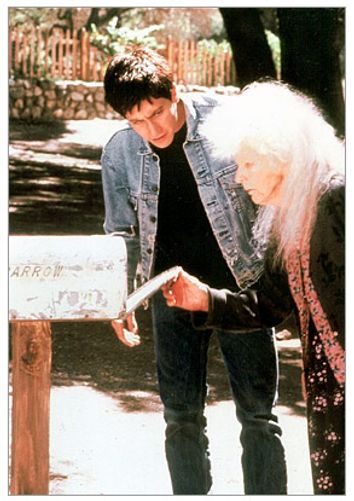
Driving Donnie home from school, Donnie’s father almost runs over Grandma Death, a 101-year-old woman who lives in their neighborhood. Actually named Roberta Sparrow, Grandma Death spends every day walking back and forth to her mailbox, checking for a letter that never seems to come. As Donnie helps her out of the road, she whispers in his ear.

After a fruitless therapy session with Dr. Thurman (Katharine Ross), Donnie meets Frank again that night. Frank sends him to break a water main in the basement of his school; Donnie also embeds a hatchet in the bronze head of the school’s mascot. School is canceled the next day as a result of the flooding, and Donnie walks Gretchen home from her bus stop. During their conversation, Gretchen reveals that she has moved to town because her stepfather stabbed her mother. Donnie asks Gretchen to “go with” him; she accepts. “I’m really glad school was flooded today,” Donnie says, because otherwise, “you and I would have never had this conversation.”

While Donnie’s parents attend a PTA meeting a few nights later, Donnie sees Frank again, this time in his bathroom. When he tries to touch Frank, some kind of barrier seems to separate them. Frank asks him, “Do you believe in time travel?”

The school’s health teacher, Mrs. Farmer (Beth Grant), seems to be teaching a curriculum derived entirely from a series of cheesy self-help videos hosted by Jim Cunningham (Patrick Swayze). An attempt to get Donnie to play along causes him to erupt in class; he is suspended from after-school activities for six months.

A few days later, Donnie asks his science teacher, Dr. Monnitoff (Noah Wyle), if he knows anything about time travel. Monnitoff responds enthusiastically; for time travel to occur, you’d need some kind of metal vessel, he says, and a time-space wormhole. He lends Donnie a copy of “The Philosophy of Time Travel,” a book written by none other than Grandma Death herself, back when she was a science teacher at Donnie’s school.

In therapy, Donnie reveals what Grandma Death whispered to him: “Every living creature on earth dies alone.” He confesses to Dr. Thurman how afraid he is of being alone, and of dying alone.

Watching a Redskins game soon afterward, Donnie is surprised to see, protruding from his father’s stomach, a silvery, aqueous blob. The blob stretches out and precedes his father as he gets up to go to the fridge; it looks like a liquid snake and seems to be a visible manifestation of his father’s future. Donnie sees his own future flowing out of his stomach; he follows the iridescent snake up the stairs to his parents’ room, where he finds a handgun hidden in a closet.

While discussing a class project, Donnie and Gretchen come close to kissing, only to be interrupted when they notice a fat guy in a tracksuit smoking a cigarette and watching them.

Late at night, Donnie sees Frank in his bathroom again. Using a kitchen knife, he taps on the liquidy barrier between them; Frank’s right eye flashes as the point of the knife hits the barrier.

Jim Cunningham brings his self-help shtick to a school assembly. Donnie acts up again, demanding to know how much Cunningham is being paid to visit the school and calling him the Antichrist. He is hustled out of the auditorium.

Donnie shows Gretchen “The Philosophy of Time Travel.” “I’ve been seeing stuff,” he says, and the book describes the visions he’s been having. “It can’t be a coincidence,” he adds. Donnie and Gretchen try to visit Roberta Sparrow, but she doesn’t answer her door. Donnie looks in her mailbox. It’s empty.

Donnie finds Jim Cunningham’s wallet on the sidewalk. “Now you know where he lives,” we hear Frank’s voice say.

Having kissed for the first time, Gretchen and Donnie go to a movie, Sam Raimi’s “The Evil Dead.” Gretchen falls asleep instantly and Donnie sees Frank sitting near them. Donnie asks Frank to take off his bunny suit; Frank removes his mask and reveals himself to be a normal-looking kid with a mutilated right eye. The movie on the screen is replaced by a picture of Jim Cunningham’s house. “Burn it to the ground,” Frank says.

Meanwhile, Donnie’s family is at the school’s talent show, where his little sister Samantha’s dance troupe, Sparkle Motion (coached by Mrs. Farmer), is performing. They are watched by an enthusiastic crowd and a mysterious woman with a clipboard. (Donnie, having been banned from after-school activities, was not allowed to attend.) As Sparkle Motion performs, we see Donnie torch Jim Cunningham’s house. Firefighters discover a kiddie porn dungeon in the ruins of Cunningham’s mansion; he is arrested the next day.

A distraught Mrs. Farmer visits Donnie’s mom. Sparkle Motion has been invited to perform on “Star Search ’88,” but Mrs. Farmer has to attend Cunningham’s arraignment and cannot chaperone. Donnie’s mother agrees to fly to Los Angeles with the girls for the taping.

We see Donnie holding a letter addressed to Roberta Sparrow.

Donnie visits Ms. Pomeroy, who has been fired. She has written the words “cellar door” on her blackboard and tells him that a “famous linguist” declared them the most beautiful words in the English language.

In therapy, a hypnotized Donnie sees Frank again. He freaks out. When he comes to, Dr. Thurman tells Donnie that his pills are placebos.

With both their parents out of town, Donnie and Elizabeth decide to throw a party. The house fills with costumed high-schoolers dancing to Joy Division. Gretchen appears at the door, crying; her mom has disappeared and she’s afraid her stepfather has found them. Donnie and Gretchen go upstairs. Bow chicka bow chicka bow chicka bow. While they’re doin’ it, Donnie’s mom calls and tells the answering machine that she and Samantha will be returning on the red-eye. Downstairs, Elizabeth asks a friend if they’ve seen Frank.

It’s midnight. A title card tells us that “six hours remain.”

Donnie and Gretchen return downstairs. Donnie sees the future blobs protruding from partygoers’ stomachs; he follows his own to the kitchen, where written on the dry-erase board is “Frank was here Went to get BEER.” Gretchen’s future blob approaches Donnie; he falls to his knees, looks inside it and sees a tunnel of water racing through clouds. He and Gretchen leave the party and ride their bikes, “E.T.”-style, to Roberta Sparrow’s house.

Once there, they climb through Grandma Death’s cellar door; two thugs from their school attack them and force them outside at knifepoint. As they struggle in Grandma Death’s dusty front yard, we see approaching headlights in the distance. One of the thugs throws Gretchen to the ground. “Deus ex machina,” Donnie says as the car approaches.

The red Trans Am’s headlights illuminate Roberta Sparrow, who is standing in the middle of the road reading Donnie’s letter. The car swerves to avoid her and runs over Gretchen, killing her. The thugs run away while Donnie races to Gretchen’s side. Two guys step out of the car: a guy in a clown costume and Frank, dressed in his rabbit suit, his mask off. “Is she dead?” a terrified Frank asks. He seems to have never met Donnie before. Donnie shoots him through the right eye.

Roberta Sparrow approaches Donnie. “The storm is coming,” she says. “You must hurry.”

It’s the early morning. Donnie carries Gretchen’s body back to the house, loads her in the car and looks up at the eerie black cloud hovering over the house. He drives to the mountains where he began the film and sits on his car’s hood. We hear Frank’s voice say, “I’m going home.” In the distance, a black funnel cloud hangs over Middlesex; a tiny plane flies toward the cloud. Donnie stares at the horizon.

We see Donnie’s mom and sister on the plane; there is an explosion and the passengers begin to scream. The jet engine falls through a tunnel in the clouds. We hear Gretchen’s voice repeating something she said earlier in the film: “What if you could go back in time and take those hours of pain and darkness and replace them with something better?” We see pixilated representations of the events of the past 28 days, running in reverse. Time flows backward while we hear Donnie’s letter to Roberta Sparrow. “I can only hope the answers will come to me in my dreams,” he says.

We see Donnie in his bedroom, laughing. It’s Oct. 2 again, a little after midnight. Elizabeth comes through the front door and her date honks his horn outside. Donnie is lying in bed when the jet engine crashes through his room.

Dr. Thurman wakes up gasping. Ms. Pomeroy and Dr. Monnitoff are in bed together; he is awake, staring at the ceiling. Jim Cunningham weeps in his bed. Mrs. Farmer looks aghast. Amid drawings and models of rabbit masks, Frank stares moodily into space.

The next morning, Gretchen rides her bike past the Darko house. A truck carts off the smoking engine. She asks a neighborhood kid what happened and he tells her a boy named Donnie Darko died. Donnie’s mother is standing in the front yard amid her weeping family, smoking a cigarette. Gretchen cautiously waves; Donnie’s mom waves back. The boy waves too.

- – - – - – - – - – - -

What the hell just happened?

The vast majority of “Donnie Darko” takes place in a parallel universe. From the moment the clock in the Darko house strikes midnight, 10 minutes into the film, right up to Donnie’s hysterical laughter in bed, the setting of the film is Tangent Middlesex, a parallel dimension, spontaneously created, which exists only during the 28 days that cover the majority of the film’s action. The through-line of the film is Donnie Darko’s quest to erase the Tangent Universe before it destroys the world.

To understand what actually occurs in “Donnie Darko,” it helps to have read “The Philosophy of Time Travel,” by Roberta Sparrow. This is difficult in that the book is an imaginary one, written by a fictional character. Luckily, much of the book’s text is included on the film’s Web site and DVD and is now incorporated into the director’s cut.

“The Philosophy of Time Travel” explains that time, while usually stable, will occasionally become corrupted for reasons unknown to all. When this happens, a Tangent Universe is created — an alternate reality parallel to the primary universe in which we all live. “If a Tangent Universe occurs,” Sparrow writes, “it will be highly unstable, sustaining itself for no longer than several weeks. Eventually it will collapse upon itself, forming a black hole within the Primary Universe capable of destroying all existence.” During that collapse, a time-space vortex will form that leads back to the birth of the Tangent Universe.

In a nutshell, this is precisely what the hell happens in “Donnie Darko.” At midnight on Oct. 2, 1988, a Tangent Universe is spontaneously created, centered in Middlesex, Va. This Tangent Universe threatens the existence of life as we know it; it falls to one person to do whatever necessary to put the world back in order and keep the Tangent Universe from destroying the real world when it collapses in 28 days. That person — that superhero — is, of course, Donnie Darko: a 16-year-old with emotional problems, a history of arson, and bedroom eyes.

The Artifact

Hand in hand with the creation of a Tangent Universe, writes Roberta Sparrow, is the spontaneous appearance of an Artifact. Made out of metal, this artifact will inexplicably show up near the epicenter of the Tangent Universe; in order for disaster to be averted, the Artifact must be sent through the time vortex back to the Primary Universe — back to before the split in dimensions occurred. The Artifact in Tangent Middlesex, of course, is a gigantic freaking jet engine that falls out of the sky.

The Living Receiver

That’s Donnie, in the words of “The Philosophy of Time Travel”: the Living Receiver. He’s the chosen one, picked (seemingly at random) to return the Artifact to the Primary Universe in order to avert catastrophe. Being the Living Receiver has advantages and disadvantages: You get superpowers, like strength, telekinesis and the ability to see into the future, but you also get horrifying hallucinations and the people around you tend to fear and attack you.

The Manipulated

This refers to pretty much everyone else in the movie. “They are prone to irrational, bizarre and often violent behavior,” writes Roberta Sparrow, because their entire raison d’être is to help the Chosen One fulfill his task. Which is to say that every other character in the movie has been set up like a piece on a chessboard, ready to behave in the exact perfect way necessary to push Donnie toward his eventual destiny — returning that jet engine to its proper time and place in the Primary Universe. Nearly every event in the film, when viewed in this way, has a specific purpose; together the events create an inexorable chain of coincidence and consequence designed to make Donnie’s fate inescapable.

All this mumbo-jumbo, of course, skirts the big question: Chosen by whom? Manipulated by whom? The movie leaves that ambiguous, but it seems clear from comments Kelly makes during the DVD commentary that the person in charge here is, basically, God. When the Middlesex Tangent Universe is spontaneously created, God arranges the people in that Tangent Universe around Donnie Darko in such a manner that their actions lead inevitably to Donnie’s delivering the jet engine back through time.

Deep breath.

Questions?

- – - – - – - – - – - -

Yeah, how the hell am I supposed to know all this? Hardly any of that stuff was in the movie.

That’s true. Many of my friends complain that to understand “Donnie Darko,” a viewer needs to watch the movie and listen to the DVD commentary and crack the Web site. In an interview, Kelly has said that he created the pages from “The Philosophy of Time Travel” as an exercise in interpretation and that they are not intended to be read as canon; nonetheless, his inclusion of many book excerpts in his director’s cut suggests that his feelings on the matter have changed and he intends them to be definitive. (Incidentally, this might be the first time that a director’s cut includes large chunks of material lifted directly from the film’s Web site.)

Couldn’t you interpret this whole movie in another way, without any sci-fi stuff at all? As sort of a subjective rendition of Donnie’s descent into paranoid schizophrenia?

Absolutely. A number of my friends read the film this way and feel it is a far more interesting interpretation of the events of “Donnie Darko” than the dominant sci-fi narrative. Certainly aspects of the film — the flatness of affect in Donnie’s meetings with Frank, Donnie’s increasing menace and the way the mechanics of the plot revolve so explicitly around typical teenage sexual hang-ups — support a reading of the film as Donnie’s Descent, shown from inside his head. Even the careful tying-together of the plot doesn’t necessarily negate this read; one trait of the budding schizophrenic is the creation of coherent, if unlikely, narratives tying together the hallucinations and paranoia often manifested as part of the illness.

That said, I’m not dealing too much with this read in these Cliffs Notes because it seems to me that through his supplementary materials and his director’s cut, Richard Kelly is pushing viewers to accept the primary narrative — the sci-fi, Tangent Universe narrative — as the “proper” way to interpret the film. We can argue all day about whether Kelly’s decision is clarifying or foolishly reductive. Many of my friends think that the film is far richer as an exploration of madness than as an “Escher thriller about freaking wormhole bullshit,” as one friend so succinctly put it. Conversely, I myself am much more interested in watching a clever sci-fi flick with good ’80s tunes than another inside-the-nutcase’s-head movie, and so I’m perfectly happy to have Kelly attempt to clarify the intentions of his plot a bit. Kelly himself has spent years crowing about his film’s careful ambiguity, so I’m interested in why he made the additions he did to the director’s cut, additions that serve primarily to make the film far less ambiguous.

I still think that my interpretation is valid, man.

Of course it’s valid. Don’t take it personally. We’re all relativists here.

What’s with the 6-foot-tall rabbit?

Well, that’s as good a place to start as any. Frank (played, in fur coat and out, by James Duval) is the boyfriend of Donnie’s sister Elizabeth. (It’s he who drops her off just before the jet engine fiasco.) Frank himself never meets Donnie until their fateful encounter on Halloween eve. The Frank who speaks to Donnie on the golf course and elsewhere is a kind of ghost Frank — a remnant of Frank who, because Donnie shoots him in the eye within the Tangent Universe’s 28 days, can move freely in time throughout the Tangent Universe. Frank’s purpose — for he’s been chosen, as surely as Donnie has — is to serve as Donnie’s guide through the Tangent Universe, leading him toward clues and offering tasks that will smooth Donnie’s way toward his goal.

According to Roberta Sparrow’s book, Frank is an example of the Manipulated Dead. Apparently, those who die within the confines of the Tangent Universe are given some level of knowledge of the catastrophe to come and serve to some extent as the Chosen One’s guide. There seems to be some variation in the level of understanding given to the Manipulated Dead; Gretchen, for example, the other Manipulated Dead, seems to have an inkling that something terrible is going to happen but clearly doesn’t have the detailed comprehension Frank does. Nor does Gretchen’s spirit appear to Donnie behind any kind of watery barrier. Nor does she dress up in a bunny suit.

Yeah, what’s up with that bunny suit?

Donnie meets the real Frank — not his Manipulated Dead specter — for the first time on Halloween eve, with Frank in costume. But it’s also an allusion to “Alice’s Adventures in Wonderland” — just as the White Rabbit leads Alice down the hole into her great adventure, so does Frank lead Donnie into his own. Rabbit imagery abounds in “Donnie Darko,” from a VW Rabbit driving down the streets of Middlesex to stuffed bunnies to a photograph of toddler Maggie Gyllenhaal next to a kid in a rabbit suit to (in the director’s cut) an extended subplot revolving around Richard Adams’ rabbits-in-peril novel “Watership Down.”

OK, I still don’t get it. How exactly does Donnie deliver the jet engine back through time? I get that there’s a time portal or whatever above his house, and the jet engine falls through it, but it seems like it just falls off his mom’s plane for no reason.

I couldn’t figure this out at all, but, thank God, Kelly explains it on the DVD commentary. In addition to his super strength and super future-sight and super sulking power, Donnie has the power of telekinesis. He rips the engine off the plane himself.

Oh. I didn’t get that.

I don’t know anyone who did.

Why does he do that?

Well, he’s basically railroaded into it. Previous events — his conversations with Dr. Monnitoff, his reading of Roberta Sparrow’s book — have made it clear to Donnie what is going on, and he pretty much knows what he is supposed to do. But he’s spurred on most directly by the events of the previous evening. Once he has killed a person and seen his girlfriend die before his eyes, he feels he has no choice but to send time backward — to telekinetically rip off the engine, send it through the time vortex, and fulfill his destiny as the Living Receiver. (Sparrow’s book refers to this as an Ensurance Trap, a snare created by the Manipulated Dead — in this case, Frank and Gretchen — to make absolutely sure that the Chosen One does his job.) Donnie believes that if he does what he’s supposed to, this Tangent Universe he’s in will disappear and it will be as if the past 28 days never happened — Gretchen and Frank will still be alive.

But doesn’t he know that if he sends the jet engine back in time, and it lands on his house, but he’s back there on Oct. 2 in a regular universe with no Frank calling him out of bed, he’ll get squashed like a bug?

Impaled, actually, as seen in a gruesome deleted scene on the DVD. It’s hard to tell whether he knows this or not. His hysterical laughter at the end of the movie suggests he knows something’s up. Sparrow’s book notes that many of the Manipulated will see the events of the Tangent Universe in their dreams. So we can assume that at midnight on Oct. 2 in the Primary Universe, Donnie Darko wakes up from an exceptionally detailed dream in which he developed superpowers, got lucky, burned down a pervert’s house, and discussed the sexual habits of Smurfs with his friends. Whether he understands the dream is uncertain; I think he does but chooses, due to all he’s seen and his worries about repeating the mistakes of the Tangent Universe, to stay in bed and take a jet engine right in the kisser.

Interestingly, Kelly suggests in the DVD commentary that the car horn we hear as Elizabeth comes in the door is Frank’s — that he’s honking not as a message to Elizabeth, but as one to Donnie. Perhaps Frank at that second realizes everything that happened in the Tangent Universe, and knows what is about to happen, and attempts to wake Donnie up and get him out of bed before the sky falls?

Also interestingly, this means that once again an extremely complicated film can be basically explained as being a representation of the dream a troubled character has just before death.

People remember the Tangent Universe in dreams? Is that why we saw everyone looking sad in bed?

Yeah. And Jim Cunningham is crying because he realized what a total perv he is. According to the film’s Web site, he shoots himself 10 days later. The Web site has all kinds of fun tidbits: The FAA never figures out where the engine came from. Roberta Sparrow finally dies in December 1988. And Dr. Monnitoff marries Ms. Pomeroy; when he dies under suspicious circumstances in 1999, she sends his copy of “The Philosophy of Time Travel” to the Library of Congress with a cryptic note. Check it out, but be warned it’s one of those annoying mysterious Web sites that take a week to figure out; look here for a step-by-step walkthrough.

The sexual habits of Smurfs?

Yeah! Apparently Smurfs lack genitalia. According to the DVD commentary, the estate of Peyo, creator of the Smurfs, allowed Kelly to keep this very funny scene in the movie because Donnie’s description of Smurf sexuality is perfectly accurate.

So how are all the Manipulated manipulated?

The Manipulated do irrational or unexpected things with consequences that inevitably push Donnie toward his fate. Consider the film’s climax, the deaths of Gretchen and Frank. It’s fascinating to see all the choices by various Manipulated that get Donnie outside Grandma Death’s house on that fateful night — and cause him to be so devastated by the deaths of Frank and Gretchen that he is willing to destroy the universe in which he finds himself just to undo those deaths.

How does Donnie meet Gretchen? Well, on Gretchen’s first day of school, Ms. Pomeroy behaves strangely, giving Gretchen that not-approved-by-the-Board-of-Ed directive to sit next to the boy she finds the cutest. And then Frank helps them become better acquainted by getting Donnie to break that water main. Remember? “I’m really glad school was flooded today,” Donnie says, because otherwise, “you and I would have never had this conversation.”

How does Donnie know to communicate with Roberta Sparrow? Dr. Monnitoff talks time travel with him and gives him a not-approved-by-the-Board-of-Ed book to read.

How does Donnie know to look in Grandma Death’s cellar? Ms. Pomeroy’s out-of-left-field invocation of the phrase “cellar door.”

The two thugs’ weird idea to rob Grandma Death sends Donnie and Gretchen into the road. Mrs. Sparrow — who’d refused to answer the door when Donnie previously called on her — is reading Donnie’s letter when Frank’s Trans Am swerves around her and runs over Gretchen.

Why does Donnie love Gretchen so much that he’s willing to shoot Frank in retaliation, willing to erase the universe to bring her back to life? Well, because of their deep emotional connection, sure, but also because they just made love for the first time. And why do they make love? Gretchen’s stepdad, we’re led to believe, irrationally attacks Gretchen’s mother, leading Gretchen tearfully to Donnie’s door and into his arms.

And why is Frank there at all? Because he left a party where he could’ve been making out with Maggie Gyllenhaal in order to buy beer, even though the party already had a keg. The behavior of an 18-year-old guy doesn’t get much more irrational than that.

What other irrational behavior do the Manipulated exhibit?

Well, Donnie gets driven to his misbehavior by Mrs. Farmer’s moronic adherence to the cult of Swayze. Said misbehavior gets him suspended from after-school activities; that’s why he can’t attend the talent show and is instead free to torch Cunningham’s house. Once Cunningham is exposed as a panderer, Mrs. Farmer can’t go to L.A. with the Sparkle Motion girls, so Donnie’s mom goes, so the house is devoid of parents, so the Gyllenhaals can throw a bitchin’ party where Donnie gets laid. And since Donnie’s mom had to go to L.A., she’s on the plane when the engine comes off, and … um … actually, I still have no idea why she had to be on that particular plane. That makes no sense at all.

Oh, and of course, everyone thought Sam Raimi was crazy when he made “The Evil Dead,” but he irrationally did it anyway, and that movie was Donnie’s and Gretchen’s only date.

Thanks, jackass. Who are the fat guy in the tracksuit and the mysterious woman with the clipboard?

He’s one of the FAA employees we see near the beginning and end of the movie. Apparently the FAA is so freaked out by the jet engine weirdness that they’ve sent their tackiest agent to keep an eye on the Darko family.

She is a talent scout for Ed McMahon’s “Star Search ’88.”

What does it mean that Donnie’s medication is a placebo?

This scene, which appears in the director’s cut, is another hint from Kelly that he doesn’t think Donnie’s crazy. Dr. Thurman doesn’t fully understand what’s going on, but like so many of the other characters, she recognizes that something momentous is in the air and that Donnie seems to be in the middle of it, whatever it is.

What’s the story with “cellar door”?

Ms. Pomeroy’s vague attribution of the quote to a “famous linguist” was, I assume, mandated by the legal department; it’s hard to get a handle on who first claimed those two words to be the most beautiful in the English language. I’ve seen it attributed to Pound, Poe, Tolkien, Mencken and a Chinese student of Mencken’s who knew no English.

What does that creepy thing Grandma Death whispers have to do with anything?

I think it’s telling how scared Donnie seems when he discusses her notion that “every living creature on earth dies alone.” As the Tangent Universe draws to a close, Kelly is careful to give Donnie moments of reconciliation with nearly everyone important to him: his mother (in a sweet scene up in his room), his father (in a director’s cut scene in the backyard, one of the nicest additions to the new version) and Gretchen (during the Halloween party). A friend of mine pointed out that another way of interpreting Donnie’s smile as he settles into bed, just before he gets engined, is that he is pleased about the circumstances of his onrushing death. He was afraid of dying alone, without a connection to God or anyone? Well, following “God’s channel,” he has known love for the first time and has been given a chance to sacrifice himself for the love of Gretchen and his family and everyone. He knows he is about to die, but he doesn’t feel at all alone.

What’s with those weird blobs leading out of everyone’s stomachs?

They’re a visual representation of the future, inspired, Kelly said, by watching John Madden operate the CBS Chalkboard Telestrator on NFL broadcasts. Included among Donnie’s many superpowers is the power to see the future. Donnie and Dr. Monnitoff have a discussion in which Donnie asks whether this representation suggests there’s no such thing as free will. Dr. Monnitoff says that just because you see your future doesn’t mean you have to follow it, but Donnie seems to believe that the future blobs represent “God’s channel.”

The film comes down pretty firmly against the concept of free will, at least in Tangent Universes. But that leads to a daunting question…

Why all the rigmarole? If no one in this Tangent Universe has free will — and if God or whoever can make them act irrationally and do whatever He wants — why did this whole scheme to get the jet engine off the plane have to be so complicated? It seems like a stupid way to save the universe, in the sense that anything could have gone wrong at any step. Why couldn’t Whoever was in charge just make Donnie sleepwalk into the hills on Oct. 30 and use his superpowers to knock the engine off the plane? In the whole scale of things, that doesn’t seem more irrational than some of the other irrational things characters do throughout this movie.

That’s the exact daunting question to which I referred. It all seems very baroque, doesn’t it, reminiscent of the overcomplicated plans hatched by villains in potboilers since the beginning of time. (My wife asks: If Voldemort needs Harry’s blood so bad, why do they have to rig the entire freaking Triwizard Tournament to get it? Why couldn’t Fake Mad-Eye just, like, send Harry to the infirmary for a Magical Mumps blood test?)

There’s no good answer to this question — why does God or Whoever make saving the universe so complicated? — other than the obvious one. If saving the universe was as easy as all that, what a boring movie that would make, right?

Continue Reading Close

Page 1 of 4 in Dan Kois

www.salon.com/writer/dan_kois/index.html