Erin Aubry Kaplan
“Precious” in the age of Obama
Why the hopeless story of a ghetto teen is just the kind of movie black people need right now
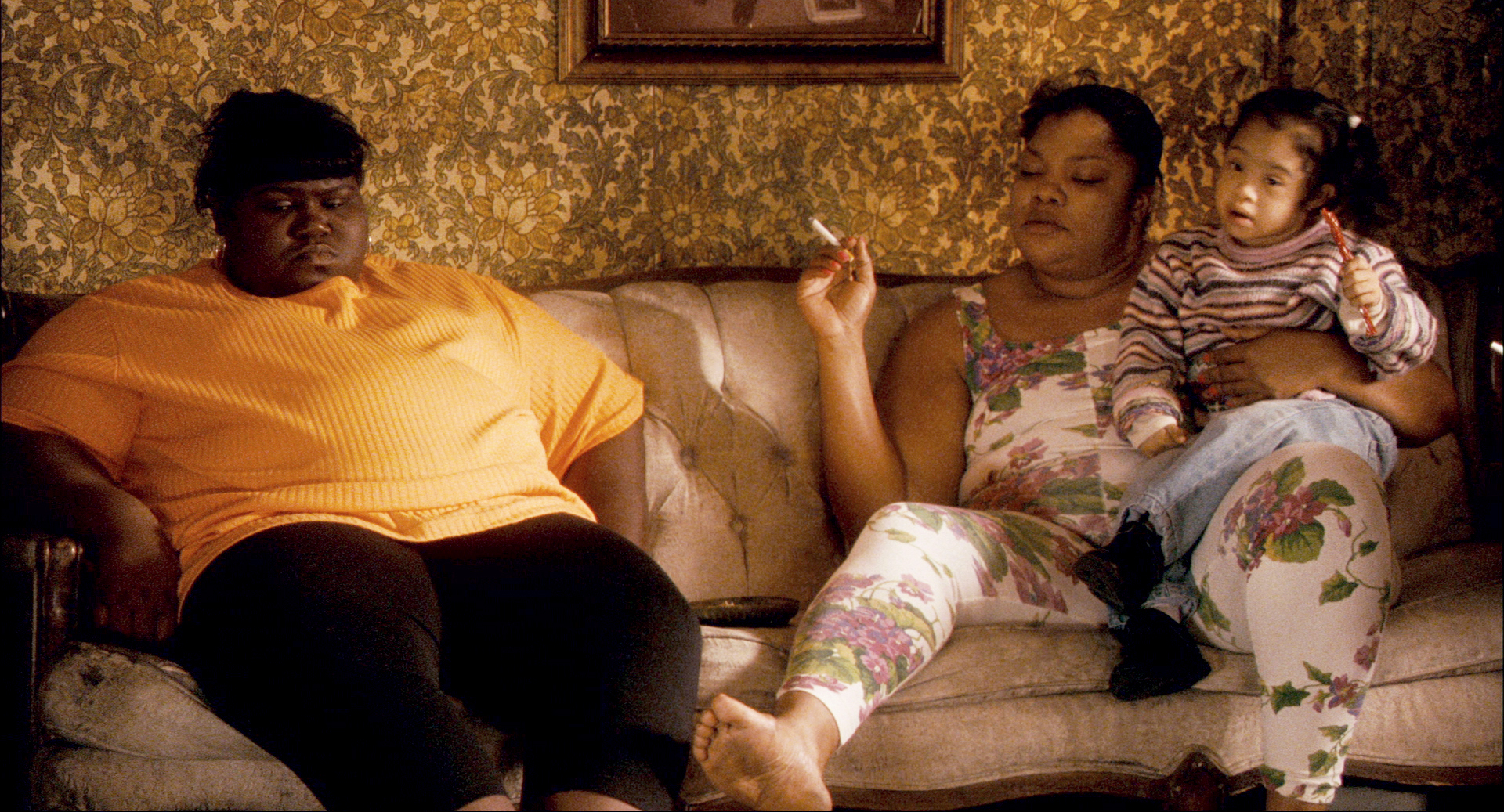
Gabourey Sidibe, left, and Mo'Nique in "Precious." As a black woman, I had one overwhelming reaction to the trailer for “Precious”: horror. Watching the unflattering images pile up in the space of a minute — hugely overweight teen, crazy welfare mother, illegitimate babies, an especially bleak-looking Harlem — my political alarms went crazy. I glanced uneasily around the almost exclusively white West L.A. theater and thought: Boy, they’ve done it this time. Noble “Precious” looked to be one more brick in the wall for black folks, something that would bury ever deeper a more nuanced reality that never makes it to the big screen.
And I was right about one thing: They have done it this time. But not at all in the way I imagined. Far from being some exploitative spectacle for whites, the hard-hitting tale of “Precious” is a film for blacks and a challenge to drop our own emotional armor and embrace a real-life story we have been minimizing for a long time — that of a big, black, sullen-faced, illiterate girl who lives in the depths of the ghetto and in all likelihood will stay there. She is the bogeywoman not just of white society but of black society, too, especially for a middle class that’s been trying for years to rescue its “negative” racial image from the likes of Precious. But while we in the real world preach community ad nauseam, it’s girls — and boys — like her who remain at the bottom of the well. In making the bottom dweller eminently human, the movie forces blacks to assess their own humanity. And I found myself squirming in the seat more than once.
Of course, my squirming speaks to how comfortable we’ve all gotten with set paradigms in black film. Hollywood has long favored comedies or “urban” dramas, both of which mine the deprivation and depravity of the ghetto for entertainment (a phenomenon I call “ghettotainment”). Movies like “Menace II Society” and “Barber Shop” sit comfortably atop the Netflix queues of a multicultural audience. And at the opposite end of the spectrum are the uplifting dramas, stories of dignified black folk overcoming oppression and/or segregation, movies often set in a distant, racist past — “Glory” or “Remember the Titans.” But “Precious” is jarring, because it breaks all these rules. The movie is about racial oppression, but it’s modern; its protagonist is inner-city but a female, not an archetypal gangbanger or would-be criminal; though she perseveres, Precious is clearly a victim, not a victor.
Perhaps the best thing about “Precious” is how it dismantles the well-honed defense mechanisms of the black audience. As viewers, we tend to be ready commentators, snickering at our own pain; we make fun of these on-screen moments because they’re frequently so unconvincing. Movies, among other things, have taught us not to take ourselves seriously. But in drawing black pain so specifically and unsentimentally, “Precious” makes those cavalier attitudes impossible. When Mo’Nique snaps, “Shut the fuck up!” for the hundredth time or Gabourey Sidibe, the remarkable actress in the title role, tearfully confesses to her own sense of nothingness, the largely black audience I sat with was silent; I could feel a rare chill of recognition. In one of the film’s most heartbreaking moments, Precious stands on the cold sidewalk with her new baby, looking longingly through the window of a church at a gospel rehearsal in joyous full swing. It’s rare to see a black church portrayed as impotent. But it isn’t a condemnation so much as an illustration of her isolation — our isolation.
The truth is that all blacks harbor a bit of Precious inside them. To one degree or another, we have all lived her, been her. Who hasn’t looked in the mirror and wanted “better” hair, less body mass, lighter skin, more confidence, more assurance that we’re worthy? Who hasn’t lashed out in anger at a world that we know holds us in subtle and not-so-subtle contempt? Who among us hasn’t retreated behind an emotional mask in order to get by? Precious is a fully realized character but also a metaphor representing blacks at our lowest psychological ebb, a place we’ve always feared because we know it has the potential to swallow us whole. We tend to refer to that low ebb via statistics — rising levels of depression and suicide — but those are sociological abstracts that keep black people at an emotional distance from each other. “Precious” unceremoniously closes that gap. And just in time for the Obama era, which urges us to believe in the president as a symbol of success for blacks everywhere. Role model? Not hardly. To Precious, Obama is only another light-skinned black fantasy boyfriend with a dazzling smile and good hair.
It’s perhaps not surprising that this project comes to us from Oprah Winfrey. Yes, she is the queen of love-yourself affirmation, but she’s also a dark-skinned black woman with a history of weight problems. She is also a lightning rod for political controversy. When Stephanie Zacharek’s review of “Precious” ran last week, some commenters groused about Winfrey’s involvement, complaining that she too often mined the depressing territory of rape and degradation in projects like “The Color Purple” and, I suppose, “Beloved.” But this is nonsense. Why should Oprah or anybody else in Hollywood have a quota for certain stories? How many harrowing Holocaust or violent mob stories has America embraced with fresh enthusiasm for each telling? (It’s worth remembering that few Oprah fans supported the ambitious “Beloved,” probably because slavery itself was unending sexual degradation that nobody wanted to stomach — not even for one movie, even one with Oprah in it). Even more intriguing but less discussed is the involvement of Mo’Nique, the plus-size actress/comedian who plays Precious’ Joan Crawford-like mother, Mary. Mo’Nique has graced several covers of Essence magazine and is rightly considered a touchstone of black female empowerment. Her no-holds-barred performance as the black woman of everybody’s worst nightmares carries a certain risk — will people think this harridan is the “real” Mo’Nique? Such are the questions of authenticity that dog every black film, whatever it is.
I give even bigger props to the film’s co-producer Tyler Perry. Unlike Oprah, whose tastes run to the literary, Perry has become famous making simple stuff — broad cross-dressing comedies and black family drama with overtly Christian messages of hope and redemption, movies that are really more propaganda than art. Those movies may top the box office, but they don’t do much to humanize black folk or expand our story. But Perry has shifted gears with “Precious,” at least temporarily. Maybe he’ll even stay on this courageous course, something that is the polar opposite of crowd-pleasing pablum like “Why I Got Married” and “Madea Goes to Jail.” But “Precious” proves you don’t always have to choose between artistic and commercial success; the film’s first opening weekend was record-breaking. It’s a sign how much we needed to tell this story. And, perhaps, how many stories there are left to tell.
Tyra Banks takes it all off
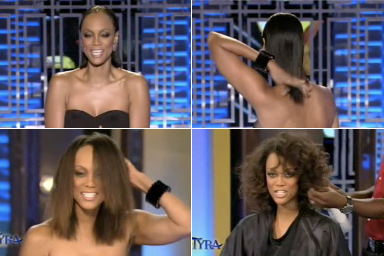
The talk show host tossed her weave for the first time. Is embracing the state of black hair the new liberation?
Tyra Banks Thanks mostly to the intense physical scrutiny of Michelle Obama, black hair is now a subject suitable for public consumption. Well, almost. For the last year, big media’s been creeping rather awkwardly up to that point and now seems ready to take words like “pressed” and “processed” out of the black particular and move them into a more permanently accessible cultural space; both Time and the New York Times Sunday Styles section recently ran sober pieces on the social history and multiple meanings of black hairstyles. Meanwhile, black people have been almost forced into a new mode of self-reflection about workaday rituals they assumed were of interest to no one but themselves. (See Chris Rock’s upcoming “Good Hair,” an unironically titled documentary that profiles the lucrative but little-observed industry that black hair care has been for well over a hundred years.)
Continue Reading CloseThe Michelle Obama hair challenge
Nappy or relaxed, African-American hair has always been a loaded subject. So what does it mean to have a black do in the White House?
Are we moving toward a “black hair” moment?
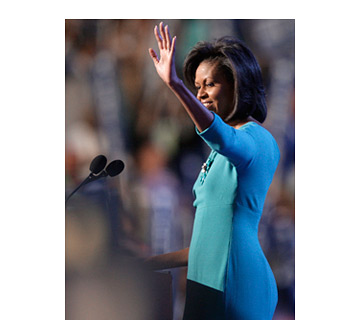
It might sound like one of those media-created, racially overwrought questions meant to boost ratings and Internet chatter. But with Obama in the White House and a black family center stage — not to mention a first lady whose appearance and fashion choices are already being endlessly dissected — the question suddenly becomes almost reasonable.
Consider: Michelle’s hairdresser, Johnny Wright, just signed a development deal for his own beauty reality show. Chris Rock recently went to Sundance to screen his documentary “A Good Hair Day,” a look at the enormous but mostly unexamined industry and culture of black hair care. “[Black women's] hair costs more than anything they wear,” Rock recently said in a Salon interview. “It’s like the No. 2, 3 expense of their whole life.” Meanwhile, in a recent discussion on MSNBC, black Princeton prof Melissa Harris-Lacewell agreed with Rachel Maddow that an Obama administration meant white people would be more emboldened to ask black people about previously taboo issues, like how they do their hair (Harris-Lacewell admitted she wasn’t looking forward to that). The interest is encouraging to a point. And like all white scrutiny of any aspect of black life, it also feels like voyeurism, to a point. The gray area is just one of many reminders that bridging the racial divide, like black hair itself, is going to be complicated.
Continue Reading CloseFirst lady got back
I'm a black woman who never thought I'd see a powerful, beautiful female with a body like mine in the White House. Then I saw Michelle Obama -- and her booty!
Free at last. I never thought that I — a black girl who came of age in the utterly anticlimactic aftermath of the civil rights movement — would say the phrase with any real sincerity in my lifetime. But ever since Nov. 4, I’ve been shouting it from every rooftop. I’m not excited for the most obvious reason. Yes, Obama’s win was an extraordinary breakthrough and a huge relief, but I don’t subscribe to the notion that his capturing the White House represents the end of American racial history. Far from it. There is a certain freedom in the moment — as in, we are all now free from wondering when or if we’ll ever get a black president. Congratulations to all of us for being around to settle the question.
Continue Reading CloseWho’s afraid of Michelle Obama?
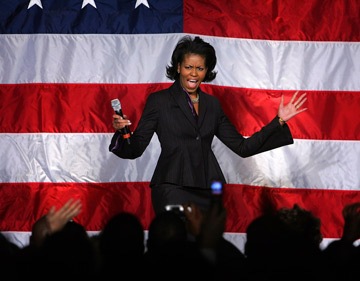
The flap about the potential first lady's "image problem" proves how uncomfortable the country feels about a shift in racial dynamics. But as far as I'm concerned, I've found a kindred spirit.
As Barack Obama moved through the maelstrom of the primary season, I held my breath, along with much of black America. My fear increased in proportion to my exhilaration, at times outpacing it. What would a country that had criminalized blackness for 350 years do when it woke up and realized it was seriously supporting a black man for president? I tracked the bad signs big and small, from the Jeremiah Wright crisis to reports that Obama’s young campaign workers were getting shellshocked by racism in Pennsylvania. I kept my eye on the ball with an obsession fueled by a half-sensible, half-quixotic belief that if I and other concerned citizens were vigilant, we could identify any racial slime at its source and contain it before it spread into a national, nonsensical conversation. The goal was not to keep Obama in a bubble, or even to get everybody in his camp — this is a presidential election, after all — just to allow a historic campaign to go forward as unimpeded as possible by scurrilous attacks rooted in his color.
Continue Reading CloseAfter Jena
I applaud the outcry over Jena. But what about stopping the injustices inflicted on black people every day -- like crappy schools, underemployment and unequal sentencing?
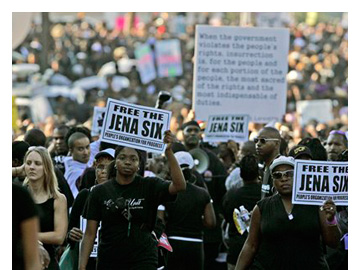
Last week, my brother Ahromuz went to Jena, La., and came back a changed man. He took a bus that left Los Angeles and didn’t stop until it had reached the tiny Louisiana backwoods town. The march and rally in Jena last Thursday were the culmination of a year of protests over the felony charges against six black Jena teenagers who had allegedly beat a white student at a high school beset with racial tension. One of the many things Ahromuz found unexpectedly transforming was the presence of so many very different black people — doctors, lawyers, rappers, black nationalist types — who had gathered from many points around the country for a single purpose. “It was understood that we were all there for the same reason,” he said. “Jena — it was all that people talked about. There was no disagreement. It was incredible.”
Continue Reading ClosePage 1 of 2 in Erin Aubry Kaplan