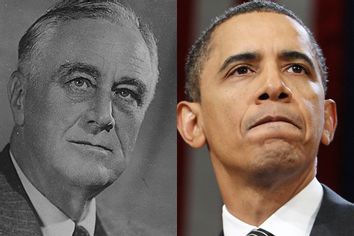
Comparisons between President Obama and Franklin Roosevelt often assume that Obama’s electoral fortunes will rise the closer he hews to FDR. A look at past election results, though, suggests that Obama is indeed heading down a path trod by FDR — one that bodes ill for Democrats’ hopes this fall.
Obama’s tenure has frequently been likened to the first few years of the FDR administration, but the better comparison is probably to 1937 and 1938. That period, like the current environment, is thick with charges of socialism and communism, as well as more mundane calls for lower taxes and a balanced budget. These are, by now, the most frequently-deployed tools in the conservative arsenal, but they were, if not first forged, then first sharpened in 1937 with the publication of the Conservative Manifesto. (Among the principles espoused in this right-wing Decalogue were revision of the tax code, reduced federal expenditures, a balanced budget, and the “maintenance of state rights.”)
As now, the increasingly frantic criticisms of federal action in 1937 and 1938 can be traced to a difficult economic climate. In 1938, the unemployment rate was a catastrophic 19% (nearly double the current rate. And as now, the opponents of the president argued that the economic turbulence was aggravated by his policies, which allegedly created a climate of uncertainty that was hostile to economic growth.
FDR campaigned mightily in 1938, but the electoral cake was all but baked: the Democrats lost 7 Senate seats, more than 70 House seats, and 13 governorships. If history is any guide, then, 2010 will see a sharp curtailment of Democratic gains from 2006 and 2008, just as 1938 saw Democratic majorities recede from their historic highs of 1934 and 1936.
Despite the high-volume right-wing cries that accompanied the losses in 1938, the lesson of that election is emphatically not that Obama should shift ideological course or move to placate his critics. Instead, a look at other FDR-era elections reveals that electoral losses were most likely linked to economic conditions and not the trenchant criticism of his adversaries.
In 1934, the unemployment rate was at 20 percent. Prominent opposition to Roosevelt’s policies emerged, for example, in the form of the American Liberty League, which decried allegedly socialist New Deal policies and the attendant loss of personal liberty. Defying gravity, the Democrats gained seats in both houses of Congress that year, increasing their already sizable majorities. The crucial factor was that the unemployment rate, though admittedly terrible, was marginally better than the rate when Roosevelt was elected in 1932. In the lead up to the 1934 election, Roosevelt asked the country, “Are you better off than you were last year?” Democrats held their ground in Congress because most Americans answered “yes.”
1936 told much the same story. In 1935 and 1936, Roosevelt signed into law, among other things, the Emergency Relief Appropriation Act – at the time, the largest peacetime appropriation ever — the Social Security Act, and a dramatic increase in the tax rate for the wealthiest Americans. These acts were, predictably, accompanied by cries of “socialism” and “communism” (Al Smith compared New Dealers to Marx and Lenin) and complaints that FDR was punishing the successful and shattering the budget. Amidst these cries, the unemployment rate continued to fall, reaching a low of around 17 percent. In November, FDR won a 523-to-8 electoral college victory over Alf Landon. In the next session of Congress, Democrats held a now-unimaginable 331 House seats and 76 Senate seats.
So what changed in 1938? Not the complaints of FDR’s critics, which, though louder and crisper in 1938, had been heard more or less consistently since the New Deal’s inception. Instead, the main difference between the triumphant elections of 1934 and 1936 and the setback of 1938 was the direction of the unemployment rate, which was high in 1934 and 1936 — but falling — and high in 1938 — and rising.
The bad news for Obama is that the unemployment rate is unlikely to get much better by November — and certain to remain higher than when he took office. Electoral losses this fall are thus all but inevitable.
The good news, though, is that the slings and arrows of the right wing — e.g., that Obama is a white-hating socialist with secret plans to destroy the United States — are probably more a handmaiden to current economic woes than fixed beliefs about Obama’s character. An even more important lesson is that ideological opposition to governmental programs gains traction only when those programs don’t seem to be working. The anti-Obama chorus seems uncomfortably loud now, but it is likely to lose many listeners when the inevitable economic recovery materializes.
If you’re part of the Obama administration — particularly a member of the Department of Justice — today is a day you might want to spend in bed.
Judge Susan Bolton, a federal trial court judge stationed in Arizona, will likely decide today whether to enjoin enforcement of Arizona’s immigration law, SB 1070, before it goes into effect tomorrow. If last week’s hearings on the law are any indication, her decision will find most of SB 1070 unobjectionable and fundamentally reject the central argument raised against the law by the Department of Justice.
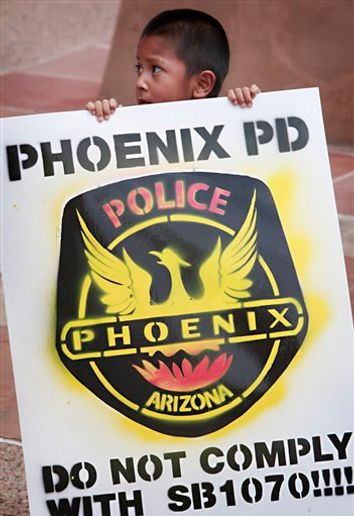
To recap: SB 1070, an unwieldy omnibus anti-immigration bill, contains six sections, including one particularly notorious provision: Section 2, which requires police officers to check the immigration status of anyone who (1) they reasonably suspect is in the country illegally or (2) is arrested for any crime. Other parts of the law — sections outlawing, for example, the smuggling, soliciting, or harboring of illegal aliens — have attracted less notice, and less opposition.
In challenging the law, civil rights groups targeted Section 2, arguing that the provision encouraged the widespread detention of lawful residents based on vague suspicions of illegal status. The Obama administration, meanwhile, advanced a sweeping challenge to the law, avoiding any race-based arguments and asserting instead that all six sections were trumped, or “preempted,” by federal law. (Attorney General Eric Holder reserved the right to mount a civil rights challenge to SB 1070 if evidence emerged that the law was discriminatorily applied.)
Based on her questions last week, Judge Bolton seems inclined to hold that, apart from several relatively uncontroversial provisions, SB 1070 does not impinge on the prerogatives of the federal government. (At one point during the argument, she asked pointedly of a DOJ attorney, “How is there a preemption issue?”) The general thrust of her queries was that illegal immigration is in part a “public safety” issue and that SB 1070 is largely a legitimate attempt to address a “dangerous situation[].”
The challenges filed by civil rights groups, on the other hand, are likely to meet with greater success. Bolton seemed persuaded by arguments that Section 2 impermissibly authorizes police officers to detain people, even where there is no reason to believe that they are in the country illegally. She also might enjoin Section 2 based on the comically vague and seemingly random list of factors that, according to Arizona’s police training board, give rise to “reasonable suspicion” of illegal status (for example, “dress,” “demeanor,” and “traveling in tandem”).
If Judge Bolton rules as predicted, the Obama administration will emerge from the legal battle over SB 1070 badly bruised. It will have gone toe-to-toe with Arizona Governor Jan Brewer and lost quickly and decisively, at the hands of judge appointed to the federal bench by Bill Clinton. Absurdly or not, conservatives are likely to paint the whole episode as the Democrats’ version of the Terri Schiavo debacle — an arrogant federal overreach into an area of predominantly local concern. Holder’s admission that he hadn’t read the law before opining on it will be the new armchair, video-based diagnosis of cognitive function.
It would be one thing if a loss were unexpected. But that’s hardly the case. As this space has noted, the preemption argument was always legally tenuous. Illegal immigration has unquestionably adverse consequences for local governments, and no moderate judge was or is likely to hold that any state effort to address the problem, however reasonable, is an intrusion on federal authority. (Some journalists and scholars have disagreed.) And as also noted, the preemption argument rests uncomfortably with the Obama administration’s failure forcefully to advocate for any version of comprehensive immigration reform. It’s hard for a court to credit the argument that the field of immigration is reserved for federal action when the federal government so manifestly lacks a coherent immigration policy.
It is, of course, entirely too early to draft a definitive epitaph for the administration’s offensive against SB 1070. Judge Bolton’s courtroom is only the first stop on a litigation train that may reach its terminus at the Supreme Court. Things are not likely to get better for the administration any time soon, though, given the parties’ next stop: the Ninth Circuit. A favorable ruling there will be written off by SB 1070 supporters as a predictable, liberal result from an activist court, while a loss would aggravate the injury inflicted by Judge Bolton’s ruling.
The Obama administration’s blemish (and Jan Brewer’s consequent glow) tells only part of the story, of course. The fight over SB 1070 is partially a political battle, but it’s also one about principle, as the intervention of the ACLU and other advocacy groups illustrates. Judge Bolton might not give civil libertarians everything they want, but a decision paring even in part SB 1070’s most offensive provision will vindicate the animating philosophy of their suit: that threats to a state’s social order, no matter how grave, must be addressed within constitutional limits. The Obama administration might have preferred that this lesson were conveyed in a slightly friendlier text, but it can’t very well quibble with the message.
Continue Reading
Close
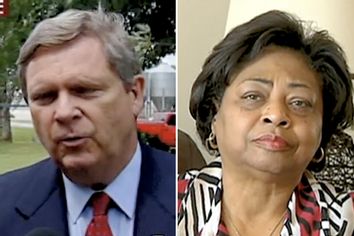
In the wake of the grievously unjust firing of Agriculture Department official Shirley Sherrod, it’s clear that agency head Tom Vilsack might be a hack, and he’s definitely a coward.
One day after Andrew Breitbart posted a truncated video of Sherrod’s allegedly racist speech before the NAACP, she was out of a job. If the White House pushed for her exit, as Sherrod claims, then Vilsack appears to have served as a diligent functionary in carrying out the task. If the decision was entirely his own, as Vilsack and the White House maintain, then he’s responsible for ending the career of a longtime farm-aid veteran based on an abbreviated video circulated by a discredited conservative provocateur. That level of rash gutlessness is not what you’d expect from a one-time presidential aspirant (even one who dropped out of the race 11 months before the Iowa caucuses).
If Vilsack’s decision to fire Sherrod was misjudged, his rationale for the termination was downright dishonest. In an interview with CNN, he explained his reasoning as follows: “When I saw the statements and the context of the statements, I determined that it would make it difficult for her to do her job.” He reiterated that his decision was based on Sherrod’s “statements and the context of those statements.”
That’s nonsense, of course. Vilsack’s decision to fire Sherrod ignored not only the specific context of her remarks but the larger, historical significance of her story.
As the full video of Sherrod’s speech makes clear, the “context of the statements” had nothing to do with racial bias against whites. The narrative in fact, is entirely the opposite: that, for a time in her life, Sherrod pledged to help “black people only,” but that following her efforts to save Roger Spooner’s farm — in 1986 — she realized that “the struggle is really about poor people,” not about race.
That’s the theme of Sherrod’s speech, one she hammers home repeatedly throughout her (extremely repetitive) 45 minutes at the lectern: “Working with [Spooner] made me see that it’s really about those who have versus those who don’t. . . . They could be black, they could be white, they could be Hispanic. And it made me realize I needed to work to help poor people, those who don’t have access the way others have.”
(And continuing: “Poor whites and poor blacks are in the same boat. . . . There is no difference between us. . . . God helped me to see that it’s not just about black people, it’s about poor people. . . . I’ve come a long way. I knew that I couldn’t live with hate . . . I’ve come to realize that we have to work together . . . we have to overcome the divisions we have . . . we have to get to the point where . . . race exists but it doesn’t matter.”)
So Vilsack’s claim that he reviewed the “context” of Sherrod’s remarks is simply a fiction. Just as bad is his cynical reference to the USDA’s history of discrimination as an excuse for Sherrod’s termination.
Some background: In the 1990s, African-American farmers brought a class action suit against the USDA, alleging that the agency had systematically discriminated against minority aid applicants since the Reagan administration disbanded the USDA’s Office of Civil Rights in 1983. The USDA eventually settled for about a billion dollars, and a subsequent suit was settled this year for another billion dollars (although payment is contingent upon an appropriation from Congress, which has not yet been forthcoming). The backdrop for Sherrod’s story, then, was the routine injustice faced by minority farmers as recently as 15 years ago, injustice which, in many cases, has yet to be remedied.
Vilsack referred obliquely to the agency’s historical troubles in his statement explaining Sherrod’s firing, alluding to “the sordid civil rights record at USDA.” But perversely, Vilsack offered this “sordid” record as a justification for Sherrod’s termination, explaining that an agency with racial problems can’t afford the appearance of racial bias — the appearance of racial bias evidenced, in Vilsack’s mind, by Sherrod’s speech explicitly decrying racism.
Vilsack’s contorted reasoning and the stench of unfairness around the whole fiasco guarantee that Vilsack will face a fusillade of criticism in the coming days. And justly so. He deserves scorn and more for being goaded into an irresponsibly hasty decision based on intellectually dishonest reasoning and incomplete facts. Breitbart’s blatantly flimsy (and demonstrably false) allegation of racism is another example of the right’s obsession, increasingly intense, with bias against whites.
But it’s also an unseemly example of Democratic panic in response to scurrilous racial allegations. It’s Breitbart’s role as an agitator to try and make trouble (this is, after all, the guy whose biggest mission is to prove that John Lewis wasn’t on the receiving end of racial epithets during the healthcare debates). It’s the Obama administration’s duty, though, to respond surgically to these attacks, not hack off a non-gangrenous limb. Vilsack’s willingness to be led by the nose by the most craven parts of the Republican base doesn’t speak well to his leadership skills, and his simultaneous slander of a subordinate says even worse.
If someone from the USDA needed to be excused from the USDA, it wasn’t Shirely Sherrod.
Continue Reading
Close
When Rep. Steve King said a few weeks ago that Obama “favors the black person,” public attention paused briefly before quickly moving on. There is evidence, though, that the Obama administration might not be as quick as the general public to disregard claims of race-favoritism. In fact, the Obama Justice Department’s challenge to the Arizona immigration law filed on Tuesday suggests that sensitivity to claims like those of King may exert a strong influence on administration policy.
The government’s complaint in the Arizona case, which challenges the law commonly referred to as SB 1070, asserts repeatedly that the law frustrates the federal government’s ability to implement national immigration policy. (In legal parlance, the argument is that federal immigration law “preempts” state statutory enactments.) Entirely absent from the government’s argument, though, is any claim that the law encourages officers to racially profile Hispanic residents and violate their Fourth Amendment protection from unreasonable searches — the aspects of the law that many people find the most objectionable.
That’s surprising, because a preemption argument is unlikely to fell the most controversial provision of the law: the requirement that officers investigate the immigration status of any person they reasonably suspect is in the country illegally. The government’s lawsuit argues that this mandate impermissibly burdens the federal bureaucracy, but it’s hardly intuitive that verifying immigration status with federal officials would thwart the goals or policies of the feds. (To the contrary, federal law specifically authorizes state officers to verify immigration status with the federal government.) In contrast, the notion that that the law foists raced-based decisions on law enforcement officers offers both a more compelling storyline and firmer legal ground.
The government’s focus on preemption makes even less sense when you consider the (largely accurate) perception that the government has abdicated its responsibility to legislate in the area of immigration. Does anyone look at the patchwork of federal immigration law, sporadically enforced, and think that it represents the well-considered judgment of Congress and the president, to which all fifty states must defer? Probably not, which is likely part of the reason that the Ninth Circuit in 2008 rejected a preemption challenge to another Arizona immigration law. It’s also probably part of the reason that the ACLU, in its own challenge of SB 1070, made many arguments that the law infringes a variety of constitutional rights, all of which are missing from the Department of Justice suit. (The ACLU’s press release heralding its suit labeled SB 1070 “Arizona’s racial profiling law.”)
This might be enough to make you suspect that the Justice Department’s preemption-only strategy is not the result of pure legal analysis. Instead, it seems that the Obama administration is walking a fine political line — attempting to please the left by challenging a much-despised law while avoiding the firestorm that would result if the challenge were grounded in race. By omitting from the suit any suggestion that the Arizona law unfairly targets Hispanics or other minorities, Obama and the Justice Department withhold from Steve King and his ilk ammunition for the claim that the administration holds special solicitude for minorities. (Or, in Glenn Beck’s phrasing, that Obama has a “deep-seated hatred for white people.”)
When you consider the host of race-tinged episodes faced by Obama and his team, from the nearly catastrophic (Jeremiah Wright) to the comically mundane (the Skip Gates beer summit) to the largely under-the-radar (the Black-Panthers-at-the polling-station case), the idea that racial politics has influenced the Justice Department’s legal strategy seems credible. After seeing his presidential ambitions nearly incinerated in the flames of race after the Wright tapes surfaced, Obama seems reluctant to place his hand back in the fire. An accusation that SB 1070, favored by a large majority of white Arizonans, amounts to state-sanctioned racism would throw Obama directly into racial debates of the type he has assiduously sought to avoid.
Conventional wisdom holds that this is a smart political strategy — that when a president claims racial unfairness, it better be unfairness to whites. (See Ronald Reagan and “welfare queens,” Bill Clinton and Sister Souljah.) But it’s difficult to see how it makes good policy. It may be beneficial to Obama, politically, to have the Congressional Black Caucus criticize his inattention to the plight of unemployed African-Americans, but it’s hardly good news for anyone else.
The same holds true for the Justice Department’s decision to scrub its challenge to SB 1070 of any racial references. The government may have avoided a politically costly public discussion on race, but it also neglected to throw the weight of the presidency behind the claim that the Arizona law sanctions racism. The missed opportunity is especially surprising coming from the office of Attorney General Eric Holder, who famously declared that America was a “nation of cowards” when it comes to matters of race. He was, predictably, excoriated by conservatives for the proclamation, which may in part explain his reluctance to raise racial issues in the government’s papers. That might be the politically expedient course, but it falls far short of the standard for civic bravery that he set for himself and for us.
James Doty is a writer and lawyer in New York City.
Continue Reading
Close
Since the days of Barry Goldwater, the idea that ordinary, law-abiding Americans are culturally and physically besieged has been a central tenet of the conservative belief system. Today, this notion animates the loose confederation of groups known as the Tea Party, whose members seem to harbor an inchoate sense of rage against intellectual, East Coast elites, along with a belief that the American way of life is faced with some kind of unspecified existential threat.
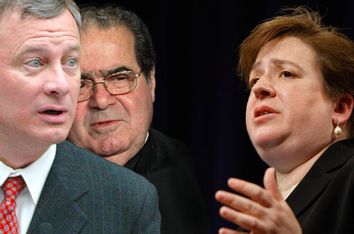
On Monday, these views found an echo in a surprising place: the Supreme Court, where Justice Samuel Alito is quickly becoming the Tea Party movement’s most prominent judicial face.
In his most significant opinion to date, Alito wrote that an individual’s right to bear arms cannot be abridged by states or cities. The ruling, which was decided 5-4, reads less like a technical legal analysis than a paean to guns as a guarantor of all other rights: “The right of the citizens to keep and bear arms has justly been considered as [the primary protector] of the liberties of the republic” because it “offers a strong moral check against the usurpation and arbitrary power of rulers.”
In less clinical terms, the idea is that a government is less likely to violate your rights if it knows that you might shoot its representatives. Or, as Sharron Angle, the Tea Party-backed Nevada GOP Senate candidate, put it in a radio interview several weeks ago: “Our Founding Fathers, they put that Second Amendment in there for a good reason, and that was for the people to protect themselves against a tyrannical government.” (She added that she hoped that “Second Amendment remedies” wouldn’t be necessary.)
That notion is troubling as the central premise for any piece of legal analysis, but even odder is the narrative that Alito tells to support it, a story that relies almost exclusively on the horrors suffered by African-Americans during Reconstruction. In Alito’s tale, the popular consensus after the Civil War was that the way to safeguard the freedoms of African-Americans was to grant them gun rights. Not to pass more rigorous legal protections, not to deploy the muscle of the federal government to see that federal rights were being respected, but instead to give African-Americans guns so that they could shoot their oppressors.
Embedded in this historical scholarship is a Tea Party-approved lesson that firearms are needed because of a government that is feckless at best and dictatorial at worst. In the minds of most people, those might be statements of unfortunate historical fact; in Alito’s apparent view, the threats from government and general lawlessness are sufficiently imminent and grave that they justify applying today the lessons from the most violent time in American history.
Other portions of the opinion betray a Tea Party-esque concern that American values are at risk of subversion by foreign influences. At one point, Alito remarks somewhat peevishly that the only relevant question is whether a particular right is fundamental to “our scheme of ordered liberty and system of justice,” not whether it exists in any foreign society (emphasis Alito’s). At other points he stresses the exclusive importance of “American tradition” and the “American perspective.” This judicial concern resembles the political anxiety, borne on signs at Tea Party rallies from coast to coast, that Obama and a Democratic Congress are attempting to remake America in the image of Western European (or, even more fantastically, Leninite Russia).
In a separate opinion also released on Monday, Alito likewise adopts a common pose of political conservatives: a peculiar notion of victimhood where aggressors become the aggrieved. That case held that a law school was within its rights to deny recognition to a student organization, the Christian Legal Society, that refused to accept members who engaged in “unrepentant homosexual conduct.” Alito, dissenting, wrote that the real victim was the Christian student group, which was being punished by that conservative bête noire, the “prevailing standard of political correctness.” Where others saw an evenhanded attempt to enforce a non-discrimination policy, Alito saw a belief system under attack. (In another case from this term, Alito showed concern for the signers of a Washington state anti-gay-rights referendum, who could, if their names were disclosed, suffer the same “widespread harassment and intimidation suffered by supporters of California’s Proposition 8.”)
None of this is to say that Alito is in any sense a political hack. (John Paul Stevens, for example, called his opinion in the gun rights case “careful and scholarly.”) In many ways, Alito has gotten a bad rap, which the “Not true” flap has not helped. He is as analytically rigorous as anyone on the court, less caustic than Antonin Scalia or John Roberts, less prone to jurisprudential wackiness than Clarence Thomas, and more genuinely modest — judicially, at least — than any of the three. He is, though, more apt than his conservative brethren to let the language of the current political patois leak into his opinions. That voice (today, anyway) belongs to the Tea Party, a group to which Alito, as an older, Republican, married, and well-educated white male, is well-suited, demographically. And though it’s uncomfortable to see the mantras of a fringe group echoed in significant rulings on constitutional rights, it is a helpful reminder that the utterly neutral arbiter of the law, the umpire in John Roberts’ metaphor, is mostly a legal fiction.
Continue Reading
Close
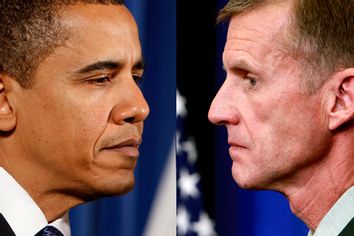
As Stanley McChrystal takes the long walk to the principal’s office, many commentators have suggested that the president shed his image as a cerebral waffler and bring the short, unhappy tenure of General McChrystal to an end. This would, according to some, show the kind of firm, decisive leadership often associated with Truman’s dispatch of MacArthur, or Bush’s impromptu remarks to the 9/11 cleanup crews at the site of the World Trade Center.
Let’s hope that Obama is not persuaded by such patently silly advice. It is an idée fixe of some political commentators that Obama should parlay every presidential dilemma into an opportunity to show “true leadership.” But judging Obama’s presidency by whether he’s displaying the right emotions (resolve, toughness, and anger, to name a few) gives an unintended and entirely superficial meaning to the phrase “presidential performance.”
John Kerry seemed to understand this yesterday when, in a futile attempt to douse the emerging firestorm, he said, “Everyone needs to take a deep breath and give the president and his national security team the space to decide what is in the best interest of our mission.”
That is, of course, an eminently sensible approach to the McChrystal flap. The idea that the president’s decision would be based on anything other than McChrystal’s ability to implement Obama’s Afghanistan strategy betrays near-Nixonian levels of political cynicism. Can anyone seriously suggest that the president dismiss the commander of U.S. and NATO forces in America’s longest-ever war, based on sassy comments in a magazine article, because the optics would be good?
Even if he were so inclined, any attempt by Obama to use McChrystal’s departure to burnish his leadership credentials would likely fall flat. One of the central themes of Obama’s tenure has been the return of the presidency to adult hands after many years of petulant and impulsive leadership. Obama has stuck with his restrained, sober, analytical governing style through the tumultuous 18 months of his presidency (even when various corporate villains have provided tempting opportunities for him to raise his voice and stomp his feet). This is, after all, the man who waited to enter the congressional healthcare debates, waited to take public ownership of the BP fiasco, and waited . . . and waited before ordering an additional 30,000 troops to Afghanistan. Does he really want to send the message that the one thing he can’t abide, the one thing he will not brook, is calling the vice-president “Senator Bite Me”?
And assume, contra this reasoning, that Obama’s firing of McChrystal were greeted as a rare display of political backbone. There’s little indication that the message would resonate beyond the chattering class. Nearly nine years in, the war in Afghanistan is barely the subject of notice, let alone the locus of intense popular attention. (It’s not for nothing that the most talked about Afghanistan article in recent months involved mineral deposits.) It hardly makes sense for Obama to make empty gestures to an empty crowd.
Worth noting, too, is the fact that any boost to Obama from McChrystal’s firing is likely to be short-lived. The war in Afghanistan is not, after all, a subject that lends itself to flashy displays of symbolism. People may applaud Obama’s decision now, but if past is prologue, the situation in Afghanistan will remain fragile and messy for years to come. If that’s the case, Obama’s decision to dump McChrystal only months into the troop surge will look less like strong, principled leadership than the type of rash, gut-level, Bush-43-style decision-making that so many have grown to despise.
None of this is to say, of course, that McChrystal’s remarks should not be condemned. They should be, as should the atmosphere of disrespect toward civilian leadership that flourished among his aides. But after the rain of rebukes from Republicans and Democrats alike, and the ignominy of McChrystal’s walk of shame to the White House this morning, there’s not much to be accomplished by further punishment.
The message of civilian superiority to military brass has been conveyed and, one would think, received. Obama can shout that message even more loudly with McChrystal’s termination, but is the marginal benefit worth the host of practical problems that would flow from his departure? Certainly not if the benefit is the vindication of some vague principle of military “respect” for civilian command. And especially not if the whole exercise is merely to engage in a pantomime of leadership.
We can be forgiven for having an occasional weakness for big, grand gestures like Bush’s speech at Ground Zero. But we shouldn’t forget that Obama’s Afghanistan problem is an attempt to close a military conflict that Bush eagerly anticipated in his chest-thumping speech at the World Trade Center site in 2001. It’s worth remembering that next time someone tells the president to pick up a bullhorn.
Continue Reading
Close