Jennifer Sey

Why my coach got away with sexual abuse

A champion gymnast -- the first to blow the whistle on a national coach -- on why parents and athletes stay silent

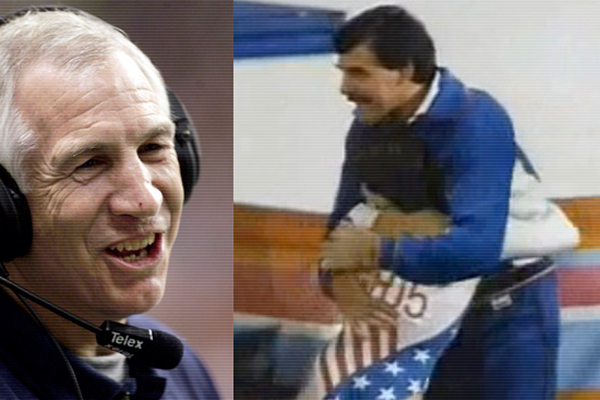
Jerry Sandusky, left. Right: Mary Lou Retton and Don Peters (Credit: AP/YouTube)

Disgust flows freely after reading each new story about Penn State. Why, we wonder, would someone willingly ignore reports of heinous sexual abuse of a child? Why would someone as “good” as Joe Paterno brush aside the alleged despicable and predatory actions of a coach on his staff, a coach representing his Nittany Lions? By all accounts, Paterno was the hero coach, a model of highly invested and supportive team building, a molder of men, a teacher and a mentor. As a thinking, feeling adult, it seems so obvious what the right choice would be. Report Jerry Sandusky to the police. No matter what.

So why are good people likely to do not so good things? Well, in the microcosmic world of hyper-competitive athletics, a high-performance culture where winning trumps all, obvious moral choices become blurred. The sport, the team, a berth on the squad, a medal on the stand – that becomes the priority. The parents, coaches and teams put everything else aside in honor of the win.  I know this firsthand.

I was the 1986 national champion in gymnastics. I competed on broken bones, with black eyes, and went days without food. I broke my femur and had the cast removed more than a few weeks too early so that I could get back to training in time to compete at the U.S. Championships. I broke the opposing leg’s ankle in the process — but I competed and won. Two bum legs, but I got the trophy. There was never any question about what I’d do. Long-term damage didn’t matter. My mental and emotional health didn’t matter. Winning did.

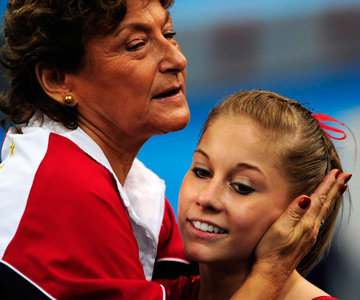
During this time, I met Don Peters, the coach of the U.S. national team and the head coach of a Southern California private club called SCATS. He was personally responsible for producing scores of national team members. And as the 1984 Olympic coach, he led that team to silver-medal glory and a record eight medals, including Mary Lou Retton’s gold medal in the all-around.

Peters was revered. He was a legend in our sport, even if he was relatively unknown to the outside world. And within some corners of the team, he was rumored to be involved with one of the gymnasts at his club, Doe Yamashiro, one of my teammates on the national squad. I first wrote about it in my 2008 memoir “Chalked Up: Inside Elite Gymnastics’ Merciless Coaching, Overzealous Parents, Eating Disorders and Elusive Olympic Dreams.” Earlier this fall, Yamashiro said publicly that Peters began fondling her in 1986, when she was just 16, and began having sex with her when she was 17. This week, USA Gymnastics permanently banned Peters from coaching and kicked him out of the sport’s hall of fame.

Some of us whispered about it at the Goodwill Games in 1986. Doe was with Peters all the time. She was shy and he kept her away from the rest of the team. She didn’t hang out with us in between practices, doing girly things like makeovers and diet soda binges. He squirreled her off to some private place. We wondered what happened when they were alone. I recall mentioning it offhandedly to my parents and other coaches at the event. Everyone waved it off. I almost giggled about it when I said it, so perhaps my revelation was not to be taken seriously. But it made me so uncomfortable, how else was I to share it?

As I wrote in the book, “It got to the point where we all joked about it. ‘Where’s Doe?’ one girl would say, and we would all fall into a pile in fits of laughter. Nobody asked Don, ‘What’s going on here?’ Everyone just let it happen.”

Looking back, I was hoping someone, anyone, an adult with some common sense would have done something. But no one did. And the effect on me was: You girls don’t matter. He does. Because Don Peters creates winners, and that is the most important thing.

And so, despite the fact that I wasn’t sexually abused, the insidious effects of a culture that allowed it, are salient to me. You learn not to trust your own experience. Maybe I’m wrong? Maybe it’s fine. Everyone else seems to think it’s OK. If I am good, this won’t happen to me.

Morality viewed in the funhouse mirror of elite athletics is grotesquely distorted. And the distortion becomes invisible after a time. A parent or coach might say: What if the reports aren’t true? It would be unthinkable to ruin this great man’s reputation. Oh, and by the way, he might not let my daughter/gymnast compete in the next big meet if I implicate him in such ugliness. This all-powerful man will strike back and my daughter/athlete will suffer. We’ve worked too hard. Let’s let it slide.

So it slid for almost 25 years. Until this week, when Peters was issued that lifetime ban. More than 20 years later Doe Yamashiro  found her courage, stopped believing that she was somehow complicit, or that maybe it wasn’t that big of a deal.

She told her story to the Orange County Register, and USA Gymnastics, the governing body for the sport, responded. They investigated and held hearings. Peters resigned his coaching positions, but the sport still expelled him for good. It took this long because those of us in the sport were enthralled by his power. And the same might have been true of Paterno. While he didn’t commit these alleged acts of abuse, he did run the legendary program. No one wanted to mess with that. Even now, students remain in his thrall, protesting his firing – because he made winners.

Pediatricians and other healthcare workers are required by law to report any suspected abuse of children. They can lose their licenses and their livelihoods if they fail to do so. Teachers are held to a similar standard. So why aren’t coaches? They spend more time with the kids they coach than doctors or schoolteachers. I spent up to eight hours a day with my coaches. But coaches somehow exist outside the laws of child protection.

The solution needs to be legally mandated guidelines for coaches of minors. If the guidelines are violated, legal action must be taken. And the guidelines must specify that other member-coaches are required to report suspected abuse to child protective services. Adults cannot be compelled to “do the right thing” when there are wins at stake. They must be required to do so.

And child athletes must be encouraged to speak up when there is abusive or questionable behavior from a coach. All too often an athlete in this sort of relationship feels powerless. He questions his own rights, his own take on the experience. He is beguiled by the coach in hoping for that all too critical break — the spot on the team or an extra hour of one-on-one training. So enthralled, the athlete is unable to come to his own defense — and the lingering effects will last a lifetime.

Parents must demand regulation that has real legal implications — not just a ban or a firing. The good coaches need to come to the defense of their beloved sports by requiring that the “bad coaches” be held to task in the eyes of the law. And we all must insist that coaches are teachers of children first, and champion builders a far, far distant second.

Athletes are just people

The outrage over Usain Bolt's chest-pounding proves that we expect athletes to be heroes -- and when they're not, we turn on them.

I’ve been pondering the dust-up over Usain Bolt’s record-breaking, chest-pounding, no-effort waltz across the 100-meter finish line since he did it a little over a week ago. As I watched the event, I screamed out loud, swept up in his joy and the sheer superiority of his athleticism. I love that he had one shoe untied as he slapped his chest before he even crossed the finish line. I love that he had a belly full of Nuggets at race time. And I love that he enjoyed himself before, during and after the race. The audacity!

I do not share Bob Costas’ view that Bolt’s gesture was disrespectful to the other athletes as well as to the fans who came to see the best possible performance. If that wasn’t the best possible performance a sprinter could put on, I’m not sure what would be.

Was he gloating? Perhaps a bit. Should he have? Why the hell not! He’s the fastest man alive and he was barely trying.

I think the reason that Bolt’s exuberant behavior has produced such exaggerated outrage is that we expect our athletes to be superheroes. We engage in idol worship, demanding that these mere earthlings fulfill our communal hunger for picture-perfect symbols of humanity. We require our athletic champions to do no wrong — on the field and off. If they fail to live up to our grandiose expectations, we turn on them.

Politicians disappoint us. They cheat on loving wives sick with cancer, they’re on the corporate dole, they renege on promises, they compromise. Corporate titans do the same. They steal the 401Ks from their employees to throw lavish parties and deride workaday plebes as unenlightened, stupid toilers.

In today’s America, heroes are in short supply.

Thus we have come to rely on athletes to fill this primal craving, this need for awe-inspiring, larger-than-life illustrations of humankind. So that we can believe in ourselves. But really, athletes are just people. They are faster, stronger, more physically courageous and willful than most of us. But like the rest of us, they are full of all-too-human foibles — weakness, egotism, sorrow, uncontained joy, anger, fear, regret and even a little spite at times.

Marion Jones took steroids. She’s a cheater. 2004 gold medalist diver Laura Wilkinson broke into a bighearted, generous smile when she failed to medal. She’s a real winner with a heart of gold! Mike Tyson bit off part of Evander Holyfield’s ear during a fight. He’s an animal! Surprised? He beats his opponents’ heads in for a living. Is it really shocking that he has trouble controlling his rage at times?

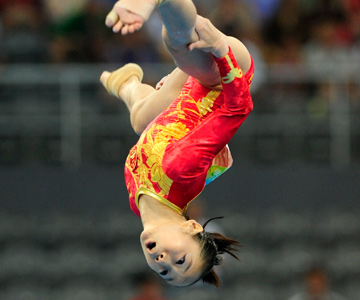
Costas disapproved of Bolt’s midrace behavior. But one could regard Shawn Johnson’s constant avowal that she trains for only four hours a day, while her competitors all train twice that, as a similar affront. Her confession before and after the meet, which appeared in every media outlet known to man, could be construed to reek of arrogance. She’s better than all but one of the competing Olympic gymnasts and she puts in half the training time, half the effort. It must make those poor little underage Chinese girls feel just awful about themselves. They train 10 hours a day, see their parents once a year, and the best any one of them could muster in the all-around was a pitiful bronze. And what about Alicia Sacramone? She hung in there after missing the Olympic team in 2004, trained long grueling hours — and fell twice in the team finals. Ms. Johnson should stop showboating, cease the constant yammering about her languorous, halfhearted training schedule. She’s making the other girls feel bad!

I have no issue with Shawn Johnson talking about her training schedule. And I fully understand why it is discussed so relentlessly. The USA Gymnastics machine is countering the negative press out there about gymnastics — the injury rates are sky-high, the girls are generally very young when they engage in brutally rigorous training schedules, eating disorders are alleged to run rampant, these children train on broken bones and feel the pressure of being their coaches’ second chance. Not Shawn Johnson, though.

Good for her, and I truly mean that, with absolutely no sarcasm whatsoever. I am merely drawing a comparison. Costas took no issue with Johnson’s bragging about her moderate training schedule because it made her more superhuman, not less. It fed the myth of the athlete superhero. And on top of her athletic prowess, she acts like a gracious, dignified young lady, grateful for the silver medal, proud of her competitor Nastia Liukin. But Bolt’s gesture makes him less of a hero. He’s swift but arrogant, insensitive and gloating.

Usain Bolt may be faster than a speeding bullet but he’s not Superman. He’s just a guy. And I, for one, applaud when athletes show their humbling, mortal fallibility.

Continue Reading Close

Chasing the dragon

For young stars like Shawn Johnson and Lolo Jones with their whole lives ahead of them, the Olympics are a tough act to follow.

After Shawn Johnson won the gold medal on balance beam, Bob Costas asked her if she planned to continue until 2012 for the London Olympics. She responded by saying, in effect, that she’d had such a wonderful time, the experience had been so emotionally extraordinary, that she’d do anything to get that feeling back. Yes, she’d like to continue until 2012. She’d be willing to endure pain, injury and punishing hard work to get there, to relive the brilliance of Olympic gold.

That winning performance now defines her. She will forever be introduced as “Olympic gold medalist Shawn Johnson.” By her own admission, she will “chase that dragon” for the feeling of splendor. The chasing may last longer than she can fathom at the tender age of 16.

When Lolo Jones fell on the track, tangled up on the second to last hurdle in the women’s 100M final, she crashed face down and screamed in anguish upon dragging herself across the finish line. She, too, is forever defined by a moment. While we may have gasped in disappointed momentary horror — her 7th place finish standing for everything we may have failed to deliver in our own lives or simply in empathy of defeat — she will inevitably be haunted by it for some amount of time that is considerably longer than a moment. Perhaps, in some way, forever.

Jones will always be able to reach back to that fall, feel her front foot against the hurdle, her knees against the track. It will bring a rush of shame and lost chances each time. She will likely get better at brushing it aside, but it will always reside within her, a deep and cruel sense of “I was deficient when it mattered most.” And every time an Olympic “sure-thing” competitor fails to deliver, the clip of Lolo will be shown. The commentators will say, “remember when,” throwing devastating disappointment in her face, yet again.

These two young women are changed forever.

Shawn Johnson will forever feel tremendous pride. She may also ceaselessly search for that twinkle of transcendence, as she’s known a sense of climactic accomplishment that most will never get close to. It’s a blessing, to be sure, but perhaps, over time, it can come to feel like a curse.

Let’s say that she continues training and endures through injury and maturation to make the 2012 games. There are a few ways it could go. She could indeed recapture some of the glory, perhaps even winning more medals and more fame. She could be a double gold medalist, instead of just a single one. She’ll retire. Then how to get that amazing feeling again? In everyday life, how will she experience that transformative moment of glorious victory that she could easily become addicted to in order to feel alive?

Or, Johnson could qualify, go to the 2012 games and win no medals. She’ll be done with gymnastics but at the start of her life. Her final moments in the sport will have been far less joyous than those in China but no less consequential. And she’ll be left with a bad taste in her mouth, having to sidestep the losing routines in her mind when she finds herself searching for the glory days of her youth.

Or, worse yet, she could train and not qualify, her shining abilities eclipsed by those younger, sprier, healthier. Again, left with that sticky, lingering bitterness that will forever require an emotional breath mint to obscure the disappointment. This is not the worst thing in the world; I know this. There are starving children everywhere, the earth is going to hell in a handbasket. But it’s something I think about nonetheless. What happens after gold? Or after an Olympic berth with no gold to show for it?

Then consider Lolo. It’s not hard to imagine that she will try for 2012 so she can live with herself, that falling-down moment shoving her forward toward redemption. In a perfect world, there is salvation in the form of Olympic gold in London. But she’ll be 30 by then. It’s not impossible for her to continue, but can her body hold up? Can she get faster, stronger, better? What if she makes it and screws up again? Whatever happens, this stumble defines her. If she continues, the fall is why and pushes her every day. If she doesn’t, it sits there in her gut, easily recalled when a track meet is on television, when someone recognizes her, when she is prompted to admit she was in the Olympics. “Did you medal?” “No.” Ugh.

Being defined by a single accomplishment, a fleeting juncture, is a mixed blessing. An athlete will forever be celebrated for that moment if it is a triumphant one. In her heart of hearts, she may always wonder how to get it back. Unless she’s so well-adjusted that she can just go about her normal old life and remember the glory days with a nostalgic but not painfully wistful smile. If the moment is less than exultant, an athlete may forever be haunted by it — always searching for how to recover, to recoup the loss of possibility. It won’t be salient all the time, but it will clog her thinking, make her catch her breath, now and again. A horrific déjà vu that repeats itself when life is difficult.

There are far more horrendous things than failing to deliver a gold medal and I’m sure many of you are thinking: Who cares?! Stop being so melodramatic! But it’s hard not to consider the singularity of this kind of moment in a young life. What’s next when a flash of speed and youth has determined who you are? A gleaming success. A miserable loser. Either way, it is etched into the psyche. And it’s a tough act to follow.

Continue Reading Close

Fool’s gold

The real question to ask after Liukin and He's routines: Why can't there be a tie?

By now, we all know that China’s He Kexin narrowly won the gold medal on uneven bars, with Nastia Liukin securing the silver, after a double tiebreaker involving a highly complex set of rules put in place by the International Gymnastics Federation at the request of the IOC, clearly laid out by King Kaufman in perfect detail.

The debate about which gymnast had the better routine is moot. Those claiming that Liukin’s was clearly better because she stuck the dismount shows little understanding of where other, less conspicuous deductions can come from. It isn’t always the obvious step or the fall that begets a few tenths off. A few degrees shy of a handstand, a barely visible leg split or “cowboy tuck” on the dismount (knees separated to build acceleration) can also warrant points off. In fact, it could be argued that Shawn Johnson benefited from judges’ overlooking executional deductions each time her split leaps were short of 180 degrees, thus facilitating her silver in the all around. I don’t agree. But I’m confident that there are many proponents of grace and artistry in gymnastics that put forth this point.

Some of these types of “mistakes” can be easily missed, even by experts, depending on the angle, the inadvertent blink of an eye. And, of course, they can be purposely overlooked or exaggerated, depending on the integrity of a judge, a disappointing reality within gymnastics.

But this is an aspect of the sport that those who have grown up in it come to accept, though never embrace. Like ice skating and diving, gymnastics is a judged competitive endeavor. There is always the possibility of human error. Or human foible. It can go the athlete’s way as often as not, evening the scales in the long run.

And just because judging is involved, it doesn’t make this event any more or less of a sport, as many of the commenters claim. A sport by definition is a competitive activity in which physical exertion is involved. Gymnastics is most definitely competitive and the athletes’ exertion is unquestionable.

The new scoring system is an attempt to make things as impartial as possible, providing two marks — one for difficulty, one for execution — and adding them together. Though clearly, it removes little of the debate about executional deductions. At the end of the routine, a judge has to decide where the flaws were. Though she is well trained, she is human.

For the recreational viewer, not catching the shortfall or tilt on a handstand let alone how difficulty levels are calculated (there is no way of knowing unless you study the code of points; the viewer must simply take Tim Daggett’s word for it), the conversation about which girl was more deserving of the gold is a pointless conversation to have. And to cite the non-objective American team coordinator or Liukin’s coach — her father — as proof that Liukin deserved the gold, is clearly not adequate defense. I’m certain one could find many a Chinese commentator or coach that could argue for He’s deservedness.

When watching NBC’s airing of the event, Al Trautwig asked Tim Daggett with flaunted disbelief if the pint-size He could actually believe she won the gold. Of course she believes it, it’s around her neck. Just like Liukin would have believed it had it been around hers. Though He’s coaches would surely have felt and perhaps argued that their girl was robbed.

Because Liukin missed out on gold by .033, a shortfall arrived at when an additional low score was dropped as a tiebreaking mechanism, it can hardly be said that He Kexin was markedly better. Though arguably as close of a call as Phelps’ one-hundredth of a second win in the 100M butterfly, it is harder to swallow because a photo finish doesn’t solve it with any resolution. Phelps quick half-stroke that won him the gold can be verified. He Kexin’s .033 victory cannot, even by those ardent American fans that are absolutely convinced that Liukin’s routine was obviously better.

The real question is: Why can’t there be a tie? “Real sports” have ties. There are ties in soccer. After overtime is completed, if the scores are still the same, a tie is declared. Though I’m no expert, I imagine a tie in track is possible if each sprinter actually crosses the finish line at the exact same time. Though hard to fathom, it is possible that two girls could achieve the exact same scores. Perhaps one had more difficulty, another was more perfect. In the case of He and Liukin, they had equal difficulty scores. Their deductions came in different ways, minuscule missteps barely visible to the naked eye delivering tenths off here and there.

There are legitimate ties in other sports and there were ties in gymnastics up until 1996. And there are ties in the World Championships. Why then is it not possible to be equal in the Olympics? What is the IOC hoping to achieve in eliminating the tie?

Is it somehow less exciting if two girls stand atop the winner’s podium? I don’t think so. Still pretty darned exciting. Is it somehow less fair? More fair, I’d say.

Continue Reading Close

33 and fabulous

The most astonishing event of the women's individual gymnastics event finals was turned in by a 33-year-old mom.

The most shocking moment of the women’s gymnastics individual event finals was not when Romanian Sandra Izbasa beat favorite and reigning world champion Shawn Johnson out of a gold medal on floor exercise. Though Johnson’s routine had a higher start value, Izbasa’s was executed more flawlessly, gleaning her the top spot.

The most shocking moment was not when Johnson, who seems impossibly good natured and robustly charming, was once again grateful for silver.

“The scores, the placements, they don’t matter to me anymore. I’m having the greatest time of my life. I just want to go out there and have fun and just show the world I can be the best I can, no matter what,” she said.

Ara Abrahamian, the Swedish wrestler stripped of his bronze medal for throwing it down in anger over a disputed penalty call in his semifinal match, could learn a thing or two about sportsmanship from this 16-year-old Iowan.

And, though surprising, Anna Pavlova’s receiving a zero on her second vault because she failed to wait for the green light was not the most dumbfounding moment of the women’s event finals.

The most outrageous happening, by a long shot, was when Oksana Chusovitina won the silver medal on vault at 33 years of age. It was Chusovitina’s fifth Olympics, and first for Germany. She formerly competed for Russia as a native Uzbek, but moved to Germany so that she could secure medical treatment for her son after he was diagnosed with leukemia.

Much has deservedly been made of Dara Torres’ outstanding performance at age 41. If 41 is old for a swimmer, 33 is ancient for a gymnast. Chusovitina competed in her first Olympics at 17 years of age in 1992, winning a team gold. This was the year that Shawn Johnson was born.

Thirty-three is mature for any Olympic athlete. Sports are generally the purview of the young and unbroken. But gymnastics is a particularly cruel endeavor, ejecting many mortals as well as champions from its chalky training venues before high school graduation tolls. A recent study published in Pediatrics Magazine indicated that 425,000 children sustained injuries from gymnastics that were severe enough to send them to emergency rooms between 1990 and 2005. And, according to the Nationwide Children’s Hospital in Columbus, Ohio, this number likely understates total gymnastics injuries, since it only includes those severe enough to require an E.R. visit.

The brutality of the sport was acknowledged when Liukin and Johnson were asked by Bob Costas after their medal-winning performances in the all-around if they planned to stay in the sport until the London 2012 Games. They responded by saying, “If our bodies hold up.”

I haven’t heard any teenage swimmers wondering whether or not their bodies will last until the next Olympics. Dara Torres was 17 when she competed in her first games and won gold and she was considered to be something of a prodigy. It was expected that she would go on to compete in another Olympics.

Former World Champion Chellsie Memmel had a disappointing competition in Beijing. She could hold out for London if she felt the need for redemption. But at 20 years of age, having competed on a broken ankle in these games, she’s all but stated that this was it for her. Mary Lou Retton retired less than two years after she won Olympic gold in Los Angeles at age 16. Not yet 20, she was packing it up for the old-age home with a single winning Olympics under her belt.

It is an amazing feat to compete in the games. To compete in five is unfathomable. To do so at 33, in a sport that can be said to eat its young, is downright superhuman. Chusovitina’s feat is nothing short of heroic. She is a mother who has won her first Olympic individual medal while nearing her mid-30s. She is a grown woman in a girl’s sport, and she has proved that age is indeed just a number.

Continue Reading Close

Watching Nastia’s gold and Shawn’s silver

As a former elite gymnast myself, it's hard to watch Olympic competition. But then Nastia Liukin and Shawn Johnson blew me away.

My post from the other day, “The Beast,” was my teeny-tiny effort to reveal something honest yet a little bit ugly in my not altogether black soul, not, as widely perceived, an aggressive attempt to insult every amateur athlete who reads Salon. Nonetheless, I took the feedback seriously and decided to watch the women’s gymnastics final with actual people, in an effort to take the kindly offered advice of the commenters and get over it. I settled in with a close friend and my oldest son, age 8, by my side, as I made an attempt to exorcise the foul stench of self-righteousness and put all that therapy to work, once and for all.

We settled in. My son to my left, close friend to my right. The marquis event was preceded by an inordinate amount of women’s beach volleyball, endless swimming and occasional dozing by the three of us. But coffee and pistachios kept us going in the marathon wait for Nastia Liukin and Shawn Johnson. There was plenty of time for chatter while awaiting the main event.

In the long run-up to the 11:30 p.m. start time, I decided that I was pulling for Liukin in a desire to see grace count for something in this sport again. I didn’t really believe she could pull it off, but I rooted for her just the same. She fell behind on the first event, vault, crippled by a lower start value on her one and a half twisting Yurchenko, despite what looked to be flawless execution.

Close friend who shall remain nameless, lest she be criticized for being kind to beast, didn’t care. She thought the whole thing was boring, which I can’t quite wrap my head around. She made a few snarky comments with accompanying demonstrations of the weird gymnastic-y “dance” moves that can resemble a Nazi goose step. I suppose I hadn’t really put myself up to much of a challenge after all, watching with these two.

Johnson was in the lead after the vault. She took a single step to the side after her two and a half twisting Yurchenko, the highest-start-value vault of the competition, and my son asked, “Can you do that, Mommy?” I explained that Mommy doesn’t belong in the same room with that child. He nodded all too knowingly.

The 16-year-old Johnson was magical, undeniably perky and nearly perfect throughout the night. NBC’s slightly overdone tales of her normalcy were utterly convincing, and her sweet and supportive coach, Liang Chow, deserves a medal of his own for raising such a seemingly lovely young lady while training one of the very best gymnasts in the world. Liukin was markedly withdrawn, digging down deep for the upset she knew was possible. Her father and coach, Valeri, watched sternly from the sidelines. My friend piped up, “I’m not sure about that dad coach thing. If she doesn’t win, will he comfort her as a dad, or show disappointment as a coach?” Good question.

We were all getting along famously. I wasn’t even irritable. Until Elfi Schlegel’s, Tim Daggett’s and Al Trautwig’s droning voices and grating commentary put me over the edge. The constant criticism over every barely visible “balance check” on the balance beam, every horrified “that’s a big step,” every in-depth perseveration over whether a move was connected enough to get an extra 10th in start value on the balance beam. They never stopped talking. Daggett and Schlegel almost seemed to bicker over the wobbles on dance moves. Then Trautwig would inevitably say something incomprehensibly inane like, “If you could allow yourself to think [about being in the Olympics], it could be daunting.” Ya think? Or, my favorite, in reference to the Chinese competitors, he said something to the effect of “send them in to ruin the American dream.” Wow. And his crowning glory, when they cut to Mary Lou Retton in the audience: “How about a perfect 10 lady!”

Less talk would have been better. Perhaps a bit of information about the skills these girls performed, what it takes to learn them, where the dangers lie. I suppose getting too technical about the tricks could get boring. But then maybe silence would have been the best policy. Certainly three commentators were too many.

By the time the final event came around, I was cheering for Nastia while praying for it all to end (it was 12:45 a.m.). My son and friend were sound asleep. And Trautwig had officially worn out my patience.

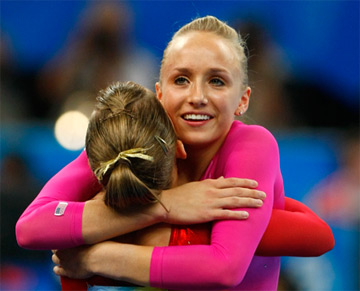
And then, in the second-to-last routine of the aired competition, Liukin came through with a floor routine that showcased her ballerina poise and well-concealed but explosive power. She won by more than a half point. Her face cracked with emotion for the first time during the entire competition when Johnson’s score — the final score of the competition — was flashed and she realized she’d won. Johnson was second, and in a display of unmatched dignified maturity and generosity, she approached Liukin, tapped her on the shoulder and gave her a heartfelt hug. These two were something to be proud of.

And I did OK as far as keeping the beast under cover. My difficulty wasn’t nearly high enough but my performance was pretty good. No overt outbursts or even internal struggles. I’ll have to give myself a bigger challenge next time with provocative viewers who might push my buttons. That’s when I’ll really have to prove my own nerve and character. I’m hoping to show a mere fraction of the grace under pressure that Liukin and Johnson showed to take the No. 1 and No. 2 spots in the women’s individual all-around competition.

Continue Reading Close

Page 1 of 3 in Jennifer Sey