Mandy Van Deven

Secrets of the sperm bank

What do we want from a donor? An expert explains the hidden dynamics of the fertility industry

(Credit: iStockphoto/ignasi_martn/Salon)

Since the economic downturn, a growing number of Americans have begun making money off their bodies. Since the recession began, the number of aspiring sperm and egg donors has surged dramatically in the United States. In 2009, some sperm banks saw a 15 to 20 percent increase in applicants, while, in 2008, egg agencies reported a similar rise — including, at one company, a 40 percent increase in wannabe egg providers. At a time when other industries are collapsing, the sex cell business seems to be doing well for itself. But what is it actually selling?

“Sex Cells,” a new book by Rene Almeling, an assistant professor of sociology at Yale University, pulls back the curtain on the egg and sperm market. She looks at the ways our cultural assumptions about gender roles influence not only the egg and sperm donation industry but also the people within it. As it turns out, egg and sperm donors have remarkably different experiences of the process. “Sex Cells” explains how this unique industry shapes the way we think about gender and parenthood.

Salon spoke to Rene Almeling over the phone about the strange rhetoric of the sex cell industry, which donors are most valued and what this says about the American family.

Egg and sperm donors are essentially providing the same thing, so why are they treated differently by sperm banks and egg agencies?

Egg agencies and sperm banks are both in the business of recruiting sellable donors who will attract recipient clients. But the details of how they go about doing this reveal the importance of gendered stereotypes in their day-to-day operations. For example, drawing on the stereotype of women as nurturing caregivers, egg agencies emphasize the plight of infertile couples so that women will want to “help” people by giving the “gift of life.” In contrast, sperm banks rarely mention recipients, and they encourage men to think of donation like a job.

One cheeky ad calls on them to “Get paid for what you’re already doing!” So the market for sex cells is structured both by traditional economic forces, such as supply and demand, and also by cultural expectations of women and men that are associated with reproduction and the family.

Are there biological explanations for the differences?

For most people, the first thing that comes to mind when I talk about comparing egg and sperm donation are biological sex differences. Women who provide eggs must self-inject fertility medications for several weeks before undergoing outpatient surgery. Sperm donors do not face any such physical risks, to say the least. But many people do not realize that sperm banks require men to donate on a regular basis, usually once a week, for at least a year. It costs a lot of money to screen donors, so sperm banks have to make sure that the tiny fraction of men who are accepted as donors will produce enough samples to make the investment worth it.

All that is to say that there are biological differences between women and men and there are technological differences between egg and sperm donation, but neither biology nor technology explains why producing eggs for money is a “gift” and producing sperm for money is a “job.”

How does the screening process differ between men and women?

Egg agencies and sperm banks require extensive medical evaluations of all donors, including a family health history that goes back three generations, but that is where the similarity ends. Many of the screening standards are driven by social concerns. Sperm banks usually require that men be at least 5 feet 8 inches tall. Egg agencies don’t set height minimums. Most sperm banks require that men be enrolled in college or have a college degree. Egg agencies do not. Most egg agencies require psychological evaluations to assess how women feel about having children out in the world. Sperm banks don’t require that men discuss this possibility with a mental health professional.

But that carries an illogical assumption that the sex of the child will be the same as the sex of the donor. So why might a donor be rejected?

The largest egg agencies in the country receive hundreds of applications every month, so they can afford to be picky. Some differences are driven by medical guidelines to optimize fertility. For example, egg donors must conform to rigorous height and weight ratios, but sperm donors do not. And women over 30 are unlikely to be accepted as donors while sperm donors can donate until they are 40.

Even though most of the egg and sperm donors I interviewed reported that they were motivated by the money they could make, being honest about that would result in a woman’s application being thrown in the trash. Egg agencies prefer women who are motivated by altruism, or at least say they are motivated by altruism, because otherwise they violate the cultural framing of egg donation as a gift from one woman to another. Sperm banks are just the opposite: They expect men to be motivated by the money.

Who are the most valuable donors for agencies?

There were really interesting differences by gender and race. Egg agencies and sperm banks post “donor catalogs” on their websites, and they strive for diversity of various kinds — racial, ethnic, religious, and even donors’ hobbies — to appeal to a diverse recipient population. In all of the donation programs where I did research, staffers complained about the difficulty they had recruiting African-Americans and Asian-Americans, so these donors were considered particularly “valuable.” In a given sperm bank, all men are paid the same rate, usually around $75 or $100 per deposit. In contrast, some egg agencies will adjust a donor’s compensation based on her personal characteristics, including race. As a result, sometimes African-American and Asian-American egg donors are paid a few thousand dollars more than white donors.

It seems silly that this is referred to as a “donation” when people are getting paid.

Fertility is a multi-billion dollar industry in the United States. However, the idea of selling body parts makes people very uncomfortable, so the euphemistic language of donation suffuses the market for eggs and sperm. Staffers at egg agencies and sperm banks consistently use this rhetoric, even as they make profits on the sale of sex cells. Egg and sperm donors use it, even as they earn thousands of dollars for their genetic material. And recipients of sex cells use it, even as they purchase eggs and sperm in the hopes of conceiving children.

Do male and female donors react differently to their experience?

Framing paid donation as a gift or a job has profound implications for egg and sperm donors. Egg agencies are constantly thanking women for the wonderful difference they are making in the lives of recipients, so egg donors spoke with a great deal of pride about helping people have children. Some egg donors even described the money they received as a “gift” for the gift they had given. Sperm banks treat men more like employees who are expected to clock in on a regular basis, and sperm donors respond by calling the money “income” or “wages.” More importantly, several of the sperm donors said they felt like “assets” or “resources” for the sperm bank, which reveals a sense of self-objectification. I didn’t hear that kind of language from the egg donors, even though they are making much more money than sperm donors. These kinds of differences demonstrate the power that fertility agencies have in shaping donors’ views. Framing donation as a gift or a job is not just a matter of rhetorical flourish. There are actual effects on how women and men experience the exchange of sex cells for money.

How is sex cell donation changing our ideas about family?

Donors are often asked, “How does it feel to have children running around out there?” The truth is that women and men will answer this question in different ways, but not because biology is dictating their responses. Not only are donors responding to how fertility agencies organize the process of selling sex cells, they are also drawing on a longstanding cultural assumption that the male contribution to reproduction is primary. Sperm donors think of their seed as essential to the child, downplaying the role of the recipients in conceiving, gestating, and rearing the baby. Egg donors do just the opposite, de-emphasizing the egg and pointing to the recipient’s nurturance in pregnancy and beyond. So along with all those who rely on reproductive technologies to have children, egg and sperm donors are building on old stereotypes to craft new definitions of motherhood, fatherhood and, ultimately, what it means to be a member of a family.

One of the most interesting aspects of your research is that egg donors do not see themselves as mothers while sperm donors do identify as fathers.

It is interesting because egg and sperm donors each provide half the genetic material needed to create an embryo, so they have the same biological connection to the children who result. Yet sperm donors have a straightforward view of themselves as fathers, while egg donors insist they are not mothers. This is the opposite of what many people would expect, given the greater physical commitment of egg donation and our beliefs about maternal instinct. But it begins to make sense when you take into account the emphasis that egg agencies place on recipients.

Egg donors consider the recipient to be the “real mother,” because she is the one who will carry the pregnancy, give birth and raise the child. Women can make this distinction because, thanks to technology, maternity is more easily separated into different parts than paternity. One woman can provide the egg, another can carry the pregnancy and a third (or more) can raise the child. All of these women can lay claim (or not) to the label of “mother.” Fatherhood is more often reduced to a cultural equation in which sperm equals dad. Sperm donors rely on just this definition of fatherhood, particularly because they are not asked to think much about the people who use their donations to become parents.

Why we can never escape our siblings

New science sheds light on how birth order and brother-sister relationships shape our lives. An expert explains

Sometimes a family tragedy can expose bonds you didn’t know existed. That’s what happened with my younger sister and me. Although just 11 months apart, we could not have been more different: I rebelled as hard as she conformed, and if you met us at a party … well, that would never have happened, because we never went to the same parties. If we hadn’t been forced to spend summers together with our dad after our parents’ divorce, my sister and I would have spent scarcely any time together at all. Then my mom was diagnosed with Stage IV lung cancer and given less than a year to live. Suddenly, for the first time in our lives, my sister and I were not only inseparable but totally in sync.

Some patterns came naturally, since they were holdovers from when we were kids. Negotiating household chores was a breeze. I agreed to wash the dishes if she would dry and put them away. The next night, we swapped duties. Other moments of synchronicity caught us by surprise, like realizing we both avoid dealing with our emotions by taking on more responsibility. During the nine months my mother fought a losing battle for her life, she found joy in watching her daughters put aside their childhood differences and learn to appreciate each other as adults.

In “The Sibling Effect,” science writer Jeffrey Kluger argues that the relationships we have with our siblings are the most important ones of our lives. From the time we gain a brother or sister, they can be both our fiercest competitors and closest confidantes. They teach us the social skills we carry for life and stand by us during our best and worst experiences — divorce, the birth of children and our parents’ deaths. In his book, Kluger uses the latest scientific findings to explain the meaning of everything from birth order to the stigma of the only child.

Salon spoke to Kluger about the enduring loyalty of siblings, why treating children the same is a bad idea, and the problem with being the middle child.

When you were researching the book, were you surprised by how intense the sibling relationship is?

The relationships I have with my siblings have always been very important in my life, but it wasn’t until 2005 that I began reading a lot of papers on the topic. The value and centrality of sibling relationships across the board was surprising to me, particularly because a lot of these dynamics are very deeply encoded. So many of the sibling dynamics we find in the home are replicated in the natural, non-human world, and so much of what I found is universal across several hundreds of species. When you get up to humans, we’ve embroidered and built on these dynamics in all kinds of elaborate ways, but human sibling relationships are deeply rooted into the evolutionary chain.

Is this why you make a strong case for people staying close to their siblings?

One of the reasons I made that case is that there is a real uniqueness to sibling relationships that people never fully appreciated before. Siblings are the only relatives, and perhaps the only people you’ll ever know, who are with you through the entire arc of your life. Your parents leave you too soon and your kids and spouse come along late, but your siblings know you when you are in your most inchoate form. Assuming you all reach a ripe old age, they’ll be with you until the very end, and for that reason, there is an intimacy and a familiarity that can’t possibly be available to you in any other relationship throughout your life. Certainly, people can get along without siblings. Single children do, and there are people who have irreparably estranged relationships with their siblings who live full and satisfying lives, but to have siblings and not make the most of that resource is squandering one of the greatest interpersonal resources you’ll ever have.

So what do we learn from our siblings?

You can think of what goes on in the playroom as a long-term, total-immersion dress rehearsal for life. There is a lot of real-time nimble improvisation that goes on when we’re learning how to deal with different relationships and conflicts as they come up, as well as how to embrace and settle into happy moments. When you learn conflict-resolution skills in the playroom, you then practice them on the playground, and that in turn stays with you. If you have a combative sibling or a physically intimidating, older sibling, you learn a lot about how to deal with situations like that later in life. If you’re an older sibling and you have a younger sibling who needs mentoring or is afraid of the dark, you develop nurturing and empathic skills that you wouldn’t otherwise have. This comes down to our basic interpersonal software, and our siblings help lay it in.

Does the sex of our siblings, whether we have brothers or sisters, make a difference?

The sex of siblings matters a lot. There is a lot of empirical truth to the popular wisdom that you can tell a boy who grew up with sisters and a girl who grew up with brothers. There is ruggedness, a winking lack of complete seriousness or grimness, to a girl who grew up with brothers. There’s a greater degree of sensitivity and listening skills in boys who grew up with sisters. Studies show that when you pair people up in 5- to 15-minute conversations, as if it were a speed date, the males who grew up with sisters tend to do better than the ones who grew up with brothers or as only children. Similarly, the females with brothers tend to do better with boys. This is because you learn a little bit about how to turn the tumblers of the opposite sex. Your relationship with your sibling is obviously very different than your relationship with a potential romantic partner, but you still learn how the mind of an opposite-sex peer works, and those skills are relatable to the outside world.

Why are we so interested in what birth order might say about us?

One of the researchers I talked to said that people read information about birth order in the way they read horoscopes. Birth-order research does seem to show that a lot of what people arrive at on their own is confirmed by the studies. For example, the tendency is for middle children to be a little more lost, oldest children are more responsible, and younger kids are wild.

Are there rational explanations for these traits?

Older siblings get more total-immersion mentoring with their parents before younger siblings come along. As a result, they get an IQ and linguistic advantage because they are the exclusive focus of their parents’ attention. The idea of what businesses call “sunk costs” comes into play here, which means that by the time an older child is 2 or 3 years old, the parents have sunk a great deal of money, time, and physical and emotional energy into them. When a younger child comes along, evolutionarily speaking, it’s like a product that is not as far down the creation and assembly process. So, you put more energy into the product that is further along because that one has the greatest chance of success to thrive in life. There is a lot of parental focus on the older child, even if they’re not aware they’re doing it.

The youngest child has a valedictory quality because he or she is the parents’ final shot. Youngest kids tend to develop a greater ability to use low-power strategies, like getting inside the minds of and charming other people, because they’re the smallest child in the house. When you can’t thump your older siblings to get what you need, you learn to disarm them by being funny, or you learn to have a better intuitive sense. The biggest advantage a youngest child gets that middle children do not is to eventually become an only child. They get to experience the uniqueness of being the focus of parents’ attention that the firstborn had, if only for a little while, because they’re the last one left in the house. The middle child gets none of this. That’s why they tend to invest in greater ways in friendships outside the home and be much less connected to the family.

There are a growing number of unconventional families these days — with lots of stepparents and stepbrothers and sisters. How is this impacting sibling relationships?

Blended families are much more common than they used to be, and that’s changing sibling relationships, since more kids are experiencing them. With blended families you can get explosions of the traditional birth-order sequence, which can be very disorienting, but also educational, for kids. A firstborn child who is used to being the prince of the family can be knocked down to second or third. The baby of the family might be used to coddling and indulgence, but when a younger kid comes along, it can put them in the middle, which can be an unremarkable position. Relationships with step-siblings tend to be more fraught in some ways because you’re competing more for parental attention, and there is a lot of territoriality that goes along.

On the other hand, if blended families survive beyond the benchmark of six years, the relationships between step-siblings are often as intimate and enduring as the ones between full siblings. In some ways they can be better because they’re devoid of that biological competition for parental attention. A lot of this depends on how long the kids are in the house. If you’re 14 years old when your mom gets remarried, you don’t get six years with the members of your step-family. The younger the kids are when families blend, the better they do, because they have more time together and they resent the stepparent less. In this respect, the research is a moving target because we’re seeing all kinds of radical changes in families that may take time to see exactly how they affect sibling relationships.

What conflicts cause the most problems for siblings?

Property is the biggest one. With very young kids, when researchers look at what the causes of fights are, some 80 percent of all fights in the playroom break out over property disputes. It’s a “my toy, not his toy” issue, which is an easy one for parents to identify and resolve. Once you figure out whose toy it is, you have a nice lesson in sharing and in respecting other people’s property. Parents shouldn’t just roll their eyes, even though conflicts over sharing are so common, because property for a small child is a critical way of establishing authority and control over a world in which they have virtually no power. You’re physically little. You don’t have any resources beyond what your parents can and are willing to give you. So, when something is yours, it becomes a real totem of the little bit of authority you have, which is one of the reasons little kids are so terrible about sharing.

There is a prevailing idea that divorce is really bad for children, but you talk about ways family conflict can actually be good for siblings’ relationships.

This is one of the things that drove me to write the book. My parents were divorced, and my mother was divorced twice. Each time we came through it, my brothers and my relationships seemed to be annealed in some way. They were strengthened. If you begin with relatively strong sibling bonds, divorce is like any other any crisis in that the people involved tend to pull together. When your parents, who are the anchors you’re counting on the most, are falling down on the job, siblings look to each other and find way to pull together, because the last thing you can afford to see fractured at that point is the unit among yourselves.

Paradoxically, siblings also tend to pull together in situations in which any of the kids are battered, particularly if there is one target child. Parental abuse tends to rupture the ties between parent and child, so kids who survive terrible situations like that often end up much closer to their siblings. Older children especially tend to side with the abused younger sibling over the abusive parent.

What happens to sibling relationships when a parent dies?

The loss of a parent can draw kids closer together. In fact, if a parent dies, older siblings will quickly jump into that breach to become caretakers and gentle disciplinarians. Sometimes parents have to instruct an older child to fill in and help encourage the younger siblings to clean up their room or do their homework, but often that isn’t necessary. The older children fall into that naturally, and the younger children tumble into that relationship very comfortably, because who could be safer than someone you already know and trust?

Why do single children get a bad rap?

In the early 20th century, some scientists said things like being an only child is a disease and the world would be better if only children didn’t exist. The idea was that only children learn self-absorption and selfishness when they should learn sharing. They learn entitlement when they should learn earned favors. When you think of an only child, the stereotypical image that comes to mind is of a forlorn figure in a silent house whose parents are occupied by adult chores and who doesn’t know how to play with cousins at Thanksgiving. Yet study after study has found that none of this is true.

Only children tend to exceed other kids in terms of academic accomplishments, sophistication, vocabulary, and often, social skills as well. They have a great ability to make and maintain friends, and to resolve conflict, because they have to be nimble about learning skills outside the home, like in daycare, play groups, and school. One of the advantages of being an only child in the home is that the conversations you hear and participate in, the TV shows you watch, and the vacations you go on tend to skew older. All these things become food for the developing brain, and by the time the child is in first grade, he or she has a background in adult thinking and abstract concepts that children with siblings just don’t get.

In each chapter there are gems of advice for parents, and one is that treating children equally is a bad idea. 

You can’t treat your children equally, because they’re very different people and they have different needs. Age is the obvious driver of this, because older children will get certain privileges and freedoms that younger kids don’t get, and younger kids will get indulgences that older children won’t get. But if your older child is a natural student and your younger student is a natural artist or athlete, you’ve got to look early at what the aptitudes are — not only to support them but also to celebrate them. It’s important to understand that kids will often de-identify from their older siblings. Kids grow like leaves in that they look for the places where there is a spot of sunlight and shift into that space instead of growing directly under the other leaves that are shading the spot above them. Parents have to be aware that it is critical for kids to find their niche in the family as the smart one, the pretty one, the funny one or the athlete. To try to hammer kids into the same mold is a mistake. All kids find their way to say, “This is how I stand out,” and parents have to respect that.

Continue Reading Close

Why won’t America embrace the left?

In two centuries, the movement's history in America is plagued by failure. An expert explains why

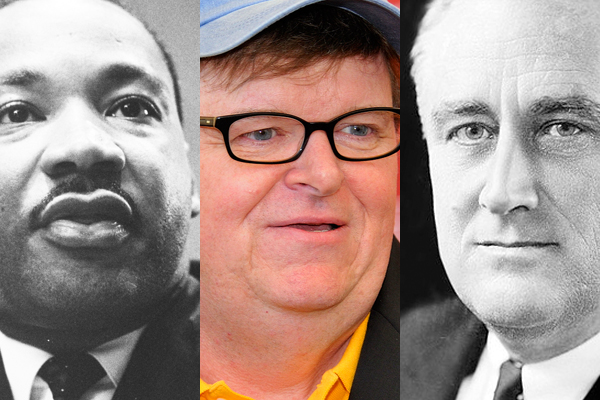
Martin Luther King, Jr., Michael Moore and Franklin D. Roosevelt.

What has the left really accomplished over the past two centuries? FDR’s New Deal remains one of the great American success stories. In the ’60s, leftist politics created a massive countercultural movement — and sexual and feminist revolutions. The civil rights movement transformed both American society and the American soul. But, if you compare the accomplishments of the American left to those of other parts of the world, like Western Europe, its record is remarkably dismal, with a surprising lack of real political and social impact.

At least, that’s the main takeaway from “American Dreamers,” a new book by Michael Kazin, professor of history at Georgetown University, which covers nearly 200 years of struggle for civil rights, sexual equality and radical rebellion. His book explores the way the national conversation has been changed by union organizers, gay rights activists and feminists. He also writes about how their techniques have now been adopted by the Tea Party movement. From Michael Moore to “Wall-E,” he argues that, although the left has been successful at transforming American culture, when it comes to practical change, it’s been woefully unsuccessful.

Salon spoke to Kazin over the phone about the difference between Europe and America, the rise of the professional left — and why the Lorax is a progressive icon.

In the book, you argue that the left has been very successful at changing American culture — but not at making real economic or political change. Why?

It’s easier to get people to think about things differently than it is to construct institutions that alter the basic building blocks of society. When leftists talk about having a vision of how things might be different, they attract an audience and create a new way of perceiving things. It’s a different issue altogether to go up against entrenched structures of wealth and political power. There are few obstacles to talking differently, singing different kinds of songs, or making a different kind of art, but it takes a sustained movement of millions of people to really change the structures, and that is much harder to organize. Also, most Americans accept the basic ground rules of capitalist society. The ideas are that if you work hard you can get ahead and that it’s better to be self-employed than employed by the people. They believe that the basics of a capitalist society are just or can be made just with small alterations. Americans want capitalism to work well for everybody, which is somewhat of a contradiction in terms since capitalism is about people competing with each other to get ahead, and everyone’s not going to be able to do well at the same time. That’s simply not possible.

Why has the left in Europe been so much more successful at making real change?

The left in Europe arises out of a more traditional class structure, and the left parties there were formed on the basis on those class divisions. Most European countries had feudal societies before they transformed into nation-states. When those societies became capitalist, they retained many of the old divisions both in terms of people’s consciousness and in terms of the new social structure. Peasants and lords became workers and employers. So, the parties there tended to fall along class lines much more than in the United States, and people growing up on either side of the class boundary fueled the movements on the left. Even though the differences between the labor or socialist parties and the centrist or right-wing parties have diminished over time, the vision of a socialist society is still alive in many European countries. In America, however, socialism and communism were never more than marginal beliefs.

You would think that the left would become more popular during a bad economy, but that doesn’t seem to be happening right now. Why?

That idea is based more on what happened in the Great Depression era than anything that has happened since. The left’s success in the 1930s was based on a lot of preparation that went back to the Gilded Age and the Progressive Era when corporations were seen as malefactors of great wealth. When the Great Depression hit there was immediate support for ideas that people on the left had been talking about, like that corporations are selfish and exploit their workers or that the wealth should be more evenly spread out. For the past 35 years, conservative notions about Big Government rather than liberal ones about Big Business have been dominant. When the economic crisis hit in the 2008, Americans were already primed to believe the government couldn’t do anything right because it hasn’t been doing anything right for years. Ironically, the conservatives were proved right when the stimulus didn’t do what the Obama administration hoped it would do, and clearly the Tea Party has been able to grow on that policy mistake. The reaction depends on what people think when an economic crisis hits, not what people say to make their case after it has happened.

So what arguments does the left make well?

The ones regarding equality and rights. That’s clear when you look at how popular support is for gay marriage now, but Keynesian economics is not so popular. It’d be nice if they were both popular, but to make political change, you need sustained mobilization of social forces in your favor. You need to make good arguments and also put pressure on people in power. For all kinds of reasons, it’s been more difficult to do that. The support Americans have for what could be called “moral capitalism” goes very deep. The myth of the self-made man that emerged in the 19th century wasn’t entirely a myth. There were people who came to America and did very well for themselves. They had to do things like kill Native Americans and destroy the land in the process, but they made better lives for their families.

Historically, a lot of leftist activism has been based in religion, but these days, few people would make that connection. Why does that get lost in the retelling?

The wide political divide we have now between people who go to church regularly and people who don’t tends to break down along liberal and conservative lines. As a result, we tend to forget that evangelical Protestants in the 19th and 20th centuries were attracted to a social gospel that taught them to be their brother’s keeper and that Christ called on them to change the world. That belief system was true for the abolitionists, the Populists, the labor movement, for many early socialists, and for black radicals like Frederick Douglass and David Walker. We’ve lost that history since the 1950s or so because this growing division frames the understanding of religious politics for a lot of people. I think it’s a real shame that we allow the arguments about whether there is a God or not to obscure the potential consequences of what people do with their beliefs.

So what influence has the left actually had on American ideals?

The left has promoted a lot of the important changes that have occurred in American society, especially in expanding the meaning of “individual freedoms” to include African-Americans, women and homosexuals. The United States says it is committed to individual freedoms, but in practice those freedoms have been either betrayed or not fully realized. The left in this country has always been the vanguard of calling for complete equal rights and social equality. A lot of the major movements for equal rights that we celebrate — the black freedom movement, the women’s movement, the gay liberation movement — were all started by people who were considered to be radicals in their time. The memorial for Dr. Martin Luther King Jr. is being unveiled this week in Washington, D.C., and most people don’t realize how daring and dangerous it was for him to talk about civil rights and take part in that movement. The March on Washington was actually a protest for jobs and freedom that was heavily financed by and mobilized by the labor movement, even though people remember it as a march for African-Americans’ civil rights.

Is that because we revise our own history once it’s no longer fashionable to hold a particular point of view?

Once things are accepted, they become sanitized to a certain degree. Some parts of what it means to be radical get accepted and other parts get sheared off. Privately, King called himself a Democratic Socialist and wanted a much more profound redistribution of wealth. Politicians like Dennis Kucinich or Ralph Nader wouldn’t dare advocate today for the things King was struggling to change in the 1960s. Most Americans know King as a charismatic leader who wanted the races to be nicer to each other and worked for African-Americans to have legal equality, but that was only part of it. He was after a much more radical dream. Of course, he wouldn’t have a monument or a national holiday if he were perceived to be a radical, so there is good and bad in the revision. 

Well, if anything, the left knows how to capture the media’s attention — from burning bras in the 1968 Miss America protest to SlutWalks.

There are a lot of examples of leftists doing outlandish things that bring attention to the issues they support. Americans have been attracted to mass spectacles since the evangelical Great Awakening in the mid-18th century. We like yelling and protesting in colorful ways. The United Auto Workers was really established in the 1930s with the sit-down strikes in Flint, Mich., which is when the workers occupied the factories and kept the bosses out. It was a very imaginative event that was organized by members of the Communist Party. The workers weren’t just staying inside the warm plants in the middle of the winter in Michigan. They were saying the plants were as much theirs as the employers because without the workers no cars would be made. So, they slept on the upholstery of the cars they’d made until the union was recognized.

These days, a surprising number of Americans actually make their living by working in leftist activism. When did being a leftist become a career?

The professionalization of the left was inevitable in some ways because the work of the 1960s was primarily anchored in colleges and college communities. It’s not surprising that people like me became liberals instead of radicals after the revolution didn’t happen. When we had to find a way to make a living, it made sense to become professionals. That is essentially what we were going to college to become, even though we took a detour for a while. To some degree, you need professionals to organize. The people who organized the labor movement in the 1930s were often skilled workers, but there were also professionals like lawyers and journalists. The problem, of course, is when the movement is perceived as a movement of the better-educated, wealthy, privileged elite who are simply self-interested. That image is a problem the left, including liberals, continues to have because it has been cut off from a lot of ordinary working people.

How has the Internet changed the left in America?

The Internet makes it easier to mobilize if you already have a group that’s organizing around some issue. It’s good for meet-ups more than movements. Even the word “movement” has gotten away from the idea of making change. Now it just means people are moving. As wonderful as the Internet is, it doesn’t obviate the need for some of the old things that movements need to grow — like face-to-face organizing. That builds up a sense of trust among people who work together. Some people tend to be wowed by a great new idea or video, as if that is going to be enough. The Internet can quickly educate people about issues, but it’s not going to replace the need for a civil society.

What lessons do you think contemporary leftists should learn from their own history?

In order for the left to be successful, it needs to build institutions that involve people who are not intellectuals and professionals, and ones that aren’t full of people who only talk to each other. The left should welcome debate because it is healthiest when it argues with itself as well as with other Americans who think differently. When people on the left talk, they have to figure out ways of connecting their ideas to American ideals. Liberty and equality for all are wonderful and utopian standards that most Americans identify with, and this is a good thing for the left because it’s what we have been fighting for all along.

Looking back at the whole history of the left in the United States, who are your favorite American leftists?

I have been made fun of recently for saying this, but I think Dr. Seuss has been greatly overlooked as a leftist. He wasn’t a propagandist, but many of his best-selling books — like “Yertle the Turtle,” “The Lorax” and “The Butter Battle Book” — show that he had a leftist political message. Most successful political messages come from people who aren’t very closely associated with a particular left-wing group. Also, although the Greenwich Village artists and writers of the early 20th century aren’t exactly neglected, they are cast off as some sort of bohemian dilettantes. But Max Eastman, the editor of the magazine the Masses who later became a conservative, was a major voice of industrial labor unions, sexual liberation, birth control and modernism. In a lot of ways, whether they know it or not, the cultural left today has been inspired by the things the Masses was doing a hundred years ago.

Continue Reading Close

How we became a nation of cutters

In the last two decades, self-injury has become a sociological phenomenon. An expert explains what happened

When you’re a teen girl with a grotesque scar in the center of your wrist, people tend to make assumptions about how it got there. Although mine actually came from an accident with a piece of broken glass, I was ashamed of the questions — “You really tried to do it, didn’t you?” That is, until I realized my scar might have cachet. If dangerously cool celebrities like Johnny Depp and Drew Barrymore cut themselves, maybe my own wound marked my own outsider mystique.

Every generation of angst-filled teens comes up with new and scandalous ways to cope with adolescence. My mother had blue jeans and rock ‘n’ roll. I had riot grrrl and self-injury. The shocking revelations of self-harm from young stars had the power to transform physical indications of suffering into trendy status symbols, at least among the kids I hung out with who dyed their hair blue and listened to Nine Inch Nails. So, during high school I simply didn’t tell anyone that my gruesome gash wasn’t self-inflicted. (My mom didn’t tell her friends she preferred Patsy Cline to the Rolling Stones either.)

Self-injury isn’t anything new; it’s been used by clergy in religious rituals and by soldiers seeking to avoid military service for the better part of history. But as Patricia Adler, a professor of sociology at the University of Colorado, and Peter Adler, a professor of sociology at the University of Denver, explain in their new book, “The Tender Cut,” over the last few decades self-injury has changed itself from a psychological disorder to a sociological phenomenon. During the mid-1990s the practice spread through alternative subcultures, like punk rock, and became a form of social bonding and secret rebellion. To express their dissatisfaction with ideals they couldn’t or didn’t want to live up to, young people began to write their pain on their bodies and formed friendships with others who were doing the same.

Salon spoke to Patricia Adler about how the media spurred the phenomenon, what motivates people to self-injure — and why it’s not always a destructive act. 

How did self-injury become a social phenomenon?

Self-injury has changed so much over the last 20 years and it has spread to a vast number of populations. It was started by people who did have serious problems, but in the mid-’90s it was picked up by people in avant garde, heavy metal and punk rock music scenes. Injury was used as a way for people to express their alternative identities and disaffection from society. From there it spread to Goths and then gained popularity among mainstream youth who were struggling with normal issues related to adolescence. For most young people, adolescence is not an easy time of life. People rebel, feel depressed and experiment with drug use. 

In the early 2000s, youth started seeing self-injury appear in magazines and movies. As it became more known, people weren’t as freaked out about it. Teens recognized that people who self-injured used it as a coping mechanism when they were feeling lousy, overwhelmed and out of control. These stories conveyed that self-injury was a way to stop feeling badly, so they decided to try it. They didn’t think it was an attempt at suicide or self-mutilation. In fact, for them, it’s an anti-suicidal act that makes life more manageable. People plan their self-injury. If someone knows they’re going to have a rough time, they find a time to self-injure so they can relax. This is a social and rational behavior, not an impulsive and uncontrollable urge. 

Is the media responsible for making self-injury so popular? 

Self-injury was almost entirely unknown until the media started talking about it, and now it’s firmly implanted in our cultural consciousness. The single biggest way self-injury spread was from people knowing it was out there. The media made it more acceptable by showing people who have self-injured that others could relate to. By sharing their experience, movie stars and other celebrities changed the idea that people who self-injure are deeply damaged or psychotic. Before that happened, people who self-injured didn’t talk to their peers about it because they didn’t want to appear to be so damaged and needy. Now, it’s talked about so much in high schools that teens aren’t afraid to be friends with someone who self-injures because they know it’s not necessarily a sign that someone has serious psychological trouble. 

So what’s the difference between self-mutilation and self-injury?

Self-mutilation is a harsh and derogatory term. The people who practice self-injurious behavior don’t call what they’re doing self-mutilation, and they don’t like it when others do either — and the term can be used pretty widely. Some people think tattooing and piercing is self-mutilation. Others say it’s mutilation to wear 4-inch heels or have cosmetic surgery. The term is invariably used as a negative value judgment, and that shows a lack of understanding about self-injury. It also doesn’t take into account that most of these people are using self-injury in order to self-soothe, not as means of self-destruction. 

What are the most common ways people self-injure? 

Cutting is far and away the most common form of self-injury. After that is burning, like a cigarette or chemical burn. Next popular is branding, which is when someone heats up a metal object and presses it against their skin. I’ve seen bone breaking, scratching and self-picking. We interviewed a woman who kept a scab alive under her hairline for more than three years. What isn’t included in self-injury is the homosocial bonding guys do. 

So hazing doesn’t count? 

If you injure in accordance with your gender role, you’re rewarded. Men and boys who outwardly express their anger by punching a wall are seen as tough and masculine. Since they’re socialized to strike out when they’re upset, we don’t call it self-injury, even though it comes from the same feelings. Men tend to cut or burn themselves very visibly and harshly. They flaunt their behavior by using duller instruments and make bigger injuries that can easily be seen on the outer part of their arms or on their chest. If men hide their self-injuries or self-injure in small ways, they are regarded as suspicious. Similarly, women who don’t conform to their gender role as self-injurers are very strongly condemned. 

Why do so many more women self-injure than men? 

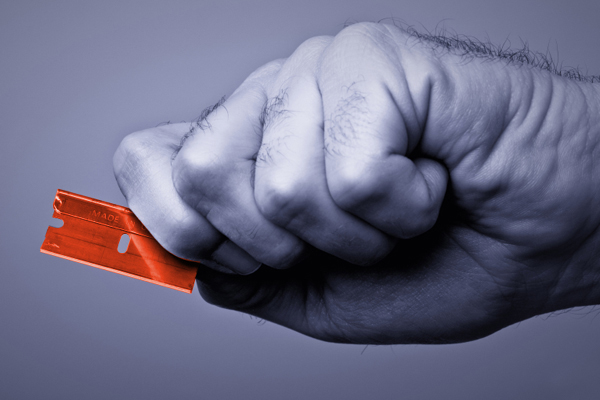
The pressure on women to follow gender norms is so destructive, and a lot of women use deviant means like self-injury to try to feel normal. There is a lot of stigma around not being happy, and we don’t have a very high tolerance for people who are sad. Women are socialized to take out their anger and sadness on themselves. They used to take Valium and stay home in isolation. Now they use X-Acto knives or razor blades to cut their inner arms, thighs and stomach. Women are so judged by their bodies that they look for places where they can hide it. There is some overlap between eating disorders and self-injury because women look to their bodies to help them feel more in control of their lives. Women who are self-injurers are rarely showy about their behaviors, although they do it more. 

Is self-injury always a “cry for help”? 

In a way, it is a cry for help. Mostly, it’s a way for someone to express that they don’t feel good. A lot of people don’t have the maturity to know what they’re feeling, much less express it or ask for help. In our society, there are acceptable and unacceptable ways of asking for help, and if you ask for help in a way that is unacceptable, you may be shunned and condemned, which is kind of ironic since that’s clearly the last thing a person having trouble coping with their emotions needs. 

In that case, do you think self-injury can actually be good for some people? 

I do think it can be helpful. I’m not saying everyone should run out and do it, but I’ve spoken to a lot of people who use self-injury as a temporary coping mechanism to get through a difficult period of life. It’s not illegal. It’s not addictive. It doesn’t hurt other people. And the body heals. If people are stuck in a bad situation, until they’re able to get out of that situation, it can be a way to make it through. 

So how do most people stop? 

People begin self-injuring at all different ages, although most start when they’re in their teens. As people get older the population gets smaller because of the changes that occur during the lifespan. There are certain key points in one’s life that encourage people to stop self-injuring. A lot of young people stop during the transition from high school to college. Some people give it up when they get a professional job or if their significant other is bothered by it. Others give it up when they have children because they don’t want to be a role model for their child in that way. The largest number of self-injurers pick it up because they’ve got situational life problems, and as their life changes, they are able to move out of it. 

How has the Internet changed self-injury? 

The Internet has let people know that they’re not alone or crazy. Before the Internet age, people who engaged in behavior that’s seen as deviant were very isolated, but now that’s not the case. Self-injurers found people online who could understand their behavior and accept them without judgment. They found people they could talk to who actually wanted to talk about self-injuring, whether sharing stories about how they injured or finding out how to stop. However, people don’t only go to the Internet to get help. They also go to give help. One of the biggest reasons self-injurers go online is to give other people the kind of informal counseling they wish they’d received. Nobody understands how to talk to a self-injurer like someone who has self-injured. 

The Internet has been really helpful in building a self-help community for self-injurers. It used to be that people had to meet in formal groups that were run by an expert who supposedly had some higher knowledge and they would instruct people on how to solve their problems. These organically emerging peer support groups are really revolutionizing that format. Now there is no expert. There is just a bunch of people sharing their experiences with each other. 

It sounds very similar to Alcoholics Anonymous. 

People split their lives in really interesting ways. Some keep their relationships online and others decide to meet in person or through video chats. Most self-injurers have a cyber-community of people that know about their self-injury whom they talk to in very intimate ways, but these people don’t share their everyday life experiences. Then they have friends in real life that they don’t share this really emotional part of themselves with. The relationships people form on the Internet help them manage the stress of their daily lives by giving them an outlet to talk about things that upset them. It helps them to go back into the world the next day and start all over again. And in this time of great mobility, no matter where you go, your Internet friends can come with you.

Continue Reading Close

When youth culture stood up to tyranny

Can hip-hop help modernize the Middle East? A veteran observer suggests music and comedy shaped the Arab Spring

Young people throughout the Arab world are in a state of rebellion. In the past two years, the world has seen Muslim youth help overthrow authoritarian presidents in Egypt and Tunisia, and challenge the suspicious ballot results of an Iranian election. In a break from the region’s often-violent past, the anger and frustration of this new generation of revolutionaries has been expressed in surprising ways. Some young Muslims are using humor, hip-hop and peaceful demonstrations to protest tyrannical leaders and Muslim extremists who brutalize their countrymen and demonize the Islamic faith.

In “Rock the Casbah,” veteran journalist Robin Wright highlights the artistic and political work of numerous counter-jihadis and explains why she believes the current rebellions in the Middle East are distinctly different from earlier ones. Using Internet tools like Facebook and Twitter, youth have been able to expand the reach of their nonviolent messages for widespread social, cultural and political change. They are mobilizing their peers online and in the streets in places as distinct as Syria, Palestine and Yemen.

Salon spoke to Wright about the historical precedents for the counter-jihad generation, the changing meaning of martyrdom and the power of the pink hijab.

In the 40 years you have been writing about the Middle East, what key changes have you seen?

The modern Islamic revival has had four phases. The first one began with the 1973 Middle East war, which is when Islam became an effective tool for mobilizing people. In the next phase was the rise of extremism in the 1980s. I was in Beirut when the first suicide bombs went off against American targets at two embassies and the U.S. Marine compound. Although the use of suicide bombs began with the Shiites, it had extended to the Sunnis by the end of the 1980s. The 1990s was the third phase, when Islamist movements began using the ballot as well as the bullet to integrate into politics. Hezbollah came out from underground for the first time, and its members ran for Parliament. This also happened with the Muslim Brotherhood in Egypt, Islah in Yemen, and the Islamic Action Front in Jordan. What all three of these phases have in common is that they were reactive, whether to autocratic leaders, the Arab-Israeli conflict, or foreign intervention. In the current phase, which grew out of the aftermath of 9/11, Muslims are working proactively to reject both the political status quo of autocracies, outdated monarchies and extremism.

 What caused this change?

 One of the biggest factors is demographics. Two-thirds of the 300 million people in the Arab world are under 30 years old. No regime has been able to accommodate the number of young people moving into the labor force. Muslims are increasingly turning against extremist groups like al-Qaida because they’ve been unable to provide basic needs, like housing, education, healthcare or employment. Also, for the first time the majority of youth are literate. They may not have graduated from high school, but they have the ability to read about what has happened elsewhere in the world. They also have access to an extraordinary number of sources of information. In 1996, Al Jazeera became the first satellite station that could circumvent the state-controlled media in every country. Today there are over 500 satellite channels in the Arab world, not to mention the Internet.

How is this “counter-jihad generation” distinct from their forebears?

Counter-jihadis are young people who are striking out on their own to create a new future. This is happening in many different forms, from protesting in the street to rapping. They are using their voices to convey a message that represents their generation. Comedians are challenging the status quo and rejecting extremists. Playwrights are using the word “jihad” in their titles in an attempt to reclaim the idea from the militants. In this part of the world, poetry is still a strong literary form, and poets are writing against radical fatwas. Counter-jihadis are expressing themselves in many ways, but they’re all part of the same phenomenon: defining what they want to politicians and other traditional elites.

What is so striking about the uprisings in the Arab world is that all the protests started with the use of peaceful civil disobedience. Libya disintegrated into civil conflict, but in Syria they’re still predominantly trying to use peaceful demonstrations. That is really an extraordinary change in the world’s most volatile region.

Are the artists and protesters communicating with each other across national borders?

People told me common stories, but they didn’t tend to know about each other. Several people told me that they were frightened after 9/11 because they were condemned by so many parts of the world just for being Muslim, even though they had nothing to do with bin Laden and felt he had besmirched their religion. They were looking for a way to do something that would rescue their faith.

The mission of Tissa Hami is to redefine the Muslim presence in the United States through comedy. She’d always been funny and loved cracking jokes. Tissa was an investment banker in Boston on 9/11, and after enrolling in a comedy class, dropped everything to become a comedian. Comedy has become a common language that spans the Islamic world. Telling jokes is a way people can belittle, question, challenge or tell the truth about politics and politicians.

How do they share their work with one another?

Mostly through the Internet, but they all have different ways. In the case of El General in Tunisia, he put his song on Facebook. He had no idea it would generate the kind of response it did. Now he’s enormously popular, and his music has been played in other countries as one of the anthems of opposition. He has recorded a lot of music since then and a lot of it is political. Some of the most interesting rappers have tapped into the political environment, and for them, that is the most immediate, important and stimulating part about it. The Palestinian group, DAM, raps against drug use and a sewage project that is close to a children’s school. They talk about all kinds of issues that are particular to their neighborhood as opposed to their country. It’s not just against the autocrats and the extremists.

How widespread are technological tools like Facebook and Twitter?

Access varies from country to country. There are a lot of arguments about whether the number of people using these technologies is the majority, but it doesn’t have to be the majority in order to generate a significant opposition. All it takes is a few people who use these tools and have that message spread through the legendary neighborhood grapevines.

How have these tools aided the counter-jihad?

The virtual uprising began in Iran in 2009 after the disputed presidential election because the press was banned. Young Iranians used cellphones to capture pictures on the street and sent them out to let the world know what was really happening there. One of the most moving videos was of a young woman named Neda Agha-Soltan, whose death after being shot by a sniper was captured on someone’s cellphone. That video was one of the defining moments of the protest.

Over the next two years, Twitter and Facebook really took off, so that by the time Tunisia erupted in late December of last year, one in five Tunisians was on Facebook. Facebook was the one outlet the government couldn’t censor or manipulate. So, in a country that banned rap, El General got his song out that challenged Ben Ali. He said things that politicians did not dare say against a president who had ruled for 23 years. The Egyptian uprising took off after Tunisia because of a Facebook page started called “We are all Khaled Said,” who was a younger blogger that had been arrested and beaten to death by police in the streets of Cairo in the middle of last year. That led to tens of thousands going out into the streets on Jan. 25; 18 days later, the president of Egypt, who’d been in power for 30 years, was gone.

Martyrdom has significance in Islam, and each of the uprisings has had one. What function did these people’s deaths serve?

Technology has allowed counter-jihadis to communicate an entirely different set of values, goals and tactics. After three decades of associating the word “martyr” with suicide bombers, you now have people being called martyrs who weren’t trying to hurt anyone else and died in the process of protesting. In the case of Mohamed Bouazizi, the young Tunisian street vendor who died as a result of self-immolation, he was trying to shame a corrupt government. Neda was out peacefully protesting a disputed election. Hamza al-Khatib was a 13-year-old boy in Syria who tried to challenge the arrest of his friends who had been arrested for writing anti-government graffiti on public walls. The process has generated the phenomenon of a new kind of martyrdom that isn’t about the destruction of other people’s lives. It is about using the most precious essence of your own life to change the political system.

Are social networking sites virtual stand-ins for more traditional gathering places, like mosques?

They supplement the mosque. These are all leaderless movements, and that’s quite remarkable. They could probably use a little bit more leadership, but the fact is that it’s through this new means of communication that the youth have created bodies that have no head. They also don’t have any ideology except that they want to oust the system. They have been rallied by a combination of technology and principles, not by a leader or an ideology. That may be their vulnerability down the road, but it’s certainly been stunningly effective in some places already.

What roles are women playing in the recasting of Islamic societies?

The two engines of change in the region are youth, because of the demographics, and women, because for the first time the majority of them are literate in every country. Women want to have more control over their lives. That doesn’t necessary mean they want to become a doctor or lawyer, but they do want to be able to marry when they’re ready to, get an education, and have a sense that they’re doing something useful with their lives.

The women were at the forefront of the uprisings in both Syria and Yemen. They’ve even had all-women uprisings, just to be clear that they’re as much a part of this as the men. It is clear that women still have an enormous way to go. In Cairo’s aftermath of Mubarak’s ousting, they tried to have a million women’s march in Tahrir Square, but the men blocked them, harassed them, and gave them a hard time. Getting women’s rights is a long way off, but in the United States we can’t get an Equal Rights Amendment either.

Are there specific issues women are advocating for?

Women in the Middle East are going through something that women of my generation went through in the United States. During the women’s liberation movement in the 1960s, women stopped waiting for men to pass laws that would empower them or change the dynamics of personal relationships. They began to push for rights in their own way, and that’s what you’re seeing now in many parts of the Arab world. Women have had enough with men saying they need better political systems before they deal with rights for women, and they’re demanding their rights be pushed to the front. That’s why the “pink hijabi” is so important.

What is the “pink hijab” generation?

Forty years ago almost no women wore hijab, and today over 80 percent wear it. Yet most women now wear hijabs that are very colorful and tied in creative ways. They aren’t black; they’re sometimes even adorned with things like sparkles and sequins, because the women want to be fashionable while also observing the modesty of their faith. Women want to wear the veil, and they want to make decisions for themselves. It’s a really interesting combination of modernity and tradition.

What are the challenges the youth in these countries face as they move forward?

The next generation in the Arab world is going to be very tough.There will be many setbacks and diversions. It’s now a generation after the demise of the Soviet Union, and still there is a former communist and KGB spy chief in power in Moscow. A generation after Nelson Mandela walked to freedom in South Africa, many blacks are economically worse off than they were under apartheid, and life expectancy has decreased. The majority rule government has not taken them seriously. Egypt and Tunisia have gone through the first of a multi-phase political, economic and social transformation, and there is so much work ahead. Change takes a long time in every place, and it will be very difficult in this most volatile region.

What role should America play in supporting Muslim youth resistance movements?

We need to reach out beyond the traditional elites who are our contacts and understand that we need a better grasp of what’s happening on the ground. Instead of propping up the militaries, we need to use our aid to help generate jobs; the real challenge will often be economic. With the possible exception of Saudi Arabia, no country in the Middle East can afford democracy. We’re spending something like $10 billion each month to fight a war in Afghanistan, but our Congress is reluctant to spend money to help countries with their rebuilding process.

There was a heartbreaking story I heard in Egypt about a camel driver who worked at the pyramids. He said he could no longer feed his family and he could no longer feed his camel, so he had to consider feeding his camel to his family in order to survive. But then he would have no job. The U.S. has to use its resources more wisely to ensure that the political process that has begun is not diverted or destroyed by economic issues. That said, we also need to allow these countries to learn through their own experience instead of rushing in to tell them what to do and how to do it. To be credible and legitimate, the change has to be defined and achieved by the people themselves.

Continue Reading Close

D.B. Cooper, a uniquely American hero

The FBI claims to have found a lead in the famous hijacker's case. An expert explains why we're still captivated

The legend of D.B. Cooper is a curiously enduring one. On the day before Thanksgiving in 1971, a man calling himself Dan Cooper boarded a plane in Portland, Ore., and after a drink and a cigarette, slipped a note to the flight attendant saying he had a bomb and was hijacking the plane. Within a few hours, he parachuted out of a Boeing 727 with $200,000 of ransom money and was never heard from again.

Even after 40 years, the FBI hasn’t been able to pinpoint his real identity — until, possibly, this week. The FBI claims to have a new lead in the case: A retired police officer suggesting the real D.B. Cooper died in a car crash in the Pacific Northwest 10 years ago. (So far an attempt to match the man’s fingerprints, obtained from an old guitar strap, to Cooper’s has proved unsuccessful.)

It’s no small feat to hijack a plane and elude capture for decades, but what’s more astounding is the iconic status D.B. Cooper has gained ever since. Perhaps it’s because, as a nation of rugged individualists (or so we like to think), Americans are drawn to stories of rebels who stick it to the man. Or perhaps we just like a good mystery.

In the wake of this week’s news, Salon spoke to journalist Geoffrey Gray, whose new book, “Skyjack: The Hunt for D.B. Cooper,” is out on Aug. 9.

How do you think people will react if this latest news is true?

The news doesn’t give a lot in the way of proof. All they have is a secondhand story, a guitar strap and a hunch. The Cooper case is littered with those. There are literally many feet of files full of those kinds of claims. So, before they release any information, I think the FBI needs to be sure they can prove the identity of the hijacker conclusively. I’m not sure a partial fingerprint or a partial strand of DNA is enough to get rid of the doubt that exists.

So either the hijacker got away with it for 30 years or he’s still out there getting away with it. Regardless, the myth continues.

For this case, these kinds of leads have happened so often. What is different this time is that the FBI appeared to take it seriously by passing it along for testing and telling the public about it. One of the theories out there is that most of what the FBI has done has only taken them farther away from finding the hijacker. Five days after the hijacking, they released the Cooper sketch because they were desperate for clues in the case. But what happened next was that they were bombarded with information from all over the country because everybody saw somebody they knew in that sketch. So, they couldn’t do any investigative work because there were too many leads to follow.

As it turns out, there were a tremendous number of hijackings in the early ’70s. What was going on?

The story of a hijacking never starts in the plane. It actually starts on the ground. The United States in 1971 was a country at war with itself, and it was a time of tremendous upheaval. There was a recession happening in 1971 that coupled with a lot of counterculture stuff. The number of bomb threats and explosions in government buildings was at an all-time high. Inner cities were becoming ghettos. We were losing the Vietnam War and soldiers were coming home addicted to heroin. The overwhelming idea was that there was no control. The country was unhinged and there was a state of national paranoia.

What about this particular hijacking? Why were people so quick to get behind D.B. Cooper?

Seattle was a company town, and Boeing had laid off a lot of its workforce. Some of the best aeronautic engineers in the country had to mow lawns because there were just no jobs available. The Pacific Northwest is a unique part of the country that has a real outlaw, flannel, corned-beef-and-hash spirit. Because of the recession, the government started collecting back taxes, which forced a lot of people to sell their homes. Then the government bungled giving out emergency food rations to unemployed people by making it so bureaucratic that the food spoiled before they could get it out the door.

At the same time, these jumbo jets were coming off the line, and all these big planes were freaking people out. There was already resentment and fear against the government and the big and complex technology. The early 1970s is when big machines were coming into vogue, and anyone who was working with their hands or had a concept of what it meant to put in an honest day’s work were disenchanted by the efficiency of the modern corporation. Then along comes Dan Cooper, a man who paid $20 in cash that day to buy a ticket from Portland to Seattle on a Boeing 727.

Was he immediately seen as a hero?

Almost immediately. I call him a transcendental hero because, through one tremendous act of courage, he was able to convince the good guys to root for the bad guy. He changed the moral compass of the moment. He had the FBI agents and law enforcement officials who were trudging through the woods in search of him — but actually did not want to find him and hoped he would escape. They wanted him to get away with the jump because he executed all the romantic elements of the perfect crime: no harm done, no victims, skillful execution. It was hard not to be in awe of this one act.

Why does this myth captivate the American imagination?

In the cult of Cooper, people see who they want to see. At the time, people wanted to see this man as a hero who could do something that defied the government. It was a way to rid themselves of their own feelings of helplessness. D.B. Cooper was able to seize control and become the director of a great drama. After their houses had been taken from them because of money they owed to the government, followers of Cooper wished they could do that. Who’s going to miss $200,000, especially when insurance is paying for it?

It’s not like these people were slackers. They were hardworking people. The system and society at the time was becoming so unfair and mechanized, and this guy was able to turn that all upside down. In an airline town, he was able to defeat the airlines. He was able to defeat the government and law enforcement. What his real motives were is an entirely different question that we may never know the answer to, but that’s not the story that lingers in legend. Any time you have a legend, you have a hero who serves a purpose. To this day, Cooper serves a purpose.

How so?

There is a rebel in all of us, some more than others. This guy was able to strike that chord. He was able to show us what something bold truly is, and we love that.

Is this why we still hang onto news about possible breaks in the case?

The frenzy surrounding news of this case is strikingly similar to what happened on Nov. 25, 1971. Once people learn that a man had boarded a plane just like everyone else does, was able to convince the FBI to give him four parachutes and a small fortune, then disappeared into thin air over the remote mountains of the Pacific Northwest, it’s impossible not to be interested in the story, and it’s very easy to become obsessed with it. In an environment where the mystery lingers, there is only the pursuit for the facts. In this case, the hunt for Cooper is a really bumpy, infuriating and life-changing road. People have devoted their whole lives to solving this case.

At this point, even if conclusive evidence existed, people would probably come up with reasons not to believe it.

If we think about what is going on in this country at this moment — the debt ceiling, the recession, high unemployment, failed wars, the increased reliance on technology — there are some strains of similarity. In approaching the 40th anniversary of this event, maybe we are just in a similar moment where this story is the kind people want to hear about. Maybe this is simply a ripple effect from the history of one man jumping out of a plane in such epic fashion.

Continue Reading Close

Page 1 of 2 in Mandy Van Deven

www.salon.com/writer/mandy_van_deven/index.html