Mary Roach

Don’t jump!

Exactly what happens when a person leaps off the Golden Gate Bridge? Reading this article is the safest way to find out.

  • more
    • All Share Services

Don't jump!

In 1996, I jumped off a 350-foot-high bridge over a river gorge. I wanted to experience what it would be like to leap, head first, from a lethal height and hurtle toward my death. The death part itself I had no interest in experiencing — in fact, a fairly strong interest in not experiencing — so I had a bungee cord wrapped around my ankles. After the initial terror and involuntary-scream portion of the event, the fall was quite enjoyable. I didn’t flail or rotate helplessly like people pushed from balconies on TV, but dropped smoothly in dive formation. I felt the way, as a child, I imagined Superman feeling. It led me to believe that jumping off San Francisco’s Golden Gate Bridge would be a lovely way to go.

I don’t feel that way anymore. This I blame on several people, including Gary Erickson, an investigator at the Marin County, Calif., coroner’s office, where bodies pulled from the water below the Golden Gate Bridge are taken; Richard Snyder, author of a research paper titled “Fatal Injuries Resulting From Extreme Water Impact”; and Herb Lopez, a Golden Gate Bridge safety patrol sergeant.

In fact, the pointed lack of loveliness involved in a bridge suicide is one of the things Sgt. Lopez uses to dissuade the suicidal individuals he encounters in his job. In response to pressure from San Francisco Suicide Prevention, the Golden Gate Bridge District has safety officers regularly (depending on their workload) patrolling the bridge on scooters and bikes, scanning crowds for possible jumpers. (Unlike tourists, jumpers are usually alone, do not carry cameras and do not look like happy people on vacation.)

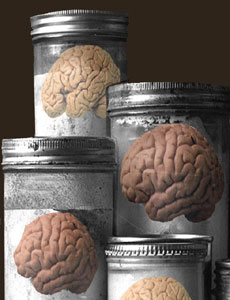
Lopez regales would-be suicides with details of has-been suicides he has helped recover. (While the U.S. Coast Guard retrieves bodies that land in open water, bridge personnel are responsible for jumpers who land on the ground or in the concrete-ringed moat that surrounds the bridge’s South Tower.) I asked Lopez for a “for instance.” He thought for a moment — I cannot begin to imagine the horrors that flashed through his mind in that moment — and then he said: “One time Lt. Locati was down on the moat bringing in a body and someone yells, ‘Look out, Mike!’ He looks down, and right there on the concrete in front of him is a complete human brain. Something sheared off the back of the guy’s head.”

We were on the South Tower at the time, so Lopez leaned over the railing and pointed out the spot where the brain had sat. A tourist stopped alongside us. “What are we looking at?” he said.

“Pelicans,” said Lopez.

The most recent suicidal individual got to hear about a terminally ill man who landed between two boulders near the shore on the Marin County side of the bridge. “All we could see of him,” said Lopez, “was his legs sticking up.” He made a peace sign to illustrate the man’s legs protruding from between the rocks. “When we put him in the basket to haul him up, he was about this long.” Lopez held his hands about a yard apart, as though relating a fishing story, which, in a way, I guess he was.

The basket to which Lopez was referring was a crab basket. In its present incarnation, it, and a grappling hook, are the primary tools used by bridge personnel to haul bodies from the moat. This is not to say that the crab basket does not occasionally still haul crabs. “A lot of times, we pull bodies out with crabs hanging off them,” said Lopez. Crabs apparently consider people as much of a delicacy as people consider crabs. “They go for the eyeballs first, then the soft flesh on the cheeks.” Lopez possesses the matter-of-factness and healthy remove of people who deal with death as part of their job. He didn’t strike me as callous or uncaring, just inured.

When people land on open water, the result is less grisly, though it still falls far short of lovely. “If you look at these people,” says Gary Erickson, the Marin County coroner’s investigator whose job is to do just that, “they don’t look like there’s a whole lot wrong with them.” Depending on what position they were in when they hit, very few bones may be broken. Bodies that enter the water feet first or lying flat tend to emerge with the skeleton largely intact. Of the 169 Golden Gate Bridge suicides in Snyder’s paper, 17 had no fractures at all, and two had no injuries. If you manage to enter the water feet first and close to vertical, it’s possible to survive a leap from the bridge. But it’s not very likely: At the time of Snyder’s paper, the death rate was 99.3 percent. Ironically, according to another of Snyder’s papers, suicides are more likely than accidental plungers to survive extreme impacts — perhaps because they wish to die and are thus more relaxed when they hit.

Usually what kills you is your ribs. According to Snyder’s research, 85 percent of the jumpers had broken ribs. (By comparison, only 15 percent emerged with fractured vertebrae, and only a third with arm or leg fractures.) These jagged pieces of rib “macerate,” to use Erickson’s verb, the heart, lungs and/or major arteries. Of the bodies in Snyder’s paper, 76 percent had punctured lungs, and 57 percent had heart or “great vessel” ruptures.

Dying in this manner is akin to death by gunshot or a stab wound to the heart: It’s not always instantaneous, but it’s very fast. When a major artery is severed, the brain quickly shuts down for lack of oxygen-bearing blood. “When a vessel the size of the carotid artery has been cut wide open,” writes Sherwin Nuland, author of “How We Die,” “the entire sequence can take less than a minute.” One thing is known: It happens fast enough that few people drown. Only 45 of the 169 suicides in Snyder’s paper lived long enough to inhale much water.

Out on the bridge, Lopez and I were joined by Mike Locati, the man who nearly slipped on a brain. Locati’s patrol that morning had been uneventful. He was keeping his eye on a lone man with no camera who was staring down at the water. I noticed him too, for he glanced back at Lopez and me after we’d passed. He wore no jacket, just a T-shirt and a pair of Wranglers, which, had he decided to leap, would likely have had the crotch blown out and the rear pockets blown off. (“Even on a sturdy pair of denims,” Erickson marveled.)

According to Lopez and Locati, there are two types of jumpers — and only one they can do much about. There are the suicidal people who aren’t quite sure they want to jump and who typically walk the bridge several times or climb over the railing to sit on the 4-foot-wide ledge below it, deliberating. “Ninety-five percent of the time, if we get to these people,” said Lopez, “we’ll get them back over.” The more determined suicides are harder to stop. Some people simply stop their car in traffic, get out and jump, stunning tourists — who typically compose themselves quickly enough to snap photos or shoot video — and blocking traffic for hours. (Most suicides park in the parking lot, considerate to the end.) Others appear to be out for a stroll and then suddenly turn in midstride and, as Lopez puts it, “take a flying leap over the railing.”

The only way to keep people like these from jumping would be to put up fencing, which the Bridge District thinks would spoil the view. And so, 25 or so times a year (there’ve been more than 1,000 deaths to date), someone jumps. When it happens, bridge personnel call the Coast Guard and then hurl a buoy over the side from the spot where the person jumped. The buoys have the same density as a human body, so that, in theory, they travel in the current just as a body would. Very often, though, depending on the body fat of the jumper and whether any air bubbles are trapped in his or her clothing, the body will have sunk before the Coast Guard can get to it. In this case, it doesn’t float to the surface for about a week and a half, after gases from the bacterial decomposition process have inflated it sufficiently. Talk about spoiling the view.

Continue Reading Close

The last tourist in Mozambique

Want to chat with the president? No problem, as long as you're willing to go where nobody's ready for you.

  • more
    • All Share Services

Topics: ,

Late one night in 1995, I dialed directory assistance for Maputo, Mozambique, and asked for the fax number for the Office of the President. I sent His Excellency a letter on a piece of Health magazine stationery, requesting an interview on the topic of meditation. I had read that President Chissano was a devotee of Transcendental Meditation, so much so that he required his cabinet members and his military recruits to be trained in TM. He even attributed the signing of the peace treaty with the guerrilla group RENAMO in part to the practice of TM in his country. A week later, the president’s secretary faxed me back. To my great and giddy disbelief, Chissano had agreed to see me.

If anyone needed help relaxing, it was Joaquim Chissano. For years, guerrilla warfare had consumed his country, flattening tourism and every other industry that had managed to take root in the preceding decades. It was a country of guns and politics, and seemingly little else. Though the civil strife was technically over, the nation was still in shock. It lay like a downed prizefighter, dazed and bleeding. The infrastructure in the capital had long ago been given up on. Power outages happened nightly, leaving cars and pedestrians to navigate the shelled-out streets by moonlight.

Maputo hadn’t been as hard hit as the countryside, but mortar shells had fallen frequently enough to turn the occasional cement sidewalk blocks into sandboxes. Garbage hadn’t been collected in weeks; it lined the streets like snowbanks in Wisconsin. Cabs were scarce and dilapidated, their trunks and doors held shut with coat hangers and packing twine. Soldiers were threatening revolt, demanding pay for services no longer needed. The atmosphere was spiked with resentment and discontent. If you ruled Mozambique, you’d meditate too.

This was my first visit to a place that had no tourism, a country that didn’t know what to do with me. I had traveled to far-flung places before, but I’d been on eco-travel junkets, where they’d take you to the kind of remote mountain hamlet that “just got electricity last year,” yet the pension owner’s little boy had a Stimpy sticker on his door. More and more, “untouristed” doesn’t mean remote. It means hostile and smelly. Travelers can get to pretty much anywhere they want to. It’s the places they don’t want to go that are left alone. As far as I could tell, I was pretty much the only foreigner on earth who wanted to be visiting Mozambique.

- – - – - – - – - – - -

In return for holding the passenger-side door in place on the rutted drive from the airport, the cab driver helped me find a room. Pensao Martins was airy and clean, so much so that I was lulled into thinking it was a-OK to drink the tap water. (Back home, weeks later, lab personnel would be trumpeting with glee at the bacteriological rarities found cavorting in my sample. “Endolimax nana! It’s a first for us!”) Because I wasn’t meeting the president until the following day, I thought I’d do my usual Third World-interloper thing: a little wandering, a little lunch, a little shopping.

I stopped first at Banco de Mocambique to change money. The lobby was chaos, a human pasta of curling, overlapping lines. I was handed a plastic token and directed to a line. This was apparently the line you waited in to find out the proper line to wait in, which turned out to be longer again by half. I could ascertain no common theme to the plastic tokens being held by the people in my line. Mine was green and said P; the woman behind me had a red one with an impala on it. Perhaps they were gifts, a little something to thank us for our patience. I was the only one in my line changing foreign money. Apparently I was the only one changing foreign money in quite some time, for the teller seemed perplexed. Finally he disappeared and returned with a newspaper, which he opened and began reading, as though I had so overtaxed him that he felt the need for a break right then and there. As it turned out, he was looking up the exchange rate. So that was pretty much my morning.

As I walked around the city, it began to seem odd that there had been so many people in the bank. It was hard to see how anyone was making enough money to bother with a savings account — though this wasn’t for lack of trying. Tiny business transactions were taking place everywhere, homespun economies springing up from the war’s aftermath like weeds from the cracks in a cement sidewalk (a sidewalk someplace other than Maputo).

At the city’s natural history museum, a pair of guards motioned me aside to show me some hand-made pencil cups covered with strips of zebra and leopard hide — floor scraps from the museum’s taxidermy room. (I bought three.) Out in the streets, teenage boys and women manned the intersections, selling whatever they could. A boy was selling individual garlic cloves, the way people sometimes do with cigarettes. When I later chanced upon a youth holding out a box of toothpicks, I wondered if the price he quoted would buy me the box, or just a solitary pick. One group of boys was selling potted tropical plants, as though, unable to come up with anything else, they’d turned to the earth itself to make a sale. Vendors would walk alongside me for as much as a block, trying to convince me that I really did need a jar of Cobra Wax Car Polish, a pair of shoulder pads, a Richard Marx cassette. It didn’t seem to faze them that I spoke no Portuguese.

The one kind of thing I might have bought, they simply didn’t have: Souvenirs, other than the gastrointestinal variety, were nonexistent in Mozambique. Though the islands off the coast had once enjoyed popularity among European sun-seekers, there had been no tourism since the conflict with RENAMO broke out. As the souvenirs had disappeared, so too had the smiles that had once been used to sell them. People didn’t smile at foreigners here, or look them in the eye.

Not that they didn’t look. They looked at my shoulder bag. I had a small leather pouch in which I carried some cash and my passport. People were staring at it so openly and so hungrily that I transferred the contents a nondescript plastic bag. The menace was palpable, and I’m the sort who’s generally oblivious to menace. I used to look with disdain upon the travelers I’d see in Peruvian markets who’d put their backpacks on their fronts, defensively hugging them to their bellies. Peru didn’t unnerve me, nor did Moscow or India. Mozambique did. People were desperate, and their desperation had made them hard.

I took a streetcar to the outskirts of the city, to a large open-air market someone had suggested I visit. Here my discomfort edged toward fear. Here people stared not only at my plastic bag, but at me, as though calculating what they might get for my shoes, or how long their dogs could gnaw on my bones. I transferred my cash from plastic bag to shirt pocket. I stepped off the streetcar into a press of impassive faces. Within minutes, a hand reached for the bills in my shirt. There was no attempt at guile, none of the true pickpocket’s finesse. The man had simply seen the money and moved to take it. I turned sharply to block the theft, then took my cash from my pocket and wadded it in my fist. My sunglasses were left in my shirt pocket, however, and they were next to go. This thief, at least, made a stab at technique; he tried to conceal his hand behind a folded newspaper. The result of this was that he could no longer see his target. The hand flailed blindly at my shirt for a moment before locating its quarry. “Hey,” I said, and looked at the glasses in his hand. He shrugged and handed them back to me. Good people; bad times.

If only to rid myself of the sweat-logged cash stuck to my palm, I bought some impressive black-and-white porcupine quills from a medicine woman. It was hard for me to imagine the jungles of Mozambique as being home to a gentle woodland creature like the porcupine; however, my image of the Mozambican wilds had undoubtedly been tainted by my earlier visit to the natural history museum. The displays there seemed to have been influenced by the country’s enduring climate of violence. Lions and leopards were posed snarling and fang-faced on the backs of their prey, claws tearing pink gashes in taxidermied flesh, rivulets of dried stage blood running down and puddling on the diorama floor. It was the most horrifying museum I’ve ever seen — and I’ve been to the South African Police Museum and a Tokyo parasite museum with a 30-foot tapeworm recovered intact from a man’s intestine.

My quills and I rode the streetcar back, trying to look like we made sense. I retreated to my hotel, feeling defeated and out of place. In the lobby I found a South African Cosmopolitan magazine. A cover line read, “How to Be Shamelessly Shallow.” This I did not need to read. War-blighted, impoverished countries are highly effective at making the casual visitor feel shallow and spoiled. I was here on a lark. I felt self-centered and resented. I fell asleep in the afternoon heat.

At 4 p.m. the phone rang. It was Carlos, the president’s personal secretary. “Judy?” He had forgotten my name. He informed me that my interview had been rescheduled, and that a car was coming in five minutes to take me to the presidential palace. Five minutes! Ay carumba! Endolimax nana! I spackled the pillow creases on my face and went down to the lobby.

I was met by Carlos himself, a smug miasma of cologne and wealth. The price of his suit could have fed a family of pencil cup-makers for months. His rings could have put a fleet of dilapidated cabs on the streets. It’s dangerous to go from one end of the economic spectrum to the other so suddenly. One gets the mental bends. Carlos pressed his cheek to mine, European style. Soon a red spot would appear where he’d touched me. I was allergic to his cologne, or maybe just to him.

I was whisked through a series of armed gates and security checkpoints. This was a country in which it was easier to meet the president than it was to cash a traveler’s cheque. Carlos deposited me in an ornately furnished anteroom and disappeared. I could see the president, waiting in the next room behind a lace curtain, like a shy bride awaiting her betrothed.

“Judy.” Carlos and his pet musk cloud had returned. “His Excellency the President of Mozambique will see you now.”

Joaquim Chissano is small for his title, perhaps five foot five, and unassuming. When I picture African leaders, I picture rotund men in loud fabrics and showy eyewear. Chissano was dressed in a dark blue suit and unremarkable black dress shoes. He wore no jewelry aside from a wedding ring and a tie tack. He radiated calm and modesty. I liked him immediately.

The president spoke with me for over an hour. He explained how meditation had helped him handle the deaths of his brother and father and the stresses of his post. He said that meditation recharges his batteries and has helped him with tension headaches. He said he meditates on the way to work (someone else drives) and during delegation meetings. “If people talk and I don’t care what they are saying,” he said, “I meditate.” Carlos pursed his lips.

Then the president began talking about some yoga postures he had just learned, which he did each day as preparation for meditating. “Six postures, which you can do in one minute.” Abruptly, he stood up and took off his suit jacket. “If you like, I can show you.”

And so the president and I got down on the beautiful blue Persian carpet. We arched our backs and rolled our heads and released our toxins. The president lay down on his back and stuck his legs straight out above his head. Carlos looked up to see the president’s dress shoes waving in the air before him. I lay down and did what the president was doing. My dress flopped onto my face. Carlos examined his cuticles.

The president got up and returned to his seat. His tie was hanging over his shoulder. “There is one more very essential exercise,” he said to me. He put his index fingers beside his nostrils. “You blow the air out from one side and close the other like this, then take the air like this. Very fast. Now switch the sides. Out and in and out and in.” His eyes rolled up into his head, and he made a sound like workmen sanding walls.

The president was practicing alternate nostril breathing, a sort of rhythmic, snorting hyperventilation that calms the nervous system and alarms guests. When I had regained my bearings sufficiently, I joined in. We sat there making funny nose sounds until Carlos could stand it no more. “I think,” he stood up, “that it is soon time for the president to have his dinner.”

I hoped that Chissano, my one friend in Mozambique, would invite me to join him, but he did not. Carlos drove me back. I ate dinner in a restaurant that appealed to me because it did not have jarring fluorescent lights, and then I realized that the jarring fluorescent lights were simply out, along with all the others in the city except the president’s. In a blackout, I ate pummeled-looking chicken and thought to myself that I had never had a stranger day in my life. The strangest thing about it was that it wasn’t a strange day for anyone in it but me. Travel is like that.

Continue Reading Close

Ladies who spray

If you sprinkle when you tinkle, cut it out!

  • more
    • All Share Services

Ladies who spray

Let’s say you are afraid of contracting VD from a toilet seat. You are misinformed, but we’ll get to that later. What do you do? You use a disposable toilet seat cover. There. Perfect. All is good with the world.

But all is not good with the world. In maybe a third of the stalls in women’s rest rooms these days (according to my desultory research), the toilet seat is liberally puddled with piss. Somewhere along the line, germ-phobic women began crouching above the toilet seat rather than sitting on a paper seat cover. Women have begun peeing like men, but they lack the courtesy to put up the seat. And since women cannot aim like men — they have nothing to aim with — a good many of them end up hosing urine on the seat. Very few, it would seem, bother to wipe it up.

Now when the rest of us come along and want to use this toilet, a seat cover is no longer an option, for it will soak through, forcing us to sit down on paper sopped in someone else’s excretions. So we are forced to either wipe up said excretions, or stand ourselves.

There is no rational reason — other than avoiding someone else’s mess — not to sit down on a toilet seat. You cannot catch venereal disease by pressing the back of your thigh and butt cheeks to a piece of plastic where someone else’s thigh and butt cheek have been pressed. Catching VD requires direct contact. In order to catch VD from a toilet seat you would have to rub your crotch on the toilet seat in precisely the same place that someone else has previously rubbed her contaminated crotch.

“It’s a lovely thought,” says Alan Copperman, director of reproductive endocrinology at Mount Sinai Medical Center, “but it doesn’t happen.”

To be absolutely certain, I called the American Social Health Association — “social health” being a euphemism for sexually transmitted diseases (STD) — to see what they had to say on the topic. I had been referred to them by an editor at Self magazine, which recently ran a piece advocating crouching above the toilet seat to avoid contracting trichomoniasis, a common bacterial vaginal infection. (Thank you, Self magazine!) But neither ASHA nor the CDC’s STD hotline said they knew of any study documenting the transmission of trich in this manner. They said it might be possible to catch trich from sharing the wet towel or bathing suit of someone who’s infected, but not from sitting on a toilet seat.

I then did a search on Medline using the key words “toilet seat.” The search turned up nothing on trich, but it did uncover a study by a University of Arizona microbiologist named Chuck Gerba. I know Chuck Gerba from a story I did years ago. Gerba is the all-knowing god of bathroom and kitchen germs.

Chuck Gerba can tell you the number of bacteria in the average human stool (3 trillion), the average number of toilet paper squares used by American women (7 sheets), the average amount of fecal material in the brown streaks in a pair of men’s underwear (a tenth of a gram — an amount comparable to a quarter of a peanut). He knows the scientific term for the sexual organ of a salmonella (pillus), and the average time a man sits on a toilet (10 minutes, according to research done himself, using a stopwatch and a stethoscope in a men’s room stall at Baylor University). Gerba knows all.

I told Gerba about the item in Self. “I think that’s baloney,” he said. “Even if there were bugs on the seat, you’re not going to catch them. You don’t catch things off your butt. You catch things off your hands.”

What you catch, in the case of bathroom bacteria, is usually nothing and very occasionally a case of food poisoning. If someone has, say, salmonella food poisoning, their gastrointestinal tract is full of salmonella bacteria, which means their excreta is too. (A healthy person’s fecal bacteria are unpleasant enough but harmless.) Let’s say this infected person goes to the toilet, has a messy time of it, and gets a microscopic amount of the brown on her fingertips while wiping. Now she touches the faucet. If you touch it after her, you could take salmonella home on your fingers and deposit them in whatever you’re making for dinner. If whatever you’re making sits out on the counter long enough for the bacteria to multiply sufficiently (and isn’t then cooked), you and your dinner companions might end up with food poisoning.

Simply sitting down on bacteria can’t hurt anyone, except possibly the bacteria. Nor is there much bacteria on a toilet seat to sit on. According to Gerba, toilet seats suffer an undeserved reputation for filth. In 1998, he and two colleagues took swabs from 14 sites in household bathrooms and kitchens, and cultured them to check for E. coli and other fecal bacteria. “The toilet seat was one of the cleanest spots in the house,” he reports. “The refrigerator door handle was dirtier. And the cutting board. There are 200 times more fecal bacteria on a cutting board.” In this case, the fecal material usually comes from chickens — who literally have the shit squeezed out of them during processing — and can contain salmonella.

“If you have a choice between licking a cutting board or a toilet seat,” concludes Gerba, “pick the toilet seat.”

Even toilet seats in public rest rooms are not especially germy. In a 1995 study, Gerba found E. coli on only one out of 59 public rest room toilet seats — most likely from the toilet water, which aerosolizes into a microscopic mist when the toilet flushes. There were far more fecal bacteria in sinks and on sanitary napkin dispensers, the latter being commonly overlooked by janitors. (Other commonly overlooked bacterial ick zones, as determined by Gerba over the years: hotel TV remotes, vending machine buttons and bank pens.)

I do not have high hopes that what I have written will change the restroom behavior of American women. I told a friend of mine that the average refrigerator handle has more fecal bacteria on it than the average toilet seat, and I then asked her whether, now that she knew this, she would relax about sitting on toilet seats and even forgo the toilet seat cover.

“No,” she said. “Now that I know this, I’m going to start using toilet seat covers on the refrigerator handle.”

Continue Reading Close

Deep, active penetration

How researchers at one toothbrush maker figure out ways to make dental hygiene a pleasurable experience.

  • more
    • All Share Services

Deep, active penetration

You’re probably not getting deep, active penetration. Seventy percent of American adults aren’t. But I am. I’m getting deep, active penetration because I spent an afternoon at Oral-B Laboratories, where deep, active between-teeth penetration is a multimillion-dollar pursuit and where they hand out samples of their new deeply, actively penetrating $5 CrossAction toothbrush.

Apparently the CrossAction isn’t just any toothbrush. It isn’t, in the same way the Mach 3 wasn’t just any razor. Both were developed by Gillette (Gillette owns Oral-B), a company with a flair for extravagant, costly research into everyday toiletry items.

I asked CrossAction development team member Dave Weber why a company would spend three years and $72 million reinventing the humble toothbrush. He said, “We believe that being leaders in daily oral hygiene care and physical plaque removal really takes understanding the science and going beyond what’s been traditionally thought of in terms of toothbrush design.” This is what a man who spends 11 months in a room working on a toothbrush sounds like. It sounds to me like the company should have let him out to go to the movies every now and then, but who am I to argue with a leader in daily oral hygiene care and physical plaque removal.

The notable feature of the CrossAction toothbrush — aside from its costing a dollar or two more than its competitors — is that it has angled bristles. “Vertical bristles just sweep across the teeth,” said Dave, who is 40 and has a mustache with bristles of about the same length as the CrossAction toothbrush’s. “If you angle the bristles in the direction of travel,” continued Dave, “they are pushed between the teeth as they sweep across. So you get better penetration.”

Does better penetration matter? Apparently so. Dave told me about a study from this month’s American Journal of Dentistry. On the off chance that you don’t subscribe to the American Journal of Dentistry, I’ll tell you what it says. It says CrossAction blew 14 leading toothbrush brands out of the sink. It removed 9 percent to 64 percent more plaque.

The tests were done in Oral-B’s product evaluation laboratory in Belmont, Calif., home of the “brushing robot arm” and the glass prism tooth. These were gizmos invented by the toothbrush engineers to let the toothbrush R&D people film actual between-teeth close-ups of angled bristles penetrating at different depths. I would bet you the cost of a CrossAction toothbrush that at some point in the robot arm tooth brushing proceedings, one of the lab techs leaned over and opened his mouth and had the robot brush his teeth, the way people who spend too much time in the copy room eventually photocopy their faces, or other parts. At least I hope so.

The other CrossAction feature that Oral-B crows about is the handle. “We wanted to help provide a more fulfilling grip in terms of the hand,” Dave told me. Sometimes Dave sounded so serious about toothbrushes that I worried about his grip of reality. To find out how most Americans grip their toothbrush, Oral-B paid people to let them come into their bathrooms and videotape them brushing their teeth. I wondered whether it might have been simpler to just send around a questionnaire and ask. Dave’s colleague Maisie Wong-Paredes said no. “Brushing is something people can’t really tell you about,” she said. To prove it, she asked me to describe how I gripped my toothbrush. I couldn’t really tell her.

But we were going to find out. Dave and Maisie led me into a room with a row of bathroom sinks with one-way mirrors that allow toothbrush researchers to spy on people while they perform oral care on themselves. They gave me a CrossAction toothbrush and disappeared around the wall into the viewing room. At home that night when I brushed my teeth, I had to fight an impulse to open the medicine cabinet to be sure Dave and Maisie weren’t in there.

As it turned out, I am power gripper, with periodic forays into oblique and distal oblique gripping. Oral-B identified the five major grip styles of American tooth brushers, and then designed their toothbrush to fit them. Should you care to know what these grip styles are, you can log onto the CrossAction online news bureau. Here you will also learn that Neil Armstrong brushed his teeth with an Oral-B toothbrush minutes before stepping onto the moon, and that the average person brushes his or her teeth for 46 seconds, despite constant nagging from dentists to spend a full two minutes at it. Maisie said that out of 160 people that Oral-B observed tooth brushing, only one brushed for two minutes. We shook our heads. If they can send an Oral-B toothbrush to the moon, why can’t they build a man who knows how to brush his teeth?

Dave and Maisie asked me how I felt about my brushing experience with the CrossAction. I told them that my mouth felt really clean now. They looked disappointed, even a little hurt. At Oral-B, there’s more to brushing than just cleaning and deeply penetrating. “The other thing we want to do is to deliver a pleasurable brushing experience,” said Dave.

Maisie said that Oral-B’s focus-group brushers were in fact delighted. As support for this, she directed me to a press release that quoted people saying they felt “movement inside their mouths similar to the multiple cleaning actions of an automatic car wash.” I wouldn’t have guessed this to be the sort of brushing experience that provides delight. I would have guessed it to be the sort of brushing experience that provides abrasions and tire tracks along the gum line.

I have been using my complimentary CrossAction toothbrush, but I’m a few bristles short of delighted. It feels too big to me. But maybe I’m weird. Maybe I need to spend some time with an automatic carwash in my mouth.

Continue Reading Close

Twelve steps in the end zone

Self-help for sports junkies (or the spouses who can't stand it).

  • more
    • All Share Services

Topics: , ,

According to Kevin Quirk, recovered sportsaholic and the author of the self-help paperback “Not Now, Honey, I’m Watching the Game,” my husband is addicted to baseball. I, in turn, am addicted to my husband. This means that five or six times a year I accompany him to the ballpark, though I care nothing about the San Francisco Giants and understand few subtleties of the game. I would love it if my husband were addicted to me rather than to Dusty Baker and his merry spitting men, and so I turned to Quirk’s book for help. More accurately, I suppose, I turned to Quirk’s book to make Ed feel bad about his passion for baseball, for I am a jealous and needy person. No doubt I suffer from some as-yet-unnamed personality syndrome that someone will one day write a book about, which Ed can then buy and use to make me feel bad, too.

The first thing I learned from Quirk’s book is that as sports addicts go, Ed is hopelessly minor league. He qualifies by dint of a checklist on Page 59, which is like one of those depression checklists psychologists dream up, where if you answer yes to three or more questions, like, “Have you ever sighed audibly?” they tell you that you may want to seek professional help. Even though Ed answered yes to five of the 20 questions, qualifying him as an addict “to some degree,” he is nothing like the men Quirk describes.

Ed doesn’t collect pennants and programs and display them in a sports memorabilia room. He didn’t name his kids after players and dress them in tiny Giants uniforms when they were too young to protest. He doesn’t paint his face in team colors or fax advice to the dugout. These are actual behaviors sports addicts admitted to in a survey conducted by Quirk. He was, for a time, as extreme as any of them. He once had a heated argument with his wife over his sports habit, all the while sneaking glances out the kitchen window and in through the living room window to keep up with the game. They divorced soon after.

The extreme sports fan strays from ordinary devotion to deeply irrational, compulsive behavior. In Troy, N.Y., there lives a man who will not eat during Dallas Cowboys football games, because one day during a game, he got up to fix a snack and when he returned, the Cowboys had fallen behind and proceeded to lose. He blamed himself, as though the act of eating a sandwich could affect the actions and decisions of a group of men in tight pants and helmets 2,000 miles away.

Quirk says that although the majority of sports addicts are men, women are by no means immune to the condition. Quirk describes a pregnant woman who decided to go to the game though her contractions were only 10 minutes apart. Another woman had the Cubs game on in the delivery room both times when her children were born. “They say it helps to simulate your home environment in the delivery room,” was the rationale she gave Quirk.

Quirk’s book presents many theories as to why people become obsessed with sports. He thinks boys get involved with sports as a way to bond with fathers who are otherwise hard to bond with. He said some men use their relationship with their team to fill their need for intimacy. “They don’t feel as deeply about the people and events in their lives as they do about their Cleveland Indians,” he told me. “When you think about it, the team is with them from the time they’re kids to the time they’re grandparents. It’s the longest-term relationship in most of these guys’ lives.”

Quirk also believes that men use sports as an escape, a way of shutting out worries or making up for what’s missing in their lives. “Maybe their job isn’t everything they want it to be or their relationship isn’t everything they want it to be. For a lot of sports addicts, there’s some degree of emptiness, something they’re hungering for. And the sports world is never empty. There’s always something going on.”

I presented Ed with these theories last Saturday afternoon, while the Diamondbacks were eviscerating the Giants. Oddly, Ed wasn’t watching the game. He was making banana bread. This wasn’t what I’d had in mind. I had wanted to ask him these things while he was absorbed in the game, thereby forcing him to, in the language of the Sportsaholism Checklist, “get annoyed or angry when someone interrupts you while watching a game.” This would have provided me with lively, ironic material for the article. What I got instead was some really good banana bread. (As it turned out, the Giants lost. The outcome of the game probably had nothing to do with my eating banana bread, but you never know.)

Ed didn’t buy Quirk’s explanations for why he spends so much time watching baseball. He said his father didn’t care about baseball. He said that the Giants did not fulfill his need for intimacy, although he could not rule out the possibility that J.T. Snow could make him happy and could at least be counted on not to confront him with quizzes from self-help psychology books. Ed said he loved the game because it has poetry. He said he likes the way the field is a perfect square, and how it’s the only game where the defense has the ball, and then he stopped. “I am so not a baseball addict.”

The defense had the ball. I took a couple more swings and then I let him win, because maybe he was right. Maybe he just loves the game, and I just don’t. There’s no point going into extra innings over that.

Continue Reading Close

Disaster drill

Where's the virile firefighter who's supposed to cut off my clothes?

  • more
    • All Share Services

There are many good reasons to volunteer as a “victim/actor” at a mock chemical weapons attack. There are the free doughnuts. There are the virile and omnipotent firefighters who cut your clothing off and carry you to safety and more doughnuts. There is the knowledge that your efforts are helping to prepare emergency personnel in the event that such a heinous thing should ever occur.

Having spent last Friday morning acting the part of a sarin nerve gas victim at the Henry J. Kaiser Arena in Oakland, Calif., I am here to tell you that should such a heinous thing ever occur, the citizens of Oakland are in a bit of trouble. It was called a disaster-preparedness exercise, but as far as most of us could tell, it was the exercise that was a disaster, minus most of the preparedness.

Disaster-preparedness drills happen all the time — earthquake, terrorist attack, plane crash, biological weapons; you name it, they prepare for it. The American Red Cross sets up a lot of them. If you, too, would like to be a victim/actor, they’d love to hear from you. They usually have to badger their own volunteers into action. Student paramedics and high school kids also get pressed into duty a lot. I seemed to be the only one there for the fun of it, and now I know why.

My fellow victims and I were playing the part of pharmaceutical sales reps at a convention. Upon arriving at 7 a.m., we were directed to the moulage room. “Moulage” is a term for makeup used to simulate accident gore. “Moulage” also happens to be the term used by Kegeling inventor Arnold Kegel for his plaster-of-Paris vagina models, which he created to demonstrate the effects of diligent Kegeling. Apparently “moulage” is French for something moist and anatomical that you don’t want to talk about over breakfast.

The basic sarin moulage package was whiteface with some blue face paint blended in, as though one of the effects of sarin was to render its victims indistinguishable from “Braveheart” extras. Those of us designated as trauma victims got to have additional trauma moulage items, such as lacerations and special-effects blood dripping from our noses and mouths. We played the starring roles, the conventioneers who were not only downed by the gas but also injured by the explosion that delivered it.

My trauma moulage amounted to a “fist-size bruise” on my neck. I was happy with my bruise until I glanced over and saw the woman next to me having the end of a plastic bone taped to her arm and slathered with stage blood, so that it looked as though it had broken loose from its moorings and poked through her flesh. I had gore envy. I wanted a protruding bone. The moulage lady patiently explained that there was a shortage of plastic bones. They were actually ballpoint pens in the shape of bones — freebies from an osteoporosis drug manufacturer, the sort of thing a pharmaceutical conventioneer might bring home if a bomb didn’t explode and blast his belongings helter-skelter across the room.

After moulage, the Domestic Preparedness team handed out our “symptomology badges.” Mine included shortness of breath, sweating, nausea and muscular twitching. This is what happens to you if you’re exposed to sarin gas. Conveniently enough, this is also what happens to you if you have stage fright, lack acting experience and are expected to perform the role of a dying pharmaceutical sales rep.

People were walking around, preparing for their roles as best they could. This would prove difficult for some of the victim/actors, for instance, the ones whose symptom badges included diarrhea or excessive drooling or the woman who got “speaks Spanish only and unable to talk.” The scene was like something from a first-year ESL class. “I’m sweating heavily,” said a smiling man to his wife. “I’m anxious and combative,” she replied cheerfully.

As it turned out, our acting abilities were irrelevant. The emergency personnel didn’t try to figure out what was wrong with us. The firefighter who came to my aid ignored my wrenching performance of muscular twitching, nausea and vomiting and simply gestured for me to follow him. My symptom badge also said unable to walk, and I pointed this out to him.

I was looking forward to experiencing the firefighter’s carry firsthand. He scowled. “Help me out here,” he said. “That’s my line,” I replied, but I got up, because he seemed to be in a bad mood and I couldn’t blame him. He was spending his morning wearing heavy rubber clothing and a gas mask in record-high 80-degree heat in order to rescue a bunch of drooling fakers in Scottish war paint.

My firefighter deposited me with the rest of the trauma victims at the base of the convention hall steps. Ten minutes later, someone pointed to a box on the steps labeled “BOMB.” We wondered what would prompt a terrorist to write BOMB on the box that contained his bomb. The same thing, we supposed, that would lead him to bomb a pharmaceutical convention.

We were herded away from the bomb box to the other side of the building, where we sat in the sun for half an hour, chatting, dying and messing up our “Braveheart” makeup with sunscreen. Eventually a firefighter came over with a hose and commenced to wet us down, as though we were fans at an outdoor rock concert — or peonies. He explained that he was decontaminating us. If this had been an actual gas attack, they would have cut our clothes off, turned the hoses up high and really blasted us, and then they would have scrubbed us and put us into some sort of special suit and rushed us to the emergency room. “Jesus Christ,” said a disgruntled victim/actor named Marta, who was visiting from Spain, where the disaster drills are “great, just great.”

“If they want to practice, why don’t they do it? Come and get real, people!”

A newsman came over to film the firefighter moistening the sarin. He was wearing brightly patterned cotton trousers and a tie-dye shirt. “Someone ought to cut his clothes off,” said a woman beside me. Her fake blood had come loose from her skin and hung in strands off her chin, waving gently in the breeze.

Forty-five minutes later, we were herded into a fire department van and driven to a nearby hospital. No clothes cutting, no ambulance ride. Although the hospital had known about the drill for weeks, no one was waiting for us. “It’s 11:30,” said the emergency room woman who finally came out to the parking lot. “Someone called at 10:30 and said you’d be here in 10 minutes. We gave up on you.” She looked at the lot of us, slumped and heat-stricken in the van. We were all sweating heavily, anxious and combative, regardless of what it said on our symptom badges.

“Well, shoot,” she said.

Someone from hospital public relations showed up with a camera to document Summit Hospital’s pivotal role in the Oakland Domestic Preparedness program. One of my fellow victims, a woman who organizes safety drills in her neighborhood and is something of a regular at these events, obediently dropped to the ground and commenced retching and spasming. Marta rolled her eyes up into her head, which wasn’t on her symptom badge.

Continue Reading Close

Page 1 of 6 in Mary Roach