Here is a reason I don’t bowl. I suffer an irrational fear that one of my fingers will become stuck in the hole and the bowling ball will yank it off, and I will stand there watching the ball roll down the lane with my bloodied digit sticking out. Normally, I don’t share my fears of accidental amputation with fellow bowlers, but at this particular bowling session it seems to fit right in with the conversation, for it’s a pizza-and-bowling party hosted by a Bay Area amputee group called Stumps ‘R Us.
“Stump” is not a derogatory term among these amputees. “Residual limb” is the p.c. term, but everyone here today says stump. As in, “Your stump will change size if you gain or lose weight” or “My daughter-in-law’s Dalmatian is fascinated by his stump.” In case you are wondering what they call us, we’re TABs, which stands for totally able-bodied. “Or, less optimistically,” quips one amputee, “temporarily able-bodied.”
Stumps ‘R Us founder Dan Sorkin, who invited me, wants me to meet one of the bowlers, a man named Alan Fisk, who was born with four stumps. I have never been introduced to anyone with arm prosthetics before. Do I shake his hook? Fisk doesn’t extend it, so I don’t reach for it. As it turns out, I wouldn’t have been shaking his hook; I’d have been shaking his bowling attachment, and God only knows what the etiquette is there. (Golf and baseball mitt attachments are also available.)
Fisk steps up to bowl. He jams the plunger at the end of his attachment into one of the bowling ball finger holes. (One of the odd things about being an amputee is that you use words like “plunger” and “coupler” and “piston” to talk about your own anatomy.) By maneuvering his shoulder, Fisk can pull a cable that contracts the plunger and lets the ball go. He hefts the ball up onto his other arm prosthesis, and walks to the line on his leg prostheses and bowls a strike. This man handles himself with more grace and athletic prowess than I do with limbs intact. I am filled with awe and wonder and a fleeting thought that perhaps he doesn’t need to use handicapped-parking spaces and will want to give his decals to me.
Acknowledging the cheers, Fisk raises his hook in the air, just as victorious athletes with flesh fists do. Fisk also applauds with his prostheses, uses them to wipe sweat from his brow and wears a watch on one. It’s possible to buy arm prostheses with molded plastic hands, but Fisk prefers hooks because they’re more functional.
He demonstrates how he can hold things by opening and closing his hook, which is halved like a split end. This too is done by pulling the cable that runs from the hook to the shoulder harness that holds his prostheses in place. “I hate that word,” says Fisk. “Pros-theee-seees.” The inner surfaces of the opened hook are coated with rubber to make it easier to grasp things. I ask Fisk if he can hold a needle. “Yes,” he says patiently. “But I don’t know if I could do anything with it.”
Fisk excuses himself, goes off to score another strike and returns. To feel better about myself, I hold up my cuff. “See this button? I sewed it on.”
Having introduced me to a half-dozen amputees who bowl better than I do, Sorkin wants me to meet an amputee who in-line skates better than I do. James Prial does stunt and marathon skating. Prial claims his artificial leg is an advantage. Skating demands ankle stability, and the most stable ankle joint you can have is no ankle joint at all. Prial is wearing shorts. As discreetly as is possible, I’m trying to figure out how an artificial leg stays on. Eventually I ask.
“Suction and sleeve,” volunteers a former heavy equipment operator named Joe Peterman, who lost his right foot after a construction accident at the Pac Bell Park site. Peterman explains that there’s an air valve at the top of this type of prosthetic, and when you push down on it with your stump, it presses the air out, creating a suction that holds the thing in place. He peels back a neoprene sleeve, which creates a seal to keep the suction from breaking. Then he goes right ahead and takes his prosthetic off.
“Whoa, you’ve got a long one, Joe,” says Prial. This is the stump that has the Dalmatian entranced.
Before I leave, Prial tells me there’s loads of interesting information on the Internet about the history of prosthetics. Back at home, I run a Web search on “prosthetic” and “amputee.” It turns up many sites that are interesting, but not in a historical way.
Apparently there’s a subset of the population that is sexually aroused by amputees, which is not to be confused with the subset of the population that is sexually aroused by people with leg braces, or the subset that is hot for people in plaster casts. There’s even an America Online bulletin board posting requesting “photos, videos or correspondence dealing with gals who have severe bunions on their feet.” They would have loved my grandmother.
Most of these “devotees,” as they’re known, are men, but not all. An article in a 1997 issue of the Journal of Sexuality and Disability describes a leg brace devotee who would drive to shopping malls and loiter near the handicapped-parking spaces in hopes of seeing a disabled man. She eventually married a man with forearm crutches and leg braces, but lost interest in him after his condition worsened and he had to forsake the braces for a wheelchair.
Prial said he’s never been approached by female or gay devotees, but wouldn’t be unnerved by it. “Hard to distinguish between preference and perversion,” he wrote me. “What if they just like amputees the way some men only like blondes?”
And then there are the “wannabes.” Compared with wannabes, devotees are as normal as pizza and bowling. Wannabes — or apotemnophiles — are sexually aroused by imagining themselves as amputees and often become fixated on becoming real amputees. While most contrive some method of self-amputation (train tracks, say), some wannabes manage to persuade medics to do the deed.
Just this month, a surgeon in England got himself in hot water for amputating the healthy leg of a wannabe who claimed he was an amputee living in an able-bodied body. An article on the site Amputation quoted the man’s wife, who had begged the doctor to do the operation: “I wish to God someone could take his leg off and then we can live a normal life.” I believe Prial said it best: whoa.
Who said, “Middle age is the heinous and insidious conglomeration of small physical failings and defects that appear without warning and totally ruin your day”? It might have been me. I used to feel this way. But I have worked hard to develop a new and positive outlook about these things, which I will now share with you, so you will feel better too.
Unpigmented white spots on forearms. Compared with those little red, raised blobs on your chest and upper arms, these white spots are hardly noticeable. By the way, I’m guessing they’re not only on your arms. Have you examined the fronts of your shins lately?
Red blobs on chest. These are barely visible from across a large, poorly lit room. Try to associate with people with limited vision.
Receding gums. What you are failing to realize is that the enamel underneath your gums has been protected from unsightly coffee and cigarette stains for the past 30 years and is as white and perfect as your toilet bowl above the waterline. Also, many of you have the problem of unflattering gummy smiles, and this will be alleviated by the gradual disappearance of your gums.
Crow’s feet. If you’ve ever examined the foot of a crow up close, you’ll see that the lines around your eyes, while they detract from your once-youthful looks and tend to act as foundation sinks, are not as ugly as the actual foot of a crow.
Unsightly neck cords coming down from jaw. These can easily be taken care of by cultivating a double chin. Don’t want a double chin? Well today’s your lucky day, because you don’t have one!
Liver spots. They call them liver spots because you’ve lived a lot. You’re a liver. If you’d done less of that living out in the sun without the good sense to put on sunscreen, you’d be a liver without spots, but never mind, too late for that now.
Yellowing toenails. Why is red a desirable toenail color and yellow not? True fact: There are yellow nail polishes one can buy, though only the young have the poor sense to do this. Did you know that this condition is caused by a living fungus in your toenails? Take solace in knowing you are providing safe harbor for one of God’s small creatures.
Saggy folds in flesh above the knee. When was the last time someone complimented your knees? No one cares about your knees. If your ass is holding up and your breasts are still above your navel, you have no place carping about your knees.
Loose, flappy skin on underside of forearm. You probably haven’t noticed this one. Look in the mirror while crossing your arms. See what I’m talking about? Remember, until 10 seconds ago, you didn’t care about this. Why care now?
Unwanted hairs. Georgia O’Keeffe had visible wiry chin hairs, but no one remembers her for this. They remember her for large, vaginal nature paintings. Let this be an inspiration.
Vertical wrinkles radiating from upper lip. Don’t trouble yourself over these, because soon there will be large heavy folds on either side of your mouth, and when this happens, you’ll give anything to go back to the days when you only worried about upper lip lines. And you know what? You’re living those glorious halcyon days right now!
Heavy, dark under-eye circles. Many athletes apply black greasepaint to this area to reduce glare and improve their game. You don’t ever have to do this. That’s a savings right there.
Skin tags. If you look through a dermatology textbook, you’ll see that some people have even uglier things growing out of their skin. I heard somewhere that they don’t necessarily all get bigger and bigger.
Gray hairs. Hairs coarsen and crook when they go gray. While some people feel that the frazzled, even witchlike appearance of gray hair is unattractive, those of you who have lived your whole life with thin, limp, Tom Petty hair will probably enjoy the added body.
Bulldog jowls. Don’t let heavy jowls get you down. You know why? Because then you won’t smile, and when you smile, no one can tell you have jowls.
Creases in front of ears. Police investigators use these to gauge perpetrators’ ages in cases where it’s hard to tell. Think of them like fingerprints. They make you you. Though if you’ve got neck cords, receding gums, skin tags and bulldog jowls, God knows no one needs ear creases to tell your age.
I hope that you feel better now.
Continue Reading
Close
Generally speaking, I think it’s a good idea to spend time in places you can’t imagine yourself spending time in. At one time or another, for really no good reason, I have gone into soup kitchens, Baptist churches, porn shops, mortuaries, bingo parlors, Turkish baths. You learn things — typically that you don’t know beans about the people there and that most of your assumptions were simplistic, naive or just plain wrong.
That was my experience one afternoon inside a glass-walled smoking room at the Continental terminal of San Francisco International Airport. As with most places I can’t imagine going to, I felt a little uncomfortable walking in. But no one paid me any mind. Oddly, pathetically, being taken for a smoker made me feel kind of cool. (Why do I admit these things to anyone?)
I took off my coat and sat down. As I did not then light up a cigarette, but merely sat there looking around and smiling stupidly, the smokers soon began to suspect that something was up — that they had a ding-dong in their midst, a nonsmoker who didn’t realize she was sitting in a smoking room. One summer during college I walked in off the street to apply for a job at what I took to be a bar but in fact was a strip joint. I do not have the requisite equipment or general air of a stripper, and the manager must have suspected that I was a naive ding-dong but did not know exactly what to say. I was getting that same sort of look in the smoking room.
I told the smokers I was writing an article about airport smoking rooms. Amazingly, no one questioned this. People never do. I could have told them I was doing an article on the global impact of wheeled luggage and they’d have nodded agreeably and tried to help. People are great.
“As smoking rooms go, this one isn’t bad,” said a woman from Idaho named Darla, who reminded me of Michelle Pfeiffer. (I didn’t expect this; I expected everyone to look like Steve Buscemi.) I looked around. You could write your name in the haze over our heads. The ashtrays had no sand, and the vent on the ceiling was hairy with dust. It was hard to imagine what bad was.
“Atlanta,” offered a woman in a gray suit, whacking a pack of Kents on the back of her hand. “Salt Lake City’s is the worst,” said Darla. “I mean, OK, we like to smoke, but that place is ridiculous.” Another smoker nominated D.C.: “You go in there, you don’t even need to light up.” (This was a line I would hear three times that afternoon. It’s the “Hot enough for you?” of airport smoking rooms.)
Most of the country’s worst smoking rooms were built in the early ’90s. “The early ones were almost set up as punitive to smokers,” says George Benda, CEO of Chelsea Group Ltd., a ventilation consulting firm in Itasca, Ill. “They just sort of walled things up and said, ‘Let’s make this as obnoxious as we can, and maybe they’ll just go away.’” These days, with funding from tobacco giants Philip Morris and Brown & Williamson, airports and their concessionaires are working with firms like Chelsea Group to build properly ventilated bar-restaurant smoking areas. Denver has a popular one (the Aviator’s Club), as does Richmond, Va. (the Hitching Post). Says Benda, “It’s a major trend. Airports are waking up to the fact that smokers are people. And not only that, smokers are people who eat.”
Within five minutes, Darla had left. The typical stay in a smoking room, I realized, is equivalent to the time it takes to smoke a cigarette. Somehow I had imagined that smokers spend their entire stay at the airport inside these rooms, just as they spend their entire meal in the smoking section of a restaurant. But this was stupid. Of course they leave.
A man with a white beard walked in. I was vaguely aware of being surprised that his beard wasn’t yellowed by nicotine. Asked his opinion of the room, he said, “It stinks in here,” to which I replied, “But you people aren’t supposed to mind the smell of cigarettes.” A row of four smokers to my right leaned forward to look at me. “But we do,” they said in urgent, worried chorus. “I don’t smoke in my home,” added the Kent smoker.
“I don’t either,” said the man with the white beard. “I don’t either,” said two others.
“You come out of here and everyone knows where you’ve been,” said a man named Miles who does heating and refrigeration for airport concessions. Miles knows about ventilation, and Miles knows that the ventilation in this room “sucks.” (Or, more accurately, it doesn’t suck very well.)
Smokers are addicted to cigarettes, and thus they must put up with the stink, but that doesn’t mean they don’t mind it. The smokers I talked to felt pretty much the same way nonsmokers feel about smoke-filled rooms and clothes that smell like ashtrays. “It’s a disgusting habit,” said Miles, blowing smoke roughly and with obvious contempt, the way a bouncer heaves an obnoxious customer out the door. Smoking rooms are just one more disgusting thing about it. “Places like this help people like me quit,” said Miles.
One thing almost none of the smokers complained about were the glass walls that I had assumed would make them feel as though they were on exhibit. Only one man mentioned it, a P.R. firm owner named Peter. “You see people stopping to stare with their kids. It’s like, ‘Look, honey, he’s an addict,’” he told me. “Christ, people, I’m smoking. I’m not shooting up in front of your children.” Other than him, the smokers I spoke with preferred the open feeling of glass walls to the closed-in feeling of solid ones. They said they enjoyed people watching and seemed not to notice — or mind — being watched themselves.
The general consensus was that smoking rooms were the lesser of two airport evils, the greater being no smoking area at all. “At least you don’t have to walk all the way out through security to the front of the airport to have a cigarette,” said a man in a cowboy hat and cowboy boots who videotapes rodeo events for a living but does not smoke Marlboros. It quickly became clear that smokers are so used to being treated as third-class citizens that they are thankful for any accommodation airports make for their habit.
One woman I talked with actually enjoyed spending time in a smoking room. “The one at the United terminal is a beautiful atrium with tropical plants and palm trees,” she said. Then she took a last long drag and pressed her butt into the ashtray, that is to say, the butt of her cigarette. Miles watched her go. “I smoke over in the United terminal all the time. That room is the worst. She’s been smoking something other than cigarettes.”
Intrigued, I walked over to the United terminal and found a room much like the one I’d been in, only with more smoke and cracked chair seats. I asked a smoking flight attendant if she knew of a beautiful atrium with palm trees. “You’re thinking of the United terminal in Los Angeles,” she said. “It has no ceiling. When it rains you get wet.”
Continue Reading
Close
At first I thought it might be a joke: a research paper on “raw carrot abuse,” by one Ludek Cerny, in the venerable British Journal of Addiction. Perhaps Volume 87 contained an April first
issue, and the British Journal of Addiction was taking the piss, as they say over there. Or perhaps it was a joke played upon the British Journal of Addiction by someone pretending to be Ludek
Cerny of the Apolinarska 4 Psychiatric Clinic in Czechoslovakia.
Because I did not want to stay up until midnight (9 a.m. Prague
time) to shout “Ludek Cerny?!” to faraway Czech-speaking clinic employees, I asked around among my friends. Very
soon, much sooner than I expected, I located a domestically based carrot addict.
The woman prefers to keep her identity secret, but if you ever run
into her, she will have a hard time doing this, for her palms and soles have, as she puts it, “an orangey cast,” and the rest of her has a subtler yellow-orange “QT” tinge. The reason for this, according to one journal article, is that the palms and soles have a thicker “horny layer,” and carotene (which gives carrots their color) has an affinity for the horny layer. This was the first I’d heard of the horny layer, and I made a mental note to locate mine and take it out for a spin some Saturday night.
Carotene also has an affinity for fat, so carrot addicts sometimes have orange bellies, breasts and buttocks. As befits a carrot addict, the woman I spoke with — let’s call her Dotty — has very little fat, and so she has been spared this peculiar if visually striking fate. (Comforting note: you need to eat at
least four to eight pounds of carrots a day before any part or layer of your personage turns orange.)
Since 1976, Dotty has been consuming 10 or so pounds of carrots a day, which she buys in 50-pound bags from a horse stable in Burbank. This means that altogether she has consumed about 87,000 pounds of carrots. If you laid those carrots end to end, they would not come anywhere near to circling the globe, but you have to admit it’s a lot of carrots.
Dotty’s habit began when she joined Weight Watchers. Carrots were one of the foods participants could eat unlimited amounts of. She is a compulsive eater, and carrots allow her to continue her compulsive eating but not gain weight. Why not some other vegetable? I asked her, one that does not orangify the horny layer? She has considered this. Tomatoes she finds too messy (besides, the lycopene in them can, if you eat huge amounts, turn you red); celery is too bland and cauliflower too expensive.
One of Cerny’s carrot-abusing patients got hooked on carrots after quitting smoking. His wife had advised him that it was necessary to replace the cigarettes with something, and he found that, indeed, carrots helped him forget about cigarettes, and soon he was up to five bunches a day, a habit eventually brought under control by an East-European carrot shortage.
Dotty categorizes her dietary habit as a compulsion rather than an actual addiction. However, Ludek Cerny theorizes in his paper “Can Carrots Be Addictive? An Extraordinary Form of Drug Dependence” that a true chemical dependence might be involved. He cites as evidence a withdrawal syndrome “so intense that afflicted persons get hold of and consume carrots even in socially quite unacceptable situations.” As an example, he cites the ex-smoker, who “felt compelled to eat the carrots he had bought on his way home on the train.”
I have always thought of Prague as a freewheeling, liberated city, but apparently it’s not. Apparently it’s the kind of place where a man can’t eat carrots on a train.
Cerny’s other example better fits the standard profile of socially unacceptable addictive behavior. The patient, a 38-year-old Prague nurse, resorted to stealing to support her habit — although not from people. While visiting the racetrack with her sister, she would sneak off to the stables and steal bags of carrots from the horses. This same woman would also “preserve her carrot peelings as an emergency reserve.” In a similar vein, Dotty confided to me that in December she stockpiled 100 pounds of carrots in the event that Y2K problems interfered with her supply.
Dotty freely admits that carrots rule her life. “I think about travel,” she told me. “How would I handle the absence of carrots?” She got the chance to practice recently, when she traveled to a reunion in Chicago. “I said to my daughter, I need you to make me some carrots, and when you pick me up at the airport, please have them with you because I won’t have been able to eat them on the plane.” (Unlike like the raw carrot abusers described in Cerny’s paper, Dotty takes her carrots cooked — microwaved with vinegar, Sweet’n Low and I Can’t Believe It’s Not Butter.)
To date, no one has succeeded in isolating an addictive substance in carrots. Part of the reason no one has succeeded in doing this, I would wager, is that no one has tried. Who is going to give researchers hundreds of thousands of dollars to study carrot addiction? They would have to go to the racetrack and win it, or steal it from the horses. In the meantime, whether Dotty is an addict or just a really big carrot fan, she’s not interested in quitting: “I would rather be thin and yellow than fat and pink.”
Continue Reading
Close
Ten people get off the train in Davos, Switzerland. Six carry ski bags, three have snowboards. I am the only traveler whose luggage is rectangular.
It is a winsome fate, to be a nonskier in a world-class ski resort. To be in Davos without skis is like visiting L.A. without a car. People wonder what you’re up to (in my case, an assignment at the avalanche research center).
It doesn’t help that Switzerland is in the midst of a record-breaking snowstorm. The snow is coming down hard, in knuckle-sized rafts of flakes, big pillowy chunks that hit your glasses and explode into fluff. Roofs are mattressed with snow, a foot since last night. A car goes by with bits of white still clinging to its exterior, like a man who’s gone out with shaving cream on his face. (You can tell at once who has a garage and who doesn’t.)
Outside my hotel window, pedestrians steady themselves with ski poles. A pair of teenagers ski down the street and park their equipment in a rack outside the pastry shop. (They have ski racks here the way we have bicycle racks.)
I have to get out and do something in it. At the information kiosk, a woman suggests “sledging,” which I’ve never heard of. It has the sound of an arcane ice sport, like curling, which they do daily here in Davos. (Originally a Scottish sport, curling combines the joys of bowling and scrubbing floors and has gained great popularity in both Switzerland and Canada, countries with too much winter on their hands.)
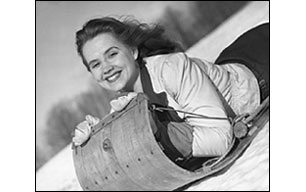
Sensing my confusion, the information woman draws me a picture of what appears to be a person in a rocking chair. Then she points to the mountain behind the building. God love the Swiss! They slide down mountains in their rocking chairs! Then she points out the window at a girl who is pulling her little sister on a sled. Sledding, is what she means.
Sledding is apparently something of a trend these days. Ski resorts are building sled runs that hairpin down the sides of mountains for 1, 2, even 7 miles. I am directed down the street to the Shatzalp funicular railroad, at the base of which is a sled rental shop. A funicular is the precursor to an aerial tramway. It’s a cable car that trundles up the side of the Alps at preposterous angles, an elevator with a slouch.
The sled rental man takes my 8 francs and hands me a sled. It is simple, made from wood and painted bright red. I hold in my mittens 35 pounds of sweet, unadulterated childhood. This is going to be great.
The funicular driver loads the sleds on the back of the tram, a good dozen of them, packed together like shopping carts. I am careful to note where mine has been placed, as they all look alike. At the top, I arrive at the back of the tram to see the driver handing No. 3, my sled, over to a woman in a teal ski suit.
As I ransack my brain for the appropriate German words (“That is my” I prepare to shout), common sense alights. They’re all banged-up red sleds; who cares which one you get? To single out the one you came up with is to join the insane ranks of restaurant table-switchers and people at butcher counters who point out the exact two chicken breasts they want. The driver simply hands the sleds over to the nearest outstretched hand. Another reason to love sledding: It’s missing the gear envy of downhill skiing.
I follow the sled people up a footpath to a stone gate, the entrance to the sledging course. A crowd has accumulated, a half-dozen adults standing around, trying to remember how to be kids. A woman sits down on her sled and urges it forward as one does with one’s chair at a dinner table.
To similar effect: The sled moves several inches and stops. The rest of us ponder and stall. Finally a boy of perhaps 7 parts the forest of brightly hued legs, bends over, puts one knee on his sled, kick-starts himself with the back leg as though propelling a skateboard and disappears into the forest.
Ahhh, we all say. Of course.
The problem with this technique is that the width of my shin bone is approximately equivalent to the spaces between the wooden slats. While this neat interlocking of wood and bone serves to hold me snugly in place atop my sled, I am in a great deal of pain by the time I round the second or third bend.
To my right, a sled speeds past me. It’s another boy, this one on his belly with his shins sticking up in the air. What I failed to realize about that first boy is that once he achieved an acceptable speed, sometime around the first turn, he flung both feet out behind himself and flopped down on his stomach. As any kid knows to do.
I resolve to try this method but am held back by the sudden realization that I have no idea how to steer. The sleds of my youth had a movable piece on the front, like a ram’s horns, that could be wrenched one way or the other with your feet or hands. This one has nothing like that. I might as well be riding a rocking chair.
I have no idea what to do.
Something is amiss when you have to be told how to slide downhill on a sled. Something in the adult brain atrophies over time. We’ve spent too much time considering options, weighing pros and cons, writing proposals, holding meetings, taking lessons. We’ve forgotten how to simply sally forth and do something. So I push off again and, once I’ve built up some speed, belly-flop onto the sled.
Some sort of instinct takes over, and I find myself banking turns in spite of myself. I lean to the side and drag one mitten in the snow like a rudder. Fortunately, the learning curve is steeper than the slope, and I manage to maneuver a veritable EKG of turns without ramming my fellow sledders or launching myself over the edge of the track. I’m flying, banking turns like an airplane, grinning like a 5-year-old.
The end of the sled run feeds directly into the narrow streets of the upper fringes of Davos. I keep on sledding, past parked cars and elderly couples walking arm in arm in the snow. Nobody seems surprised to see an adult sledding down the middle of the road. Snow makes children of us all; the people of Davos know it better than most.
Continue Reading
Close
If you made Fig Newtons for a living and you wanted to know how many insects could get into your Newtons without your getting into hot water with the FDA, you could look it up on the U.S. Food and Drug Administration’s Food Defect Action Levels Web site. Here you would learn that fig paste is allowed to have up to 13 insect heads per 100 grams.
You would then become sidetracked and further learn that approximately four rodent hairs are allowed in a jar of peanut butter, that an average of 60 thrips are allowed in 100 grams of frozen broccoli, that 10 grams of hops are allowed to contain 2,500 aphids and that 5 milligrams of rat excreta in a pound of sesame seeds is A-OK with the FDA.
What you would not learn is why the FDA might put a limit on insects’ heads and not other parts of their anatomy, what rat excreta tastes like and what sort of person takes a job that entails searching for insect heads in fig cookie innards. To find these things out, you would have to pay a visit to one of the FDA’s regional filth labs. You would, but now you don’t have to because I’m doing it for you.
I have arranged to meet with an entomologist named Dana Ludwig, who works in the FDA’s Alameda, Calif., Filth Lab, which analyzes thousands of samples of foods, most imported from the Pacific Rim, each year. In a moment of social ineptitude, I have asked Ludwig if the ludwig is a relative of the earwig. Straight off the bat, I have my foot in my mouth. I should be used to having feet in my mouth, for humans are eating insect parts all the time without knowing it.
According to an Ohio State University Extension fact sheet, most Americans unintentionally swallow 1 to 2 pounds of insects and insect pieces each year. Insects are very lightweight. If you think about how many of them it would take to make 2 pounds (and I advise you not to), you will begin to appreciate the somewhat shocking dimensions of our entomophagous intake.
The Alameda Filth Lab employs several analytical entomologists. Ludwig refers to them collectively as “filth people.” Just inside the lab doorway, we stop to go over our clothing with a lint roller. A sign on the wall says, “Pet-Hair Free Zone.” Ludwig is looking at my shirt. The look says that there’s a name for me too, somewhere in the neighborhood of “filth person.”
“There’s a lot of hair on your shirt,” says Ludwig as nicely as she can. The problem turns out to be my pet angora sweater. Ludwig covers me up with a lab coat. If my sweater were to shed into a food sample, some hapless Third World manufacturer might be cited for an infestation of lavender angora rabbits.
For demonstration purposes, Ludwig has set aside a bag of imported black bean wafers. Earlier in the morning, she measured out a sample of the wafers and put them in a beaker with boiling hydrochloric acid. Two hours later, the acid has digested the black bean wafer ingredients, leaving nothing solid behind but “the filth.” Ludwig sieves the liquid to isolate the filth, which looks but probably does not taste like a teaspoon of melted coffee ice cream. She then scrapes it onto a “filth plate,” which she slides under her microscope.
Ludwig shows me the head of a book louse, a mite fragment, a confused flour beetle underwing fragment, assorted hairs and an ant head. The magnified ant head is beautiful, a fragment of translucent amber, like what’s left on your tongue in the morning when you fall asleep with a Ricola in your mouth. I ask Ludwig why there are so many more heads than bodies. I am trying to imagine the scenario that would result in an ant’s head winding up in the flour sack while the rest of its body continues along its merry way. I am one confused flour beetle.
Ludwig explains that insects’ “head capsules” are often more durable than their bodies. “This is especially common with larvae and caterpillars, where the body parts are soft and really get messed up” in the milling process. In other words, the bodies are in the food too, they’re just not countable.
What do these insects that we are eating every day taste like? FDA entomologist Steve Anghold told me that if you have enough aphids ground up in a batch of hops, it might conceivably make the beer taste sweeter, because aphids secrete a sweet fluid. In fact, he went on to say, ants “herd aphids like cattle and milk ‘em,” feeding the sweet fluid to their ant infants. “That’s why aphids are called ant cows,” he said. It was one of those unsettling journalistic moments where you wonder whether your source has been having an especially dull afternoon and is having you on for the fun of it.
I ask Ludwig if a couple dozen beetle larvae would change the taste of a food. She says the insects she typically deals with wouldn’t impart much flavor, but that “their metabolic byproducts probably don’t taste very good.” I ask her what exactly she means by “metabolic byproducts.” She says, “Their waste materials.” She isn’t talking about coffee grounds and recyclables. Not only do you have to put up with thrips in your broccoli, you have to put up with thrip excreta.
If it makes you feel any better, none of this filth is bad for you. With the exception of the dermested beetle larvae, which have hook-shaped hairs that become embedded in your intestines and prompt all manner of gastroenterological sturm und drang, the insects encompassed in the FDA’s Food Defect Action Levels are objectionable either on a purely aesthetic level, or as an indicator of unsanitary warehouse conditions.
On the contrary, meals made from “microlivestock,” as edible insects are called by those who enjoy eating them, are good for you. According to the Ohio State fact sheet, caterpillars have as much protein as beef, a fraction of the fat, 10 times the iron and way more riboflavin and thiamine. Plus the ranches take up much less room and can be staffed by cowboy ants hired away from low-paying aphid-herding jobs.
Ludwig’s area of expertise is filth hair identification. On her desk between the copy of “World of Moths” and an 8-by-10 color photograph of Colorado potato beetles mating, is a diploma in hair and fiber microscopy. The more common filth hairs — rats, dogs, cats, mice — she can identify under the microscope by sight. For less common specimens she consults highly esoteric reference books and/or a cabinet of “authentics”: sample animal hairs culled from zoos.
She opens a drawer and shows me a glass slide with a mongoose hair fixed to it, and another from a ring-tailed cat. While Ludwig is off attending to a sample of chili paste, I pull open another drawer. This one contains human hairs of various ethnicities. “Japanese arm hair,” says one label. There are Chinese hairs, Caucasian hairs, Filipino hairs, knuckle hairs, eyelashes, eyebrow hairs. Without saying a word, Ludwig reaches in front of me and slides the drawer shut, leading me to wonder whether somewhere in that collection is an authentic human pubic hair.
Ludwig and her colleagues also make use of excreta “authentics,” glass vials of teeny tiny sample turds. I notice one labeled “caterpillar excreta.” Each unit in the vial is as small as a cake crumb.
One more reason to ranch caterpillars and not cows.
Continue Reading
Close