
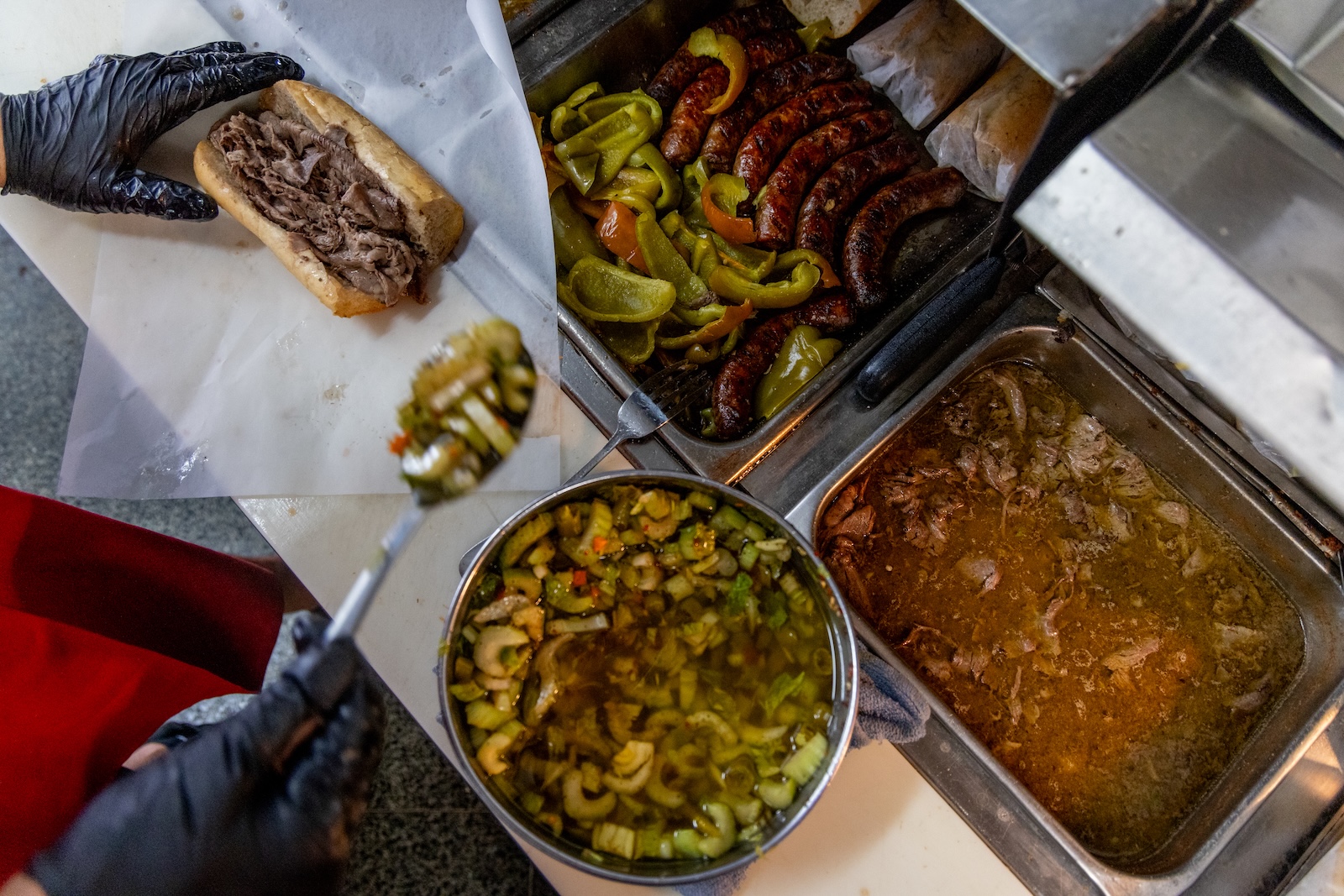

It had snowed seven inches the night before I decided to get gravy bread again — the most snow O’Hare had seen in a single day in decades. I felt like a real Chicagoan, trudging through drifts in snow boots, cursing the ghost train that left me perched under the platform heater like a Costco rotisserie chicken for sixteen extra minutes, before finally heading to Al’s Beef.
You’ve heard of the Italian beef sandwich — thanks to the Chicago-set FX show “The Bear,” it’s practically a household name. But its humble, often-overlooked sidekick, gravy bread? That one rarely gets the spotlight. It’s exactly what it sounds like: toasted French or Italian bread soaked in the rich, savory jus of an Italian beef sandwich. Gravy bread, sometimes called a “soaker,” is neither Instagrammable nor refined. It’s beige, stodgy, unapologetically itself.
Other Chicago delicacies have entire guides devoted to them — the best hot dog stand, a giardiniera ranking, a breakdown of deep-dish versus tavern-style pizza. Gravy bread has none of that glamor.
Maybe that’s exactly why I fell for it so hard.
I grew up just outside Chicago, though “grew up” feels like a technicality. We moved four times before I turned ten, with the threat of a fifth and sixth always dangling in the periphery, which ingrained something of a perennial outsider feeling. In a place, never from it. But this is my third time back in Chicago as an adult, and the first that feels like more than a long layover — the first that’s starting to stitch itself into something like permanence.
Working in food means I’ve always learned cities by eating my way through them, so when I landed here again, I gave myself permission to do a kind of edible survey of the place. Not the hip, media-mandated “taste the city like a local” version — the honest, first-draft one. I started at the outer ring of the funnel: the tourist catnip. Deep dish (still not for me), hot dogs with sports peppers piled as high as civic pride — I’ll fight you for those — then inward toward the rib tips, the tavern-style pies, the jibaritos (sandwiches that wisely swap bread for fried plantains), the jars of hot giardiniera waiting like glitter bombs on corner store shelves.
Maybe that sounds try-hard. Maybe it is. But nobody warns you about the liminal stretch of time when you technically live somewhere — utilities set up, bills forwarded, the DMV clerk squinting at your address in the system — and still feel like a visitor. You’re rooted and unmoored at once. Eating the city felt like a way to close the distance.
And then, without fanfare, my life started to take on the contours of the city itself. Not in grand, cinematic sweeps but in the quiet, accumulating ways that make you realize you’ve rooted more deeply than you intended. Mostly at the intersection of people and food, one of the places where Chicago’s pulse is easiest to feel.
Want more great food writing and recipes? Sign up for Salon’s free food newsletter, The Bite.
I became enough of a regular at the corner grocery that the clerk once held back a good loaf of sourdough because they “thought I might come in today.” I learned my barista’s favorite drink before they learned mine, and I now track the status of their foster dog with the devotion of a godparent. I built out a mental rolodex of congee spots along my morning commute up Argyle Street — that historically Vietnamese stretch on the North Side where steam rises from dining rooms even on the coldest mornings — and found myself falling in love with how nonsensical it is to try to find a breakfast place here that doesn’t serve excellent chilaquiles.
Somewhere along the way I learned that bus drivers give the best cold-weather food recommendations — pragmatic, no-frills gospel. One of them, a man who’d been running the same route for decades, knew the city at stomach level: where to warm your hands, where to sit without freezing, where to eat well for almost nothing.
By the time our paths began overlapping regularly, we had fallen into a gentle rhythm of recognition. We’d chat while waiting at the little Middle Eastern bakery that turns out the neighborhood’s best Barbari bread — long, sesame-and–black-caraway–speckled loaves that come out of the oven so hot the air around them shimmers. The bakery runs on its own kind of liturgy: a punctual 10:30 a.m. batch, and a second that might appear anytime between 4:30 and 6, the sort of unpredictability you start building your afternoon around.
We need your help to stay independent
In that warm, yeasty pocket of the day, we traded food notes — what was good, what was underrated, what was worth the walk. A friendship in increments: a nod, a comment, a shared enthusiasm for dough.
It was after one of those late-afternoon bread drops that he told me about gravy bread, delivering the tip the way someone offers a home remedy, low-voiced and almost tender. “When I was young and broke, I’d get a soaker,” he said. “A dollar, maybe eighty cents. Just the Italian beef jus poured over bread.” He paused, remembering. “There were always little scraps of meat in the gravy, too. Enough to hold you till the next thing.”
In a world obsessed with rankings — the best slice, the best sandwich, the best whatever — he was refreshingly agnostic about where the ideal version might be found. “They’re not always on the menu,” he shrugged, “but any Italian beef joint with bread and gravy will make one for you.”
I promised him I’d try one and report back.
So I did — at Al’s, where a soaker runs $4.50 (another $1.50 if you want a pop) and is described on the menu with the kind of brutal plainness that makes me trust a place: bread dunked in the gravy. Full stop. No flourish. No marketing copy trying to seduce you into believing it’s more than it is.
The thing about foods like this is that chefs have been trying to warn us for years. Anne Burrell with her simple “brown food tastes good.” David Chang celebrating the kingdom of the ugly delicious. A soaker is their thesis statement: a triple-beige stack of crisp-edged bread surrendering to brown gravy, studded with little hunks of meat that run a satisfying gradient from fatty to caramelized. It’s the best part of an Italian beef, distilled and democratized. All comfort, no spectacle.
And when you lift it from the paper boat, warm and heavy in your hands, you understand instantly why people keep coming back to it.
The next time the driver and I crossed paths, we traded updates like neighbors comparing garden crops. He’d finally tried what I maintain is one of the most staggeringly flaky croissants in Chicago — the kind Peter Yuen makes, all shatter and steam, from the bakery four blocks from my apartment. I told him I’d gotten the gravy bread.
“Was it for you?” he asked.
I nodded.
He grinned, this soft, knowing beam that made the whole thing feel like a small rite of passage. “I figured it might be.”
Since then, gravy bread has stopped feeling like a homework assignment on my self-imposed tour of Chicago foods and started becoming something closer to a genuine craving. The kind of carb-y beast I want after a cold walk or an icy bike ride; after a night with one drink too many or some other little vice. Like the driver, I’m not a purist. I’ve had it at Portillo’s, at a couple of mom-and-pop shops, and — on one extravagantly cozy night — ordered it for delivery alongside a deli tub of hot peppers.
Craving enough that, on that seven-inch snow morning, it was the thing that got me out the door.
And sure, maybe falling head-over-heels for something so unabashedly beige — so simple, so structurally unseduced by aesthetics — makes me a bit of a try-hard. Maybe it marks me as someone still learning the contours of the place she calls home.
But honestly? There are worse things to be than a person who lets herself love a city through the food that warms her hands. There are worse things to be than someone who walks out into the snow for a soaker.
Read more
about this topic
