
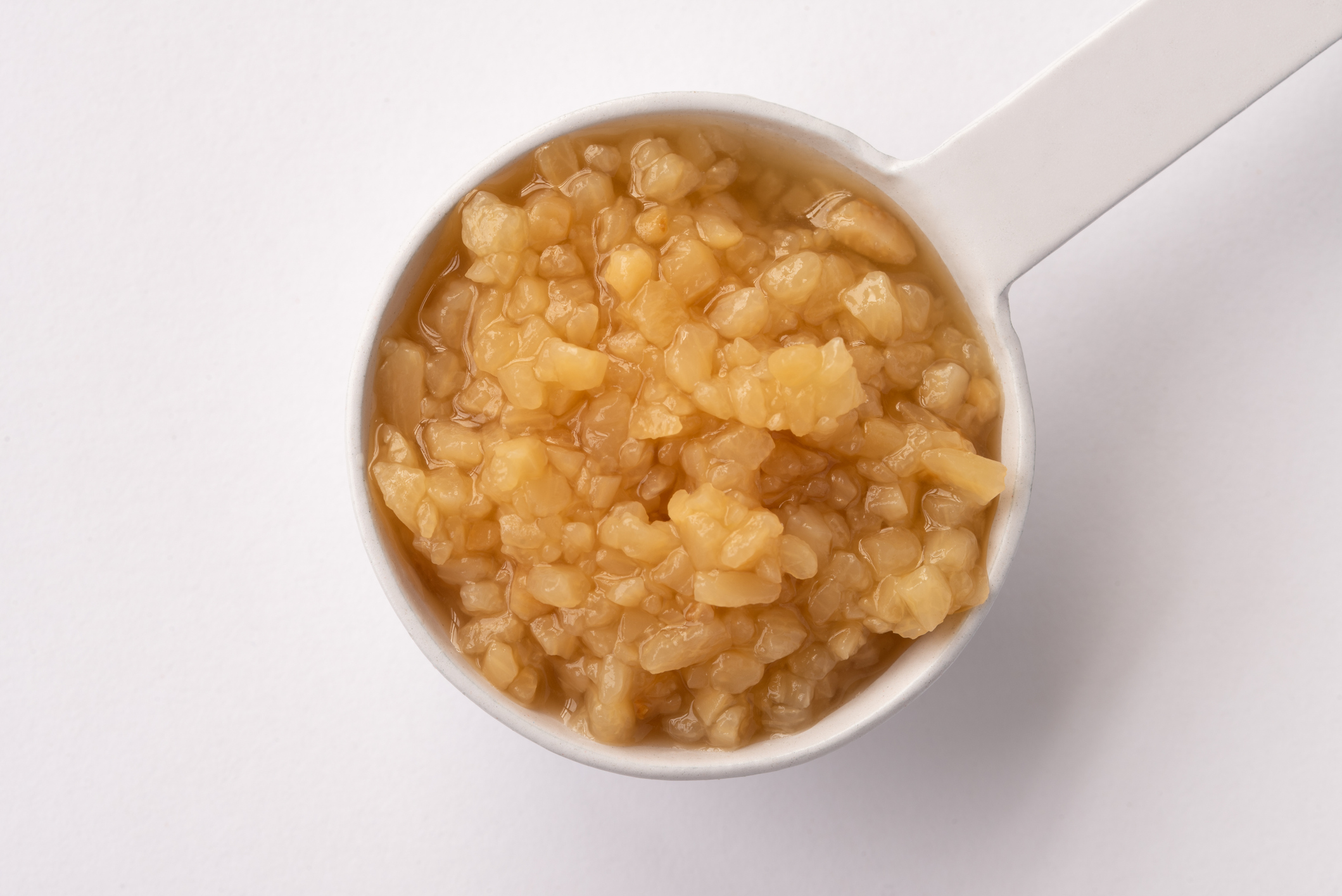

When I think back on 2025, there were several ingredients that shifted how I cooked, but one in particular that changed how often I cooked. Frozen, pre-chopped onions in a bag. The kind you can buy for $2.00 at Jewel-Osco. I had passed them by for years, not because I doubted their usefulness, but because of a vaguely inherited moral resistance to paying someone else to do a task I was technically capable of doing myself. I would linger in the frozen aisle, occasionally lifting a bag into my hand, only to hear— clearly, accusingly —the voices of my female ancestors rising up from whatever afterlife governs thrift, chanting in unison: Just go chop some onions.
I don’t dislike food prep, exactly. But, as I’ve discussed in my ode to the Big Quarterly Prep Day, I do prefer it in ceremonious bursts: a few hours at a stretch, a good playlist, iced coffee sweating onto the counter, the sense that I am provisioning not just dinner but a future version of myself. I chop, bake, mix and freeze with missionary zeal. But between these quarterly bouts of domestic competence lies a slack, unromantic middle ground—weeknights when my freezer reserves have dwindled and my patience along with them.
So when my grocery store ran one of those five-for-five promotions on frozen vegetables — a retail siren song I have never successfully resisted — I tossed a couple of bags of frozen onion into my cart.
What followed felt less like a convenience than a revelation. Suddenly, I was speed-running past a part of cooking that I would, honestly, rather skip on a Tuesday night when I am ready to just curl up with a good bowl of chicken soup or curried chickpeas or pantry pasta — all of which would, in my mind, suffer from a lack of onion, so really necessitated getting out a cutting board and knife. And cleaning a cutting board and knife. And putting away the cutting board and knife.
My repertoire, I realized, is packed with dishes that, in my cosmology, require onions — sometimes several kinds of them — but which I am far more inclined to cook when the onion has already been handled. I’ve always liked Christine Miserandino’s articulation of the “spoon theory,” a metaphor describing the amount of physical or mental energy that a person has available for daily activities and tasks, and how it can become limited.
There are some evenings where you, literally, just don’t have the spoons to deal with a knife.
Want more great food writing and recipes? Sign up for Salon’s free food newsletter, The Bite.
Over time, the frozen onions migrated from impulse purchase to infrastructure. I began to buy them routinely, the way one buys olive oil or rice, as part of what I came to think of as a complete pantry: a collection of ingredients that allowed me to assemble dinner reliably, in the narrow window between work and exhaustion, without the low-grade resentment that so often precedes ordering takeout.
An email from a reader named Andrea Frankel, responding to last week’s issue of the newsletter, clarified the appeal of that small shift for me. She wrote: “I used to be an excellent cook, but age and disability have left me with little energy for it. So I would like to share two of my current ‘pantry heroes’ that save ordinary ingredients and scraps from sad anonymity when time and energy are scarce.”
The first is garlic-infused ghee, which she keeps in multiple bottles throughout her kitchen as its a reliable pick-me-up for anything from vegetables to fish fillets.
“The second is TruLime with garlic and cilantro,” she wrote. “I used to be a snob about only using freshly squeezed juices, but this product instantly perks up lots of things when my hands are too weak to squeeze or all my fruit has grown fuzzy. My favorite is sprinkling it heavily on trout fillets and then sauteeing them in the garlic ghee! Also amazing on buttered cabbage, and as the basis of a dry rub for baked chicken thighs.”
We need your help to stay independent
Between my frozen onions and Andrea’s TruLime, a pattern begins to emerge, one that feels both familiar and slightly uncomfortable. How easily we become snobbish about ingredients that offer smart, flavorful solutions for real bodies and finite energy. What this clarified for me (and what I hope “Bite” readers carry with them into the new year) is a simple truth: ease is not a moral failure, and good food does not require suffering.
Many of the people reading this newsletter are, I suspect, the primary cooks in their households, or one of them. That role comes with a surprising amount of quiet labor: the planning and budgeting, the cooking itself, the cleaning and storing, the ongoing mental inventory of what’s on hand and what’s slipping past its prime. Even remembering — what you bought, what you meant to make, what needs using — can feel like its own kind of work. All of it grows heavier when layered with neurodivergence, disability, chronic pain or plain old end-of-day exhaustion.
Put another way: if you are the person who plans, budgets, remembers, adjusts, compensates and cleans, the friction in the kitchen is not abstract. It lands on you. And it’s reasonable — more than reasonable — to design your pantry in ways that make that load a little lighter.
Let’s talk about a few practical ways to do so.
“Care tasks are morally neutral”
(Ashlie Stevens ) Jarred minced garlic
It’s worth saying plainly that this is not an attempt to lure anyone toward subpar ingredients. I love food. My default response to a meal made with even a modest amount of care or attention is reverence. And one of my deepest hopes—both as a person who loves to eat and someone who works in food—is to help more people feel calm, capable, and creative in the kitchen.
That’s difficult to achieve when you arrive there already frayed at the edges, accompanied by a chorus of familiar voices: ancestral, familial, or perhaps belonging to the sort of influencer who seems to bake exclusively from scratch, in linen dresses, on weekday afternoons. These voices insist that it isn’t “real cooking” unless everything is homemade, that shortcuts signify failure, and that feeding yourself—or others—this way reflects some deeper shortcoming. Add a sink full of dishes from the night before, and it’s easy to see how this quiet pressure accumulates, nudging many evenings toward a resigned, pizza night it is.
But my interest here—especially at the start of a new year—is getting people into the kitchen more, not less. Which is why it feels important to say this plainly: you are allowed to stock your kitchen for the life you actually have.
I often return, in moments like this, to a line from KC Davis, the author of “How to Keep House While Drowning”: Care tasks are morally neutral. Davis uses the term to describe the recurring, never-finished work required to keep ourselves fed, clothed and functioning.
“Being good or bad at them has nothing to do with being a good person, parent, man, woman, spouse, friend,” Davis writes. “Literally nothing. You are not a failure because you can’t keep up with laundry. Laundry is morally neutral.”
The same logic applies to cooking, and to the relative convenience of the ingredients we bring into our kitchens (this is separate from questions surrounding the ethical sourcing of ingredients, which is worth its own conversation in another issue).
We’ve already seen how porous the line is between shortcuts deemed clever and those dismissed as lazy, often determined less by effort than by packaging. Tinned sardines on toast reads as aspirational; canned salmon, to some, does not. A chef friend has Big Opinions on the price at which boxed macaroni and cheese becomes “gourmet.” Frozen onions raise eyebrows (even if just my ancestors’) where frozen broccoli rarely does.
Is cooking entirely from scratch always better? I’d say it depends on the dish — and leave the rest to your personal taste buds. But semi-homemade, cooked with intention, nearly always tastes better than unplanned takeout. And more importantly, it gets you fed.
How to design a kitchen for how you actually cook
(Ashlie Stevens ) Bottled lemon juice
Designing a kitchen for how you actually cook begins, mercifully, not with a purge or a purchase, but with a little attention. Over the course of a week or two, it can be enough to notice two things: the moments when you wanted to cook and didn’t, and the tasks that made you quietly wish something had already been done.
Some of this friction is inevitable; care tasks are cyclical, after all, and no system abolishes effort entirely. But patterns tend to announce themselves if you let them. Perhaps you find that your enthusiasm reliably stalls at the thought of mincing garlic. In those moments, would jarred garlic, a squeeze tube of paste, or even garlic powder tip the balance? Or maybe you love what a little ginger does to soups or oatmeal but resent the peeling and grating it demands. Those frozen cubes of crushed ginger—now available nearly everywhere—can feel less like a shortcut than a small mercy. Want to add chicken to dinner without hauling out a grill or roasting a whole bird? Pre-shredded rotisserie chicken has quietly entered the canon for a reason.
It helps to approach these swaps the way you might any new ingredient: experimentally, without pressure. Some dishes will still call for the long road, and you’ll take it gladly. Others may surprise you. The point isn’t to optimize every meal, but to remove the specific frictions that keep you from cooking at all.
Some of my favorite recent shortcuts
(Ashlie Stevens ) Canned salmon
Other than those frozen onions, a few of the shortcuts I return to most often lately:
Canned salmon
The foundation of one of my favorite lunches: salmon mixed with Kewpie mayonnaise and chili crisp, spooned over rice with cucumber and finished with scallions. It’s also excellent piled onto an everything bagel with a smear of avocado and a little lemon zest—proof that something can be both convenient and genuinely craveable.
Frozen chopped basil and cilantro
I keep these tucked in the freezer for weeknights when a soup, braise or pasta sauce needs fresh flavor but I don’t want to deal with wilting herbs or a cutting board. A small addition, but one that reliably changes the tone of a dish.
Pre-cooked gnocchi
Roasted on a sheet pan with vegetables, slipped into chicken soup or dressed simply for a low-effort pasta salad. They’re forgiving, versatile and happy to meet you wherever your energy happens to be.
Roasted vegetables from the olive bar
Trust me on this one. They’re ideal layered into sandwiches, folded into grain bowls, or eaten straight from the container while standing at the counter.
A brown gravy packet
Not something I use often, but something I’m glad to have. It adds depth to weeknight beef stew when hours of simmering aren’t on the table, and lends a savory, umami backbone to mushroom stroganoff that tastes far more intentional than the effort required.
This story originally appeared in The Bite, my weekly food newsletter for Salon. If you enjoyed it and would like more essays, recipes, technique explainers and interviews sent straight to your inbox, subscribe here.
Read more
from “The Bite”
