
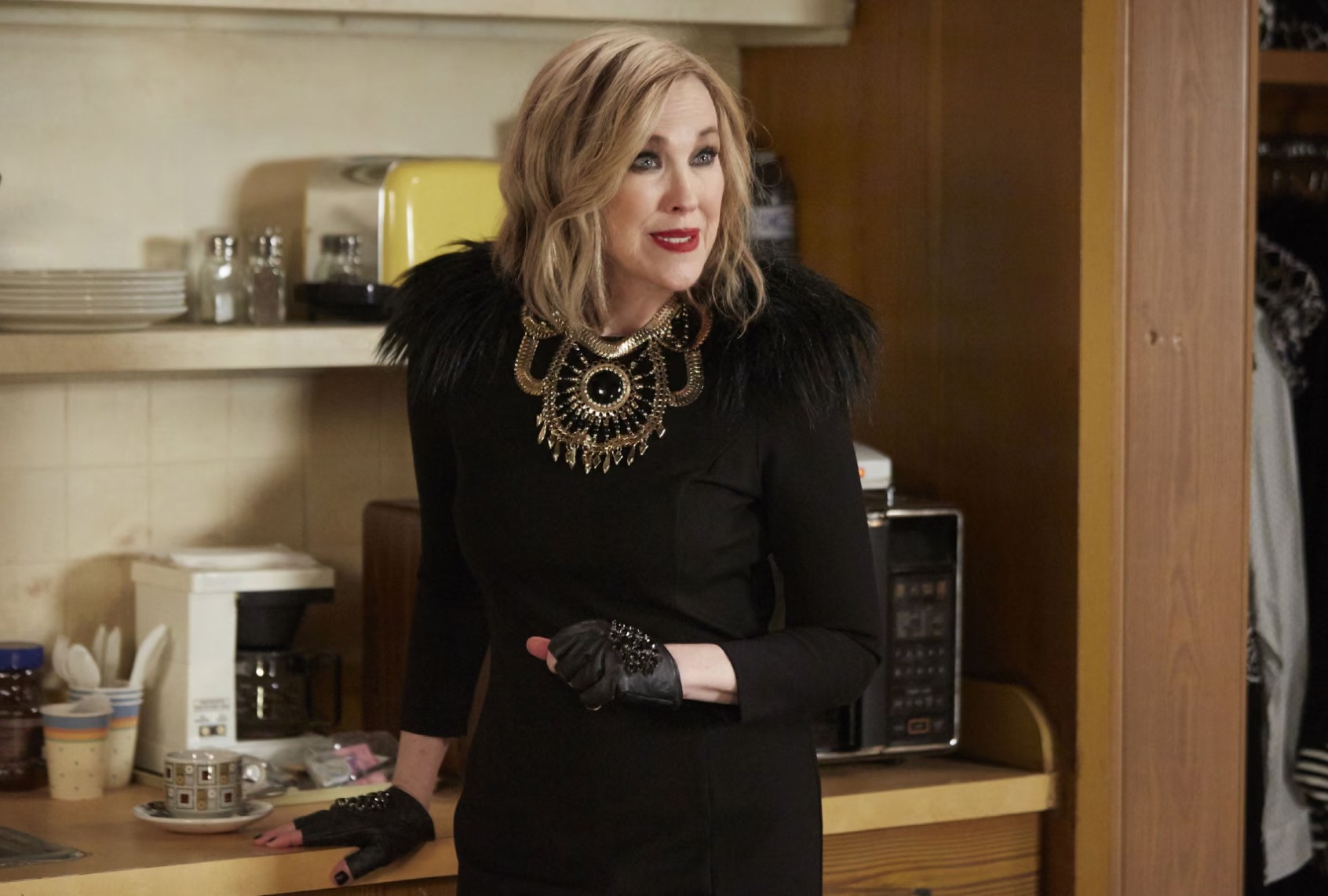

Motherhood’s long association with martyrdom is a real turn-off. Few understood that better than Catherine O’Hara, who played one of cinema’s most self-sacrificing moms – and several of its least.
As harried Kate McCallister in “Home Alone,” she hurtles across the Atlantic and back for the sake of reuniting with her youngest son, Kevin (Macaulay Culkin), who was accidentally left behind in Chicago at Christmas.
A quarter of a century later, on “Schitt’s Creek,” she regaled us with Moira Rose, a former soap opera actress and exiled socialite who ranks relating to her adult offspring a few notches below maintaining her wigs on her list of priorities. Kate declares she’ll sell her soul to the devil himself to be reunited with her baby boy. Moira responds to her adult son’s certain presumption that parents are supposed to put their children first with a firm dismissal.
“If airplane safety videos have taught me anything, David,” she retorts, “it’s that a mother puts her own mask on first.”
O’Hara, who died Jan. 30 at the age of 71, wasn’t expressly typecast in maternal roles over the span of her five-decade career. But she would not have built her reputation as a comedic force without understanding the expectations society places on women regarding maternity.
Somewhere between a yearning for motherhood and a woman’s understandable hesitation about it is where the bulk of O’Hara’s onscreen interpretations lived — confidently, outlandishly, and except for Kate, clad in eccentricity.
And if you had that kind of a mother — or better, if you are that kind of a mother — the merry derangement O’Hara brought to her performances was soul-satisfying.
To cherish O’Hara for these immortalizing parts is to acknowledge her awareness that a parent’s relationship with each of their children is a two-hander. The standard parent-child screen dynamic shuffles mothers to the wings, quietly prodding their kids to fight their way into top billing. “Home Alone” certainly made Culkin a star, which was its intention, and O’Hara, by dint of John Hughes’ characterization, an able partner.
But when we picture Kate McCallister’s eye-popping shock as she shrieks, “KEVIN!” that is the result of attuning to the audience’s ticklish spots over years of sketch work with Toronto’s Second City troupe, which O’Hara joined in 1974. It’s a shade of slapstick in a movie constructed around juvenile pratfalls and targeted destruction that allows Kate to retain her dignity.
Before she broke out in 1988’s “Beetlejuice,” O’Hara was mainly known for her sidesplitting impressions on “SCTV,” parodying outsized icons such as Lucille Ball, Tammy Faye Bakker and Katharine Hepburn. One of her original creations, the faded cabaret queen Lola Heatherton, armored herself in plastered-on wigs and stage finery, façades obscuring the jittery desperation of a woman hanging on by the quicks of her fingernails.
National exposure followed once “SCTV” launched on Canadian television in 1976, and a brief NBC run established her as central to the show’s legend, alongside fellow players John Candy, Martin Short, and frequent collaborator Eugene Levy.
Somewhere between a yearning for motherhood and a woman’s understandable hesitation about it is where the bulk of O’Hara’s onscreen interpretations lived.
One of many frustrating truths about the entertainment industry is that for the longest time, talented funny men have had a much broader range of roles available to them than their female peers. While Candy and Short’s careers hit their stride in the mid-‘80s, O’Hara popped up in small parts, including in Martin Scorsese’s cult comedy “After Hours.”
As she told Salon in 2000, her manager gamely spun her disappearance from public view as intentional, that she was holding out for suitable scripts. Cut to 1986, when they planted this seed in a People magazine profile by Franz Lidz. “Currently unattached,” it reads, “Catherine — who once dated Dan Aykroyd — is planning to ‘fall in love, get married and have children. Maybe tomorrow.’”
Tomorrow came, along with dozens after it, until we land on her 1990 “Tonight Show” appearance hours before “Home Alone” opened in theaters nationwide. By then, she’d put her knack for winking impressions of high society divas to stunning use in “Beetlejuice” as Delia Deetz, a haughty stepmother and artist whose gargantuan ego dwarfs her talent. (O’Hara also met her eventual husband, production designer Bo Welch, on that production.)
And yet, she confesses to Johnny Carson and his studio audience that she’s not so sure about becoming a wife.
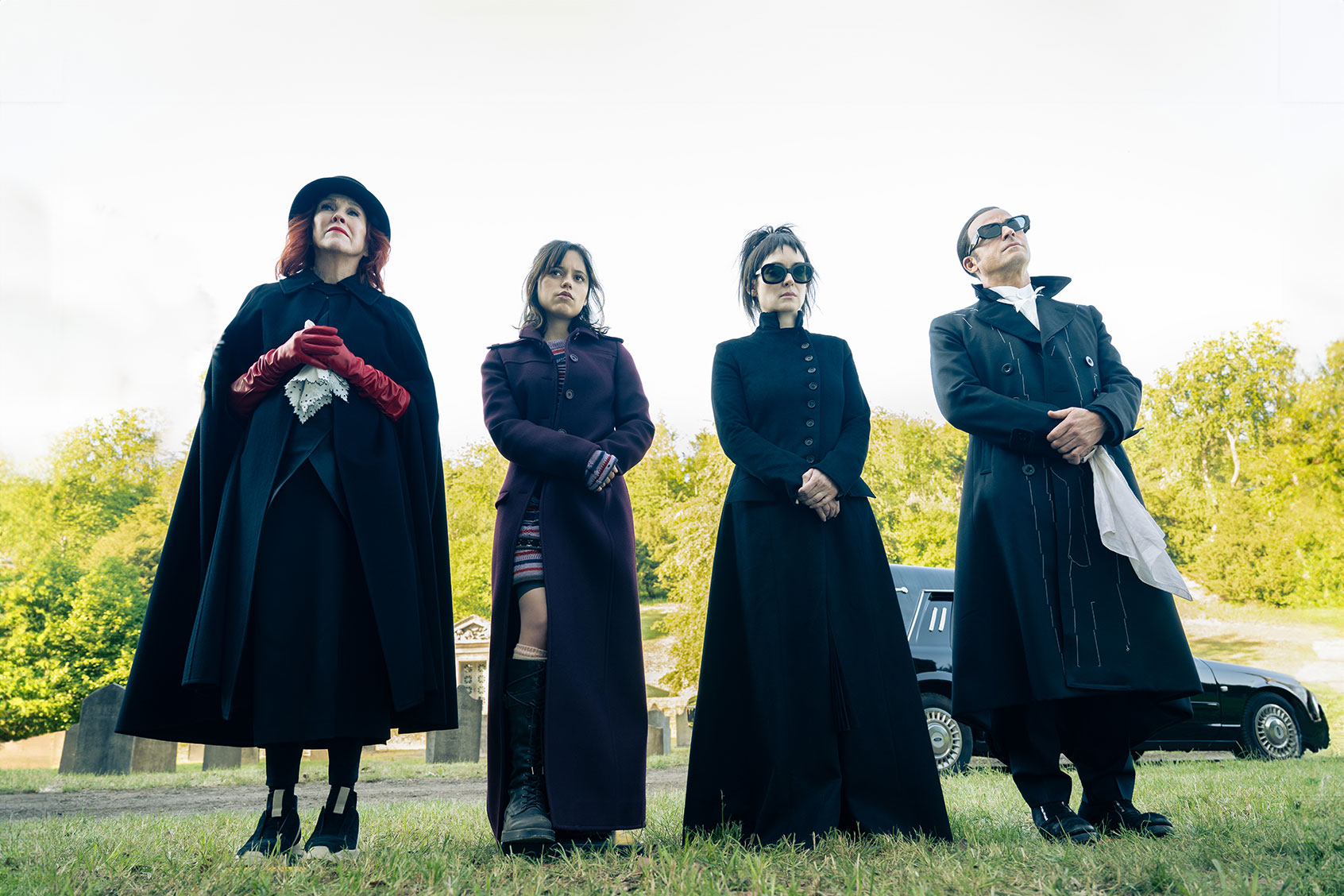
(Warner Bros. Pictures/Parisa Taghizadeh) Catherine O’Hara as Delia, Jenna Ortega as Astrid, Winona Ryder as Lydia and Justin Theroux as Rory in “Beetlejuice Beetlejuice”
“I think about marriage every day, yeah,” says O’Hara, “but I can’t make up my mind about whether it’s natural or not.” From where she was sitting at the time, who could blame her? After nearly a decade-long career stall-out, O’Hara seemed to be everywhere in 1990, thanks to roles in that summer’s blockbuster “Dick Tracy” and the Alan Alda-directed “Betsy’s Wedding.”
The release of “Home Alone” capped an incredibly productive streak. She could not have known it would fuse her into the public’s consciousness as a devoted mother figure. And looking back, that “Tonight Show” appearance marks a distinct border between what O’Hara was and what she became.
We can see Lola’s influence, along with the rest, in some portrayals more obviously than others. Delia and Moira are perpetually switched on throughout their waking hours, as if they’re aware of the public’s inability to imagine them wearing anything other than their most corseted get-ups and a blazing red lip. Every part O’Hara played drew on the spirits of her many sketch personas, especially their stubborn unwillingness to erase themselves in service of other people — including, for better or worse, their children.
We need your help to stay independent
In 1996, David Keating cast her as Cathleen, the boisterous mother to a sullen teenager played by Jared Leto in “The Last of the High Kings.” You’ve probably never heard of this movie because it went straight from festivals to video, released in the U.S. under the entirely ignorable title “Summer Fling.”
Although Keating and his other main star, Gabriel Byrne, wrote it as an Irish coming-of-age story, O’Hara’s Cathleen runs off with the movie. Her easy physicality amplifies the yearning hiding beneath Cathleen’s brashness; it’s only when a visiting American (Christina Ricci) prods Cathleen to share something about herself that we find out she’s a classically trained actor who relinquished her vocation to chase her kids.
In some sense, this is akin to the realization that dawns on most people regarding their parents: Before we came along, they had a whole identity that had nothing to do with us. Maybe, if we are very lucky, they integrate us into that flow. More typically and woefully, our parents submerge it.
Philosophers and child psychologists have dozens of thoughtful opinions about what mothers are or should be to their children. Only a few land on the side of the parent keeping what they loved about their essential selves intact, cautioning against placing the burden of what could have been on the shoulders of their offspring. Then again, Cathleen never really stops performing. She leaps on the wall dividing her home and that of her stuck-up neighbors, in heels no less. In another scene, she chases a lovelorn boy to the roof of a local building, remaining there to enjoy the view and the wind in her hair after he’s descended.
“Are you sure she’s your ma?” one of her teenage son’s awestruck friends asks while gazing up at her. “If she were your sister, I could really fancy her.”
Every part O’Hara played drew on the spirits of her many sketch personas, especially their stubborn unwillingness to erase themselves in service of other people — including, for better or worse, their children.
“Home Fries,” another little-seen feature (this one written by Vince Gilligan), presents O’Hara as Beatrice, a mother who persuades her adult sons to scare their philandering stepdad to death. O’Hara, who had only recently given birth to her second son, described Beatrice as a “dangerous mother, every parent’s nightmare” in a 1998 interview with Canadian broadcaster Dini Petty.
“She just wants to affect her children to her own benefit in each moment,” she said, “You know, trying to get them to do what she wants to do, but will take no responsibility for any effect she has on her children.”
Funny, isn’t it? O’Hara’s disdain for that character is only outdone by her affection for Moira Rose, of whom one can say the same.
“Schitt’s Creek” allows O’Hara, through Moira, to turn the tables at every opportunity, stealing focus from her children, David (Dan Levy) and Alexis (Annie Murphy), to make them fight for a spot in her narrow patch of sunshine. (“Sadly, and most of the time, we have no interest in what’s going on with you,” she gently coos at them in the appropriately titled first-season episode, “Bad Parents.”) But Moira’s foibles and extremes are lovable enough for us to forgive her cluelessness. Her melodramatic sorrow at her stilted relationship with Alexis is palpable even as she mourns her daughter’s unwillingness to join her on a wine tasting tour in France . . . when Alexis was seven.
“You could have used the spittoon! That’s what the other children did, but you weren’t interested,” Moira whines. “It’s as if you didn’t want to be seen with me.”
Want more from culture than just the latest trend? The Swell highlights art made to last.
Sign up here
None of this implies O’Hara didn’t love being a mother in real life. In 2024, she told TMZ that the role for which she most wanted to be remembered was as the mother to her two sons, who survive O’Hara along with her husband.
Rather, that contented knowing seasons the confidence with which O’Hara shaped all of her women, whether mothers or, like Patty Leigh in “The Studio,” mother figures. In a telling exchange with Seth Rogen’s Matt Remick, the protégé who fills her throne when the men above her push her out of her job, Patty somberly spells out the truth of the thankless task he’s taking on, one she successfully shouldered for years.
“But when it all comes together, and you make a good movie,” she says, “it’s good forever.” The way O’Hara gilds this line’s delivery with a wistful sparkle feels true because we’ve seen her spin such treasure playing all kinds of would-be topliners with an amiable, delicious amount of lunacy. And we’ll never really know what she surrendered to lock that picture in our collective hearts and memories so completely and wonderfully. Like all the great women we adore onscreen and in our lives, she pulled all of it off like it was nothing at all.
Read more
about this topic
