

In a Season 3 episode of “And Just Like That,” fussy gallerist Charlotte York is emphasizing to three assistants the significance of a bed piled with unkempt sheets, a used condom and empty bottles of booze. The installation was made in the ’80s, “a pre–Lena Dunham era,” Charlotte says solemnly. None of the assistants push back on the idea that messy self-abjection belongs solely to Dunham.
Emin’s explosive entrance into cultural consciousness happened at a time when the feminist mantra “the personal is political” was being taken quite literally and, in many cases, understood to mean that personal art and writing were inherently feminist acts.
Later, at the opening, a character looks at the bed — which now has a pale, naked woman lying face down on it — and says, “This would be my life if I didn’t wear deodorant.” By the end of the episode, a vertigo-stricken Charlotte has tipped over into the bed and disturbed the installation.
It’s not surprising that “AJLT” mined cheap laughs from art presented as self-indulgent; its tone, along with its predecessors’, was careful to balance out a rejection of hidebound convention with reassurance that it’s not earnest enough to treat visual art as anything other than a set-up for jokes. But the episode’s timing was notable: It aired in Summer 2025, more than 35 years after artist Tracey Emin created the installation it lampooned, and less than a year before Emin’s new show, “A Second Life,” opened at London’s Tate Modern.
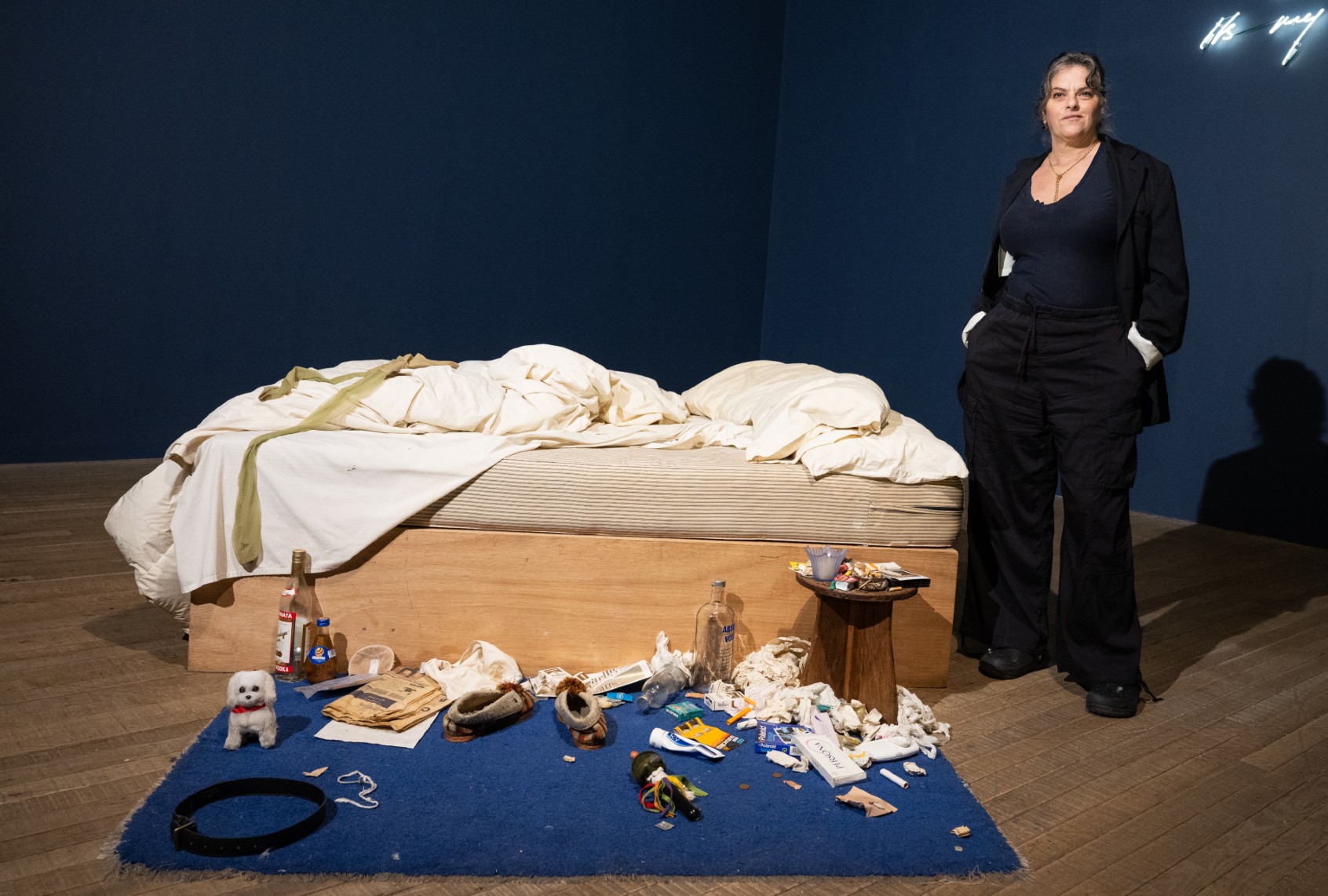
(Jeff Spicer/Getty Images) Tracey Emin pictured with “My Bed” at the “Tracey Emin: A Second Life” exhibition at Tate Modern
It’s tempting to see in this framing a tidy summation of how art made by women often comes with an invisible asterisk — is it really art? — but another interpretation might be that Charlotte’s gallerinas just can’t understand why such an installation would ever have been a controversial statement to begin with. Both readings underscore why Emin, now 62, has never stopped talking about art as an extension of her life — a way to make sense of formative traumas of rape, poverty and abuse, a way to normalize experiences, like abortion, that many women have but few, still, are encouraged to talk openly about.
Unlike the AJLT knockoff, “My Bed” remains a striking work because it’s the kind of mess that women endeavor to keep hidden — it is proof of having a body that exists in an unruly state; evidence of bad decisions and self-abnegation, and a kind of visual confirmation that something’s wrong. The mattress sits on a platform that itself rests on a swatch of blue carpet; along the bottom of the platform, a jagged line of empty bottles, cigarette packages, tissues, tampons, underpants stained with menstrual blood. There’s a discarded belt, a raggedy pair of slippers, a pile of used tissues, an overflowing ashtray, a quizzical-looking stuffed dog. Its visceral, nearly smellable despair is made haunting by the empty bed itself.
Emin created the piece after spending four days in her own bed, crushed by a bad breakup, smoking and drinking and sweating into the sheets. And yet she recalls recognizing, when she finally did leave the wretched scene, that it could be art: “I just saw it in a white space, I saw it out of that environment and, subconsciously, I saw myself out of that environment, and I saw a way for my future that wasn’t a failure, that wasn’t desperate. One that wasn’t suicidal, that wasn’t losing, that wasn’t alcoholic, anorexic, unloved.” For Emin, the piece captured the honesty of a low moment; for the viewing public — particularly after it was nominated for the UK’s prestigious Turner Prize in 1999 — it was a provocation, an overshare. Scandalous. Self-indulgent. Vulgar. This might seem counterintuitive, given that sadness, heartbreak and inertia are feelings most humans can arguably understand. But the simultaneous confession and confrontation of “My Bed” unleashed an anger and disgust meant to dehumanize the artist herself.
The piece was savaged by the British press with words like “disgusting,” “solipsistic,” “navel-gazing” and “self-centered,” and Emin herself was derided as a craven exhibitionist, “a silly show-off” and a purveyor of “tortured nonsense” that anyone could do, even if they didn’t. It’s not a stretch to say that the U.K. experienced “My Bed” as a national affront; a Daily Mail review suggested it was a harbinger of civilization’s downfall. The contradictions of the backlash were ones that became a hallmark of art made by women in the internet age: “My Bed” wasn’t real art because it recreated the life of a single degenerate, and yet its very existence was somehow also a threat to decency; Emin was a meaningless, filthy woman, yet meaning was inferred in everything she said or didn’t say about the piece.
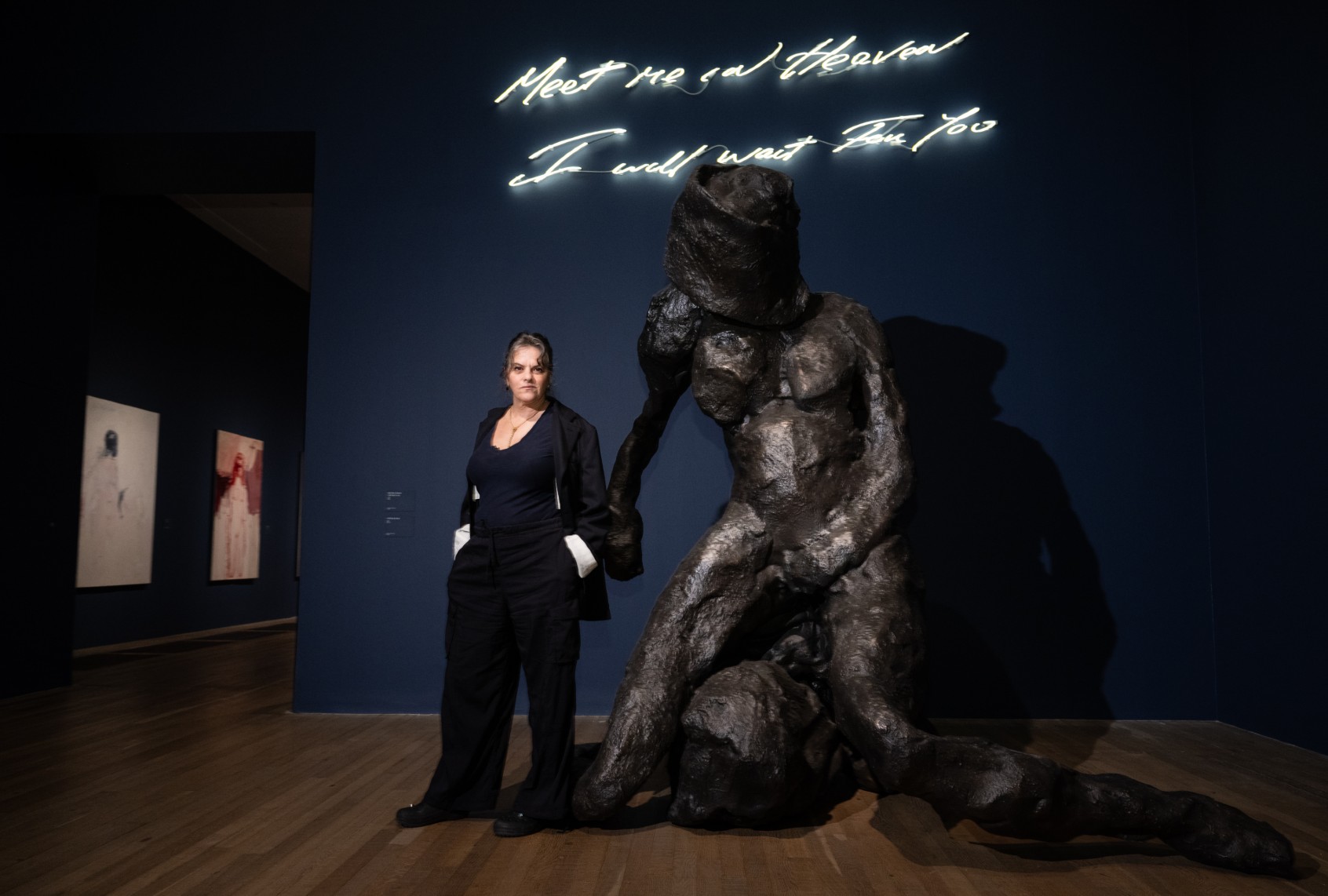
(Jeff Spicer/Getty Images) Tracey Emin pictured with “I Will Not Be Alone” and “Meet Me In Heaven I Will Wait For You” at the “Tracey Emin: A Second Life” exhibition at Tate Modern
Emin’s explosive entrance into cultural consciousness happened at a time when the feminist mantra “the personal is political” was being taken quite literally and, in many cases, understood to mean that personal art and writing were inherently feminist acts. Her ascent was also echoed in the informal communication style that defined blogging and social media; the memes and macros that became internet-speak weren’t far removed from the brightly colored outbursts, sentence fragments and snippets of dialogue that Emin appliquéd onto blankets.
The furious reaction to “My Bed” would recur in the coming decades in response to any number of things done by young women: blogging, activism, making music, dancing, writing for TV. Male antiheroes dominated prestige-cable dramas, outsized and magnetic; their dubious morality and unreliable narration made them figures of fascination, if not outright envy. But as women characters likewise grew weirder, messier and less likable, their very existence was treated as an existential threat: How could women continue to clean up messes if they were the ones making them?
Want more from culture than just the latest trend? The Swell highlights art made to last.
Sign up here
Part of what made Emin’s work so unsettling was that it wasn’t just visual, but also tactile, experiential and loud. Her words — confessions, accusations, accountings and impressions — were scrawled on paper, sewn into tapestries, sculpted in neon and recorded in films. But the work itself wasn’t unprecedented: As with other women whose art centered the unpredictability of female bodies (among them Kiki Smith, Nan Goldin, Carolee Schneemann and Emin’s mentor, Louise Bourgeois), there was an assumption that their mess wasn’t organic, but was intended to shock or upset an audience.
But the things that made Emin read as attention-seeking or histrionic became the norm as a new millennium took shape. For girls and women, the internet was a space where disclosure was not only accepted but expected, and the changing economics of media led to the rise of online content that processed current events, political issues and human-interest stories not through news or investigative reporting but via first-person essays. Things previously kept secret were refashioned as healthy, even necessary, to disclose. The #MeToo movement, Emin noted, was not only a way to demand accountability from predators and enablers; it was a validation of her existing work: “Previously, people just thought I was moaning and whining and sulking,” she said. “When actually I was writing about teenage sex, rape, abuse, child abuse, abortion — all issues that women and young girls face.” The themes that people were able to ignore in one woman’s work became more difficult to minimize when they began resonating with a global audience: “People had to come to terms with the fact that I was talking about big subjects.”
The things that made Emin read as attention-seeking or histrionic became the norm as a new millennium took shape. For girls and women, the internet was a space where disclosure was not only accepted but expected.
The world had finally started catching up to Emin’s art when she was diagnosed, in 2020, with aggressive bladder cancer. The second life referenced in the title of her Tate Modern retrospective refers to the fact that, despite a grim prognosis, she is still here. Her body is unruly in a different way since having surgery to remove her bladder, uterus and urethra, along with half her vagina. She’s had to acclimate to new bodily indignities, like the urostomy bag that externalizes what was formerly a concealed process. But she rejects the idea that these changes, radical as they are, are a signal that her body is no longer part of her work, telling The Guardian that “If talking about it is getting on with it, expressing myself, then yeah I will, because it’s much better than the alternative – a hundred million times better.”
Emin moved from London back to her hometown of Margate in 2017, and after buying and renovating several buildings — the town’s former mortuary and its public bathhouse, as well as a facility that once housed a printing press, among others — and established the Tracey Emin Artist Residency (TEAR) which offers studio and gallery space to emerging artists from around the world; and TKE Studios, which provides space for local artists. Her journey from the margins of the art establishment to its center has given her a vantage from which she sees the possibility for artists to have an art education without being a product of art school.
We need your help to stay independent
But even after decades of success — solo shows worldwide, a teaching appointment at the Royal Academy that made her one of two women to ever teach there, the title of “Dame” bestowed by King Charles — there’s an entrenched distrust of women who are their own subjects that flares up in coverage of Emin. Last week, an article in the New Statesman bore the headline “It’s hard being Tracey Emin: A major retrospective at the Tate Modern shows how the artist became the queen of the confessional – but is her work any good?” — and kicked off with an astonishingly condescending list of questions. “[W]hat if young Tracey Emin hadn’t slept with so many feckless youths and older chancers in Margate? What if she hadn’t been abused as a child? What if she hadn’t been raped at 13? What if, as the daughter of a Turkish-Cypriot father and Roma mother, she hadn’t suffered racist abuse while growing up? What if she hadn’t had a botched abortion to terminate twins?…. What if, instead, she had fallen in love as a teenager and married her sweetheart and lived contentedly as a fashion designer or dancer – both of which she once wanted to be?”
The answer, author Michael Prodger concludes, “is that she would have made no art at all, because she would have had no subject.” A quick review of Prodger’s other writing on art confirms that he doesn’t use speculative fallacy to introduce all the artists he has written about, nor does he assess their work with the assumption that true art can only be made by an artist somehow completely unburdened by subjectivity. “What if Tracey Emin, an artist, had not been an artist?” isn’t a question, but an admission of a continued double standard levied on women artists — who, as this learned critic surely is aware, were barred from art education alongside men, and when they eventually were granted admission to art schools, had no choice but to become their own subjects because they weren’t permitted to do life drawing from unclothed models as their male classmates did.
But in a way, Prodger’s piece marks a full-circle moment: It shows how much has changed since 1998, when opinions like his were the norm; and it underscores Emin’s success as one made possible by — and not in spite of — her determination to remain a glorious, full-spectrum and heartbreakingly human mess.
Read more
art and economy
