

In my early 20s, my favorite movie theater was a once-grand, crumbling landmark where you almost never had to search out a seat. After the previews, a young John Waters appeared onscreen, cigarette in hand, to say, “I’m supposed to announce that there is no smoking in this theater, which I think is one of the most ridiculous things I’ve ever heard of in my life. How can anyone sit through the length of a film — especially a European film — and not have a cigarette?”
Smoking cigarettes is objectively one of the worst things you can do to your body, a thing that leads to some of the most excruciating deaths possible, but it looks cool because it was socially engineered to look cool.
At the time, I’d recently stopped smoking. I didn’t miss it very much: Yes, there was something calming and meditative in watching the smoke undulate as it faded, the neatly rolled paper crackling and burning as it sent up tiny sparks, but there was nothing meditative about chronic respiratory infections. It was only when I went to the movies and saw Waters on the screen grinning down at us that I yearned for one cigarette. There’s no way around it: He made smoking look very, very cool.
Let me be clear: Don’t smoke cigarettes. It’s a foul, unhealthy habit that stains your teeth and etches lines around your mouth and makes your fingertips reek. It sinks into your clothing and the walls of your apartment, lingering like an acrid ghost. But none of us would have to emphasize how bad cigarettes are if smoking them didn’t look so good: To wit: On a November 2025 episode of “Good Hang with Amy Poehler,” Maya Hawke told a story about experimenting with cigarettes as a teenager, “which you shouldn’t do and is bad.” Poehler fixed her with an angry-mom face and repeated, “Very, very bad. Very, very bad. You look very cool. Don’t do it.”
Smoking cigarettes is objectively one of the worst things you can do to your body, a thing that leads to some of the most excruciating deaths possible, but it looks cool because it was socially engineered to look cool. Nobody is unaware of this: The anti-tobacco movement is among the most successful public-health campaigns in history. Billions of pages of research and testimony outline the many ways cigarettes are terrible and how exactly they will decimate your health and quality of life; Since 2020, cigarette manufacturers have since been required to cover nearly every inch of their packaging with no less than 11 warning labels, some of them photorealistic depictions of smoking’s effects — rotting lungs, neck tumors, gangrenous feet. And yet roughly 18 million packs of cigarettes are purchased each day in the United States by people who look at those images and light up anyway. In the most literal sense, smoking remains terribly, awfully cool.
And, apparently, it’s having a comeback. “Smoking is cool again!” announced The New York Post’s Page Six earlier this month, gushing over Sarah Pidgeon, portraying Carolyn Bessette Kennedy in Ryan Murphy’s “Love Story,” “looking incredibly chic in her ’90s minimalist outfits, taking casual drags from her cigarettes.” Below the fold, the article’s tone changes drastically, dropping devastating statistics on the health risks that, again, everyone knows about.

(James Devaney/GC Images/Getty Images) Kristen Stewart seen on the streets of Manhattan
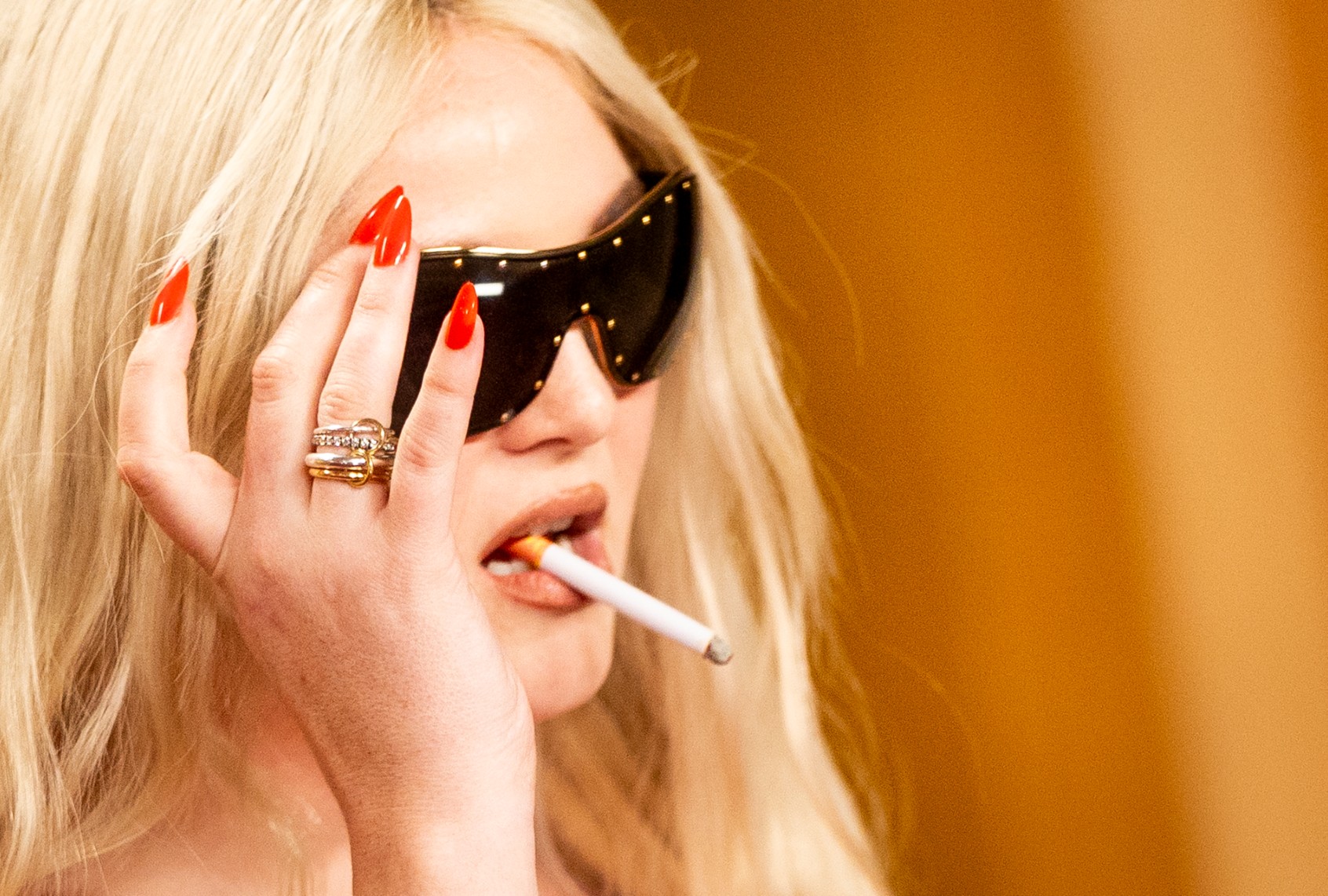
The fact that young, beautiful people look even better holding a cigarette seems to be the latest way to signpost cultural relevance and a kicky rejection of political correctness. The Cigfluencers Instagram account, which posts nothing but photos of cigarette-smoking celebrities, spent Oscar night celebrating the smokers who triumphed in their acting and directing categories. On the cover of this month’s Vanity Fair, a manspreading Kylie Jenner lights up defiantly. Charli XCX is regularly photographed with cigarettes, and allegedly had silver trays of loosies at her 2025 wedding. A W magazine story on Oscar nominees featured “Marty Supreme”’s Odessa A’zion striking a pose with a heater; her “I Love L.A.” costar (and show creator) Rachel Sennott has been spotted with cigarettes both onscreen (they’re herbal) and off (they’re not). And “Heated Rivalry” heartthrob Hudson Williams was recently photographed outside the Georgio Armani show during Fashion Week in Milan, smoking a cigarette like he was auditioning for Federico Fellini: In other words, looking breathtakingly cool.
Want more from culture than just the latest trend? The Swell highlights art made to last.
Sign up here
The new class of young Hollywood kids does not need to be told that cigarettes are coffin nails. Most of them grew up in the 2000s and 2010s, after all the cigarettes were digitally removed from the Curious George books and well after smoking was banned in bars, restaurants, office buildings, and concert venues. Content warnings on the streaming shows they star in include “smoking” alongside “violence,” “strong language,” and “sexual situations.” They know that secondhand smoke kills and firsthand smoke annihilates. They know better. In 2023, a photo of then–20-year-old “Wednesday” star Jenna Ortega mid-drag went viral, causing a reported meltdown among her young fans. “Some refuse to believe the video is real, claiming it to be a deepfake,” reported Poptopic. “Others expressed disappointment, suggesting that the act makes her less attractive.” In response, her mother — a registered nurse — posted a series of anti-smoking facts and memes on her own Instagram page, a pointed message to her daughter’s fan base.
And yet, commenters admitted of Ortega, “She looks hot af.”
I had the misfortune to grow up in the 1970s and 1980s as the child of extremely attractive, nicotine-addicted parents, which means I imprinted on people who regularly fired up little poison sticks in the family car with the windows barely cracked. My already formidably cool older siblings smoked. Sometimes, after they’d visited, I would go into the attic and take several big whiffs of what, to me, was the scent of adulthood. No one had to peer-pressure me into smoking; it was never not cool, even after my father died of lung cancer. The people who taught me learned that from their parents, who learned from their parents. And it was all thanks to one man: Edward Bernays.

(Gotham/GC Images/Getty Images) Jeremy Allen White in Tribeca
The fact that young, beautiful people look even better holding a cigarette seems to be the latest way to signpost cultural relevance and a kicky rejection of political correctness.
Bernays is known as the father of modern public relations in America. A wizard of mass persuasion, he advised Calvin Coolidge on how to leverage wartime propaganda during times of peace; smoothed the way for the NAACP’s 1920 conference in Atlanta, Georgia; and invented the soap opera, along the way inspiring the singular evil of Joseph Goebbels. Bernays was also the American nephew of one Sigmund Freud, and based his techniques on his uncle’s theories of the unconscious. Harnessing the unconscious desires of consumers would become the bedrock principle of selling to America: Not products, but feelings. Not what you buy, but who you are.
In the 1920s, Bernays worked with the American Tobacco Company to address a problem: Because it was considered so unseemly for women to smoke that they were prohibited from doing so in public, cigarette manufacturers were losing the prospective business of half the population. Coinciding with the suffragette movement, Bernays’ campaign identified cigarettes as a tool of women’s liberation, devising euphemisms (not cigarettes, “torches of freedom”), a gendered freedom-focused framing (“Fight another sex taboo”) and a highly publicized event in which women walked down New York’s 5th Avenue brandishing Lucky Strikes. The target of the campaign was what Freud had identified as penis envy: Consulting with A.A. Brill, a student of Freud’s, Bernays reasoned that smoking was a way for women to have their own penises, and thus could be convinced to associate smoking with challenging male power.
We need your help to stay independent
Appealing to the subconscious became an indelible part of Hollywood even before the silent era ended. Cigarettes functioned as character shorthand, portended shady or treacherous dealings, and — thanks, Freud — stood in for sex. Tobacco companies paid movie stars to smoke their products on screen and star in ads; in the late 1970s and ’80s, corporations like R.J. Reynolds and Philip Morris struck official (but obviously unpublicized) deals that put their brands on screen, with the latter’s marketing brief stating “We believe that most of the strong, positive images for cigarettes and smoking are created by cinema and television.” “You often hear these days that, ‘Oh, everyone smoked in the 1920s and 1930s,’” Stanton Glantz, founder of the anti-tobacco watchdog organization Smoke Free Media, said in 2022. “But it turns out that people back then smoked less than they did 10 years ago. The reason people now think people smoked so much then is that the movies back then had so many people smoking.”
Hollywood celebrities would become associated not only with smoking, but with how they smoked. Marlene Dietrich smoked seamlessly, as if cigarettes were an extension of her arms; Audrey Hepburn made cigarettes a must-have accessory; Humphrey Bogart puffed cynically. If Steve McQueen didn’t have a cigarette in his mouth, could you even see him? And I know more than one person who picked up a temporary habit after seeing Wong Kar-wai’s “In the Mood For Love,” in which Tony Leung and Maggie Cheung play the world’s most soulful smokers.
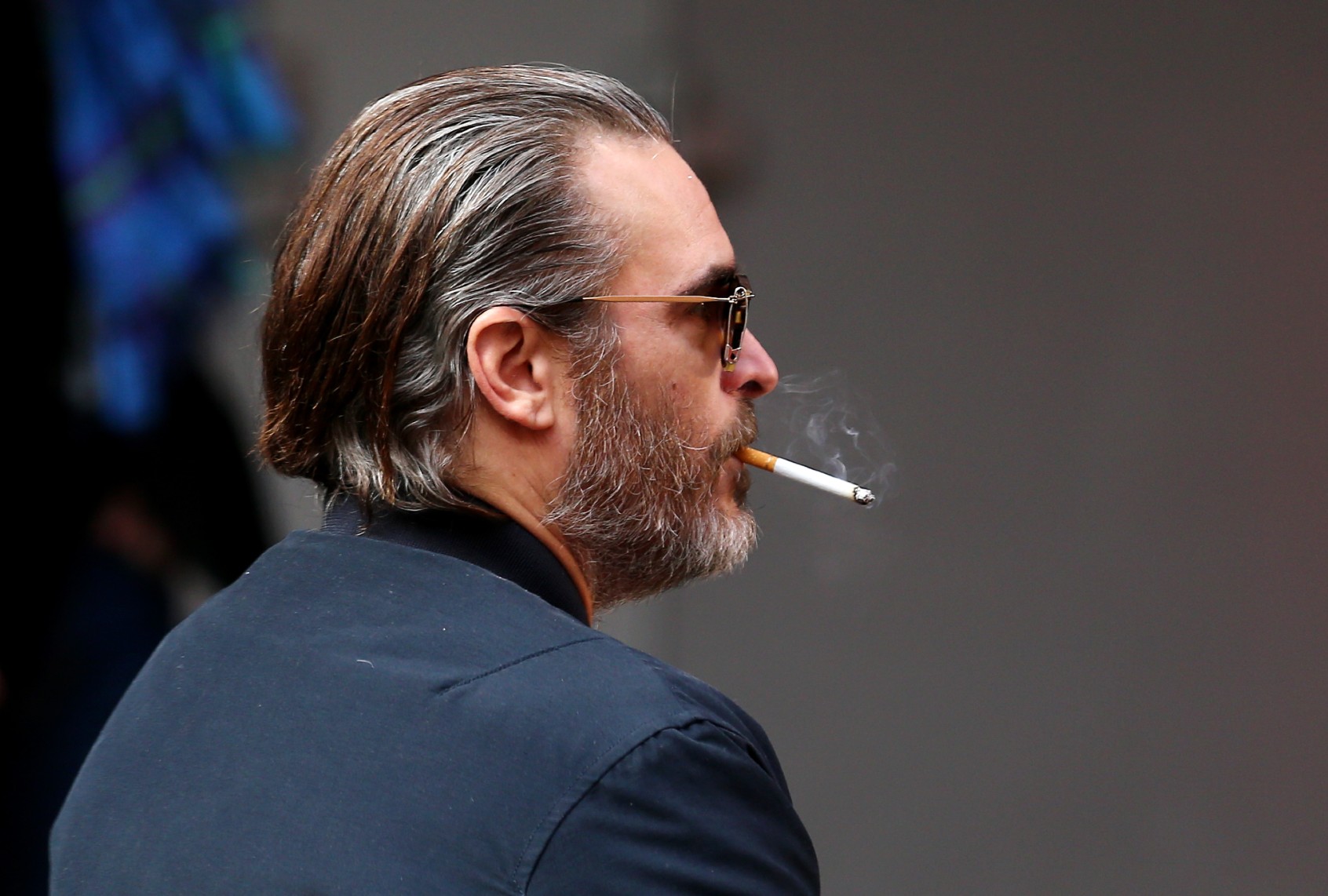
(Thomas Niedermueller/Getty Images) Joaquin Phoenix smokes a cigarette at a “Don’t Worry, He Won’t Get Far on Foot” photo call
And beyond the movies, cigarettes became associated with public intellectuals and activists like James Baldwin and Angela Davis; jazz musicians like Miles Davis and Charlie Parker; rock stars like Keith Richards and Jimi Hendrix. So many cultural innovators smoked that at a certain point, smoking as a creative tool became a kind of tacit assumption: Smoking brought forth the philosophical revelations of Jean-Paul Sartre and Simone de Beauvoir, kept Bob Fosse’s mind and feet in motion, elevated Billie Holiday’s tragic tones.
And then there’s smoking’s longtime partnership with rebellion, which may help explain its allure to Gen Z: What’s a more enticing substance than one that impacts even those who aren’t doing it? The public-health campaign against vaping, which has endeavored to make it as cringe as possible, has been fairly successful — but vaping never had the cool factor of cigarettes. Had Hudson Williams been hitting a dinky pod of Frozen Blue Raspberry on those Milanese streets, he would likely have been a lot more furtive about it. Smoking looks good on Gen Z because all you’re doing is looking: You’re not smelling it, not walking around with stinging eyes, not sighing while the person you’re with takes their 5th smoke break of the night. It looks cool because you are not there with them. (Look at Sean Penn’s boxing-glove face sucking on a cigarette and tell me you can’t smell that photo.)
John Waters quit smoking in 2004, at the age of 58. He called his years of smoking “the only decision I’ve ever regretted.” Think about that: smoking cigarettes is the only decision John Waters has ever regretted; that’s how you know it is truly wretched. And smoking is truly wretched. It’s terrible for your health; it’s terrible for the planet; and its origin as socially engineered mind control still has a terrible power. On the upside, not everybody’s falling for it: Posing on the red carpet at the 32nd annual Actors Awards ceremony at L.A.’s Shrine auditorium, Meg Stalter — possibly channeling Donatella Versace — waved an unlit cigarette around. “Sorry, I’m doing a brand deal with cigarettes now,” she joked to TikTok’s Drew Afualo. “I signed before I realized they were bad for you.”
Read more
about fashion statements
