
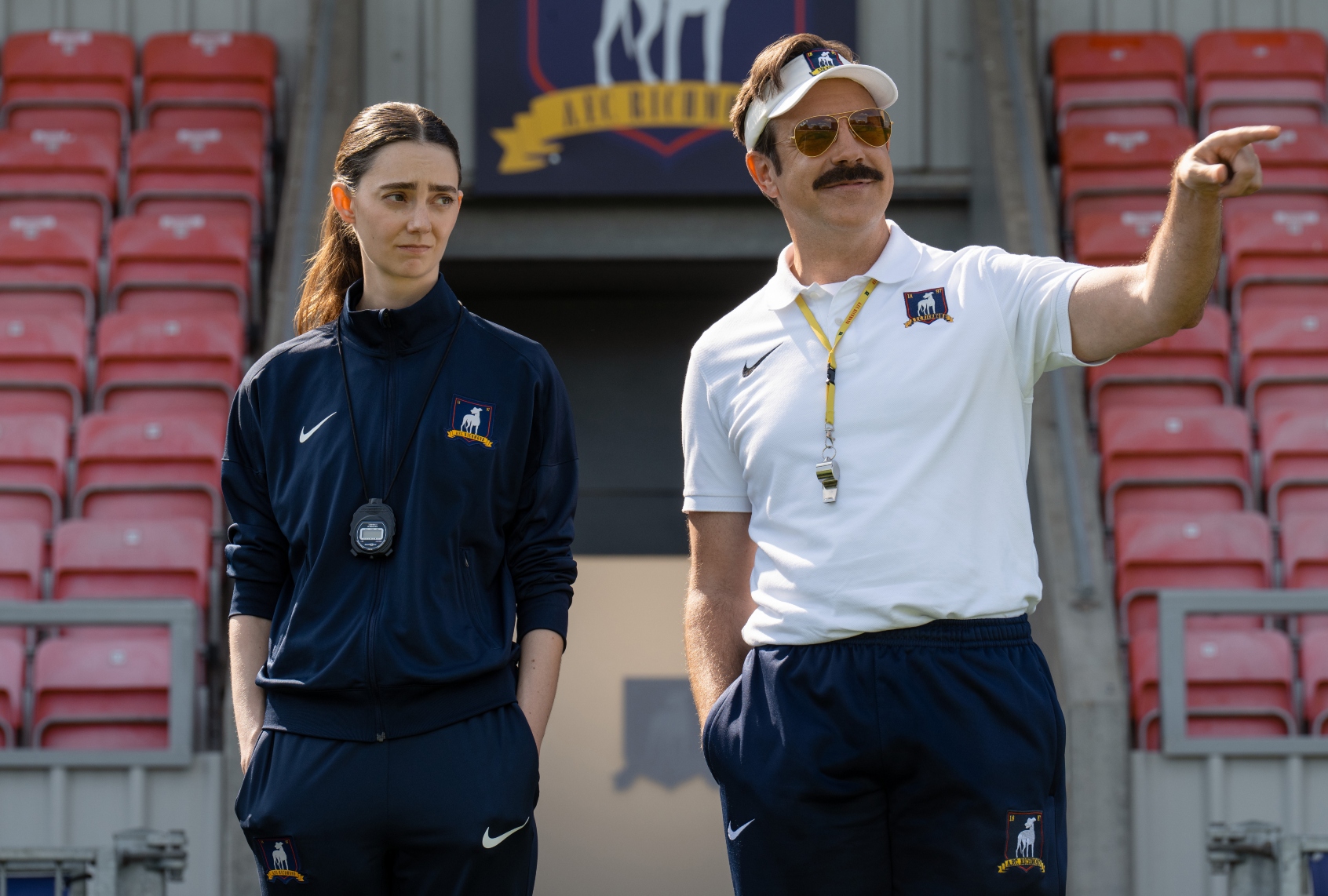

Six years ago, “Ted Lasso” reminded us that many winning TV shows are the result of the right sentiment landing at the right time — or, in this case, a terrible time. In 2020, the weight of pandemic lockdowns and an especially rancorous presidential election made life feel mean.
Enter Ted Lasso, Jason Sudeikis’ folksy Missourian loaded with cornpone wisdom, positivity and kindness. Against all good sense, Ted, an American football coach, moves to England to coach the AFC Richmond Greyhounds, a men’s soccer team, despite knowing nothing about the sport.
That suited Greyhounds owner Rebecca Welton (Hannah Waddingham) since she intended Ted, his assistant coach, Willis Beard (Brendan Hunt), and her team’s players to fail. Instead, Ted’s emphasis on personal growth and camaraderie rebuilds the Greyhounds from their league’s demoralized joke into its comeback kings, powered by their yearning to Believe.
In 2020, “Ted Lasso” made us feel like that motto, “Believe,” was all we needed. In 2026, introducing a women’s football team changes that pitch. The fourth season sees Ted, Rebecca, AFC Richmond’s PR specialist Keeley Jones (Juno Temple) and the organization’s Director of Football Operations Leslie Higgins (Jeremy Swift) attempting to transfer their proven winning methods over to the women’s team and are blocked by the sexism baked into professional sports at every step.
Data-backed analyses predict the Lady Greyhounds’ doom before they’ve even begun to race. Keeping the sponsors’ faith is challenging for Rebecca, who reminds one that a company that backs military actions shouldn’t hesitate to support a women’s football club.
“Wars are profitable,” her skeptic replies coldly. Women’s sports, not so much. So instead, Rebecca rewrites the call to “Believe” into a prayer for a chance.
“That’s what sport is. That’s what life is, isn’t it? A series of chances,” she says. “We took a chance, creating this team. Yes, for little girls to see amazing, athletic women doing incredible things on the pitch. But equally important, so that little boys . . . can grow up in a world where they don’t know any different. And to do that, we need to be given a chance. By you.”
To me, speeches like this have a dual purpose: Rebecca is obviously speaking to a specific character, but Waddingham’s passionate delivery makes an effective case to viewers. Even in the wide world of sports movies and shows, men and women are treated differently. For the reasons Rebecca spells out, they shouldn’t be.
As a recent story on Togethxr.com delineates, the heyday of movies about women in sports ended by the close of the aughts – pretty much spanning the time between the first film in the “Bring It On” franchise in 2000 and the fifth in 2009.
On TV, actors Rob Mac and Ryan Reynolds’ excursion into the wild world of British Premier football, “Welcome to Wrexham,” recently expanded to include a women’s team, the Red Dragons. In the 2023-24 season, with their star owners’ backing, the Dragons became the first Welsh women’s club to operate on a semi-professional basis.

(FXX) Maria Francis-Jones and Ava Suckley in “Welcome to Wrexham.”
And Netflix recently greenlighted “The 99’ers,” a biographical drama about the U.S. Women’s National Team’s victory over China at the 1999 FIFA Women’s World Cup.
Meanwhile, there is no shortage of films and shows about male sports icons and legendary men’s team. Recently, a new season of “Hard Knocks” premiered, HBO’s behind-the-scenes journey through one American pro football team’s pre-season training camp. This run of episodes features the Seattle Seahawks—my home team—which I find less compelling than the prospect of seeing where the Lady Greyhounds end up.
I assure you this is less about sisterly solidarity or my lingering affection for “Ted Lasso” or even a love of soccer – er, football. Sports and I are largely incompatible, sorry to say. I am, however, the kind of curious and not judgmental person who wants to see what has and hasn’t changed about these stories since “Bend It Like Beckham” became a sensation in 2002. That movie’s heroines Jess (Parminder Nagra) and Jules (Keira Knightley) saw the opportunity to play at the university level in America as the ultimate dream. America, they thought, took women’s football seriously.
We need your help to stay independent.
The diminishment of Title IX protections tells another story. Disparities in pay and resources are still a battle in both women’s professional sports and at the collegiate and Olympic levels, as publicized advocacy by athletes such as Megan Rapinoe has revealed.
In 2020, “Ted Lasso” made us feel like that motto, “Believe,” was all we needed. In 2026, introducing a women’s football team changes that pitch.
More recently, the Trump administration’s snubbing of the gold-medal-winning women’s hockey squad at the 2026 Winter Olympics in Milan broadcast a shameful message about the common disregard for female athletes and their achievements.
And in Britain, Ted’s adopted stomping grounds, the BBC recently published a collection of anecdotes from women in football, whether they be professionals or fans, describing a strain of misogyny so brutish that one woman stopped taking her daughter to live men’s matches. “I wouldn’t feel safe and I certainly wouldn’t want to expose my daughter to sexism,” she told the BBC.
The fourth season of “Ted Lasso” doesn’t entirely frost those bad vibes with its happiness and hopium. The Lady Greyhounds confront doubts about their talent in pubs, from the stands and in the media.
This being “Ted Lasso,” every determined push downfield strides on a turf green with optimism. That starts in the fourth season’s kickoff, when Rebecca, Keeley and Higgins journey to Kansas City to re-recruit Ted.
Want more from culture than just the latest trend? The Swell highlights art made to last.
Sign up here
One of my favorite moments in their adventure shows Higgins finding his way to the Negro Leagues Baseball Museum. He enters reluctantly, since he knows nothing about baseball, and leaves fired up by the heroism of men like Satchel Paige and Jackie Robinson.
“You know, their story is quite similar to how women in England weren’t allowed to play football for years,” observed Higgins, netting a doubtful reaction from the museum’s forbearing docent. This sends the oh-so-polite Higgins into a stammering fit: “Not similar. Sorry. What happened here was much worse. Much, much worse. Much, much, much, much, much, I can’t stop saying much for some reason.”
But when Higgins explains that women weren’t allowed in England’s professional leagues until 1971, even the museum guide couldn’t help blurting, “Damn – that’s recent as hell.”
Yes. It’s still new enough for us to understand that getting the Lady Greyhounds to believe in themselves was always going to be the easy part. Getting a nation and a world to believe in the women of AFC Richmond and female athletes in general? That’s always been the whole game.
New episodes of “Ted Lasso” stream Wednesdays on Apple TV.
Read more
from Salon’s Culture newsletter, The Swell
