
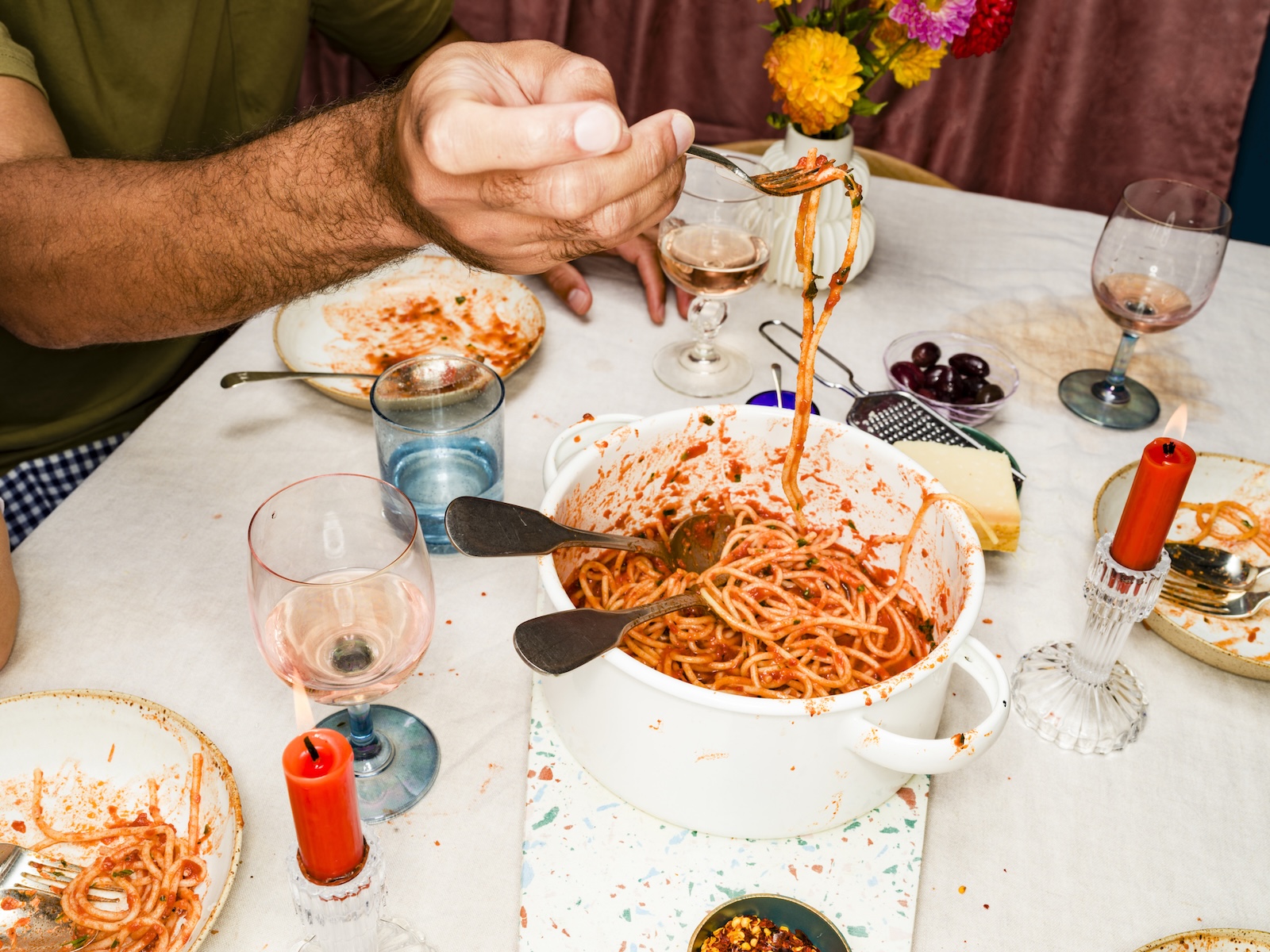

My grandmother’s baked spaghetti came in slabs, which was part of its charm. Hot from the oven, they sagged dramatically over the edge of a spatula, held together mainly by a web of browned mozzarella; cold from the refrigerator the next day, they cut much more cleanly and were arguably better. Underneath the cheese were snapped spaghetti, ground chuck and a generous pour of Ragu, and as the casserole disappeared over the course of a weekend, red sauce and rendered beef fat collected in iridescent pools at the exposed corners of the dish.
This was one of two dinners I could reliably expect when we visited her in West Virginia. My grandmother, the daughter of a coal miner and a master of the frugal feast, made either baked spaghetti or steak and gravy with mashed potatoes, green beans and biscuits with blackberry jam; stay long enough and you got leftovers of both. She passed the spaghetti recipe to my mother early in my parents’ marriage, and Mom changed almost nothing. The noodles were still snapped. The beef was still beef. The mozzarella still went on with a heavy hand.
What changed, slowly enough that nobody announced it, was the jar.
First there was Ragu. Then Bertolli. And then there was Rao’s.
I remember the first time my mother took me to The Fresh Market. It was fall, and the entryway smelled aggressively of cinnamon brooms. Just inside was a coffee station — “Complimentary,” an employee in a green apron told us — where I, a preteen with no particular business drinking coffee, poured myself something hazelnut-flavored and carried it solemnly through the aisles. Classical music played overhead. My mother remarked, approvingly, that the lighting didn’t give her a migraine.
Looking back, I suspect my father had recently begun making a little more money, because that afternoon we bought two things I distinctly remember never having had before: Kerrygold butter and a jar of Rao’s.
That night, Mom used the Rao’s in my grandmother’s baked spaghetti. On the side were little wheat rolls from The Fresh Market bakery, spread with pats of Kerrygold — a small but perceptible upgrade from the Bunny Bread and Country Crock of a few years earlier. Nothing about the occasion had changed. It was still spaghetti night. But I remember that dinner in my bones for how special it felt.
By the time I was in college, Rao’s had undergone another transformation. It started appearing in my parents’ pantry in Costco two-packs, usually beside gigantic cases of bottled water, enough paper towels to absorb a malfunctioning sprinkler system and gallon-sized jugs of olive oil. At $12.99 for two jars, it had stopped being the sauce from the fancy grocery store and become simply the sauce my mother bought. She has never gone back.
This past January, deep in winter pasta mode, I realized the supermarket had followed her. There were suddenly what looked like two additional feet of shelf space devoted to sauces with labels I would happily frame and ingredient lists apparently designed to seduce me personally: no added sugar, good olive oil, whole tomatoes, actual garlic. The average supermarket now has top-shelf pasta sauce in both senses of the phrase.
I should disclose that I am helpless in the face of good food packaging. Give me an embossed jar with a hand-drawn garlic bulb, a wobbly little restaurant façade and typography that looks like it was commissioned by someone who owns several linen aprons, and I go full Tex Avery wolf: eyes out, tongue unspooled, all higher reasoning suspended.
We need your help to stay independent.
Some of them, annoyingly, are also very good.
My first step beyond Rao’s was Carbone’s vodka sauce, which asks for a splash of fresh cream — a sentence that has probably already caused several restaurant acolytes to sit bolt upright and announce that IT IS NOT THE SAME AS CARBONE. Fine. Nobody said it was. But the jar that really got me was Sauz’s lemon-pepper pesto. I tossed it with store-bought ravioli and shredded rotisserie chicken warmed in olive oil, put peas on the side, and waited for the part where I needed to fix something. It never came.
Nothing.
Yet it was surprisingly complex: bright with lemon juice and fresh peel, nutty with almonds and Parmigiano Reggiano, savory with garlic and olive oil. It was the sort of flavor I could reproduce if sufficiently motivated. On a Tuesday, I was not.
And now we have arrived at Alison Roman selling “A Very Good Sauce,” including a jar inspired by the caramelized-shallot-and-anchovy pasta that once briefly seemed to occupy half the internet. A generous three-pack runs $30, or $10 a jar.
I made that pasta when everyone else did, and kept making it after everyone stopped posting about it. For years I’ve had deli containers of the gorgeous, sticky umami tangle rotating in and out of my refrigerator. So the ability to simply buy a jar descended from it feels like an almost comically specific luxury: somebody else has already done the sticky part.
For a dedicated home cook, this is part of the appeal. Eventually you discover that certain chefs and recipe developers simply share your tastes: their pantry looks like your pantry, their idea of enough acid is your idea of enough acid. Their recipes acquire a little micro-mythology in your kitchen. By the time they put something in a jar, you aren’t exactly starting from scratch. The product arrives pre-endorsed by your own past dinners.
Chef Scott Conant is playing in the same sandbox: his Martone Street sauces run about $10 a jar, or just under $40 for a four-pack, which is less “generic red sauce” than “Scott Conant would like to handle this part of dinner for you.”
There are, meanwhile, levels to this.
Bio Orto makes an organic butternut-squash cream sauce that I bought at Eataly for $18.49 and desperately wanted to find merely fine. It was not merely fine. Eataly itself sells a $25.99 Alfredo that, unlike so many jarred Alfredo sauces, does not taste as though someone dissolved Parmesan into wallpaper paste. There is also a $29.99 mushroom pasta sauce with white truffle flavoring.
Twenty-nine dollars and ninety-nine cents. For sauce.
I can hear the objections from here.
The problem is that these, too, are very good.
Of course, there is another possible ending for a beloved sauce: it gets very, very big. Campbell’s acquired Rao’s, and there are armies of people online who remain convinced that something must have changed, despite Rao’s FAQ explicitly assuring worried customers that the company won’t “touch the sauce.” I haven’t eaten enough Rao’s lately to join the prosecution. What interests me is the anxiety itself. Once people love a jar rather than merely use it, corporate ownership can start to feel less like a business transaction than someone acquiring custody of a family recipe.
Want more great food writing and recipes? Sign up for Salon’s free food newsletter, The Bite.
Then again, sometimes an expensive jar is simply an expensive jar. The $18.49 Bio Orto remains, emphatically, an $18.49 jar of pasta sauce. I am not here to argue that this constitutes thrift.
But lately the comparison I make in my head is less often fancy sauce versus Ragu than grocery-store splurge versus going out. Dinner for two at a neighborhood trattoria recently ran us $86 with appetizers, one cocktail and no dessert. Delivery can wander toward $60 before tip with insulting ease. Against that backdrop, an $18 sauce, seven dollars’ worth of Italian sausage, a two-dollar pound of pasta, a Caesar salad kit and some good bakery focaccia occupy a strange but useful category: not a cheap dinner, exactly, but a comparatively inexpensive special one.
Sometimes what I’m buying is 20 minutes of my own attention.
If the sauce needs nothing from me, I can spend that energy making dessert, mixing a cocktail for guests, warming bread — or simply deciding which sparkling water sounds good. I can also happily spend another night softening onions in butter and doctoring $2.62 Ragu Kettle Cooked Tomato Basil (one of the best of the budget sauces) with garlic powder, onion powder, red-pepper flakes and whatever umami booster is closest: anchovy, miso, soy.
Sometimes I want to futz. It is simply nice not to have to.
Which is why I have trouble getting particularly worked up about the expensive-sauce aisle. Sure, sometimes the beautiful jar is bought by someone who simply enjoys beautiful jars. But it might also be dinner for an exhausted parent who wants twenty minutes back and misses what the inside of a restaurant tastes like. Or it might be the thing that gets a couple through a no-takeout month while they save for their wedding without making every Wednesday night feel like financial punishment.
Convenience food has always existed to solve problems. We’ve simply gotten more specific about which problems we would like it to solve.
As for that $18.49 squash sauce, I browned some Italian sausage, boiled pasta, warmed the sauce and put a Caesar salad and good focaccia on the table. I had not roasted a squash. I had not grated cheese into a saucepan. I had not dirtied anything requiring an overnight soak. Dinner tasted rich and savory and faintly sweet, the sort of thing I would have been delighted to order at a neighborhood restaurant.
By the end, I was dragging pieces of focaccia through the last orange streaks left in the pan.
It was, after all that, just dinner at home.
Which was kind of the luxury.
Read more
from Ashlie D. Stevens about food and culture
