
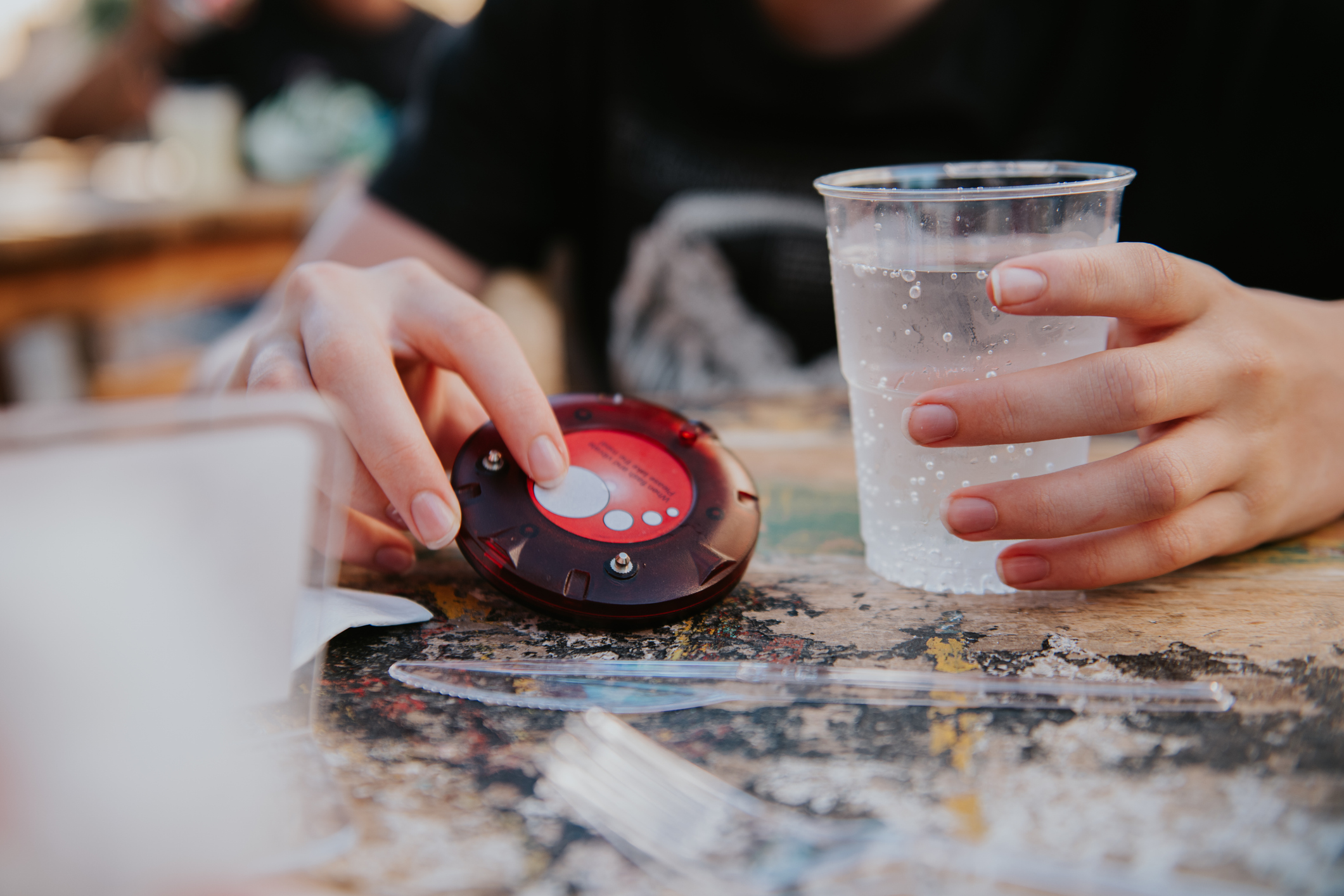

At 16, I was entrusted with one of the most important pieces of technology at a suburban Chili’s: a wire rack full of restaurant pagers.
The restaurant occupied a sprawling shopping center alongside an Olive Garden, a Cabela’s and a Costco, making it something of a regional mecca for homecoming dinners, birthday parties and Little League victories. The air smelled perpetually of tortilla chips, and the soundtrack was an agreeable mixture of Matchbox Twenty and sizzling fajita platters.
I liked the job. I liked asking people what brought them in, hearing about their celebrations and making small talk while consulting my restaurant map and section list. On busy nights, I’d estimate the wait, scribble down a last name, party size and pager number in black pen, then hand over a pleasantly hefty plastic puck.
“You can wander as far as your car,” I’d explain.
“Ope! Was hoping to make a Costco run,” some dad would inevitably reply. I laughed every time. It was a very reliable joke.
Every five or 15 minutes, another pager returned to the host stand, blinking and vibrating in the hands of a customer whose table was finally ready. I particularly liked watching one go off. A group could be deep in conversation when the puck sprang to life, producing a brief, collective flicker of delight. Dinner!
They were not beautiful objects. One woman who came in weekly after church complained that hers was ugly and bulky, then set it on the red pleather waiting bench so that it would vibrate against the upholstery rather than any part of her body. Occasionally, someone stole one, apparently deciding that a restaurant pager belonged in the same category of souvenir as a pebbled Coke glass. Sometimes the rechargeable batteries flagged, and we’d pull a pager out of rotation.
There was a reason these contraptions belonged to the Chili’s end of the dining spectrum. You wouldn’t mistake one for fine-dining theater. But they had an appealingly limited set of ambitions. They buzzed, they blinked, and when the wait was over, we took them back. The technology stayed at the restaurant.
In retrospect, what a gift.
I don’t remember exactly when the pagers mostly disappeared. There was no retirement ceremony, no last call for the little plastic puck. I began noticing their absence most acutely when restaurants reopened after the first wave of the pandemic. Minimizing shared surfaces made sense then. Why distribute and disinfect pagers when customers already had phones in their pockets? Digital waitlists predated COVID-19, of course, but for me, that was when the phone began to feel less like an option and more like a condition of dining out.
And it rarely stops at the host stand. Your phone tells you the table is ready. It may supply the menu via QR code, take your order and settle the bill. Hours later, another text arrives asking you to rate the experience.
At some point, the meal has ended, but the restaurant apparently hasn’t finished with you.
None of this is inherently awful. Some of it is useful. But every time I wake my phone to perform one of these little tasks, I’m also opening the door to everything else it contains: emails, notifications, messages I wasn’t planning to answer over lunch. What was supposed to simplify dinner can turn it into another administrative process requiring a charged device and a willingness to look at it.
Restaurants are hardly alone in this. I reach for my phone to ride public transit, pay for parking, produce concert tickets, check in at the doctor’s office and occasionally prove to one website that I am the person trying to sign into another. Each request arrives dressed as a convenience. Together, they have made the phone feel less like a personal possession and more like mandatory civic infrastructure.
Want more great food writing and recipes? Sign up for Salon’s free food newsletter, The Bite.
And mandatory infrastructure really ought to work.
For a while, I happily used the Ventra card on my phone to ride Chicago public transit. One less thing to carry! Then, for a miserable stretch, several Red Line stations I frequented seemed to stop recognizing it. One morning, I joined a small congregation of commuters attempting to convince the turnstiles that our phones were, in fact, perfectly legitimate fare payment.
“It worked yesterday!” one man exclaimed.
“The terminals are old! They weren’t meant for this,” a tired CTA employee explained, kindly ushering us through the stroller entrance as the next train rumbled toward the platform.
The backup plan wasn’t faring much better. Around the same time, the ticket machines were proving similarly unreliable about accepting credit cards. A little queue had formed at the station ATM, where commuters were withdrawing cash to buy physical transit cards so they could get on the train.
We had arrived at the future, and it required a trip to the cash machine.
After a few weeks of this, I surrendered. I now carry a physical Ventra card, load $20 onto it when necessary and go about my business. It gets me through the turnstile without involving my phone. A modest pleasure, but one I’ve come to appreciate.
The trouble isn’t that every digital convenience is destined to malfunction. Plenty work exactly as advertised. It’s that we’ve become so accustomed to conducting ordinary life through our phones that we rarely stop to consider whether they’re necessary to the transaction in the first place.
Consider, for instance, a recent brunch in which absolutely nothing went wrong.
Recently, my husband and I went to a brunch spot I love in Chicago’s Andersonville neighborhood. The front-of-house staff always seem to be navigating the aftermath of a complicated breakup between two polycules, but the breakfast sandwich is truly good enough to make the interpersonal intrigue part of the charm. I wanted to do very little beyond sit somewhere pleasant, eat something delicious and enjoy being newly married. There was a short wait. The host asked for my number; I provided it, then sat with my husband in two lobby chairs. We chatted. We waited. We did not move.
My phone buzzed. Our table was ready.
I looked up. The host stand was approximately two feet away.
We need your help to stay independent.
The system had worked flawlessly. Somewhere, a piece of restaurant software had facilitated communication between two people who could reasonably have passed each other a saltshaker. The host hadn’t done anything wrong, and neither had I. But a moment that might once have involved someone looking up and saying, “You’re all set,” now required me to be reachable by a device I had no particular desire to consult.
I understand the alternative. A digital waitlist lets you wander around the neighborhood, browse the shops, maybe get a head start on another errand. Sometimes that’s a genuine gift. But I’m not convinced that being able to do two things at once means enjoying either one more. And sometimes I don’t want to wander. I want to be there, waiting for brunch, with the reassuring knowledge that the restaurant is handling the details.
That’s part of the pleasure of hospitality, isn’t it? For a little while, someone else tends to the logistics. You don’t need to manage every notification or keep every system running. You can just be a guest.
I don’t expect restaurant owners to read this and order a fresh shipment of vibrating pucks. If texts work best, fine. I’d simply like us to question whether requiring a phone is always an improvement, and remember that convenience isn’t much of a convenience when opting out stops being possible.
Maybe the pager never comes back. I can live with that. I’d just like to be able to let my phone die in my bag and still be called to breakfast.
Though I will say this for those ugly little pagers: At least you could hand one back.
Read more
from Ashlie D. Stevens
