Spring Offer: Get 1 Year, Save 58%

Gaza, the Quran and the Torah: Is the Middle East conflict now a religious war?

During this month's traditional Flag March on Jerusalem Day, which commemorates Israel’s capture of the city's historic eastern sector during the 1967 Arab-Israeli war, marchers could be heard shouting racist, anti-Arab and anti-Muslim slogans, according to reporting from Haaretz, the BBC, AFP and other sources.

One marcher reportedly shouted: "This is my country. I am the owner here. I'm the boss here, there is no Palestine.” Reporters also recorded such chants and slogans as "We will burn your villages" and "All Arabs can suck it."

Israel's national security minister, Itamar Ben-Gvir, who has a lengthy track record of right-wing and anti-Arab provocation, said at the march: "We send a message to Hamas: Jerusalem is ours. Damascus Gate is ours. The Temple Mount is ours." That can be understood as a direct provocation, since what Jewish Israelis call the Temple Mount also includes Al-Aqsa Mosque, one of the holiest sites in Islam. "With the help of God," Ben-Gvir told the cheering crowd, "the full victory is ours.”

Ben-Gvir is a member of Benjamin Netanyahu's hard-right cabinet as leader of Otzma Yehudit (Jewish Power) an ultra-nationalist, anti-Arab political party that won six seats in Israel's 2022 Knesset election. His party is now crucial to Netanyahu's flimsy governing coalition, especially now that the "war cabinet" created after last October's Hamas attack has been dissolved.

Ben-Gvir was formerly a supporter of the banned political party Kach, a right-wing Zionist group originally founded by Brooklyn-born Rabbi Meir Kahane, which Israel ultimately designated a terrorist organization. He reportedly once had a portrait on his living-room wall of Baruch Goldstein, the Jewish extremist who killed 29 Palestinians and wounded 125 more in a 1994 mass shooting at the Cave of the Patriarchs in the occupied West Bank.

Otzma Yehudit represents one extreme within Zionism, depicting it as an essential component of Orthodox Judaism, which regards the Torah as a divine text revealed by God to Moses on Mount Sinai. Many Zionists, but not all, believe that “Eretz Israel” — generally taken to mean the entire territory of Palestine, from the Mediterranean Sea to the Jordan River — was promised by God to the Jewish people.

But Theodore Herzl, the 19th-century founder of modern Zionism, was an entirely secular figure and quite likely an atheist. In the words of his Encyclopedia Britannica entry, Herzl viewed the "Jewish question" in Europe not as "a social or religious question but a national question.” Herzl argued specifically that "matters of faith" should be entirely "excluded from public influence.”

Until recently, religion did not play a prominent role in Israeli politics, and the Jewish state's leaders were generally secular politicians. On the other side of the Israeli-Palestinian conflict, however, it's fair to say that Islam has been the driving force of Hamas since its establishment in 1988.

The Palestine Liberation Organization and the allied political party Fatah, which preceded Hamas by about 20 years and are internationally recognized as legitimate representatives of the Palestinian people, have a largely secular and nationalist viewpoint and have included at least a few Palestinian Christians. Longtime PLO leader Yasser Arafat inclined toward socialist views, and as a young man moved away from an alliance with the Muslim Brotherhood in Egypt.

Palestinian leaders to the left of Arafat, like George Habash, Nayef Hawatmeh and Yasser Abd Rabbo, were often Marxist revolutionaries who drew support from liberation movements in the developing world and sometimes from the Soviet Union or its allies. While such Palestinian militant groups engaged in spectacular acts of violence at times — including the infamous attack on Israeli athletes during the 1972 Olympic Games in Munich — they did not frame their conflict with Israel in religious terms. 

One major irony in the backstory of Hamas is that for many years before the group was established, its future leader, Sheikh Ahmed Yassin, was tolerated and even encouraged by the Israeli government, as a counterweight to the Palestinian nationalists and leftists who were seen as more dangerous.

Yassin’s Islamist charity group was allowed to build mosques, schools, hospitals and other community facilities. According to a 2009 report in The Wall Street Journal, the Israeli governor of Gaza during the late 1970s said he had maintained regular contact with Yassin, and had arranged for him to receive medical treatment in Israel. Yassin’s ally Mahmoud al-Zahar reportedly met with top Israeli officials to plot against Arafat and other socialist or Marxist Palestinian leaders.

What Israeli authorities perhaps understood too late was that Yassin, al-Zahar and their colleagues always viewed Israel as their ultimate religious and historical enemy. The mosques, hospitals and schools were part of a package deal that included the establishment of Hamas and then its military wing, the Al-Qassam Brigades, along with strict gender segregation, mandatory hijab for women and other conservative principles understood to come from the Quran.

What Israeli authorities perhaps understood too late was that the leaders of Hamas always viewed Israel as their ultimate religious and historical enemy. Building mosques and schools was part of a package deal.

Indeed, one could say the Quran, Islam's holy book, has become Hamas’ most important weapon against Israel. About one-third of the Quranic text directly or indirectly concerns the Jews – and most of that is negative, with repeated references to the Jewish people as “killers of prophets.” The first sentence in Hamas' 1988 charter quotes a famous verse suggesting that Allah has placed an eternal curse on the Jews "on account of their unbelief.” (In 2017, during a period of negotiations with Israel and the U.S., Hamas published a watered-down version of its charter that removed that reference, but never officially revoked the original.)

Hamas carried out its first attack against Israel in 1989, killing two Israeli soldiers. That began about 15 years of low-level conflict, during which Israeli officials killed several Hamas leaders, including Yassin, al-Zahar and Abdel Aziz Rantisi, and injured, arrested or deported hundreds of other militants. 

Hamas' religious war against Israel has accompanied a contradictory relationship with the U.S. On one hand, the group has held secret or indirect meetings with American officials for years. On the other, Hamas constantly criticizes the U.S. for supporting and supplying Israel, for invading and occupying Afghanistan and Iraq, and for attacking other Muslim countries, including Yemen and Somalia. Rantisi, who succeeded Yassin as Hamas leader, once declared that George W. Bush was an “enemy of Muslims” and that America had "declared war against Allah.”

Hamas' strong identification of Islam with its campaign against Israeli occupation has attracted more overt support from distant Muslim countries than from nearby Arab governments, many of which have official or unofficial ties to Israel. Led by the theocratic regime in Iran, predominantly Muslim nations such as Afghanistan, Pakistan, Bangladesh, Malaysia and Indonesia largely seem to consider the Zionist project and the Israeli-Palestinian conflict in religious terms. 

The most religious and most conservative elements of Zionism now appear to dominate the movement for the first time, as well as the Israeli government.

These issues were detailed in a recent academic paper published by the Beirut-based Al-Zaytouna Centre, “Non-Arab Muslims and Operation Al-Aqsa Flood" (a reference to Hamas’ Oct. 7 attack on Israel). The paper stresses the importance of “Ummat Al-Islam,” or the worldwide "Islamic nation," seen by many Muslims as the only true form of nationalism. When the Soviet Union invaded Afghanistan in 1979, "Arab and Muslim countries responded from an Islamic perspective," the paper continues. "They launched extensive media campaigns, called for volunteers to fight against the Soviet forces, and established popular and official donation funds.”

That reaction throughout the non-Arab Muslim world was far more effective — with thousands of volunteers fighting alongside Afghan militants — than anything that has happened during the current Gaza war. But non-Arab Muslims remain strongly concerned with the fate of the Al-Aqsa Mosque in Jerusalem, which remains under Israeli control. 


Want a daily wrap-up of all the news and commentary Salon has to offer? Subscribe to our morning newsletter, Crash Course.


Back in Israel, the most religious and most conservative elements of Zionism now appear to dominate the movement for the first time, as well as the Israeli government. Netanyahu may have great difficulty ending the war in Gaza without alienating the Orthodox far right and destroying his governing coalition. 

In March, Dutch journalist Caroline de Gruyter published an essay in Foreign Policy entitled “Israel and Palestine Are Now in a Religious War,” relating the current Gaza conflict to the immensely destructive European religious wars of the 16th and 17th centuries, which gave birth to modern nation-states on that continent. “Both in Israel and Palestine, the main internal division is between those who are secular and those who are religiously motivated," she writes. "On both sides, the religious camp seems to be getting the upper hand. …The two camps that deeply believe God has given them the land are incapable" of resolving the conflict, "because it requires them to renege on the fundament on which their faith and identity are based.”

Anshel Pfeffer, a columnist for Israel's left-leaning newspaper Haaretz, wrote something similar last November, arguing that “None of the international coverage and commentary on Hamas’s massacre in Gaza border communities, and the war it triggered, has addressed its religious aspects.” 

Hamas and Zionism, Pfeffer wrote, are both “rooted in religion,” and the contradictory national narratives that drive them are “fundamentally religious.”

Vermont Republican has been dumping water in her Democratic colleague’s bag for months

A Republican lawmaker in Vermont has secretly been pouring water into her Democratic colleague’s work bag over the last few months.

Several videos captured by state Rep. Jim Carroll showed Rep. Mary Morrissey pouring cups of water into his bag when nobody was looking. The footage was first obtained by local news outlet Seven Days through a public record request.

Carroll had been finding his bag soaked for months and said he felt “paranoid of his fellow legislators,” he told The Guardian. He then decided to secretly film the corridor where his bag was kept  and found that Morrissey had been the culprit all along.

The two have known each other since childhood, Carroll said, and both represent the City of Bennington. Morrissey later apologized to Carroll, claiming she didn’t know the bag belonged to him.

"I am truly ashamed of my actions,” Morrissey said during a state house session Monday, according to Boston.com. “It was conduct most unbecoming of my position as a representative and as a human being and is not reflective of my 28 years of service and civility.” 

Morrissey now faces an ethics investigation for harassment and could face disciplinary action if the House Ethics Panel decides she violated the Code of Conduct, state news outlet Seven Days reported.

“A sharp dagger to his heart”: Trump feels betrayed by “quite attractive” Debra Messing

Donald Trump has become fixated with another female celebrity and this time it's not Taylor Swift — it's vocal Trump critic Debra Messing.

In the new book "Apprentice in Wonderland,” the former president shared with writer and Variety editor-in-chief Ramin Setoodeh that he met the "Will & Grace" star at the NBC upfronts years ago – both "Will & Grace" and "The Apprentice" aired on NBC – and confirmed that he had a crush on the actress. 

However, according to reports by Variety, his feelings towards Messing shifted when she became one of his staunch critics during his 2016 election campaign. He even “admitted that he spent time while in the White House monitoring Messing’s Twitter feed,” the Independent reported.

Setoodeh wrote, “Here in New York, during his early months outside the White House, Trump hasn’t moved on. Messing is on his traitors list, and he can’t shake the hypocrisy — in his mind — that she once supported him as a reality TV star."

The excerpt continued, "For Trump, Messing’s rejection is still a sharp dagger to his heart. 'This Debra Messing, who I always thought was quite attractive — not that it matters, of course . . .'"

Moreover, when Trump met Messing at the NBC upfronts, he described her as, “[Messing] came up to me with her beautiful red hair. She said, ‘Sir — I love you. Thank God for you! You’re saving the network, and you’re saving my show.'"

Trump insinuated to Setoodeh that "The Apprentice" helped "Will & Grace's" rating, however, Setoodeh pointed out to "Trump that 'Will & Grace' came on before 'The Apprentice,' which would mean that it wouldn’t have received a ratings bump from viewers turning into 'The Apprentice.'"

“A lead-in — or a lead out,” Trump replied.


Human rights watchdog asks how FIFA can “seriously consider” Saudi Arabia as World Cup host

A human rights watchdog group is accusing Saudi Arabia of systematically violating the dignity of migrant workers, saying the kingdom is failing to meet the stated human rights requirements of soccer's world governing body, despite being presumptive hosts of the 2034 FIFA World Cup.

In a report released Tuesday, the human rights organization Equidem reveals what it alleges are significant human rights and labor violations to migrant workers in the sectors of hospitality, maintenance and construction. After a wealth of migrant worker abuse was revealed in the lead up to the 2022 Qatar World Cup, the group warns that FIFA could be on the verge of choosing yet another host that does not protect the rights of migrants.

Saudi Arabia was the only country to submit a bid in time for the 2034 World Cup.

“The report raises one simple question: How on earth could FIFA seriously consider Saudi Arabia as a host for its marquee event, given its human rights record?” Equidem CEO Mustafa Qadri said at a press conference Tuesday.

Other organizations, including Amnesty International and Building Wood Workers International, have similarly warned of potential human rights abuses should Saudi Arabia win the bid. 

Migrant workers make up 37.3% of Saudi Arabia’s population  the third largest per capita migrant population in the world but the country offers very little protections for them. Saudi Arabia uses the "kafala" system, which gives private citizens and employers complete control over migrant workers' lives through a binding contract. Migrants are excluded from any legal human rights framework or protections; many have equated the kafala system to modern day slavery

Through one-on-one interviews with dozens of migrant workers, Equidem researchers found that 70% of migrant workers were deceived about the terms and conditions of their employment, 42% said they faced nationality-based discrimination from their employer and 35% reported there was no mechanism to file complaints about their workplace.

“What is happening in Saudi Arabia right now can be addressed. We’re not talking about earth-shattering solutions. But failure to address them is something that all of us should be very, very concerned about,” Qadri said.

The country has an extensive history of human rights abuses and criminalization of human rights defenders. Human rights organizations cannot operate within the country, either. This makes it difficult for FIFA to fully evaluate the potential risk of migrant worker abuse, which should be an essential prerequisite for approving Saudi Arabia’s bid, Saudi human rights activist Lina al-Hathloul said at the the press conference. 

“To show its honest and genuine willingness to respect its human rights engagements, FIFA should ensure that the main risks associated with the bid are fully addressed,” she said. “This would entail, among more conditions, releasing all political prisoners ahead of the events, lifting all restrictions, including travel bans, on human rights defenders and their families, decriminalizing freedom of association and assembly, and allowing human rights organizations to operate freely without fear of defamation, prosecution or reprisal.”

FIFA did not immediately respond to Salon's request for comment.

We need your help to stay independent

Martha Waithira, a former migrant worker in Saudi Arabia and now a researcher at Equidem, experienced workplace abuse firsthand. She worked as domestic worker in the country from 2014 to 2017, where she said she was subject to 15-18 hour workdays, physical and emotional abuse, and sexual harassment. Her passport was also confiscated by her employer, an experience shared by 12% of workers interviewed by Equidem. 

“If Saudi Arabia hosts the World Cup 2034, workers will leave their homes with the hopes of improving their lives and those of their families. I am here to make sure they don’t find themselves in quicksand,” Waithira said.

The country must "make a drastic effort to stop the abuse of migrant workers,” or another international sporting event could be “tainted with suffering,” Waithira said, referencing the 2022 World Cup in Qatar. 

To protect migrant workers, Equidem is calling upon FIFA to make a public and “actionable commitment” to address the risk of human rights violations among migrant workers in Saudi Arabia. If the country does not comply with human rights regulations, it should not be able to host the 2034 World Cup.

“Saudi Arabia cannot guarantee compliance with international human rights and labor standards without taking significant measures to dismantle the kafala system, protect freedom of association, extend labor rights to migrant workers and address nationality-based discrimination, unfair hiring practices, workplace violence, exploitative wages, overwork, and exposure to occupational health and safety risks,” states the Equidem report.

Equidem shared its findings with both FIFA and the Saudi Arabian government, but neither party responded.

Ultra-processed foods: here’s how they may affect the way the immune system functions

In our fast-paced world, convenience can often come at the cost of nutrition. This shift has led to an increased reliance on ultra-processed foods.

But diets high in ultra-processed foods are increasingly being linked to numerous health issues – including obesity, metabolic syndrome and cardiovascular diseases. The poor nutritional profile of ultra-processed foods, which often lack essential nutrients and fibre, plays a significant role in these health risks.

There's also growing evidence that ultra-processed foods may affect how our immune system works. This may explain why some studies have linked ultra-processed foods with inflammatory bowel disease and potentially autoimmune diseases.

Ultra-processed foods (such as packaged snacks, sugary drinks, instant noodles and ready-to-eat meals) often contain emulsifiers, microparticles (such as titanium dioxide), thickeners, stabilizers, flavors and colourants. While research on humans is limited, studies on mice have shown that these ingredients alter the gut microbiome (the community of microorganisms living in the intestines) in several ways. These many microbiome changes can in turn affect the way the immune system functions.


The microbiome and the immune system

Studies on mice have shown exposure to low concentrations of emulsifiers can weaken the gut's mucus barrier. This can make it easier for microbes (including harmful ones) to cross in and out of the gut. Changes in the mucus barrier's integrity also correlated with higher levels of inflammatory markers. These are signs the body's immune system is activated.

The lack of fibre typical of diets high in ultra-processed foods may also affect the gut barrier's integrity. The gut's microbes need to digest fibre in order to produce short-chain fatty acids. These molecules help maintain the integrity of the intestinal barrier and regulate immune responses by dampening inflammation and helping produce T cells – a type of immune cell that attacks pathogens. Without these molecules, the integrity of the intestinal barrier may weaken and inflammation may increase.

Ultra-processed foods are also linked to changes in the gut microbiome's composition. Diets high in saturated fats, sugars, salt and additives (such as emulsifiers) have all been shown to decrease the abundance of beneficial bacteria that help maintain the gut barrier in mice. There was also an increase in harmful bacteria that triggered inflammation.


Additionally, ultra-processed foods can turn on harmful genes in normally benign gut bacteria. This could potentially lead to chronic inflammation.


Real-world evidence

Observational studies in humans appear to support these findings.

Research has shown a link between diets high in ultra-processed foods and signs of systemic inflammation, changes in gut microbiome diversity, increased production of gut molecules that cause inflammation and decreased production of beneficial short-chain fatty acids.

For example, one trial showed that a diet high in ultra-processed foods led to higher calorie intake and weight gain compared to a diet without any ultra-processed foods that was matched for calories and sodium levels. Over time, highly ultra-processed diets may contribute to obesity and chronic inflammation. Both factors are closely linked to alterations in the gut microbiome – including decreased microbial diversity and increased gut permeability – which may subsequently affect immune function.

Other research has shown that consuming a lot of salt – common in ultra-processed foods – can increase the number of T cells the body generates, which may increase inflammation. A high-salt diet was also linked with lower levels of beneficial Lactobacillus bacteria in the gut. These bacteria help maintain good gut health by inhibiting harmful bacteria and supporting the gut barrier.

Another study found that when people avoided ultra-processed foods, they had significantly lower levels of systemic inflammation and a healthier gut microbiome compared to when they were following their usual diet. It's not clear how many ultra-processed foods their normal diets included, however.

It's important to note that these are observational studies, which can only show a correlation and cannot prove causation. There may very well be other factors (aside from diet) influencing these findings.

More research is needed to fully elucidate why ultra-processed foods are so harmful. But the current evidence linking ultra-processed foods to poor health, particularly concerning gut health and immune function, is compelling. As ultra-processed foods become a more significant part of global diets, understanding how they affect our health is crucial.The Conversation

Samuel J. White, Associate Professor & Head of Projects, York St John University and Philippe B. Wilson, Associate Pro Vice-Chancellor: Innovation and Knowledge Exchange, York St John University

This article is republished from The Conversation under a Creative Commons license. Read the original article.

Trump’s “all-tariff” proposal would increase middle-class taxes by up to $8,500 a year: analysis

Donald Trump last week floated the idea of an "all-tariff policy" that he told Republican senators would enable the U.S. to get rid of its income tax." In practice, a new analysis finds any such tax swap would drastically inflate costs for consumers and widen the gap between rich and poor.

If Trump had his way, taxes on middle-income households would rise by $5,100 to $8,300 a year, according to the Center for American Progress Action Fund, a liberal advocacy group. By contrast, the top 0.1% of households would see their taxes cut by about $1.5 million a year, per the analysis, which notes that it would not actually be possible, mathematically, to replace all income taxes with tariffs alone.

Trump's separately proposed 10% tax on all imports, and 60% tax on all imports from China, specifically, would also raise costs for average Americans, according to the analysis, amounting to a $2,500 annual tax hike for the typical family. That sum includes annual tax increases of $250 on electronics, $160 on clothing, $120 on oil and $110 on food.

Trump, the presumptive Republican nominee, has also said he would use revenues from import taxes to extend his 2017 tax cuts for corporations and the wealthy, which are set to expire. That would mean the top 0.1% of Americans would experience a tax cut of about $325,000 a year while middle-income families, if after extending the tax cuts, would see a $1,600 net tax increase.

Trump's 10% tariff proposal could also cause a one-time inflationary burst of up to 2.5% in consumer prices, according to the analysis.

The center's analysis of Trump's tariff proposal fits with the expert consensus.

“Broadly substituting tariffs for income tax is a sure way to hit hard low and middle-income Americans and reward top,” David Kamin, a tax policy expert at New York University School of Law, wrote on X.

The Biden administration has also used tariffs, though in more targeted ways.

President Biden’s recent announcement of new tariffs on Chinese exports is specifically aimed at protecting the U.S. semiconductor and renewable energy industries.

The penultimate “Top Chef” episode highlights Holland America more than the cheftestants or Curaçao

Well, that "Top Chef: Wisconsin" semi-final episode didn't exactly inspire much confidence or excitement, did it? Kind of a bummer going into the finale, but I'm hoping that our top three can turn that around and end this great-but-inconsistent season on a very, very high note. 

Essentially an episode-long ad for Holland America cruises — featuring our final four, Chef Masaharu Morimoto, the judges and guest judges ostensibly alone on a gigantic cruise ship, which was another peculiar point of the episode — we were first treated to our cheftestants arriving in Curacao, speaking about the stark difference from Wisconsin, what they did over their six-week break and their hopes for winning the title.

The Quick Fire follows, then a sushi dinner, a fun excursion, the elimination challenge and then Judges' Table to cap off the episode, in which Laura bids adieu (for the second time), which sets the stage for our final three to compete in the big finale. 

Now, don't get me wrong, the ship is gorgeous and it was super cool to see Morimoto, but it wasn't especially encouraging to see seven of the eight dishes in the final four to essentially flop. Particularly when, ideally, the  cheftestants should be making their strongest dishes as the finale draws nearer. This sort of touches on why I think the six-week break is rarely a good thing, but that's a conversation for another day. 

Here are the rest of my observations from the first part of the dual-episode finale:

01
 
Loved Savannah's quotes in the opening, about how she felt like "the underdog in the room" until she had a "mind shift" in "The Good Land' elimination challenge which "gave her a feeling that she could accomplish anything." She concludes: "I came out of Wisconsin with the most challenges won [and] want to seal the deal and take this home."
 
I also dug Danny's connecting the marathon to his experience on the show. Speaking of, I like how Danny's been accommodated in recent episodes — a slightly modified taste test board, a virgin blue curacao beverage in this episode — it displays how the show does its due diligence.
 
I also liked how Savannah and Laura identified the lionfish right away, as well as how Savannah — yet again — did her research and immediately knew that guest Helmi Smeulders was talking about kashi yena. Also, I got a kick out of Danny's "cheese is invasive to a fish dish" quip prior to the Quick Fire's starting.
 
Does it crack anyone else up that Danny says "let's go" at least once per challenge? He's also been calling everything "cute" recently. I thought Savannah's agrodolce base and chile crisp sounded great, as did Laura's guava and cheese combo, and I'm always a fan of anything involving a frico.
 

Dan wins his first Quick Fire, which Danny deems a "rebuttal" for his QF performance in the prior episode. Wasn't it funny when all of the judges immediately cracked open their Saratoga Spring water bottles immediately after eating Savannah's dish? 

02
 

The elimination challenge highlighted Holland American lines EuroDam cruise ship and its global fresh fish program, which features fish "from port to plate" and is helmed by renown chef Masaharu Morimoto. The challenge itself tasks the cheftestants with making an eight course progressive fresh fish tasting menu, collectively, each handling two courses each: Raw, steamed, mousse, poached, fried, roasted, smoked, blackened. Savannah, who gets first pick because of her wins in the prior episode, is "hesitant because [her] brain doesn't work well if there are too many options." 


That little "canepa head" anecdote was sweet but the shop at the floating market was super quick, so we didn't see much of it. How interesting that Venezuela is only forty miles away from Curacao?

We need your help to stay independent

03
 
I loved seeing how in awe everyone was of Morimoto, especially Savannah, who's studied Japanese cuisine for years (how sweet were her head bows every time that he left the table?).
 
It was never outright acknowledged, but it was clear that Danny had sea sickness patches or stickers behind his ears. I had wondered how that might affect our cheftestants' cooking (and living) on board an enormous cruise ship.
 
I loved the scene when Dan broke the ice to ask for Morimoto's signature on the "Top Chef" sheet with all of these elimination challenge instructions and then everyone else jumped at the opportunity, as well as that Savannah confessional about how Morimoto wrote "only one time" on her sheet. "I have one opportunity to win Top Chef and for me, that's what this is all about." She continues to give these overarching, momentous confessionals and quotes and I can only hope they're being included because there is some big-time payoff come finale time, but we shall see. 
 

The Half Moon Cay scenes were fun but I didn't anticipate Danny to react to the sting rays in such a way? 

04
 

The elimination challenges dishes weren't exceptional, with Danny's smoked dish and Dan's blackened dish at the top of the pile (I must now blacken fish with Chinese Five Spice — what a great idea!). I do wonder if Savannah may have been given the boot had Laura had properly cleaned her banana leaves and added a bit of fat to her glaze?


We may never know. We were practically hit over the head with mentions or references to those darn banana leaves, which pretty much  telegraphed Laura's boot right away. Kristen's comments about Laura's banana leaf dish may have really been the thing that did her in; using phrases like "uncleaned banana leaf" and "murky, muddy scent" sort of ensured that Laura would be the boot. Furthermore, Laura's second dish with the emulsion and the pineapple broth looked a bit curdled or unappetizing once the broth had been poured over top. 


Danny's spheres were cool, but his mousse flopped. Savannah's futomaki with plantain and salmon was also kind of cool, but she should've steered clear of adding the pulp back into the ginger sauce. I knew there'd be some complaint about the sheer size of the futomaki, but I liked seeing Kristens going to bat for her. Her second dish, though? It left a lot to be desired — and that's putting it lightly. Tom noted how Savannah played it incredibly safe and Gail said she "didn't get juiciness" in the dish, that the bread was too much and the fish was too small, and as Kristen noted at judges' table, the whole dish ate very, very dry. 


Clearly, everybody was a little off their game (sans Tom, who got in a bunch of really funny little shady comments!). I thought it was kind of fun how Kristen and Gail were trying to defend the cheftestants to the Holland America staff, trying to clarify that their food is normally much, much better than it was that day. 


Danny's discussion of his hazelnut and lemon relish was the first time all episode that made me say "ohh, that sounds great." The rotating shot of the dish wasn't great; it looked like a subpar rice pudding  dusted with orange zest that had no "oomph" but obviously, the flavor of that dish was something special. 

05

I can't decide which Tom comment cracked me up more: "is this mousse cooked?" to Danny or "Dan said he hasn't cooked this fish since 2005 — he still hasn't cooked it." He's a riot when he leans into that more prickly tone, which has a slight Padma-esque nature to it (bringing back fond memories of her leading Qs like "Did you mean for this to taste like it does?") 


I thought that Kristen made Dan's second dish sound great, describing the "juiciest piece of fish" that she had the entire meal and the "salty and creamy potato" 


Other fun moments: Loved when Gail asked Dan why he was so "stingy with the mandarin oranges" and he said they're very hard to supreme so she said "fine, point taken." It's been cool to see Gail be a bit looser and more nonchalant this season, all the while still incorporating her incisive, beautifully-phrased feedback 


Didn't love Savannah's "I feel like every time I have an advantage, I tank," but she's not lying! Also, she has no advantage in the finale now, so I'm hoping that the opposite comes to fruition: She excels with no advantages. I'm still hoping for a “oh no, she didn’t do well, but then she comes back and wins it all” type moment, though. 


Isn't it neat when Tom's observations are proven entirely true? The lack of fat in Laura's glaze, the issue with Danny's mousse that "didn't souffle" because of the blast chiller and the condensation  that dripped back? Love those moments

06
Laura is super accepting and relaxed about her boot, which I chalk up to the fact that this isn't the first time she's been told to "PYKAG."
 
Overall, I loved her flavors, her super cool knife bag and bet her food would knock me over if I had the chance to try it. I find her exploration of Middle Eastern flavors so compelling, but I was also struck by her "embracing her Latina side" in her final episode with the guava-fish moment in the Quick Fire. I'm sure anything she makes would be stellar, though (and how lovely did her upbringing horseback riding on the beach and eating fried fish in Acapulco sound?) 
 
The end of the episode was super cool, with that rare, pure moment from Kristen and Tom's reassuring the cheftestants that while they didn't do their best in that challenge, they have an opportunity to make it up in the finale. 
07
 
Very random, but I really enjoyed some of Savannah's phraseology in this episode, which felt distinctly un-2024 to me: "sea legs," "gun shy" and "I didn't want to get caught with my pants down." I thought each one was a fun throwback of sorts, if you will.
 
Also, how cool was the fact that the "stew room" was basically just atop a gigantic cruise ship? 
08
 
Back in now-host Kristen's season, the final four (sans Kristen, who was still in Last Chance Kitchen) had a similar challenge on a cruise ship. Most of what I recall from that episode is the cold climate (it was a Seattle/Alaska cruise), Brooke's absolute domination and the fact that Lizzie was sent home, but there is some sort of fun, full-circle moment with Kristen's hosting this challenge and episode at large.
 
I am also so struck by her lovely speech at the end, showing such genuine appreciation for what the show has done for her and how authentically excited she is for the final three, as well as Tom's little back pat to console or comfort her as she began to get emotional. Such a sweet moment! 

Want more great food writing and recipes? Subscribe to Salon Food's newsletter, The Bite.


9
 
Looking towards the finale, I was excited to see Emeril, perplexed to see Kaleena back as a potential sous, excited to see Amanda and Dan paired up, and very happy with two Savannah "journey" quotes in the promo: that she's a "totally different girl" than she was in Wisconsin and that her being on the show is "taking a chance" on herself. Also interesting to see how Kristen's "you are Top Chef" delivery differs from Padma's. I'm excited!! We are so close to a new "Top Chef" being crowned. 
10
 
Random note: I was perusing Peacock's incredibly deep catalog of "Top Chef" related contented and stumbled upon "Breaking Baguettes," which is apparently a min-show starring Kevin D'Andrea chitchatting with Olympians about food. I only watched a moment of it but it seemed super fun and Kevin's charisma could be a great, natural fit for Bravo or Peacock. It makes sense, also, that Kevin, with his French background, would be the person they built the show around in conjunction with the upcoming Olympics, but I also found it really interesting that he's the person from this season who scored the first "spin-off," if you will. Very cool! 

McDonald’s has officially ended its AI drive-thru following several public mishaps

The McDonald’s AI drive-thru is now a thing of the past.

The fast-food giant is officially removing artificial intelligence powdered technology within its drive-thru restaurants, after ending its two-year partnership with IBM. McDonald’s has been testing the technology at over 100 restaurants nationwide, but now says it will remove all AI systems by the end of July.       

“The goal of the test was to determine if an automated voice ordering solution could simplify operations for crew and create a faster, improved experience for our fans. Through our partnership with IBM, we have captured many learnings and feel there is an opportunity to explore voice ordering solutions more broadly,” McDonald's said in a statement to Fortune.  

“As we move forward, our work with IBM has given us the confidence that a voice ordering solution for drive-thru will be part of our restaurants’ future. We see tremendous opportunity in advancing our restaurant technology and will continue to evaluate long-term, scalable solutions that will help us make an informed decision on a future voice ordering solution by the end of the year,” the company added.

The recent termination comes after customers shared several public mishaps while attempting to order from the AI. In one viral TikTok video, a customer attempts to order a caramel ice cream, only for the AI to add multiple stacks of butter to her order. In another instance, two customers can’t contain their laughter while an exorbitant amount of chicken nuggets is added to their order. A separate customer is given ice cream topped with bacon, which they never asked for while ordering.

In an email obtained by Restaurant Business, Mason Smoot, chief restaurant officer for McDonald’s USA, said the company plans to make “an informed decision on a future voice-ordering solution by the end of the year.” IBM is currently working with other fast-food chains including Wendy’s, Hardee’s, and Dunkin' to implement AI in their drive-thru restaurants.

Anthony Bourdain’s “Get Jiro!” comic is getting the television treatment, thanks to Adult Swim

Adult Swim is slated to produce a new animated show based on “Get Jiro!,” the New York Times best-selling DC/Vertigo graphic novels by co-writers Anthony Bourdain and Joel Rose and illustrator Langdon Foss. Per Variety, the show was announced Friday, during the Warner Bros. Discovery Adult Animation Showcase at the Annecy Animation Festival.

In the same vein as the comic, the show follows Jiro, a renegade sushi chef, who fights crime in a dystopic rendition of Los Angeles where hungry patrons murder to secure a table at the most prestigious restaurants. “It's a bloody culinary war of epic proportions, and in the end, no chef may be left alive!” according to the novel’s official plot synopsis. “Get Jiro!” the show is created by Brian Gatewood and Alessandro Tanaka, who co-wrote the 2023 A24 crime thriller film “Sharper” starring Julianne Moore and Sebastian Stan. Gatewood and Tanaka were also producers on NBC’s comedy series “Superstore.”

Peter Girardi, executive vice president at Warner Bros. Animation, told Variety that the late Bourdain “was a big comic fan, a big anime fan.” Bourdain’s favorite movie was “Mind Game,” based on Robin Nishi's manga of the same name.

“When I got to Warner Brothers Animation, ‘Get Jiro’ was one of the first things that I optioned from DC,” Girardi said, adding that he began developing an animated adaptation with Bourdain when the acclaimed celebrity chef and author was still alive.

Girardi continued, “We’re looking for things that are unexpected, that tell stories that we haven’t heard before or other way into a story that we think we’ve heard so many times. And this graphic novel was really that.”


Want more great food writing and recipes? Subscribe to Salon Food's newsletter, The Bite.


In addition to “Get Jiro!,” Adult Swim has ordered an adaptation of Jillian Tamaki’s 2010 webcomic “SuperMutant Magic Academy.” The comic will be produced by Tamaki and “Regular Show” creator J.G. Quintel. It will also be produced by Cartoon Network Studios.

At this time, no details about either of the shows’ crew, cast, or release date have been announced.

Appeals court rejects Trump’s latest bid to lift his New York gag order

New York’s Court of Appeals ruled Tuesday that Donald Trump must keep his mouth shut just a little bit longer, at least when it comes to attacking those who took part in his hush money trial, dismissing the former president's latest effort to lift his gag order.

New York’s highest court refused to hear Trump’s bid “upon the ground that no substantial constitutional question is directly involved,” CNBC reported. This means that the gag order that bars Trump from speaking about jurors, witnesses and others involved in the criminal case against remains in effect.

The presumptive Republican nominee is due to be sentenced July 11 after being convicted of 34 felonies for falsifying business records to cover up a hush payment to adult film star Stormy Daniels ahead of the 2016 election.

Trump’s attorneys had previously asked trial court Judge Juan Merchan to lift the gag order after jurors found the former president guilty on all counts. They argue that Trump should be entitled to openly discuss the case and that the gag order was a violation of his right to free speech, the Associated Press reported. Merchan is expected to rule on the issue later this month.

The Manhattan District Attorney’s office previously requested that Merchan keep the order in place at least until Trump is sentenced, four days before the Republican National Convention.

Steve Nicks says “no chance of putting Fleetwood Mac back together” after Christine McVie’s death

Fleetwood Mac is never, ever getting back together.

Rocker Stevie Nicks has revealed in a new interview with Mojo that the death of band member Christine McVie in 2022 was a "devastating" loss. Nicks recalled McVie sudden stroke and her subsequent passing. "I needed to be with her. And I didn’t get to do that. So that was very hard for me. I didn’t get to say goodbye,” she said.

But mostly, Nicks said that after McVie's death, the show can no longer go on for Fleetwood Mac.

“Without Christine, no can do,” she said. “There is no chance of putting Fleetwood Mac back together in any way. Without her, it just couldn’t work.”

Nicks continued that the band was not in shape for the kind of reunion that required a tour, mentioning health issues with guitarist Lindsey Buckingham, who had open heart surgery in 2019.

“Even if I thought I could work with Lindsey again, he’s had some health problems. It’s not for me to say, but I’m not sure if Lindsey could do the kind of touring that Fleetwood Mac does, where you go out for a year and half. It’s so demanding,” she said.

The singer, who has a string of European tour dates this show said, “I do ["Landslide"] and we have beautiful video montage of me and Chris. I can never look at it, though, when I’m singing, because I’ll just get hysterical and sob. The world is a little bit of an empty place without her.”

The first female “Star Wars” movie director says, “I’m ready for that challenge”

“Sometimes holding up a mirror to society makes people uncomfortable,” says director Sharmeen Obaid-Chinoy. “When they don't like to see a reflection of themselves, they like to shoot the messenger." The multiple Academy Award and Emmy Award-winning director and activist has spent her career elevating the stories of women “who rise like warriors." She makes films about tough topics like honor killings and acid attacks. But for her, the idea of women who rise takes many different forms. 

In the illuminating new Hulu documentary, “Diane von Furstenberg: Woman in Charge, ” (co-directed with Trish Dalton) Obaid-Chinoy now explores the life of the groundbreaking designer and entrepreneur. “Every woman watching this can resonate with Diane's struggles as a single working mother, as well as a woman who was trying to make it in a man's world,” says Obaid-Chinoy. Up next, the director has made history as the first woman and first person of color to helm a “Star Wars” feature. And though she acknowledges that “There is always going to be some form of resistance from people who are not familiar with seeing people like me in places where I have found myself,” she feels fine. As she told me during our recent "Salon Talks" conversation, “I’m ready for that challenge.” 

Watch my interview with Sharmeen Obaid-Chinoy here on YouTube or read our conversation below.

This conversation has been lightly edited for clarity and length. 

This project is a little different from the films you have done in the past.  Tell me how you wound up involved in this.

"Diane's history has been interwoven with the history of the world."

I've always told stories about women who are faced with extraordinary circumstances and who rise like warriors and take on those challenges. Diane's life is very much in that vignette. You think of Diane as the fashion designer and as the woman who was on the cover of Newsweek when she was 22 years old. But Diane's life and the tapestry of her life starts from World War II, which is when her mother went to Auschwitz. She's a child of a Holocaust survivor. She says her birth was also a miracle. Diane's history has been interwoven with the history of the world — 1950s and '60s in Europe, '70s in New York City, completely different from the New York City you see today. In telling Diane's story, we're also telling the story of the times that she has lived through. That's what really drew me to this project.

She was drawn to you, right? She reached out to you.

Diane and I have known each other for the better part of the last decade. We met on stage, so it's befitting that I'm bringing her life onto the stage. She gave me the Glamour Woman of the Year award in 2013. We were on stage at Carnegie Hall. The first time I met her, she was wearing this glittery outfit and she came out with this red award and handed it to me. I had brought with me Zakia [Parveen], who was the protagonist of my film in 2012 that won the Academy Award. She had had acid thrown on her face, and her face had been scarred badly. I get the award. Diane, myself and Zakia go backstage, and at Carnegie Hall you have to get into an elevator to go to the green room, so the three of us walk into the elevator, and the elevator has mirrors.

Naturally, women gravitate to look at themselves. Diane told me later that she had told herself not to so as not to offend Zakia, but when we got into the elevator, the first thing Zakia did was look at herself in the mirror and start smiling. Diane thought that was so powerful that life has thrown so much at her and she's taken that adversity and converted it into her strength. We instantly bonded over that moment. In fact, it's in Diane's book. We kept in touch after that. 

Over the years, Diane tried to involve me in another project where she wanted me to tell the stories of the women who she's been giving awards to at the DVF Awards. That project didn't work out, and I told her then that, "Diane, you need to tell your story. That's the story that needs to be told." She said, "I'm not ready to tell that story." Then a few years later, Fabiola [Beracasa], who's our producer, came to me and said, "Diane is ready to tell her story, and she wants you to be the one to do it."

I knew about her love life. I knew about her sex life. I did not know her relationship with a woman when she was at university. Sexuality is part of her life, she's always owned it, but she's owning it on a next level in this film.

Diane, as Nathan, her creative director, said in the film, is sexy. She has always owned who she is. I think that is the beauty of her narrative, which is that, be who you want to be in that moment. She fell in love with a girl when she was in boarding school and then she fell in love with a boy. Her sexual fluidity is about people and who she's attracted to at that time. I think that it's liberating in this environment to have a powerhouse like her say, "I don't want a label. I love who I want to love." That's the peeling of the onion as a filmmaker we did. We sat with her for countless hours and talked to her about what her life has been like. With each sitting, she allowed us into a deeper inner sanctum of her life.

She says she lived her life as a man would. She turned down a hookup with Bowie and Jagger. Hooked up with Warren Beatty and Ryan O'Neal in the same weekend. She's just out there living her life at a time when not a lot of women had the freedom or autonomy to do that in a way that they weren't judged.

Why can a man live his life the way he wants to? Why can't a woman? Men live their lives the way they want to and they're celebrated for it. It's about time that women live their lives out in the open and were celebrated for it as well, for their choices. 

Diane being open about her relationships and the people she's been with is incredible because it really does show you that you should be able to talk about your life and the way that you've led your life. Women today hide behind this persona that society imposes on us, these boxes and labels and glass ceilings. We want to fit into everything. Diane has gone and taken a club and broken that completely and shattered it and said, "No, let's own up to who we are and be truthful."

Living the way she was 50 years ago, it is a rebuke to this idea that sexual fluidity or non-monogamy or any of the other expressions we may have of our sexuality are somehow new. People have been living and loving freely forever. Diane was.

In the film, you are in Studio 54. There is no greater time for free love than in the two years where Studio 54 was in New York City. This is before the clamp down of the Reagan era. That was a time of free love. It was a very different time. The acceptance that happened at that time for side relationships, it's not as accepting today as it was then. The world was a far more accommodating place in the 1970s than it is in 2024.

She is this self-made business person. She has created an empire on her own. She's doing this also as a single mother. She’s this glamorous icon. She has these high profile of lovers. She’s also raising two children.

Every woman watching this can resonate with Diane's struggles as a single working mother as well as a woman who was trying to make it in a man's world, trying to set up a business at a time when women needed men to co-sign for something as little as a credit card. She was trying to set up a business, traveling around America, trying to sell her dresses. That’s the part that she has led, the difficulties, the constant juggling of having two young children and thinking about them and thinking about how she's going to grow her business and what she's going to do, how she's going to reinvent herself.

She came to America as a very young woman and America was not a familiar place for her. She came here to set up her home and her life, but this is not a place where she grew up. Not only was she a new immigrant to America, she was a young mother. She was setting up her business. She was trying to navigate a very different world then she had been brought up in. Within that construct, so many parallels for women today who would see a reflection of their own lives in that and how children see their parents, especially working mothers. Do you have enough time for us? The guilt that mothers carry when they're thinking about, should I travel to Oklahoma in the morning and do that meeting or should I attend the parent-teacher meeting at my child's school? This is very relatable. While Diane is this big global stage person, the idea is to pare back and really look at Diane at home, Diane with her kids as well.

She is succeeding above and beyond many of her peers in the fashion industry and she is also doing it in a way that is unapologetically feminine. Her tagline is "Wear the Dress." It is embracing both of those sides of herself and doing it in a way that says, I can be in a man's world and I can do it in high heels and a dress. I can do it the way that I want to look, the way that I want to live.

We need to set the stage for what the world was like at that time. Women were being told constantly, "Dress like men if you want to be taken seriously. Don't be feminine. Put on this slightly more masculine persona so you can be taken seriously. Wear pants." Diane came along and was wearing fishnet stockings and a dress and being very sexy and being successful and challenging that idea that women had to be like men in order to be successful. Women should be women.

"She has always owned who she is."

She was at malls in America telling women to be women, "Spend five minutes, do your makeup, look after yourself, take charge of your own life." It's something that she's been honing in from a very young age and imparting to other women. Be in charge of your life, make your own decisions, find your own self-worth. Hold on to that. Those are very important lessons for all of us to learn. Even today, women in the workforce hesitate. Should I wear that stocking? Should I wear a pair of pants? Am I going to be taken seriously if I wear too much makeup? If I have one extra button open, how will I be perceived? I think that Diane was like, "I don't really care. This is who I am," and that is so liberating to watch.

When you talk about women in charge, this is a movie that you co-direct with someone else, wrangling some of the biggest heavyweights in the world in this movie. You've got Gloria Steinem, Hillary Rodham Clinton, Oprah Winfrey. What was it like gathering that level of talent and getting them to talk about this woman and the larger context of women in the world?

It took a village to get everyone involved into the film. We divided and conquered. Fabiola, our producer, and Tracy Wood found the people that Trish and I wanted to interview and wrangled them to come in and be interviewed. Let me just say that when people heard it was a film for Diane, everyone wanted to be part of it. It was just managing all of these people's schedules, as you can imagine. All of Diane's friends, colleagues, everyone brought a very different insight into her life. Her family, first of all, provided some of the most honest testimonies I have ever heard. Her children talking about her, Barry [Diller, her husband], talking about her, and then her friends. Hillary set the stage for what the world was like. So did Oprah. Gloria talked about the real contributions Diane has made, and Marc Jacobs really set the stage of what fashion was like at that time, especially when Diane took the leap of faith to go to QVC.

I want to also ask about some of the things you've been working on. I’ve heard you talk about the cost of doing the filmmaking that you have done and the price that you have had to pay. You have said you have been threatened, you've been harassed, you have read things in the press about you that were absolutely not true

I started my career by making films in war zones about marginalized communities and about women on the front lines. Sometimes holding up a mirror to society makes people uncomfortable. When they don't like to see a reflection of themselves, they like to shoot the messenger. I found that I was in the line of fire early in my career, but my mother said something to me that I think has really kept me going, which is "Only listen to the voices that cheer you to the finish line and drown out all the other noise." I feel like I've done that throughout my career.

When you walk on a yellow brick road that you create, there is always going to be some form of resistance from people who are not familiar with seeing people like me in places where I have found myself, on podiums and in rooms that have previously been closed to people like myself. Some people find it hard to navigate having someone like me in those spaces, but that has to also come from the fact that places of power, especially when it comes to film, have been held by such few people that now that the doors are opening to others. It’s going to take a little bit of time for them to become okay with having representation of different shades and places and colors. I, for one, feel like I'm ready for that challenge.

The next new big challenge is Star Wars. Stepping into a project like that, what have you been learning along the way? 

“Star Wars” is this incredible franchise that was set up by George Lucas that really changed the way so many people in the saw the world. It's such a deep legacy, and so many other filmmakers have walked in those footsteps. I think that I'm going to be one of those filmmakers. Every filmmaker has brought a fresh perspective, a set of experiences to that.

I'm most excited about creating a story that has Rey Skywalker, Daisy Ridley at the center of it, a Jedi Academy, taking Rey's story in the future. I bring with me my experience in storytelling, in creating characters that are faced with extraordinary challenges. That's what “Star Wars” is all about. At the end of the day, if we can create films that bring young people into the cinema and did what George did in the 1970s and '80s, if I can be part of that and I can help bring new fans into “Star Wars,” then I feel like I've done my job. That's when my work will really be judged.


Climate change linked to brain damage in children — and poor kids are at greater risk

Perhaps the cruelest aspect of climate change is that it disproportionately impacts those least responsible for planet-cooking emissions, especially the poorest among us. Among many other things, experts predict that global heating will expose 70% of the working population to health risks and could ultimately kill roughly 1 billion people, most of them poor. But it's not just the environment that will be impacted, but the very bodies of people.

A new study from the journal Nature Climate Change reveals a new way that climate change disproportionately impacts impoverished individuals: It alters their brains before they are even born.

"These impacts might worsen in the ongoing climate change emergency."

It all comes down to the delicate relationship between external temperatures and the healthy development of a fetus.

Researchers from the Netherlands, the United States and Spain monitored 2,681 children over a period of more than a dozen years from a group of patients known as "the Netherlands Generation R birth cohort." The Netherlands Generation R birth cohort (which initially included 9,896 pregnant women; many dropped from the study over the years) existed to monitor whether prenatal exposure to extreme heat and cold impacts neurological development.

By examining the patients with magnetic resonance imaging (MRIs) over the years, they learned that infants and toddlers exposed to heat and cold during pregnancy and their early years are more likely during preadolescence to have structural problems with the myelin and white matter in their brain. Additionally, their brains will have reduced mean diffusivity (MD), or the ease with which water molecules move in brain tissue.

Disproportionately, the children who suffer in this way are from low-income backgrounds.

"Children living in poorer neighborhoods were more vulnerable to cold and heat exposure," the authors write. "Our findings suggest that cold and heat exposure in periods of rapid brain development may have lasting impacts on children’s white matter microstructure, a risk that must be considered in the context of ongoing climate change."

More than half of the participants were from the Netherlands, with 10 percent hailing from Suriname or the Dutch Antilles and the rest identifying from nations as diverse as Turkey, Morocco and other "non-Western countries." After most than three-quarters of the participants dropped out prior to their children aging between nine and 12 years (when they were studied using the MRI), the majority of those who remained were from "parents with a high level of education, Dutch, with a household income exceeding 2,200 euros per month, and without previous children." The authors acknowledge that this demographic homogeneity may somewhat skew the results.

Even so, those results are bracing.

"We found an association between cold and heat exposure during pregnancy, infancy and toddlerhood and global MD in children aged 9–12 years," the authors write. "These impacts might worsen in the ongoing climate change emergency, considering the predicted rise in global temperatures and potential increase in extreme cold events."

They hypothesize this means that children who suffered exposure to extreme heat or cold during their prenatal stage or early infancy will not develop a healthy white matter, or the part of the brain that is vital for intellectual activities, balance and allowing various regions of the body to connect and receive signals.

After noting there was no association between cold and heat exposure in early life and global fractional anisotropy, a measure of connectivity in the brain, at 9 to 12 years, the authors said that children living in low [socioeconomic status] neighbourhoods seem to be more vulnerable to cold and heat exposure."


Want more health and science stories in your inbox? Subscribe to Salon's weekly newsletter Lab Notes.


"Further research is needed to elucidate cold and heat impacts on children’s brain development, especially at young ages."

The new study is particularly significant because it is the first one to examine the physical structures of the brain in relationship to temperatures. Previous research has examined how children's behavior changes based on temperature, but none had directly attributed those behavioral observations to the physical structures in the brain.

"As children with psychopathological symptoms and worse cognitive performance appear to have a suboptimal brain structural connectivity, defined by a poorer white matter microstructure, we hypothesized that cold and hot temperatures may have negative impacts on cerebral white matter microstructure," the authors write. "Since white matter growth is particularly rapid in infants and toddlers, we also hypothesized that there might be specific periods of increased vulnerability to cold and heat exposure in these developmental periods." Their new research has born out those hypotheses.

This is not the only study to show that climate change harms individual health. For example, there is increasing evidence that climate change reduces male fertility because sperm rely on lower ambient temperatures to properly develop. As temperatures go up, humans' literally overheating testicles seem to be taxed beyond their healthy capacity.

We need your help to stay independent

"High scrotal temperatures have been associated with decreased sperm count and motility [ability to move], so increases in ambient temperature (e.g. through global warming) may decrease semen quality," Dr. Shanna Swan, an environmental and reproductive epidemiologist at the Icahn School of Medicine at Mount Sinai, told Salon in March "Also increased temperatures, particularly in regions with extreme heat, can lead to heat stress, which can negatively affect sperm production and quality. In addition, consequences of global warming, such as food insecurity, natural disasters, and economic instability, can contribute to chronic stress which negatively affects semen quality, reproductive hormones and fertility."

Swan added, "Separating the causal from the correlative is extremely difficult, as you know!"

Because it is indeed difficult to separate the casual from the correlative, even the authors of the new Nature Climate Change agree that further research is needed to prove those links are more than correlation. Importantly, we need to develop ways of mitigating this accelerating crisis.

Biden order could allow nearly 500,000 immigrant spouses to live “without fear of deportation”

Nearly 500,000 undocumented spouses of U.S. citizens and 50,000 children of mixed-status families could be spared deportation and provided legal status under the latest initiative from President Joe Biden, which would specifically open up the prospect of citizenship to undocumented immigrants who have lived in the U.S. for over 10 years, The Guardian reported.

This new executive action, expected to be announced by Biden at a White House event marking the 12th anniversary of the Deferred Action for Childhood Arrivals program, or DACA, comes after he announced limits on asylum-seeking immigrants at the southern border earlier this month.

“This is the biggest thing since DACA,” an immigration advocate familiar with the matter told NBC News.

DACA is a directive from Obama’s presidency that offers temporary work permits and deportation protection for undocumented immigrants who came to the country as children, the Associated Press reported. Biden's action will also allow DACA recipients with degrees in higher education who are seeking jobs in the same field to receive work visas more quickly.

“These eligible non-citizens who have lived here for 10 years or more have deep family and community ties in the United States,” a senior White House official told reporters, The Guardian reported. “Many of these families include US citizen children, yet they live in fear and face deep uncertainty about their future.”

There are some misconceptions surrounding how all the immigration system currently works, said Ashley de Azevedo, the president of American Families United.

"The system doesn’t work like it does in the movies,” he said. “You don’t marry an American and automatically get a green card. There are laws in place that make it impossible for so many."

For example, immigrants who entered the country without authorization or overstayed a visa are required to leave the U.S. and go back to their country of origin before applying for permanent residency, separating them from their families. The status quo leads many to live in the U.S. illegally and risk deportation to avoid being apart from their families.

Republicans have already attacked the action as “amnesty," and legal challenges are expected. Sen. Dick Durbin, D-Ill., chairman of the Senate Judiciary Committee, praised the move.

Biden's decision "will fully allow these deserving individuals to put down roots, start families, further their education, and continue contributing to our society without fear of deportation,” Durbin said, per NBC News.

Denmark has recalled spicy South Korean instant noodles over dangerously high heat levels

Denmark’s food agency has recalled three varieties of instant noodle products from a popular South Korean food manufacturer, saying the noodles’ high spice levels may cause “acute poisoning” in those who consume it. The noodles are made by Seoul-based Samyang Foods, the first instant ramen company in South Korea, and sold globally. The recalled products include Buldak Samyang 3 x Spicy & Hot Chicken, Buldak Samyang 2 x Spicy & Hot Chicken and Buldak Samyang Hot Chicken Stew.

In a statement made Tuesday, the Danish Veterinary and Food Administration said the three products contain dangerous levels of capsaicin, the active ingredient in chile peppers that can also be a neurotoxin and pose several health risks. The level in a single packet of the noodles was “so high that they pose a risk of the consumer developing acute poisoning,” Danish food authorities said.

Consumers are advised to discard the products if they have them or return them to the store where they were purchased. Authorities also issued a special warning for children, urging parents to contact the Poison Line if their children developed “acute symptoms” after consuming the noodles.

This is the first time Samyang Foods’ products have been recalled because they were considered too spicy. “We will closely study local regulations while responding to this recall measure,” the company said, per the Associated Press.

Samyang Foods’ line of instant ramen has gone viral across TikTok — so much so, that product shortages were reported within the US.

Switching from beef to chicken isn’t the sustainability flex you think it is

For climate conscious eaters, beef has become the food to avoid. That’s largely thanks to the outsized climate footprint of factory farmed beef, which contributes more greenhouse gases per serving to the atmosphere than almost any other food. More than half of that impact comes from methane, a greenhouse gas that’s about 25 times as potent as carbon dioxide in terms of warming the earth. Most climate experts seem to agree that reducing consumption of factory farmed beef is one of the most important shifts that developed countries can make to combat the climate crisis.

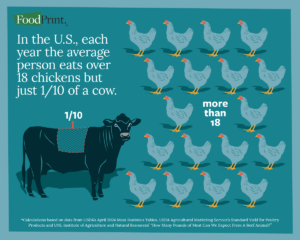
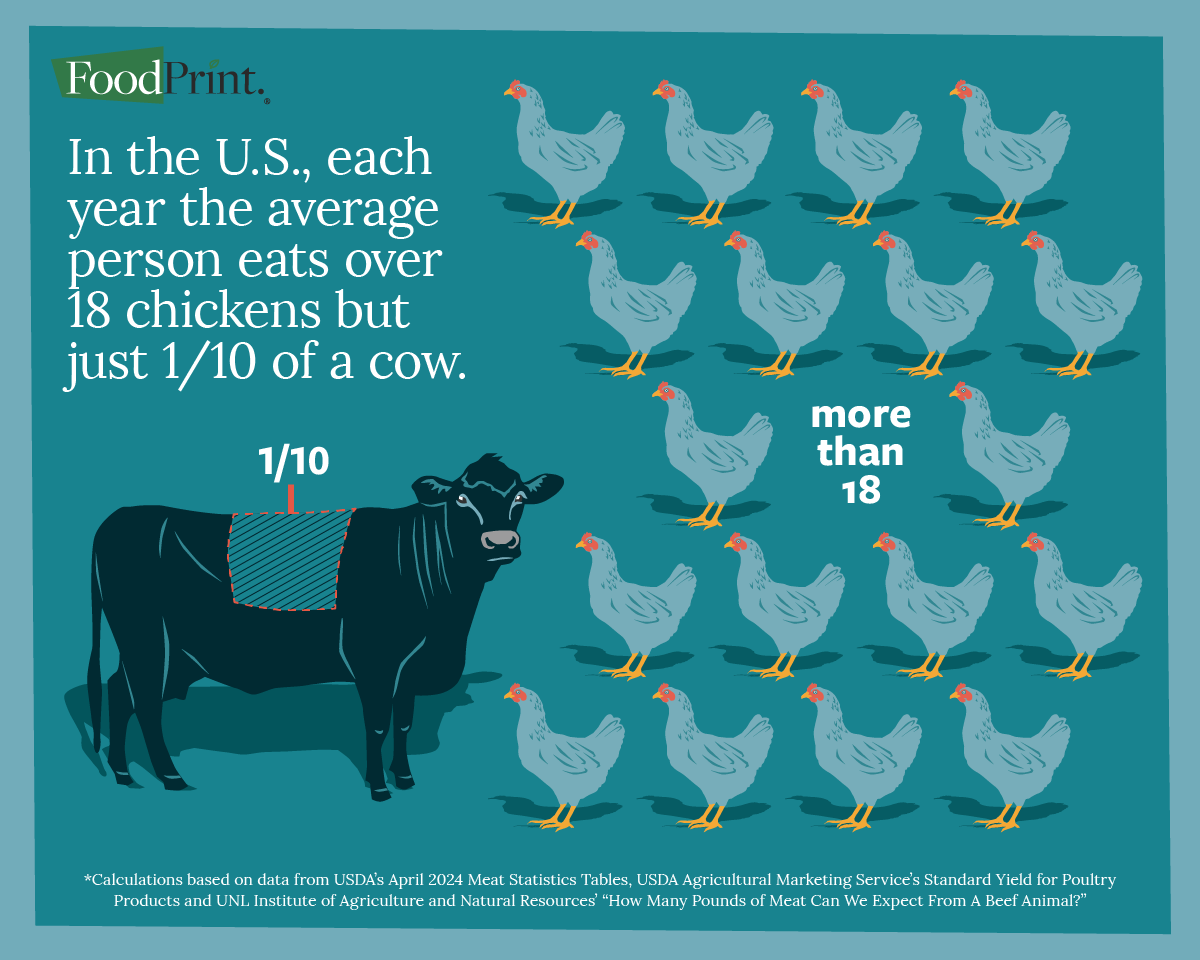
But what replaces factory farmed beef on our plates? For many people in the U.S., it’s factory farmed chicken, which has about one tenth the climate impact per serving. But some eaters might be surprised to hear that this swap isn’t as environmentally friendly as they think.

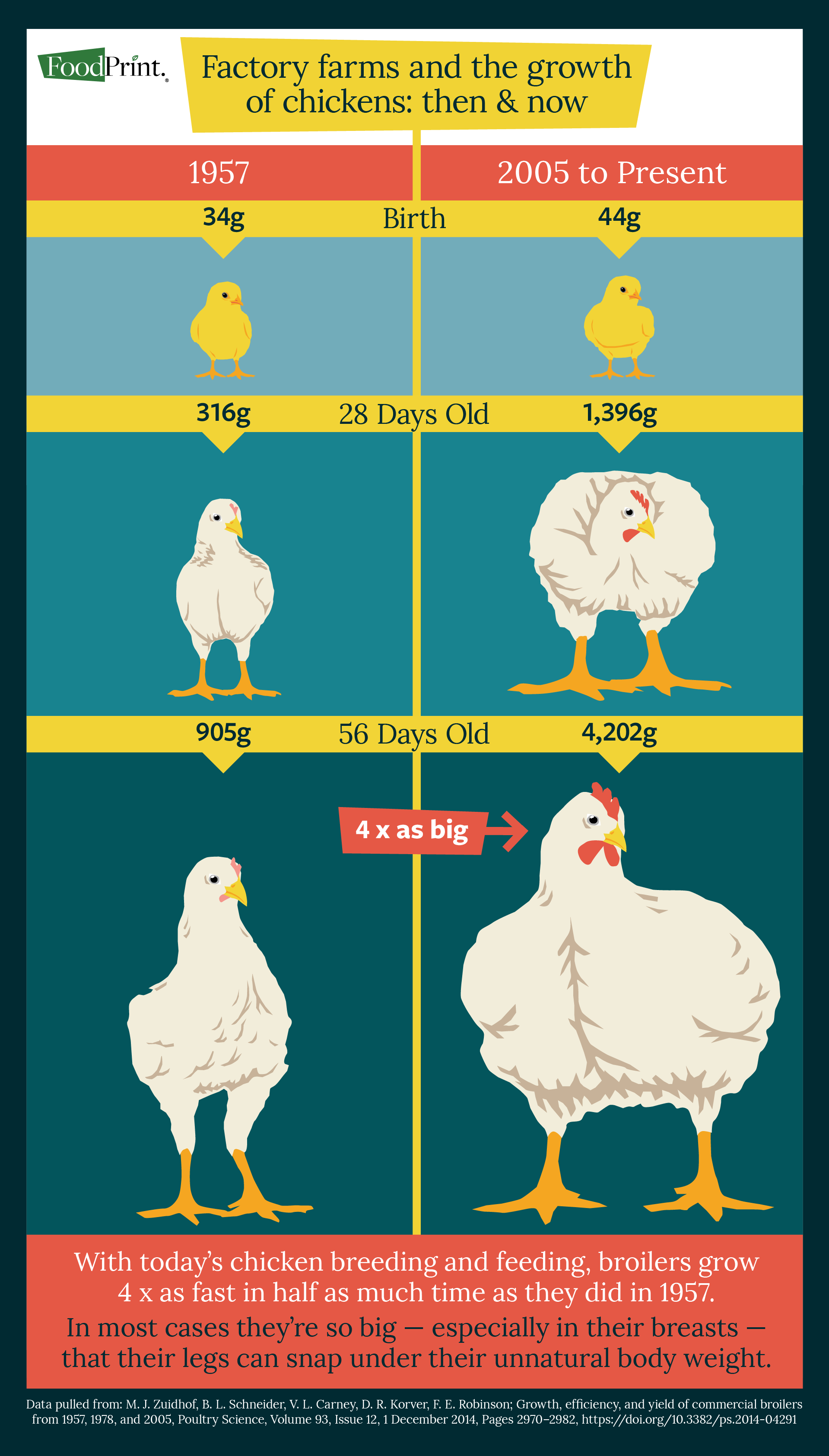
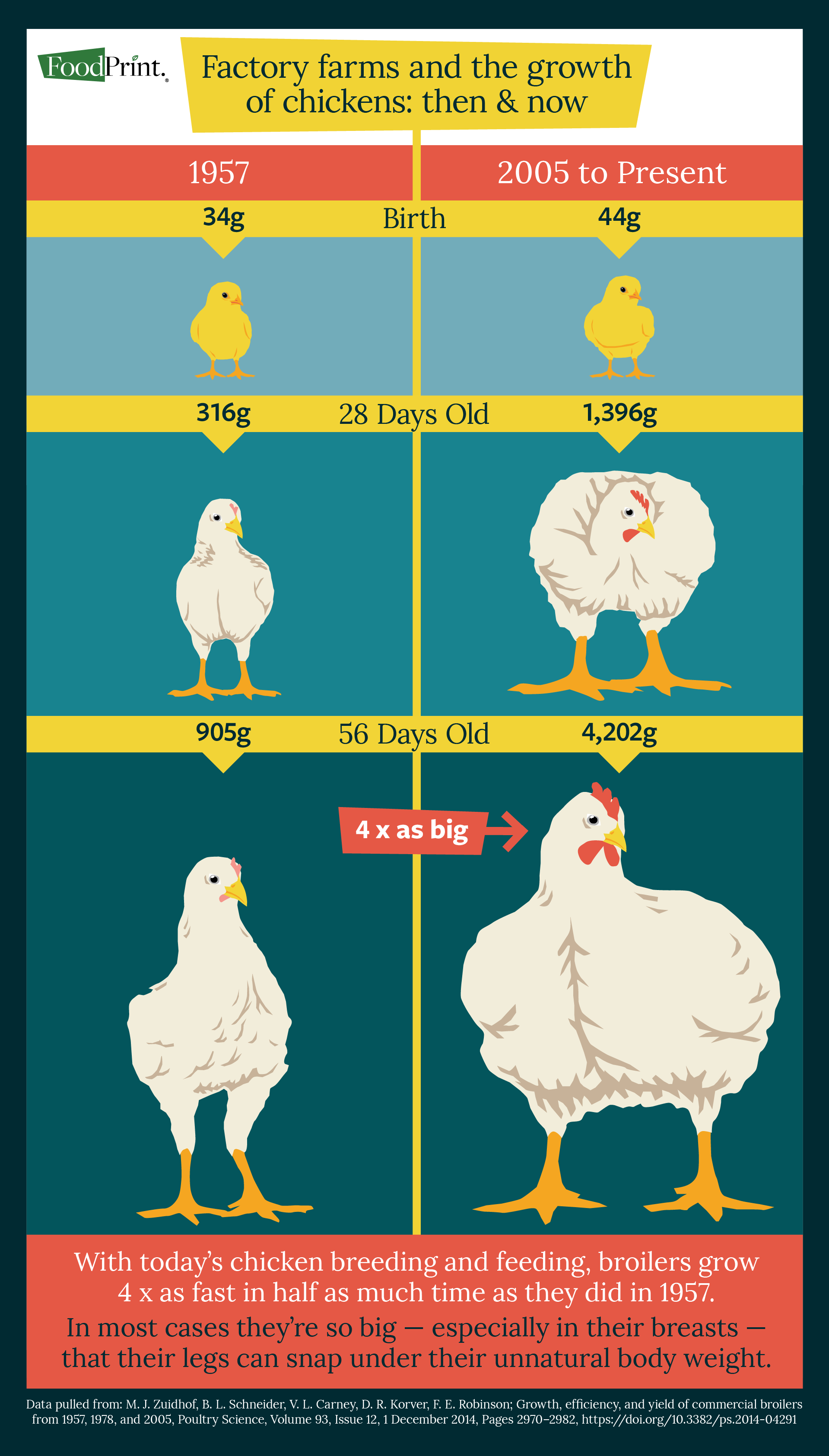
For most of history, chicken was a relatively rare indulgence — the occasional byproduct of egg production. But as farmers in the 20th century adopted the modern factory farm model, raising poultry solely for meat took off in popularity, dropping the cost of chicken dramatically and turning it into a household staple. Between 1940 and 2021, Americans went from eating an average of 10 pounds of chicken annually to about 70. And consumption appears to be rising with no end in sight.

Meanwhile, beef consumption has been trending down, even before recent widespread recognition about its carbon toll: Per capita consumption was nearly 90 pounds a year in the 1970s, but it’s less than 60 pounds today. The downward trend is partially the result of rising production prices that have made beef more expensive, even when adjusting for inflation. But the widespread availability of cheap chicken has also helped drive that shift, with chicken officially overtaking beef in 2010 as the most-consumed meat in the U.S.

Beef’s slump might seem like good news for the climate. But while chicken might have a leg up on beef in the emissions department, the overall rise in cheap chicken consumption is far from a win — for the environment, food system workers or the chickens themselves.


More than just methane: The big footprint of industrial chicken farming

So why do chickens have a better climate reputation than beef cattle? Cattle are “ruminant” mammals, meaning they have specialized bacteria in their multi-chambered stomachs that can ferment tough, fibrous foods into something they can absorb nutrients from. This allows them to eat a wide variety of foods that many other animals can’t process — but those bacteria are also the source of all those methane emissions. Chickens, on the other hand, are what animal scientists refer to as “monogastrics,” meaning they lack a partitioned digestive system and produce almost no methane, though they can’t handle the wide range of foods that ruminants eat.

At a glance, the carbon footprint of factory farmed chicken is dramatically lower than that of industrially raised beef: These chickens produce about 10 pounds of carbon dioxide equivalents (a standard measure of global warming impact) per pound of meat, while industrially produced beef’s footprint is ten times that per serving. Estimates put the beef industry’s total footprint at about 3 percent of all U.S. emissions, with most of that attributable to methane. Chicken’s contributions are comparatively minor, with its total contribution to U.S. emissions sitting at 0.6 percent. But that’s dependent on scale, and as the industry expands, so do its emissions.

Like all animals, chickens still produce a lot of waste — and chicken manure presents some unique problems, especially when there’s a lot of it in one place. And with 20,000 to 30,000 birds in each barn, that manure stacks up quickly. It is relatively concentrated in nutrients compared to manure from other animals and is especially high in nitrogen. Under the right conditions, much of the nitrogen in chicken manure can be made into useful fertilizer by bacteria in soil. When applied in concentrated form, however, that nitrogen volatilize, or transform into gases that escape into the atmosphere.

One of those gases is nitrous oxide, a greenhouse gas that’s 300 times more potent than carbon dioxide. Nitrous oxide accounts for a relatively small portion of all greenhouse gases — about 6 percent — but the amount of nitrous oxide in the atmosphere has increased by 30 percent in the last 40 years alone, and nitrous oxide accounts for nearly half of the U.S. agriculture industry’s climate impact. It’s hard to measure exactly how much comes from any one source, since excess synthetic fertilizers and other manures also emit nitrous oxide, but research has shown that poultry manure is more prone to releasing nitrous oxide than manure from other animals.

The nitrogen in chicken manure can also convert into ammonia, a gas that can cause skin, eye, throat and lung irritation in people  who live near or work on chicken farms— and with higher exposures, even permanent lung damage. For birds, ammonia can cause serious lung problems at even lower concentrations than it does in people, which also increases their susceptibility to infections. Ammonia forms most rapidly in warm, moist conditions — like those inside of a giant chicken barn.

To manage ammonia buildup, chicken farms rely on giant extractor fans that push air out of the barns. But that ammonia has to go somewhere, posing a nuisance and — if it spikes to dangerous levels — potential health threat to neighbors. To make matters worse, much of that ammonia goes on to settle in water bodies. Combined with the excess nitrogen and phosphorus in runoff from the manure itself, this can lead to uncontrolled algae growth that robs water of oxygen and kills aquatic life. In the Chesapeake Bay, for example, researchers have identified that nearly 70 percent of ammonia from chicken houses ends up settling within 30 miles of where it forms, making the industry a big contributor to the area’s water quality issues.

That settled ammonia ultimately compounds the problems that excess chicken manure (which runs off of land into waterways) already causes: dead zones where aquatic life can’t survive, ultimately disrupting the entire food web. While fertilizer and manure form other kinds of industrial agriculture cause this problem too, the chicken industry’s footprint is unique because it’s so geographically concentrated. This puts all the pressure of the industry’s waste on just a few very important and delicate ecosystems rather than spreading it out around the country. In watersheds where chicken barns are common like the Chesapeake, the expansion of the chicken industry has been a major driver of water quality decline and accompanying drops in biodiversity and ecosystem health. Because these ecosystems where fresh and saltwater meet are so naturally rich, any nutrient pollution can have devastating and far-reaching impacts for food webs and unique species on land and at sea.


The unequal impacts of the chicken industry

Industrial chicken production is heavily concentrated in just a few places in the U.S., especially in the South and the Delmarva (Delaware, Maryland and Virginia) peninsula. Poultry processing takes a lot of work, so in the early 20th century, the burgeoning factory farm industry expanded in the South, where workers could be made to accept low wages, leading to the rapid expansion of chicken farms and processing facilities in largely Black communities. Today, those communities still pay the disproportionate price for cheap chicken: Entire neighborhoods are overwhelmed with the stench of chicken manure, and the high levels of ammonia in the air trigger asthma attacks and inflammation in vulnerable people who often lack healthcare access or the ability to move elsewhere.

In recent decades, the chicken industry has moved mainly towards immigrant labor, with a large percentage of workers believed to be undocumented. Their immigration status leaves them vulnerable to exploitation, as workers who speak out against unsafe conditions or other problems could be threatened with deportation or other retaliation by employers. Sadly, workplace dangers are part and parcel of the poultry industry today, with chicken workers experiencing rates of occupational injury that are well above the average. These injuries are often the result of increasing line speeds, the rate that birds move through the plant: Plants today can process 175 birds per minute, or nearly three birds per second. Accidents with knives and other equipment become inevitable in rushed environments like this, not to mention that long hours spent doing repetitive tasks can cause chronic problems like carpal tunnel syndrome.

The industry’s track record for fatal accidents is especially troubling: Eight poultry workers died in processing plants in 2022 alone. These kinds of accidents have made headlines numerous times in recent years, with some — like the suffocation of 6 workers in Georgia after a nitrogen gas leak — the clear product of negligence on behalf of the plant owners. As conservative lawmakers across the country weaken child labor regulations and enforcement, teen workers are getting killed, too: 16-year-old Duvan Perez died in a Mississippi chicken plant when he was pulled into the equipment he was cleaning, a job that, according to federal regulations, he was too young to be doing.

The business side of chicken farming is notoriously difficult for chicken farmers, too: Chicken production has been ground zero for the corporate consolidation and vertical integration that are now also wracking the rest of the meat industry. In the modern poultry system, farmers rarely own their birds. Instead, they are effectively relegated to the role of outside contractors for a few big meatpackers, taking on most of the costs of raising the company-owned chickens and having little choice but to accept low payouts and exploitative contracts. There have been some attempts to rectify this; the Biden administration has introduced some rules that require additional transparency around those contracts, and a class action lawsuit from farmers alleging conspiracy by chicken companies is moving forward. But overall, the problem persists. With only four poultry companies controlling 60 percent of the market, opportunities to get a better contract for raising chickens (or a buyer for raising your own) are still very limited. Many poultry farmers have been forced into debt, often choosing to quit farming altogether and leave larger players to scoop up their assets to produce even more birds.


The animal welfare case against factory farmed chicken

There’s also a compelling animal welfare argument to challenge the idea of chicken as a good swap for beef: By many metrics, chicken production is more cruel. As journalist Kelsey Piper explored in a 2021 piece for Vox, most conventional broiler chickens are born and raised completely indoors with less than one square foot per bird.  That crowding makes it easy for diseases to spread, leading many chicken companies to renege on their antibiotic-free pledges and continue to overuse antibiotics that could accelerate the development of antibiotic resistant bacteria. Even if the birds had room to walk around, most modern broiler chickens have been bred to grow so quickly — with an average lifespan of just six weeks — that they can’t even move or even stand without pain.

Click to view a larger version of this graphic

Beef cattle, on the other hand, don’t have it as bad as other animals in the factory farm system. Even if their final moments are those of stress, confinement and misery, cattle still spend a good portion of their lives outside and experience cruelty and confinement mostly towards the end of their lives on feedlots and in slaughterhouses.

Click to view a larger version of this graphic

It’s hard to do clean math on something as intangible as suffering. But given the enormous number of chickens slaughtered every year in the U.S. — more than 9.3 billion in 2023 — that misery adds up quickly compared to the 32 million cattle slaughtered in the same period. Despite slaughtering nearly 300 times as many animals as beef, however, the chicken industry produces less than twice the amount of meat.

So how do we stomach killing this many birds? As animal rights lawyer and writer Elizabeth MeLampy points out in a 2021 paper for Systemic Justice Journal, many consumers see chickens as fundamentally less sentient (and therefore less capable of experiencing suffering) than animals like pigs or cows, which we perceive as being more like us. That indifference is furthered by how the industry talks about its product, using words like “harvesting” rather than “slaughtering.”


Chicken vs. beef is a false binary

Clearly, there’s ample reason to question the idea that conventional chicken is a big step up from conventional beef. The point is that both options are bad, and that a factory farm model is only going to produce bad outcomes regardless of what animals are involved. Alternative production systems can help alleviate some of those problems. In factory farming, there’s no opportunity to build soil carbon, which can help offset emissions from cows. Well-managed pastured beef helps build up that soil with the help of manure that’s well-distributed by animals themselves rather than pooling huge amounts of it in lagoons where it produces more greenhouse gases or contaminates waterways.

Alternative production systems for chickens also exist. The Department of Agriculture recently tightened its organic standards for poultry production to ensure that chickens raised organically get substantial outdoor access and have enough space to exhibit their natural behaviors. But organic certification does not ban overstocked barns outright, so while some welfare issues are improved, problems intrinsic to densely stocked chicken houses remain, especially waste buildup and the resulting pollution.

Chickens can also be incorporated onto pasture-based regenerative systems, where they can supplement their diets with insects and wild plants and where their waste will be absorbed into the soil in manageable amounts instead of polluting the surrounding air and water. You can find chicken raised this way by looking for pasture-raised birds from local producers at the farmers’ market, or by seeking out certifications like the Certified Regenerative by A Greener World, Regenerative Organic Certified, and the Real Organic Project. A Greener World also offers a more focused Animal Welfare Approved label that guarantees dramatically improved living conditions over conventionally farmed chicken.

But even if these alternative production systems can solve some of chicken’s problems, they accomplish that by producing a lot less meat than factory farms, underscoring the reality that we can’t just swap out one kind of meat for another; we have to be eating a lot less of it in the first place.

Making changes to the way we eat is going to be necessary in this current climate reality, but we have to consider all the tradeoffs associated with those choices. Yes, less methane is good, but it can’t be at the expense of all other environmental issues or animal welfare. It’s vitally important that we eat in a way that holistically supports a better system over all, and without question, swapping in factory farmed chicken in huge quantities is decidedly not the right move.


What you can do

“Mob guys”: Rachel Maddow compares Steve Bannon’s threats to “Sopranos” gangster

MSNBC host Rachel Maddow on Monday raises alarm about the the romanticized "revolutionary" political era the United States is currently experiencing because of former President Donald Trump and his allies. 

Maddow began the segment by noting the nation's film fascination with mobster tropes and people's tendency to romanticize the notion of revolutions. 

"Violence is something that we are very good at in this country," she said. "And we all know all the tropes right? You know, making business people pay protection to the mob, and if they don't pay their protection money then the mob guys beat them up and trash their business and maybe even kill them."

"The mob guys running the card games and the other gambling rackets, where sure the odds are against you while you're playing, but the odds are you're going to get yourself killed if you actually get in debt to them," Maddow added. "And extortion and stealing and prostitution and drug dealing and armed robbery — we've all seen it in a million shows and you can create all sorts of romance and drama around it.

"And we absolutely do as a country."

"But what we are contending with in our politics right now is a movement that is not doing normal politics and it's not competing in normal political terms," the host continued. "They're trying to end the American system of government. They're trying to bring about a revolution against the American system of government and against the United States of America."

Maddow continued by noting that while "being revolutionary" and "being gangster" both evoke a sense of intrigue in the abstract, the specifics of what they're actually offering are "boring because it's just gross force."

We need your help to stay independent

She then showed footage of former Trump adviser and staunch MAGA devotee Steve Bannon threatening to target his perceived political enemies and making inflammatory statements about President Joe Biden. "Go ahead. Go to the ends of the earth — we will hunt you down and bring you back," Bannon, Trump's former chief strategist, said in one clip. In another, Bannon spoke said that Biden and his "crime family" are "nothing but trash."

"It's a family of feral dogs," Bannon exclaimed in another clip. "We're gonna have to fumigate the lies of Joe Biden, the treason of Joe Biden, and how enfeebled he is." He then went on to say how he and other loyal MAGAs would go after Attorney General Merrick Garland, Deputy Attorney General Lisa Monaco, and members of the Justice Department who prosecuted Trump for his efforts to subvert the 2020 presidential election, including special counsel Jack Smith.

"You're the vanguard of this revolution," Bannon added. "We're gonna do what the Romans did to Carthage … it's gonna be a new day. And MAGA will run things. They're gonna know that MAGA is not only ascendant — MAGA is in charge. It's very simple: victory or death."


Want a daily wrap-up of all the news and commentary Salon has to offer? Subscribe to our morning newsletter, Crash Course.


"This isn't red meat for the base," Maddow argued. She followed by claiming that the version of retribution put forth by Bannon and other staunchly alt-right figures is punitive "as much as Tony Soprano's dad was providing protection for the local butcher."

Rather than providing a traditionally conservative version of politics, Maddow said, this is merely a distorted definition of power underpinned by violence. She argued that fervent Trump supporters are not attempting to win a political contest in the 2024 election, but rather, are trying to dismantle the process of democratic political contests altogether. 

"They are not trying very hard in normal campaign terms," Maddow alleged. "They're not trying very hard to compete on normal political appeals. What they are trying to do instead is take power by menacing and chasing out of the country anyone who opposed their leader."

The Rachel Maddow Show airs on Mondays at 9 p.m. ET on MSNBC.

Exclusive: A sneak peek at the “Top Chef: Wisconsin” finale

And just like that, we're down to it!

Thirteen weeks of competition have all led up to one of the biggest moments in food, the restaurant industry and competitive reality TV: The "Top Chef" finale.

As host Kristen Kish tells us at the start of every episode, the winner gets a feature in "Food & Wine Magazine," an appearance at the Food & Wine Classic in Aspen, $250,000 furnished by Saratoga Spring Water and possibly most importantly, the title of "Top Chef."

The final three cheftestants – Dan Jacobs, Savannah Miller, and Danny Garcia – gear up for the last challenge in the season to see who will be crowned the winner of Top Chef.

The exclusive preview clip shows our final three waking up on the Holland America cruise line and features the chefs heading to breakfast and meeting up with Kristen Kish, Tom Colicchio, Gail Simmons and guest judge and icon Emeril Lagasse. Kristen notes how Dan tried out eleven times for the show, while Danny mentions how he's always aimed to apply or try out, but time just hadn't worked out until this seasoning.

"So, opening the restaurant and having this time not tied to a service, I thought 'I'm going go do it' and, like, a week later, it all sort of fell into place," he says. Kristen states that Danny has a seafood restaurant opening sometime this year, which of course is perfect timing; Gail jokes that it was his master plan.


Want more great food writing and recipes? Subscribe to Salon Food's newsletter, The Bite.


Kristen asks Savannah if she also has a restaurant. She notes that she doesn't, but that she's been the executive chef of a restaurant called Glass House Kitchen in Durham, North Carolina, but she stepped away to take this opportunity, so she's now on the lookout for next steps. Gail states "I think there'll be no shortage."

Savannah then states in a confessional that "I've never competed in any sort of culinary competition in my life. I'm a finalist on Top Chef." Tom asks if she's a Carolina or Duke fan and Savannah hesitantly says "To be honest, I was raised in a Carolina family. . ." but then Tom gives her a thumbs up and everyone laughs.

We need your help to stay independent

The clip concludes on a promising note, with Savannah's saying in a confessional that "I want to do this for me. I want to do this for my family and I want to do it for North Carolina. I'm a totally different girl than I was in Wisconsin."

With only Savannah, Dan and Danny in contention for the win, who do you think will win? Perhaps more importantly, who are you rooting for?

Tune in tomorrow night, June 19, at 9:00 PM EST on Bravo — or the following day on Peacock (but beware of spoilers!) — to find out who claims the grand prize and who will be told those momentous words: "You are Top Chef."

Edy Massih talks his new cookbook, Lebanese food and why restaurants are “built for competition”

I was never a massive hummus fan. So many of my pals in college would eat their weight in hummus, but it just never clicked with me. This was until I tried hummus at a Lebanese colleagues' parents' house. It blew me away.

This was one of the first things I thought of when I saw "Keep it Zesty: A Celebration of Lebanese Flavors & Culture from Edy's Grocer" Edy Massih's new cookbook highlighting Lebanese food and tweaking it in different modernized ways. Of course, when we spoke, hummus indeed came up! 

Massih also spoke about what first drew him to food and cooking, why he felt his neighborhood needed a Lebanese grocery store, the deep importance of Riz a Jej and the myriad reasons why he transitioned away from restaurant kitchens.

The following interview has been lightly edited for clarity and length.

Keep It Zesty by Edy MassihKeep It Zesty by Edy Massih (Photo by Jessica Marx)
Your recipes take traditional Lebanese cuisine and tweak them a bit to modernize or otherwise 'update' them. Can you give me an example of a recipe in this book that exemplifies this? 

One good example of this is the Kale Tabbouleh. Tabbouleh is normally made with parsley, but I've modernized it for the grocer using kale. With a kale base (there's still parsley in it, just not as much!), it requires less prepping and lasts longer in the fridge. In this recipe, I also use pearl couscous instead of bulgur to add to the texture.

For those unaffiliated or unfamiliar with Lebanese cuisine, how would you explain its tenets and fundamentals? 

The food is fresh, with a focus on produce, herbs and of course, spices. There is a lot of marinating overnight, so as to engulf the dish in flavor.

I'm such a fan of the recipes, from the mezze and dips to the salads and desserts. Would you be able to pinpoint a singular favorite of yours? (I know it's tough!) 

Riz a Jej is probably my favorite recipe in the book. It's a Lebanese dirty rice and it just brings me back to growing up in Lebanon and being in my Grandmother's kitchen. She would make it for every holiday and now we make it everyday at the grocer. 

Edy MassihEdy Massih (Photo by Jessica Marx)

What are the three most important ingredients for any cook looking to get into Lebanese cooking? 

I'd say lemon, olive oil and spices (sumac, za'atar, aleppo pepper). Does that count as three? 

What stands out for you as a formative moment that got you into cooking or food at large? 

I got into cooking by just growing up in my Grandmother's kitchen, taking it all in and then moving to America where I no longer had access to that kitchen or that food. I craved those same flavors, dishes, memories and comforts of home, so I started cooking to create that for myself.


Want more great food writing and recipes? Subscribe to Salon Food's newsletter, The Bite.


What was the development process of the book like? 

It was so much fun to really dig deep into my memories of all the recipes I grew up with and those I have come up with over the last eight years cooking professionally, including the staple dishes on the menu at the grocer and adapt them all for a home cook. As a caterer, I cook in really large quantities, so it was challenging but so much fun to scale those back for home cooks for the book.

What would you say is an ideal “gateway” recipe for someone who’s never cooked or eaten Lebanese food before? 

Any of the mezze dips! They're simple enough to cook and for the most part, flavors everyone is familiar with. For example, everyone loves hummus and they don't necessarily realize how easy it is to make it themselves at home.

Can you talk a bit about the founding of Edy’s Grocer? 

Living on the same block in Greenpoint for seven years. I developed a relationship with Maria who owned Maria's Deli, the Polish deli on my street corner. I would always trek down to Sahadi's anytime I needed Lebanese ingredients for catering. It just hit me that a Lebanese grocery store was so missing and needed in North Brooklyn. Maria was ready to close Maria's Deli and she reached out to see if I was interested in taking it over. The rest is history!

We need your help to stay independent

How do you practice sustainability in your cooking? 

We really try to have very minimal waste at the grocer. I would always rather sell out than have too much food [or] food go to waste. We also partner with Too Good To Go to sell items that are left over from the day.

MujadaraMujadara (Photo by Jessica Marx)

What’s your biggest tip for cutting down on food waste? 

Be creative about utilizing everything in the kitchen. For example, we use chicken bones and vegetable "scraps" to make stocks, plus chicken and salmon "scraps" from our skewers to make our chicken and salmon salads. There is always a use for anything leftover in the kitchen.

What does “keep it zesty” mean to you? How does it encapsulate your approach to cooking and eating? 

For me, it really just means to have fun in the kitchen, which is what it's all about for me! Don't take things too seriously — cooking should not be daunting, it should be approachable and fun.

I read this quote in one of your recent interviews in regards to working in restaurants and catering: "It’s so hostile and every day was a battlefield of who’s better than each other. It was never to make movement." I find that that's something pretty acknowledged in most press about the industry and it's striking to read, especially for those entirely unaffiliated with the inner workings of the industry at large. Could you speak a bit to that and your pivoting to your own company in response to it? 

From my perspective, being in this industry, we should all be helping each other out and lifting each other up. Community has always been such a big part of this industry for me and I try to stick to that day in and day out, jumping up to help if anyone has a problem and also having people to reach out to if I have a problem! After all, that's what small businesses are about. That's not really the case in kitchen culture, [which is] built for competition and [the] individual rather than group rewards.

If we lift each other up, we can become better together as an industry.

CNN debunks Fox News’ false claim about Trump-Biden debate, says both will be standing throughout

Fox News host Jeanine Pirro falsely claimed that Donald Trump and Joe Biden would be seated for the upcoming presidential debate, a move she told viewers would mean “there is one less obstacle to worry about for Biden.”

“The whole idea that, you know, they’re out there saying this election is not about age, Joe and the other guy are about the same age, even for the debate is, as Jesse is saying, they’re gonna be seated,” Pirro said on Monday’s The Five show. “We don’t even get to see them walk in. They’ll be seated so that, you know, there is one less obstacle to worry about for Biden.”

CNN debunked the claim, noting that both Biden and Trump will be standing for the debate, Mediaite reported.

The false claim of a seated debate appears to have stemmed from an anonymous right-wing account on X, formerly Twitter, that claimed "two sources" had told it the Biden campaign was trying to renegotiate the terms with CNN to allow him to sit down. The post was re-shared by a number of pro-Trump lawmakers, including Sen. Josh Hawley, R-Mo., who posted “he can’t stand for 90 minutes – but he’s 100% able to be President?” It marks one of many attacks from the right on Biden's age and capabilities, often based on deceptively edited video and similarly false claims.

CNN told Forbes the claim from the "Washington Reporter" X account was “not accurate,” and that both Biden and Trump agreed to CNN’s proposed debate format.

The 90 minute debate is set to take place on June 27, live from CNN’s Atlanta studios. It will be moderated by Jake Tapper and Dana Bash with no studio audience. Candidates’ microphones will be muted when it is not their turn to speak, according to CNN.

“He got his name wrong on the cognitive test!”: Jon Stewart mocks Trump after Biden attack backfires

Jon Stewart flamed Donald Trump and President Joe Biden on how their age and public gaffes affect their larger campaigns for the 2024 election during Monday's episode of "The Daily Show."

The comedian, who received criticism from liberals earlier this year for criticizing Biden's age and cognitive health, continued to mock Biden and Trump for their numerous public errors. The episode kicked off with Stewart stating, "The election is basically boiled down to each candidate accusing the other of having soup where there should be brain!"

Stewart joked about Biden's appearance at the G7 summit last week, stating Biden's “habit of seemingly staring at what can only be considered ghosts or out-of-frame paratroopers.” In a clip, the 81-year-old president veered off away to the side of world leaders during a photo. He was then guided back by Italian Prime Minister Giorgia Meloni.

When Meloni pulled the president back into the frame, he's "somehow giving the impression someone has quantum-leaped into his body," Stewart quipped. When Biden put his sunglasses back on in the clip, Stewart mocked his expression. "No, don't look directly into the sun, sir," Stewart said.

As for Trump, "it's basically Trump tripping over his own d**k any time he tries to capitalize on Biden’s age." There have been countless critiques about Trump's cognitive health as he has publicly mistaken names, cities and facts on the campaign trail.

The comedian highlighted that Trump was at the Turning Point USA convention this weekend when he made another public blunder. "Trump articulated his case for having best brainful neutrons smart."

The show played a clip of the former president at the convention saying, "Joe Biden has no plan. He's got absolutely no plan. He doesn't even know what the word inflation means."

We need your help to stay independent

"You tell 'em Donny T!" Stewart quipped. "The case he's making to the American public is that he's the sharpest tool in the shed. See if you can find the flaw in his logic just one sentence later."

At the convention, Trump continued to question Biden's mental fitness. "I think he should take a cognitive test like I did. I took a cognitive test and I aced it. Doc Ronny Johnson — does everyone know Ronny Johnson, the congressman from Texas?"

“Acing that cognitive test is a great point,” Stewart said, “if only his doctor was actually named Ronny Johnson, and not actually named Ronny Jackson. He got his name wrong on the cognitive test!"

Stewart concluded that “The sad thing is, under MAGA law, his name is now Ronny Johnson. This is the way.”

"The Daily Show" airs Monday through Thursday at 11 p.m. on Comedy Central and streams on Paramount+

“Virtually no public information”: Trump campaign pays over $3 million to mystery company

Former President Donald Trump’s campaign has given over $3 million to a mysterious company that appears to have been first incorporated in November of last year.

The owners of the limited liability company, called Launchpad Strategies LLC, are not publicly disclosed on campaign finance records, fitting with a strategy Trump’s campaign has used in the past to hide exactly whom the campaign is paying, NBC News reported

While state business records show that Launchpad Strategies was incorporated in Delaware, campaign finance filings list an address in Raleigh, North Carolina. Last week, however, state officials in North Carolina confirmed that it is not registered in the state.

“We don’t have a business entity by that name in our Business Registration database,” Liz Proctor, a spokeswoman for the North Carolina secretary of state, told the outlet.

The company has received $3.1 million in payments from the Trump campaign and an affiliated joint fundraising committee. 

“It’s concerning to see a company formed just six months ago suddenly receive over $3.1 million from Donald Trump’s network of political committees, particularly since there is virtually no public information about this company,” Saurav Ghosh, the Campaign Legal Center's director of federal campaign finance reform, told NBC News. She said tha

“Who works there, what services they offer or have provided, and whether Trump’s payments to ‘Launchpad Strategies LLC’ are for bona fide services or are, instead, actually payments to other vendors funneled through a mere corporate shell.”

The payments Launchpad Strategies has received this year make it the the second largest vendor used by the Trump Save America Joint Fundraising Committee, the financial hub for Trump fundraising efforts.

Federal and state campaign finance disclosure filings show that Launchpad Strategies has no history of political work for other state-level or federal candidates.

“The company website shows a black sky rising above grey clouds — the crosshairs cursor shows its location along the x and y axes. The only words that appear are the company's name and a contact form,” RawStory reported

“We need loyalists”: Far-right Freedom Caucus chairman in MAGA civil war over tepid Trump support

The only thing that matters in today’s GOP is unequivocally supporting, at all times, the Republican Party’s three-time nominee for president amid a criminal conviction and hundreds of millions in court judgments. You can oppose abortion, support guns, demonize immigrants — you could even back ending the American democratic project to keep the loser of an election in the White House — and that is still not enough: To survive, one must be truly, unflinchingly devoted to one man.

Rep. Bob Good, R-Va., is chair of the House Freedom Caucus, a collection of some of the most far-right lawmakers ever make it to Congress. Elected in 2020, one of his first votes was to block President Joe Biden’s victory in the Electoral College; one of his staffers, district director Sandy Adams, was on the grounds of the U.S. Capitol as MAGA enthusiasts bludgeoned cops with flag poles during the Jan. 6 insurrection.

If you think that’s sufficient, you are not Donald Trump. Good, who is up for reelection today, has been expelled from the Mar-a-Lago extended universe — not for deviating from the Republican platform or embracing “Critical Race Theory,” but for the crime of once thinking that Florida Gov. Ron DeSantis was, as conservative media once suggested, the more competent and electorally palatable heir to Trump’s political fortune.

“After I won the primary he became a big fan — that’s not good enough,” Trump said this week at a virtual rally for state Sen. John McGuire, who is running to take Good’s seat in Virginia’s Fifth Congressional District, The Wall Street Journal reported. Their policy positions are close enough that the only thing voters really have to go off, in terms of differentiating the two, is whether or not Trump likes them today.

McGuire, for his part, is leaning in to the cult of personality, boasting to prospective voters that he is the “Trump Endorsed” candidate, a fact he wears on his sleeve.

“If you look at Trump’s endorsement for me, compared to all the other endorsements he’s done all year, he hit Bob harder than he’s hit anybody else’s opponent,” McGuire told the Journal.

Ricky Pritchett, a small business owner, told the paper that’s enough for him: He’s voting McGuire “because Trump supports him.” It’s also enough for several of Good’s own Freedom Caucus comrades.

“We need loyalists,” Rep. Marjorie Taylor-Greene, R-Ga., explained at a rally for McGuire. Good “kicked Trump when he was down, and went and endorsed another candidate,” she said, per The New York Times. Can’t have that.

We need your help to stay independent

Good does still enjoy some MAGA support, with former Trump adviser Steve Bannon, set to report to prison next month for defying a congressional subpoena, using his last moments of freedom before the November election to stump for the incumbent, whose district includes Charlottesville. Rep. Chip Roy, R-Texas, is likewise claiming it is Good who is the MAGA candidate who has been “daring to take on the swamp”; the swamp, in this case, being the Trump-led Republican establishment.

But the lawmaker, to survive in Trump’s party, has also had to fake some of his credentials. In May, the former president sent Good a cease-and-desist letter after the congressman put up yard signs with his name just below Trump’s, suggesting a vote for one was a vote for the other.

Trump, in a post on his Truth Social website Monday night, made clear that a vote for Good would be “BAD FOR VIRGINIA.”

The former president did not identify any policy disputes nor any issues of character. Rather, he said, Good was “fighting me until recently, when he gave a warm and ‘loving’ Endorsement – But really, it was too late!”

Whoever wins Tuesday's battle will be on the ballot in November, with or without Trump's support in a district that hasn't been won by a Democrat since 2008. Polls close at 7:00 p.m.

Steve Bannon gets bad news: Former Trump adviser won’t be spending his prison time at “Club Fed”

Former Donald Trump adviser Steve Bannon won’t be serving time at a minimum-security prison camp known as “Club Fed,” as he expected, CNN reported.

Bannon, podcast host and Trump devotee, was convicted of contempt of Congress in 2022 after he failed to provide documents and testimony to the House Committee investigating the Jan. 6, 2021 attack on the U.S. Capitol. Last week, a judge ordered Bannon to report to prison for a four-month sentence by July 1. 

Instead of serving time at a minimum-security “Club Fed,” which only houses non-violent prisoners, Bannon will serve his sentence at a low-security facility, the Federal Correctional Institution in Danbury, Connecticut. 

“So, he’s behind ‘The Wall,’ is what they call it. It’s different than a camp. It has more confines for the inmates that are kept there,” said Katelyn Polantz, the CNN reporter who broke the story and appeared on CNN’s Out Front

The Federal Correctional Institution houses more than 1,000 male prisoners, some of whom may be violent offenders.

Bannon isn’t eligible for a minimum-security facility because he still has a pending criminal case against him where he is accused of defrauding donors in a fundraising campaign for a border wall between the U.S. and Mexico. He is expected to go to trial in New York in September.

If he is still serving his federal sentence while his state trial proceedings take place, he may be transferred to Rikers Island, one of the country’s most notorious jails, Polantz added.