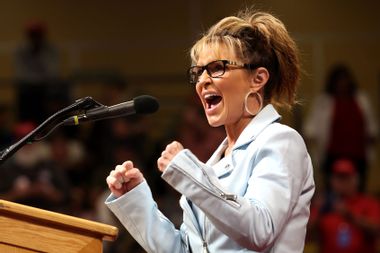
Fox News Channel may not be Sarah Palin's only foray into television.
The former vice presidential candidate has been pitching an idea for a show about Alaska to network executives. She's teamed with Mark Burnett, one of television's busiest producers. Burnett is best known for his "Survivor" series on CBS.
Three broadcast executives, who spoke on condition of anonymity because their networks don't publicly discuss story pitches, said Thursday that Palin was meeting with officials at ABC, CBS, NBC and Fox this week. The meetings were first reported by Entertainment Weekly.
Palin started work earlier this year as an analyst at Fox News. The former Alaska governor also appeared telling jokes this week on NBC's "The Tonight Show" with Jay Leno.
Sarah Palin is ready for the next chapter of her publishing career.
Publisher HarperCollins announced Wednesday that the former Alaska governor and Republican vice presidential candidate is working on a "celebration of American virtues and strengths." The book is currently untitled and no release date has been set.
Palin's memoir, "Going Rogue," released last fall by HarperCollins, has sold more than 2 million copies. Her new work will "include selections from classic and contemporary readings that have inspired her, as well as portraits of some of the extraordinary men and women she admires and who embody her love of country, faith, and family," the publisher's statement reads.
"She will also draw from her personal experience to amplify these timely -- and timeless-- themes."
In an e-mail Wednesday, HarperCollins publisher Jonathan Burnham said that "a number of ideas and concepts" were explored with Palin. "This is the idea which appealed the most to her," he said, adding that she is currently "gathering ideas and identifying favorite texts and examples."
Burnham declined comment on financial terms. As with "Going Rogue," Palin was represented by Washington attorney Robert Barnett, whose clients include President Obama and former President George W. Bush.
The proverb that the enemy of my enemy is my friend partly explains why Sarah Palin stopped by Jay Leno’s Tonight Show on Tuesday night. She and Leno have a common foe in David Letterman and by teaming up they likely delivered a ratings blow to CBS’s late-night host (who feebly counterprogrammed with Mitt Romney).
But there was more to Palin’s appearance than this. Her poll numbers, after all, have plummeted to alarming depths. More than 70 percent of all Americans – and more than 50 percent of Republicans – now believe she is unqualified for the presidency. And there are only 23 months until the Iowa caucuses.
So she was wise to sit down with Leno, who provides the kind of image boost to Republican political figures that Larry King’s does for fallen celebrities. In the last few years, Arnold Schwarzenegger and Fred Thompson launched their campaigns from Leno’s couch and Mike Huckabee stopped by on the eve of his 2008 Iowa triumph. And don’t forget Rush Limbaugh, who took a seat just a few months ago.
One of the knocks on Leno is that he’s too eager to please people to be very interesting. But this is a trait that can serve someone like Palin just fine. Little was required of her on Tuesday night. She participated in the obligatory cold open gag – informing Leno that, instead of cue cards, his monologue would be printed on her hands – walked on stage to the tune of “Everyday People,” and smiled and laughed through Leno’s please-like-me questioning.
(Actual Leno query: “With you, it seemed like they kind of went after your family. Is that fair? Oddly enough, Palin agreed with his premise.)
It’s rather remarkable, then, that despite the host’s best efforts not to make her squirm, Palin still managed to offer some sound bites that reinforce her lightweight reputation.
For instance, when Leno gently asked about how she’d read from notes scribbled on her hand at last month’s Tea Party convention, she defended the “substance” of what she’d written – as if the episode had made her look like a modern day Martin Luther, and not a seventh-grader trying to cheat on a geography test. Then, she seemed to channel that same seventh-grader and declared, “Just to get the left all wee-weed up and to get their heads spinning, I’m going to keep doing it.”
She was even more ridiculous on the subject of her burgeoning media career. “I studied journalism,” she told Leno. “My college degree there is in communications. And now I’m back there wanting to build some trust back in our media.”
OK, fair enough. But then in the next breath, she gave a shout-out to her new employer, the Fox News Channel, as an exemplar of the kind of trust-worthy journalism she wants to restore. “Because,” Palin said, “all those years ago when I studied journalism, it was all about the who, what, where, when, why. It was not so much the opinion interjected into news stories.”
Making sure not to challenge her directly, Leno replied that he likes to watch all of the different news channels so that he can learn everyone’s perspective on the news. That’s fine to do, she assured him, “as long as there is not opinion under the guise of hard news stories.” We’ll see if she speaks up the next time a Fox anchor or reporter inserts the term “nuclear option” into a hard news story about the use of reconciliation in the Senate.
Palin’s two segments closed with her performing her own Leno-style monologue (minus the high-fiving with the audience). Her delivery wasn’t terrible, but the material was indistinguishable from his: broad, light and obvious.
The temperature in Alaska, she remarked, “is five degrees below Congress’ approval rating.” The audience chuckled, and you could hear the five million or so Americans who watch Leno every night chuckling along at home. Come to think of it, Leno’s fan base is a lot like Palin’s: neither is particularly interested in thinking that much.
Watch the full interview:
Part 1:
Part 2:
WASHINGTON -- Sarah Palin is, as she so frequently reminds us, just an average, everyday American. She's more connected to the real working folks out there than the "lamestream media," or the elitist Democrats who brought the country "that hopey-changey stuff" that left her giving speeches to for-profit tea party conventions in 2010 instead of serving as vice-president.
But Palin will soon be firing off her outrage against the elites who want to keep her down from a studio her new employer, Fox News Channel, is building in her house in Wasilla, Alaska. The New York Times reported a couple of weeks ago -- and Fox News has confirmed to Salon -- that the network is installing a TV setup on Palin's property so she can appear on "The O'Reilly Factor" and other shows as a paid analyst. (Some Fox employees are grumbling privately about the studio, the cost of which hasn't been revealed.)
Admittedly, there aren't really other ways for Palin to reach national TV from Wasilla. Up to now, anyone who wanted to beam Palin's pit bull-with-lipstick mug live from her home had to rent the KTUU-TV satellite truck from Anchorage, an hour drive away. And there's little doubt that Fox's investment in having Palin on their airwaves will pay off in viewers, no matter how much cash the network shelled out for the studio (which apparently includes a camera that can be controlled remotely, so no production staff is needed on-site).
There is, though, something a little hard to swallow about populist broadsides from a political celebrity who issues them from her own home, thanks to what's essentially a very nice corporate perk. Plenty of people in "real America" face hour-long commutes each day to work, after all, without their bosses paying for a home office for them. And Palin has no trouble insisting that her family life is private and separate from her political work; meanwhile, she'll be throwing out red meat to her base, just down the hall from the personal life she's so protective of.
The studio may also be a sign that Palin isn't really planning to run for president in 2012, her willingness to flirt with the idea notwithstanding: Fox executives might not have been so eager to invest in getting her on TV if they suspected they'd have to stop featuring her sometime next year so she can begin her primary campaign.
For now, there's no word on when the studio will be ready. Which means Palin's primary means of communicating with the world may continue to be her Facebook page and her Twitter feed.
The man who assured us we’d be greeted as liberators in Iraq dropped in on this year’s Conservative Political Action Conference to make yet another prediction.
“I think that Barack Obama is going to be a one-term president,” Dick Cheney declared on Thursday.
The assembled righties roared – as they did whenever a speaker at the three-day conference forecasted a 2012 victory for the GOP. To watch CPAC was to realize that the right can be described in one word today: cocky. They have no doubt that Obama will be defeated in 2012; the only question is whether it’ll be Mitt, Sarah, Mike or Mitch replacing him.
You’ll excuse me if I rain on their parade, but there’s a source with just a little more credibility than Dick Cheney that would beg to differ: history.
The right is giddy because Obama’s approval rating, stratospheric just a year ago, now hovers around 50 percent and because his party, practically invincible in the 2008 and 2006 elections, is suddenly facing long odds in one key midterm election race after another. The nation’s political climate, indisputably, has been transformed since Obama took office, and Republicans are now on course for a strong year in 2010.
But this is where history comes in. Obama is actually the third president in the last 30 years – the “permanent campaign” era of American politics – to see his political fortunes crater in the second year of his administration. Bill Clinton in 1994 and Ronald Reagan in 1982 both endured the kind of political hell that Obama is now starting to taste (one-termer taunts and all) – and both bounced back to win lopsided reelection victories two years later.
The Clinton and Reagan comeback stories aren’t identical, but they do offer obvious cautionary lessons for those who would write off Obama today.
Start with Clinton, who, like Obama with Cheney, was branded a goner by his predecessor’s vice-president. “Let me be very clear,” Dan Quayle blustered back in ’94, “Bill Clinton will be a one-term president.”
The thing is, it was mighty tempting to believe Quayle back then. At the time, Clinton’s popularity – never as high as Obama’s (or Reagan’s) to begin with – had plunged below 50 percent and his signature initiative, healthcare reform, had just died in Congress. And the public remained angry over his 1993 budget, which had raised taxes on upper-income Americans, and unmoved by his insistence that it would prove wise in the long run. When the GOP scored massive gains and took over in the ’94 midterms, there wasn’t a Republican in America who believed Clinton could win a second term.
The famous turning point for Clinton came in November 1995, when he called the GOP’s bluff and allowed the federal government to shut down rather than sign off on Medicare cuts. In truth, though, he had been well on his way to recovery before then, thanks to the public’s mounting satisfaction that the recession of the early '90s was, in fact, over. The November '95 showdown merely crystallized what voters were already concluding: Clinton wasn’t actually half-bad. From there, his effortless triumph over Bob Dole was inevitable.
The Reagan narrative actually tracks more closely with Obama’s, for two reasons: 1) They both enjoyed enormous personal goodwill from voters when they took office; and 2) they both confronted far more dire economic conditions than Clinton did. In fact, the trajectory of their first-year job approval scores is nearly identical, and the reason was simple: With joblessness soaring over 10 percent, the public had no patience.
It’s striking to go back and read analysis of the first two years of Reagan’s presidency; you soon realize that virtually the same words are now being written about Obama. Consider the opening lines of a January 1983 UPI story:
Two years of a poor economy coupled with dim prospects of a significant recovery seriously damage President Reagan's chances for re-election. Two years ago, Reagan came into office as probably the best liked president since Dwight Eisenhower, the last chief executive to serve out two terms. If the election were held today, it is likely Reagan would suffer the fate of all those since Eisenhower and become another one term president.
This is the same Reagan, of course, who won 49 states and nearly 60 percent of the vote in his 1984 reelection campaign. The key to his turnaround was simple: Unemployment finally began falling in 1983. Voters who had pronounced his economic program a failure in 1982 suddenly decided it wasn’t that bad. And with confidence on the rise, Reagan’s poll numbers quickly improved.
Ironically, the unemployment rate was actually higher on Election Day ’84 than it had been when Reagan took office – which may well be the situation for Obama in '12. But that didn’t hurt Reagan. Voters believed the country was moving in the right direction and were happy to reward a president they had always liked personally. Obama stands to benefit from the same phenomenon if unemployment is in decline in 2012.
So before they start planning for the Romney inaugural bash, conservatives might want to pause and reflect on the Reagan and Clinton examples. They were both written off as one-termers and lived to tell about it. And Obama is now halfway to doing the same.
The revolution lives: Ron Paul stormed to a big win in the CPAC presidential straw poll.
The libertarian hero -- whose faithful followers packed the hall for most of the conservative conference's three days -- took 31 percent of the vote. Mitt Romney, who had won the last three straw polls in a row, came in second, with 22 percent. Sarah Palin, who didn't show up to speak here, was third, with 7 percent. Tim Pawlenty -- who did show up -- was just behind her, at 6 percent. So was "undecided," which also got 6 percent. The other runners-up: Newt Gingrich, 4 percent; Mike Huckabee, 4 percent; Mitch Daniels, 2 percent; Rick Santorum, 2 percent; John Thune, 1 percent; Haley Barbour, 1 percent; write-in, 5 percent.
That didn't please the crowd in the ballroom as the results were announced -- the room booed loudly, and cheered wildly for Romney, Palin, Pawlenty and pretty much anyone who wasn't Paul.
Nearly 2,400 people cast ballots, out of about 10,000 CPAC attendees. More than half of them were between 18 and 25 years old. One other figure stood out: 2 percent of respondents said they approved of the job President Obama is doing, and 2 percent also said they had a favorable impression of both Nancy Pelosi and Harry Reid. Presumably, they were joking. Or Democratic plants.
The results don't really mean much; as one GOP pollster told Salon just as CPAC started, "Winning a straw poll two years before Iowa, New Hampshire and the rest is the equivalent of being homecoming queen in high school. It's pretty neat and means you are popular right then, but it doesn't mean anything for the rest of your life."
And it mostly just shows that Paul, who has about as much chance of winning the GOP nomination in 2012 as Obama does, has a very devoted following among the conservative activists who flock to gatherings like this.
GOP pollster Tony Fabrizio, whose firm conducted the survey, did find that 53 percent of respondents were not satisfied with the possible field of candidates -- which only helps underscore the fact that 2012 is a long way off.