Haruki Murakami

“Norwegian Wood”: A rapturous tale of doomed love

Haruki Murakami's novel about a death-haunted romantic triangle becomes a gorgeous movie

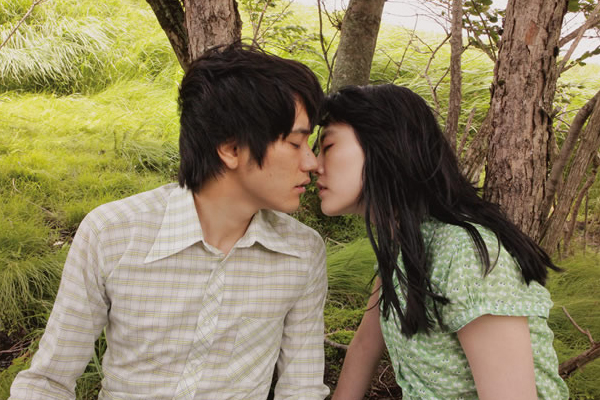
Ken'ichi Matsuyama and Rinko Kikuchi in "Norwegian Wood"

Young love in all its agonies is something we’ve all experienced, and I’m pretty sure it’s something we all remember at a visceral level, whether we’re 14 or 95 or somewhere in between. Yet it’s a notoriously difficult set of emotions and sensations to capture in novels or plays or films, at least not without resorting to the worst kinds of clichés. (I’m looking at you through my Magic Mirror, Stephenie Meyer! Not that the “Twilight” books and movies are the worst offenders — not by a long shot.) What’s so great about writer-director Tran Anh Hung’s slow-building, gorgeous adaptation of Japanese novelist Haruki Murakami’s “Norwegian Wood” is that by the time it was over I felt completely transported into a rapturous, swoony state of early-20s romance, that condition where you feel right at the edge of heartbreak and insanity, your brain and skin and nerve endings possessed by the yearning for another person. (And yes, you get to hear the title song twice, once in a sweetly hilarious Anglo-Japanese acoustic version, and once for real.)

First published in 1987, and subsequently translated into 30-odd languages, Murakami’s “Norwegian Wood” is about a death-haunted love triangle amid the campus strife of Tokyo’s universities in the late ’60s. An enormous sensation in Japan — it was embraced by many younger readers and rejected by the country’s conservative literary establishment — the book also established Murakami as a superstar in world literature, paving the way for acclaimed later works like “The Wind-Up Bird Chronicle” and the recent “1Q84.” There are any number of reasons why Tran, a Vietnamese-born one-time Oscar nominee who lives in France, seems like a strange choice to adapt this hugely popular novel. He isn’t Japanese and doesn’t speak the language, and his films, including “The Scent of Green Papaya” (1993) and “Vertical Ray of the Sun” (2000), are more concerned with lavish settings and languid sensuality than with storytelling.

But maybe this was the project Tran has been waiting for. I rate this the best film of his non-prolific career by far, and while of course Murakami buffs will have their complaints, this “Norwegian Wood” ultimately develops the right blend of spooky, sexy, pulpy intensity. For the first few minutes, the stylish young cast, spectacular Japanese settings and wide-screen digital images of cinematographer Lee Ping-bin are almost disconcertingly beautiful, and I was worried about sitting through two hours of picture postcards. But by the time teenage Kizuki (Kengo Kora) asphyxiates himself in the family car, leaving his girlfriend Naoko (onetime Oscar nominee Rinko Kikuchi) and best friend Watanabe (Kenichi Matsuyama) to muddle along without him, I was utterly hooked on Tran’s long, languorous takes and startling shifts of focus.

Kizuki is the first character in “Norwegian Wood” to die by his own hand, but not the last; through Lee’s photography and Jonny Greenwood of Radiohead’s insistent, hypnotic score, Tran powerfully captures Murakami’s notion that young love is an irresistible and universally destructive force, akin to drug addiction or mental illness. After Kizuki’s death, Watanabe’s new best friend becomes the caddish, drop-dead-handsome Nagasawa (Tetsuji Tamayama), who strings along his upper-crust girlfriend while grabbing as much side action as possible. When Watanabe asks whether it’s true that he’s slept with 100 women, Nagasawa tells him not to exaggerate: “It’s more like 70, at most.” Watanabe is far too much of a gentleman to emulate this example, and once he reconnects with the bereaved (and remarkably beautiful) Naoko, his fate is sealed. But one could argue that Nagasawa’s cynical attitude toward women and romance is the path of survival.

Tran’s Vietnamese-set films have been tremendously atmospheric, and this one captures the angry, turbulent, trashed surroundings of Tokyo’s campus uprisings in wonderful detail, even though Watanabe and his friends are more concerned with affairs of the heart. Watanabe falls hard for Naoko, but she’s clearly still suffering in the wake of Kizuki’s death, and retreats to a hospital in the mountains, a richly symbolic setting that suggests both Thomas Mann’s “Magic Mountain” and Japanese director Naomi Kawase’s little-known masterpiece “The Mourning Forest.” While she recuperates under the care of a mysterious fellow patient named Reiko (Reika Kirishima), Watanabe meets an adorable gamine named Midori (Kiko Mizuhara), who already has a boyfriend but makes it clear that she’d pick Watanabe — but if, and only if, he picks her above Naoko and all other contenders.

It’s a classic torn-between-two-lovers predicament, of the sort in which we’ve all been implicated at some point — and if there’s one thing we know for sure, it’s that all three people are going to get hurt. Murakami has an unusual ability to make such mundane romantic affairs seem urgent and dreadful and momentous, and even though I pretty much knew what was going to happen, I watched the crucial scenes of Tran’s “Norwegian Wood” holding my breath and perched on the edge of my seat. This is a wonderful, passionate, well-nigh unforgettable adaptation of a great novel about the horrors of love, and the wonderful fact that at least some of us live through it and come back for more.

“Norwegian Wood” is now playing at the IFC Center in New York and the West End Cinema in Washington, D.C. It opens Jan. 20 in Chicago and San Francisco; Jan. 27 in Los Angeles, Seattle and Wilmington, Del., and March 2 in Portland, Ore., with more cities and dates to follow.

“1Q84″: Love in an alternate universe

Haruki Murakami's new novel is the international literary giant at his uncanny, mesmerizing best

Haruki Murakami (Credit: Petr Josek / Reuters)

“1Q84,” Haruki Murakami’s new meganovel (it was published in three volumes in his native Japan), begins with a young woman in business attire on her way to an appointment in Tokyo. Her taxi gets stuck in a traffic jam on an elevated highway, and the cabbie suggests that if she’s really anxious to arrive on time, she might want to climb down a nearby utility access ladder and jump on the subway. So climb down she does, finding her way out of a neglected storage area and off to her appointment — which turns out to entail killing a man with a very slender, very discreet silver needle to the back of the neck.

The woman, Aomame, has done this sort of job before, and her life continues more or less as usual, until she notices that policemen’s uniforms are somewhat different, and that they’re carrying more serious handguns than she remembers. She asks a friend when these changes took place and is told it happened a couple of years earlier, after a big shootout with a radical group up in the mountains. A faithful newspaper reader, Aomame has no recollection of such an event. Not long after that, she looks up into the night sky to see two moons: the accustomed one and “a small, green, misshapen” one next to it.

Like so many Murakami characters, Aomame is a self-disciplined, levelheaded loner who, when confronted with the impossible, only briefly considers the likelihood that she’s lost her mind. Instead, she decides that when she climbed down that ladder, she stepped out of the 1984 she had been living in and into an alternate version of her world, one that she calls 1Q84 (a bilingual pun suggesting uncertainty). She’d like to ask someone about the second moon, but she can’t: If she’s still in 1984, they’ll think she’s crazy for seeing it, and if she really is in 1Q84, they’ll think she’s crazy for finding it strange. So she resolves, pragmatically, to take it all in stride.

The novel’s other principle character is Tengo, a math tutor and aspiring author who gets talked into heavily rewriting a novel by an odd teenage refugee from a secretive religious cult. A prodigiously ugly private detective hired by the cult to find Aomame also becomes a central figure later in the book, but “1Q84″ mostly describes the long, slow process by which Tengo and Aomame, who knew each other as schoolchildren, seek to reunite. Never was a love story so overpopulated with hardcore isolates, people who have severed ties to family, maintaining a cool distance from friends and lovers while investing their identities in the rigorous pursuit of some personal cause or obsession. The possibility that Tengo and Aomame might at last come together seems genuinely epochal because it will overthrow the atomized social order that otherwise prevails.

This faith in the significance of Tengo and Aomame’s bond makes “1Q84″ warmer than some of Murakami’s other “big” novels; since 2002′s “Kafka on the Shore,” a greater yearning toward human connection has suffused his fiction. This is still the sort of story in which a character goes about some perfectly mundane daily business on one page (Murakami is famous for his peculiarly fascinating descriptions of food preparation) and has an inexplicable, uncanny experience on the next, as if slipping back and forth between waking and dreaming. But while his early novels took their (often perplexing) structure from dream logic, “1Q84″ is a book about wanting to wake up.

There’s still plenty of weirdness along the way. Behind the cult is an ambiguous band of supernatural entities, the Little People, who are enraged when the novel Tengo co-writes becomes a hit and somehow lessens their power. Even creepier is a never-seen collector of state television license fees, who pounds on the characters’ doors in the middle of the night, berating them as they cringe in silent distress; this may or may not be a spectral projection of Tengo’s comatose father. A rosy-cheeked nurse passes on prescient messages from an owl. Characters are doubled, or split, and some apparently innocuous encounters leave them with the sensation of having had pieces of their souls removed.

The spell cast by Murakami’s fiction is formed in the tension between his grounded accounts of everyday life and the otherworldly forces that keep intruding on that life, propelling the characters into surreal adventures whose exact meaning rarely gets explained. Over the years, his style has gotten plainer and plainer — which, for one thing, makes it more translatable. It’s worth noting, though, that one of the two translators who worked on this book (Jay Rubin; the other is Philip Gabriel) recently told the New York Times that Murakami’s Japanese often reads as if it had been translated from English. The creation of a relatively frictionless “international” style seems more a side effect of the author’s stripping-down process than the goal.

This is not great writing by conventional literary standards. Murakami isn’t afraid of repetition, outright cliche (“They were just letting off steam”) or the overuse of such vague, anodyne terms as “special,” and the characters all tend to express themselves with the same declarative, matter-of-fact diction (“This isn’t a question of whether I want to or not, or whether it’s the right thing to do. Once I start something, I have to see it through”). Yet even if you haven’t read his earlier, more lyrical novels, the occasional figurative flight here — about “an inexhaustible source of clouds” in the north where people “worked silently from morning to night to make clouds, like bees make honey, spiders make webs and war makes widows,” for example — indicates that the author’s spartan style is a deliberate choice.

Murakami has long described his fiction as an extended foray into his own unconscious rather than a psychologically realistic portrayal of social relationships. You’re either tuned to his frequency or not. A surprisingly large number of people are; bookstores are staging midnight festivities for the day, Oct. 28, when “1Q84″ goes on sale — an honor usually bestowed on YA phenomena like the Harry Potter and Hunger Games series. Readers speak of being hypnotized by “The Wind-Up Bird Chronicle,” despite that novel’s many unresolved enigmas and dangling loose ends. “1Q84″ has the same heady effect. (Although “Wind-Up Bird” probably remains the best entry point for those unfamiliar with this remarkable novelist.)

References to Carl Jung in “1Q84″ suggest that Murakami has himself contemplated the paradox of an author who mesmerizes strangers by excavating the depths of his own psyche. You could say that the units with which he builds his fiction aren’t words and sentences but emblems and actions, storytelling elements that are, if not pre-literary, then extra-literary. Sanding off the surface texture of the language only makes the lines of this underlying structure more visible and immediate. Translation is at the center of what Murakami does; not a translation from one tongue to another, but the translation of an inner world into this, the outer one. Very few writers speak the truths of that secret, inner universe more fluently.

Further reading

Salon’s review of Haruki Murakami’s “The Wind-Up Bird Chronicle”

Salon’s 1997 interview with Haruki Murakami, on the U.S. publication of “The Wind-Up Bird Chronicle”

Salon’s review of Haruki Murakami’s “After the Quake”

Salon’s review of Haruki Murakami’s “Kafka on the Shore”

Continue Reading Close
Laura Miller

Laura Miller is a senior writer for Salon. She is the author of "The Magician's Book: A Skeptic's Adventures in Narnia" and has a Web site, magiciansbook.com.