Mortgage Crisis
National Journal reports: Things are bad out in Real America
The crumbling of once-great institutions isn't to blame for middle-class decline and anger. Politicians are
(Credit: Andy Dean Photography via Shutterstock) Ron Fournier, the editor in chief of the National Journal, and reporter Sophie Quinton have a story on hard times in Muncie, Ind., as a microcosm of the failure of American institutions as a whole.
It’s a good piece. It’s even an “important” piece, in the sense that the cloistered elites who run the country could learn something of the reality of life out in the country at large if this piece makes it to their desks. D.C.-based news organizations should report from “the rest of America” more often, because in Washington mass foreclosures and double-digit unemployment are usually seen as abstract problems slightly less pressing than the fact that Social Security will, decades from now, pay out slightly more than it takes in. (Joe Klein, who is basically a buffoon, returned from his stunt “2010 road trip” sounding suddenly much less buffoonish. Getting outside the bubble is often instructive.)
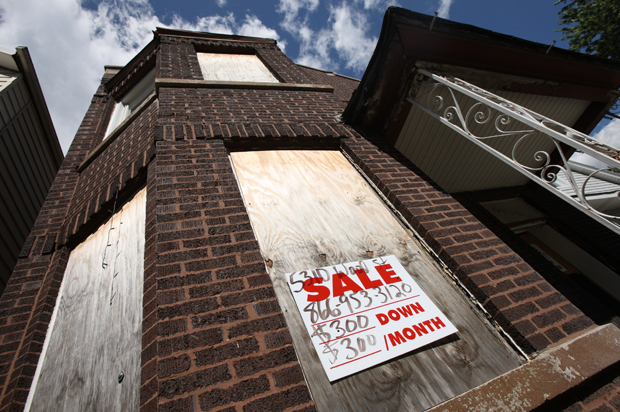
The piece is bookended by the story of Johnny Whitmire, a guy who was unceremoniously dropped from the rolls of the middle class by the Very Serious People In Charge of Things. His wife lost her state job. They fell behind on their mortgage. He applied for the Obama administration’s mortgage modification program. His modification was canceled, Citi billed him for back payments, and his home was foreclosed on. Then he got a bill for not cutting the grass at the home his bank seized, because banks keep foreclosed homes in the names of their former owners to avoid liability issues.
So, Whitmire is angry. And he has every right to be.
Whitmire is an angry man. He is among a group of voters most skeptical of President Obama: noncollege-educated white males. He feels betrayed — not just by Obama, who won his vote in 2008, but by the institutions that were supposed to protect him: his state, which laid off his wife; his government in Washington, which couldn’t rescue homeowners who had played by the rules; his bank, which failed to walk him through the correct paperwork or warn him about a potential mortgage hike; his city, which penalized him for somebody else’s error; and even his employer, a construction company he likes even though he got laid off. “I was middle class for 10 years, but it’s done,” Whitmire says. “I’ve lost my home. I live in a trailer now because of a mortgage company and an incompetent government.”
Whitmire’s life was ruined by a few specific “institutions”: Mitch Daniels and the Indiana Republican Party, the finance industry as represented by the bank that decided to screw up his paperwork and seize his home, and the Obama administration, which failed spectacularly on mortgage modification efforts for a variety of reasons.
The piece as a whole lays blame for the sorry state of affairs in Muncie at the crumbling of institutions — church, school, government — but Whitmire is actually a victim of elites. It’s elite consensus that loan modifications have to be limited and difficult for homeowners in order to preclude “moral hazard” and save banks from having to overexert themselves. Mitch Daniels, a leading GOP presidential contender among George Will-style Republicans, slashed state payrolls, in the name of fiscal responsibility. The sorts of people who pay for National Journal subscriptions are actually responsible for this guy’s life going to hell.
Fournier and Quinton’s piece goes on to describe the decline in various Muncie institutions: the mainline Protestant church dying as a corporate-inspired Megachurch thrives outside of town, some local government scandal involving improperly cast absentee ballots and an arrogant one-term mayor. The schools are apparently awful, in part because of elite-mandated testing regimes, more Daniels budget cuts, and, of course, because many of their most motivated students have been redirected to private-run and publicly funded charter schools. (Though as usual the awfulness of the public schools is simply stated — there’s no data or anything.)
But if we want to talk about how things got so bad for formerly middle-class people like Whitmire, the culprit is basically the financialization of our entire system of capitalism and the crippling of the labor movement; the slow death of the Mainline Protestant tradition doesn’t really enter into it. Whitmire was screwed by a venal bank and betrayed by an administration that gave venal banks way too much leeway to screw people.
The National Journal advertises that their piece on “the solution” will run next, but I’m not entirely convinced they’ve nailed down “the problem.”
Alex Pareene writes about politics for Salon and is the author of "The Rude Guide to Mitt." Email him at apareene@salon.com and follow him on Twitter @pareene More Alex Pareene.
The big banks win again
Foreclosure victims get little help in a mortgage-settlement plan that only benefits the banks' bottom line
This Oct. 12, 2011 file photo shows the J.P. Morgan Chase logo at the base of one of the bank's larger Lower Manhattan buildings in New York (Credit: AP Photo/Kathy Willens) On Thursday, a group of well-connected and powerful men announced that the federal government and state attorneys general had agreed to a multibillion-dollar settlement of claims relating to falsified foreclosure documents. The image of former corporate lawyer-turned-Attorney General Eric Holder and Iowa official Tom Miller complimenting each other on their courage and bravery was a stark reminder of how little power foreclosure victims have in Washington. The terms of the settlement were still secret, but we saw hints of what is to come: The website set up to inform the public noted that homeowners may not know for up to three years whether they are eligible for help.
Continue Reading CloseThe foreclosure deal: Every little bit counts
The banks don't get the punishment they deserve, but the White House finally gets some traction on housing woes
(Credit: whitehouse.gov) The first thing to understand about Thursday’s much ballyhooed $26 billion foreclosure fraud settlement between five big banks, the federal government and 49 states is that it is nowhere near as big of a deal as it is being made out to be. You can safely ignore the claim that the torturously negotiated settlement is the heftiest financial punishment of industry by government since the landmark multistate tobacco deal in 1998 or President Obama’s declaration Thursday morning that it is the “largest joint federal-state settlement in our nation’s history.”
Continue Reading Close
Andrew Leonard is a staff writer at Salon. On Twitter, @koxinga21. More Andrew Leonard.
Newt Gingrich can’t talk his way out of Freddie Mac tie
His former firm invents excuses not to release the former speaker's "consulting" contract
(Credit: AP) I bet, when he launched his presidential campaign in what I still assume was primarily an attempt to embarrass those who said he’d never actually do it, that Newt Gingrich did not think his greatest liability would be consulting for the Federal Home Loan Mortgage Corp. No, he surely assumed it’d be the marriages, adulteries and divorces. Or even the climate change ad with Nancy Pelosi. But the one attack he has not been able to talk his way out of has turned out to be that he took a great deal of money from Freddie Mac, which, according to Republican lore, caused the financial crisis.
Continue Reading Close
Alex Pareene writes about politics for Salon and is the author of "The Rude Guide to Mitt." Email him at apareene@salon.com and follow him on Twitter @pareene More Alex Pareene.
Old people getting richer, young people getting poorer
The age-based wealth gap is big and growing, thanks to younger Americans' debts
(Credit: MitarArt via Shutterstock) Have you noticed how most of the Tea Party people were sort of old, while most of the Occupy Wall Street people are fairly young? Here’s an interesting factoid, from the USA Today: Old people are much, much richer than young people. According to the Pew Research Center, Americans 65 and older are 47 times richer than those 35 and younger.
It makes sense that old people would have more money than young people, because they have been working and saving longer. But this wealth gap is massive by historical standards. In 1984, old people were a mere 10 times richer than young people. Not only have old people gotten richer since then, but the median net worth of households headed by young people has declined considerably.
Continue Reading Close
Alex Pareene writes about politics for Salon and is the author of "The Rude Guide to Mitt." Email him at apareene@salon.com and follow him on Twitter @pareene More Alex Pareene.
Sensitive banker Jamie Dimon comforted by Mitt Romney
Still smarting from an off-hand insult to the all-powerful financial sector, JPMorgan's CEO cozies up to the GOP
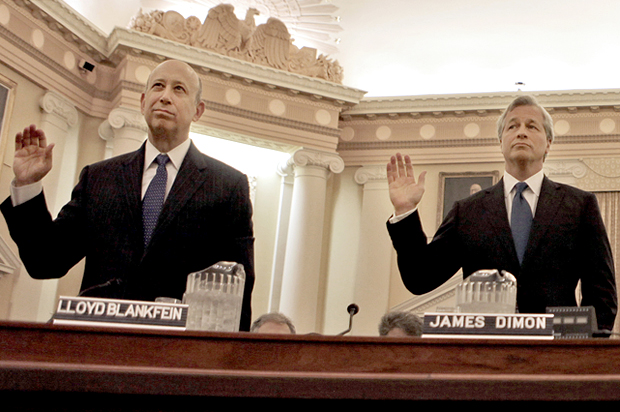
Jamie Dimon and Mitt Romney(Credit: AP) Jamie Dimon, CEO of JPMorgan Chase, is not supposed to endorse a presidential candidate, because he sits on the board of the Federal Reserve Bank of New York, but he is out partying and attending fundraisers with former Massachusetts governor Mitt Romney. (Of course, Dimon also probably shouldn’t have accepted billions of dollars from the Fed while sitting on the New York Fed board either, but that happened.)
Continue Reading Close
Alex Pareene writes about politics for Salon and is the author of "The Rude Guide to Mitt." Email him at apareene@salon.com and follow him on Twitter @pareene More Alex Pareene.
Page 1 of 21 in Mortgage Crisis