Garrett Epps

A dead end for progressives

Crusading against the Senate filibuster as "unconstitutional" can harm, not help, liberal causes

  • more
    • All Share Services

A dead end for progressives

The Senate filibuster, as abused by the Republican minority, is a bad idea gone wrong. By allowing any senator to block a vote unless 60 senators vote to proceed, the filibuster rule permits senators representing a small minority of the population to block or delay measures that have overwhelming popular support.

But is it unconstitutional? Though the Constitution is silent, progressive icon Thomas Geoghegan thinks so. In a New York Times Op-Ed Monday, he argues that the filibuster is “at worst unconstitutional and, at best, at odds with the founders’ intent.”

I yield to no one in my admiration for Tom Geoghegan. His career as a labor lawyer and progressive writer leaves me in awe. I gave money to his ill-fated House campaign. For a brief period last year, he and I were part of a litigation team trying to prevent the dubiously Honorable Roland Burriss from squatting in Barack Obama’s old Senate seat for the remainder of Obama’s term.

But even Jove nods. Geoghegan’s arguments aren’t just flawed — they are actually harmful to the cause of progressive constitutionalism. They may impel progressives to squander their energies on a constitutional crusade that will make them look hypocritical and ridiculous. Even worse, they may help legitimize the constitutional techniques that the right has devised to get its political way. Many of the same arguments were used during the Republican era of dominance to threaten the Democrats’ use of the filibuster to block Bush’s worst nominations. That dispute was settled by negotiation and deliberation — which the founders clearly did intend — instead of by spurious arguments about “original intent.”

The right has poisoned constitutional debate by advancing ridiculous claims — that, say, the vice-president isn’t part of the executive branch, or that the president may ignore the Foreign Intelligence Surveillance Act — and getting them taken seriously by claiming they are “clearly” part of the Framers’ “intent.”

In fact, the chief usefulness of Geoghegan’s piece may be to serve as a compendium of wrong ways to interpret the Constitution. Here’s a list of those techniques:

1. Ignore the clear text and overinterpret the unclear text. Article I of the Constitution says “Each house may determine the rules of its proceedings.” Pretty clear? Geoghegan insists that this language is trumped by such provisions as Article I, § 5, which states that “a majority of each [house] shall constitute a majority to do business.” This is the kind of strained parsing the Supreme Court has used to limit Congress’s power to enforce civil rights. The 14th Amendment says that Congress can enforce its provisions by appropriate legislation. Chief Justice Rehnquist pioneered the argument that this section granting power was actually “intended” to limit Congress to doing what the Court considers “appropriate.”

2. Invoke a general sense of what the founders must have thought to trump what they actually said. “The founders … were dead set against supermajorities as a general rule,” Geoghegan writes — therefore they must have secretly opposed the practice of filibustering, even though they didn’t say so. The Rehnquist Court used the “the background principle of state sovereign immunity embodied in the Eleventh Amendment” to block federal lawsuits against states under such laws as the Americans With Disabilities Act. “State sovereign immunity” appears nowhere in the Constitution, but conservatives “know” the Framers liked it.

3. Recharacterize the question. The right uses this all the time — remember that conservatives Ronald W. Rotunda and J. Peter Pham recently charged that Obama’s Nobel Prize is not a national honor but “an emolument, and a foreign one to boot,” thus barred under the Constitution. In Geoghegan’s analysis, the filibuster isn’t a rule of procedure governing debate — it is an issue of the vice-president’s prerogatives. The vice-president is to vote when the Senate is “equally divided,” he notes. But with the 60-vote requirement to cut off debate, an “equally divided” Senate won’t vote. “The Senate is never ‘equally divided’ on the big, contested issues of the day,” he argues. This is a clever substitution — but it’s textual nonsense (if the Senate doesn’t hold a vote under its rules, it’s not “equally divided”) and not even true. In 1993, Al Gore cast a tie-breaking vote to enact the first Clinton budget, for example. In all, Gore cast four such votes — and Cheney cast eight.

4. Interpret the Constitution like a statute. Because the founders included some supermajority provisions, Geoghegan argues, there can’t be any others. “The founders knew and operated under the maxim ‘expressio unius est exclusio alterius’ — the express mention of one thing excludes all others.” This Latin wheeze is nearly obsolete as a rule of statutory interpretation; as a constitutional principle, it would be a disaster. The Framers left many things out of the Constitution — some because they wanted the government to work them out, and some because they just didn’t think of it. The president’s power to remove Cabinet members is never mentioned; some early leaders argued that meant the Cabinet had to serve for life. Designating a flag is not a listed power of Congress. Is the American flag unconstitutional? Healthcare’s not in the Constitution either. “We must not forget that it is a Constitution we are expounding,” Chief Justice Marshall wrote in McCulloch v. Maryland. Progressives in particular should pay attention to this rule.

5. Treat “The Federalist” as a dispositive source of meaning. Geoghegan says the authors of “The Federalist” defended constitutional supermajorities “with an obvious sense of guilt.” So we should imagine that they really opposed them, even though they pretended to be writing to affirm them. “The Federalist” is a brilliant book, but it’s not a source of law. One of its authors, Alexander Hamilton, barely attended the sessions in Philadelphia. Another, John Jay, was not even a delegate. Conservative justices have used conjectures about “The Federalist” to invalidate parts of the Brady Handgun Act and to support state-imposed term limits on Congress. Like Tocqueville’s “Democracy in America,” “The Federalist” can be tortured to mean whatever we want it to.

6. Finally, and most pernicious, invite the Supreme Court to take the decision away from the political system. “We needn’t rule out the possibility of a Supreme Court case,” Geoghegan writes. Oh, please, please, Tom, please can we agree to rule that out? Do we really want the current Supreme Court deciding when and how a Democratic Senate can vote? Look what an impartial job they did picking the president. Progressives’ motto, for the next few years, should be the one Dickens coined about the Victorian Court of Chancery: “Suffer any wrong that can be done you, rather than come here!”

Geoghegan has some good suggestions — a resolution by the House denouncing the filibuster and united political action to support candidates who will vote for reforms. But the right way to reform the filibuster is political, not constitutional. The Senate has changed its rules before — until 1975, a cloture vote required 66, not 60, votes. The Senate can enact new rule changes. Obviously it would be hard to do, but it can be done.

For a generation, the right has been arguing that any reform it opposes is unconstitutional. They’ve had great success limiting the national agenda in the name of a will-o’-the-wisp called “original intent” or “original understanding.”

Progressives shouldn’t play that game; it’s rigged.

The true “original intent” of the Framers is indicated by what they wrote. On a few questions, there are hard and fast rules. Aside from that, we are supposed to work things out. The way to win on progressive issues is to get down into the trenches and win votes. We shouldn’t fog our national debate with strained constitutional claims.

Garrett Epps is professor of law at the University of Baltimore and a former reporter for the Washington Post. 

How to get rid of Roland Burris

The Constitution contains enough wiggle room to allow Illinois to fire its embarrassing senator.

  • more
    • All Share Services

How to get rid of Roland Burris

Rod Blagojevich is gone — but his legacy is tainting both the Illinois political system and, now, the United States Senate. The prospect is for a miserable, drawn-out inquiry into the deceptions of Blago’s Senate appointee, Roland Burris. On Wednesday morning, both the Washington Post and Burris’ hometown Chicago Tribune called for Burris’ resignation, the Tribune noting that the new senator had now offered four different versions of how he came by his seat. Just hours later, Burris spoke at a City Club of Chicago luncheon and said, “I’ve done nothing wrong and I have absolutely nothing to hide.” The likelihood that this ambitious rogue will fold his cards seems slim.

The ambiguities of the United States Constitution, however, offer the Illinois state Legislature an opening to short-circuit this dreary ritual. The Legislature should call a special election in the next few weeks to fill Burris’ seat, and offer the voters a chance to weigh in on the artful evasions of their new unelected senator. It would be the constitutional equivalent of a Hail Mary pass, but desperate times call for desperate measures.

Federal wiretaps quote the colorful ex-Gov. Blagojevich as saying, among other things, that the Senate seat “is a f–king valuable thing, you just don’t give it away for nothing.” Yet a few weeks after his arrest, he asked us to take on faith that he had done exactly that. He appointed Roland Burris, a former Illinois attorney general, to the seat, and insisted that Burris is “an individual who has unquestioned integrity … a good and decent man.” Burris vouched for himself as well, assuring the public that “I have no relationship” with the pervasive corruption alleged against his patron. Senate leaders, having promised not to seat any senator appointed by Blago, meekly seated Burris on Jan. 13.

But the “no relationship” statement is now inoperative. In testimony given to the Illinois Legislature during Blago’s impeachment, Burris recalled only one discussion about the seat, with a member of the governor’s staff. In the past few days, his memory has improved, and he now recalls that he spoke with, well, five Blagojevich associates, including the governor’s brother, and that the subject of campaign contributions did come up. Tuesday he admitted agreeing to raise funds for Blagojevich during those talks. Still, he insists, he has done nothing wrong, and he faults the media for making a big deal of such a small memory lapse.

God alone knows how many other shoes will drop over the next six months, as Illinois prosecutors ponder whether to indict their new senator for perjury, and Senate leaders mull the prospect of an inquiry by the Senate ethics committee. The presence of Blago’s protégée on the national scene is both an embarrassment and a distraction. Can nothing be done to bring this tawdry saga to a quicker end?

One possible answer lies in the text of the 17th Amendment, adopted in 1913, which provides for the election of senators by the people. Under the original Constitution, senators were named by the legislatures; the governors had the power to appoint senators if a vacancy occurred while the legislature was not in session. As Edward Zelinsky of Cardozo Law School wrote recently, many legislatures met infrequently. “A temporary gubernatorial appointment was a sensible way to reduce this gap in senatorial representation until the legislature met to elect a new U.S. Senator.”

What the 17th Amendment now says is that “the legislature of any State may empower the executive thereof to make temporary appointments until the people fill the vacancies by election as the legislature may direct.” In fact, four states currently by statute bar the governor from making any temporary appointments; eight others permit appointees to serve only until a special election can be held. The rest permit the governor to appoint a senator to serve until the next general election.

Illinois is such a state. Its statute currently provides that “the Governor shall make temporary appointment to fill such vacancy until the next election of representatives in Congress.” When the Blagojevich scandal broke, the Legislature considered stripping the governor of appointing authority, but punted — in part, one suspects, because Democrats wanted to keep the prerogative of appointment for Blago’s successor. That was the wrong call. Arguably, the Legislature could go back and undo the mistake it made by passing a statute tomorrow calling for a special election to be held on, say, Tuesday, April 7.

Would this be constitutional? The amendment says that a gubernatorial appointee shall serve at most “until the people fill the vacancies by election as the legislature may direct.” The Legislature at first directed that an appointee’s term should run until January 2011; but there is nothing in the text to suggest that it couldn’t change its mind, even after the fact. In fact, the words “may direct” directly echo language in Article II of the Constitution that provides that presidential electors shall be appointed “as the legislature … may direct.” Defenders of the Court’s decision in Bush v. Gore argued that this language meant that the Florida Legislature had sole authority for deciding how to award the state’s electors, a responsibility that did not arise from or depend on state law and could not be limited by the state courts. The same argument would suggest that the Illinois Legislature could delegate its authority to the governor under the 17th Amendment — but that no state statute could divest it of its continuing responsibility to determine when “the people [shall] fill the vacancy,” even if that means taking back its initial delegation.

This argument is not a slam dunk. Burris could rush into state and federal court and argue that he has a vested right to his seat. There’s no case law I can find on this, and one can make a good argument that a court should abstain from such a case as a “political question.” But the choice would be Burris’: If, as he insists, he is a public servant of spotless rectitude, wouldn’t it be better to put the question to the people and let them reaffirm or reject his appointment?

One objection to this procedure would be that it would permit a back-door recall of appointed senators. The Illinois Legislature could spike that argument by doing what it should have done in December — permanently taking the governor’s appointment power away. Replacement senators in Illinois would henceforth be chosen by the people, and like all elected senators, not subject to recall by anyone.

Nowhere else in the United States political system is a powerful office the property of one official, to be awarded without any check to another. Judges, Cabinet officers, ambassadors — all must be confirmed by the Senate. Members of the House take office only after a special election. Giving the Rod Blagojeviches of the world the power to create senators in their own image is an open scandal.

In the weeks since the 2008 election, we have seen the disadvantages of appointed senators on display. Illinois we know about. In New York, the governor flirted with naming an amiable celebrity who could probably not have been elected in a fair contest. And in Delaware, the governor named an able chair-warmer whose mission seems to be to prevent anyone from earning the seat before Vice President Biden’s son Beau can run for it.

To hell with all of that. The people of every state deserve a real choice and a real senator at all times.

As a nation, we made the choice for popular election of senators in 1913. We as a people should carry through the logic of the amendment by getting rid of gubernatorial appointment. Sen. Russ Feingold has proposed a constitutional amendment to fix the anomaly in the amendment; but we needn’t wait for the tortuous amendment process. Every state can fix this glitch by statute, and Illinois should be the first.

Continue Reading Close

Let’s abolish the Electoral College

Created to protect the slave states, it is championed now by conservatives who fear the power of America's true majority. It's time to ditch the antiquated way we choose presidents.

  • more
    • All Share Services

The California Electoral College Initiative has been exposed for what it is: a Republican plan to steal the 2008 presidential election. The idea was to divvy up the electoral votes of the nation’s biggest state by congressional district rather than give all 55 to the statewide winner — who would almost certainly be a Democrat. But a mysterious $175,000 contribution heightened suspicions that the Rudy Giuliani campaign was behind the initiative, and prompted two key staffers to leave their posts with the group pushing it.

The collapse of the effort seems to represent a Florida-style cooked-election bullet dodged. But our democracy won’t be safe until we disarm the weapon intended to fire such bullets.

It’s time to abolish the electoral vote system. We should do it now.

Other nostrums only go halfway. Maine and Nebraska already split their electoral votes. Maryland has a law ordering the state’s electors to vote for the winner of the nationwide popular vote. Wisely, the legislators also mandated that the law would not take effect until states representing a majority of the nation’s electoral vote adopt similar laws. But there are two problems with this approach. First, state laws directing electors how to vote are unconstitutional; and second, they leave in place the skewed distribution of votes in the electoral count, which award disproportionate influence to states with small populations.

Even in 1787, the electoral system was the Framers’ single worst idea. As time has passed, it has become less and less defensible. It can’t be reformed or tamed. It has to go.

Americans revere their Constitution but don’t understand it. Every year my students at the University of Oregon law school, channeling their 11th grade civics teachers, tell me that the Constitution is a brilliant document, conceived in near perfection more than two centuries ago. Virtually everything these students — and bright high-school graduates everywhere in America –”know” about the Constitution is wrong. That ongoing mystification is nowhere more glaring than in the justifications offered for the “Electoral College” (a phrase, by the way, that appears nowhere in the Constitution).

Consider the arguments most often advanced in the so-called “Electoral College”‘s favor: The Framers distrusted democratic elections; the system prevents candidates from ignoring small states; it maintains the two-party system; it recognizes the vital role of the state governments; without it, we’d have to have a national voting system; it has served us well.

These arguments are all sophisticated and sincere. But they’re wrong. First, electing the president by popular vote would not make the United States into a direct democracy. It would simply assure to each president the legitimacy that the Framers were eager to grant to each member of the House, the certainty that he or she had received more votes than any other candidate. That would be a good thing, not a bad one — despite one of the most elegant arguments for the system, offered by that redoubtable progressive Walter Dellinger. “At the time of Iran-Contra, Oliver North suggested that the president could legitimately defy the law because he alone was elected by all the people,” Dellinger wrote in Slate in 2004. “But the Electoral College system itself should remind every president that although he is chosen by a process that involves significant popular input, his selection is not by virtue of a plebiscite that makes him, like a Juan Peron, the embodiment of the People Themselves.”

Presidents, however, already claim a unique mandate from the people. Even Andrew Johnson, who had been elected by nobody, once told Congress to butt out of Reconstruction because “each member of Congress is chosen from a single district or State,” while “the President is chosen by the people of all the States.” And democratic systems are rarely threatened because their elected officials have too much legitimacy.

In addition, much of what we are told about the Framers’ distrust of democracy is misleading. Majority rule was what Madison called “the republican principle,” and was to be limited by granting enforceable rights to political minorities, not by creating loopholes that would allow those political minorities to win elections.

Anyway, even if the Framers distrusted democracy in the 18th century, that’s not a good reason for us to distrust it in the 21st. We scrapped the Framers’ system more than a century ago. We no longer permit individuals to own slaves, for example (13th Amendment); we no longer permit states to maintain old-South-style semi-dictatorships or skew their legislative apportionment (14th Amendment) or to bar voting by racial minorities (15th) or by women (19th) or by those who don’t pay their poll tax (24th) or by young adults (26th). Senators are elected by the people, not state legislatures (17th). Why should we tolerate a system that lets state legislatures decide how states pick their electors, as Article II does? (And remember, if Al Gore had won the recount, the Republican majority in the Florida Legislature planned to set that vote aside and choose the electors themselves.)

In fact, the Framers’ high-minded elite republic died at Fort Sumter, and should not be mourned. Since Appomattox, we have believed in “government of the people, by the people, for the people.” The intentions of the Framers don’t bind us, and they shouldn’t. The Framers weren’t as far-seeing or as noble as we have been taught they were.

As for protecting small states, the argument reminds me of something a Greek Orthodox priest once told me: “There is an ancient Greek word meaning fantastic.” (I won’t say what word it was, but it appears somewhere in the bestselling work of philosophy by Harry G. Frankfurt, “On Bullshit.”) As Akhil Reed Amar of Yale Law School points out, “Only three small-state men have ever been elected president,” Zachary Taylor, Franklin Pierce and Arkansas’ Bill Clinton. “If the original elector system had been chiefly designed to aid small states,” he notes, “its inadequacies were already plainly visible within its first dozen years of operation.” Try explaining this theory to people in South Dakota, or Hawaii, or any small state that politicians of one party habitually take for granted, and that presidential candidates of both parties almost never visit.

As for the two-party system, does it really need the electoral-vote system to protect it? In many state elections, a simple plurality is enough to elect a governor, a representative or a senator. Yet very few third-party candidates ever succeed. And if one does get more votes than major-party nominees, he or she should win.

Then there’s the claim that the electoral vote system honors our federal system by involving state governments in the election. But why should local officials have any role in picking federal officeholders? Elections belong to the people. In fact, the current system often rewards state officials for interfering in elections and preventing their citizens from voting. Take, to pick a state not entirely at random, Florida. It has 27 electoral votes. It has those 27 votes no matter how few people show up at the polls on Election Day. So a governor of Florida may be better off if he can restrict voting to the kind of people who vote the way he likes. In the old days, Southern state officials used lynchings, “literacy” tests and poll taxes to keep the “wrong ” voters, meaning blacks and poor whites, at home. Today they use police, purges of the voter rolls, rigid felon-disfranchisement laws, skewed allocation of voting machines or repressive ID requirements to achieve the same end. Under a system of direct election, state officials would want more, not fewer, people to vote.

It is true that if we go to direct election, we should probably also have the federal government running the election. So what? That’s what every other industrial democracy I’m aware of does. A well-designed federal election process would have more integrity than the current politicized state-by-state mishmash, which empowers characters like Katherine Harris and Ken Blackwell. By comparison to our present system, Mexico is a model of clean elections.

Finally, the argument that the electoral system has worked well is ridiculous. No part of the Constitution has failed more often, and brought us closer to disaster, than the election provisions of Article II. In 1800, when the election was thrown into the House of Representatives and Jefferson, the Democratic Republican candidate, was nearly robbed of the office, Jeffersonian state militia began assembling to march on Washington. The elections of 1876 and 2000 also caused prolonged crises that were ended by a corrupt bargain (1876) or a judicial coup d’état (2000). And in 1824, 1876, 1888 and 2000, the electoral-vote majority went to a candidate who got fewer popular votes than his opponent. Perhaps in 1789 this would have been OK (though I doubt it); there’s no excuse for it in a modern democratic republic.

Because of the electoral system, every presidential election is a moment of danger for the Republic. Not only is the voting system undemocratic, the electors are individual people, a fact that creates what constitutional scholars call the problem of the “faithless elector.” Electors have sometimes refused to vote for the candidate they were pledged to. So far this hasn’t switched the result of an election. But it could have, and it could in the future. In 1976, a recount in Ohio might have brought Gerald Ford within 7 electoral votes of the popular-vote winner, Jimmy Carter. If that had happened, Bob Dole, Ford’s running mate, later baldly explained, “We were shopping — not shopping, excuse me. Looking around for electors … We needed to pick up three or four after Ohio.”

The fact is that the electoral system owes its creation to the worst possible source: chattel slavery. In Philadelphia, Madison described “the people at large” as “the fittest [source of election] in itself.” But without a great deal of regret, he immediately sacrificed this principle because “the right of suffrage was much more diffusive in the Northern than the Southern States; and the latter could have no influence in the election on the score of the Negroes. The substitution of electors obviated this difficulty.”

After all is said and done, there’s one overriding reason why many (not all) of the defenders of the existing system are so tenacious: By giving too much representation to small states, it skews the result toward conservative victory. Much of the talk about fear of democracy is really fear of the popular majorities that regularly show up on opinion polls for progressive measures like national healthcare and public financing of campaigns. John Samples of the Cato Institute wrote in 2000 (while Florida hung in the balance) that without electors, “We would probably see elections dominated by the most populous regions of the country or by several large metropolitan areas. In the 2000 election, for example, Vice President Gore could have put together a plurality or majority in the Northeast, parts of the Midwest, and California.”

In short, the wrong person would be apt to win, and the wrong voters — urban, nonwhite, progressive — would outvote the right ones. In 2004, Gary L. Gregg wrote in National Review Online that “it’s the electoral college that keeps the values of traditional America relevant in the 21st century and the electoral college that helps rural America balance the immense cultural, economic, and social power of urban centers.” In other words, it prevents majorities from changing America. Most baldly, conservative pundit Steve Farrell wrote a few years ago that electoral voting “insures a candidate must balance his approach with rural, property, and state rights issues. It is one of many checks against direct democracy found in our Constitution, and is therefore a check against socialism.”

A voting system should be designed to determine the majority will, not to disguise it. No matter how many bullets we dodge, this system is a loaded gun pointed directly at the heart of our democracy. That we pointed it there and keep it there ourselves doesn’t make it any less dangerous. The solution is not to fiddle with the bullets; we need to put the gun down, and make another vital step toward real democratic government, 21st century-style.

Continue Reading Close

Vengeance is Brandon Mayfield’s

Falsely accused of being a terrorist, the Oregon lawyer wanted something more from the government than a cash settlement. He's fighting the Patriot Act -- and so far, he's winning.

  • more
    • All Share Services

Vengeance is Brandon Mayfield's

“Someone must have slandered Joseph K,” begins Franz Kafka’s classic novel “The Trial,” “for one morning, without having done anything truly wrong, he was arrested.”

Last week America’s own Joseph K., the terrorist who was not a terrorist, got a little more revenge on the government that had persecuted him. Brandon Mayfield, falsely accused of involvement in the Madrid train bombings of 2004, has already collected a hefty cash settlement; on Sept. 26, a federal judge in Portland, Ore., ruled that the two Patriot Act provisions the government had used against him violate the Constitution. Though the ruling will be strongly challenged on appeal, its larger importance may be as another straw in a judicial wind blowing against the Bush administration’s contemptuous treatment of the Constitution and the courts.

These days, Mayfield lives much as he has for the past decade or so, practicing family law from a small solo office next to a strip mall on the southern edge of Portland. He is a slight man, 41 years old, who likes to take his lunch at a nearby Middle Eastern restaurant. In many ways, what’s most interesting about Mayfield is how utterly unexceptional he is. He was born in Kansas and got his law degree from Washburn University in Topeka. An Army veteran, he is married, with three children, and lives with his family in a nearby suburb with the homey name of Aloha.

Almost the only vaguely exotic thing about Brandon Mayfield is his religion: He is a Muslim convert and belongs to a local mosque. But like Alexis de Tocqueville, the 19th-century French writer whom he likes to quote and who helped define the American spirit, Mayfield worries that in a democratic system, the tendency of government will be to augment its power at the expense of minorities. “I’m suspicious of government anyway,” he said in an interview last week. And it’s not hard to conclude that Mayfield’s one deviation from the norm, the thing that makes him a minority, explains why, for a few weeks in 2004, he was one of the most famous people in the world.

On May 6, 2004, FBI agents descended on his law office, his home, and the family farm in Kansas to search for evidence that Mayfield was a terror mastermind. Media leaks let it be known that he was responsible for the Madrid train bombings of March 2004, which killed 191 people. The evidence was said to be a fingerprint found on a plastic bag of detonators at the scene. Federal agents threw Mayfield into the Portland city lockup not as a defendant but as a “material witness.”

But not only had Mayfield been far from Madrid at the time of the bombing, he hadn’t even left the United States since 1994. The FBI, however, insisted that his Army fingerprint matched a digital photo of the print from the Madrid bag. The Spanish police, who had the original fingerprint, were never convinced that Mayfield’s was a match. But that didn’t stop the FBI from swearing to a judge that it was.

The case collapsed when, after Mayfield had been held for two weeks, the Spanish police identified an Algerian, Ouhnane Daoud, as the real holder of the fingerprint. The feds released Mayfield.

Then the payback began. Gerry Spence, the Jeremiah Johnson of America law, ambled down from the Wyoming mountains to represent Mayfield in a civil-rights lawsuit against the government. The FBI apologized and gave him a $2 million settlement. Mayfield agreed to waive all his personal claims against the government and specific agents; but he insisted on retaining one claim: that two provisions of the Patriot Act were unconstitutional on their face.

In the weeks before his arrest, Mayfield’s wife, Mona, repeatedly came home to find the deadbolt locked on their house, even though no one in their family ever used it. Sometimes she would feel an eerie sense that someone was in the house. She would walk through their home calling the family cat, Mayfield recalls, “not because she wanted the cat to come, but because she wanted to let any intruders know she was coming.” In general, the entire family began to suspect that someone was going in and out when they were not at home. Mayfield, who had heard of federal investigations among the Muslims of Portland, suspected it was law enforcement. “If it was a burglar,” he recalls thinking, “why didn’t they take anything?”

And in fact, FBI agents, using a warrant issued under the Foreign Intelligence Surveillance Act, had begun to enter Mayfield’s home and office surreptitiously, photographing papers, downloading hard drives, and planting listening devices. This kind of warrant is known as a “sneak and peek,” and does not require any notice to the target of the surveillance.

When FISA was passed in 1978, the government could obtain “sneak and peek” warrants only when it certified to the secret FISA court that eavesdropping on foreign agents was “the purpose” of the surveillance. The Justice Department was careful to segregate this type of intelligence information from ordinary law-enforcement proceeds, which were gathered under the Fourth Amendment’s protections against “unreasonable” search and seizure. Under the Fourth Amendment, a law-enforcement warrant must be supported by “probable cause” — in essence, good reason to believe that the target has committed a crime.

The Patriot Act did away with this separation. Now foreign intelligence need only be “a significant purpose” of the surveillance — and the feds are free to share the information thus gathered with any part of law enforcement. This new tool gives the government a much broader power to investigate citizens without meaningful court review and use against them the evidence it acquires.

Those two provisions — the authorizations for secret searches and secret wiretaps against Americans — formed the subject of Mayfield’s remaining claim. And on Sept. 26, District Judge Ann Aiken held that both provisions violated the Fourth Amendment. In place of its specific guarantees, she wrote, “the people are expected to defer to the Executive Branch and its representation that it will authorize such surveillance only when appropriate.” She added that the government “is asking this court to, in essence, amend the Bill of Rights, by giving it an interpretation that would deprive it of any real meaning. This court declines to do so.”

In order to reach the Fourth Amendment issue, Aiken had to find that Mayfield and his family had what lawyers call “standing” to sue the government. In essence, that means that, despite the settlement, some live “case or controversy” still exists. Mayfield argues that the dispute continues because the government has the information it seized from his home and office, and there’s no guarantee that it won’t use that information against him or, as it apparently did during his 15 minutes of fame, selectively leak it to the media. And beyond that, Mayfield says, there were confidential legal files in the office. “What if I have clients who were subject to a FISA search?” he asks.

The judge found “standing” by reasoning that a decision in Mayfield’s favor would at least put the government on notice that it should not misuse the information.

That part of the ruling will surely be contested before the Ninth Circuit Court of Appeals. In addition, there is another case flatly disagreeing with Aiken’s — a mysterious decision titled In re Sealed Case, issued in 2002 by the highly secretive Foreign Intelligence Surveillance Court of Review (called “the FISCR”). This court meets at an undisclosed location, and only the government is a party to its cases. When the Foreign Intelligence Surveillance Court itself turns down a government request for a warrant, the government (but no one else) may appeal to the FISCR, and if it loses in the FISCR, the government (but no one else) may appeal to the U.S. Supreme Court.

Not long after the Patriot Act changed the “purpose” requirement, the FISC issued an order requiring the government to continue to segregate the information to prevent misuse by law enforcement, holding that those measures were needed to protect citizens against a violation of the Fourth Amendment. The FISCR reversed that decision, holding that “the procedures and government showings required under FISA, if they do not meet the minimum Fourth Amendment warrant standards, certainly come close” and that the amended act “is constitutional because the surveillances it authorizes are reasonable.”

But that was then, and this is now. Just as the tide of public opinion has turned against the Bush administration, so does the tide of judicial approval seem to be running against it. While Mayfield’s motion was pending, another federal court, in New York, held that the Patriot Act’s provision allowing investigators to obtain phone and other business records using “national security letters” is also unconstitutional. Even the Supreme Court of Chief Justice John Roberts has recently shown heightened concern about administration’s conduct of the war on terror. Last April, the court denied review of the law stripping courts of jurisdiction over Guantánamo detainee challenges. But two months later, in an all-but-unprecedented move, the court reversed itself and granted review — apparently because of an affidavit from a military lawyer stating that the detainees are receiving only a travesty of due process.

By repeatedly lying to the nation and to the courts, by extending government secrecy to new heights, and by pushing its constitutional and statutory authority to the furthest imaginable limits, the Bush administration has forfeited the trust of the courts. Judges of all political stripes simply no longer believe government assurances. Trust us, the government said, Mayfield’s the guy; he wasn’t. Trust us, we won’t abuse national security letters; they did. Trust us, we don’t torture; they do.

Harvard professor Jack Goldsmith, a conservative and a Bush appointee, is the man who withdrew the infamous “torture memos” that apparently authorized cruel and inhuman interrogation by soldiers and spies. In his recent book, “The Terror Presidency,” Goldsmith writes that Bush, unlike other strong wartime presidents, has repeatedly refused to consult with Congress, defer to the courts, or make any concession even to public opinion. “He has instead relied on the hard power of prerogative,” Goldsmith writes. “And he has seen his hard power diminished in many ways because he has failed to take the softer aspects of power seriously.”

This diminution suits Brandon Mayfield fine. Behind his desk are two framed posters, made at a local copy shop, of the Bill of Rights. Black-clad federal agents worked directly beneath them, he notes, as they ransacked his computers and his clients’ confidential files in a fool’s quest for a Spanish bomber.

Mayfield is now working on his own account of the events of 2004, and he spends other free time reading the history of the Constitution and the Bill of Rights. The Constitution guarantees every American the right to choose a religious belief, even if it’s one the government does not approve of. And it’s impossible not to believe that Mayfield’s spiritual choice is what landed him in prison, branded a mass murderer, on the basis of phony assertions and faked “evidence.”

Mayfield’s prescription for what ails the country is as straightforward as most other things about him. It’s the Constitution.

“We have a perfect balance between liberty and security, between criminal investigation and privacy. It’s called probable cause,” he said. “We ironed out these issues a long time ago. That’s why we’re such a wonderful country.”

Continue Reading Close

“The Nine”

Jeffrey Toobin's new book peeks inside the sheltered world of the Supreme Court justices. Are the unpredictable personal dynamics among the justices more important than the agenda they brought with them?

  • more
    • All Share Services

Last July, Chief Justice John Roberts — one of four votes on the “conservative” wing of our closely divided Supreme Court — was rushed to the hospital following a seizure. At a human level, the news was gripping: a young man, the father of small children, forcefully reminded of his mortality.

But Roberts’ private trauma has much wider implications for the country, which we can only dimly foresee. A uniquely powerful, uniquely American institution made up of unelected lawyers, the Supreme Court is dependent on the unpredictable fortunes of the nine ordinary mortals who make it up.

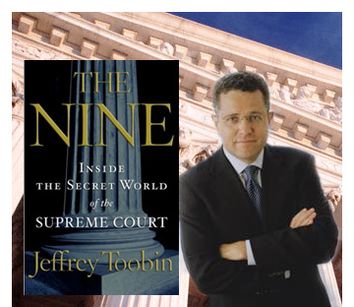
“The Nine,” the latest book from the indefatigable New Yorker legal correspondent Jeffrey Toobin, provides fascinating glimpses into the humanity of these mortals. But in the end, Toobin falls prey to the temptation to reduce them to “conservative” or “liberal” votes. That temptation is widespread in media coverage of the court, and often obscures the real process of change that takes place inside its closed chambers.

Sheltered by life tenure, and surrounded by deference and flattery, the justices live in an airless bubble even harder to penetrate than the one surrounding stubborn presidents. Events outside can seem distorted or far away; developments inside — many invisible to the larger public — can take on outsize importance. Each justice influences the others in ways that are hard even for those involved to understand. One may be alienated by his nominal allies; another may find himself unexpectedly beguiled by the “enemy.” Justices sometimes migrate permanently (Harry Blackmun was a rock-ribbed conservative when named to the court) or move back and forth depending on events inside and outside the court (as Justice Anthony Kennedy sometimes seemed to do on the Rehnquist Court between his appointment in 1987 and the chief justice’s death in 2005). The result is an institution that has often defied the predictions of seasoned analysts and observers. Present appearances to the contrary, it may do so again.

- – - – - – - – - – - -

A generation ago, the financial writer Burton Malkiel suggested that the motions of the stock market, though in broad outline reflective of economic trends, were random and unpredictable from day to day. A similar case, it seems to me, can be made for the Supreme Court. Courts move in broad directions as a result of the political leanings of new justices; but in individual cases they can be quirky and unpredictable.

Being one of the nine is different from being an advocate on the outside, or even from being one of the nearly 180 appellate judges on the federal courts. A justice’s vote can shift history, and that responsibility can change the way he or she looks at issues. “When you put on the black robe, the experience is sobering,” Justice Lewis F. Powell once said. “It makes you more thoughtful.” The justices, in fact, may sometimes take their own importance a bit too seriously. Toobin quotes the more histrionic Justice Kennedy, moments before going into court to announce a key ruling, as saying to a reporter, “Sometimes you don’t know if you’re Caesar about to cross the Rubicon or Captain Queeg cutting your own tow line.”

Kennedy occupies the swing-vote position on this court that Powell occupied during the ’70s and ’80s. Summarizing the 2006-07 term, Toobin writes, “No justice in history had had a term like his; in the twenty-four cases decided by votes of five-to-four, Kennedy was in the majority in every single one.” The justice in the center can have an outsize influence — and not just when the votes are counted. Other justices know they must win the swing vote, and they often tailor their constitutional arguments in an attempt to read his or her mind. But of course the reverse is also true — the justice who seeks the center will very often find him- or herself moving right or left according to the pull of the opposing wings.

The story of the court’s swing votes — from Powell in the ’80s to Sandra Day O’Connor until her retirement in 2005 to Kennedy today — maps a fairly steady pilgrimage to the right. But that pilgrimage has included detours that defied nose-counting projections. The Rehnquist Court refused to overturn Roe v. Wade or Miranda v. Arizona, pulled away from rigid limits on federal power, and even reaffirmed a limited role for racial preferences in higher education — all disappointments to the conservative presidents who nominated six of the current nine. It also extended the right of privacy to cover the choice of consenting adults to have sex — gay or straight — in their own homes.

To Toobin, these detours, not the overall conservative trend, truly define the meaning of the Rehnquist Court. After Bush v. Gore, he argues, the court set off “in its most liberal direction in years.” But he warns that those days are over. The appointments of Roberts and Samuel Alito, he says, mark the ascendancy of the “movement conservatives,” prepared to use their power of judicial review to block political initiatives to protect civil rights, free speech and the environment. Long frustrated by the unpredictability of Republican appointees like O’Connor and David Souter, Toobin says, the members of the legal hard right “are very close to total control.”

“The Nine” generates its story arc by overemphasizing the liberal detour after 2000 to set up a coming violent swing to the right. It covers much of the same ground as “Supreme Conflict” by ABC News correspondent Jan Crawford Greenberg. Greenberg got deeper inside the court’s bubble, with background interviews with nine justices and extensive on-the-record comment from Justice O’Connor. Toobin is a tireless reporter, but his beat at the New Yorker is much wider than the Supreme Court, and he is at his best covering volatile stories like the O.J. Simpson case or the Florida recount. He has a less sure feel than Greenberg for the constitutional issues that dominate the Supreme Court’s agenda.

Within these limits, though, “The Nine” is entertaining and illuminating. Toobin draws a vivid and irreverent picture of the justices; it’s best summarized in his estimation of seven justices’ performance in Bush v. Gore. In his account, Chief Justice Rehnquist is slapdash and result-oriented; O’Connor, image-conscious; Kennedy, bloviated and incoherent; Antonin Scalia a self-righteous bully; Clarence Thomas, withdrawn and rigid. The two Clinton appointees, Ruth Bader Ginsburg and Stephen Breyer, are portrayed as timid and flabby. Only Justice John Paul Stevens emerges as an admirable jurist, though any personal picture of Stevens is largely absent from “The Nine.” By contrast, Toobin draws a moving portrait of David Souter, whose faith in moderate-conservative judging was nearly shattered by the haste and fatuousness of the court’s interference in the election. “There were times when David Souter thought of Bush v. Gore and wept,” he writes.

His portrait of swing-vote Kennedy is particularly merciless. “More than any of the other justices, Kennedy loved drama and what he called ‘the poetry of the law.’ Kennedy’s vanity was generally harmless, almost charming — sort of like the carpet in his office.” But Toobin suggests that it was Kennedy’s grandiosity and love of excitement that drove the court’s disastrous involvement in Bush v. Gore, a decision in which, he notes, the court disgraced itself by the “inept and unsavory manner that the justices exercised their power.”

Some readers may question whether these portraits do full justice to their subjects. Greenberg’s book draws a more subtle portrait of the complex interaction among the justices. Toobin writes that Clarence Thomas has been “ideologically isolated, strategically marginal, and, in oral argument, embarrassingly silent.” Greenburg shows that Thomas in fact has influenced his conservative colleagues, and suggests that it is Scalia who tends to march in step with Thomas rather than vice-versa, as many commentators suggest.

As for Rehnquist, the latter years of his court seem to me more suggestive of the random day-to-day fluctuations Burton Malkiel saw in the stock market than of any kind of concerted lurch to the left. To support his liberal-detour thesis, Toobin de-emphasizes or blurs the real hard-right aspects of that court’s jurisprudence. Of the court’s federalism and civil-rights cases, he writes, “the Court limited Congress’s right to pass laws that gave citizens the opportunity to sue state officials; similarly, they interpreted federal statutes so that they did not give citizens the right to sue states. These were important, but hardly revolutionary, limitations on federal power, with little practical impact on the lives of most people.” And he states offhandedly that the Rehnquist years saw “real, but also modest, movement to the right on church-state issues.”

In fact, the civil-rights cutbacks are of great practical importance. Congress has repeatedly passed civil rights statutes to protect racial minorities, women and the disabled; time and time again, the right wing of the Rehnquist Court threw the supposed beneficiaries out of court. In church-state relations, the court was not modest, but revolutionary: it has now cleared the way for direct payments of tax funds to religious institutions. (Read properly, the Roberts Court’s decision last June closing the courthouse doors to most future challenges under the Establishment Clause is just an extension of that revolution.) In this analysis, milestones like Lawrence v. Texas, striking down laws against gay sex, are outliers on a curve that bends to the right side of the graph.

Toobin’s idea of the Rehnquist Court as a moderate court that sometimes reached liberal results reflects lack of a larger context. In fact, there hasn’t been a real judicial liberal among the nine since Justice Blackmun retired in 1994. Even Bill Clinton’s two appointees, Ruth Bader Ginsburg and Stephen Breyer, are at best cautious moderates who often fold their cards under pressure from their brethren.

The so-called liberal wing of the court — John Paul Stevens, David Souter, Ginsburg and Breyer — is actually made up of old-style judicial conservatives. They respect precedent and view the court’s role as modestly building on and explaining the work it has done before. Not a one of them shows any enthusiasm for interpreting the Bill of Rights and the Fourteenth Amendment in radical new ways, as former justices like William Brennan and William O. Douglas did brilliantly.

The real energy in the current court resides in the conservative wing — Roberts, Antonin Scalia, Clarence Thomas and Samuel Alito. To them, precedent means little or nothing if it does not fit with conservative ideology, and the court’s job is to drive the law — and the nation — far to the right.

The Roberts Court will continue its move to the right. Its most important recent decisions give a hint of the route the court is mostly likely to follow. In cases involving “partial-birth” abortion, church-state relations, school integration and free speech in public schools, the new majority proclaims its fidelity to uncongenial precedent — and then reinterprets the previous cases until literally nothing is left of them.

If the current trend continues, this court could be the radical anchor conservatives have dreamed of, taking on the role of guarding (as did the now-discredited conservative court of the early New Deal era) against social and political change favored by political majorities.

But will it continue? This brings us back to John Roberts’ moment of vulnerability. Toobin correctly notes that the true nature of the Roberts Court will depend powerfully on the outcome of the presidential election next year. Justice Stevens is 87, though hale; Justice Kennedy is 71; Justice Ginsburg is 74 and has suffered from colon cancer; Justice Scalia is 70 and, it must be said, acting very strangely. Each new nominee will not just affect the vote total, but the thinking of their fellow residents of the bubble.

The unpredictable dynamics among the nine — and the personalities of those named to join them — may matter, in the long run, more than any agenda they brought with them from outside. Bill Clinton persistently wooed Mario Cuomo for the seat that eventually went to Ruth Ginsburg; one can only imagine how Cuomo’s force of personality and charm might have changed the mix in the last decade. A Democratic president who could put even one bold, persuasive liberal on the court might see more change than raw nose-counting would suggest.

Progressives have despaired of the court over and over since Richard Nixon was elected in 1968. And yet the court has surprised us repeatedly before. Toobin suggests that the surprises are over; but despair is not the true lesson of “The Nine.” Sober realism is, to be sure — but hope as well.

Continue Reading Close

Free speech for the rich and powerful

How the Roberts-led Supreme Court is setting the stage for bureaucrats to shape American culture from the top down.

  • more
    • All Share Services

Free speech for the rich and powerful

“Where the First Amendment is implicated,” Chief Justice John Roberts wrote this week in an important free-speech opinion, “the tie goes to the speaker, not the censor.”

It’s a comforting thought, and a nice example of the kind of judicial rhetoric Americans are used to. It appeared high up in most news accounts of the Supreme Court’s decisions in three First Amendment cases on Monday, and it is sure to appear in conservative commentary hailing the arrival of the Roberts court.

Unfortunately, the implication that this court defends First Amendment rights is pretty much hogwash. If one carefully reads all three of these First Amendment cases, the court is really saying that the tie goes to speakers who have money and power. That is, if the speaker is rich and influential, then free speech wins. If not, free speech loses. Taken together, the cases give a picture of a new court majority that takes a very narrow view of free speech and a deferential approach to bureaucrats who seek to shape American culture from the top down.

Considering that one of the three cases dismissed the right of high school students to ridicule the solemnities of their elders, the cases might be scored as Ferris Bueller 0, Ben Stein 3. The cases also provide an example of how the new justices, John Roberts and Samuel Alito, operate. Both proclaimed themselves respectful of precedent; and unlike Justices Antonin Scalia and Clarence Thomas, they did not go in for the wholesale overruling of precedents they dislike. Instead, in all three cases, they have chosen to narrowly interpret previous cases, until in the end there is almost nothing left of them. Think of it as a soothing way of diminishing liberal precedent, slice by tiny slice. But the direction is clear, and we should not be confused about where this court is taking us. “Reason by degrees submits to absurdity,” Samuel Johnson once wrote, “as the eye is in time accommodated to darkness.”

Consider the first case, Federal Election Commission v. Wisconsin Right to Life, Inc. This is the case that gave the court the opportunity to praise its own devotion to freedom of speech. The issue was whether Congress could ban certain types of interest-group advertisements — in essence, disguised ads for or against candidates — within 30 days of a federal election. This restriction on “electioneering communications” was a key provision of the McCain-Feingold Act, passed in 2002, which sought to limit the impact of special-interest funds on political campaigns. Wisconsin Right to Life ran TV spots attacking Sen. Russell Feingold for supporting the Democratic filibuster against President Bush’s most conservative judicial nominees. “Contact Senators Feingold and Kohl and tell them to oppose the filibuster,” the ad concluded. As luck would have it, the ads were running just before the Wisconsin senatorial primary, in which Feingold was running for re-nomination. Right to Life had earlier announced that one of its priorities was ridding the Senate of the stubbornly independent Feingold; so even though the ad did not say, “Defeat Feingold,” a lower court held that it was barred under the law, and that Right to Life’s challenge was foreclosed by McConnell v. Federal Election Commission, a 2003 case that said the courts would not hear most challenges to McCain-Feingold.

The majority reversed the lower court and held that this set of ads was not an “electioneering communication.” It didn’t overturn McConnell, but it did interpret it so narrowly that it’s hard to see what pre-election ads it will cover. And in that context, Roberts enunciated his theory that First Amendment interests win in a tie.

The issue is a genuinely complex one, and there are very powerful arguments against government attempts to limit speech by any person or group in the run-up to an election. So perhaps it is a coincidence that this is the only one of Monday’s cases that the challengers won; that the speech at issue was nothing that wouldn’t fit into a sound bite on Fox News; that the speaker was a powerful and well-financed political group; and that the speech in question could be read as “Vote against any candidate who opposes judicial nominees like, say, John Roberts and Samuel Alito.” But if it is a coincidence, it’s a striking one.

Consider the next case, Hein v. Freedom From Religion Foundation. In that case, the challengers sought to block the White House Office of Faith-Based and Community Initiatives from funding conferences designed to promote the administration’s radical contention that government social service funds should flow through avowedly religious groups as part of their proselytizing mission. The Freedom From Religion Foundation argued that this use of tax money violated the First Amendment’s prohibition on government “establishment of religion.” They went into court under Flast v. Cohen, a venerable precedent from the Warren Court era that permits taxpayers to challenge tax expenditures used for promoting religion. In most cases, taxpayers can’t sue the government just because they don’t like the way their taxes are being used; but the Supreme Court in 1968 had made an exception for establishment challenges. It read James Madison’s writings on establishment to suggest that the use of tax monies for religious purposes was a gross violation of the rights of conscience, even if the amount thus extorted from the taxpayer was small — even, Madison said, if it was ” three pence only.”

The Roberts court dismissed the challenge; it didn’t overrule Flast — that would have seemed radical — it simply reinterpreted it to allow challenges only to congressional appropriations directly for religious purposes. Because the White House Office of Faith-Based and Community Initiatives was set up by executive order rather than by congressional line item, the case was dismissed for lack of standing. As in Wisconsin Right to Life, an existing precedent has been left as a shell of itself. Under the new interpretation, citizens will be able to go to court only against congressionally passed statutes that in essence proclaim their religious nature, say, “An Act to Establish an Official Religion and Fund It.” In the 21st century, however, it is the executive that makes most of the decisions about how appropriated funds are spent; and the court has now proclaimed those decisions off limits to religious objectors. In this case, a tie pays the powerful.

The same is true, most painfully, in Morse v. Frederick — the “Bong Hits 4 Jesus” case. An Alaska high school sent its students out to the street to watch the Olympic torch pass by; as it did so, a group of students, clearly hoping to get themselves on television, unfurled a large banner with the enigmatic memo, “Bong Hits 4 Jesus.” Acting on the repressive instinct of every high school principal everywhere, the Alaska high school’s Deborah Morse demanded it be taken down at once. When one irrepressible scamp, Joseph Frederick, refused, the principal confiscated the banner and suspended him.

The principal argued that the banner needed to come down right away because it encouraged drug use. Frederick said “the words were just nonsense meant to attract television cameras.”

As we learned during his confirmation, Chief Justice Roberts is an indefatigable grammarian, and in his opinion he engaged in an exhaustive parsing to conclude that the phrase must mean either “[Take] bong hits…” or “‘bong hits [are a good thing],’ or ‘[we take] bong hits.’” And thus Frederick was either advocating or celebrating drug use, Roberts reckoned, and could be punished because “failing to act would send a powerful message … about how serious the school was about the dangers of illegal drug use.” To put it another way, as Roberts sees it, schools have the power to make sure that students not only listen but that they don’t laugh at the message. In Roberts’ view of students’ view of free speech rights, laughter is not protected. Humorlessness: The anti-drug.

Anyone who remembers high school should have understood that the message was not one to be decoded by Roberts’ pedantic brackets and ellipses; it was the same message sent by students everywhere every day in every free society — “This whole thing is a farce” or, in the words of Lewis Carroll’s Alice, “Who cares for you? You’re nothing but a pack of cards!”

The idea that that in a free society debate should be, as a former Supreme Court said in New York Times v. Sullivan in 1964, “uninhibited, robust, and wide-open” does not apply to the young. Solemn acquiescence is the major skill of citizenship to be taught in the schools of our democracy, and those who will not learn the lesson can be punished.

The concept of freedom sketched by these three opinions is an thin one. We have the right to listen to TV ads from PACS. When the executive branch wants to lecture the rest of us about how we should believe in God, we have no right to challenge their actions, taken in our name and with our funds. And when the government sets out to make our children conform, they’d better not give back any guff about the emperor lacking clothes.

You, reading this: Welcome to American freedom, ca. 2007. And wipe that smile off your face.

Continue Reading Close

Page 1 of 3 in Garrett Epps