Joy Press

Like a Virgin Megastore, shut for the very last time

All U.S. outlets of the music chain will be closed before summer in another sign that the record store as we knew it is dead.

  • more
    • All Share Services

Like a Virgin Megastore, shut for the very last time

Salon/Julie Coburn

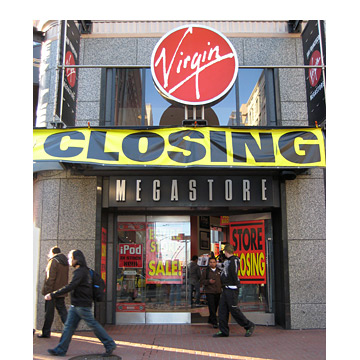
Virgin Megastore on Market Street in San Francisco

The ground floor of the Times Square Virgin Megastore has an air of chaotic neglect. Generic “Everything Must Go!” and “Nothing Held Back!” signs hang over shelves crammed with recent DVDs, “Guitar Hero” dolls and PS2 games. Downstairs in the deserted music section, one person distractedly stops at the table piled with box sets of Springsteen and Björk. Almost everything is 40 percent off, but that’s not convincing enough. I walk over the image of Nirvana’s “Nevermind” cover projected onto the floor — a reminder of a time when people actually got excited about buying records — and try not to step on the floating baby.

This branch of Virgin Megastore at Broadway and 46th Street in Manhattan, apparently the single highest-volume music store in all of America, is closing in less than a month. In fact, all six remaining U.S. Virgin branches are being shuttered this spring, leaving more than 1,000 people jobless and leaving New York City without a major record store. It’s not just the chains and the big names that are suffering. Some genre-specialist outlets are hanging in there, but generally speaking the independent record store is also teetering on the brink of extinction. It’s the same story from big cities like New York and Los Angeles to college towns across the country. The current economic crisis is the death blow to an already weakened species. Even an economic uptick in the near future probably wouldn’t save the retail music industry, which was staggering even when times were good. Sales of CDs have fallen in seven of the past eight years, and were down a full 20 percent from 2007 to 2008.

We know why people aren’t buying music from stores the way they used to: online purchasing for those laggards who still crave albums in physical form, legal and illegal downloading for everyone else. I can’t even recall the last time I bought a CD from a flesh and blood salesperson. But sometimes when an old song pops up in my iPod, my mind inadvertently flickers back to the place that I first touched that record, and the epiphanies that punctuated my record store rambles. Maybe it was something I heard in the cramped second floor backwater Connecticut dump where the guy at the register played a Joy Division single on the store turntable, causing me and everyone else there to stop in our tracks; or the impossibly narrow West Village basement hangout where I always met people I knew who pointed me toward vinyl I needed to have. Yes, vinyl, as in a “record,” from whence record stores got their names, the kind that had cover art big enough to see as well as a satisfying weight as you sifted methodically through the overstuffed record store racks.

And then there was Virgin Megastore on Oxford Street in London, which I visited on my first trip abroad as an Anglophile teen in the ’80s. I was pretty wowed by everything English (a fast food chain called Wimpy Burger! Toilet paper made out of wax!), but I can still feel the special frisson of entering what appeared to be a music-lover’s paradise: an enormous space pulsating with music and light, packed with miles of aisles of cool vinyl. Sure, you lost the intimacy of the independent store, but you also lost the potential downside: the “High Fidelity”-style resident snobs/experts, invariably male, ready to congratulate you when you made an aesthetically impressive choice or humiliate you with their withering looks when you failed to meet their standards. Virgin had an in-store D.J., private listening booths and plenty of room to mingle with records while also flirting with cute, lanky boys in eyeliner. Alongside the diversity of music, the megastore stocked a selection of culty and esoteric books, adding to the sense that Virgin offered a magical combination of mall-like consumer convenience and independent-minded cool. In America at that time, there was really nothing in between your Sam Goody chain store and the tiny mom-and-pop.

If I had known anything about Virgin’s origins, it probably wouldn’t have surprised me so much to find a place that seemed both mainstream big and underground intimate. Virgin mogul Richard Branson, now one of the most famous entrepreneurs (and richest men) in the world, had begun his career selling records out of the trunk of his car. That led to a mail order record company specializing in European imports of cosmic rock and progressive music. When a postal strike screwed with his mail-order business, Branson opened his first Virgin outlet in 1971 — a groovy record store in Notting Hill Gate, then London’s equivalent to San Francisco’s Haight-Ashbury. Customers would hang out in the store all day, smoking joints while plopped on beanbags. Propelled by the fingers-in-too-many-pies ambition that would be the hallmark of his entire career, Branson also started a fashion company (called Virgin Rags) and a health-food store around the same time. Neither did as well as the record store or his next big venture, a music label that supported a roster of audaciously non-commercial music from its birth in 1973 right through to punk (Branson famously signed the Sex Pistols after they’d been kicked off two other labels).

The Notting Hill store begat the first megastore, which launched on Oxford Street, London’s most bustling shopping boulevard, in 1979. Over the next decade and a half, Virgin would export the megastore concept all around the world, including the U.S. At its peak in 2002, the U.S. chain counted 23 stores and $230 million in sales. Those American spots generally offered the same kind of range as the Oxford Street store I visited all those years ago (even if they seemed a little less glamorous here on familiar ground, where the boys wore a lot less eyeliner). But it did have a rival, in the form of Tower Records, another store that made the record fiend feel giddy at the sheer scale and range of its stock, and also wore its alternative cred on its sleeves.

Tower went bankrupt in 2006. But Virgin Megastores in the U.S. is being dissolved because its current owners — not Branson, who long ago sold off his retail chain, but a joint venture of real estate companies that bought the chain in 2007 — believe they can make a lot more money from the property that the Megastores occupy than from CD sales. (The British chain of megastores is also shutting down, though stores in places like Australia and Japan survive.) In other words, the new U.S. owners are betting on something, anything, other than music.

Virgin, like Tower, started to lose its luster a long time ago, of course, becoming more like a shopping mall than a record-geek haven. Still, for those who remember its prime, it’s another melancholy reminder that an era is ending. In fact, there’s been a whirlwind of commemorative activity recently dedicated to the independent record store, from the book “Old Rare New” (a collection of testimonials and essays) to the documentary “I Need That Record!: The Death (Or Possible Survival) of the Independent Record Store,” which continues to make the rounds of the festival circuit. There is even a Record Store Day — April 18 — devised as a way to support independently owned American stores with special releases and performances. The only area of record retail that seems to be doing OK, even prospering, is used vinyl, especially the high-end, boutique sector catering to collectors willing to pay good money and who are still addicted to the thrill of the hunt and the random discoveries that you don’t get from eBay or Gemm. But that only serves to reinforce the grim truth: The future of the record store lies in music’s past. The Times Square Megastore, meanwhile, will be replaced by an outlet of the clothing chain Forever 21.


Joss Whedon just wants to be loved

The creator of "Buffy the Vampire Slayer" talks about his new series "Dollhouse," the perils of sex trafficking and life as a cult icon.

  • more
    • All Share Services

Joss Whedon just wants to be loved

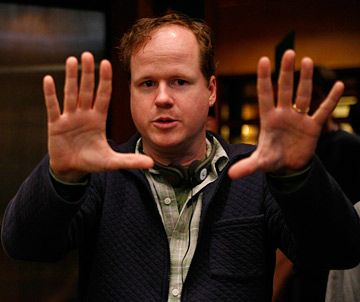
 Joss Whedon looks rough and rumpled, as if he just tumbled out of bed and into his hotel lobby. Is this what a great television auteur looks like? The man who created “Buffy the Vampire Slayer,” “Angel” and “Dr. Horrible’s Sing-Along Blog” has earned a zealous cult following with his special blend of giddy fantasy, brainy humor and beautifully constructed narratives.

Wearing an unbuttoned shirt covered in tiny retro TVs, Whedon doesn’t resemble a Hollywood icon so much as a guy who spent part of the previous day at New York’s fanboy festival ComicCon. Where he was, by the way, the star attraction. Along with the various fantasy worlds that he has conjured on big and small screens, Whedon also writes comic books, contributing to hugely successful series like “X- Men” and “Runaways,” as well as penning comics based on his own TV shows.

Whedon’s most surprising recent success was “Dr. Horrible’s Sing-Along Blog,” a charming online musical about a lonely wannabe-supervillain (played by Neil Patrick Harris), which Whedon and his brothers (and sister-in-law) created on a shoestring budget during the writers strike. Originally intended to be streamed for free on the Internet last summer, the three episodes became a stone-cold smash via iTunes and later DVD. One might reasonably think that Whedon would now give up on network television for the creative freedom of the Internet — especially since his last TV show, the 2002 sci-fi western “Firefly,” was canceled by Fox after just 11 episodes. (Whedon later remade “Firefly” into the 2005 movie “Serenity.”)

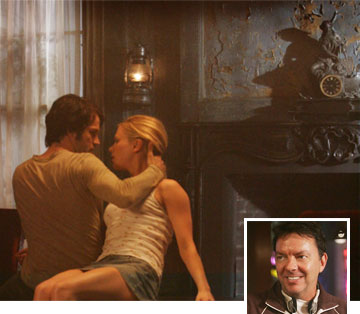
And yet here he is, back on Fox with the new series “Dollhouse” (reviewed here). It stars former “Buffy” star Eliza Dushku as Echo, a young woman — known on the show as an “Active” or “Doll” — sapped of her memories and free will, who is sold to rich clients to fulfill their needs and fantasies. For each assignment she is imprinted with a fresh personality, complete with new skills, intelligence and neurological information; sometimes she morphs into a sexbot, other times she takes on the life of a highly methodical negotiator. Echo and her fellow Actives live in a giant Zen loft called the Dollhouse, blissfully unaware that they are being remote controlled by a shadowy organization under investigation by a Fox Mulder-style FBI agent (played by “Battlestar Galactica” escapee Tahmoh Penikett).

The “Dollhouse” pilot may not immediately strike the Whedon lover as quite silly or talky or girl-powered enough. But this is a man who knows how to blow up genre expectations, and even in the debut episode we start to see cracks in Echo’s vacant veneer that will undoubtedly force us to think about the nature of identity, memory and sexuality, and even what it means to be a TV auteur who creates roles for sexy actresses to live out. Whedon swears that in “Dollhouse,” he has created a premise full of juicy possibilities for fun, fantasy and intelligence, one that can also — he hopes — run the brutal gantlet of network TV execs.

You went to New York ComicCon this weekend. I assume that must be the epicenter of your fan base.

Sometimes you go because you’ve got to promote something, and sometimes you go because you just want people to remember that you’re still around, even though you have nothing to promote. I did that one year. I was terrified. I was like, uh, I just want to say, I’m still alive!

What’s that movie where the movie star goes to a mall when she’s feeling insecure so that fans will recognize her and ask for an autograph?

“Soapdish”! I was thinking about that yesterday. I understand that on a level I wish I didn’t.

You have a huge cult — it’s not very often that TV show creators and writers get that kind of adulation.

I was one of the first. The Internet community started forming right when “Buffy” started airing, and the notion of a show creator being anything other than a name people recognize on the screen was completely new. When you become a writer you assume it’s this life of anonymity, and then all of a sudden it’s this other thing. But at ComiCon everybody’s like that. There’s a reason all the comic book artists trudge out there, because they do get, as they say, treated like rock stars.

I don’t know that there are a lot of other instances of people taking their own TV shows and continuing them on as comic books for years after the series ends. Do you have the same kind of emotional attachment to the characters in “Dollhouse”?

It’s different because this universe is so complicated. It’s not a gut-punch like, “She’s little and she beats up monsters.” Echo is a much more complicated character by virtue of being hardly a character, and the premise itself is designed to be kind of distancing. I did pitch it with a six-year plan. But when we did the [first] 13 episodes, we eventually said, instead of holding back, let’s just go nuts. And by the second half of the season, we just started blowing shit up. And I don’t mean literal explosions, because we couldn’t actually afford those anymore.

In the pilot, one of the men who works in the Dollhouse says, “There’s nothing good or bad, but thinking makes it so.” It seemed very much a trademark line of yours, because, aside from quoting Shakespeare, which you do –

I do way too often.

But you also like to play with the whole good-and-evil-are-relative thing in your shows. How is that gonna play out in “Dollhouse”?

Constantly. The good and evil is kind of the point, the relativity of both and our assumptions about what’s evil is something we want to explore all the time. The Dollhouse is by definition kinda sketchy. And very illegal.

It’s kind of a combination human trafficking/whorehouse/corporate fulfillment center.

There’s also some assassination. Actually, did we ever do that or did we just talk about it in the room? And of course the network is like, can we have more assassination and less sex?

Fox asked for less sex?

You’d be surprised. The networks are very prurient, especially after Janet [Jackson] decided to share with us. So the networks are like, we think this premise is hot. Just don’t show anything or talk about it. Which can be so disingenuous that it becomes offensive.

Obviously it’s tough because — and this is the thing that kept me up nights — human trafficking in the real world is beyond heinous. What we were trying to do was create a situation in a science-fiction world where people gave themselves up for five years to the idea of, “I don’t care what happens to me. I won’t know about it. And as long as I’m not hurt, go with God. It’s fine.”

So for whatever reason these “Actives” have voluntarily given up their bodies?

Well, the question of whether they’ve actually volunteered or not is obviously somewhat dicey. And as we’ll begin to learn, every Active has a different backstory. What I wanted to do was talk about the idea of sex and what we expect from each other. Power, love, how these things are all connected. We’re positing the idea of, if people were in a position to give up their lives, how many of them would?

We saw a thing on “This American Life,” where guys had found a way to block a memory stream on mice and they got flooded with letters from people begging them to be test subjects, because they were like, I don’t want to remember my life. Something bad happened or I want to cut out something. There is also this fantasy of not having control, of not having responsibility. These people are taken care of like children. They live in the best spa ever.

I believe that prostitution is not, in concept, repulsive. I believe that people are gonna want to have sex for a long time. Eventually, I think that computers and TVs will become so awesome that they’ll stop wanting to …

Or they’ll forget about it.

Right. What interests me is that urge and what we do with it. People will always want to give up their power on some level. It’s a nightmare and a fantasy. The nightmare is, I have no will. And the fantasy is, I have no responsibility or memory of what I’ve done.

 Along with “Buffy” expat Eliza Dushku, you have “Battlestar Galactica” star Tahmoh Penikett in “Dollhouse.” Are you a Galactica obsessive?

Um, I think obsessive is too light a word. I absolutely adore it. It’s my favorite show ever. Come on, it’s “The West Wing” with space battles. It covers all of my needs. I watch their storytelling and go, “Oh, so that’s how it’s done. Fuck.”

Based on the  pilot, ”Dollhouse” seems much less playful than some of your previous shows.

It is less playful, which doesn’t mean we don’t play. There’s a lot of silliness and repartee and fun, but first we have to win over the world. I think the first episodes are trying to get people to understand and accept how this world works. But the show really finds itself in the second half. It’s really where we start to go, “Ohhhhhh, we can do thiiiis. Right, this is why we showed up!” And so I’m hoping people will stick with it.

So you’re doing a bait and switch? You’re tricking them with the more conventional stuff up front?

Well, it’s more that by episode six, people know the characters, they get it, now we can start to really mess with them.

Viewers seem much more TV-literate these days. Certainly, your shows helped to create that literacy, but people seem able to cope with much more complicated ideas and structures.

I think television is getting smarter and dumber at the same time. As it gets harder for the networks to figure out how to make their money and what’s going to happen structurally with advertising, at the same time, on cable and even on some of the bigs, people are taking chances. It’s a time of crisis, which means a lot of entrenching, a lot of let’s just go for exactly what we know how to do, and a certain amount of let’s shake it up. And those will be the shows people remember.

I was startled to see that you were back on Fox, since you’ve had problems with networks supporting your previous series. There’s so much good stuff on cable channels like Sci-Fi and AMC — and obviously you had a hugely successful experiment with “Dr Horrible’s Sing-Along Blog.”

Yes, well, I made that after I made the deal for “Dollhouse.” [smiles] And um, [the Internet] is definitely a brave new world, in which I would like to live. But you know, TV is like a home for me, and Eliza obviously is a buddy [who had a production deal with Fox]. It just made sense. And since then, it’s made less sense — and then it made more again, and then it made less again.

It was so clear to me what was interesting about this show — the idea of identity, and the idea that everybody is compromised. But knowing going in that the premise was going to be offensive to some people scared the shit out of me. Because I’m usually like, please love me. I actually had a lyric that was cut out of the commentary musical for “Dr Horrible” where I just go, “Love me,” very pathetically.

So that’s what motivates you — a desperate need for love?

Yeah, hello! But this was one where I was just going to let that fall by the wayside because I wanted to deal with the issues. I wanted to actually deconstruct this love that I seemed to need so badly. But again, if the parallels to the horrors of the real world overwhelm the fantastical aspect of it, it won’t work.

Early in your career you worked as a writer on “Roseanne,” which was kind of a social realist comedy, and very much of its era. How much do you feel like your shows reflect their moment? Thinking about “Dollhouse,” where the clients are these zillionaires — are you going to have some of them being bankrupted by Madoff?

Well, we wrote all of it before all this economic hilarity, so we were like, “Yeah, people are really going to want to see this show — a lot of billionaires, this is awesome!” Ultimately everything I do is pretty baldly classist — like, the powerful people are taking advantage of the poor people, and they don’t get it.

Looking at the set I was reminded of Wolfram and Hart, the creepy law offices in “Angel” that looked very normal and slick but were run by the devil.

Yes, it is the same designer. And we wanted the same feeling of, “Isn’t this attractive? You can’t leave.”

And it’s a similar idea of these mysterious people who seem very normal and slick, but are they … evil?

Yeah. And we get to confront them with the consequences of what they do, and learn more about why they do what they do. Because very few people are entirely evil. I know it’s hard to believe that after the last eight years of government in this country, but everybody has two sides, and I believe that not only are people often less or more righteous than they understand, but they often don’t know what part of them is actually the good part. And a lot of the things that we prize in America might not actually be useful traits, and a lot of the things we vilify, to me, are not necessarily harmful, and that’s something that’s been in my work from the start.

I’m always stunned by how much you appear to be doing. You seem to have a zillion comic books and 10 movies in production.

I create that illusion. I would like to become what I appear to be. I would like to have as much going on as other people do, but my problem is I get so attached to things, and there’s my kids, and I need my sleep, and then there’s being married, gotta check in on that, too. But living my life now is as important to me as telling stories, which it never used to be. Stupid kids.

You grew up with a TV writer for a dad. Was it a different kind of a job for him?

It was different, I think. He worked on other people’s shows. He enjoyed what he did enormously, and I think his father enjoyed it too. But their love was really writing lyrics for musicals, off-Broadway musicals, and TV was something they did because they were good at it. But I got to incorporate all the things that I loved into my TV.

Did you absorb stuff from your father?

Oh, yeah, all of the most important lessons about writing I learned from my father. He never set out to teach me anything, it would just be something he said casually in conversation. In fact, he warned me, don’t be a television writer. You’ll have to work too hard.

Continue Reading Close

Shop and awe

Christmas shopping during an economic free-fall is making me anxious: Everything is on sale, but at what cost?

  • more
    • All Share Services

Shop and awe

Yesterday I did something that made me feel sickened and confused: I went Christmas shopping.

I’ve always loved the ritual of holiday browsing, drifting in and out of stores with a vague mission (and an even vaguer list of potential gifts). But in this year of economic apocalypse, shopping has become a minefield — a financial, political and ethical nightmare. The thrill of insane bargains and the suggestion that we can rescue our economy by spending money is colliding with the nauseating sensation that we should be saving up for a long, dark winter.

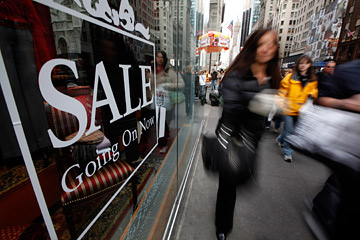
As I walked down Manhattan’s Fifth Avenue yesterday, I noticed sale signs jostling for space with ornaments in nearly every store window. A line of tourists crowded outside Saks Fifth Avenue to gaze at the elaborate window decorations, but when the doors opened at a few minutes to 10, only a trickle of women actually hustled to get inside. They moved sluggishly through the store, fingering gloves or leather bags and then putting them back down, seemingly unimpressed by the slashed prices. Upstairs on the deserted 8th floor where the expensive shoes live, sale goods (up to 70 percent off) were arrayed on racks that circled the whole department, a mess of less-than-desirable footwear that had obviously been pummeled and picked over for weeks already. I’d been hearing rumors that the hallowed department store might declare bankruptcy in the new year, following in the footsteps of several other chains; standing here, it wasn’t hard to imagine.

I slipped across the street to Rockefeller Center, New York’s unofficial Christmas headquarters, thanks to the confluence of Radio City Music Hall, a gigantic Christmas tree and a picturesque skating rink. And, of course, lots of stores. None of them seemed wildly busy: In fact, Anthropologie, the Nintendo Store and Sephora all hummed with very light weekday morning traffic. In J.Crew, I spotted the cashmere cardigan that I had been hoping might go on sale; a stack of them in my size sat neatly folded on a table, the price marked down 40 percent. It was still pricey, but the saleswoman circling me pointed to a small sign on the table: an additional 30 percent discount off already marked-down prices.

I convinced myself that this was a good buy, the kind of wardrobe staple that would always be useful. If I ended up on unemployment and had my heat turned off, it would keep me toasty. If — in the worst case scenario — the economy were to utterly collapse and dollars became worthless (as happened several years ago in Argentina), I’d have a quality sweater to trade for food in the ensuing barter economy. And if the recession ended tomorrow, I’d have snagged an incomparable bargain.

Standing at the counter (there was no line), I clutched two different colors, unable to decide between them. A salesperson pointed out to me if I bought both sweaters, I’d get an extra 20 percent off the 30 percent cut taken on the previous 40 percent discount! And if I wanted to grab something worth another $10, I’d get another 5 percent off! (I declined, but not before I had scanned the front of the store for small items.)

Although I didn’t need two cardigans (or even one, really), I plunked down my credit card and then watched as my cashier and then his manager typed in an endless serious of codes and numbers until finally the magic number pinged: $110 for two sweaters, marked down from the original $336. The cashier looked up at me. “If you want to open a store credit card account today you could — “

“Get these sweaters for free!” I said.

“Pretty much,” he replied, smiling weakly. I almost asked how they could afford to give away so much merchandise, but I didn’t really want to hear the answer. At what point do they just bypass their customers and start sending these clothes straight to T.J. Maxx?

It’s hard not to feel ambivalent this season about whatever you buy (or don’t). The collapsed economy continues to get worse partly, we hear, because consumers are so scared that we aren’t spending enough. The antidote to all this? Buy stuff and save the world — throwing money at a problem being the wonderfully American solution to all ills. Of course, Salon’s own Andrew Leonard recently pointed out that it’s not necessarily the American people who should be rushing to lay out cash; only massive public spending by the government is likely to turn things around. And even if you do help stores clear out their current inventory at these free-falling prices, they’ll be very cautious about restocking in the new year, which won’t exactly boost production.

And yet, how can we resist shopping when everything we’ve ever wanted — or at least wanted to buy — is 50 percent off?

“This is a rare opportunity in any consumer’s lifetime,” retail analyst Marshal Cohen enthused to the New York Times last week, while Barneys creative director Simon Doonan agreed: “It’s a smart time to make good investments. You can get clothes you’ve always wanted but winced at the price. Now you can feel permission to buy.”

We have permission to buy!

It’s not like I’m a compulsive shopaholic; on the contrary, shopping has always been tinged with caution for me. My first memory of discussing money dates back to the winter I was 4, when my dad told me we wouldn’t be getting many presents because money was tight. So tight that my mother, a translator, had taken a second job working evenings and weekends at Lord & Taylor for the holidays. Nowadays, I happily splurge once in a while — usually at sample sales, where bargains and airless dressing rooms induce a kind of fashion fugue state. But most of the time I carefully consider purchases and hardly ever set foot in Circuit City or Macy’s without doing research.

So when the sales frenzy hit just before Thanksgiving, I remained calm. I admit that I put a few big-ticket items in my Amazon cart, toyed with the idea of buying an ultra-cheap new camera and TV and food processor. But then I shut my laptop and hung out with my kids. Midnight came and went, and I hadn’t pressed the final checkout button: I hadn’t bought anything.

The rabid consumerism of Black Friday — and especially the fatal stampede that killed a Wal-Mart employee — soured the mood for a lot of people I know. The bargain mania suddenly felt really delusional and wrong, like gambling in the casino of the Titanic as it sunk. Friends started talking about anti-consumerism activist Reverend Billy and his Buy Nothing Day campaign, which called for Americans to turn their backs on excessive consumption and break free of the corporate stranglehold. Neighbors discussed crafting their own presents or ditching gift giving altogether this year.

Meanwhile, though, the stores were still full of things — increasingly cheap things. Not just cheap, but eerily cheap. Something’s-seriously-messed-up cheap. Colleagues returned from shopping expeditions with shocked looks on their faces: Bloomingdale’s had discounted designer boots so severely that a Salon writer could actually consider buying a pair! Macy’s was showering New Yorkers with nearly daily coupons offering deep discounts for their “Biggest one day sale ever,” and most chain stores had loosened their definition of a “friends and family sale” to include, well, everyone.

I guess it’s not so surprising, in this bleak environment, that I spent the 24 hours following my double-sweater purchase filled with confusion and guilt. Should I be propping up local stores to keep people employed — or knitting sweaters for my loved ones? Are these bargains a good thing or a harbinger of doom? Is there some way that individuals can contribute to rebuilding a more humane, civilized economy?

I’m sure I’ll still be thinking about all of this as I walk out into the midtown rain to get some lunch, vowing not to pop my head into Macy’s. Although I hear they are having a big friends and family sale — today only!

Continue Reading Close

Beyond the valley of the doilies

The billion-dollar scrapbooking industry may be cheesy, but as author Jessica Helfand explains, there's rich history in that glitter and glue.

  • more
    • All Share Services

Beyond the valley of the doilies

Several years ago, Jessica Helfand wandered into the scrapbooking area of a crafts store and stumbled upon a multibillion-dollar industry. An alternative universe of visual accessories greeted her: flair and foil, lace wraps and eyelets, glitter and “word fetti.” An eloquent design critic and graphic designer who teaches at Yale, Helfand was flummoxed by this close encounter with the scrapbooking community and decided to write about her ambivalence for Design Observer, the Web site she co-founded.

“It’s at once horrifying and fascinating to witness the degree to which design is being discussed online by people whose concept of innovation is measured by novel ways to tie bows,” Helfand confessed. Unable to resist a further jab, she continued: “I could write an entire post just on the scrapbooker’s predisposition toward fonts like ‘Whimsy Joggle’ and ‘Pool Noodle Outline’ but I will try and restrain myself.”

Helfand couldn’t dismiss scrapbooks altogether, however. Although they were often cheesy and sentimental and generic, this was also hands-on design as practiced by regular people rather than artists — an attempt to represent everyday experience through visual culture. Digging through archives, she was amazed by the medium’s rich pedigree. The result of all this research is her captivating new book, “Scrapbooks: An American History,” which explores American life over the last two centuries through the prism of the humble scrapbook.

This beautifully illustrated coffee table tome suggests that the scrapbook is an amazingly flexible medium, one that adapts to and reflects the times. In fact, it may once even have been ahead of its time. Helfand calls it “the original open-source technology, a unique form of self-expression that celebrated visual sampling, culture mixing, and the appropriation and redistribution of existing media.” That may sound a little too highbrow for an artform that thrives on ribbons and roses, but Helfand’s text points out that all kinds of lively minds have kept scrapbooks over the years, from playwright Lillian Hellman (who hilariously kept track of her running feuds and pasted in nasty clippings about herself) to poet Carl Van Vechten (who maintained a clandestine and artful compendium of male pornography) to Anne Sexton, who gathered telegrams, recipes and fledgling poems into a newlywed’s memory book, 25 years before she commited suicide. Mark Twain not only recognized the importance of the format but also profited from it, patenting the first “self-pasting scrapbook” back in 1872.

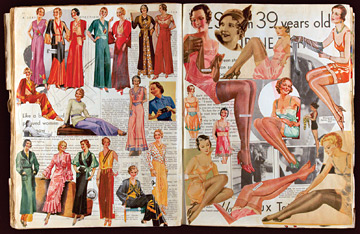
But “Scrapbooks” doesn’t dwell on famous names. Helfand is more interested in peeking at the historical shifts embedded in the way people recounted their lives: the episodes they chose to describe, the objects they included (newspaper clippings, gum wrappers, dance cards, dog tags, family photos), and even the way they laid out the pages (sophisticated modernist visual styles like collage had somehow already been absorbed by ordinary scrapbookers of the early and mid-20th century). She zooms in on an antibellum society woman whose marriage is (shockingly, for the times) falling apart, the privacy of the scrapbook’s pages liberating her to record her life as she wanted it to be. Then there is the Seattle doctor, an immigrant who crams his meticulously laid-out book with portraits of presidents and newspaper clippings on wartime health — “a kind of self-initiated primer for good citizenship,” as Helfand notes.

These books are remarkable to look at — so individual and specific, each becomes a “repository of evidence” from someone’s life. An early 20th century young woman’s scrapbook veers between movie star worship and suffrage marches, whereas a WWII soldier’s volume gathers together enlistment papers, medals and Japanese money. In fact, war and danger seem to spur the desire to preserve memories and make one’s mark, and Helfand partly traces the current mega-boom in scrapbooking — now a nearly $3 billion industry with its own national holiday and a vast network of Web sites, groups and retreats — to the trauma of 9/11.

Helfand spoke to Salon by phone from her design studio in New Haven, Conn., about the beauty of homemade things, religious scrapbooking and the future of memory in a digital era.

The piece you originally wrote about scrapbooking in Design Observer got people very angry. The scrapbookers felt insulted, but the serious design people were pissed off, too, because you didn’t completely dismiss this practice. Why did people get so agitated about such a humble hobby?

The design people called the scrapbookers “crapbookers,” and the scrapbook people thought I was being a Yale elitist professor. There was one woman who said, “I’m a thoracic ER nurse, my husband is on disability and I have three kids and no money — this is the only pleasure in my life. How dare you criticize me?” And I thought, yes, how dare I?

Writing this book was very hard, because I couldn’t soft-pedal my willingness to accept this as graphic design under the standards I believe are important. But I do recognize the instinct to want to put pen or paste to paper and commemorate some aspect of your life. It’s just when you see this $2.6 billion industry and people critiquing each other’s work as “cute” — it makes me break out in hives. But we’re talking about raising money for a documentary about this because, in a kind of Morgan Spurlock, “Supersize Me” view of an American phenomenon, it is a world unto itself. Why are women targeted in this treat-them-like-13-year-olds way? I went to one of these scrapbooking retreats, and it’s all these women in their pajamas with snacks — Hostess Twinkies everywhere! There’s something about junk food being part of this. It’s like, no husbands, I’m going to let myself go and look at pictures of my family and eat Twinkies. It’s not really about design, so it’s out of my league in terms of a critique, but it fascinates me sociologolically.

There’s a huge boom in DIY crafting, with everyone from indie-rock kids to stay-at-home moms selling their wares on Etsy and at regional craft fairs. Does crafting and scrapbooking come from the same impulse?

I don’t know. What I found was that in the past, it wasn’t always a gendered activity. I have marvelous scrapbooks in my collection by two or three men that are as beautiful and as detailed and as soul-searching as ones by women. In this most recent boom, which to my way of thinking is since 9/11, it’s been very much targeted to women. A number of sociologists have done studies about what this is about. One of them was called “Making Me Time,” about the creative crisis of the stay-at-home mom who needs to feel she’s doing something with her day. The physicality of putting pen to paper and grease pencil to word fetti is making them feel they’re doing something.

You object to the way today’s scrapbooks are so schematic, right? There are rules and guidelines for how to do them, and every element of them is premade rather than just gathering the flotsam and jetsam of your life and organizing it in a beautiful way.

By and large, what is so beautiful about scrapbooks [historically] is that they are so messed up! They are messy. They are not chronological, and they go back and forth and change things, and they rip out pictures of guys they broke up with. They’re so idiosyncratic.

I found this scrapbook of a woman from about 1912 who was clearly notoriously late to everything. Every note says, Please be on time to my party. Please come at 8:30. And in the middle of the scrapbook is a little gold watch and card that says, “Kitty is always late, it seems to be her fate, so here’s a little watch, to help her keep her date.” This woman was like my grandmother’s generation.

There’s something so humanizing and humbling about realizing, it’s not now and then. It’s us. It’s part of some greater human need to mark what you were doing.

In the book you point out that there was a huge range of preprinted scrapbooks designed for soldiers or newlyweds or new mothers. My own mom kept a baby book about me that is crammed with so much data and detail that it’s almost illegible. There are all kind of titles and headings that came with the book telling her what kind of information she should be noting down about her infant. Was that kind of instruction very common by mid-20th century?

Yes, and the enabling is very interesting. In these memory books I found from the late ’30s and early ’40s called “The Log of Life,” there’s a place for you to put your fingerprints, and it actually says, if you ever lose your memory take this to the nearest police precinct and they’ll tell you who you are. This was right after the war, and I guess people were worried you’d have too much shrapnel in your brain and you’d need help getting home.

You think these are just silly scrapbooks, but then you start to see how they codify our expectations and our fears, and it’s quite moving.

I thought it was interesting that the increasing popularity of psychoanalysis in the 20th century brought ideas of self-interrogation being therapeutic to the fore — but was that bad for scrapbooks? It seems like people need these books less, now that there are other opportunities for expression.

So many scrapbooks these days seem to be about other people, like — I’m going to make this about my son or my dog or the prom. But 100 years ago, a scrapbook was about you, about your experiences. And that’s why I became so absorbed by them as biographical receptacles of people’s lives. That’s why the banal things could be the most important thing. My critique of current scrapbooking materials is that it creates a meaningless visual grammar. Why would you want to follow a pattern? It’s like you take a giant piece of tape and stick it up to the wind and see what catches — that’s the residue of your day. I see a million things lying around my house that are going to say more about the life I live than going to the art supply store and buying something new.

I have a theory that contemporary scrapbooking is a little bit of a reflection of reality TV. You look at a show like “The Biggest Loser,” or take Joe the Plumber — he’s famous for 15 minutes and now he’s gunning for a singing career. People want to gussy themselves up.

They’re ready for their close-ups.

Yes! So you take this scrapbooker, and she’s thinking, I’m overweight and I don’t want a picture of myself in the scrapbook, but I do want to show off my cute kids and pretty pink ribbons. It’s this externalizing idea of, I want this to look good for everyone else so if I ever get famous my scrapbooks will show that I’m perfect. But the whole purpose was to celebrate the everyday.

The problem is that there is so much stuff in our everyday lives. It’s hard to distinguish what’s important or special. You have a zillion receipts. Which do you choose? What is special?

And you’ll always have more. Whereas if you go to the art supply store and you buy Martha Stewart’s pretty paste-on initials it’s going to cost you $3.95 for six of them, and you have to use them judiciously. So then you have the fear, what if I put it in wrong? As opposed to just grabbing an old pencil.

Some of the examples of stuff people saved in your book are just gorgeous — and weird. There are the tickets and flowers and calling cards, but my favorite is the girl you mention who pasted in her blisters. As if she needed to commemorate her suffering feet for all time.

Can you imagine someone doing that today? Unless Martha Stewart comes out with a “Beautifying your blister” collection!

I was fascinated by the way people I know, normally unsentimental people, were saving Obama campaign objects after he won, and even putting together scrapbooks of election material. Why do you think that was?

It’s the most emotional thing that has happened in a public way since 9/11. And 9/11 was another time people grabbed everything and saved it.

Tell me about “faithbooking.” I had never heard the term until recently, but I guess there’s a huge number of faith-based scrapbookers?

If you are a Mormon you are required by the church to document your family history. The scrapbooking community is really huge in Utah. But people that are religious of any faith — I was educated in Quaker schools, and I could see Quakers liking this because it’s kind of a daily meditation. It doesn’t necessarily have to be about Jesus and the church, but it can be about ethics and morals.

But what is interesting, in conjunction with faithbooking, is the notion of “journaling.” Serious hardcore scrapbookers talk about anything handwritten as journaling. But any sentiment you’d want to express probably already exists on a sticker so you don’t have to say it, because a lot of people don’t trust their own handwriting, they can’t spell, and they equate writing even in a scrapbook as something that has to be professional. So you buy these sound-bite cards and daily affirmations that have a Stuart Smalley quality to them.

In the book you write very excitedly about tracing the way people absorbed the visual grammar around them through old scrapbooks. Someone with no interest in avant garde art might reflect very modern ideas in the way they laid out a page.

That was so fascinating to me. I found a scrapbook of a woman in the 1920s who had decapitated the heads of everyone in her family and stuck them in a birdcage — at a time when Dada was happening. A light bulb went off, and I thought, could you actually show that people had gleaned things from their environment that might change the way they visualize things in their scrapbook? And you find a girl in Iowa or a boy in Santa Fe who has done this even though they were nowhere near the salons of Paris — so where did they see this? There were no movies and so little access to pop culture. But in the tilting of a word, or the collaging of something on top of something else, you can see modernism coming to America in these scrapbooks.

How much of scrapbooking is about preserving memory, and how much is about self-presentation?

On the topic of memory, they are using scrapbooking with Alzheimer’s patients and victims of abuse now. They even use them with children who are moving — real estate companies create scrapbook kits for kids so they can have some daily activity with the memories they’re going to build in their new home.

What is happening to the scrapbook in the digital era, when nobody writes letters or prints out photos anymore? There is a whole community of digital scrapbookers, of course, but is the print version of the memory book going to vanish?

I was lecturing Yale undergrads, and some 19-year-old said, isn’t Facebook a scrapbook? I’m sure there’s some artist out there saving every single status update, but the digital is ephemeral and you have to actively pursue the fleeting digital evidence of our existence.

Right, you can’t just put it in a box. You have to make an effort to archive it.

But those people who are choosing to print out their photos and make scrapbooks may have the last laugh because the materials they are working with now are much more [durable] than they were before. Archivists are struggling to maintain old scrapbooks, but in 100 years these things will last, they are indestructible. There will be an entire world of material culture studies that looks at just this, these scrapbooks.

Continue Reading Close

Luxury gifts for the house proud

Transform a memento into a work of art and dine underneath silverware for a change.

  • more
    • All Share Services

Luxury gifts for the house proud

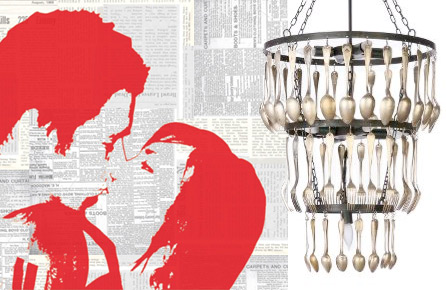
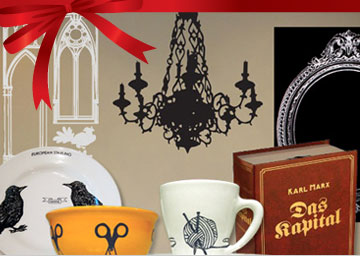
It takes a special kind of person with a special kind of house to make this stunning Eat Drink and Be Merry Chandelier ($4,800) work. Handcrafted out of vintage silverware, it is both simple and magical enough that it will never go out of style.

Impress anyone on your list with the personal touch of a customized canvas (starts at $129). You pick out a background culled from old newspapers, send a photo — blissful lovers, childhood moment, family portrait, whatever you wish — and wait until it is transformed into a one-of-a kind canvas.

Midrange gifts for the house proud

An Oscar Wilde-inspired mirror boasts style and humor, and graceful LEDs light your way to a lower electricity bill.

  • more
    • All Share Services

Midrange gifts for the house proud

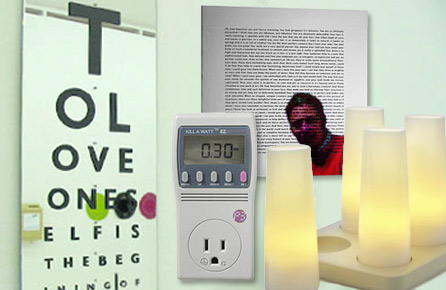
For the person on your list who has a sense of style and humor in equal measures, consider this Innervision Mirror ($89). It may look like an eye test on first glance, but get your eyes checked: It actually bears the Oscar Wilde quote “To love oneself is the beginning of a life-long romance.” Not to be mistaken for the Oh How Beautiful (You Are) mirror ($99), which sycophantically flatters its owner without quoting Oscar Wilde.

How many Republicans does it take to screw in a light bulb? None, if you use these Candela lights ($69 for a set of four), lit by LED rather than bulbs. Rechargeable, graceful and handy, these lights fall somewhere between a candle, a lamp and a flashlight; they can be used indoors and out, to set a mood or just fill in for that light bulb no one ever bothered to replace.

Chances are that most of your friends and loved ones will be spending a lot more time nesting during the recession. And more time at home means more wantonly wasted electricity. Exactly how much does it cost to keep that DustBuster or iPod docking station permanently plugged in? The Kill a  Watt EZ power monitor ($34.99) can tell you. Plug electronic devices into this little gadget and it’ll show how much each household appliance is costing on your energy bill. Who wouldn’t want to know that?

Continue Reading Close

Page 2 of 4 in Joy Press