Matt Duss

Smugglers’ tunnels are Hamas’ lifeblood

The subterranean politics of war and peace in Gaza

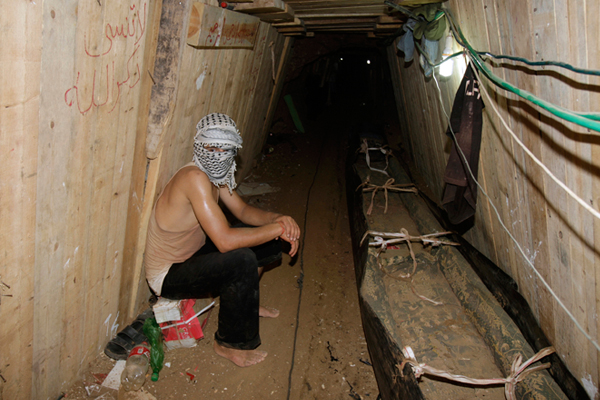
A Palestinian sits in a smuggling tunnel beneath the Egyptian-Gaza border in Rafah.(Credit: Reuters//Ibraheem Abu Mustafa)

RAFAH, Gaza Strip — The first things you notice are the trucks, entering Rafah’s dusty main thoroughfare from small side streets, flatbeds fully loaded and covered. Then there are the young boys packed three to a motorbike, darting heedlessly in between the rumbling behemoths, clutching shovels. As you get closer, you see the enormous mounds of earth and rubble, some 10 feet high and more, set amid acres of makeshift canopies, tents and metal garages, which serve as loading docks for Rafah’s booming tunnel trade.

This underground entrepot is now another front in the multifaceted Israeli-Palestinian conflict.  After years of virtual – and sometimes actual — civil war, the Palestinian factions Hamas and Fatah have gotten more serious about reconciling and forming a united front, ostensibly to better achieve Palestinian national goals, more immediately to stem growing popular discontent at the abject failure of either party to do so. Yet the unity talks have also exposed a division between Hamas’ external leadership, represented by Khaled Meshaal, and the Gaza-based leadership, represented by current Prime Minister Ismail Haniyeh.  When Meshal and Palestinian President Mahmoud Abbas of Fatah announced the outlines of a deal (one that would make Abbas both president and prime minister of a unity government) in Qatar  earlier this month, the Hamas leadership in Gaza strongly criticized it, saying they hadn’t been sufficiently consulted.

While tensions between the various factions within Hamas have long been rumored, until now the organization has been fairly good at managing such tensions in private. What explains the Gaza wing’s decision to so publicly disagree with its external leadership? The Rafah tunnel trade — and the considerable amount of revenue (estimates range as high as $20 million per month) that the Gaza Hamas wing derives from it — offers a clue as to why.

How the tunnels grew

The Rafah tunnels have an ancient heritage.  Mentioned in official documents as far back as 1303 BC, Rafah was an important trading center for centuries, serving as an entryway between North Africa and the Levant. After falling into decline in the Ottoman era, the town swelled in size with the influx of refugees fleeing from the war between Israel and the Arab states in 1948, after which Gaza was occupied by Egypt. After the 1967 war, the Gaza Strip came under Israeli control. The town was divided between Egypt and Israel in the Camp David Accord, which created a buffer zone between Egypt and Israeli-controlled Gaza known as the “Philadelphi corridor,” and the tunnels soon began to spring up, primarily for the transfer of drugs and other contraband, but also for other goods not easily available under Israeli occupation.

With the coming of the Second Intifada in 2000, the tunnels increasingly began to be used by violent factions like Hamas and Palestinian Islamic Jihad to smuggle weapons and explosives for attacks on Israeli civilians, a problem Israel attempted to deal with by destroying homes and buildings suspected of covering tunnels. In 2003, American activist Rachel Corrie was killed by an Israeli bulldozer as she attempted to prevent it from demolishing a Palestinian house in Rafah.

Following Israel’s 2005 withdrawal of its settlements from Gaza, which is home to 1.7 million Palestinians, the Rafah crossing came under the control of the Palestinian Authority, though according to both the United Nations and the U.S. State Department, Israel retains responsibilities as an occupying power. In response to Hamas’ 2006 capture of Israeli soldier Gilad Shalit, Israel enacted a strict closure on Gaza.

In 2007, Hamas took over Gaza in a short but extremely violent war with its rival, the secular nationalist Fatah, which continues to rule in the West Bank. Israel tightened its closure even more, allowing the entry only of goods “vital for the survival of the civilian population,” banning exports, and prohibiting Palestinians themselves from leaving the Gaza Strip in all but the most exceptional cases. In response, the tunnel business took off.

Under Hosni Mubarak, Egypt helped enforce the official blockade on Gaza, periodically cracking down on the tunnels, which invariably sprang back up. In May 2011, after the fall of Mubarak, in an effort to placate popular opinion, the Egypt’s transitional military government opened the Rafah crossing to Palestinians. It remains closed to materials. “Egypt is OK with it,” said Taghreed El-Khodary, a Gaza-based journalist and former New York Times correspondent. “They can’t push too hard, even during Mubarak’s time they couldn’t push too hard during the siege, and they are making money from it.”

“Prior to 2007, the tunnels functioned to smuggle contraband into Gaza, cash, weapons, and drugs,” said Sari Bashi, the executive director for Gisha, an Israeli human rights group that advocates for the freedom of movement of Gaza’s residents. “The tunnels were defined as a security issue, and Israel cracked down with little success. Beginning in 2007, Israel began restricting civilian goods, and the response was flourishing of the tunnels, on which civilians in Gaza now depend.” (In a recent report, “Scale of Control,” Gisha argued in favor of Israel’s continuing responsibility for Gaza, based on the considerable extent of Israel’s continued control of the lives of its residents.)

Based on what I’d seen reported on the tunnels before, I was expecting to see camouflaged holes in the ground guarded by guys with guns. While those smaller ones continue to exist (“There are tunnels even Hamas doesn’t know about,” one observer told me), the ones I saw were housed under tents and garages, out in the open, with trucks backing right up to them to load. The tunnels varied in size. One was a tight space reminiscent of “The Great Escape,” reinforced with scrounged plywood and not big enough to stand up in, while another had walls and ceiling reinforced with steel beams and concrete, thoughtfully decorated here and there with artificial leaves. Both used truck engine-powered pulley systems to draw sleds-full of materials the few kilometers from Egypt. Rumor has it that some tunnels are even big enough to bring cars through, and have done so.

For something that is thoroughly illegal, I was surprised at the openness of the activity. A proud worker even invited me to snap a photo of the tunnel he was currently digging. One doesn’t commit this much time, energy and resources to such an enterprise if one isn’t reasonably sure about the safety of such investment. The tunnels now represent the cutting edge of entrepreneurship in Gaza. There are estimated to be over 1,000 of them operating now in Rafah.

“The policy of civilian restrictions is what has made the tunnels basically impossible to close,” said Bashi. The tunnels also provided a source of tax revenue for the Hamas government. “Israel banned construction materials, so the Hamas government has been bringing them in through tunnels and levying taxes and operating fees. Prior to the ban the [Ramallah-based] Palestinian Authority was benefiting from the taxes, and the providers were Israeli and Palestinian business people.” Now, she said, that money goes to Hamas. “Israel, through its restrictions, has created a flourishing black market economy, and a new class of entrepreneurs, at the expense of the Gaza’s traditional business community.”

A couple of Gaza businessmen with whom I spoke confirmed this.

“I want to do business with my friend at General Electric in Tel Aviv,” not with the “gangsters” who run the tunnels, said one. Another, an Internet technology entrepreneur, noted that a Dell laptop computer was far cheaper from the tunnels than bought legally through the Israeli-controlled Kerem Shalom crossing, which put him in a tough spot as someone trying to run a business both legally and profitably.

“Once you have a tunnel you have to pay fees, and that goes to the municipality, which provides you electricity” for the tunnel, said El-Khodary. “Then you pay taxes on the goods you bring out. Whether it’s oranges or cement, Hamas gets its tax.” The continuing closure combined with the tunnel economy puts Hamas in a comfortable spot: They can blame the continuing Israeli blockade for their own failures of governance, while using the tunnel revenue to distribute patronage and maintain favor with key constituencies in the Gaza Strip.

 Egypt looks the other way

On the Egyptian side of the border, there’s no apparent enthusiasm for cracking down on the tunnels trade.

“There’s little Army presence, much of this area is Bedouin controlled, and it’s pretty much isolated from the central government in Cairo,” said El-Khodary. “Many Egyptians in Rafah will talk about how isolated they are, but if you go to El Arish,” a coastal city about 50 kilometers west of Rafah, “you see people making a hell of a lot of money out of the tunnels. There’s no way they’re going to let them go.”

Israel’s security concerns over threats emanating from Gaza are quite legitimate. Materials smuggled through the tunnels have been used to manufacture rockets and mortars launched against towns in Israel like nearby Sderot, and there are fears that the range of these weapons is increasing.

The result of the  policy of closure, however, has been the development of a sizable black market economy based upon illegal tunnel trade. This has been accompanied by the growth of influential constituencies in both Egypt and Gaza that oppose any effort to shut down the tunnels, and will lobby hard against  the creation of a more open, regulated border. By empowering a large new merchant class that profits from the tunnels, the closure policy has effectively created another stumbling block to normalization of relations between Israel and the Palestinians.

To repeat, the tunnels have also created a welcome source of tax revenue for the Hamas-controlled Gaza government that has both helped them to resist the impact of the closure and empowered them to challenge their external leadership when it commits to things they don’t agree with.

Hamas’ external leadership is in a more accommodating mood. In reaction to Bashar al-Assad’s brutal crackdown, they have left Damascus, and are looking for a new home and new patrons. The Gaza leadership, on the other hand, feels more secure.  Having borne the brunt of the Israel’s operation Cast Lead in 2008-2009, and feeling the wind of the Arab awakening at their back, they also seem to feel far more justified in asserting themselves against such accommodation. And skimming the cream off the tunnel trade gives them a source of revenue that makes governing easier.

In short, a policy whose ostensible goal was to weaken Hamas’ hold on Gaza has apparently strengthened it.

The closure policy has hollowed out the sectors of Gaza society with ties to Israel and the West Bank, and thus isolated those with a greater interest in a two-state solution. The policy has also empowered those with ties to Hamas and to organized crime. “If I were to write a strategic plan on how to strengthen the Hamas government,” Bashi said, “I would suggest everything Israel has done over the last four years.

The neocons’ big Iran lie

The right-wing hawks who thought Iraq would be a cakewalk think it'd be easy to attack Iran. Real soldiers say no.

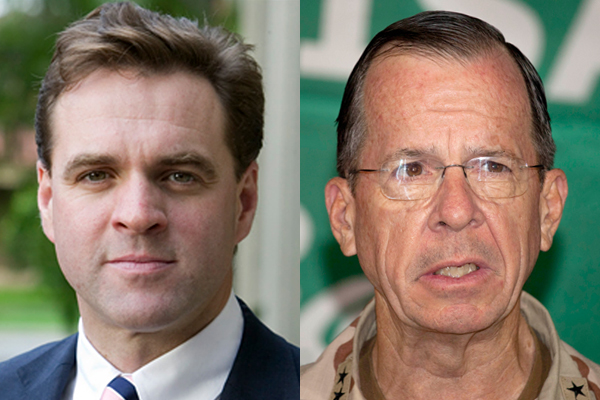
Pro-war historian Niall Fergusson and Joint Chiefs of Staff Chairman Adm. Mike Mullen (Credit: nsb.com/AP)

In February 2003, less than a month before the U.S.-led invasion of Iraq, Gen. Eric Shinseki told a hearing of the Senate Armed Services Committee that “Something on the order of several hundred thousand soldiers” would be required to occupy Iraq in order to stabilize it in the wake of an invasion.

What quickly followed is well known. Several days later, in what journalist James Fallows called “probably the most direct public dressing-down of a military officer, a four-star general, by a civilian superior since Harry Truman and Douglas MacArthur, 50 years ago,” Deputy Secretary of Defense Paul Wolfowitz called Shinseki’s estimate “wildly off the mark,” and said that “it’s hard to conceive that it would take more forces to provide stability in post-Saddam Iraq than it would take to conduct the war itself.”

The cavalier dismissal by civilian officials and conservative pundits of military analysts’ predictions of the likely consequences of the Iraq war was symbolic of the entire hubristic enterprise. Over $800 billion and tens of thousands of civilian casualties later, the idea that America can deal with its problems and create specific outcomes simply through the application of its considerable military might is rightly understood as a mirage.

Fortunately, when it comes to the challenge posed by Iraq’s neighbor Iran, the current administration has shown itself to be far more reality-based. But this hasn’t stopped many pundits from making similar calls for military action, though now thankfully doing so from outside the halls of power. As with Iraq, these calls for action are couched in the rosiest of post-strike scenarios, which fly in the face of what a preponderance of military and civilian analysts have predicted would have extraordinarily negative consequences.

The latest upsurge in calls for military action against Iran began with a piece in Foreign Affairs by Matthew Kroenig, a former  analyst at the Pentagon and fellow at the Council on Foreign Relations, titled “Time to Attack Iran.” The U.S. should carry out limited strikes on Iran’s key nuclear facilities, Kroenig argued, and could “reduce the political fallout of military action by building global support for it in advance.” “By building such a consensus in the lead-up to an attack and taking the outlined steps to mitigate it once it began,” Kroenig wrote, “the United States could avoid an international crisis and limit the scope of the conflict.”

The Internet quickly worked its magic, as numerous writers dismantled the elements of Kroenig’s argument. Among the most effective and devastating rebuttals came from Kroenig’s own former Pentagon boss, Colin Kahl, who wrote that Kroenig’s “picture of a clean, calibrated conflict is a mirage. Any war with Iran would be a messy and extraordinarily violent affair, with significant casualties and consequences.”

Regardless of its weaknesses, Kroenig’s piece opened the floodgates to calls for military action against Iran. Indeed, in a great demonstration of the Overton Window theory, many advocates of war have suggested that Kroenig did not go far enough, and that we should not settle for less than the end of the Islamic Republic of Iran.

“War is an evil. But sometimes a preventive war can be a lesser evil than a policy of appeasement,” wrote historian Niall Ferguson. “It feels like the eve of some creative destruction.” Illustrating the enormous chasm between clever and smart, the Foreign Policy Initiative’s Jamie Fly and the American Enterprise Institute’s Gary Schmitt suggested that, well, if we’re going to be there anyway, we shouldn’t stop at the nuclear sites, but instead go all the way and destroy the Iranian regime. “If strikes are chosen,” they wrote, “it would be far better to put the regime at risk than to leave it wounded but still nuclear capable and ready to fight another day.” The Wall Street Journal’s Brett Stephens concurred. “Destroying Iran’s nuclear sites will be a short-lived victory if it isn’t matched to the broader goal of ending the regime,” Stephens wrote. “The ultimate remedy is Iranian regime change,” chimed in Washington Post columnist Richard Cohen.

As with the calls for war against raq, what all of these pieces share is a shockingly blithe attitude toward the likely costs of such a war, and a failure to seriously grapple with the consequences. (Though, it must be said, Niall Ferguson’s stands out for the clubby, back-slapping brio with which he advocates the “creative destruction” of Iran. Omelettes, eggs, right?)

But as with Iraq, perhaps even more so, U.S. military leaders have repeatedly made clear that they believe those consequences would be severe. Let’s review: In testimony to the Senate Armed Services committee in April 2010, then-Joint Chiefs Vice Chairman Gen. James Cartwright said that strikes would, at best, only delay the Iranian nuclear program for a few years, while at the same time solidifying Iranian domestic support for the regime and removing any hesitancy that may have existed over the necessity of obtaining a nuclear weapon.

Asked by Sen. Jack Reed whether the only way to prevent Iran from achieving a nuclear capability was “to physically occupy their country and disestablish their nuclear facilities,” Cartwright answered: “Absent some other unknown calculus that would go on, that’s a fair conclusion.”

Cartwright’s comments echoed those of retired Gen. Anthony Zinni from a speech at the New America Foundation in September 2009. Zinni said that he liked to respond to advocates of strikes on Iran with “And then what?”

After you’ve dropped those bombs on those hardened facilities, what happens next? What happens if they decide, in their hardened shelters with their mobile missiles, to start launching those? What happens if they launch them into U.S. bases on the other side of the Gulf? What happens if they launch into Israel, or somewhere else? Into a Saudi oil field? Into Ras Laffan, with all the natural gas? What happens if they now flush their fast patrol boats, their cruise missiles, the strait full of mines, and they sink a tanker, an oil tanker? And of course the economy of the world goes absolutely nuts. What happens if they activate sleeper cells? The MOIS, the intelligence service; what happens if there’s another preemptive attack by the West, the U.S. and Israel, they fire up the streets, and now we’ve got problems. Just tell me how to deal with all that, OK?

Because, eventually, if you follow this all the way down, eventually I’m putting boots on the ground somewhere,” Zinni concluded. “And as I tell my friends, if you liked Iraq and Afghanistan, you’ll love Iran.”

Former Joint Chiefs of Staff Chairman Adm. Mike Mullen also made a point of highlighting the costs of military action, telling a forum at Columbia University in 2010, “Iran getting a nuclear weapon would be incredibly destabilizing. Attacking them would also create the same kind of outcome … In an area that’s so unstable right now, we just don’t need more of that.” Weekly Standard editor Bill Kristol dismissed this as “silly.”

Needless to say, it’s not silly. It’s deadly serious. This is not to suggest that debates over the appropriateness of military action should be the exclusive purview of the military. But when the overwhelming consensus among those in the business of war is that such action would have hugely negative consequences, that should tell us something. It should also tell us something when those who disagree do so entirely on the basis of best-case scenarios.

Continue Reading Close

The snake oil of “Who lost Iraq?”

Conservatives fume over Obama's popular pullout from a foolish war -- but don't understand what really happened

War over (Credit: AP/Reuters)

When Communist forces took over China in 1949, a debate erupted in U.S. foreign policy circles over “Who lost China?” Amid the growing ferment of the Red Scare, blame was soon affixed to “China hands” in the State Department who, either through incompetence or (more likely, according to Red-hunters like Joe McCarthy) nefarious intent, had neglected to give the anti-Communist forces of Chiang Kai Shek the support they had required, and thus helped deliver China into the hands of America’s enemies, undermining the cause of freedom and democracy. Over the next few years, the hysteria grew to such an extent that eventually even President Dwight Eisenhower was accused by some on the extreme right of abetting the Communist conspiracy through failing to combat it as vigorously as he should have.

Echoes of the “who lost China?” debate can be heard in many of the complaints over the recent U.S. withdrawal from Iraq. Columnist Charles Krauthammer, as he so often does, led the charge, with a column titled, creatively, “Who lost Iraq?” When Obama took office, Krauthammer wrote, “He was handed a war that was won … He blew it.” Condemning Obama for leaving our allies in Iraq “exposed to Iranian influence,” Krauthammer lamented, “Just this past week, Massoud Barzani, leader of the Kurds — for two decades the staunchest of U.S. allies — visited Tehran to bend a knee to both President Mahmoud Ahmadinejad and Ayatollah Ali Khamenei.” Left unmentioned was the fact that many of America’s allies in Iraq have had close relations with Iran for decades. Barzani  has visited Tehran before.

The GOP presidential candidates soon followed suit, in similarly disingenuous terms. Calling the withdrawal a “naked political calculation,” former Massachusetts Gov. Mitt Romney said of the administration, “Either they failed to do it, either by virtue of ineptitude, or they decided that it wasn’t that important — politically or otherwise.” Obama had “lost the war.” Former Pennsylvania Sen. Rick Santorum told CBS that Obama had “lost the war in Iraq” and that now “we have Iran having broadened its sphere of influence.”

Taking to the Senate floor to register his displeasure, prominent Iraq war supporter Sen. John McCain said, “It is clear that this decision of a complete pullout of United States troops from Iraq was dictated by politics and not our national security interests.” The thing is, McCain is not wrong about the politics, but he is wrong about whose politics. The pullout of U.S. troops from Iraq was dictated by politics — Iraqi politics. It’s overwhelmingly clear that the Iraqi people wanted U.S. troops out of their country, and, whatever else they may have said in private, Iraqi parliamentarians weren’t willing to publicly disagree with them on that.

Confronted with this point while on a panel at the Halifax International Security Forum last November, McCain was strikingly dismissive of the very democratic processes that he had supported forcibly installing. “We’ve got troops in Kuwait, and we didn’t have to pass it through their parliament!” he insisted.  One wonders how McCain will be able to deal with a more democratic Middle East where governments, more accountable to the will of their people, will not be as willing to toe the U.S.’s line.

In a Wall Street Journal piece in December, Fouad Ajami, another big supporter of the war, similarly condemned the withdrawal. “A president who understood the stakes would have had no difficulty justifying a residual American presence in Iraq,” Ajami wrote, as if all it would have taken to keep U.S. troops in Iraq was a president who was really, truly committed to making the Iraqis see things our way.

As with so many other claims about the American intervention in Iraq, these arguments are not reality-based. Brett McGurk, who served as a senior advisor to three U.S. ambassadors in Baghdad, helped negotiate the 2008 withdrawal agreement with the Iraqi government. He also attempted to negotiate a new agreement in 2011 that would’ve allowed a residual U.S. force to stay.

It wasn’t possible, as he explained in a Washington Post Op-Ed. “The decision to complete our withdrawal was not the result of a failed negotiation,” McGurk wrote, “but rather the byproduct of an independent Iraq that has an open political system and a 325-member parliament.”

Trying to force an agreement through that parliament would have been “self-destructive,” he wrote. “That had nothing to do with Iran and everything to do with Iraqi pride, history and nationalism. Even the most staunchly anti-Iranian Iraqi officials refused to publicly back a residual U.S. force — and in the end, they supported our withdrawal.”

As for the claims that Iran would benefit from the U.S. withdrawal, the fact of the matter is that Iraq became “exposed” to Iranian influence the moment the Bush administration removed Saddam Hussein.  For years Saddam had served as the biggest check on Iranian power in the region. It was the Bush administration, supported by the likes of Krauthammer and Ajami, that created an Iraqi government largely run by Iran’s partners and clients. Paradoxically, removing the U.S. presence from Iraq could actually serve to diminish Iranian influence there, by removing one of the drivers of resentment that Iran has exploited in recent years to its advantage.

Whatever the merits of the conservative attacks on Obama’s pullout, it is worth noting how little traction they have gotten in the media and in the presidential campaign. The anti-pullout talking points have been delivered and repeated with frequency and discipline that conservatives regularly exhibit, but Americans just aren’t interested in hearing it, at least not right now. Polls continue to show about three-quarters of Americans support Obama’s decision to withdraw troops, with around two-thirds believing that the war was not worth the costs and consequences.

Indeed, Rick Perry’s impetuous declaration that if elected he would send U.S. troops back into Iraq was seen as a harbinger of the end of his candidacy. In an era of constrained budgets, expensive, open-ended troop deployments do not represent an attractive option to voters. While they are clearly not interested in bringing all the troops home and pulling up the drawbridge, Americans do seem to be getting more comfortable with the idea of a less expansive international military presence.

This may change, of course. Desperate for the small shred of vindication that an enduring U.S. presence in Iraq might have provided them, and furious at Obama for denying it to them, the war’s supporters will no doubt continue to sharpen and refine the “Obama lost Iraq” argument, probably to be included in a larger “Democratic weakness” broadside closer to the election.

The continuing violence in Iraq (which is itself driven by enduring political tensions that call into question the “success of the surge” narrative) will be offered as evidence of Obama’s alleged bungling of a war that was won for him. Iraqi Prime Minister Nouri al-Maliki’s increasingly authoritarian tendencies (which were very much apparent when President Bush was still in office) will be presented as proof of Obama’s alleged failure to commit the necessary resources to the building of Iraqi democracy.

In reality, these things should be taken as evidence of the limits of U.S. military power to create the outcomes we would like. While Americans currently aren’t buying what the Iraq war’s remaining advocates are selling, it’s important to keep reminding everybody what’s in the snake oil.

Continue Reading Close

Scary movie: Commander in chief Gingrich

Obama's adroit handling of threats from Iran raises the question: What would Newt have done?

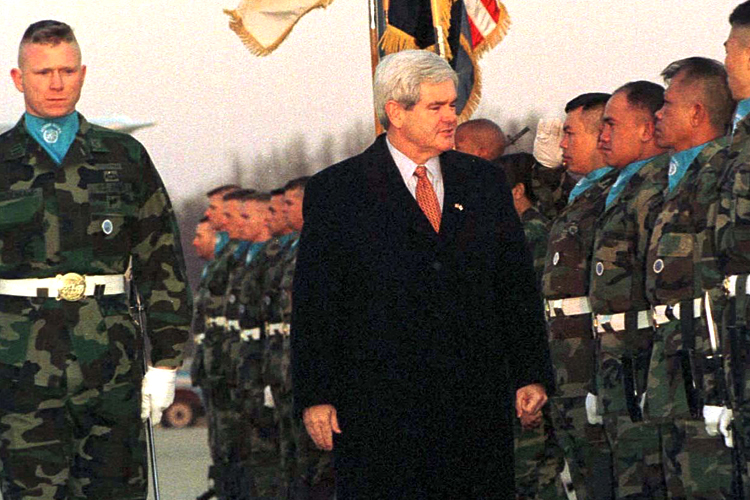
Then U.S. House Speaker Newt Gingrich reviews U.S. military honor guards in South Korea in 1997. (Credit: Yun Suk Bong / Reuters)

Presidential campaigns offer an opportunity to compare what the candidates say on the trail with what the job requires in the White House. With regard to foreign policy in 2012, the issue of Iran offers a case in point. In recent weeks, the United States and the Islamic Republic have once again clashed publicly while still seeking to negotiate privately over Iran’s nuclear program. The responses of President Obama and of the candidates who hope to succeed him illuminated the fundamental foreign policy choice facing voters who will choose a commander in chief next November.

On Sunday, the aircraft carrier USS Abraham Lincoln moved through the Strait of Hormuz, the world’s most heavily trafficked oil export route, on schedule and without incident. While the carrier had transited the strait numerous times before, it did so on Sunday amid a series of threats from members of the Iranian government in response to a tightening of international sanctions against Iran’s oil exports.

“If Iran oil is banned, not a single drop of oil will pass through Hormuz Strait,” Iran’s First Vice President Mohammad Reza Rahimi said on Dec. 27.  Four days later, President Obama signed the latest, and toughest, congressional sanctions yet, mandating penalties on companies that do business with Iran’s central bank.

On Jan. 3, after the aircraft carrier USS John C. Stennis had departed the gulf, the Iranian regime raised the stakes. “Iran will not repeat its warning,” said Iranian Army commander Ataollah Salehi, “I recommend and emphasize to the American carrier not to return to the Persian Gulf … we are not in the habit of warning more than once.”

Whether or not the Iranians would actually follow through on the threat to close the Strait of Hormuz (an act that would probably do more than any other to unite the world against it) the dire implications of such an action make it worth taking seriously. In 2011, almost 17 million barrels of oil a day passed through the strait, nearly 20 percent of the global oil trade. A disruption of traffic through the strait, even a temporary one, could have a considerable, and immediate, impact on the global economy.

“No one in this government seeks confrontation over the Strait of Hormuz,” Pentagon spokesman George Little said in response to the Iranian saber-rattling. “It’s important to lower the temperature.”

Appearing on CBS’ “Face the Nation” the following Sunday, Secretary of Defense Leon Panetta said that the U.S. would “not tolerate” the blocking of the strait, calling it a “red line for us” and stating that “we will respond” if the Iranians attempted to block it.

Appearing alongside Secretary Panetta, chairman of the Joint Chiefs of Staff Gen. Martin Dempsey added that the U.S. would be able to turn back any attempt to deny access to the Strait. “They’ve invested in capabilities that could, in fact, for a period of time block the Straits of Hormuz. We’ve invested in capabilities to ensure that if that happens, we can defeat that,” he said. “We’ve described that as an intolerable act. And it’s not just intolerable for us, it’s intolerable to the world. But we would take action and reopen the Straits.”

President Obama, of course, went ahead and signed the sanctions anyway.  And when the USS Abraham Lincoln carrier group, accompanied by a British Royal Navy frigate and a French vessel, returned to the Persian Gulf, the Iranian response was … muted.

“U.S. warships and military forces have been in the Persian Gulf and the Middle East region for many years,” Revolutionary Guard Deputy Commander Hossein Salami told the official IRNA news agency, “and their decision in relation to the dispatch of a new warship is not a new issue and it should be interpreted as part of their permanent presence.”

In response to the new sanctions, which the EU has since followed up on, Iranian government also sounded conciliatory notes. “Consensus can only be reached through serious negotiations based on a cooperative approach and not via the wrong path of sanctions,” an Iranian Foreign Ministry spokesman told the official Islamic Republic News Agency.

The Obama administration was wise not to trumpet the Iranians’ humiliating climb down, but it was certainly not lost on either the international audience or those watching inside Iran. The sanctions had gone forward, the ships had traversed the strait, yet Iran leveled no consequences.  Tensions are, for the moment, down from extremely high to their usual level of high, thanks to a steady, firm response from the Obama administration.

“It definitely could have gotten out of control, because the new set of sanctions were interpreted by Iran as a major escalation, close to an act of war,” says Vali Nasr, author of several books about Iran who previously served in the Obama administration with the late Richard Holbrooke. “The Iranians decided that the best way of reacting was through toughness, trying to find ways of deterring the U.S., so they made provocative statements about closing the strait, and threats against our aircraft carrier.”

The assassination of Iranian nuclear scientist Mostafa Ahmadi-Roshan on Jan. 11 also heightened tensions, but Nasr stresses the U.S. reaction. “The U.S. made clear that as tough as the new sanctions were, that was all the U.S. was undertaking. The U.S. disowned the killing of the scientist, but also made warnings about the closing of the strait.” Importantly, Nasr notes, the U.S. “also encourage the Iranians to come to talk” over its nuclear program, demonstrating once again that the U.S. is not the recalcitrant party.

Yet, to watch the Republican debate on Monday night, you’d have thought that President Obama had been the one to climb down, and that America had been humiliated. Mitt Romney continued his pattern of castigating Obama while strenuously articulating the exact same policy. “We want to show Iran” that closing the Strait, or any similar action, Romney said, “will be considered an act of war, an act of terror and America is going to keep the sea lanes open.”

Newt Gingrich responded, “I would say that the most dangerous thing — which, by the way, Barack Obama just did — the Iranians are practicing closing the Strait of Hormuz, actively taunting us, so he cancels a military exercise with the Israelis so as not to be provocative?

“Dictatorships respond to strength, they don’t respond to weakness,” Gingrich continued, “and I think there’s very grave danger that the Iranians think this president is so weak that they could close the Strait of Hormuz and not suffer substantial consequences.”

While Gingrich’s claim about the U.S.-Israeli exercise was false (“On the record, officials have said it was a joint decision,” wrote Ron Kampeas of the Jewish Telegraphic Agency, “and I have been told point blank by Israeli and U.S. officials, on background, that it was initiated by Ehud Barak, the defense minister”), it’s useful to imagine how a President Newt Gingrich might have reacted to a similar situation – would he have similarly de-escalated, or would his version of “showing strength” have led to a serious crisis? It’s quite possible, given that Gingrich’s view of “strength” apparently involves asserting America’s prerogatives in the most aggressive and obnoxious way possible.

And if you’re inclined to chalk up his bellicosity to campaigning, and think that Gingrich would be steadier once in office and surrounded by more sober-minded advisors, consider that he has already announced that he would ask John Bolton to be his secretary of state. An advocate of bombing Iran from way back, Bolton recently dismissed the assassinations of Iranian scientists and the new sanctions — the most severe that Iran has ever faced — as “half-measures.”

As to what impact crazy statements from Republican candidates have on Iran’s calculations, Nasr is measured. “Iranians are very well aware that it’s election year and there is pressure to be tough on Iran,” he says. “But the danger of this kind of talk is that the Iranians [could] conclude that American foreign policy is driven by the dynamics of the campaign, and it doesn’t matter whether they come to talks or not.” While Nasr says it’s difficult to see how talks would actually resolve the issue, “the campaign makes it very difficult to maneuver. The Republicans are not making any room to craft talks that could actually be successful. Talks may not produce results in the first meeting, they could be indecisive, but if the administration is under so much scrutiny from Republicans, that makes it more difficult to have successful negotiation.”

Then, Nasr concluded, “There’s the fact that Iran is in a [parliamentary] election year, so a similar dynamic is in play there.”

Even in the absence of the tension like we’ve seen in the past week, Iran presents an extraordinarily complex challenge. But while counterfactuals are always iffy, it’s very much worth recognizing that this is a crisis that did not escalate. It could have, if the current administration confused strength with belligerence.

Continue Reading Close

The “appeasement” parrots of the GOP

Except for Ron Paul, the Republican candidates target the president with their own ill-informed policy

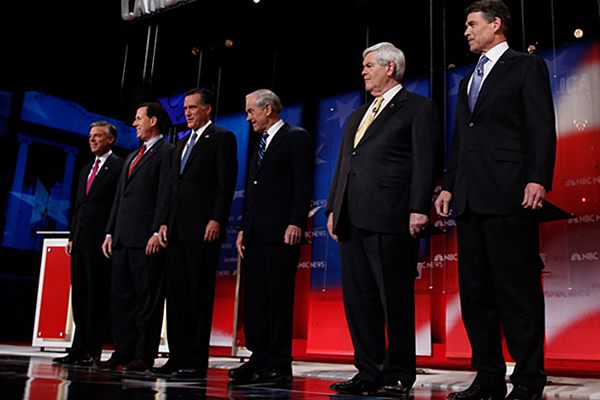
LIned up against Iran (Credit: Reuters)

With the country still struggling to pull itself out of an economic recession, foreign policy has not rated the highest among issues discussed by the Republican presidential candidates. But among those foreign policy issues that have been debated, one has dominated the agenda: Iran. And other than Ron Paul, the candidates have arrived at the same verdict on President Obama’s Iran policy: It is appeasement.

Speaking at a forum last month, the candidates lined up to launch the charge at Obama. “For every thug and hooligan, for every radical Islamist, he [Obama] has had nothing but appeasement,” said former Sen. Rick Santorum. “Internationally, President Obama has adopted an appeasement strategy,” said former Gov. Mitt Romney. In September, standing alongside hard-line supporters of Israel’s settlements, Texas Gov. Rick Perry similarly condemned the administration’s “Middle East policy of appeasement” — at almost precisely the same moment that Obama was delivering a speech defending Israel at the United Nations and demanding that Iran meet its nuclear treaty. In late December, Newt Gingrich said on an Iowa radio program, “You have an Obama administration who’s dedicated to appeasing our enemies and dedicated to giving away our secrets.”

It’s not a particularly surprising line of attack. “Appeasement,” with its obvious reference to British Prime Minister Neville Chamberlain’s capitulation to Adolf Hitler at Munich in 1938, is probably the single most overworked accusation in the conservative foreign policy lexicon, a free-floating, no-evidence-required assertion of weakness and surrender. The charge has become so unmoored from any actual historical context that many who use it are not even aware of its provenance. During the 2008 presidential campaign, “Hardball’s” Chris Matthews famously humiliated right-wing shout radio jock Kevin James by repeatedly asking what had actually happened at Munich, to which a red-faced James could only repeatedly scream, “Appeasement!”

One can disagree with the Obama administration’s two-track approach of engagement with and pressure on Iran. But to describe that approach as “appeasement” is to declare oneself desperately in need of a dictionary. The Obama administration has overseen the adoption of some of the most stringent multilateral sanctions ever on Iran. It has undertaken unprecedented defense cooperation with regional allies, including the placing of a NATO missile defense radar system in Turkey, to Iran’s continued outrage. And the administration successfully facilitated the appointment of a special U.N. human rights monitor for Iran to track the regime’s continued abuses.

Iranian President Mahmoud Ahmadinejad’s recent jaunt through Latin America, intended to combat the perception that Iran is increasingly isolated, was a bust, long on photo ops and statements of solidarity from the likes of Hugo Chavez, but short on actual measures that might help Iran out. The Wall Street Journal reported Tuesday that Iranians’ efforts to protect their savings from rampant, sanctions-induced inflation by offloading rials for more stable currencies had gotten so bad that Iranian authorities cracked down on the practice.

There is a legitimate argument to be had over whether the punishing measures taken by the international community will actually push the Iranian government toward a compromise on its nuclear program, which it insists is for peaceful purposes, but about which the International Atomic Energy Agency continues to have troubling unanswered questions. At the very least, though, one would think that enacting such measures would inoculate the administration from the charge of being weak on Iran. But no, some of Obama’s conservative critics have gone so far as to redefine appeasement as simply the act of talking to one’s adversaries, as columnist Charles Krauthammer did when he insisted that the administration’s efforts at negotiations with Iran “did nothing but confer legitimacy on the regime.”

In reality, talks with Iran have served as a force multiplier for other efforts to put pressure on Iran over its nuclear program. As one Israeli defense official told me for an article last year, the Israelis themselves were very skeptical that talks with Iran would have any benefit, but now recognize that the effort “contributed to building international consensus” around the problem. Negotiations have actually done the opposite of conferring legitimacy on the regime — they made clear to the world, and to the Iranian people, that the Iranian government, not the U.S., was the central obstacle to a resolution, thereby facilitating further sanctions. On Monday, Nicholas Burns, the under-secretary of state for political affairs during the George W. Bush administration, told MSNBC’s Andrea Mitchell that “Iran is probably more isolated today than the day that President Obama took office.”

Conservative mendacity aside, it’s worth looking at what former British Prime Minister Winston Churchill, the patron saint of the anti-appeasement crowd, had to say about it. “The word ‘appeasement’ is not popular, but appeasement has its place in all policy,” Churchill told an audience in 1950. “Make sure you put it in the right place. Appease the weak, defy the strong.” Returning to the theme later that year, he noted that “Appeasement in itself may be good or bad according to the circumstances.”

It should come as no surprise that the views of Churchill the man are quite a bit more nuanced than those of Churchill the Neocon Dashboard Saint, but what might this mean with regard to Iran? It means remembering that, despite the significant self-inflicted setbacks created by our invasion of Iraq, the U.S. is still dealing from a position of considerable strength against a weaker power in Iran. The U.S. has by far the largest military in the world, with an annual defense budget of over $700 billion, while Iran spends around $9 billion per year.

This certainly doesn’t mean that the U.S. should acquiesce to an Iranian nuclear weapon, but it does suggest that the U.S. and its partners should at least consider making explicit what was implicit in the proposed 2009 deal on fuel for the Tehran Research Reactor: a recognition of Iran’s right to domestic enrichment in exchange for the complete satisfaction of the IAEA’s concerns, and a commitment to ongoing verification. At the very least, talks should continue to be pursued in the hope of establishing some line of regular communication between the U.S. and Iran as a way to calm tensions, which are running high over Iran’s provocative threats to close the Strait of Hormuz, and the assassination of another Iranian nuclear scientist.

Finally, as we face a new round of calls for preventive war against Iran, from many of the same people who advocated preventive war against Iraq, it’s very much worth remembering that the Iraq war provided a greater strategic benefit to Iran than any “appeasement” conceivably could. Some of those gains have been lost in recent years, partly as a result of the Arab Spring, partly as a result of the Obama administration’s hard diplomatic work, and partly because of Iran’s own incompetence and belligerence. Clearly, Iran continues to represent a challenge to the U.S. and its interests on a number of fronts, but it’s important to keep that challenge in perspective, and not allow ourselves to be marched into another ruinous military adventure with unforeseeable consequences through the ridiculous idea that anything short of war is  “appeasement.”

Continue Reading Close

Talking to the Muslim Brotherhood (finally)

U.S. diplomats bow to reality and talk to Egypt's Islamic party

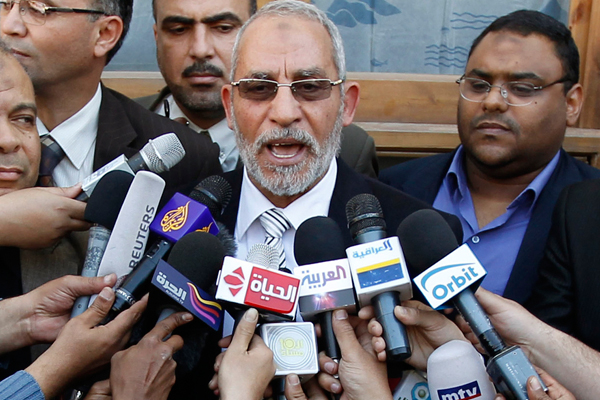
Muslim Brotherhood leader Mohammed Badie (Credit: Reuters)

Last week, the New York Times reported that the Obama administration had decided to significantly increase contacts with Egypt’s Muslim Brotherhood, in the wake of the group’s significant showing in recent elections. According to the Times, the new contacts represented “a historic shift in a foreign policy held by successive American administrations that steadfastly supported the autocratic government of President Hosni Mubarak in part out of concern for the Brotherhood’s Islamist ideology and historic ties to militants.”

“Now, the Americans come to meet us in person because they have estimated that we will be coming to power,” Mohamed Saad Katatny , the secretary-general of the Brotherhood-affiliated Freedom and Justice Party, told the Washington Post, “and therefore they want to know us, but we have not discussed more than the general conditions and made introductions.”

On Wednesday Deputy Secretary of State William Burns met with the head of the Brotherhood’s political party, the highest-level contacts ever.

The Obama administration’s first tentative steps toward the Muslim Brotherhood go back to the president’s Cairo speech in June 2009, which was attended – at the administration’s request – by Muslim Brotherhood-affiliated activists. “America respects the right of all peaceful and law-abiding voices to be heard around the world, even if we disagree with them,” the president told those assembled at Cairo University. “And we will welcome all elected, peaceful governments — provided they govern with respect for all their people.”

Laying down a condition for democratic participation, President Obama continued in Cairo, “government of the people and by the people sets a single standard for all who hold power: you must maintain your power through consent, not coercion; you must respect the rights of minorities, and participate with a spirit of tolerance and compromise; you must place the interests of your people and the legitimate workings of the political process above your party.”

The shift has been some time coming. For decades, U.S. policymakers struggled to develop a coherent approach to Islamic political parties in the Middle East, of which the Muslim Brotherhood is the oldest. Founded in 1928 by schoolteacher Hassan al-Banna as a populist social movement aimed at returning Egyptian society to its Islamic roots, the group originally supported the Egyptian revolution of 1952, but soon fell out with the new government of Gamal Abdel Nasser. An attempt on Nasser’s life in 1954 led to the organization being outlawed and to a prolonged period of repression, some splinter factions turning to violence.

After Brotherhood-affiliated candidates won 88 seats in the national assembly in Egypt’s 2005 parliamentary elections, the Bush administration began talking to them, but pulled back as Mubarak launched a renewed crackdown on democracy activists. Bush’s “freedom agenda” was buried under a wave of anti-American radicalism driven by the occupation of Iraq.

Obama’s election on a pledge to change direction and his Cairo speech put him in a decent position to side last year with the Tahrir Square protesters’ demand for political reform and the end of Mubarak’s regime, something for which Obama has continued to be criticized by Republicans who see little difference between the religiously oriented politics of the Brotherhood and the violent nihilism of al-Qaida. Faulting the administration for not supporting Mubarak, presidential candidate Rick Santorum called the Muslim Brotherhood “as dangerous to western civilization and the future of our country” as al-Qaida.

Back in July, as it became even clearer that Islamist parties were preparing to make significant gains in the coming elections, it was reported that the Obama administration was seeking “limited contacts” with Brotherhood activists. Conservatives once again criticized the shift, but it’s unclear what the other options are, aside from doubling down support for Egypt’s current interim government, headed by the Supreme Council of the Armed Forces, which has become increasingly violent against protesters over the last months. (That is, repeat the same mistakes that we have made for decades in supporting oppressive authoritarian regimes against their own people for the sake of stability.)

“I think the [New York Times] story was a little overstated,” said Steven Cook, a Middle East Scholar at the Council on Foreign Relations, whose book “The Struggle for Egypt” was published in September. “For years we’ve been having unofficial contacts with the Muslim Brotherhood. And pretty early on after Mubarak fell, the State Department indicated that there would be contacts.”

The bottom line, according to Cook, is that the Brotherhood is “an important part of the political landscape and choosing to wall ourselves off from them is unnecessarily handicapping ourselves. They haven’t engaged in any violence for the better part of five decades. So it’s reasonable to be talking to them. There doesn’t seem to be any downside, unless you buy into this idea that the Brotherhood is part of the effort to establish the global caliphate, which is not the case.”

Some analysts take a darker view. “It is tempting to believe that the FJP will moderate once in power,” writes Eric Trager of the Washington Institute for Near East Policy, but a number of factors make this highly unlikely, including the challenge to the Brotherhood’s right flank from more extreme Salafi parties. Trager also argues that Egypt’s peace agreement with Israel is in danger. “Although the party has said that it will honor Egypt’s international agreements,” Trager writes, “it has carved out an exception for the Camp David Accords, which it intends to put to a national referendum, thereby shielding itself from direct responsibility for the treaty’s demise.”

But Olivier Roy, a French scholar who has covered trends in political Islam for some time, asserts that the parties like the Muslim Brotherhood and Tunisia’s Ennahda, which won recent elections there, should be considered “post-Islamist.” While they continue to espouse many ideas at odds with modern liberalism (just as do some Western conservative religious political movements), in Roy’s analysis they have  adopted in principle the necessity of working within a pluralistic political space.

“The paradox of Islamization is that it has largely depoliticized Islam,” Roy wrote. “Social and cultural re-Islamization – the wearing of the hijab and niqab, an increase in the number of mosques, the proliferation of preachers and Muslim television channels – has happened without the intervention of militant Islamists and has in fact opened up a ‘religious market’, over which no one enjoys a monopoly. In short, the Islamists have lost the stranglehold on religious expression in the public sphere that they enjoyed in the 1980s.”

By reaching out to parties and Islamic movements that have been vilified for the past decade, the Obama administration is taking a risk, especially in an election year. Brotherhood members continue to make contradictory statements in regard to their plans and goals for a new Egypt, and the group’s most prominent affiliated cleric, Yusuf al-Qaradawi, regularly issues the grossest anti-American and anti-Semitic slanders on his Al Jazeera show. There is clearly reason for concern. But, if the U.S. is to be serious about democracy promotion, it is unclear what other options exist.

“We’re going to have to get used to the fact that there’s a strong Muslim Brotherhood presence in Egyptian politics,” Cook concludes. “It doesn’t mean we shouldn’t speak out then we disagree with their policies, but this is the reality. The question is: Do we adjust? Or do we forever fight against the political will of the people in the region?”

Continue Reading Close

Page 1 of 2 in Matt Duss

www.salon.com/writer/matt_duss/index.html