Michael Moran

Is the Iran threat an illusion?

The nation's recent moves look increasingly like those of a desperate regime, not a war machine

  • more
    • All Share Services

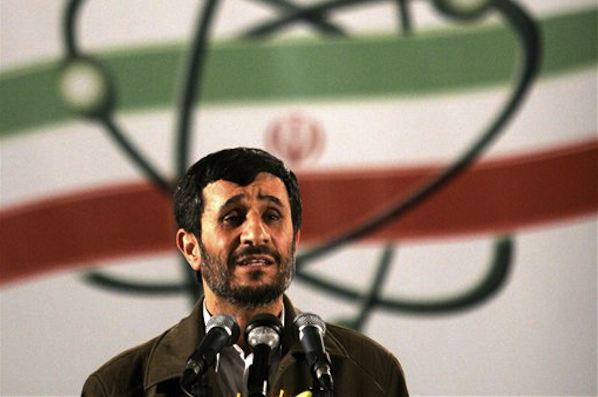
Is the Iran threat an illusion?Iranian President Mahmoud Ahmadinejad (Credit: AP Photo/Hasan Sarbakhshian)

As a tit-for-tat war rages in the shadows between Iran and Israel and some are seeing signs of serious duress in Tehran.

Global PostIsrael’s Prime Minister Benjamin Netanyahu and some right-leaning voices in the United States, including most of the GOP’s presidential contenders, continue to pound the war drums over Iran’s nuclear program.

But over the past several months, the image of the regime as a snake coiled to strike has lost some of its appeal to Iran observers. The erratic and often amateurish mix of bungled attacks and histrionic threats has prompted a reassessment of Iran and its putative allies.

Its thwarted attempts to assassinate Israeli and Saudi diplomats, stubborn defense of — and covert aid to — the bloodthirsty Syrian regime and its inept economic policy moves and apparently empty bluster about closing the Strait of Hormuz all have contributed to the belief that Iran may not be the fearsome adversary its president, Mahmoud Ahmadinejad, would have us believe.

“Iran’s recent threats to close the Strait of Hormuz are almost certainly just that — empty threats,” wrote Aref Assaf, an Arab-American scholar on Middle Eastern affairs. “But it is the sort of ill-conceived bluster that could have unintended consequences.”

With economic sanctions finally biting hard, Iran’s recent behavior has exacerbated regional trends that, since the Arab Spring began last year, have increasingly isolated the Islamic Republic.

Only recently, it was an article of faith among most Western experts that Iran’s influence and power would inevitably rise in this decade, particularly after the U.S. installed an Iran-friendly Shiite government in Baghdad.

But in the past six months, a combination of greatly improved Western economic sanctions, covert action by Israel and other intelligence agencies aimed at Iran’s nuclear establishment and the continuing instability of the Arab Spring has severely tested the regime’s ability to hold together the domestic constituencies that keep it in power.

There was first the bold challenge to the regime laid down by the country’s Western-oriented urban elites after President Mahmoud Ahmadinejad’s brazenly stolen reelection in 2009, then the recent collapse of the Iranian currency.

The country’s economic crisis has sustained the smoldering resentment of Iran’s elites, whose 2009 protest was crushed by the regime’s security apparatus and its fanatical militia. A barely concealed power struggle between Ahmadinejad and Iran’s Supreme Leader, the Ayatollah Khamenei, has raged ever since.

Tehran has also proved unable to get out ahead of popular uprisings in the Arab world — even in Shiite-majority Bahrain, where Saudi allegations of Iranian agitation are mostly imaginary.

Just last week, Hamas, the Palestinian political movement regarded as a terrorist group by the U.S. and EU, agreed to a power-sharing agreement with its rivals in the Palestinian Authority, a move that could end Shiite Iran’s role in arming and funding Sunni Hamas — as well as its bid for influence there.

The deal could prove illusory, as several previous ones have, but the reconciliation brokered by Qatar’s relatively liberal Gulf monarchy will certainly have included demands from the PA that Iranian influence be kept at bay.

This Iranian losing streak — coming with the region in flux and both American and Al Qaeda’s influence arguably also in decline — has surprised Western intelligence analysts who have long regarded Iran and its Lebanese protégé, Hezbollah, as possessing formidable disruptive capabilities.

Of course, this can change quickly should Iran’s Revolutionary Guard, the terrorist syndicate that protects the regime’s power base, decide to mount a major terrorist attack somewhere.

Hezbollah, which Iran supplies with arms and funding, also has a history of violent attacks — ranging from its role in the destruction of the U.S. and French military barracks in Lebanon in the early 1980s, to a murderous attack on an Buenos Aires Jewish organization in 1994 that killed 84 people, to the 2006 “missile war” with Israel.

The decision to unleash a wave of suicide bombers targeting Israeli diplomats is real enough. But even here, it has only added further to evidence of disarray in Tehran.

Thai police believe an abortive attempt to bomb Israel’s embassy there Tuesday (the bomber blew his legs off instead) can be traced to an Iranian cell in the country. They held two Iranians, including the luckless, legless bomber, Wednesday.

Some in the Israeli military and intelligence agencies have come to see more desperation than dastardly competence in Tehran’s recent behavior.

Even some notable hawks in the U.S. security establishment have retracted their talons. Patrick Clawson, director of the Washington Institute for Near East Studies, published a paper last week arguing that the latest round of sanctions implemented by the EU and United States have had significant effects on Iran.

Alone, Clawson writes, they probably are not enough to force Iran to stop enriching uranium. But he goes on to say that a military strike will not work — indeed, that it would likely be deeply counterproductive in the long run.

Rather, he says, there are better ways to bring Iran to heel. Ever-tighter sanctions could exacerbate the effects of broader regional changes, including the rising appeal in the region of Turkey’s secular democracy as a model, the discrediting of Iran’s ally Bashar al-Assad in Syria and impatience on the part of Russia and China with Iranian behavior.

“The Iranian nuclear impasse is not an easy problem to solve. But, in fact, the Obama administration is more correct than the pessimists when it sees room for action in 2012 on all these fronts. The Iranian nuclear problem is very unlikely to be resolved any time soon, but progress can be made,” he said.

What America can learn from the EU crisis

Six lessons we should take to heart when dealing with our own economic problems

  • more
    • All Share Services

What America can learn from the EU crisis
This article originally appeared on GlobalPost.

NEW YORK — Europe’s leaders must be longing for the good old days of 2008, when America’s financial lunacy nearly tipped the world into a Depression and politicians in Europe had their “I told you so” moment.

Global Post

Back then, French President Nicolas Sarkozy intoned that “Laissez-faire is finished. The all-powerful market that always knows best is finished.”

“Anglo-Saxon capitalism,” as the deregulated U.S. and British variety is called on the continent, “was as simple as it was dangerous,” declared Germany’s finance minister at the time, Peer Steinbruck. “The world will never be as it was before the crisis.”

Today, it may be tempting for Americans to believe that Der Schuh is on the other Fuss. That would be delusional. For as complex and uniquely European as the current turmoil “over there” may be, the euro zone sovereign debt crisis holds important lessons that the United States ignores at its own peril.

Of course, the comparisons are not perfect. The euro zone has a structural problem that America does not face. Unlike Europe, America has a centralized federal budget that addresses regional economic imbalances — so Mississippi’s low output isn’t as relative to New York doesn’t strain the U.S. economy and the dollar the way the lopsidedness between Greece and Germany hurts the euro zone.

Here are some lessons from Europe’s crisis that are applicable to America’s current economic problems:

GROW OR DIE:

When the size of the PIIGS’ (Portugal, Ireland, Italy, Greece and Spain) debt mountains became clear, the policy response dictated by Germany — the nation with the most at stake in terms of the subsequent bailout — turned out to be disastrous. German taxpayers, understandably, find it difficult to swallow the idea that they must sacrifice for the benefit of countries less fiscally prudent than themselves — as they had in joining the euro and in reunifying with East Germany.

As a result, they have demanded punitive austerity on the Greeks, Irish, Portuguese, Italians and Spanish. This has only worsened the crisis. Austerity has slowed growth and even caused recession, particularly in Greece. As such, markets grew pessimistic that the mixture of debt and low or negative GDP growth could be sustained.

The lesson here for America is simple: When tackling enormous, long-term debt that needs to be refinanced on global markets, radical, mindless cuts in government spending will worsen the crisis. A moderate approach that keeps growth alive through short-term stimulus — while laying out a medium-term plan for curbing government obligations — is the way through the minefield.

INFLATION IS AN INFLATED RISK:

Since 2008, voices on the right in the U.S. and in Europe (primarily German voices over there) have warned that keeping interest rates near zero risks unleashing 1930s-style hyperinflation. And yet, since 2008, the Fed has held the course, and inflation remains the least of our problems.

Unfortunately, German’s historic fears of inflation have forced the European Central Bank to raise rates in 2009 as the financial crisis began, causing the euro to rise in value, and reducing the PIIGS economies’ already-low competitiveness.

The ECB compounded the mistake in July, raising rates again because of arcane pricing pressures. The new ECB chairman, Mario Draghi, reversed course as soon as he replaced Jean-Claude Trichet in November, but many believe the reversals have come too late to help the weaker European economies.

Today, facing an existential crisis, the ECB has belatedly started to do precisely what the Fed has been doing all along – cutting rates, buying the bonds the market is shunning, and doing everything it can to keep growth alive.

Unfortunately, Germany still will not allow the ECB to become the lender of last resort to the euro zone. This is keeping market volatility alive and well. Americans should be thankful that their own central bank’s charter mandates the maintaining employment along with stabilizing prices, and is not beholden to politicians to the extent that the ECB is.

BANK LOSSES CANNOT BE WISHED AWAY:

Throughout the euro zone crisis, one of the great concerns has been the fact that past practices encouraged banks — especially large German and French ones — to lend recklessly to Greece, Portugal, Ireland and other now shaky countries.

It is clear that the exposure of some banks — including such giants as Societe Generale, Commerzbank, BNP Paribas and others — could fail. This would tip not only Europe into crisis, but also threaten to pull down all these banks’ business partners in the U.S. and around the world, just like Lehman Brothers in 2008.

To stave off these risks, the EU conducted “stress-tests” of the continent’s banks, modeled on similar audits the Fed conducted in 2010. The results: flying colors! While some small banks were listed as at-risk, most of the potential disaster was papered over. In some ways, this made sense, since it gave banks time to meet new requirements that they increase their reserves. But absent the “lender of last resort” powers for the ECB described above, the risk still remains high that a default of, say, Italy, or even a continuation of the current death-by-a-thousand-cuts, could cause major bank failures.

The lesson for the U.S. is clear: while the Fed’s bank audits have been more credible, it too was inclined to “pass” many banks that have major balance sheet problems. For instance, Chris Whalen, one of the country’s leading bank analysts, believes Bank of America — which swallowed up mortgage giant Countrywide right before the crisis — now has bad debts of more than $100 billion on its books and “should declare bankruptcy.” Bank of America rejects this, and the Fed and other regulators back them up. But math is math: in a crisis, Bank of America and several others could be holding out the begging bowls again. This reality should be dealt with upfront before a crisis. Otherwise, the choice again becomes another Toxic Asset Relief Program, or Depression.

RATINGS CAN BE HAZARDOUS TO YOUR HEALTH:

Americans, who tend to shrug off things that happen to other people since we’re so exceptional, shrugged off the fact that bond markets recently turned on Germany.

Think about it: Germany — a country with a quarter the population of the U.S. that earns more from exports than we do — had trouble borrowing on international markets. The following week, international ratings agencies put Germany, as well as 15 other Euro zone countries, on notice that their credit ratings might be downgraded.

To simplify the consequences, think of it this way: no matter who wins in November 2012, American government borrowing is going to continue. None of the GoP or Democratic plans calls for a balanced budget by 2013 (indeed, none of them even get their in a decade). Furthermore, debts outstanding have to be rolled over when the bonds come due. At each point, the country is exposed to market rates for the next batch of borrowing. If the U.S. thinks continued downgrades will have no consequences, just look at Europe. Italy, the eighth largest economy in the world and the producer of world-class brands like Ferrari, Fiat (Chrysler), Dolce Gabanna and Parmalat, is paying credit card interest rates at its bond sales. (For the solution to avoiding this, reread #1).

There are other, simpler lessons as well:

DEMOCRACY MATTERS:

The European Union has repeatedly done end-runs around its voters and those voters are very, very angry. Whatever the pain, decisions need to be exposed to public opinion, explained carefully and not snuck through (the way TARP was in 2008). The governments dumped by voters across Europe since 2010 are all evidence of this folly.

CHINA PLAYS THE LONG GAME:

When given a chance recently to pick up some bargains in Europe — a car maker, perhaps a bank — in exchange for helping bail Italy out, China demurred. China knows that time is on its side, and bailing out Europe perpetuates a world where China is a second tier power. While China has a lot more at stake in America’s economic health, the long game is a Chinese specialty.

Continue Reading Close

Behind OWS’ staying power

The movement's core complaint about Wall Street isn't left-wing fringe; it's shared by most Americans

  • more
    • All Share Services

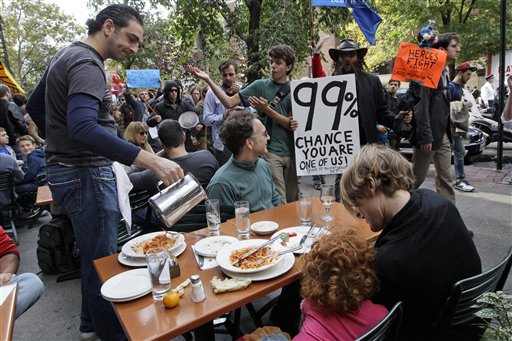
Behind OWS' staying powerDemonstrators affiliated with the Occupy Wall Street march past a family dining at an outdoor restaurant, Saturday, Oct. 15, 2011 in New York (Credit: AP Photo/Mary Altaffer)

NEW YORK — The officer, a burly Queens resident, regarded the scene before him with some amusement. “You know, in 20 years, most of these kids will be Republicans.”

Global Post

NYPD policy forbids sergeants from holding forth on sensitive political matters or otherwise commenting in the media.

But something’s happening here. Maybe it was the metronome of the protesters’ constant drumming, the boredom of this duty on a warm fall night — or the promise that his comments would remain anonymous.

Whatever the case, the sergeant felt like speaking his mind.

“They’re not bad kids, just filthy and misguided a bit,” he said, as he and dozens of other cops stood vigil over the Occupy Wall Street encampment one recent evening at Zuccotti Park.

“You know, there are some real troublemakers in there. Guys getting high, guys who just want to break bottles and bait the police,” he said.

“I hope they don’t instigate something, because as you can imagine some people would love an excuse to go clear this out. Because most of them are gentle kids and they have a point about things — well, they have too many points. But I’m not surprised people are paying attention.”

Journalists love a moment like this. Man bites dog. Hard-bitten NYPD sergeant sympathize with the hippies — you know the script.

But the sarge had a point: People, even those who might normally write off the movement at Zuccotti Park as a left-wing fringe or a bunch of rent-a-marchers, see something different this time.

The core complaint in the disorganized chorus of other issues — that Wall Street banks nearly destroyed the American economy and then fleeced its taxpayers on the way out the door — is neither divisive nor partisan.

It is, in the mind of a majority of the American public at least, simply true.

A new survey by National Journal found that about 59 percent of adults agree with the protesters. Only 31 percent disagree.

“This is a major implicit complaint of the OWS protests and it should absolutely strike a nerve with Tea Partiers, many of whom were talking about some of the same things when they burst onto the scene a few years ago,” wrote Matt Taibbi, a contributing editor for Rolling Stone.

“This thing is bigger than one or two or a few people, and it isn’t part of the same old story.”

This may be why, unlike countless other movements since the golden days of American civil disobedience in the 1960s, Occupy Wall Street appears to have legs.

It explains why average New Yorkers keep showing up with food donations and tarps; why other “Occupy” sit-ins and marches have sprouted in cities from Los Angeles to Athens; why people like Robert Halper, a former vice chairman of the New York Mercantile Exchange just down the street, volunteer some of their time to help.

Most of all, it explains why New York’s police have been kept at bay in spite of a major who launched his career at an investment bank, Salomon Brothers, and city laws on public gatherings, security and sanitation that could easily be used to force the protesters to disperse.

Think of the important movements in the United States since 1980 that drew significant support from mass demonstrations.

In the Reagan era, large protests organized by the anti-nuclear movement demanded a “nuclear freeze” on the U.S. and Soviet arsenals, and a shutdown of America’s nuclear power plants.

These were, at best, movements that represented only a portion of American public opinion, and as a result, neither got very far.

It was a very different set of dynamics — the collapse of the USSR — that ultimately tamed the nuclear arms race. Meanwhile, high operating costs and difficulties finding communities willing to host nuclear power plans trimmed the industry’s sails.

In contrast, mass protests of U.S. Pershing nuclear artillery missiles in Europe organized by German, British and other green and peace movements forced NATO governments to seek negotiations and ultimately withdraw them. The difference: their presence on European soil united a majority in opposition.

By the mid-1980s and into the 1990s, social issues dominated mass demonstrations. Pro-choice and anti-abortion marchers descended on Washington, determined to represent their own views. Gay rights and HIV/AIDS demonstrations spawned Christian-funded counter rallies. Neither side spoke to the country as much as they spoke at it.

Even the anti-war protests that accompanied the invasion of Iraq united only a minority of Americans. More than 50 percent of the country had become convinced that Saddam Hussein had something to do with 9/11.

Those inside the Occupy movement claim inspiration from the great, successful civil-disobedience campaigns of the past. Signs quoting Gandhi and Martin Luther King Jr. abound in the park.

At the movement’s media table, the closest thing to a leadership body, constant references are made to “the American Spring,” an extension of the Tunisian, Egyptian and other uprisings aimed at toppling corrupt autocracies.

The main similarity between the Arab Spring and what’s going on in Zuccotti Park is really quite simple: in both cases, a majority of citizens waited anxiously for someone, anyone to stand up and say, “The Emperor has no clothes!”

With regard to the Wall Street bailouts, neither President Obama nor the leadership of the GOP, authors of the TARP bailout after all, have made a convincing show of prosecuting those responsible, and helping those most affected by the crash.

The Tea Party certainly has tackled the issue, but the white, anti-tax anger in its DNA drowned out its anti-Wall Street message.

In the end, after all, Wall Street and the Tea Party want the same thing: lower taxes.

That left a vacuum to be filled — or occupied, as the case may be.

Continue Reading Close

Italy looks for a Beijing bailout

The decision to ask China for help shows just how quickly America's influence is declining

  • more
    • All Share Services

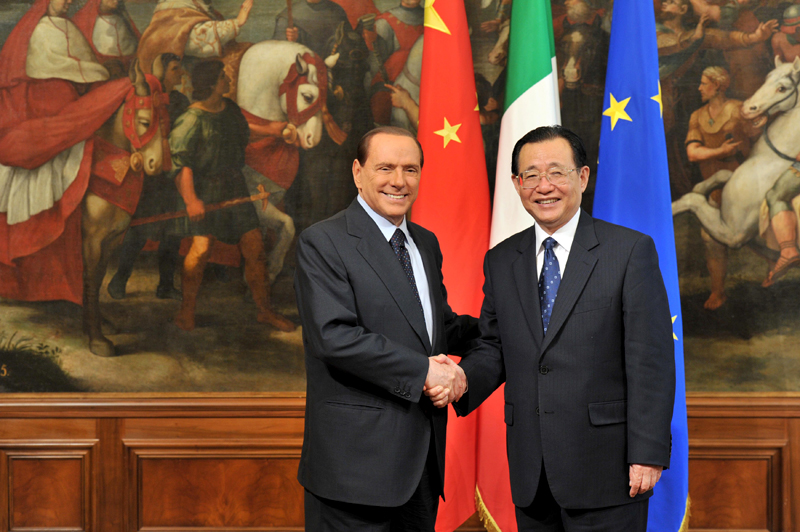
Italy looks for a Beijing bailoutItaly's Prime Minister Silvio Berlusconi (L) welcomes Wang Gang, the vice-chairman of China's main government advisory body, during a meeting in Rome on September 14, 2011.

NEW YORK — In recent days, Italy became the first major Western economy to turn to China for what amounts to a bailout.

Italian officials confirmed last week that they held talks with China’s $340 billion sovereign wealth fund about buying Italian government bonds.

Little was written outside the financial press about this development. In Italy, where national debt now exceeds 120 percent of GDP, news that senior officials had set up a hotline to the cash-rich East was greeted as a sign of hope as the bond markets threaten to shut down the Italian government’s access to capital.

Italy, the eighth largest economy, is a founding member of the U.S.-led Group of Seven (G-7) club of industrial economies that until recently called the shots in the global economy. Not long ago, the idea that a global export and financial powerhouse like Italy would turn for assistance to China, the chief proponent of authoritarian state capitalism, would have raised alarm bells in the United States. America would have scrambled to engineer a rescue, as it did in Mexico in 1994, South Korea in 1998 and Brazil in 1999 — and as it had for Europe both financially and militarily, in two world wars.

China previously has stepped in to offer loans to far smaller economies, including Portugal, Spain and Greece. It also helped investment banking giant Morgan Stanley stave off collapse by purchasing a large share at fire sale prices during the 2008 global financial crisis.

Italy’s appeal to China, however, signals something new.

The past three years have delivered a stark reality check to the American superpower. Offering financial help to even its closest allies these days would be an exercise in keeping up appearances. America — and Japan, Britain, France and, yes, even Germany, have their own deep financial problems.

Instead, the Italian-Chinese talks sparked a statement from Brazil’s finance minister announcing that the so-called “BRICS,” Brazil — Russia, India, China and South Africa — will meet on Monday to see what can be done for the sick man called “Europe.”

As the perpetual crisis in the most developed economies indicates, the world that emerged out of the cauldron of the American century is unraveling. The decline of U.S. economic and political influence is clear, as is the rise of the BRICS and other emerging powers. Much has been written about the policy mistakes, demographic problems and debt woes that beset the old “West” and its Asian protege, Japan.

But most analysts have underestimated the potential speed of American decline. Very few have grappled with the consequences for U.S. and its allies as the American-led status quo across the globe begins to fray and even break apart.

Do not be fooled: America’s global military dominance rests entirely on its ability to pay its bills. Military juggernauts with dysfunctional economies end up in the same predicament, most recently exemplified by the fall of the Soviet Union. By the time the USSR was declared dead, even the Soviet military — only 20 years earlier a match for any on the planet — had deteriorated to the point where recruits had starved to death at one military base; warships rusted at their moorings for years; and control of the military’s version of the crown jewels, the nuclear arsenal, was seriously under threat.

No direct comparison can be drawn between the incompetence of Soviet state central planning and the flaws of American-designed global capitalism. The U.S., for all its mistakes over the past several decades, remains the vital player in global economics, and will remain the world’s largest for decades to come.

But therein lies the planetary danger: the Soviet economy’s collapse affected primarily a small group of similarly distorted economies tied to it through communism’s version of the Commonwealth — called Comecon. For Cuba, Eastern Europe, selected African despotisms and Moscow-friendly India, it was a disaster. For the rest of the planet, it was pleasant surprise and an opportunity.

In contrast, the U.S. economy is so large and the rest of the planet’s holdings of dollars and U.S. debt so endemic that America’s fate concerns everyone, friend and foe alike. China, Russia and the Gulf emirates fear an American debt default far more than American military might — as their chiding of U.S. fiscal prevaricating shows.

China has made similar appeals to European economic policymakers, urging them to put aside the domestic political concerns that so far have taken precedent in the rich E.U. countries, preventing a true solution to the tumbling dominoes of the euro zone periphery, the so-called PIIGS: Portugal, Ireland, Italy, Greece and Spain.

The U.S. and China, along with all major economies that depend on selling goods to the gigantic E.U. market, are terrified about the prospects of a “lost decade” taking hold in Europe. Such stagnation would further collapse demand and consumption that’s already struggling in the absence of the once-spend-happy American consumer.

Partly for that reason, last week the Fed and European Central Bank reestablished a “swap” capability so Washington could pump money into Europe’s banks if worst comes to worst — a move seen as crucial to Europe’s vast economy.

But politically, the implications are deep and so far unappreciated. Think of it: the uncontrolled unraveling of Lehman Brothers, a second-tier investment bank, nearly caused the global financial system to crumble in 2008. And now, the threat of default of a small sovereign player like Greece could destroy the European Union’s common currency. In comparison, the uncontrolled unraveling of U.S. power would be a disaster of global proportions.

Britain’s long retreat from global dominance in the early 20th Century sparked civil wars and left geopolitical Gordian knots like Kashmir and Palestine and Northern Ireland all over the planet. Likewise, the pull back of American power in our time will expose, for the first time in decades, parts of the geopolitical shoreline that American power, political will and diplomatic influence have heretofore sheltered.

It could be that the world suffers right now from a kind of “crisis fatigue.” After all, the spectacle of European economic powers appealing to China for massive purchases of their shaky government debt follows on some truly scary episodes:

  • the effective bankruptcies of three European states — Greece, Ireland and Portugal, met feebly by European Union politicians with half-measures, parochialism and denial.
  • the battering of Japan’s economy by a combination of natural, man-made and policy-induced disasters, a combination that has it well into a third consecutive “lost decade” of debt and low growth.
  • the theater of the absurd in Washington, with know-nothing politicians threatening to default on the United States debt and sparking the richly deserved downgrade of its long-term credit rating from AAA+ to AA+ by Standard & Poors.

Well, sorry for the fatigue. But as the great Al Jolson said in 1927, on the cusp of another great calamity, “Folks, you ain’t seen nothing yet!”

Continue Reading Close

Why is China really going after Facebook?

More than economics is behind the nation's efforts to buy up shares of Zuckerberg's company

  • more
    • All Share Services

Why is China really going after Facebook?

NEW YORK — Sometime in early 2013, if current trends hold steady, the number of Facebook users worldwide should exceed the population of China.

Call it a coincidence, but now it seems China wants a piece of the action.

Last month, analysts who monitor China’s gargantuan sovereign wealth fund detected signs that a deal was in the works to buy a huge stake in Facebook. Neve rmind that access to Facebook has been blocked in China since 2009.

The fund, known as the China Investment Corporation (CIC), is a $332 billion portfolio that seeks to earn money from the government’s massive export earnings. It operates in almost complete secrecy, as do many sovereign wealth funds in the Persian Gulf, Russia and elsewhere. These have grown into major economic players over the past 20 years.

But a number of high-profile investment websites have quoted “inside sources” describing efforts by Citibank to secure for China a stake in Facebook large enough “to matter,” according to Business Insider. Citibank, incidentally, is undertaking a major expansion in China.

The logic behind such a deal from China’s perspective is clear.

Politics aside, Facebook is one of the most sought after share offerings in history. The economics just make sense.

But many believe China has more than profits in mind.

As a factor hastening the revolutions raging across the Middle East, Facebook and other social networks represent a real threat to the Chinese Communist Party’s monopoly on political power.

Minxin Pei, a China expert at the Carnegie Institute, says the Arab Spring, combined with the coming Communist Party leadership transition in 2012, has pumped up the paranoia in Beijing and led to the current crackdown on domestic dissent.

So, would a major Chinese stake in Facebook inoculate China from a “Facebook revolution?” Not likely.

When Facebook finally goes public, the company is expected to be valued at over $100 billion. That’s a daunting sum, even to the portfolio managers of China’s war chest.

But the non-voting stock Facebook’s IPO is offering is all that China could obtain. This would hardly allow it to steer corporate policy or even to get a look behind the curtain of Facebook’s software developers.

China’s leadership would dearly love such a portal into the social networking software, but even in the unlikely event that voting stock were ever offered, Congress would never allow a Chinese takeover of Facebook.

Starting in 2005, when China’s state oil firm, CNOOC, tried to buy financially strapped California oil producer Unocal, American politicians began question what constituted an appropriate Chinese investment in the U.S. economy. 

Not all China’s proposed investments have risen to the level of political fights — China State Construction Engineering Group, for example, is a major contractor on the reconstruction of San Francisco’s Bay Bridge and has won contracts for work on New York City’s subway. But China’s foreign direct investment in U.S. corporations remains tiny — a paltry $791 million in 2009, compared with over $43 billion invested in China by American firms that same year.

There is, however, a second benefit to getting a foot in the door at Facebook, from China’s standpoint: the chance to fund the one force on Earth, other than the Communist Party’s censors, which have taken software giant Google down a peg.

Google’s brave decision in 2010 to close up shop in China — leaving untold billions in potential profits on the table — deeply embarrassed Beijing, which had sparred with the software giant over censorship of its search engine results.

Sergey Brin, Google’s founder, told reporters his upbringing in the Soviet Union had definitely influenced the decision. A “hack” of Google China’s database apparently was the last straw. “Our objection is to those forces of totalitarianism,” Brin said at the time.

Facebook, growing at a pace of about 100 million new users every five months, will plateau sooner or later. There are only so many internet users on the planet.

And the competition is heating up with the launch of Google+, an innovative effort by Facebook’s primary digital rival to stake a claim in the world of social networking. It is far too early to know if the new Google initiative will take off, or if it does, whether it will rival Facebook or just complement it.

China, of course, has plenty of other investment options. But Facebook has good reasons to tolerate a Chinese stake. China represents something of a last frontier for Facebook, whose website has been blocked by Chinese censors since its value as an organizing tool became clear during Iran’s 2009 Green Revolution.

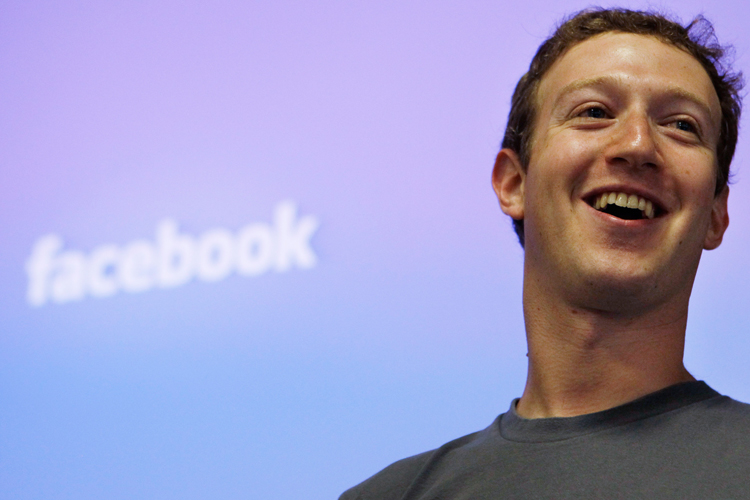
Mark Zuckerberg already had China in his sights long before rumors of the possible stock deal arose. Last December, Zuckerberg toured the headquarters of Baidu, the native-grown Chinese search engine that benefitted most from Google’s decision to leave the country.

Zuckerberg has been studying Mandarin, and during a speech last year he asked, “How can you connect the whole world if you leave out 1.6 billion [sic] people?” (China’s population is actually 1.33 billion.)

So far, speculation that a strategic partnership is in the works has proven unfounded. But China’s investment in Facebook implies an open door to the Chinese market, which Google has now officially eschewed.

Thanks to China’s “Great Firewall” that allows most people to connect only to state-approved sites, Facebook has a relatively small footprint in China. But growth has taken off since the New Year, going from 100,000 in January to approximately 700,000 today.

Analysts believe Zuckerberg’s visit, combined with the software’s notoriety in recent Arab uprisings, has driven a particularly motivated digital elite in China to “vault” the Great Firewall using virtual public networks, which Western nonprofits have made available in their cat-and-mouse battle with the censors.

This is small potatoes in China, of course, which has 450 million internet users. But Facebook marches on. At 700 million users and rising, particularly in Asia and the Middle East, Facebook’s “community” towers over anything previously unleashed by the creative mind of global capitalism.

With its chief commercial rival now moving to counter its dominance of social networks and a spotty history of protecting its users privacy, just how much would Facebook be willing to compromise to get access to China’s 1.3 billion people?

At this point no one knows, but you can be sure that China’s twitchy leadership isn’t about to unblock the social network that rocked the Middle East unless its security officials know exactly how to track down troublesome users bent on speaking their minds.

Continue Reading Close