



Scott Thill

Writing in the Margins

Our monthly roundup of indie publishing: DC Comics terrifies with Lovecraft; Lethem and Denis Johnson do avant-cabaret; a harrowing tale of the 1997 Red River flood.

  • more
    • All Share Services

Writing in the Margins

Man alive! I did not predict nor was I equipped to deal with the e-mail inundation my last column generated. But that is not to say that I am asking all of you crafty readers out there to cease and desist; on the contrary, to quote President Bush — or John Kerry, you decide — “Bring it on!” By all means, keep sending me your releases, kits and solicitations and I promise to try to sift through it all before turning in to watch “Cowboy Bebop.” I’m interested in almost anything not involving Martha Stewart.

And another quick note before we get this bookworm party started. While this column is oriented toward the latest in indie publishing, my personal definition of what exactly that encompasses is probably a bit broader than the one offered by the excellent Punk Planet. For me, “indie” sometimes connotes a particular state of mind, usually one involving bizarre experiments and risky brilliance; sometimes I can find that confluence in a major release (Jonathan Lethem’s latest comes immediately to mind, and not just because he’s the finest writer working today). But the majority of the time that will simply not be the case.

Plus, today’s optimistic terminology quickly becomes tomorrow’s buzz-soaked ad copy. To wit, there is already a self-proclaimed “indie” radio station owned by Entravision Communications — Indie 103.1 in Los Angeles — that broadcasts deep cuts rarely heard on radio stations unaffiliated with universities or colleges.

All of this is another way of saying that I just want to bring you the goods, no matter who publishes it. I’ll try to stick mostly to the hardscrabble outfits publishing shot-in-the-dark screeds from basements in Omaha, Neb., or Santa Monica, Calif., but just not all of the time. Let’s start with an example.

“Lovecraft”
By Hans Rodionoff, Enrique Breccia and Keith Giffen
144 pages
DC Comics
Order from Powells.com

“It’s a Bird”
By Steven T. Seagle and Teddy Kristiansen
128 pages
DC Comics
Order from Powells.com

“Y: The Last Man”
By Brian K. Vaughan, Pia Guerra and José Marzán Jr.
DC Comics
Order from Powells.com

DC is one of the oldest and finest publishing houses in the world; it almost single-handedly revolutionized comics for the 21st century in 1986, the year that both Alan Moore and Dave Gibbons’ “Watchmen” and Frank Miller, Lynne Varley and Klaus Janson’s “Batman: The Dark Knight Returns” wrecked the comic book shop for good. Before those graphic novels hit the streets, the superhero narrative was mostly a cliché-ridden genre out of touch with a society well past its simplistic worldview. In one fell swoop, Batman went from being a heart-of-gold crime-fighter to a self-absorbed psychopath with a messiah complex, and that dark and dangerous metamorphosis was all the world needed to explode comic books even further into the stratosphere. (Tim Burton’s “Batman” came out a scant three years later, and Hollywood hasn’t looked back since.)

But if you still believe at this late date that comics are strictly for kids, take a look at DC’s adult readers’ line, Vertigo. Hitchcock would be proud of that title, as the protagonists of Vertigo’s newly released or upcoming “Lovecraft,” “Y: The Last Man” and “It’s a Bird” are harried males at the mercy of oppressive — sometimes feminizing — forces arrayed against them. While “The Last Man” series is a bit more traditional in its fantastic plot — a heroic male magician named Yorick finds himself alone in a post-apocalyptic world full of women, a comic nerd scenario if there ever was one — the other two derail the superhero narrative in favor of a metafictional horror; that is, they are both books about the metaphysical struggle to, well, write books.

Steven Seagle and Teddy Kristiansen’s “It’s a Bird” seizes upon the Superman mythos as its point of departure, but it is actually about Seagle’s struggle to write a Superman comic as his family succumbs to Huntington’s disease. “The two subjects collided in a unique amalgam of family history and Superman deconstruction,” Seagle explained to me in an interview. “I realized I could tell one story using the other as an emotional punching bag, and that seemed like something I had never seen done before.”

“There have been other metafictional moments in comics — Grant Morrison’s appearance as himself in his own superhero comic ‘Animal Man’ comes to mind — but ‘It’s a Bird’ is a bigger departure for comics than just metafiction,” he added. “This is a book about the real-world Superman, the one who exists only as a comic book character. It’s about the absurdity of trying to chronicle a man of infinite powers while living in a world populated with people whose ‘powers’ — to speak, to walk, to feel — are waning.”

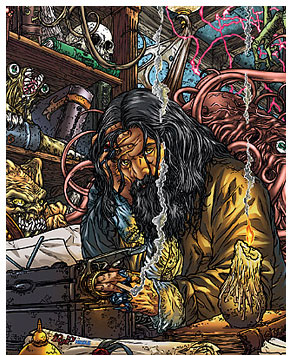
Meanwhile, “Lovecraft” is an imagined biography of H.P. Lovecraft that literalizes the horror master’s legendary creations like Cthulhu and Arkham (after which Frank Miller named the asylum where Batman banishes the Joker and Two-Face in “The Dark Knight Returns”) as real places and beasts that terrorize his every step. Using the bizarre intricacies of Lovecraft’s real life — his philanderer father contracted syphilis and eventually died in an insane asylum; his mother dressed young Howard up in girls’ clothing and met her own demise in an asylum — and turning them into actual events that lead him to a lonely doom, “Lovecraft” blurs the line between fantasy and reality to the point that separation is simply no longer possible.

“At a time when most horror fiction was about creatures from the deep or invaders from Mars, Lovecraft chose to explore a hidden world that existed just outside human perception,” Rodionoff told me recently. “He essentially built the foundation for modern horror, and I wanted to write something that would inspire readers who weren’t familiar with his work to discover Lovecraft for themselves. The story of the man is just as bizarre and ultimately tragic as many of the myths he created.”

Rodionoff is no stranger to horror, having penned screenplays for more than a few Clive Barker-ish gore films (including three in 2004 alone), and Giffen’s distillation of his twisted narrative, as well as Breccia’s harrowing artwork, makes this a read worthy of the “Dawn of the Dead” and “28 Days Later” faithful who are currently flooding the theaters and rental shops around the country. Horror is massive right now, which means there’s no time like the present to rediscover the tortured Lovecraft while you can. More important, it’s long past time to stop looking down on comics as some form of lowbrow entertainment.

“Things like ‘Maus’ and Neil Gaiman’s ‘Sandman’ have elevated graphic novels to a legitimate form of literature,” Rodionoff added. “Comics are no longer limited to being housed in plastic bags and stored away in the attic; they can now be put on the shelf with the other books.”

“As Smart As We Are”
By One Ring Zero and various authors
Soft Skull Press
Order from Powells.com

Speaking of Gaiman and Lethem, both have lately taken a detour into songwriting — as have other authors like Dave Eggers, Paul Auster, Margaret Atwood and more — on this strange two-headed hydra from Soft Skull. A CD/book featuring lyrics from the aforementioned stalwarts put to the bizarro neo-cabaret sounds of Brooklyn’s own One Ring Zero, “As Smart As We Are” is a compelling yet hilarious listen that recalls Eggers’ clever work with They Might Be Giants. Which is no accident — this collaboration landed its sea legs after One Ring’s Michael Hearst tracked Eggers down shortly after moving to Manhattan in 2001. The rest, as they say, is history.

One Ring Zero are well-suited for a project like this, because they’re not afraid to travel beyond the usual guitar-bass-drums territory into more abstract, alien lands where accordions, toy pianos, theremins and other strange instruments rule the roost. Plus, their musicianship is wide-ranging enough to encompass the varied structures and styles — everything from blues and high lonesome to torch songs and ballads — that the authors throw at them. There are numerous standout tracks, but high honors go to Paul Auster, whose tongue-in-cheek “Natty Man Blues” boasts some stellar twists of phrase (“There ain’t no sin in Cincinnati/ since I been in Cincinnati/ I gotta get out of Cincinnati/ or else I’ll go plum dumb and batty/ since I mean to sin wherever I am”) and Calexico-like desert country. Denis Johnson’s “Blessing” is also a western hoot, blending noodling guitars, mandolin, theremin and a rumbling bass with strange lyrics about Mel Gibson’s favorite cinematic subject: “Christ by the dumpster/ Peeling and tossing your lottery tickets/ O Nazarene, drinking dust/ Christ rising and a-falling/ Jesus Christ giving us the finger.” Fans of They Might Be Giants, Black Heart Procession and Tom Waits’ diagonal songcraft will be crying in their whiskey after this CD winds down on Lethem’s fractured “Water.”

Now I know that Soft Skull Press nabbed a mention in the last column, but have you taken a look at its catalog? It’s a blast. Plus, the press has been taking a beating, even in these hallowed pages, for picking up the late J.H. Hatfield’s controversial screed on George W., “Fortunate Son,” as if they should have just passed on it. A book exposing the grifting ways of the Bush clan written by a guy who stored a corpse in his trunk? How can you resist that? It’s freakin’ gold!

“De-loused at the Comatorium”
By Cedric Bixler and Jeremy Ward
24 pages
Gold Standard Labs

While we’re on the subject of music, you would have been hard-pressed to find the ambitious prog-punk epic “De-loused at the Comatorium” on critics’ Top Ten of 2003 lists, but that’s probably because they preferred the amateurism of Dizzee Rascal or the color-coded cuteness of the White Stripes to Mars Volta’s vertigo-inducing swirl of high-impact poetry, muscular guitars and 10-minute jam sessions. In a perfect world, those critics would have their passes revoked: Mars Volta, more than any band in recent memory, has convincingly fused Led Zeppelin’s riff library, Pink Floyd’s conceptual strivings and Fugazi’s sheer fury into one cathartic lump.

One of the reasons Mars Volta’s release is so jarring is its pained, psychological exploration of addiction and doom. “Comatorium’s” lyrics — now expanded at length into book form and available only from the independent Gold Standard Labs label or, if you’re lucky, your local indie music store — recall William Burroughs’ disturbing “Naked Lunch” or Dalton Trumbo’s “Johnny Got His Gun” in their imaginative extrapolations and uncompromising portrayal of the solitary mind in a state of irrevocable deterioration. Based on the true story of Julio Venegas, a doomed childhood friend of Volta vocalist Cedric Bixler and guitarist Omar Rodriguez-Lopez (who also moonlights as one of Gold Standard Labs’ head honchos), “De-loused” tells the story of Cerpin Taxt, who after trying to commit suicide by taking morphine ends up in both a coma and a spiritual battle for his own condemned soul.

Like Burroughs and especially Beckett, Bixler unleashes his language in psycho-scatalogical torrents, fusing poetry’s high-impact wordcraft with conventional narrative’s more accessible structure. Unlike the CD, the book, in a dense and deceptive 24 pages, offers up much more information about the various angels and demons Taxt encounters on his way to salvation, all the while engaging some audacious poetic exercises; picture Dante’s “Inferno” with Robert Plant in the lead role and you’re partially there. Separated from its sonic counterparts and stretched in format, Bixler’s poetry sticks in your throat the way Chester Himes’ “If He Hollers Let Him Go” does.

And, unlike “Naked Lunch,” you can actually read the thing in one day without reaching for the methadone.

“Red River Rising: The Anatomy of a Flood and the Survival of an American City”
By Ashley Shelby
266 pages
Borealis Books
Order from Powells.com

“We were otherwise silent, watching houses slide into the ocean, whole villages crackle and ignite in the mass of advancing lava. Every disaster made us wish for more, for something bigger, grander, more sweeping.” — Don DeLillo, “White Noise”

While “De-loused at the Comatorium” charts the spiritual catastrophe of one fictional character based on a real-life individual, Ashley Shelby’s harrowing tale chronicles the collective ruination wrought by the 1997 Red River flood that displaced more than 50,000 North Dakota residents and cost billions in disaster relief. While the story merited a healthy amount of national coverage at the time, it has dropped out of the national consciousness — that is, if you don’t happen to live in or around any of the towns it devastated. If you lived in Grand Forks on or after the Red River broke through its dikes and submerged the town, you’re probably still looking for some well-earned closure.

That may be, as Shelby explained to me recently, because after the initial solidarity and media coverage wear off, the aftermaths of catastrophes like the Red River flood usually deteriorate into bitter chaos. “It’s difficult to streamline aftermaths and recoveries,” Shelby said, “because each community is unique. And a flood is a very different kind of disaster from a tornado; a flood tends to steal from its victims for a much longer period of time.”

The aftermath, she continued, “contains an initial solidarity, in which the community unites against the disaster. Then, as federal agencies trickle in, the community closes in upon itself, suspicious of outsiders. As time passes, though, and the federal government begins doling out money and aid, the community begins to fragment into individual islands of pain and resentment, because suddenly there are gradations of loss. As we’ve seen in the last few years, there is hardly anything more politicized and highly charged than victimhood.”

Shelby’s strength lies in charting the uncomfortable collisions between a disturbing natural reality and an unsettling bureaucratic fantasy, a domain populated by well-meaning but harried scientists, apathetic government agencies, calculating insurance companies, under-the-gun local politicians and residents who suddenly find themselves at the mercy of Mother Nature. More often than not, Americans feel they’re in control of the natural world and take their planet for granted, but history is littered with the casualties of that wrongheaded philosophy. Shelby’s book forces us to look into the mirror and come to terms with our pride and our ignorance, our faith and our policies.

“Whether it’s a tornado, a flood, or even an act of terrorism, people are emotionally injured and yet are asked, immediately, to find closure and rebuild,” says Shelby. “The stages of personal grief apply to the grief suffered by victims of all disasters — and like someone grieving for the loss of a loved one, you can’t force people to get over it sooner than they are able, especially when they cling to beliefs that are informed by faulty information. Survival isn’t something that occurs overnight — it takes years. But the media leave disasters as soon as the opportunities for dramatic pictures disappear. The bulk of the surviving takes place after the water recedes, and I think the story of how Grand Forks survived its disaster can be illuminating for any community that suffers a catastrophic event.”

This story has been corrected since it was first published.

Eminem vs. Robert Frost

Is hip-hop saving poetry -- or trashing it? Beneath the feel-good rhetoric of "Def Poetry Jam" and the "spoken-word revolution" is a battle over the future of literature's oldest form.

  • more
    • All Share Services

Eminem vs. Robert Frost

“There are only three legitimate things anyone can do with poetry — write it, read it, or publish it. Writing reviews, or holding seminars, or reading it in public — even making records of it — well, this is secondary activity, unimportant at best, meretricious at worst.”

– Philip Larkin

The votes have been cast and the results are in — hip-hop is now the preferred entertainment medium for the next generation. Hip-hop sales make up a larger and larger proportion of the pop-music universe every year, and even when it does not thoroughly dominate, its styles are forming the backbone of whatever does, whether it happens to be bubble-pop, electronic music or rap-rock. You need look no further than Eminem’s Oscar win for “Lose Yourself” to know that, like it or not, the form has arrived in mainstream culture and isn’t going anywhere.

Along the way, it has made capitalist kings out of Russell Simmons, Jay-Z, Rick Rubin, LL Cool J, Ice Cube and countless others. Simmons alone is now a cultural force to be reckoned with, and his “One Mind One Vote” campaign hopes to pull millions of nonvoting young African-Americans into the 2004 election.

Simmons understands a zeitgeist when he sees one, and so it is no surprise that such a progenitor of hip-hop would latch onto the burgeoning poetry movement known as spoken word — or “slam,” depending on the venue — and take it mainstream. In 2003, Simmons morphed his king-making HBO vehicle known as “Def Comedy Jam” into “Def Poetry Jam,” hoping to explode the careers of outstanding poets like Saul Williams, Jimmy Santiago Baca, Ursula Rucker and others as convincingly as he did for comedians Martin Lawrence, Jamie Foxx, Bernie Mac, Steve Harvey and Dave Chappelle. It worked like a charm — “Def Poetry Jam” garnered stellar reviews and a Peabody Award to boot.

That’s because, as Saul Williams — whose recent epic poem “, Said the Shotgun to the Head” was released by MTV Books last fall — explains, hip-hop has had as massive an influence on today’s spoken word poets as jazz had on the Beats — and the African oral tradition had on jazz.

“I’m definitely a hip-hop head by nature, by generalization, by generation,” says Williams. “I’m there in the mix, so I’m turned on by the same things, nod my head to the same things. Even if I’m writing a piece of prose, there is still an intrinsic rhythm that I’m looking for, even without rhyme, even without beats, even without music and microphones.”

But even with the considerable clout of hip-hop — and Russell Simmons — behind it, spoken word is sometimes still considered the redheaded stepchild of poetry. It has yet to fully win over the academics, 183 years after Percy Bysshe Shelley argued that “poets are the unacknowledged legislators of the world.” Former United States poet laureate Robert Pinsky has publicly praised the spoken-word movement, but the Favorite Poem Project Web site he started in 1997 to celebrate and promote “poetry’s role in Americans’ lives” includes exactly zero spoken-word or hip-hop artists (although it does contain a spirited reading of Gwendolyn Brooks’ canonical “We Real Cool,” a poetic hip-hop antecedent if there ever was one). This is curious, considering that the site features so many readings of classic poems by ordinary citizens like you and me.

If you ask Tree Swenson, executive director of the Academy of American Poets — since its inception in 1934 the country’s largest organization dedicated to poetry — she’ll tell you that it’s just business as usual. “As long as there has been poetry, there have been poetry wars,” she explains. “Very little of what’s written in poetry survives. But this sorts itself out through time. I think it’s very difficult to draw a line that will stay put. It wavers.”

Swenson believes part of the reason for that wavering is the inherently personal nature of poetry itself. “Poetry by its very nature resists categorization,” Swenson continues. “You can’t simply lump all poets into a single group. As with more traditional poetry, it’s always based on the individual poet and poem.”

That may be Swenson’s world view, but the prologue to editor Mark Eleveld’s “The Spoken Word Revolution: Slam, Hip-Hop & the Poetry of a New Generation” (released last year by Sourcebooks) paints quite a different picture, one where categorization — and marginalization — cannot be extricated from the world of professional poetics. A few well-decorated poets sit at a table responding to questions from various interviewers, and the intergenerational and occupational tension is palpable. “They sat at the panel,” Eleveld writes, “the learned and the poetic, some with their credentials resting high upon their shoulders … sound[ing] as if they just got off the Concorde from Paris … name-dropping Ivy League pretensions and Nobel Prize winner mentorships.”

That “aristocratic bullshit,” as Eleveld describes it, is what led the sole poet on the panel without those ivory-tower credentials, Marc Smith, to create the Poetry Slam. “I was an outsider,” Smith explains in “The Spoken Word Revolution,” “and I thought I had something to say, like a lot of outsiders do. There were a lot of people snubbing me who shouldn’t have been snubbing me. So I just ended up doing it my own way.”

The rest, as they say, is history. Spoken-word and slams quickly became poetry’s most vital, vibrant movements, populating smoky clubs and silver screens alike, most notably in the form of Marc Levin’s 1998 “Slam,” a film that starred and was co-written by Saul Williams — and took home the Sundance Film Festival’s Grand Jury Prize in the process. Williams has also become a star of sorts, landing roles in big-budget movies like “KPAX” and opening slots on tours for Rage Against the Machine, the Roots and, most recently, Mars Volta.

Meanwhile, Eleveld’s book is in its second printing, having sold 20,000 copies in approximately nine months, a major feat for a poetry release whose market considers a bestseller to be around 1,500 copies sold. No doubt the inclusion of such esteemed figures — in both the book and an accompanying CD — as Williams, “Lord of the Rings” star Viggo Mortensen, Sherman Alexie and Andrei Codrescu, as well as an introduction by current U.S. poet laureate Billy Collins, has contributed to the brisk sales.

Whether you like the forms or not, spoken-word and the poetry slam have resuscitated poetry for popular consumption. “I think poetry is more popular now than it has been in the last 100 years, at least,” says Eleveld. “‘Poetry Speaks,’ published by Sourcebooks, sold 100,000 copies because of three CDs that had canonized poets like [Walt] Whitman, [e.e.] cummings and [Sylvia] Plath reading their own work. ‘Spoken Word Revolution’ sold 20,000 in its first run. In poetry, these numbers are unheard of. The National Poetry Slam in 2003 ran for four nights, taking up eight clubs in Chicago’s Wicker Park area, and boasted 1,100 people at the individual finals at the Metro, which is where the Rolling Stones, Smashing Pumpkins and more have played.”

According to Eleveld, those numbers are a far cry from a literary landscape before poetry slams. In the mid-1980s, he remembers, “Poetry readings were sparse; audiences were usually around something like 15 people. Now, professional poets are regularly touring high schools, colleges and clubs. If you go to Billy Collins’ site, you’ll see that he travels 15 days out of the month reading his work. This is all related to slams, hip-hop and the appreciation of oral tradition.”

But even though that oral tradition — whether it was handed down from Homer, Rumi, Allen Ginsberg or Chuck D — is alive and well in the spoken-word sphere, there is still a performance aspect of slams that remains largely alien to conventional poetics. And that added dimension of public performance is just as complicated as it is attractive.

“We don’t really have an academy position on spoken word,” explains Swenson. “The lines are blurry. You certainly have more traditional poets, who begin with the page and then read their poems. Some read it well and some read it abominably.”

That is, just reading your work aloud might not be enough sometimes. You’ve got to “move the crowd,” as Rakim said on “Paid in Full.”

“There are a couple of different elements here,” Swenson continues. “Do these words work on the page? There are some poems that are so complex on the page that they’re impossible to read. But there is some middle ground, where the poem can come alive through the voice. Then are some great performers who can put on a show and wow an audience, but when the words are put on a page, they become lifeless.”

Then there is, getting back to hip-hop, what Saul Williams considers to be the built-in oppression coursing through the rap game.

“The difference between the poet and the M.C. is that the M.C. is by definition a master of ceremonies,” Williams explains. “If you aim to be the master of ceremonies, then you have to play the role of the oppressor. You have to be in control, you have — to use a hip-hop slogan — ‘to act like ya know, son, you have to act like ya know.’ Whereas the poet is allowed to be introspective, allowed to raise questions — is allowed to say, ‘I don’t know, I wonder why, I wonder what this means.’”

That innocent questioning of what the L.A. ska-punk poets Fishbone called “the reality of my surroundings” is often frowned upon by those in hip-hop and rap who, like 50 Cent, build their reputations on flak jackets and bullet holes. “The poet is allowed to be vulnerable,” Williams continues, “whereas, with M.C.’s and in hip-hop, vulnerability is a sign of weakness. And so it becomes less and less real, less connected to the true nature of humankind. The further out we go on the tip of invulnerability and being hardcore, the less we can show a soft side.”

It is this simplistic hyper-masculine posturing that has continually plagued the rap game, and kept it from achieving the type of legitimacy bestowed upon other forms of poetic expression. 50 Cent’s unimaginative subject matter and Eminem’s persistent homophobia, no matter how cleverly worded it may be (and in 50′s case, that’s being exceedingly charitable), are ultimately alienating. Which is not to say that Eminem’s work, in particular, hasn’t inspired thousands of kids to dye their hair blond and put their thoughts on paper, but to what end? Does the world truly need another dick-grabbing M.C. who’s interested mostly in heaping calumny on homosexuals, groupies, Moby and his own mother? Can we really consider lines from 50 Cent’s “In Da Club” like “I’m that cat by the bar toasting to the good life/ You that faggot-ass nigga trying to pull me back right” poetic in the slightest? 50 Cent might have been the hottest selling rap act of 2003, but to call him a poet would be testing the limits of the terminology.

But it’s not as if the world of conventional poetry doesn’t have its own issues with masculinity. Two decades back, poet Robert Bly’s wildly successful “Iron John” initiated a “men’s movement” that called much of society’s sexual advances into question. Bly’s basic thrust, pun intended, was that 20th century males had become too soft, and he set off a firestorm of feminist criticism. On the other hand, his books, videos and seminars sold like hotcakes.

Forget for a second that Bly’s work was skewed mostly to white heterosexuals and also forget that Bly’s way with words was a bit more sophisticated than 50 Cent’s — both men, along with the majority of the hip-hop acts that have hit the charts since the genre exploded in the late ’70s, utilize the figure of the warrior as man’s saving grace. In fact, 50 Cent’s continuing appeal lies in his ability to get shot up and live to tell the tale. Bly’s so-called soft males have been redeemed as much by rap’s hard guys as by beating tribal drums in the wilderness.

In other words, hip-hop is not the only place you find this kind of social narrowcasting; the ivory tower set is just as much to blame for it as anyone else. Which is why the argument over whether or not hip-hop is true poetry will always be a red herring. To mangle Shakespeare, the play on words is the thing. The presentation, however compelling or alarming, is incidental.

Plus, hip-hop, if you ask Eleveld, is simply one facet of an oral poetic tradition that has enthralled global culture for millennia. “Hip-hop is huge,” he says, “but so is slam. I would still say that poetry is the queen of all mediums. There are no limitations to how good poetry can be and in what directions it can go. Look at Lou Reed’s [stage production of] Poe’s “The Raven” or Laurie Anderson doing Melville or Pearl Jam including spoken-word pieces on their albums.”

That democratic strain of appropriation, presentation and representation is ultimately poetry’s gift to the world, whether it be written, spoken or slammed. Rap is just the form’s latest popular incarnation, one that is spreading like wildfire if only because, as Eminem’s ascendancy to superstardom illustrates, it can deliver hope, motivation and sustenance to those who feel they have no avenue of expression, no way to voice their concerns and desires.

“Poetry is the voice of the people,” Eleveld says. “It is open to all. When a poetry slam is pulled off correctly, the least likely effect will be a great show. The most powerful effect can be — and has been — life-changing.”

Continue Reading Close

Writing in the Margins

Our new monthly roundup of indie publishing: Junko Mizuno's deranged manga, Disney's war against the underground, Flann O'Brien on life during wartime, lefty theorist Mike Davis' children's book (set in Greenland), and William Upski Wimsatt bombs the 2004 election.

  • more
    • All Share Services

Writing in the Margins

If you think noteworthy book releases begin and end with the New York Times’ bestseller list, my condolences. Much of what appears on that list is P.R.-engineered phantasm, what William Gibson might have called “a consensual hallucination” had he not used that phrase to describe his invented “cyberspace” in the epoch-making novel “Neuromancer.” How the bestseller lists of the New York Times, USA Today and Publishers Weekly are composed is a secretive process, about as complicated — and crooked — as the U.S. tax code.

In other words, there is a brave world to explore once you put down that volume by Ann Coulter (or even Al Franken). It’s all in the margins, sometimes known as independent publishing, other times known as under-the-radar circulation. And although right and center fields are dominated by the major publishing houses, some of their releases have underperformed compared with their indie counterparts, a few of which are greater in substance, enjoy much longer shelf lives, and are — every so often — more lucrative to boot. So throw away your pretensions and burn your bestseller lists. They never did that much for you anyway.

But this is all prologue — we’re here to talk about the unheralded releases of past, present and future, as well as why you should care about any of them.

“Junko Mizuno’s Princess Mermaid”
By Junko Mizuno
144 pages
Viz Communications
Order from Powells.com

Junko Mizuno is a feminist conundrum, kind of like the dark arts anti-heroine played by the amazing Brigitte Lin in the blood-soaked Hong Kong film “The Bride With the White Hair.” Like Lin’s Bride (now you know where Tarantino came up with that whole business in “Kill Bill”), Mizuno’s nubile and sometimes nude protagonists, who preen and pulverize with aplomb in her fractured graphic novels, are guilty male pleasures. They’re hot, sometimes naked women who kill faster than Russ Meyer’s infamous pussycat, Tura Satana. Think the Power Puff Girls with curves and no bras and youre there.

But Mizuno is a female working in the male-dominated world of manga (cartooning) and a Japanese sensation on top of it (you can get a Mizuno screensaver for your phone, for Pete’s sake). That twist makes much of which is dominated by sweet-faced cuties that eat their own offspring, or the men they seduce, even more complicated and problematic.

Or, as Eric Nakamura — publisher of Asian/American pop culture’s de facto bible, Giant Robot — explains in an interview, “Mizuno’s style is emerging into the psyches of many designers and American artists spawning copycat T-shirt graphics and club flyers. She rounds up psychedelia, Japanese big-eyed manga and nippled princesses with intensity, and then slam-dunks it into a narrative geared towards 3-year-olds. Her books are for adults and loaded with gummy D-cups that visually rain Japanese muscat soda.”

Got that?

Maybe that’s another way of saying that readers will need to sift through Mizuno’s ambiguous, provocative graphic novels using their own theoretical filters. Sure, men — and boys — will gorge themselves on the mermaid hotties populating Mizuno’s third revisionist fairy tale, “Princess Mermaid,” published last month by North American manga giant Viz Communications. But the women — and girls — will most likely enjoy witnessing those same vengeful sea sirens take out their frustration with the human race by destroying every male sailor they come across. Like her previous excursions through popular folklore — 2003′s garish but gleeful “Hansel and Gretel” and 2002′s hilarious “Cinderalla” (featuring a hapless prince on I.V. life-support) — “Princess Mermaid” is a nightmarish narrative that will probably ensnare fans of David Lynch and Camille Paglia alike.

But once again, buyer beware: “My Pretty Pony” this ain’t.

“The Pirates and the Mouse: Disney’s War Against the Counterculture”
By Bob Levin
270 pages
Fantagraphics Books
Order from Powells.com

Here’s a story you can tell your kids — if you want them to cry all night. In 1963, Dan O’Neill became the youngest syndicated cartoonist in American history, up until his “Odd Bodkins” strip got too comfy with San Francisco’s counterculture (evidently there was something strange going on in that town, circa the late ’60s!), at which point he was summarily dropped by the stodgy San Francisco Chronicle. Sure, O’Neill was probably sampling the brown acid in the Haight, but what pissed the Chron off more than anything else was the cartoonist’s proclamation that Mickey Mouse had to be destroyed. Once and for all.

What happened next is the meat of Bob Levin’s rollicking book, and it isn’t pretty. O’Neill formed the Air Pirates Funnies with other like-minded animators, and the crew started mercilessly lampooning Disney’s moneyed stable from a warehouse owned by Francis Ford Coppola. As you can guess, the always incendiary and sometimes blue satire didn’t sit well with the House of Mouse, so their legal department took sure aim between the Air Pirates’ eyes. I won’t spoil the ending for you — you’ve got Google, after all — but it doesn’t matter anyway, because the treat of Levin’s book lies in its Merry Pranksterish narration, equal parts smart-ass opinion and conventional reportage.

The whole affair, as Levin recently explained to me, “was a classic ’60s struggle. Disney fostered a view derived from an idealized small-town, Midwestern, turn-of-the-century America — an unquestioning patriotism, a puritanical morality, a celebration of consumption and conformity, an unflagging obedience to father, God and the FBI. The Air Pirates were for sex, drugs, and end-the-fucking-war. It was better than Frazier and Ali.”

“The Pirates and the Mouse” is out now from Fantagraphics Books, the finest publishing house for those seriously looking for comic culture and its attendant issues and neuroses. Fantagraphics publishes the work of everyone from the brave “cartoon journalist” Joe Sacco (“Palestine,” “Safe Area Goradze”) to “Peanuts” creator Charles Schulz (in fact, in a publishing coup, Fantagraphics is reprinting all 50 years’ worth of Schulz’s “Peanuts” strips). In other words, these guys know what the hell they are doing. So does Levin.

“At War”
By Flann O’Brien
191 pages
Dalkey Archive
Order from Powells.com

Although widely considered, alongside James Joyce and Samuel Beckett, to be one of the greatest Irish writers of the 20th century, Flann O’Brien remains relatively little known. Whether that’s because Joyce and Beckett cast such lengthy shadows or because O’Brien wrote under a gripload of pseudonyms — Count O’Blather, George Knowall, Peter the Painter, Brother Barnabus, John James Doe, Winnie Wedge, An Broc and Myles na gCopaleen — but never under his real name, Brian O’Nolan, is an intractable argument for Dublin’s pubs.

But there is no question that O’Brien, like his compatriots, was possessed of an acerbic wit — and he wielded it with glee on everyone and everything he could find. His work is wildly varied and recalls the dark self-conscious humor of Thomas Pynchon more than the torrid floridity of Joyce. His classic novel “The Third Policeman” is narrated by a not-so-sharp murderer who spends much of the novel working out the bizarre theories of O’Brien’s manufactured philosopher de Selby, who believes, among many other strange things, that the earth is “sausage shaped.” Both “The Hard Life” and “The Poor Mouth” are scathing comedies about the abject poverty of Ireland’s people and cultural history, and it brought the wrath of the nation down upon him like a tidal wave (poverty doesn’t usually play for laughs with the Gaelic nationalist set).

But O’Brien’s fearlessness won the audacious author a fair share of proponents, including Joyce, Edna O’Brien, the equally fearless Anthony Burgess (who wrote that “If we don’t cherish the work of Flann O’Brien we are stupid fools who don’t deserve to have great men”) and John Updike. As “City of Quartz” author and MacArthur fellow Mike Davis recently said (to me, last week, when we were having a drink), “Flann is Mad magazine for adults. He’s to Joyce as Roberto Arlt, the Argentine author of ‘The Mad Toy,’ is to Borges: Their anarchist libidos unleashed.”

“At War,” like “The Best of Myles” and “Further Cuttings From Cruiskeen Lawn” — all currently available from Illinois State University’s indispensable Dalkey Archive Press — collates O’Brien’s column work for the Irish Times written under the pseudonym Myles na gCopaleen. It doesn’t sound like much, but editor John Wyse Jackson sifted through 3,000 pieces to craft this concentrated snapshot of life during wartime, and very little is skipped — O’Brien’s thoughts on limiting the use of the shamrock and his daring proposition to move Ireland to a more pleasing climate in the Mediterranean are all included.

“Land of the Lost Mammoths”
By Mike Davis
178 pages
Perceval Press
Order from the publisher

Speaking of Mr. Davis, I have to put in a shameless plug for his first — but not last — children’s book. For those of you familiar with the sometimes controversial Davis, you’ll know that he writes books the way most of us read the DMV manual — very quickly. But his research is top-notch, his criticisms incisive and uncompromising, and his desire to speak truth to power overwhelming. And unlike the horribly passive syntax found in that last sentence, he’s always on point and refreshingly aggressive.

Which is why “Land of the Lost Mammoths” — recently released from Viggo Mortensen’s indie Perceval Press — is such a curveball. Who would expect a history freak deeply interested in the sociopolitical mechanisms of urbanization to produce a Harry Potter-like tale of three kid scientists nosing through Greenland in search of an ancient undiscovered Viking colony? Davis also contributed (along with Naomi Klein, Joseph Wilson, Mortensen and others) to Perceval’s recent all-star vivisection of the corporate payday known as the Iraq War, “Twilight of Empire: Responses to Occupation.” But “Land of the Lost Mammoths” is the book garnering the local buzz in Los Angeles. Speaking of the Iraqmire…

“How to Get Stupid White Men Out of Office”
William Upski Wimsatt, editor
160 pages
Soft Skull Press
Order from Powells.com

William Upski Wimsatt’s name might not easily roll off the tongue of those who peruse the aforementioned bestseller lists with gusto, but the guy has a résumé longer and stronger than most authors working today. He came up in Chicago as a graffiti artist, before realizing quickly that his community didn’t really appreciate the conjunction of those terms. So he published his first broadsheet and distributed it on Chicago public transit, before becoming, at the tender age of 16, a regular columnist for the Source. The National Endowment for the Humanities soon tabbed the burgeoning hip-hop virtuoso as a “younger scholar,” the Illinois Arts Council decorated him with an individual artist award, and the Chicago Tribune, Chicago Reader and Utne Reader started hosting his work.

The props soon came rolling in from both sides of the tracks, culminating in mostly unanimous praise for his essential release, “Bomb the Suburbs,” a no-holds-barred deconstruction of hip-hop’s mass-market deterioration at the hands of pop-cult America’s “cash and hos” obsession. While his previous book, “No More Prisons,” had carved out a niche for Wimsatt’s engaging street reportage, “Bomb the Suburbs” demolished the critical floodgates, as well as the highbrow bias against hip-hop culture — which, like it or not, has overtaken rock as the youth market’s entertainment genre of choice.

Wimsatt’s latest missive is a collective effort aimed at galvanizing the continually ignored youth voter market. If the 50,000 first-run printing and 80-city signing tour are a harbinger of things to come, he and his band of new-school multiculturalists might just tip the scales against the Bush administration’s reelection bid. “How to Get Stupid White Men Out of Office” offers the strategies of several political artists, organizers and agitators aimed at reclaiming the country’s top office, utilizing methods that have already worked to help swing some local elections. There are enlightening success stories in the book that may restore your post-Gore faith in the democratic process, including the tale of Alisha Thomas, a young African-American woman who won a seat in the Gingrich-friendly Georgia state legislature, and a band of South Dakota Native American youths who purportedly swung a U.S. Senate race by barely 500 votes.

Unlike many of the recent books that merely call the Bush administration a bunch of swindling liars — as if conventional politicians, especially ones whot grifted their way into office, could be anything else — Wimsatt’s book offers tangible solutions for actually doing something about it. Probably because he and his merry band of activists already understand what many of us sometimes forget: The United States is a democracy, and every vote counts if it is cast. Not even Justice Scalia can stop that, especially if you keep that heat lamp squarely in his eyes. So if you’re down to amend rather than read about the transgressions of a handful of energy-sector hucksters, then by all means read this book and shoot it off to your friends like a chain letter. You might just swing a national election in the process.

Continue Reading Close

The man who would be king

In an exclusive interview, Viggo Mortensen, who plays Aragorn in "The Lord of the Rings," talks about his photography, his indie publishing house, and why Bush will go down in history as the Sauron of American presidents.

  • more
    • All Share Services

The man who would be king

If you’re a hardened J.R.R. Tolkien fan feasting on the “Lord of the Rings” largesse that’s possessed popular cinema over the last few years, then you don’t need an introduction to Viggo Mortensen. But for those who haven’t followed Mortensen too closely before he landed the meaty role of Aragorn — the king-in-exile whose ascension to a scrupulously avoided Middle Earth throne is one of many subplots embedded in “The Lord of the Rings: Return of the King,” the vastly popular trilogy’s final installment, opening Dec. 17 in theaters around the world — then now’s the time to, as they say in hip-hop, recognize.

Mortensen has been a busy man since his debut in Peter Weir’s 1985 thriller, “Witness.” The New York native, who just celebrated his 45th birthday, has put together a series of compelling roles in films by auteur types like Gus Van Sant (“Psycho”), Sean Penn (“The Indian Runner”) and Jane Campion (“Portrait of a Lady”), as well as a couple of blockbusters (“Crimson Tide” and “G.I. Jane”) from the Bruckheimer and Birnbaum wing of Hollywood. He’s spent years in Southern California’s arts scene, whether participating in poetry readings at Venice’s Beyond Baroque Literary Arts Center, jamming with Buckethead and other fixtures in L.A.’s sonic landscapes, or exhibiting paintings and photographs in well-established galleries.

Along the way, he teamed up with Pilar Perez, a curator and former editor at Smart Art Press, and formed the independent Perceval Press. Perceval’s first few books were an assortment of books by Mortensen and various young, lesser-known artists, and their popularity allowed the start-up to stash money away for further offerings featuring figures as diverse as L.A. artist and poet Georganne Deen (with Sonic Youth’s Thurston Moore), “City of Quartz” author Mike Davis, Japanese artist Yoshitomo Nara and more.

“There was no particular goal in mind, no ideology other than the desire to put information and images out there that might otherwise not be available,” Mortensen explains; his latest book, “Miyelo,” follows that free-flowing train of thought perfectly. Filled with one-take panoramas of Lakota tribesmen re-creating the controversial Ghost Dance — a practice that brought the full force of the United States Army down on South Dakota’s Native Americans, and led to the massacre at Wounded Knee — “Miyelo” is also a current installment at L.A.’s Stephen Cohen Gallery, through Nov. 8. It offers a significant amount of commentary and context on what remains a relatively obscure and tragic chapter in American history.

But exploring the dark chapters of history and experience is something in which Mortensen seems to take pride. An upcoming Perceval book on the Iraq nightmare — “Twilight of Empire: Responses to Occupation,” featuring contributions from Amy Goodman, Naomi Klein, Mark Levine, Mike Davis, Kristina Borjesson, the embattled Joseph Wilson and more — lays bare the unbridled corporate arrogance at the heart of the Bush empire.

Then, of course, there is Peter Jackson’s amazing vision of Tolkien’s “Return of the King.” Ever since its publication half a century ago, Tolkien’s masterpiece has had nothing but sad tales to tell about those who use and abuse power for its own sake. By the end of his “Lord of the Rings” run, Viggo Mortensen will have graduated from mercurial Renaissance man to full-fledged star.

How did you approach the photography for “Miyelo”?

Well, the idea came from a scene in the movie called “Hidalgo” [about long-distance horse rider Frank T. Hopkins, forthcoming in 2004] where the character I play, who’s at the end of his energies and in the middle of nowhere without any water or hope left, begins to hallucinate. In a delirious state, he starts to hear these voices and see these fragments of people. I wondered how one would use a still camera to represent images of the ephemeral dancers in wide-open, empty landscape — how the ghosts of Ghost Dancers might look. So I really approached it as an exercise. In the end, I didn’t actually use my own camera. I wanted to include more of the landscape, and Richard Cartwright, a very fine photographer who was shooting the official stills for the movie, was kind enough to lend me his panoramic Hasselblad camera.

I shot the one roll of film at different settings, with increasingly longer exposures. The sun was very bright, so I was hoping to get one interesting image from the roll. Luckily, this was one of those rare situations where intentionally doing “the wrong thing” with the camera worked in an interesting way. As conscious an exercise as making these particular pictures was, there are accidents in the images — weird spots, unexpected areas of saturation and contrast variations — strange things that I couldn’t see when shooting and still cannot really explain. The longer the exposure, the more room for surprises. I like the fact that even with a medium as supposedly controlled and predictable as photography is meant to be, there still is mystery in the results. You won’t necessarily be sure what you will get, where you are going.

Which is cool, because it bleeds thematically into the idea of the Ghost Dance.

Yeah, it felt right. I was initially inspired to do it partly from what I heard about the Ghost Dance, but more by the serious way that the dancers and singers had prepared for the scene. The dance had been performed once before in South Dakota, and now we were in the middle of the California desert trying it again, as a sort of mirage, a distorted memory. Just as they had done for the Wounded Knee reenactment, the dancers took their responsibilities in the ritual very seriously; there was an atmosphere that was created through the sheer earnestness of their effort. It transcended anything else that was going on with regard to the filming of the scene. When the dancers had finished and it became my turn to be filmed observing the dance, a pair of dust devils and weird crosswinds suddenly blew in on what had been a completely still day. As soon as the last take of the scene had been shot, the winds instantly and completely ceased, leaving everyone and everything calm and silent for several moments.

Sounds haunting.

Yeah, it was. I wanted to remember it. In taking the pictures, I wanted to join it rather than observe from a distance. Or at least to take pictures in the spirit of the event itself.

Talk a bit about Perceval Press. What led you to start it?

I don’t remember exactly how the conversation went, but Pilar [Perez] and I talked about how it would be interesting to start a press. We had no idea how it would go — most small presses have a hard time of it, really. For books to pay for themselves is a huge accomplishment, and most small, independent presses don’t seem to last long. It’s a hard thing to pull off, because you’re not counting on big distribution and the chain bookstores. The idea was to try to publish books that had to do with art, writing, ideas. There was no particular goal in mind, no ideology other than the desire to put information and images out there that might otherwise not be available, in terms of artists or poets or photographers. Books that might not get published in the form that the writer or the artist would like to see it published. That goes for the look of the book, the contents, the subject matter. The idea was to allow the material and presentation of each book to take shape as organically as possible, independent of any other publication and true to itself.

Where did you come up with the name?

Well, the legend of Perceval involves, in part — I’m sure you know about this — the notion of choosing and making your own way. A group of knights comes to the edge of a forest and each one makes his individual path. They consciously choose not to take a path that’s already there, but instead create their own. Symbolically, that was the idea behind the press, and that is what we have tried to do with each book.

How has it been collaborating with Pilar on this venture?

She’s pretty extraordinary. It’s been really good working with her. A very satisfying adventure in teamwork. We seem to have the same goals in mind. It would be impossible to do this without her. She keeps everything running smoothly and has so many good ideas, such a good eye. Gives complete attention to every detail.

How are you doing so far?

It’s a lot of work for us, especially in this second year in which we have made so many books. But the system of preparing them — with the invaluable assistance of our designer, Michele Perez — has become pretty efficient. We have stayed small, in contrast to some publishers who’ve come out of the gate doing well and then have either added too many books or felt a need to bring in partners to expand. Our goal is to stay relatively small so that we can guarantee quality books that are made well and have something to say. If you expand too much or leave the job in other people’s hands, then you’re not taking the book from concept to finished product, including supervising the printing and everything else. So even though you could make more money as a company and therefore have the resources to publish a greater range of books, I think the price that you pay in terms of losing creative and quality control is not worth it.

What about the upcoming book on Iraq, “In the Twilight of Empire: Responses to Occupation”? You’re moving away from art books to more openly political books. Are you worried about that?

Not at all. It is simply one more book from Perceval Press. There is no plan on our part to begin making any one kind of book as a general rule, whether it be about current events, painting, chess, blow guns or animal hospitals. We would certainly find it dull to limit ourselves to making sociopolitical commentary or history books. I think the majority of Perceval’s books will continue to be art-related, but we have nothing against publishing — if it seems interesting — a textbook on 19th century Russian astronomy, for example. It’s OK not to have a master plan. We like not having to justify the books we publish on any but their own terms. First of all, we’re pleasing ourselves, and then, hopefully, we’ll be able to please others. I think there’s a certain integrity in that approach.

We’re under no illusion that everyone will like what we do. If we’ve served the artist or the writer well, and they’re happy with the finished work, we simply hope that people will gravitate toward it. That has proven to be the case so far. In the end, you’re not going to please everyone, and I would defend Perceval on the grounds that we definitely don’t have an agenda or, as I’ve pointed out, even a specific artistic course that we’re on. Now, it’s very possible that someone might pick up the book of essays on the invasion and ongoing occupation of Iraq by the predominantly Anglo-American …

Consortium?

Yeah, consortium. That’s a good word for it. If someone picks that up and it’s the only thing they’ve read from Perceval, they might say, “Oh, I see, it’s that kind of place.” But hopefully they’ll look at the Web site and see that we’ve got a whole range of books. I think the information contained in this book will be the kind that many people will, unfortunately, not have had the chance to read. But I don’t see us being crusaders, other than in the role of defending the right of people to express themselves.

What do you think about the fact that many in the U.S. want part of the money we give Iraq to be considered a “loan” to be repaid with oil revenues?

[Vice President Dick] Cheney was speaking to a bunch of Republicans the other day, and he said that the U.S. taxpayer would not pay a single cent for the Iraq reconstruction. He said Iraqis would have to do that themselves. I think this is not only a lie — one that he is quite conscious of telling — but the statement itself, true or not, displays the horribly arrogant attitude of the current administration. We went into Iraq and made a friggin’ mess for no reason at all — well, for economic reasons that will benefit a lucky few — and we’ve seriously undermined any kind of global community.

As many problems as the U.N. has had and as much hypocrisy as it has displayed, I would rather have them taking care of business over there as opposed to our government’s piecemeal, self-serving efforts. To see the president of the United States and his administration admonish the U.N. and individual wealthy nations to pitch in with reconstruction now that such a mess has been made by the U.S. government — which, as everyone knows, chose to deride and completely ignore the grave concerns expressed by the community of nations when invading Iraq in the first place — displays a degree of arrogance that’s as frightening as it is ridiculous. For the American citizen, real dialogue and balanced information about these matters has been largely choked off. In some way, I think that small companies or individuals that are willing to help draw a broader picture, offer more information and contrasting views, are especially valuable at this time. They’re worth their weight in oil! [Laughs.]

You have to speak in terms the administration will understand!

Yeah. If I said, “They’re worth their weight in gold,” one might think it sounded a little corny.

That’s so 19th century.

Worth their weight in uranium?

Has the political volatility of our time hindered your ability to travel significantly? You’ve been to Cuba, and I know that you were thinking of going to Iraq before the war started.

Last year, I had made plans to visit Iraq and Israel. I was interested in seeing those places a little for myself, to take pictures, get to know people. Unfortunately, due to professional and personal obligations, I was unable to go. Later I read that Sean Penn and others were going. The mainstream media in the United States were highly critical of Sean for having gone to Iraq, calling him “Baghdad Sean” and the like. Those who run this country and hand-feed carefully crafted propaganda to the media will immediately and automatically label a show of genuine curiosity about the world and the role of the U.S. government in it — which is how I view Sean’s trip — as unpatriotic.

How is it unpatriotic for him or anyone else to want to go to Iraq or any other place to educate themselves? How is it unpatriotic to want to go visit other people, other human beings, on this planet? By all means, go find out the truth for yourself, if you are fortunate enough to be able to! Bring back your observations and share them. Just having got back from Morocco where I was working on the movie “Hidalgo” in the Sahara desert, it seemed obvious by the end of September to anyone with eyes and ears that the invasion of Iraq was on a fast track. The business decision and arrangements had been made. The show had already been budgeted and planned, just like a movie.

The money had already been allocated and it was run — to the detriment of the soldiers and Marines — like a movie schedule. Generals and commanders were being dictated to by people like [Defense Secretary Donald] Rumsfeld, who don’t seem to know their ass from a hole in the ground with regard to military tactics and the requirements of leadership in the field. They were telling soldiers to advance a certain amount of kilometers a day, that it didn’t matter if they outstripped their protection or supply lines. Which is idiotic, and had tragic consequences for the military personnel trying their best to do their duty in the desert.

It’s about as stupid as sending English soldiers out to march around in the American woods in bright red uniforms during the Revolutionary War, only to be picked off by sharp-shooting colonials. We certainly shouldn’t have gone there in the first place; there was no real reason to go, other than for the sake of the ego and greed of the Bush family and its friends. Of course, when a person points that out they are accused of defending Saddam Hussein and terrorism, of being a vile traitor.

They’ll yell at you and tell you you’re unpatriotic.

There’s a well-promoted notion: “Why are you speaking about things you don’t know anything about? You’re not in politics, you’re not a senator or a congressman. You have no right to speak about these things. You are an actor, or a teacher, a cab driver, a nurse, and therefore you have no right to worry about or express concern over the moral decision-making of the government you have elected to represent you.” Which is absurd, of course.

Who do they think pays their salaries?

Exactly. People clearly have a right to express their opinion. Everyone has to work at staying open-minded no matter where they’re coming from, and it’s not easy when you’re bombarded with calculated messages all the time. The current administration is, in many ways, perhaps the most powerful and effective public relations firm in the world. When I hear “Homeland Security,” I immediately think of Vaterland. Red lights start flashing — “Vaterland, Vaterland, Vaterland! Deutschland über Alles!” (Laughs.) You know what I mean?

Just the names, the words for some of these things, can be intimidating and distracting. The PATRIOT Act — when you find out what that actually means, when you do a minimum of reading and research, you find you have not misjudged the intent behind such legislation when you instinctively felt alarm, were worried that the government was amplifying its control over our individual rights, our free will. The PATRIOT Act sounded scary, but turned out to be even scarier than its name. You can read about it, inform yourself. Most people don’t. Most people don’t even know what the Bill of Rights is, but they throw that phrase around. A lot of politicians and government officials don’t even know what the Bill of Rights is about.

Well, I’m pretty sure they don’t right now.

The way things are going, there won’t be much more than a lot of asterisks, anecdotal information, historical footnotes left of what was the Bill of Rights. Much of it is in grave danger of being invalidated or erased completely. The language and tactics used — like enacting Homeland Security, the PATRIOT Act, co-opting the flag and other national symbols — are all techniques of the Big Lie. The way this administration, without justification, neatly linked Saddam Hussein to the 9/11 attacks and al-Qaida, for example, is a bold lie.

It’s a huge lie, but if it’s repeated often enough, it doesn’t matter if long-overdue, halfhearted disclaimers are proffered later on, or even if the media itself make retractions. People are going to remember and believe the initial lie. If they say an individual has three heads and has sex with rabbits, people will say, “It does sound ridiculous, but there’s gotta be some truth to it.” Even if they say the next day, “Look, here’s a photograph of this person and there are no visible scars from the other heads having been surgically removed. He clearly only has one head and there are no rabbits in sight.” [Laughs.]

You read about Bush saying just the other day that he knows Hussein is not connected to 9/11? Well, it’s nice that you say that now, so long after the fact, after all the needless suffering, destruction and ill will generated toward the United States. I mean, I can’t count how many times he has consciously linked Hussein and al-Qaida in his speeches before, during and after the war. He kept doing it and didn’t retract any of it until after we’d already done incredible damage, to not only Iraq but also America’s credibility, image and standing in the world. To say nothing of the ordinary American and Iraqi lives lost or irrevocably harmed. It’s a little too late to say that. It’s like that retraction on Page 14 about the story of the guy with three heads who fucks rabbits — a little too late now! That guy’s gonna be denying that story for the rest of his life, pulling down his shirt collar to show there are no scars.

That’s hilarious. But it just goes to show you how powerful language can be, right?

With regard to history, Bush’s record with regard to foreign relations, the environment, the economy, concern for the average citizen … I can’t think of any accomplishment that will put him anywhere else than in last place historically as a president. Of all the presidents in the history of the United States, it’s hard to think that there’s anything other than public relations — getting people to swallow huge lies so you can get your dirty work done — that this president will be considered remarkable for.

Switching topics just a little, are you ready to do the press junkets for “Return of the King”?

No! All of that’s going to be long as hell. We’re going around the world repeatedly starting now and up until Christmas. It is, of course, much easier to motivate yourself when you have a fondness for the movie you are promoting, and for the team you’ve worked on it with. Just looking at the schedule, it’s going to be pretty extensive.

I can’t help thinking that Peter Jackson has been underappreciated for what he’s managed to do with this enterprise. If Stanley Kubrick or Steven Spielberg were making this thing, there’d be an uproar of appreciation and publicity. I mean, he literally made three epics in almost one sitting, put together incredible extended DVDs and somehow managed to stay faithful to the spirit of Tolkien and his massive following.

Yeah, as well as you possibly could. You know, he’s not someone who goes out there, like some people, and very obviously chases awards. He does what we all are not only contractually obligated to do but, most importantly, are happy to do — promote these movies. He’s not an artist who goes around relentlessly chasing Oscars. Some people will take or pursue a particular job so they can put themselves in a position to win an Oscar. I think that can be kind of sad. It doesn’t mean that they’re in any way deficient as artists or they’re not going to do a good job, but I think someone who has that as their main goal risks missing out on the true satisfaction of teamwork, of being in the moment and enjoying the moviemaking process. You’re not really giving your full attention to the work.

I don’t think Peter has anything against being rewarded with trophies, but I don’t think he really cares about it as much as he does about making good movies, about telling good stories. Maybe he hasn’t gotten an Oscar because he doesn’t seem to be kissing enough ass, or the appropriate asses. I don’t know.

What are your thoughts on Aragorn? He’s always been one of the most compelling characters in Tolkien; at first he’s this wild mountain man defending the weak and then he’s revealed, like Shakespeare’s Henry V, to be a king in hiding, ready to put the world back together.

He’s well suited to be a leader, in part because of his interest in different cultures, his extensive travels throughout Middle Earth. He’s always looking for what he has in common with other people. He is inclined to be compassionate, show mercy; that’s the way he was raised, what he’s been taught. And he’s conscious of these having been the most positive qualities of the greatest of his ancestors. At the same time, he also knows that even they eventually showed weakness and were distracted by their own concerns or greed.

They succumbed to the temptations of the One Ring, ended up being destroyed or otherwise consumed by a desire to control the wills of others, and never followed through, never rose to their true potential as leaders. I think Aragorn has consistently had to work on the fact that he has so many doubts about himself: Why should he fare any better than these noble ancestors? Why should he be more exemplary in the most difficult moments? When you spend most of your life — or in his case, since he has a long lifespan, around eight decades — hiding and operating under assumed names, identities and dialects, it becomes a habit.

Except as a child, he’s never really ever been truly able to be himself publicly, or even privately — how would he even get used to that? When you get into that or any other habit, there’s a resistance to or fear of changing; it’s not a comfortable notion. To suddenly come out of the closet and say, “This is who I am” — to no longer operate in hiding and keep leaving the scene like the Lone Ranger, to stand in one place undisguised and let others have access to you — is in some ways more frightening than fighting any army. That inner conflict is an interesting thing to portray. It’s not always something that’s written, or can be fully written.

In the first two parts of the story, it’s hopefully something the moviegoer learns or feels about Aragorn, without much explanation needed. For me as an actor, it was a privilege to play a character struggling with that kind of doubt. We probably all have similar problems and responsibilities, whether we’re ready for them or not. The interesting question, in real life and in make-believe, is how you deal with the challenge, how you react to it.

And also how to be part of a global culture, in a way. One reason that Tolkien still seems relevant is that he’s trying more than anything to communicate how dangerous and difficult it is to get completely different cultures to come together for the common good.

Oh, yeah. I think the movie’s success highlights those complications. We’ve talked about how some people don’t feel the films have gotten their due; to me, that’s something to be vigilant about, because it’s a trap. I mean, how much credit do you need? You find people getting greedy, even over that. It’s one thing to expect to be paid the money or respect you’re owed and have earned. But ideally that is not really why you’re doing the job in the first place; you’re expecting to be treated fairly, yes, but that is not guaranteed. That is something that either comes to you or it doesn’t, that you will sometimes need to fight for.

If you’re going to get pissed off about not getting your due in terms of special individual attention in popularity contests such as award shows, that’s akin to not being satisfied with working within a group for the common good. What you can control is your attitude and the integrity of your own effort. There’s an interesting parallel in that, with the characters’ individual journeys in this story.

They’re all tempted to put on the Ring and forget everyone else.

In the movie business, you unfortunately see that kind of thing a lot. Some people, no matter how much credit they receive or how much money they make, instead of sharing it with the group, or accepting it as a special and unexpected result, always crave more for themselves and themselves alone. Getting success makes them want to have even more; they get hungry for it, rather than saying, “Wow, that was amazing. I got really lucky. I’m not going to count on that happening next time.” I think most people fortunately don’t tend to go that route, at least not permanently. They realize, with the passage of time, how unique their experiences were, and that the reward wasn’t as good as anything else that they got from the experience of taking part in the storytelling.

Continue Reading Close

The kids are alright

Indie godhead Richard Linklater on teaching fifth-graders to shred for "School of Rock," the amazing Jack Black and moving from the margins to the mainstream -- and back again.

  • more
    • All Share Services

The kids are alright

Talk about your roads not taken. Richard Linklater’s name came to the attention of popular consciousness when his 1991 no-budget film “Slacker” helped light the spark for an independent film renaissance that some guy with the last name of Tarantino helped turn into a full-fledged conflagration. And although he dipped into the mainstream here or there — most notably with 1998′s “The Newton Boys,” which, with its relatively modest $27 million budget, was hardly a big-ticket blockbuster — Linklater has stayed true to his prodigious vision and his small films. Fans of his bittersweet 1995 romance “Before Sunrise” — a film that might be considered an ancestor of Sofia Coppola’s current “Lost in Translation” — will be thrilled to learn that his next project will catch up with Ethan Hawke and Julie Delpy’s characters nine years later.

Linklater’s last film, the dazzling “Waking Life,” was an equilibrium-challenging animated film that featured not one chase scene or jaw-dropping stunt, but rather a series of deeply philosophical dialogues with street prophets, barstool visionaries and other heavy thinkers. Bob Sabiston’s unusual animation software — which integrated live action with painterly superimpositions — gave Linklater the perfect visual palette to play out his ideas on societal strictures, love’s mysteries and the problems of agency in a world becoming more dominated by routine and program every minute.

So it’s a testimony to Linklater’s laid-back worldview that he’d jump right from that heady philosophical tangle into a conventional studio comedy featuring Jack Black, Joan Cusack, Sarah Silverman and a classroom full of kids learning how to be rock stars. “School of Rock” is riding a pretty addictive buzz, and chances are by the time you read this it will be well on its way to both dominating its weekend opening and cementing the status of Jack Black as the intimidating comic talent that everyone know he can be, even after the troubled “Shallow Hal.” (How troubled was it? How much time do we have?)

But if anyone knows how to rock — besides Black, one-half of the hilarious riff factory known as Tenacious D, that is — it is Linklater. After all, where do you think he got the title for 1993′s “Dazed and Confused”? The mighty Led Zeppelin, of course, the band that Black spends most of “School of Rock” trying to get his class to emulate.

And though he may not agree — I asked him, so you’ll see for yourselves — many have been emulating Linklater since “Slacker” hit the screen. If it’s not his enthusiasm for film history and culture, then it’s the pot-happy kids from the ’70s around whom he built “Dazed and Confused” (“That ’70s Show,” anyone?) or the singular animation style of “Waking Life” (see the carbon-copy Target commercials, among others) that has helped pop culture make way more money than he probably ever will. But then, that’s why he’s the perfect guy to helm “School of Rock.” The dude is in a class by himself.

Like “Dazed and Confused,” “School of Rock” seems like an homage to the rebel ethos. What do you think of it?

It’s a little rock ‘n’ roll fable, and it was fun to tap into the same brain as “Dazed and Confused.” The rock ‘n’ roll comedy; that’s always a good thing. I initially read the script that was sent to me — I get stuff sent to me all the time — but I passed on it at first. I actually bent myself out of shape thinking about it, and I’ve never really been in that dilemma. Usually, I just say no to everything and keep doing what I’m doing. But this time, it got its hooks in me. I was thinking, “Well, this could be good, but it’s not quite there yet.” And it wasn’t until I met Scott Rudin, the producer, and then independently with Mike White, who wrote the script, and Jack Black that I felt like I could get in there and have fun with it.

I felt that it needed some direction, someplace to go. That’s sort of what a director does; he pulls everything together and gives it a tone. I mean, it was very funny, but it still needed a lot of work and we all started from there. And I was in sort of uncharted waters, but I learned a lot in the process. I learned that the director has more control than I ever imagined. (Laughs.)

Uh-oh, you’re power-mad now.

(Laughs.) No, no! I just treated it like every other film that I’ve done, you know? I really did. I didn’t say, “Oh, since I didn’t write the script, I can’t do this.” It was more like, “OK, three weeks rehearsal, we’re going to rewrite some things, do some improv, etc.,” basically do the normal things I do on every project. In this case, it was great to be collaborating. I wasn’t limited to my own writing; I could go to Mike and we could work together. And he and Jack were great collaborators. We all rocked and rolled together. It was a lot of fun.

My favorite film of yours is “Waking Life,” and this one seems, um, just a bit different than that.

I don’t think you can get more different for back-to-back films than “School of Rock” and “Waking Life.” (Laughs.) I don’t know how much farther apart you can get. That’s pretty great, to do them not 20 years but one year apart. I’m feeling versatile these days. But seriously, I treat them all the same. For me, being stuck in my own brain, I know they couldn’t look more different. But I take a similar approach and bring the same methodology. One is tapping into one part of my brain and the other is tapping into another. We all have these different parts of ourselves, and I never wanted to be consistent. In anything. You want to explore different parts of yourself, in everything you do. And “School of Rock” appealed to the part of me that loves comedies, that loves Preston Sturges, that likes Jack Black and would like to take the challenge of collaborating with him to make something funny.

I’ve always been very critical of studio comedies, but I love them. I go out of my way to see them all, but I’m like, “Well that’s funny, but it could be better.” My critical antennae are always up. I see a big action-adventure and I just tune out, because I can’t see myself doing one. But comedies? It’s more fun for me to be playing in that sandbox.

Has the process of making these larger films eased for you over time?

Yeah. The only one that I was really traumatized by was “Dazed and Confused.” I did that one for Universal, so it was a studio film, even though it’s kind of seen as an independent. It did get an independent-level release, and didn’t make that much money at the box office initially, although now everyone’s seen it on video. But not only was that an early film for me, it was my studio filmmaking wake-up call. After that, I recalibrated everything, and it’s been smooth ever since. And “School of Rock” is probably the smoothest film I’ve worked on. It helps when they like your dailies, you’re on time and on budget and everything’s going great. They liked the cast and the script; we felt that everybody liked what we were doing. I’ve been on those films when they’re not happy with what you’re doing.

It’s funny to hear you say that “Dazed and Confused” didn’t get much notice when it emerged, because it was only a few years later that “That ’70s Show” came out and took over the world. I wonder where they got the idea for that show?

Right! (Laughs.) Well, no one copyrights a decade.

Talk about Jack Black a bit. He’s got some serious gifts.

Oh my God, he’s incredibly gifted. And he just keeps coming at you with more ideas. He was the greatest to work with because he has all the tools. Not only is he a good musician with a great voice, but he’s an actor who came up in theater and a gifted comedian too. He just has so much ability. He was always going, “Give me one more take. Let me work on this some more.” He never gave up on trying anything; he’s the opposite of lazy, and he’s hardest on himself. I would walk over to him in between takes and he would already be getting on himself. “I put a little too much mustard on that one. I’ll get it right.” Between him, Joan Cusack, Sarah Silverman and Mike White, there were scenes where I was just going, “Wow, I’m blessed to work with such comedic talent.”

Were you and Jack each familiar with the other’s work?

Yeah. You don’t talk about it much, but I found out later that he had seen “Slacker” way back when, which was cool. But I was a big fan of his, both as an actor and musician. Like everyone, I’m a Tenacious D fan, so I was really looking forward to working with him. I thought it would be fun to rock ‘n’ roll together. I mean, a lot of our first meetings were spent talking about music. Even now, after we’ve wrapped, we’re still turning each other on to stuff. He was always laying CDs on me, people I hadn’t heard too much about, and vice versa.

Since we’re talking about music, how did Jim O’Rourke, who’s now a member of Sonic Youth, get involved with you and this film?

He’s amazing. I think my music supervisor, Randy Poster, just called him up. I’m a big Sonic Youth fan, always have been, and Jim is such a smart producer and a really cool guy. The kids respected him, and he taught them how to be rockers, you know? How to carry themselves. He’d come up with fun bits that they could rehearse. He was great; Craig Wedren, who wrote some songs and scores, was great; George Drakoulias, the music producer, was great. We were blessed. But Jim was wonderful; he was even giving some of the kids help on how to sing off-key for the audition scenes, because, as much as I love music, I’m not technically that helpful. He’s multitalented.

Every day you’re going, “Gosh, we’re getting paid to do this?” When people say that it must have been hard to make this movie, I just go, “Uh, no.” Being an offshore oil worker, that was hard. But this? The hours are long and everything is built to be supportive and help you do the best that you can, but it’s not hard. Mowing yards is hard; hanging out with Jack Black and a bunch of kids and putting the camera in the right place is not.

I read an interview recently where Jack talked about how “Shallow Hal” had brought him an uncomfortable amount of fame. Did you two ever get a chance to talk about negotiating that tightrope between mainstream acceptance and the desire to retain some independence from it?

That’s sort of an actor dilemma that’s not really a problem for someone behind the camera like myself. But yeah, you get recognized by people going, “Hey I loved ‘Shallow Hal.’” And I’m not sure Jack would say that’s his best film, but you’d have to ask him. You’ve got to get used to that if you’re going to put yourself out there. But Jack’s an incredibly gracious person; he’s really a sweet guy that way. So I don’t think it screwed him up, but — this goes for the industry — people have a tendency to put you in boxes. “OK, you’re good at this. You’re good at that. You can’t do that and you shouldn’t do this.” We all want to limit others, tell them what they can and can’t do. But I think Jack can do anything. I wouldn’t want to put any limits on what he can do. He’ll probably take it slow and follow his own instincts. He’s got amazing range, especially with anything comedic.

How about you? Your films don’t seem to respect limits in any way.

I hope so. I mean, that’s what I’m trying do, although not consciously. If you’re working within a genre, you want to kick ass within it, and maybe create some of your own genres along the way. I’ve got all kinds of things I want to do, but you are stuck with your own interests and personality, so I’m not itching to make a certain film. There are certain kinds of films that I don’t think I’d be totally fulfilled by, but comedies have always spoken to me.

And this one has some great lines. I dig Jack Black’s incredulous response when he finds out that his kids have never heard of Led Zeppelin.

“Don’t tell me you’ve never gotten the Led out.” (Laughs.) I love when adults in their 30s or 40s watch that and laugh, while their kids don’t get it at all. I love those moments.

See, it’s not just for the kids, parents!

No, no, no! I’ve always pitched this film at Dewey’s level. To me, I wasn’t making a kids movie. I was making a movie that has kids in it, that kids would like, I hope. But he doesn’t treat them like kids; he treats them like peers, so I thought that should be the tone all the way through. We’re not making some condescending kid movie; it’s more about suspended adolescence! (Laughs.) That was the tone.

Which seems to be a more constructive way of bridging the gap between the generations.

Yeah, because it’s fun for kids to be treated as older people. Your worst memories of childhood always involve someone treating you like a little kid, not giving you any respect, you know? That happens early; by fifth grade, you’re certainly dealing with it. Someone’s telling you what to do all the time. And you’re your own person by that age; I know, because I have a 10-year-old daughter. At that age, you’re a complex psychology in full bloom.

Did you see any of that maturation in action as these kids grappled with working together musically as a group?

Yeah. They were already pretty cohesive and got along really well, but it was fun to see them become a band. It didn’t take long. Kids are so adaptable. It was just fun to see them have such a good time. And they really took it in. I could sit and talk to them about their characters and I don’t think they ever felt that I was pushing them too much. I was never making it all about pleasing me or anything; it was all about them doing their thing, being cool and having a good time. They weren’t thinking that I was the guy that they were working for. You know, “the Director.” I was just trying to be like an older brother or an uncle. I never had to ride them hard; they were always good.

Are you worried at all about the future of independents, especially with this FCC debacle about media ownership? Can the independent spirit survive in that kind of environment?

I don’t know, but I think it’s always been that way. It’s disturbing to think that a few companies are going to own everything; that sounds ominous. But people will discover that independent spirit on their own. I think, in this film, Dewey is giving kids a jump on things they might have experienced later in life. But it’s up to each individual to explore their pop-culture past, and they’re going to. They’re going to check out music from different eras, or follow a thread from something they like back into the past. If they’re curious, that is. If they’re not … well, they’re already consumers anyway. But there will be those who do explore things that mean something to them. The message of this movie isn’t just that they’re consumers; it’s more about them realizing that they can be in a band and have fun.

Everyone is mostly interested in people — kids in particular — as consumers, but this movie is more about showing kids that they can express themselves. I think that’s a positive thing to tell people. I think people are always going to rebel and create; you can never stop that. There will always be a creative force out in the margins; the creative rebel spirit will find its place.

How do think that independent spirit has changed over time since you made “Slacker”?

I think it’s the same, I really do. I don’t think things change much. I mean, back then it hadn’t changed much from the previous generation. The thing that changes is the business, you know, the distributors and the theaters. There’s a continuum that goes back to the late ’50s and early ’60s that’s been fairly consistent. I think the difference is that now there are more people making films, whether it’s indie or digital or whatever. There are a lot of people doing it now. But that’s good, you know?

I mean, not everyone’s a director. I’ve always said that everyone should be able to make a film, but that doesn’t mean everyone should make a film! (Laughs.) Just like everyone should be able to write a book or paint a picture. But you’ll find out who’s good at it, who has talent. I mean, I grew up thinking that it wasn’t an option. Growing up in East Texas, making films just was not a career choice. It wasn’t until my early 20s that it even crossed my mind as a possibility. I always thought I’d be a writer.

How did it eventually cross your mind?

I just started getting interested in movies. I was studying theater, but something about film, probably the visuals, clicked for me. It tapped into my mind. And it might have been the combination of the writing, the technical aspects of storytelling, and the whole visual apparatus, but it just took over and I never looked back. It might have happened to me earlier had I ever thought about it. It just wasn’t put out there.

What was it that gave you the hunger to express yourself? It seems to me that kids are growing up today without realizing that expressing themselves in a creative way is an option, as you say.

Well, I felt that my whole life, to be honest. Even as far back as second grade, I was always writing. I always felt I would do something like that, but I didn’t know what. It’s also the environment you grow up in; there’s never much encouragement for that, you know? Most people are so obsessed with getting their kids into the right college or job. No one ever says, “What will be fun? How will you express yourself and have a good time in this life?” That doesn’t figure into most parents’ thinking.

I think you’ve got to link the two together.

Well, they should be. The best teachers will say that: “You really learn when you’re goofing off.” That’s how my rehearsals were, but we were also honing the movie. We’re finding humor and writing it down, but it’s about play. The best teachers you ever had? They made it fun. You looked forward to that class, to reading that story and talking about it. Anything can be made into drudgery if there’s no enthusiasm. It’s that old saying — “Nothing great ever comes without enthusiasm.” Much better than doing everything by rote.

Which leads me to the Austin Film Society. How has your enthusiasm changed it over the years?

We’ve been watching movies since 1985, and now we’re giving out grants. I just believe in local film culture; I like the idea of watching movies with an audience that hangs out and talks about them afterwards. I love the social, communal aspect of movies; mainstream cinema is good for that because people still go to the theaters. But when it comes to repertory or the history of film, more and more that’s something you see at home on video or DVD. Which is fine, but I still value those moments with a group in the theater; that’s increasingly become harder to do, economically. But we manage pretty well.

Does it give you a sense of satisfaction to share that enthusiasm with the community you came up in?

Oh yeah. I’ve always felt that the Film Society is an equally expressive outlet of my passion for film, even more so. When I spend a year of my life on one film, well, that’s just one film. But I probably communicate with more people by showing 100 films a year that we’ve picked from world cinema or curating a series. That’s equally important, and to me it’s the same. I mean, the French New Wave all thought that cinema was just a part of your life; you live it, whether you’re writing or creating it. Unfortunately, the busier I get, the less I get to do with the Film Society. I’m still artistic director, but I’m in and out of their orbit. Yet I just love the communal aspect of it; we’ve built up a serious film community.

So what’s next for you?

Actually, as we speak, I’m editing another film. When I finished the “School of Rock” sound mix, I flew to Paris the next day and shot a film that I’ve been working on for the last year, a continuation of “Before Sunrise” with Ethan Hawke and Julie Delpy. It’s those same characters nine years later. It’s very low budget; we shot it in like three weeks. I like them; they’re great collaborators. They were in “Waking Life” as well. It’s important to work with people you’re on the same page with.

Speaking of “Waking Life,” where would you rank that in your body of work so far?

It’s all integral; there’s certainly a thread that runs from “Slacker” to “Waking Life.” That’s how my mind works — in the narrative vein, using film as a storytelling medium. “Waking Life” was something that I thought about forever. It actually predated “Slacker,” but I just didn’t know how to do it. It was the animation technique that brought it to a boil. When I saw Bob’s animation, it was the “Eureka!” moment.

It seems like a “Eureka!” moment for others too. I’m starting to see a lot of commercials using a similar method.

Oh definitely, it’s been totally ripped off. They’re cribbing the style the best they can. They don’t have his software, but they’re going for the look. His software is already at a new level. I was actually thinking of doing another animation film. Something in a totally new direction.

Do artists have a duty to push that envelope, move things in a new direction?

I think you can’t help it. When you dig into the human spirit, you’re going to explore and push the parameters of genre and technology. I always felt shackled into narrative, period, so I’m pushing storytelling. Maybe not on something like “School of Rock,” but other films. There’s a part of me that enjoys that, pushing the envelope, and then there’s a part of me that enjoys the traditional stuff. It’s all about tapping into the different parts of your brain.

Continue Reading Close

Funkenstein’s monster

George Clinton and Parliament-Funkadelic are a hugely groove-alicious influence on contemporary pop culture. But could anything like Clinton's grand artistic vision -- and inclusive politics -- thrive in today's shallow realm of bling?

  • more
    • All Share Services

Funkenstein's monster

“The P-Funk clientele has always been a peculiar mix of ages, sexes, races and nationalities, and faiths unified and collectively categorized by a common state of mind. Funk fans knew world order as ‘One Nation Under a Groove.’”
– George Clinton, “Funk: The Music, the People, and the Rhythm of the One”

You might not know it from the mania surrounding thug lifers like 50 Cent, multi-genre salesmen like Ludacris or crossover marketing dreams like Eminem, but George Clinton’s fingerprints are everywhere in today’s hip-hop landscape — and everywhere in pop culture. (Consider acts as diverse as Prince, Primus, Lenny Kravitz, the Roots and Public Enemy, to name just a few.)

Created by the mercurial Clinton (who also went by the name Dr. Funkenstein, among others) and rounded out by the irrepressible Bootsy Collins on bass and the amazing Bernie Worrell on keyboards, the Parliament-Funkadelic monolith — three of whose timeless ’70s classics, “Up for the Down Stroke,” “Chocolate City” and “Mothership Connection,” have recently been reissued on CD by Universal Music — birthed a heady mixture of party music, democratic optimism and prodigious technical skill that reshaped the consciousness of generations of pop acts and pop fans. And to get specific, next to James Brown, P-Funk’s collection of funk classics is by far the most sampled catalog in contemporary hip-hop.

In fact, take a quick look around and you’ll find a budding or entrenched Clintonite ready to answer the question found in P-Funk’s classic tune “Mothership Connection”: “Who wants the funk?” Of course, there’s Snoop Dogg, the Long Beach-bred franchise, whose P-Funk worship shows through his stoned paeans to gin and juice, low riders and the ghetto life of leisure. Snoop’s antics and music have ignited the imagination of hip-hop nation worldwide — as well as led to a score of film roles and a new show, “Doggy Fizzle Televizzle,” on MTV.

Those who haven’t picked up their copy of “Mothership Connection” or caught sight of Bootsy Collins onstage might not realize that much of Snoop’s vibe — from the fur-lined coats and diamond-studded sunglasses to the laid-back raps and musical prowess — comes directly from Clinton and, especially, from Collins. Snoop makes no bones about his love of P-Funk, and has spent much of his successful career paying homage, either through collaboration or appreciation or both, to its outrageous pioneers.

“Snoop reminds me of me when I was coming up,” Collins explains in an interview, “so when we actually played together, we just clicked so much. A lot of the time, we don’t even have to say anything. We just feel each other. And it’s good to see that spark in the younger generation. Snoop is taking P-Funk to the younger generation in a cool way, in a way that I would have done. There’s something special about that to me.”

Then there are those funky upstarts, the Red Hot Chili Peppers, who asked Clinton to produce their second release, “Freaky Styley,” and are now rock icons in heavy rotation on both MTV and its sister station, VH-1. Much of the Chili Peppers’ music — and attitude — has also been structured around the ambitious work of their bassist, Flea, who cites none other than Bootsy for helping him see the funky light.

“Flea will tell them in a minute!” laughs Collins. “Parliament-Funkadelic was one of his major influences. And now all the kids that dig the Peppers connect the musical dots and, the next thing you know, they’re picking up a P-Funk record and going, ‘Whoa!’ To me, it’s evolution. The new fans are going to keep taking it to the next level. Kids will say, ‘I got into this because the Chili Peppers were doing it’ and so on. It’s all connected, whether the kids realize it or not.”

Yet, though the Red Hot Chili Peppers have spawned legions of similar bands, not to mention countless fans, few of them would recognize Clinton or Collins on the street. In a musical landscape that’s more focused on flavor-of-the-month product than ever, it’s difficult to entice listeners to dig past the samples and guest turns for some historical perspective. And there are some who feel that problem has more to do with the proliferation of media than the apathy of the beat-addicted public.

“People are fans of the medium now,” asserts Davey D, an Oakland-based hip-hop historian and DJ who’s been in the rap game almost as long as Eminem has been alive. “They’re not fans of the artist. If it ain’t on the radio, it doesn’t exist. I recall one time at KMEL, James Brown stopped in but they wouldn’t put him on the air. I’m going, ‘James Brown? The Godfather?’ He didn’t fit the format. We have to look at how there isn’t an appreciation for the past. The past is undermined, sometimes intentionally or sometimes unwittingly, to the point that it’s very hard to build off of the legacy that was left behind. It’s even hard to get people to respect it.”

Indeed, if today’s hip-hop medium, or format, has a message, some would argue that it’s removed from the spirit behind the funk on which it was built. Take, for example, the bling-bling contingency, whose videos — featuring a non-stop medley of Bentleys, ice, pool parties and phat ass — are still using the mode of expression that Dr. Dre’s party music adapted almost completely from Parliament’s “Mothership Connection.”

As author, DJ and music historian Rickey Vincent — who (literally) wrote the book on funk when he penned “Funk: The Music, the People and the Rhythm of the One” — explains, it was Dre’s sampling of “Mothership” that gave his seminal release, “The Chronic,” its sonic identity, even down to the “Mothership” title track’s melody in the Grammy-winning hit, “Let Me Ride.”

“‘Mothership Connection’ is probably the most important funk album there is for West coast hip-hop,” says Vincent. “Dr. Dre recognized that on ‘The Chronic,’ which itself is probably the most important West Coast hip-hop album there is. See, East Coast hip-hop really developed around the beat — the turntable, the scratch, the breakbeat. But West coast hip-hop has always been more oriented towards the funk bass. And ‘Mothership Connection’ is scripture for people who want to know the roots of all funky things. If you’re going to study jazz, then you’re going to make your way to John Coltrane and ‘A Love Supreme.’ And if you study funk, you’re going to make your way to P-Funk and ‘Mothership Connection.’ End of story.”

When “The Chronic” won a Grammy, the mainstream music industry’s doors blew open to hardcore rap, after several years of exclusion. Only a few years earlier, Public Enemy’s brilliant but controversial “Fear of a Black Planet” had lost out to the lightweight Young MC, just as Spike Lee’s film, “Do the Right Thing” (built primarily around P.E.’s rallying cry, “Fight the Power”) had been passed over for an Oscar in favor of “Driving Miss Daisy.” But it is now no secret that “The Chronic” was a watershed moment for hip-hop, and gangsta rap in general. After all, the television and music industry is currently saturated to excess with black and white Dre and Snoop wannabes. But without George Clinton and his seminal Parliament releases, “The Chronic” would be nothing more than, if you’ll pardon the phrase, a pipe dream.

“Four or five years ago, when Vibe did their top 100 albums of all time, they left ‘Mothership Connection’ out entirely,” says Vincent. “Meanwhile, ‘The Chronic’ is somewhere high up on the list. And ‘The Chronic’ wouldn’t be there if it wasn’t for ‘Mothership Connection.’ I think people need to know this. Cornel West actually wrote about ‘Mothership Connection’ during the early ’80s. He compared P-Funk to bebop, and said both forms were grand creative breakthroughs that brought a different sensibility to a whole new generation. And when that hip-hop generation got to the sampling stage, they went straight for the funk. Once samplers hit, it was James Brown and P-Funk.”

But P-Funk’s sample library doesn’t begin or end with Dre and “The Chronic”; that album was simply the apotheosis of years of P-Funk musical tradition. Before Dre, or Ice Cube for that matter, had ever left N.W.A., hip-hop standouts like De La Soul, the Jungle Brothers, Digital Underground, Public Enemy, Naughty By Nature, Kool Moe Dee, A Tribe Called Quest and countless others were mining Dr. Funkenstein’s coffers for addictive beats, maddening bass hooks (courtesy of the legendary Collins), dirty keyboard riffs (courtesy of the equally legendary Worrell) and more for albums on end. A single immortal Parliament track, “Flash Light” (from “Funkentelechy vs. the Placebo Syndrome”), was sampled by everyone from Ice T and Ice Cube to Del Tha Funkee Homosapien and Run DMC. As Vincent writes in “Funk,” Digital Underground “went literally overboard with their allegiance to P-Funk,” doing everything from citing Parliament’s “Aqua Boogie” on “Underwater Rimes” to naming their album “Sons of the P” in honor of the P-Funk aesthetic.

What was it about P-Funk’s music that dug so deeply into the minds of music fans, two to three generations removed from Clinton and company’s reign in the ’70s? It’s that potent combination of intimidating talent and perfect timing.

“First of all, you have one of the greatest ensembles ever,” explains Vincent. “You’ve got Bootsy Collins on bass, Bernie Worrell on keyboards, Jerome Brailey, who’s very underrated; he’s one of the greatest drummers of all time. You’ve got Eddie Hazel on some tracks, and then Fred Wesley and Maceo Parker, who were the glue for all of James Brown’s ’70s funk. You have musical mastery and George Clinton at his creative high point. You have this creative peak from a collection of musicians who were untouchable, plus great timing. They were able to fuse the raw street sound with the latest technology and get as futuristic as they wanted. And people are still trying to figure that out.

“There are those who come from music school and are slick and try to get funky, and then there are those who are raw, self-taught talents who have a hard time getting sophisticated. P-Funk could outdo either extreme, and ‘Mothership Connection’ is one of the best examples of that. So hip-hop artists can find samples that are as raw as they need them to be, as well as samples that are chilly, creepy and can get you what you need.”

But it seems that few of Funkenstein’s current monsters have imbued their take on the P-Funk tradition with George Clinton’s optimistic and inclusive worldview. Where Parliament talked about “One Nation Under a Groove,” 50 Cent’s Escalade-frenzy video for “Wanksta” seems to be interested in separation and difference. Where Parliament was interested in gathering the people of the universe (literally — Clinton and Bootsy came up with “Mothership Connection” after claiming to see a UFO following them from Toronto to Detroit) together under a single funky umbrella, the bling-bling set seem more possessed with initiating beefs or smacking down all comers. Why the conceptual shift?

“Some of today’s hip-hop content is narrow because I think that certain things are underplayed,” explains Public Enemy’s Chuck D. “I mean, shit, you got to have a topic. You can’t just write. I think a lot of times it’s safer searching for similarity. But young people need guidance and leadership. And sometimes, when it comes to music, there is no direction. The companies are all just out for the bottom line.”

More often than not, that corporate bottom line has spent an inordinate amount of time pushing sensationalist product rather than keeping Clinton’s progressively political spirit in the public view. 50 Cent is just one in a long line of gangsta fairytales involving bullet holes, manhood insults and fast-lane living; he is anything but unique. Whereas, even now (but especially when it landed), Clinton’s booty-movin’ Mothership was more about singularity than the “similarity” that Chuck D mentions. As volatile as the music industry was when the Funk Mob were ascendant (Clinton was involved in a slew of tiresome legal battles with his labels — and still is as of this writing), it has since become a more homogeneous environment, largely uninterested in musical history and tradition. In fact, looking back is the last thing the industry wants to do.

“Listeners don’t know that they’re missing history when radio stations go, ‘Let’s take it back to the old-school,’ and play something from four years ago,” says Davey D. “There’s a premium on what is new and what can be marketed. Knowing your history goes against the grain of businesses that sell culture. So they make culture disposable, and the way to do that is to cut out history so there’s no connection.”

It is that crucial connection between not just musical histories and traditions but also disparate styles and genres that Clinton and the Funk Mob negotiated to a stunning degree. They had a knack for letting it all hang out on a record — and especially in their mind-bending live concerts — and were unafraid of trying something radical, if only because it had never been done before. In fact, part of Clinton’s funk aesthetic was based on pushing artistry’s conventional envelope; sounding like the next man was anathema to P-Funk’s sense of mission. That method of constant risk and exploration can get lost in translation to newer generations, who look at Parliament’s finest work on “Mothership,” “Down Stroke,” “Chocolate City” and other albums as one extended sample database.

“That’s what a lot of this is — really shitty rap music on top of hittin’ beats,” says Vincent. “Some joker will come along with a weak rhyme and get paid for taking a song that someone spent a career working their lives toward and finally got recorded. These samples come from human beings who have laid out careers blending jazz and gospel, rock and soul into this form of music that everyone wants a piece of. P-Funk knew they were building a library of sounds, songs and sensibilities; they always covered a wide range of tones and moods. George Clinton has such an expansive brain; he could take doo-wop and make it psychedelic. But ‘Mothership Connection’ was a moment in time when all of those high standards for great music fell into place.”

It was also a moment in time when the political landscape of America was searching for alternative means of communication, different modes of expression and, most importantly, an answer from someone else besides the establishment. It is that aspect of funk’s nature, and hip-hop’s history, that some are worried may be ignored or forgotten by future generations.

“Political conditions brought about the music of hip-hop, but now some people just want to hear a dance beat,” says Davey D. “Are they actually listening to the lyrics? Melle Mel isn’t welcome. Chuck D isn’t welcome. George, to a certain degree, has tried to keep himself relevant. He wrote to make every word count, but all some people can remember is his colorful hair.”

Whatever they do remember, one thing seems almost certain — it will be a very long time before an ensemble as massive, intricate, inclusive and talented as Parliament-Funkadelic will walk the earth again. As the Federal Communications Commission strives to consolidate media ownership even more than it has already, homogeneity might well be the hallmark of the next generation. That could breed an environment in which something as potent as P-Funk would never stand a chance.

It’s almost impossible to imagine P-Funk arising today, says Vincent. “Someone would have to have both the vision and access to the pop industry, which is tough because they’re just cycling pop stars in and out,” he explains. “By the time you’re 22, you’re over the hill. It’s going to be really tough to pull something together that puts a collective vision out; the industry is usually in control of vision, and it’s not democratic in that respect. It’s not democratic, period.

“But the idea that there’s a transcendent vision for the world we’re living in? How are you going to get that when the kids are watching the Disney Channel, the teenagers are watching MTV, and the adults are listening to the oldies stations? No one’s trying to get out of their situation, they’re trying to cope within it. And the music industry feels like it’s losing the battle or its frame of reference. It once was a movement that opened people’s eyes. They need to go buy these Parliament albums and understand that it is possible. It can be done.”

Continue Reading Close

Page 3 of 4 in Scott Thill