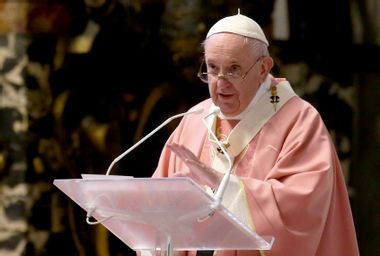
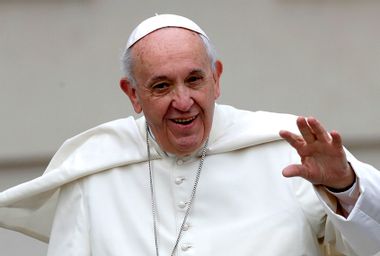
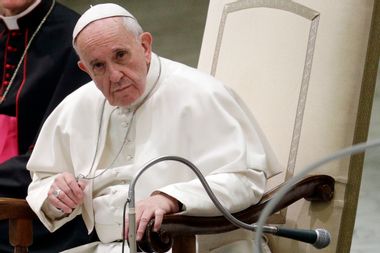
Pope Benedict XVI has made some Anglicans an offer he thinks they can't refuse. The pope has opened his arms to welcome, en masse, Anglican and Episcopalian priests, bishops and even whole congregations into full communion with the Catholic Church -- so long as they disagree with Anglican decisions to accept women priests and gay bishops. The Anglican priests and bishops can even bring their wives and kids with them.
In some ways this is nothing new. The U.S. Roman Catholic Church began reordaining married Episcopal priests in 1981. About 100 married Episcopal priests crossed over into Catholicism. At the time, news reports noted what seemed to be an injustice: Catholic priests who wanted to marry and have children needed to leave the priesthood while these ex-Episcopalians seemed to be getting a pass on the whole celibacy thing because of their conservative theological views. The ex-Episcopalians even had the right to get divorced and remain in the Catholic priesthood; in 1995, Father William Shields became the first married Roman Catholic priest to get divorced. His wife kept the five kids and in the divorce settlement it was agreed that the Roman Catholic Church did not have to pay any support for them.
But this latest gambit appears to be part of Benedict's larger attempt to increase Catholicism's market share without compromising on his version of theology. The invitation to the Anglicans, like Benedict's earlier outreach to the once shunned ultra-right Lefebvrists, seems designed to grow conservatism in the European Catholic Church by scooping up dissidents on the right. But the danger is that Benedict's push to pump up the church's numbers will alienate as many as it attracts. As some customers come in through the sanctuary, many others will be fleeing out the side door.
The head of a conservative Anglican group in Britain, the Right Rev. John Broadhurst, estimates about 1,000 Anglican priests in the U.K. are disaffected and if the COE goes ahead and ordains women as bishops others think the numbers might grow. For Benedict XVI, a German who has railed against European secularism and called on Europeans to return to their Christian roots, adding 1,000 or so new clergy, a few more conservative bishops and possibly a few whole congregations would be a shot in the arm. Increasing market share by getting consumers to switch brands is a tried and true corporate strategy. (The unhappy U.S. Episcopalians for whom the installation of Gene Robinson, an openly gay priest, as bishop was the last straw have already formed their own Anglican church in America. Meanwhile, African Anglicans are considerably more conservative than even Rome so they are likely to stay put.)
But just as with the church's latest mass-conversion offer a quarter-century ago, there are questions being raised about the pope's plan. At an Oct. 20 press conference the Vatican said more information would be released within several weeks, but some elements of the agreement were explained. There will be a new, unified international procedure that will permit mass conversions rather than a case-by-case evaluation of each potential convert. The new Anglican-Roman Catholic priests and bishops will have their own leaders and not be part of the normal diocesan structure. It is expected that these leaders will be former Anglican priests and they may oversee individual priests, whole congregations or even new dioceses composed entirely of converts.
So eager is the pope to add to his army that he has agreed to allow the Anglicans to keep their liturgical practices as well as their wives and children. What, one wonders, might they have to give up? Well, they do have to accept the pope. And, if they are bishops and married, they can no longer serve as bishops. Married Anglican priests will not be able to climb the corporate ladder and become bishops but perhaps they can divorce and then be bishops.
Not yet clear is what they will do about sex with their wives. It is anticipated that they will need to take the vow of chastity -- not celibacy, chastity. That means they can only have sex with their wives. In the early church, priests were married, but the ideal was for the priest and his wife to live like "brother and sister." Contraception is another matter. Anglicans can use it. Roman Catholics can't. If the crossover priests and bishops must follow Catholic rules on contraception, will the church be able to support all those kids? Parish priests don't take a vow of poverty, so perhaps we will find the crossover guys will be more demanding about pay scales or take second jobs -- or their wives will go out and get jobs.
And then there's the case of Florida's Father Cutie. Known in South Beach as Padre Oprah, Father Cutie left the Catholic priesthood earlier this year and became an Episcopal priest so he could marry the woman he loved. Can Father Cutie now come home again and be a Catholic married priest? What a slap in the face to the one in three Catholic priests who left the priesthood to marry and can't even get the pope to answer a letter or their local bishop to provide them with a pension for the years they were priests.
This week the pope meets with the Lefebvrists, those "traditionalists" who broke with Rome over the reforms of Vatican II and whom Benedict has been courting along with the homophobes and misogynists of the Anglican communion. It was just a few months ago that he lifted the excommunication of four of their bishops and then discovered that one was a Holocaust denier and the others part of a system that consistently issued anti-Semitic statements. It seems he thinks they are worthy of religious leadership.
The pope is, as usual, unconcerned about how the Catholic people will react to his willingness to open his heart to homophobes and misogynists and anti-Semites in the name of corporate survival. A few die-hard optimists who still think justice can emanate from Rome are making soothing sounds. Sister Christine Schenk, the executive director of Future Church, a Catholic group that favors married priests, thought the Vatican ploy was "very interesting and probably somewhat encouraging in the sense of, yes, there is flexibility, there is openness."
But for other Catholics a serious question has been raised about how long to stick it out. Mary Hunt, a Catholic feminist theologian not known for drinking the Kool-Aid, was blunt: "Let history record this theological scandal for what it is," she wrote in Religion Dispatches, "the joining of two camps united in their rejection of women and queer people as unworthy of religious leadership."
I personally am left asking at what point fighting to reform a corrupt system becomes the same as contributing to it. Bishop Martyn Minns, a leader of the dissident Anglicans in the U.S., rejected Rome's offer out of hand. "I don't want to be a Roman Catholic. There was a Reformation, you know." If you are Roman Catholic, like me, you are still waiting for the Reformation.
Dear Cary,
I've recently realized that I am atheist. Now being that atheists are 1 percent of the population, this could produce a lone sense in anyone. However, I feel especially alone. My husband's family -- I have no family of my own to speak of -- is intensely Roman Catholic and close-knit. I love them very much and have for many years, but their Catholicism is their identity. The holiday and social gatherings all revolve around a conservative Catholic faith and a conservative political base. I have always been the token liberal, politely placing counterpoints to their own. Or simply staying silent with the more reactionary members of the family. It is a somewhat lonely existence as a result of the only other liberal being a poorly read and largely ignorant knee-jerk friend of my husband's.
I just had a baby and do need the support of my husband's family but the constant silence and playing along is causing me depression. I have no real issue with religious people, I'm certainly not one of the in-your-face New Atheist types. But to be unable to share this with even my husband forces me to live an endless lie of church services and religious gatherings. I do not believe in the miracles they constantly trumpet or find comfort in the theological books they offer! I do not feel any kind of supernatural presence in my life or feel that birth control is inherently evil. Yet if I shared these beliefs I would be shunned faster and with more passion than a leprous Nazi with a rotting cheese on her head. I hear the passionate gossip they speak of other wayward family members all the time!
I look down at my son and realize I even must lie to him. I must parrot the tired myths to him or else risk the natural talkative nature of children to spill my words to everyone. While there is no real evil in living out religion, any more than there is deciding to dance in a circle in your yard with a flowerpot every day, it is not some truth. Nor is it a surefire cure for what ails you. To me it represents wasted time and effort. I do not know what to do because I love these goodhearted people. They are the only family I have. My constant silence and lies depress me greatly because I love them so much.
Thank you for your consideration of my issue.
Surrounded by Saints
Dear Surrounded,
Is faith a matter of choice? Is it an act of will? Are we therefore to be held accountable for the presence or absence of faith in our lives?
I don't see how that can be.
Is it not possible to be a person of goodwill who honestly has no faith? If people who profess to have faith cannot accept that, then it seems to me they lack some essential element of understanding.
How could people of faith accept as a miracle an event in which faith came unbidden to someone, and yet condemn the opposite but equally plausible event in which faith did not come unbidden, or departed unbidden never to return? Why should one occurrence be treated with reverence and the other with scorn, if they are both equally mysterious in this putatively mysterious, god-infused universe?
I would think that people of both good faith and goodwill would accept your atheism as simply another miracle.
But I am obviously not living in the real world.
If the people around you lack deep understanding and intellectual capacity, what is to be done? I do not know. Can they be educated? Not by you.
If they cannot accept your difference then that is their own personal hell; that is their tragic incapacity of perception.
If you would like something to read, let me suggest the estimable Terry Eagleton's small book, "Reason, Faith, and Revolution: Reflections on the God Debate."
Let's hope that there is a God, and that she shows her hand in such a way that these people are struck with sudden holy forgiveness, and that they see, in this moment of wholly improbable struckness, how you, too, and your atheism, are part of their perfect godly world.
And let us hope that this merciful God tells them, in a few simple words, to leave you the fuck alone and not try to convert you.
Wouldn't that be a nice kind of God to have?
What? You want more advice?
It was just a week ago that I sat in Democratic Rep. Rosa DeLauro’s office, along with others in the Religious Coalition for Reproductive Choice, to strategize about getting pro-choice people of faith out to make sure that health insurance reform would include private and public options for women who choose abortion. It was a painful discussion. DeLauro, a pro-choice Catholic, is deeply committed to abortion choice as a matter of social justice, but she understood how important even a flawed reform bill would be to providing healthcare for low-income working people.
At one point I looked at DeLauro and both of us welled up with tears over the dilemma we knew she and others would face. About 20 antiabortion Democrats, mostly Catholics, with the full lobbying power of the Catholic bishops behind them, were very likely to force the inclusion of Rep. Bart Stupak's antiabortion amendment to the Affordable Health Care for America Act, the inaptly named House bill. I did not envy the choice DeLauro and others would have to make. I knew the likeliest, and probably the right choice, would be to vote for passage of the bill.
That is just what happened when Democrats voted Saturday night for the act, which passed with the broadest restrictions on funding for abortion since the Hyde Amendment was enacted in 1976. The Stupak amendment forces insurance companies that currently provide abortion coverage to choose between continuing that coverage, or dropping it for all women if they want to participate in health insurance exchanges, and sell their product to government-subsidized consumers. If Democrats don’t get over their lust for a majority at any cost, this health insurance reform will haunt them the rest of their lives.
Ezra Klein of the Washington Post gets it exactly right.
Because of the limits placed on the exchanges, most of the participants will have some form of premium credit or affordable subsidy. That means most will be ineligible for abortion coverage. The idea that people are going to go out and purchase separate "abortion plans" is both cruel and laughable. If this amendment passes, it will mean that virtually all women with insurance through the exchange who find themselves in the unwanted and unexpected position of needing to terminate a pregnancy will not have coverage for the procedure. Abortion coverage will not be outlawed in this country. It will simply be tiered, reserved for those rich enough to afford insurance themselves or lucky enough to receive it from their employers.
Many Democratic women were shocked, and a wave of revulsion and anger at the Democrats who voted for these restrictions has ensued. The strongest advocates for choice in the House have moved quickly to pledge to reverse the restrictions. The Progressive and Pro-Choice Caucuses, led by Rep. Diana DeGette, announced they have 41 signatures on a letter to Pelosi that says they will not vote for a final bill if the restrictions on abortion go beyond current law.
President Obama is once again silent. Robert Gibbs refused in today’s press conference to offer any assurances that the president would stand up for choice. And, shockingly, Sen. Claire McCaskill, one of Obama’s "feminist" campaign surrogates, pushed the party’s flawed decision to sell out women for a Democratic majority, extolling the party’s commitment to “moderates.” So now anti-choice Democrats are moderate? McCaskill went further and pooh-poohed the restrictions, claiming most women would still get their coverage from employers and the bill would affect only a few women.
We started down this road in 1976 when the Hyde Amendment passed and when, in 1980, the Supreme Court upheld the principle that the federal government had the right to enact policies that favored childbirth over abortion by restricting funding for abortion. Most Democrats saw that giving antiabortion taxpayers greater moral standing than women who choose abortion was a political power play. After all, taxpayers don't get any other say in how their taxes are used. Pacifists' dollars support war; anti-bailout Americans saw their taxes go to banks just this year. Except on the issue of abortion, if you want to be a tax resister, the only thing to do is not pay your taxes and go to jail.
Clearly, the antiabortion right was using poor and powerless women as surrogates for their inability to control all women’s access to abortion. Sadly, a few pro-choice Democrats agreed with the antiabortionists that abortion should be legal but was morally repugnant, and should not be supported with federal dollars. Joe Biden, Jimmy Carter and Al Gore (who later changed his mind) were in that camp.
While efforts to overturn Hyde from 1976 to 2004 were sporadic and unsuccessful, at least some legislators tried. Most pro-choice legislators and advocates continued to agree that it was immoral to deny public funding to poor women for a service that was legal. All that changed with the Democratic defeats in 2004, which led the Democratic Party to falter seriously in its commitment to choice. Party leaders courted antiabortion Democrats as candidates for the House and Senate in conservative districts and states.
Howard Dean, then party chair, initiated an outreach plan to integrate anti-choice Democrats into the party. In fact, they were able to hold their press conferences in the Democratic National Committee building. Democrats for Life has proved to be radically antiabortion, and its members have been congressional ringleaders of the effort to exclude abortion coverage in health insurance reform. The party stopped calling them anti-choice and adopted the language they preferred, “pro-life." In many ways, the message was sent that being pro-choice and antiabortion were equivalent, morally and politically. Deeply held beliefs were not to be critiqued, they were simply to be accepted so that Democrats would be seen as sensitive to religious values.
Religious groups that were broadly in alliance with the positions of the Democratic Party, but disagreed with the party on abortion, stepped up and began to “advise” the party on how to talk religion and gain the votes of the small percentages of anti-choice Catholics and evangelicals who are progressive on other issues. Democratic operatives promoted the new antiabortion progressives with deep-pocket party donors who were searching, post-2004, for new groups to support to reach out to "people of faith." Most of those same groups have worked for the Stupak amendment, including Sojourners, Catholics United and Catholics in Alliance for the Common Good. They are now among the religious voices listened to on the Hill and in the White House.
Obama himself contributed to the rehabilitation of the immoral positions on abortion and poor women taken by these groups when he adopted the common-ground approach to abortion. The president chose to emphasize the “good will” and deeply held beliefs of those opposed to abortion and funding for poor women as opposed to a clear critique of the immorality of restricting a woman’s right to decide whether abortion was a moral decision for her, personally. The White House pushed pro-choice leaders to acquiesce to this form of diplomacy by creating a “dialogue” among all players, with no reference to the merits of various positions on abortion, simply a so-called shared commitment to “reducing abortion.” The president presented his own pro-choice position as just one view among many.
Common ground was featured and promoted even on Web sites devoted to choice, when RHRealityCheck.org dedicated a special site to providing a platform for both pro-choice and antiabortion views, further legitimating the idea that the legality and morality of abortion rights were debatable. We were treated to glowing descriptions of the “good” pro-lifers like Alexia Kelly of Catholics in Alliance for the Common Good, who compared abortion to torture and capital punishment, as well as the “bad” old pro-lifers like Doug Johnson of the National Right to Life Committee and the Catholic bishops. Following the vote on the Affordable Health Care for America Act, Catholics United issued a press statement in which they allied themselves with the bishops: “We are proud to stand with the US Catholic Conference of Bishops, the Catholic Health Association and other Catholic groups who have lent their unified support to this bill.” (How any progressive Catholic group can be proud to stand with a religious institution that just opened its doors to every homophobic and misogynistic Anglican to come on over and join our church is beyond me.)
Some pro-choice leaders warned that the party’s strategy, in the name of morality, muted the moral justice inherent in the pro-choice position. Former NARAL president Kate Michelman argued with Chuck Schumer and Howard Dean about anti-choice Democratic candidates to no avail. Party leaders were reassuring and adamant: If we could get a Democratic majority and a Democratic president, we would save choice.
So far, at least when it comes to health insurance reform, Dean and Schumer have been wrong. Let’s hope that the wrath that has gripped women in the face of this vote, and the immediate move by the Progressive and Pro-Choice Caucuses to adopt the take-no-prisoners strategy of the anti-choice crowd, saves the Democratic Party from itself.
Bill Donohue, the president of the Catholic League, has never been known for holding his tongue. In fact, the conservative Catholic leader -- who's not affiliated with the Vatican -- is something of a firebrand, always ready with sharp words for someone. Even by his standards, though, a piece he wrote for the Washington Post's Web site earlier this week seemed to hit a new low; it was certainly a low for the Post.
From the essay, posted to WashingtonPost.com's "On Faith" section:
Yesterday's radicals wanted to tear down the economic structure of capitalism and replace it with socialism, and eventually communism. Today's radicals are intellectually spent: they want to annihilate American culture, having absolutely nothing to put in its place. In that regard, these moral anarchists are an even bigger menace than the Marxists who came before them ....
Sexual libertines, from the Marquis de Sade to radical gay activists, have sought to pervert society by acting out on their own perversions. What motivates them most of all is a pathological hatred of Christianity. They know, deep down, that what they are doing is wrong, and they shudder at the dreaded words, "Thou Shalt Not." But they continue with their death-style anyway ....
There was a time when Hollywood made reverential movies about Christianity. But those days are long gone. Now they just insult. And when someone finally makes a film that makes Christians proud, he is run out of town. Were it not for Mel Gibson, there would have been no "Passion of the Christ." But for every Harvey Weinstein who likes to bash Catholics, there is always someone else waiting in the wings to do the same ....
Catholics were once the mainstay of the Democratic Party; now the gay activists are in charge. Indeed, practicing Catholics are no longer welcome in leadership roles in the Party: the contempt that pro-life Catholics experience is palpable. The fact that Catholics for Choice, a notoriously anti-Catholic front group funded by the Ford Foundation, has a close relationship with the Democrats says it all ....
The culture war is up for grabs. The good news is that religious conservatives continue to breed like rabbits, while secular saboteurs have shut down: they're too busy walking their dogs, going to bathhouses and aborting their kids. Time, it seems, is on the side of the angels.
There are at least two factual assertions in there that are just plain wrong -- Gibson wasn't "run out of town" for making "Passion of the Christ;" he was shunned for his alcohol-fueled, anti-Semitic rage. And if "practicing Catholics are no longer welcome in leadership roles in the Party," how do you explain the late Sen. Ted Kennedy, D-Mass.?
But for the most part this just isn't worth engaging. Which leads to a very simple question: Why would the Post run it? The idea of printing a controversial piece, even one that insults as many people as this did, is a fine one. But there's simply no way anyone can say that what Donohue wrote here added to the discourse. There were no facts, no arguments, nothing new -- just a long string of insults. The Post can, and should, do better.
Dear Cary,
My younger brother graduated from college earlier this year. Needless to say, the post-college period, which is rough even in good times, hasn't been easy for him. He hasn't been able to find a steady paying job. He has an internship in what was until recently the industry of his dreams, but, now that he sees it from the inside, the field is no longer so appealing. He is living at home with our parents, but has the freedom to come and go as he pleases. The main thing they ask of him is to have dinner together if he comes home in time. This has always been very important to our parents, and it isn't so bad, considering that my brother doesn't do very much else to "earn his keep." Recently, however, he has been coming home later and later without explanation. It turns out that he has been attending mass at a local church for the past month and, as he announced earlier this week, is going to convert.
This has been a great shock to our family, and not just because it came about so suddenly. Our parents are immigrants from a non-Christian country and practice a very liberal form of our faith. Religion is wrapped up in our cultural identity, which makes my brother's decision to separate himself that much more difficult for my parents to comprehend. To them, his decision to convert is like a renunciation of the family. Perhaps our parents are taking it too far, but I can at least understand where they're coming from. They are worried that they will lose him if our religious differences become an irreconcilably divisive issue.
His attempts to explain have not made the situation easier. In the few conversations we've had about his choice, my brother has blown up and has accused the rest of us of being close-minded. He has always had a temper, but his anger during these conversations has made it very difficult for him to explain his thoughts clearly and has confused the rest of us even more. We are trying to understand him, but when we ask questions that are reasonable in such situations, he accuses us of being judgmental. Meanwhile, he freely criticizes our parents for not believing enough or for believing in the "wrong" things. I know that faith is a personal matter that may not be easily explained, but I feel like he should at least be able to respond to us without yelling. We, the rest of the family, are not our religion alone. We are trying to be patient and calm in order to have a conversation about differences of opinion and beliefs that, while heated, can also be respectful. Unfortunately, we haven't been able to do so with my brother.
His temper aside, what also bothers me is the swiftness of such a serious decision. It almost feels like a quick fix, a way to apply meaning to a life that is currently very unsettled. I know what he's going through. I was there just a few years ago, but I didn't choose this path. I have learned that making sense of your circumstances, of the unfairness and difficulties of life, takes time. It's not about flicking a switch. At least it hasn't been that way for me. Perhaps I'm being unfair, but I feel like my brother is taking an easy way out. He has a tendency to go through phases of devotion followed shortly by a lasting indifference. He went through many similar crazes during his teenage years, which may have just been typical stuff for that age, but his phases have been so strong and so short-lived that I question whether he has given enough thought to his conversion.
I am a non-religious person, and I freely admit that I am biased, but my criticism isn't just against him. I say similar things to friends who are looking to graduate school or money or jobs to give their lives meaning. Hell, I say the same things to myself all the time. Still, while I don't understand my brother's search for meaning in organized religion, I want to support him if this is indeed where his life is going. I know that he is in many ways a regular post-college kid, lost and frustrated. At the same time, he is an adult and can make these sorts of choices for himself. It's unfortunate that he hasn't reached a point where he can express these choices with his family in a calm, clear way. My parents are very distressed and are blaming themselves for not raising us in a stricter household. In a fit, my mother asked me if she should kick my brother out of the house. I don't think that's the right way to deal with this, but unless he starts expressing himself better and stops yelling at us, our house is going to be a miserable place. How can we be supportive without being harsh? How can he be more rational or at least coolheaded without judging us in turn? How do families make it through this in one piece?
Brother
Dear Brother,
It would probably be best for everyone if he left home. He has to carve out his own space in the world, or he has to find the space that has already been carved out for him and occupy it. But do you have to throw him out? I hope not. Let's hope he will move on soon, when he is ready.
He has to work this out in his own way, as you yourself did.
Imagine that personal progress is a foot journey. Imagine a wanderer crossing a field. He comes to a barbed-wire fence. When he is climbing the fence, all his attention is on the fence. It cannot be climbed haphazardly or carelessly; all his attention must be on the fence and its perils. It appears to those of us who stand by and watch that he has become transfixed by this fence, fallen in love with this fence, renounced everything in life but this fence; he recites the mantra of this fence; he studies the fence, how it came into being, what it protects, what it separates, how it is maintained.
Why does he need to know all this if he is simply trying to climb over this fence to get somewhere else?
For one thing, he doesn't know that he's on his way somewhere else. He doesn't know where he is going. That is OK. That's how it is right now. He is wandering. He is at a crossing; he is crossing over a chasm. Perhaps he is afraid of what lies ahead, so that even as he moves, as he must, through one field to the next, even as change happens, he has to believe that every road he crosses, every ditch he jumps, every hill he walks over and down the other side of is what he believes in. He may be unable to comprehend, or admit to consciousness, that he is in motion, that all these ideas and belief systems are stations along the journey. So he yells: This is the one true way! And the next crossing he comes to will be the one true way. And the one after that, and the one after that.
And those of us around him say, Sheesh, he has no perspective! He thrashes about like a wild animal in captivity!
Why would that be? Well, our motion toward wholeness and maturity brings us constantly up against the unknown; it brings us to grieve the things we leave behind; it brings us to face things we do not know how to do; it humbles us; it shows us that we are not in control of every doorway and every automobile and every fence. At times we freak out, and at times we try to put a good face on our terror. We say at every difficulty, Ah, yes, I saw this coming! This is the answer! I know how to handle this. I'm going to convert!
He is wandering and looking for something. He does not know what it is. He won't know what it is until he finds it. But he cannot say this in so many words. And apparently he cannot be blessed by the family for doing this. Apparently he cannot come to you, his big brother, and say, Big Brother, I am lost but it's OK; I'm going to find what I need to find; meanwhile I may appear lost to you; have faith; I'm here; I'm on my way somewhere. I'll be OK.
Perhaps you could at least say to him, Little Brother, I know that you are on your way somewhere, and I know you'll find it, and right now you seem lost to me but I can live with that. I know you'll be OK. Do what you have to do.
He is spiritually hungry. He is looking for a system bigger than he is. He is looking for communion, a sense of belonging to the world. Most likely he will find this communion or belonging well outside the confines of the family. Where he finds it will not be clear for some time. But he is going to find it outside the family system. And, in a sense, it might be said that, for a time, during this wandering, his family is going to have to cease to exist for him.
So what can you and your parents do? You can provide a container for what appears to be his craziness but what is actually his necessary wandering, and when the time is right you can send him on his way. It may be that he has to wander for a long time.
How can you come to understand what he is going through? Start with what is analogous in your own experience. You changed. You cast off things that no longer served you or made sense. In casting them off, you probably felt some kind of grief or separation. It cannot have been completely trouble-free. So think about how you did it, and imagine what he is going through now, having perhaps less balance than you had. To your credit, you did this with apparent completeness, and you did it with skill. You adopted a set of beliefs and behaviors that serve you. You did it without creating loud, emotional ruptures. You did it without converting to a new religion.
His interest in religion has galvanized the family but what is at stake is something larger. There is something larger than religion. There is something larger than culture. That larger thing is self, or destiny, or soul. A soul may take from many religions as needed. A soul may attach himself to Catholicism, a religion or doctrine, because that is the step he is on, in the staircase he is ascending. That is the fence he has to climb to get to the field beyond. But there are many fields and many fences. He's on his way somewhere.
Makes a great gift. Can be personalized for the giftee of your choice. Signed first editions on sale now.
What? You want more advice?
There’s little doubt that the 2002 sex abuse scandal in the Catholic church brought out the worst in official and some unofficial Catholic circles. Coverups and unconvincing explanations about why pedophile priests were routinely transferred to new parishes where they could continue to abuse children were the order of the day. While the U.S. bishops fairly quickly established a commission and put in place policies to prevent future abuse, they pretty much continued to claim innocence as more and more dioceses faced lawsuits for the coverups.
The Vatican was even less nimble. Pope John Paul II came in for heavy criticism for his handling of the scandal and for Vatican policies that used diplomatic immunity as well as orders of secrecy to suppress information and limit legal exposure. For John Paul II being pope seemed to mean never having to say you are sorry.
Benedict XVI made up for some of his predecessor's actions by not only apologizing but meeting with abuse survivors on his 2008 U.S. visit. But any goodwill the Vatican gained was eroded when Archbishop Silvano Tomasi lashed out at criticism of the Vatican’s handling of clergy sexual abuse at last week's meeting of the U.N. Human Rights Council in Geneva. In a petulant written statement Tomasi, identified in media reports as the Vatican’s representative to the U.N. but known within the Vatican by the strange title of Ambassador to Nowhere, became the Ambassador from Hell, repeating nearly every shibboleth the Vatican and its apologists have used to minimize clergy sexual abuse over the past decade. And Tomasi's statement also exemplified the odd role that the Vatican plays in the U.N. He was exercising the Vatican's "right to reply" as a "Non-member State Permanent Observer" to a complaint brought by an NGO. But is the Vatican really a state? For a long time, the Vatican has sought to have its cake and eat it too, enjoying the privileges of statehood without the responsibilities. Now the issue of child abuse has laid the contradictions bare.
Tomasi was responding to a charge brought to the U.N. Human Rights Council by the International Humanist and Ethical Union, alleging that the church had covered up abuse and allowed it to continue. Tomasi recited a familiar, and disappointing, litany. The problem is minor, the Catholic church is being picked on while other religious groups that are more abusive are ignored by the media and, of course, homosexuals, not pedophiles or bishops, are to blame. Outraged that anyone would question the church's intentions, Tomasi noted that "the church has been busy cleaning its own house" and suggested "it would be good if other institutions and authorities where the major part of the abuses are reported could do the same and inform the media about it."
In an unscientific critique reminiscent of Vatican claims that condoms don’t prevent AIDS because they have little holes in them, Tomasi argued that it would be more appropriate to consider the problem one of homosexuality rather than pedophilia: “While many speak of child abuse, it would be more correct to speak of ephebophilia, being a homosexual attraction to adolescent males. Of all priests involved in the abuses, 80 to 90 percent belong to this sexual orientation minority which is sexually engaged with adolescent boys between 11 and 17 years old." Of course, 11-year-olds are not adolescents, but the archbishop seemed ignorant of the basic principle that sex between an authority figure and anyone in his or her care of any age is an abuse of power.
And he seemed totally oblivious to the fact that the reason he was called on the U.N. carpet had far more to do with the Vatican's failure to protect children from such abuse. As recently as 2004 Pope John Paul II granted a special audience to Father Marcial Maciel, the Mexican priest who founded the right wing group the Legion of Christ and had been repeatedly and credibly accused of child sexual abuse since the 1970s. It was Benedict who finally had enough of Maciel and ordered him in 2006 to retire quietly to a life of prayer and initiated an investigation of the charges of sexually abusing young seminarians as well as fathering three or four children and supporting them with the order’s money. Not a single bishop has faced serious repercussions for his role in covering up sexual abuse. Boston’s Cardinal Law was forced to resign as archbishop of Boston but given a sweet job in Rome as the titular cardinal of Santa Susanna, the American Catholic church in Rome.
It is unsurprising, then, that for years NGOs interested in separation of church and state have criticized the Vatican’s special status within the U.N., calling it a violation of the separation of church and state. The Vatican is the U.N.'s sole Non-member State Permanent Observer, giving it all the privileges of a member state except voting. No other religious body enjoys this status in the U.N., and some would say its claim to statehood rests on shaky grounds.
The 1933 Montevideo Convention on the Rights and Duties of States defined the four criteria of statehood -- permanent population, defined territory, government and the ability to enter into diplomatic relations. On the first count, the Vatican fails miserably. There is no permanent population at all. There are fewer than 1,000 residents and "citizenship" is temporary. One holds it only so long as one has a job or function related to the Vatican. Its territory is defined, though it occupies less than half a square kilometer in the center of Rome, but its governing capacity is minimal. The Vatican depends on the Italian government for most civic services, from garbage collection to healthcare and policing. And while the U.N. has no requirement that governments be democratic, the idea of a government run by an infallible head of state elected for life by a small group of men is a bit strange.
Even the Vatican admits its role in the U.N. is strange. "The Holy See finds itself in a particular situation because it is spiritual in nature. Its authority which is religious and not political extends over one billion persons throughout the world ... Its strength ... consists in the respect that its words, its teachings and its policy enjoy in the conscience of the Catholic world ... The real and only realm of the Holy See is the realm of conscience."
Sounds pretty much like an admission that the Vatican/Holy See is not a state. And yet, it has defended its right to participate in the U.N. as a state while seeking to have its cake and eat it as well. For the most part, the U.N. goes along. After all, on a number of traditional issues, the Vatican lends credibility to the peaceful objectives of the U.N. and to an emphasis on eradicating poverty. But in many areas, the Vatican uses its special privileges to obstruct more modern consensus on the usual issues -- contraception, condoms, women’s rights and stem-cell research. And although the Vatican signs some U.N. treaties and conventions, it refuses to be held accountable.
This was the crux of the IHEU complaints before the Human Rights Council. The Vatican has signed the Convention on the Rights of the Child, which calls for all states to protect children from sexual abuse. Not only has the Vatican failed to do that, according to the IHEU it has actively engaged in practices that put children at risk. IHEU cites actions that include claiming that children and their parents have lied about abuse, failing to inform civil authorities of accusations of abuse and impeding investigations by transferring priests accused of abuse out of the country. On a minor level, it has neglected since 1994 to file the reports on the status of children in its "state" required of signatories every five years. IHEU calls on the Human Rights Council and the Committee on the Rights of the Child to open up all Vatican records on child abuse and permit CRC workers to interview workers with knowledge of these matters.
Lawyers for victims of clergy sex abuse in Ireland and the U.S. have sought to use the deposition process to gain access to the Vatican records without success as the Vatican uses diplomatic immunity to prevent any investigation of its role in covering up clergy sex abuse. It will be interesting to see if the United Nations will have any greater success or even try to get the Vatican to comply with the Convention on the Rights of the Child. Wasn’t it Jesus who said "suffer the little children to come to me" and "what you do unto the least of mine, you have done unto me"? Who would have thought it would take the U.N. to get the Catholic church to listen?
A British publishing house has created a stir with a new book. No, not the latest teen vampire saga or bestseller of intellectual derring-do; this hot commodity is the Prayer Book for Spouses. The 64-page booklet from the Catholic Truth Society (CTS) contains prayers about pregnancy, about caring for children and elderly parents. The prayer getting all the attention, however, is about sex. It is the prayer married couples are advised to say “before making love.”
It's hard not to detect a note of skepticism and confusion in media reports, as though the prayer is something akin to Scientologists using e-meters to uncover childhood secrets. "The Roman Catholic Church encourages couples to pray before sex to remind themselves that intercourse is a selfless act not driven by hedonism," reads a caption in London's Daily Mail, which illustrates the story with a cutesy photo of a couple kneeling by a white bed. Those crazy Catholics -- what will they think of next?
As for the prayer itself -- well, it's gibberish. Perhaps it's unfair to subject prayers to literary criticism, but this one is a dour series of poorly strung-together clichés about married couples being mired in “half-truths and little deceits," as CTS director Fergal Martin said on the organization's website, adding this gloomy forecast for marriage: “For many the struggle for sincerity and truth in loving will be constant.”
But more important, whoever wrote this prayer (the authors are unnamed) squeezed all the juice out of sexual pleasure. Had they bothered to study the greatest of all prayers and songs of love -- the Old Testament Song of Solomon, in which the lover and the beloved sing to each other in 117 lines of exquisite intimacy and truth-telling -- they might have written something beautiful and evocative. It could have started bydrawing on the third verse: “By night on my bed I sought him whom my soul loves.” It could have ended as the Song of Solomon ends: “Make haste my beloved and be thou like to a roe or to a young hart upon the mountain of spices.” It could have invoked fine wine, the nectar of the pomegranate, the “waters that cannot quench love,” the “floods that cannot drown it.”
Instead the couple in the prayer whines and pleads and pretty much avoids sex altogether: “Father, send your Holy Spirit into our hearts. Place within us love that truly gives, tenderness that truly unites, self-offering that tells the truth and does not deceive, forgiveness that truly receives, loving physical union that welcomes. Open our hearts to you, to each other and the goodness of your will. Cover our poverty in the richness of your mercy and forgiveness. Clothe us in our true dignity and take to yourself our shared aspirations for your glory, forever and ever. Mary, our Mother, intercede for us. Amen."
Avoiding sex is something religion -- especially Catholicism -- excels at. From the earliest days of Christianity, sex was suspect. The early Christians were sure the second coming of Jesus would happen in their lifetime and believed it was their obligation to prepare by spending as much time as possible praying and thinking about God. They understood that sex -- and especially its pleasure -- distracted them from that purpose. The only possible redeeming feature of sex was procreation. Just the idea of a prayer for making love would have been anathema to them: Christians were advised to avoid sex, and married couples living “as brother and sister” were the ideal. After all, church leaders postulated that, if Adam and Eve had not sinned and had been able to remain in paradise, sex would be devoid of all those messy emotions -- pleasure, pain, jealousy, anxiety, need. And this fear of sexual pleasure did not disappear with time. As late as the 18th century, sex was a sin outside procreation. The more pleasure you had, the more sinful it was.
Modern Catholics are embarrassed by this history. They claim everything has changed and, in some ways, it has. But even today, the Catholic Church does not accept sexuality separated from procreation. This despite the fact that most Catholic couples have sex for the purpose of having children only a few times during their married life and thousands of times as an expression of love and in pursuit of pleasure. And why not? It is incomprehensible to believe that God wishes couples to have more children than they can afford or thinks it is “good” for them to abstain from sex when they are not prepared to have children. This hostility to sexual pleasure has caused much suffering. When modern contraception became available 50 years ago, in the form of the pill, the church forbade its use and, for a time, Catholic couples listened -- often to their detriment. Kate Michelman, the former director of NARAL, was a young, faithful Catholic wife who used the rhythm method. She had three daughters in three years and a fourth child on the way when her husband left her. She had an abortion, a painful choice about which she has eloquently written. Today, 90 percent of Catholics in the U.S. use contraception and few of them see any need to beg for forgiveness. The principles and values that govern their sex lives are so far removed from the “prayer for spouses” that the prayer is more like a fairy tale.
Catholic couples -- married, unmarried, gay and straight -- feel no need for “forgiveness” for the wrongs the prayer alludes to. They do not believe their lives are impoverished. They do not feel the need to be “clothed” in dignity. Truth is found in nakedness; love itself is enriching and requires no pardon.
If anyone needs to pray for forgivenessit is Popes and bishops for the pain they caused to children by scaring them into believing they’d go to hell if they masturbated, for the divorced and remarried Catholics who have been denied the sacraments, for couples who followed the teaching against contraception and had more kids than they could care for, for gay Catholics who have been denied the right to marry, and for infertile couples who are told they can’t use modern fertility treatments.
The rest of us might pray that, as time marches on, more and more Catholics stop following what bishops and "spousal prayers" say on these matters -- and continue to follow their common sense and their conscience.