Abu Ghraib
Wisconsin governor threatens layoffs unless bill passes
Scott Walker warns he could start cutting up to 1,500 jobs if his controversial bill doesn't pass by next week
Wisconsin Gov. Scott Walker walks away after talking to the media at the state Capitol in Madison, Wis., Monday, Feb. 21, 2011. Opponents to the governor's bill to eliminate collective bargaining rights for many state workers are in the 7th day of protests at the Capitol. (AP Photo/Andy Manis)(Credit: AP) Wisconsin Gov. Scott Walker warned Tuesday that state employees could start receiving layoff notices as early as next week if a bill eliminating most collective bargaining rights isn’t passed soon.
Walker said in a statement to The Associated Press that the layoffs wouldn’t take effect immediately. He didn’t say which workers would be targeted but he has repeatedly warned that up to 1,500 workers could lose their jobs by July if his proposal isn’t passed.
“Hopefully we don’t get to that point,” Walker said.
It could take weeks or even months to lay off workers under the terms of their current union contracts.
Meanwhile, Wisconsin Assembly Speaker Jeff Fitzgerald announced Tuesday the Republican-led chamber would pass its version of a bill cutting collective bargaining rights for most public employees. Fitzgerald said Republicans were elected to lead the Assembly in November to make deep cuts to state spending, and they will deliver on that pledge.
“When you talk about a compromise, no. We’re going to make a reform,” Fitzgerald said.
Senate Democrats walked out last week rather than vote on Walker’s bill that would force public workers to pay more for their benefits. He also wants to eliminate collective bargaining for nearly all workers except concerning salary increases that aren’t greater than the Consumer Price Index.
The proposal, designed to help Wisconsin plug a projected $3.6 billion budget hole, has led to eight straight days of massive protests that grew as large as 68,000 people on Saturday.
Security was tight in the Capitol on Tuesday morning as both the Senate and Assembly were in session. Democrats in the Assembly planned to push for adoption of more than 100 amendments.
The Senate continued to be stymied in its ability to vote on the bill after the 14 Democrats walked out on Thursday, making it impossible for the remaining Republicans to take up the measure. The Democrats stayed away again on Tuesday, while the 19 Republicans continued on with other business, including passing a resolution commending the Green Bay Packers on winning the Super Bowl and extending a tax break to dairy farmers.
The Senate met under the watchful eye of state patrol troopers, but only about 15 members of the public, in the galleries. The roar of protesters chanting and beating on drums just outside the Senate chamber in the Capitol Rotunda could be heard as Republicans conducted its business.
Walker and Republican leaders have repeatedly called on the Democrats, who escaped to Illinois, to return and get back to work.
Democrats have said they won’t come back until Walker is willing to negotiate.
Public employees have said they would agree to concessions Walker wants that would amount to an 8 percent pay cut on average, but they want to retain their collective bargaining rights. One Republican senator also has floated an alternative that would make the elimination of those rights temporary.
Walker has repeatedly rejected both offers, saying local governments and school districts can’t be hamstrung by the often lengthy collective bargaining process. He says they need to have more flexibility to deal with up to $1 billion in cuts he will propose in his budget next week and into the future.
It’s a high-stakes game of political chicken that has riveted the nation and led to ongoing public protests. Neither Republicans nor Democrats are budging: Walker says he won’t negotiate, and the 14 missing Senate Democrats say they won’t return until he does.
“We’d love to come back today,” said Democratic Sen. Jon Erpenbach, one of the 14 who went to Illinois. “We could be up there this afternoon and pass this if he would agree to removing the language that has absolutely nothing to do with balancing the budget.”
Republicans planned to forge ahead with other business Tuesday, including a resolution honoring the Green Bay Packers for winning the Super Bowl and a bill extending tax breaks to dairy farmers. Those bills have bipartisan support, but Senate Majority Leader Scott Fitzgerald — Jeff Fitzgerald’s brother — has tried to put pressure on Democrats by threatening to take up more controversial matters, such as a GOP-backed proposal requiring voters to show photo identification at the polls.
“You have shut down the people’s government, and that is not acceptable,” Fitzgerald said to Democrats during a brief meeting Monday setting the Senate’s agenda for Tuesday. Two Democratic senators participated in the meeting by phone.
Democrats counter that Walker could compromise and put an end to the stalemate.
“It’s right in front of the governor,” Miller said. “He just needs to pick it up and allow us to move on. … This is a no-brainer.”
As Walker spoke under heavy guard at a late Monday afternoon news conference inside his conference room, thousands of protesters could be heard through the doors blowing whistles, banging on drums and chanting “Scott Walker has got to go!”
“This guy is power drunk and we’re here to sober him up,” said Bert Zipperer, 54, a counselor at a Madison middle school who was among the protesters. “He wants to do it unilaterally without any compromise. He wants to be a national conservative hero and he thinks he can get away with this.”
Walker’s plan would allow unions representing most public employees to negotiate only for wage increases, not benefits or working conditions. Any wage increase above the Consumer Price Index would have to be approved in a referendum. Unions would face a vote of membership every year to stay formed, and workers could opt out of paying dues.
The emergency plan is meant to address this year’s $137 million shortfall and start dealing with the $3.6 billion hole expected by mid-2013. The benefits concessions would amount to $30 million this year, but the largest savings Walker proposed comes from refinancing debt to save $165 million.
That portion must be done by Friday for bonds to be refinanced in time to realize the savings by June 30, the end of this fiscal year.
Walker said not passing the bill by Friday would make even deeper cuts necessary and possibly result in laying off 1,500 workers over the next four months.
Associated Press writer Ryan J. Foley contributed to this report.
The Abu Ghraib guard who thought he loved me
The notorious prison scarred him. His wife left him. But I did something no one else had: I listened
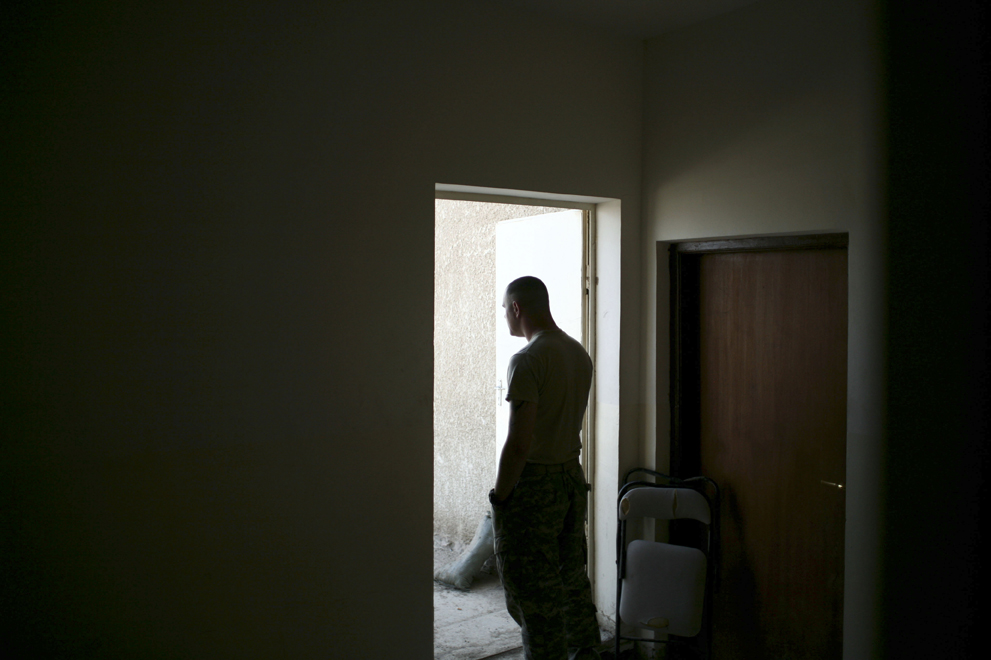
A U.S. soldier stands at the door of a police station, part of the GSS (General Security System), in the southeast of Baghdad, February 28, 2007. REUTERS/Carlos Barria (IRAQ)(Credit: © Carlos Barria / Reuters) It was 2:30 a.m. on July 4 when I received the text: “I fallen in love with u from just talking 2 u. What do u think justine. My wife has already left me.”
I didn’t recognize the phone number, but I knew the area code, 301: Cumberland, Md., aka Torturetown, USA. The area had gained notoriety as the home to many of the soldiers depicted in the infamous Abu Ghraib prison abuse photos. I had visited Cumberland numerous times over the previous two years researching a book I was writing about our torture program’s effects on ordinary Americans. I had listened to people describe their deep level of betrayal by the military as well as those who said they wished we had done even more to the prisoners.
Continue Reading CloseJustine Sharrock is the author of "Tortured: When Good Soldiers Do Bad Things" (Wiley, 2010). Her article "Am I a Torturer?" was part of a Mother Jones series nominated for a 2008 National Magazine Award. Her work has also appeared in Alternet, the Utne Reader, San Francisco magazine and the San Francisco Chronicle. More Justine Sharrock.
What they’re saying: Today’s big CIA/torture report
Government officials brace as long-anticipated report on torture is finally set to be released
Today, a controversial report compiled by the CIA’s inspector general in 2004, is finally set to be released. Even with the ghosts of Abu Ghraib lingering, Americans will likely receive another reminder that U.S. operatives, acting under the authority of the Bush administration, did in fact engage in torture while attempting to combat terrorism. Newsweek reported Friday that the inspector general’s report will show that CIA interrogators used mock executions and threatened a prisoner with a gun and an electric drill. The report could increase pressure on the Obama administration to begin formal investigations into the interrogation techniques used on terrorism suspects during the Bush presidency. The Wall Street Journal also reports today that President Obama intends to distance itself from the abusive practices of the Bush years by creating a new interrogation team to handle high-value detainees.
Continue Reading CloseVincent Rossmeier is an editorial assistant at Salon. More Vincent Rossmeier.
The Washington Post endorses Abu Ghraib scapegoating for torture
It's time to scapegoat low-level torturers in order to shield the high-level officials who are responsible.
(updated below - Update II)
The Washington Post Editorial Page — keeper of all establishment Washington wisdom — today advocates that low-level CIA interrogators who went beyond John Yoo’s torture guidelines, and only them, be criminally investigated and prosecuted by the Justice Department:
Continue Reading CloseWe reject the distorted interpretations that underpin the OLC memos and that serve as legal justification for harsh interrogation techniques that either border on or constitute torture. But those who relied on the memos and shaped their behavior in the good-faith belief that they were following the law should not be subject to prosecution. It is an entirely different story for those who went well beyond the often-extreme measures authorized by the memos.
In 2004, the Pentagon reported that 34 deaths had occurred in detention facilities in Iraq and Afghanistan; at that time, nine deaths were classified by military medical examiners as homicides. . . .
We continue to believe that an independent commission would best be able to shed light on a wide range of questions regarding detainee detention and treatment policy. It would help to ensure that such mistakes are never repeated. But some acts, including the violent deaths of detainees at the hands of U.S. personnel, must be investigated and addressed by law enforcement.
Follow Glenn Greenwald on Twitter: @ggreenwald. More Glenn Greenwald.
The CIA’s secret history of psychological torture
Throughout the Cold War, the agency outsourced abuse to other nations. Will Obama put us back on this path?
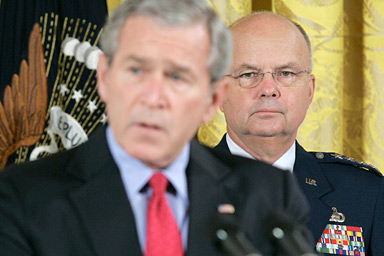
CIA Director Michael Hayden, right, looks on as President Bush speaks before signing the Military Commissions Act of 2006 which sets new standards expediting the interrogation and prosecution of terror suspects during a ceremony in the East Room of the White House in Washington, Tuesday, Oct. 17, 2006. If, like me, you’ve been following America’s torture policies not just for the last few years but for decades, you can’t help but experience that eerie feeling of déjà vu these days. With the departure of George W. Bush and Dick Cheney from Washington and the arrival of Barack Obama, it may just be back to the future when it comes to torture policy, a turn away from a dark, do-it-yourself ethos and a return to the outsourcing of torture that went on, with the support of both Democrats and Republicans, in the Cold War years.
Continue Reading CloseSuppressed images don’t show rape, official says
The Pentagon says no sexual abuse, no Abu Ghraib photos among those held back in ACLU suit.
Last Thursday, the Obama administration asked a federal court to block the release of images that depict detainee abuse in Iraq and Afghanistan. The court had sided with the American Civil Liberties Union in its request that the administration release the photos. The administration’s move seemed to lend credence to swirling rumors on the Internet that the administration was suppressing a cache of images showing sexual abuse of detainees. The day of the administration’s request to the court, Britain’s Daily Telegraph published a story claiming that the images included rape and sexual abuse of prisoners at Abu Ghraib prison and elsewhere in Iraq and Afghanistan. On Friday, the Daily Beast reported that many of the photographs were “sexually explicit” and included images of “a uniformed soldier receiving oral sex from a female prisoner, a government contractor engaged in an act of sodomy with a male prisoner” and “penetration involving phosphorous sticks and brooms.”
Continue Reading CloseMark Benjamin is a national correspondent for Salon based in Washington, D.C. Read his other articles here. More Mark Benjamin.
Page 1 of 25 in Abu Ghraib