Gilbert Gottfried

So, Gilbert Gottfried, about those tsunami jokes …

Gilbert Gottfried talks about the jokes that cooked his goose with Aflac, and the great virtue in a good shock

  • more
    • All Share Services

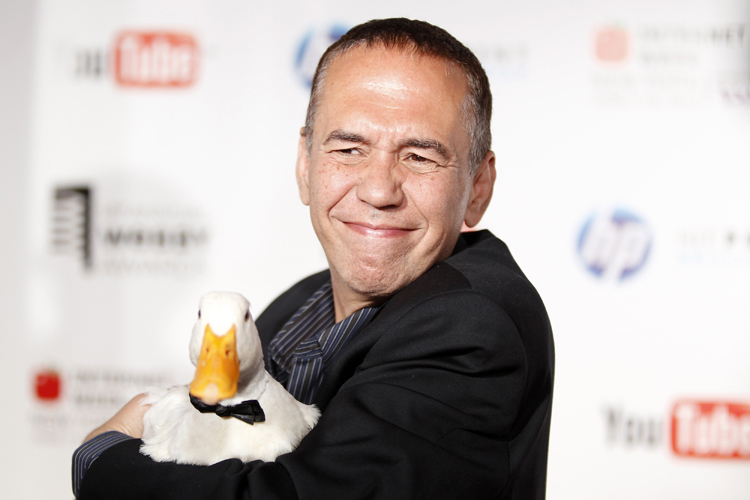
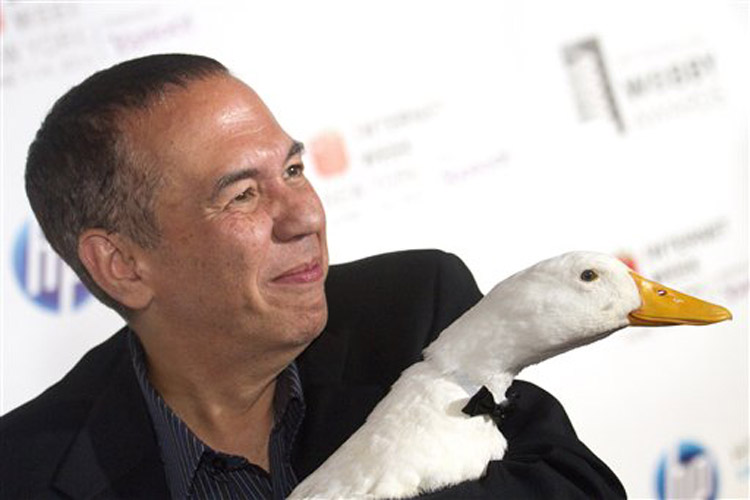
So, Gilbert Gottfried, about those tsunami jokes ...Comedian Gilbert Gottfried arrives with a duck at the Webby Awards in New York June 14, 2010. REUTERS/Lucas Jackson (UNITED STATES - Tags: ENTERTAINMENT ANIMALS)(Credit: © Lucas Jackson / Reuters)

It had been about a month since Gilbert Gottfried lobbed those brutally crude jokes about the Japanese tsunami when I met him earlier this week. He still seemed a little stunned by the reaction, which included a public drubbing by the morality police, and being fired as the voice of the Aflac spokesduck. Still, he couldn’t quite make himself grovel for forgiveness. “You start to feel sorry, and then you wonder what you’re feeling sorry for,” he says. “That I made jokes?”

Sure, they weren’t just any jokes. (Buzzfeed has ranked the most jaw-dropping of them.) But in many ways, they are typical ones for Gottfried, 56, who has paved a long career with the shock and awe of the taboo. He is famous for his version of the notorious “Aristocrats” joke, delivered a mere three weeks after Sept. 11, at a New York Friars Club roast for Hugh Hefner, which has somewhat romantically been christened (by Frank Rich, the New York Observer and the film made in honor of the joke) as the moment it was OK to laugh again. That epic release was made possible, though, only by the World Trade Center joke Gottfried detonated right before, which drew boos, hisses and the refrain that could wind end up as Gottfried’s epitaph: “Too soon!”

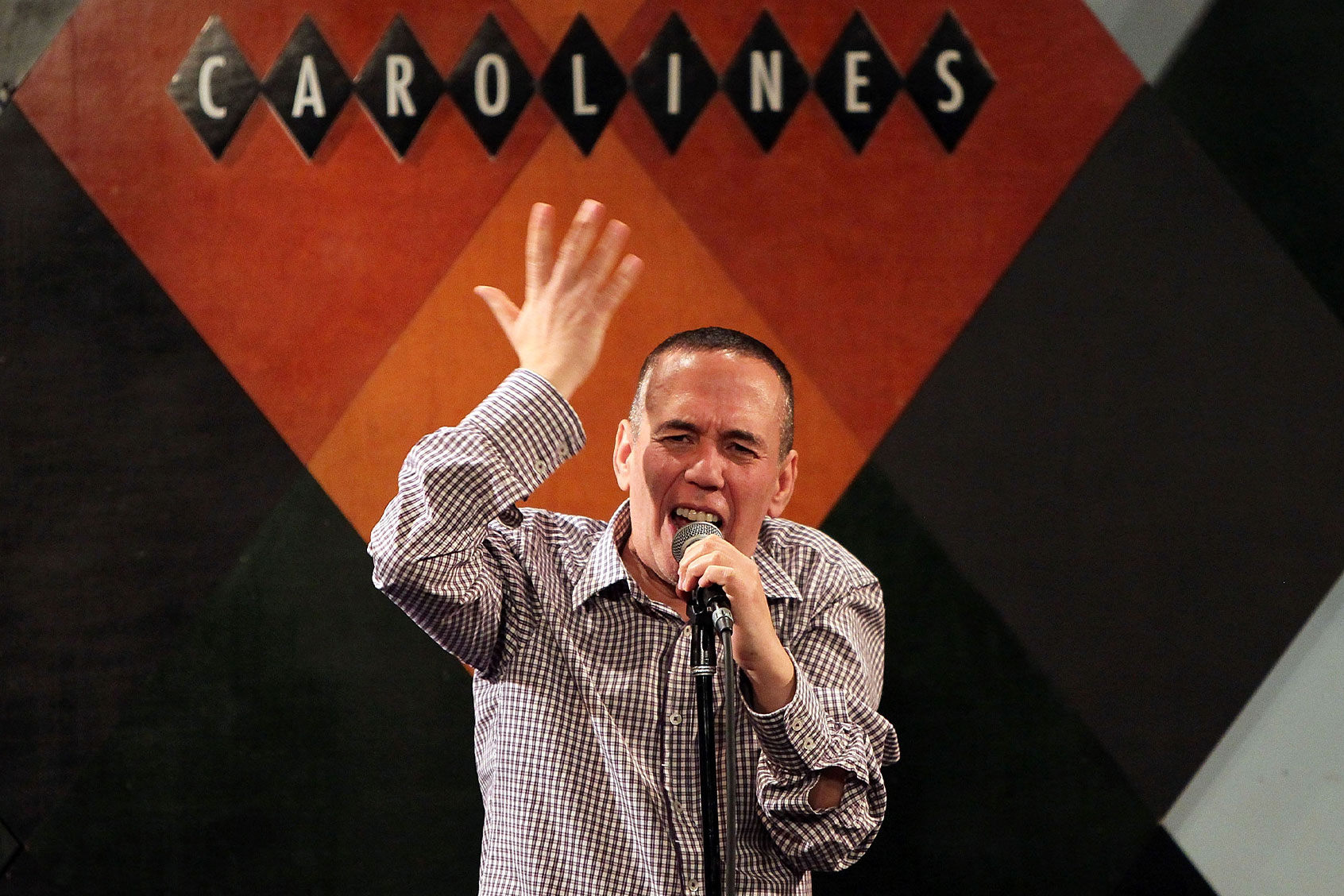
Everything about Gottfried’s comedy is intended to grate, from his shrieking delivery (in person, he speaks softly and thoughtfully) to his material, which is in rich display in his new comedic memoir “Rubber Balls and Liquor,” where the Brooklyn-born Gottfried manages to squeeze a warmly remembered childhood and sometimes perilous career (he was an “SNL” cast member for the much-derided 1980 season, the year after all the originals left) in between a succession of generously filthy stories and jokes. We spoke over a lunch picked up by Salon at a Midtown Manhattan steak restaurant, during which Gottfried carefully ordered three courses — including a New York strip, with a side of baked potato and a side of broccoli — most of which he barely touched and had wrapped to go. An edited transcript of the lunch follows.

So about those tsunami jokes…

It’s amazing. I think millions of years from now when aliens land here and are digging up our civilization, they’re probably going to be looking at all the reports and say, “This guy must have caused the tsunami.”

When I look at how the media just went nuts with it, there were so many tricks they had. Number one, they didn’t say “his jokes,” they said, “his comments and remarks,” because if you say jokes, it just lets the air out of the sails. If you say “jokes,” people say, “Well, yeah, he’s a comedian, he makes jokes.” And then you say, “Yeah, but these were bad-taste jokes.” And then people go, “Kind of like the bad-taste jokes I heard at work today.” And then they go, “Well, this is a guy who starred in ‘The Aristocrats,’ and is on every roast and was on ‘The Howard Stern Show,’ so we were of course shocked that he would do something in bad taste.”

Then they pick out some of the jokes, and they go, “We’re warning you ahead of time that this is shocking and offensive.” So they present it, and it’s what I’ve always thought about the media, they [warn that something] is shocking and offensive, like, “We’re good, we’re watching out for you,” but it’s really their way of saying, “Here, we got you now, you gotta watch this.” And it’s OK for them to say it, because they have a stern look on their face. The people most outraged in the beginning were TMZ and Perez Hilton, Dr. Laura. Oh, [CNN's] “Showbiz Tonight” picked me as the most provocative celebrity, beating out Charlie Sheen.

Who doesn’t want to be provocative?

Yes. But then to talk about how offensive and how wrong it was, they brought out Kelsey Grammer’s ex-wife Camille, and she was…

She was the voice of reason?

Yes!

TMZ and Perez Hilton have built their brands having it both ways.

Right, Perez Hilton, who outs gay stars and draws penises on their faces, was very shocked and offended. And the best part is that they always say, “Too soon,” and “Too soon” meant that if I had waited like three more days, the tsunami was forgotten about. And what I remember was turning on the TV one day, and all of a sudden I noticed there’s not one mention of the tsunami, and the big news item all over the place — all over the Internet, all over TV — was that Chris Brown got angry backstage on “Good Morning America” and threw a chair. And the tsunami was lucky to get mentioned after funny sports bloopers.

Did you regret the jokes? Because you did delete the tweets.

Oh, yeah. I deleted it. And then they dug [them] up.

Right, which always makes it look like there’s been a coverup.

Yes. With the Internet, if you erase something it just means you have to spend another half-minute to find it. It’s just like when they go “so-and-so did not comment.” If you’re avoiding their news show or their paper, then you’ve got something to hide. I actually did have cars parked outside my building, with these different news crews and people hiding in hallways.

Were you shocked when Aflac reacted the way it did?

I remember I was away in Philadelphia working; I came back and then the whole world blew up. When people say, “Are you sorry you did it?” I’m kind of mixed on the whole thing because it’s my character. You start to feel sorry and then you wonder what you’re feeling sorry for. That I made jokes?

Those particular jokes are exactly what you do.

The funny thing was, any comedian who heard it didn’t understand what the big deal was about, and usually started their emails to me with, “Hey, did you hear about the Japanese so-and-so,” and then they’d go into a joke. And my fans, in the very beginning when it first happened there were the psychos’ emails, the ones who I think live on the Internet and are shocked; I think they’re the people who send hate mail to Jennifer Aniston for calling Brad Pitt…

Right, right. They take it all very personally.

Yes! But then there was just an overflow — pardon the pun — of people going, “Hey, what’s the big deal? You made jokes.”

Did anyone you know say, “Too soon”?

No.

The other part that really got me was when they’d report how much these things hurt the Japanese people. And I’m thinking, so what this means is that when the tsunami was taking place, their top priority was [going to] Gilbert Gottfried’s Twitter account, translating the jokes, and being offended. I’m thinking, they really need to get their priorities straight.

And the crazy people in the press were saying, “Imagine if it was your loved ones,” and I’m thinking, so? If it were my loved ones I [wouldn't be] going, “Let me get onto some Japanese comedian’s Twitter account, and see what he’s saying…”

Did Aflac contact you immediately?

I really can’t say much about that.

Was that the extent of the fallout?

Well, it’s hard to say what may or may not have happened. At times like this I get a better understanding of things like the House Un-American Activities [Committee]; you know, maybe no one was out-and-out saying, “We’re not hiring you because we’re scared of this,” but they just weren’t hiring you.

So you’re left to your own paranoia.

Sure.

At the same time you’ve got your book coming out, so there’s that. Has it all helped your comedy?

Nothing can help my comedy. [Laughs] But what I did notice was that the thing that started all this — my Twitter account — was at this certain level, and it wasn’t going much higher, and then all of a sudden it just exploded. Like 50 times as many people were following it.

And I did a thing on “Funny or Die” called “Too Soon” that’s me throughout history telling bad-taste jokes. I’m convinced that when Christ was on the cross there were people around there telling jokes to each other, making sarcastic remarks.

What is Twitter like for a comedian?

I find the whole Internet, number one, how quickly everything moves … like, I feel like if tomorrow I say I have a Twitter account, they’ll go, “You’re still on Twitter? We stopped using that years ago.” I feel like this line has been erased between people who do stuff and everybody else. So, like, columnists and writers who you used to buy a paper to read what they had to say, or watch their news shows … it’s like the line is erased, now everybody is commenting on things, with some people … much like with cellphones, when you hear somebody on a cellphone going, “I’m about three doors from your house now, OK, now I’m two doors, OK, now I’m in front of your building, I’m about to press the button.” It’s like they narrate their entire life.

Everyone wants the stage now.

Yeah.

You were sort of a prodigy; you were performing live in the Village when you were 15. How different are you now from then?

I remember when I started out I was doing mainly impressions, and I remember I would do Bela Lugosi, and you know, back then, as I said in the book, growing up the greatest film school in the world was in your living room, because you’d turn on the TV and there’s all these movies coming on constantly. So I remember part of my act I would do Groucho Marx and Bela Lugosi, and the funny thing is, even back then, it was pretty dated with my references. And then somewhere along the way I started more kidding around in between the impressions, and it developed into whatever I developed into.

Do you think that’s changed a lot? Is that how young comedians do it now?

That’s a scary thing, that I find very worrying. Now, if someone wants to be a comic, they just film themselves and put it on YouTube. And they haven’t learned anything, they haven’t learned to develop anything or how to experience working in front of an audience. When I see people doing stuff on YouTube, or even if they’re just writing things, I always think, Wow, thank God this wasn’t around when I was that age.

You think you wouldn’t have developed your chops?

Yeah. I think I would have terribly undeveloped, unfunny bits that I’d be doing on YouTube.

There’s this new kind of celebrity comic, Kathy Griffin being an example, who isn’t crafting jokes, but just trying to create a sort of amusing persona, maybe getting a reality show.

Yeah, there are the people who just have a certain quirky personality and get famous. That’s another thing now. Reality TV has totally destroyed soap operas. They’re gone. They used to be the biggest thing in the world, they’re gone. Sitcoms are pretty much dead. There used to be billions of those on, now they’re dead. It’s just so much cheaper to make reality TV.

Which spawns stars like the Situation, who bombed thoroughly recently during the roast for Donald Trump. Is it satisfying to see something like that?

What I thought about that was, he did bomb. But it’s like, so now because he’s bombing on TV, he’ll still be making a fortune from the TV show, and he’ll get paid a few hundred thousand to show up at a restaurant opening.

To bomb.

Yeah.

I envy like crazy those people who get money to show up at events, where they just walk down the red carpet and then sneak out a side door.

You’ve never been paid an appearance fee?

No.

Do you get a lot of requests to just tell the “Aristocrats” joke?

Oh yeah.

Do you?

I tell jokes from my dirty jokes DVD, but the “Aristocrats” one I don’t tell that much. I’m almost like rebelling against people who want it, and that was a funny thing too as far as people being offended. It started with the Sept. 11 joke. And they’re booing and gasping and yelling, “Too soon!”

I think a lot of people forget the first part, the World Trade Center joke that really upset people. They just remember the “Aristocrats” joke — and that Gilbert made it possible for us to laugh again.

Yes!

What I love about that, they were all offended and shocked and outraged, and then I win them back by talking about incest and bestiality. And they go, “That’s OK. Now we can relax.”

You had to know the World Trade Center joke was going to be risky.

Yeah. I definitely wanted a reaction. There was the case of people walking around putting flags on their cars and flags on their lapel like, “Look, I’m doing something,” just like the red ribbon that cured AIDS. Scientists saw those red ribbons and suddenly realized they had to cure AIDS. And what I remember, too, about that time, they were thinking of canceling the Emmys, and then they decided to run the Emmys because there’s just too much money in the Emmys not to run, but people would be dressing down. So Pam Anderson showed up and she was not showing as much cleavage — that makes the people who died in the World Trade Center feel that much better.

The funny thing is, a couple of days after the whole Japan thing, I attended a funeral. And you know, of course, at the funeral people were going up speaking and they were telling funny stories about the person, and you’d see people whisper something to another person and they’d laugh nervously, and I had people come up to me and say, “I know I’m going to hell for this but I laughed at some of those jokes.”

I put up on Twitter a line from George Carlin. He said it’s the duty of a comedian to find where the line is and cross it. And I thought that put it much better than I ever could.

There is no bigger laugh than when you’ve just crossed the line, is there?

Yeah, and there’s that laugh where people laugh extra hard because they don’t want to laugh.

Have there been times when you think, that was too far?

Sometimes when I say it. But then afterward I think, What is going too far? When people first learned to communicate there were people laughing at bad things that happened, as some kind of release. As long as civilization is around that’s going to happen.

Your book is coming out, while Tina Fey’s book will be at the top of the bestseller list. Are you going to topple her?

Oh, naturally. [Laughs]

Are you a fan of hers?

Yeah, I guess. I did a voice on an episode of “30 Rock,” so I guess I’ll be a fan.

What was the episode?

Oh, it was peculiar. It was an episode of the show where they’re auditioning people for their “Saturday Night Live”-type show that they do, and there’s a guy who does impressions, and he does a dinner party impression of me, Martin Scorsese and Christopher Walken, [and] they actually got all of us to do our own voices. There’s also a scene too where they get voice messages saying, “Hire this guy, he’s great,” from me, Scorsese and Walken. And they believe it’s the real people. And Tina Fey says, “This guy is really impressive, he did a film with Martin Scorsese, he was in an off-Broadway show with Christopher Walken, and he studied the Meisner technique with Sir Gilbert Gottfried.” [Laughs]

Kerry Lauerman

Kerry Lauerman is Salon's Editor in Chief. Follow him on Twitter: @kerrylauerman.

Aflac hiring for “America’s Greatest Job”

Gilbert Gottfried need not apply

  • more
    • All Share Services

Aflac hiring for FILE - In this June 14, 2010 file photo, Gilbert Gottfried arrives with the Aflac duck to the 14th Annual Webby Awards in New York. Aflac on Monday, March 14, 2011 announced that it has severed ties with Gottfried over jokes about the earthquake and tsunami in Japan that the comedian posted on Twitter. (AP Photo/Charles Sykes, File)(Credit: Charles Sykes)

Aflac is opening the field to people who want to take a quack at doing the new voice of the insurer’s ever-abrasive duck mascot.

Aflac Inc. will begin accepting submissions on Wednesday in the search for someone to replace Gilbert Gottfried, who was ousted last week after voicing the duck for more than 10 years because he made insensitive remarks on Twitter about the earthquake and tsunami in Japan.

Rather than hire another celebrity voice right away, Aflac decided solicit submissions from the general public, said Chief Marketing Officer Michael Zuna.

“There’s a lot of undiscovered talent in the U.S.,” Zuna said, citing shows like “American Idol.” “We’re calling it America’s best job.”

Anyone interested will be able to submit a 30-second audio or video file belting their best version of the Aflac duck’s signature “Aflac” squawk at http://www.quackaflac.com. The company wants to hear interpretations of the character that may be different from Gottfried’s, Zuna said.

A 2006 ad featuring the Aflac duck in a silent movie — without Gottfried’s voice or any dialogue at all — was re-edited to promote the talent search and will begin airing Wednesday. It points users to contest details on the Aflac Duck’s Facebook page.

Aflac is also posting a job description on Monster.com that includes the following job responsibility:

“Translates complex messages into a single word that tells people, ‘Aflac is the insurance company that they can count on in their time of need.’”

The submission deadline is midnight on April Fool’s Day. Aflac plans live auditions in six markets including New York and Los Angeles. It expects to air the first ad with the new voice, to be created by its longtime agency, The Kaplan Thaler Group, on April 22.

Although Aflac is throwing the field open, Zuna said the company isn’t ruling out using a celebrity.

“We’re considering anyone and everyone,” he said. “We’re looking for the best voice.”

Gottfried voiced the Aflac duck for 11 years. About 75 percent of Aflac’s revenue comes from Japan, where the supplemental insurer’s ads feature a less abrasive voice performed by a different actor.

Aflac said last week that Gottfried’s jokes did not represent the feelings of the company. It previously donated 100 million yen ($1.2 million) to the International Red Cross for disaster assistance.

Continue Reading Close

Sympathy for Gilbert Gottfried

The comedian's insensitive Japan jokes may have cost him his job -- but they were a legitimate response to tragedy

  • more
    • All Share Services

Sympathy for Gilbert GottfriedGilbert Gottfried arrives with the Aflac Duck to the 14th Annual Webby Awards in New York, Monday, June 14, 2010. (AP Photo/Charles Sykes)(Credit: Charles Sykes)

Too soon. After sending out a series of jokes about the Japanese earthquake and tsunami on his Twitter feed, comic Gilbert Gottfried has been roundly excoriated for his poor judgment, and on Monday, he lost his gig as the voice of the Aflac duck. Though he’s since deleted the offending gags, nothing ever goes away on the Internet. Buzzfeed compiled 10 of the more outrageous ones — a relentless string that included the observation that “I was talking to my Japanese real estate agent. I said ‘is there a school in this area.’ She said ‘not now but just wait’” and “I asked a Japanese girl to sleep with me. She said ‘okay, but you’ll have to sleep in the wet spot.’” Aflac, the No. 1 insurance company in Japan, said in a statement that the comments “were lacking in humor and certainly do not represent the thoughts and feelings of anyone at Aflac.”

Gottfried isn’t the first person in history, or indeed, even this week, to bomb. Michael Sorrentino, better known as The Situation, drew boos a few days ago at the Donald Trump roast for his crass, racist remarks. Do you know how hard it is to offend at a roast? For Donald Trump? And the always willing to say the wrong thing 50 Cent tweeted this weekend that “Its all good Till b*tches see there christian louboutins floating down da street shit gone get crazy” and “Look this is very serious people I had to evacuate all my hoe’s from LA, Hawaii and Japan.”

But the distinction between The Situation and 50 Cent and Gilbert Gottfried is that when The Situation and 50 Cent fall flat in their jokes, it’s because they aren’t comedians. There’s something that rings especially offensive when someone unskilled in the craft of humor attempts it and flubs — it’s like listening to Pierce Brosnan sing. Gottfried, on the other hand, may not be your cup of comedy tea, but he hasn’t been at this for over 30 years for nothing. And he’s been shocking people just as long.

Gottfried is known for a variety of things: the voice of the parrot in “Aladdin,” that Aflac duck, one of the millions of veterans of “Saturday Night Live.” He’s also the man who, nearly 10 years ago, introduced us formally to the concept of “Too soon!” At a Friar’s roast for Hugh Hefner just two weeks after 9/11, Gottfried got up and quipped that he was trying to get a flight to Los Angeles, but “they said they have to connect with the Empire State Building first,” inspiring that now-famous cry for comedic restraint in the face of disaster. Gottfried went on to win back the crowd by delivering a stunning version of the classic “aristocrats” gag — and Frank Rich later called the performance, 9/11 bit and all, “greatest dirty joke ever told.” “At a terrible time it was an incongruous but welcome gift,” he wrote. “He was inviting us to once again let loose.”

Of course, Gottfried was letting loose within the very culture that had suffered a blow. He wasn’t an outsider halfway around the world. And two weeks after 9/11, the smoke had mostly cleared and the dead were largely accounted for. Japan is still very much under siege. They say comedy is tragedy plus time, but how much time, exactly? Heard any good Katrina jokes lately? When was the last time somebody really killed on Conan with a routine about Darfur? And even when the cathartic power of humor finds its way into a harrowing story, there’s still a different level of acceptance for finding the funny in a movie clip about Hitler’s last days  and out and out riffing on the Holocaust.

Was it insensitive for Gottfried to make light of human tragedy — and foolish to bite the quacking hand that feeds him? Absolutely. But what is a comic but another word for a fool? He was clumsy and tasteless, that’s why he removed the posts. He told the Hollywood Reporter Tuesday, “I sincerely apologize to anyone who was offended by my attempt at humor regarding the tragedy in Japan. I meant no disrespect, and my thoughts are with the victims and their families.” But relatively speaking, Gottfried’s ill-considered attempt at levity at a horrible moment still seems considerably less stupid than Glenn Beck’s cackling speculation that the earthquake was “a message” from God to follow the Ten Commandments. At least Gottfried knew what he was saying was over-the-top and ridiculous. He intended it to be so.

In the wake of unsurpassed devastation, it’s hard to find anything to smile about. Gottfried’s instincts were a comic’s: to look at catastrophe and try to attack it with the main weapon in his arsenal. In the worst moments of life, humor can be a potent force for healing (think of The Onion’s brilliant post-9/11 coverage) — or salt in a still bleeding wound. Gottfried was likely trying to lash out at the horror of the quake itself, but the barbs fell too close to its victims. And while timing is everything in comedy, for one comic, never might be too soon to start joking about this as-yet-unfathomable disaster.

Continue Reading Close
Mary Elizabeth Williams

Mary Elizabeth Williams is a staff writer for Salon and the author of "Gimme Shelter: My Three Years Searching for the American Dream." Follow her on Twitter: @embeedub.

“The Aristocrats”

This delightful, innocently perverted look at what stand-up comics do to amuse one another may require a high tolerance for toilet humor.

  • more
    • All Share Services

“The Aristocrats,” Paul Provenza and Penn Jillette’s exhilarating documentary about the genesis and continual evolution of one very dirty joke, is less about free speech than about the freedom of speech. And viewing it as a manifesto only detracts from its indelicate, yet delicately calibrated, brilliance. It doesn’t matter that AMC has opted not to run the movie in its theaters: That’s not censorship but a business decision. (Everyone has the constitutional right to be a numbnuts.) Nor is it particularly meaningful that conservative critic Michael Medved has sniffed derisively at the picture, like a dog who thinks it’s above the smell of its own shit. The inherent offensiveness of the joke itself (more on this later) is the controversial sticking point. But the picture itself is so ebullient and celebratory that it practically beams with perverted innocence. It also moves with an acrobat’s timing. (I’ve seen French art house movies that aren’t nearly so beautifully made.) All of this is a roundabout way of saying that unlike Medved, I know art when I smell it, and “The Aristocrats” is it.

The joke at the heart of “The Aristocrats” is an in joke among comedians, one they’ve historically told among themselves but never (at least until recently) in public performance. As at least one of the some 100 stand-up comics featured in the film puts it, the joke is a kind of secret-society handshake, a way for comedians to get laughs from their colleagues, the toughest crowd they’ll ever face. The joke is also, as Provenza says in the movie’s press notes, “the comedy equivalent of jazz”: Like a jazz standard, it’s a gag with a predefined structure, or melody, that holds a universe of possibilities for improvisation.

The melody goes something like this: A guy walks into a talent agent’s office and launches into a detailed account of his act, which involves himself, his wife and his kids, as well as, possibly, any number of family pets and assorted clever props. (Aunts and uncles, grandpas and grandmas, often join in the fun too.) The description of the act is the body of the joke, a transgressive shaggy dog story that may include, but is by no means limited to, lewd sexual acts of all sorts (incest, bestiality, you name it), plus blood and other types of bodily goo, and, ideally, a great deal of slippery, slidey shit and piss. The object of the joke is to come up with the filthiest, most offensive, most imaginative details possible. The booking agent listens to the windup and asks, in disbelief, “What do you call that act?” thus setting up the punch line: “The Aristocrats!”

While you do need a high tolerance for toilet humor and verbal filth to enjoy “The Aristocrats,” whether you find this half oblique, half grapefruit-in-the-face joke funny is beside the point. “The Aristocrats” is an extended riff on an extended riff, a glimpse at the lengths to which stand-up comedians will go to amuse one another. It’s also, as any smart anthropologist would tell you, an exploration of the ways populations share stories (“And then Grandma comes out and has an abortion onstage!”) and anecdotes (“Pops has taken plenty of laxatives beforehand, so everything is really loose”) to affirm their identities. Or, as Jillette so eloquently puts it, “In all of art, it’s the singer, not the song.”

What’s amazing about “The Aristocrats” — both the joke and the movie — isn’t so much what’s in it as how that intentionally offensive content is spun out for the audience’s pleasure. Some of the comics featured in the movie tell their versions of the joke (Dana Gould has an Amish interpretation that’s particularly ridiculous; Mario Cantone tells it as Liza Minnelli describing her new act, which will begin with her fitting an entire piano up her vagina), while others just ruminate on the pros and cons of its mere existence. Some, like stately snapping turtle Pat Cooper, don’t exactly respect the joke, but you can tell they harbor a grudging affection for it. A few, like Eddie Izzard, don’t get it at all (fascinating in itself because the “melody” of the aristocrats joke is the very thing that allows other, perhaps more literal-minded, comedians to do the kind of free-form dada that’s Izzard’s stock in trade). Others, like the exquisitely deadpan Richard Lewis, state outright that the joke is a “piece of shit,” and yet, as Lewis gazes soulfully into the camera, we realize that we don’t know whether to buy the words coming out of his mouth or the gleam of mischievous appreciation we see in his eyes.

Comics are drawn to the joke like moths to a naked flame, and Provenza and Jillette capture as many outlandish variations of it as possible. George Carlin tells the first complete version of the joke we hear in the film, an opera of scatological intensity and magnificence; “Full House” star Bob Saget tells a version that gets so horrifically grisly in its details that it made me queasy; Drew Carey, that handsome, barrel-chested lug of a guy, adds a dainty, flamenco-style finger snap to his version; Jillette appears with his stage partner, the quizzical imp Teller, whose silent shock and dismay at Jillette’s explication of the joke becomes its real punch line; and Eric Mead performs an astonishing version that uses card-trick sleight of hand as a visual aid.

But the movie’s centerpiece is the footage of Gilbert Gottfried telling the joke — perhaps the first time it has ever been told in front of a civilian audience — at the Friars Club roast (the guest of honor was Hugh Hefner) held in New York a few weeks after Sept. 11. Just before unleashing the joke on his unsuspecting audience, Gottfried had tried a gag about how his flight back to Los Angeles had been rerouted through the Empire State Building; the audience, not yet ready for 9/11-themed humor, booed him. So Gottfried, in a sharp turnaround that amounts to nothing short of comic genius, decided to switch gears and assault them with the filthiest joke they’d never heard. His staccato, crisply enunciated, ear-splittingly nasal delivery turns the joke into a kind of “Mona Lisa” of perfection. (Rob Schneider is clearly visible in the footage, literally tumbling off his chair. In fact, he can’t seem to stay in it: He simply keeps falling off it.)

Gottfried’s stunt has become the stuff of legend among his colleagues: They’re in awe of it, they respect him for it, and, most of all, they find it howlingly funny. “The Aristocrats” opens a secret window into the world of stand-up comics — into how they relate to one another and compete with one another, but also into how they themselves are never quite sure about what makes a bit funny. With “The Aristocrats,” Provenza and Jillette blow the lid off what is perhaps the greatest shared joke among comedians, while respectfully preserving the mystery of what makes the joke — or any joke — work. The aristocrats joke is funny because it pushes the limits of what we think we should allow ourselves to laugh at, but beyond that, it defies analysis. Sometimes the profane is sacred.

Continue Reading Close

Stephanie Zacharek is a senior writer for Salon Arts & Entertainment.