The Daily Show

Blue Glow

Salon's TV picks for Wednesday, Dec. 15, 1999

  • more
    • All Share Services

Series

Dawson, Joey and Andie travel to Boston for a student film festival and a tour of Ivy League universities on Dawson’s Creek (8 p.m., WB). Can’t you picture Joey at Radcliffe (on a scholarship, of course)? She’s the Ali MacGraw of the new millennium. It’s Christmas at the White House on The West Wing (9 p.m., NBC), and a crisis looms — the President hasn’t done his shopping yet. Drew thinks Kate finds him boring, so he desperately seeks ways to liven up their dates on The Drew Carey Show (9 p.m., ABC). On Norm (9:30 p.m., ABC), Laurie accidentally shoots Santa Claus, whom she mistakes for a burglar.

- – - – - – - – - – - -

Specials

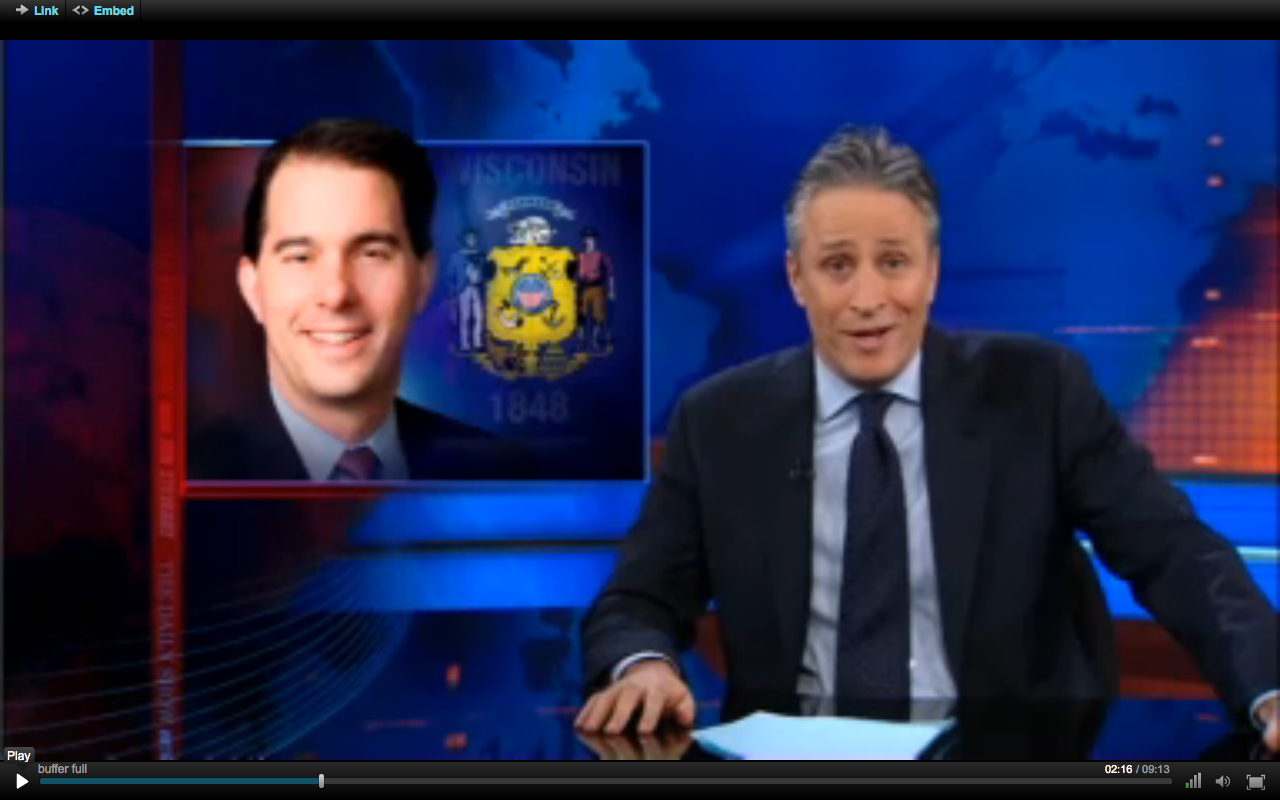
Walter Payton, Payne Stewart and Joe DiMaggio are among those remembered in SportsCenter: Legends of Our Time (8 p.m., ESPN), a look back at sports greats who died in 1999. The Daily Show with Jon Stewart: The Greatest Millennium (11 p.m., Comedy Central) wraps up the past 2,000 in satirical fashion, with segments from “Daily Show” correspondents Beth Littleford, Vance DeGeneres, Lewis Black and Steve Carell.

- – - – - – - – - – - -

Sports

Basketball:

Raptors at 76ers (8 p.m., TBS)

Hockey:

Kings at Rangers (7 p.m., ESPN2)

Mighty Ducks at Avalanche (10 p.m., ESPN2)

- – - – - – - – - – - -

Talk

Rosie O’Donnell (syndicated) Gwyneth Paltrow, Jewel

David Letterman (NBC) Danny DeVito

Jay Leno (NBC) Geena Davis, Chow Yun-Fat

Politically Incorrect (ABC) Julie Warner

Conan O’Brien (NBC) Julianne Moore, Michael Stipe

Joyce Millman is a writer living in the Bay Area.

What dreams may bomb

For years, Richard Simmons has made people earn their dreams the hard way. Now he can't give them away.

  • more
    • All Share Services

What I love to do is help people and I wanted to do a show that was non-competitive [and] very exciting. It’s not just about giving away money. That’s easy, but to give away dreams and make them come true is more intricate.

— Richard Simmons in TV Guide

Richard Simmons is one our more exuberant showbiz personalities. The man hides his feelings about as well as his trademark skimpy satin shorts cover his “buns.” But nakedness has served him well, as millions of the unhappily overweight have turned to Simmons to learn how to eat sensibly, exercise and feel good about themselves. In return, they’ve helped him sweat his way to an empire rivaling Martha Stewart’s.

Not many people, even celebrities, will ever know what it’s like to feel so needed by so many. Simmons’ constant efforts to “be there” for his fans — the aerobics classes he leads at his Beverly Hills exercise center, “Slimmons,” and elsewhere; the “Cruise to Lose” vacations he captains; the monthly chats from his online clubhouse — mean a day seldom goes by that he does not hear another emotional testimonial by someone who couldn’t have done it without him. If hugs were hamburgers, Simmons would have a tally to beat McDonald’s.

Imagine Simmons taking a moment to reflect on the incredible run he’s had. When he shuts his eyes, a parade of faces, many of them tear-streaked, must appear before him — the faces of the bed-ridden, the morbidly obese, the snack-obsessed — one for each life he’s touched over the past 27-years.

Another man might congratulate himself on a job well done, figure he’s earned a little break, take the time to replenish his emotional resources with a little work on “Project Me.” But not Mr. Richard Simmons — he can only fret about how many more remain unsaved. By focusing his compassion on one demographic, he has selfishly ignored countless other forms of human misery.

This is, I imagine, the kind of crisis that spawned “Richard Simmons’s Dream Maker,” a short-lived syndicated daytime show that debuted in September and ceased production last week.

Simmons made his intention to reach out beyond the Deal-a-Meal demographic very clear from the get-go: He actually wore pants. The “court jester of health” reinvented himself as the “Dream Maker,” and all were invited to petition him for a few rubs of his genie’s lamp (literally) in the service of their particular desire.

Those whose phone calls, e-mails or letters were chosen won the chance to have their dream come true on national television. But dismal ratings have unplugged the “Dream Maker” request line, and the already-taped episodes that will languish on the air until Jan. 14 may help explain why.

In the P.R. blitz preceding its premiere, “Dream Maker” was presented as “Nice TV,” an antidote to the kind of mean-spirited trash talk produced by Jerry Springer, Maury Povich, et al.

Those wondering what form this antidote would take were invited to imagine an updated “Queen for a Day,” which ran on NBC from 1956 to 1960. An ironic comparison, considering that the show was an exploratory foray into territory Jerry Springer would later colonize.

Both “Queen for a Day” and “The Jerry Springer Show” satisfy a similar craving in the viewer: a taste for that pleasant mix of gratitude and smug superiority we get when see some poor slob who’s worse off than we are make a fool of himself on TV. Whatever else you want to call it, “nice” it’s certainly not.

On one episode of “Queen for a Day,” host Jack Bailey — a dapper, mustachioed asshole who barely bothered to conceal his contempt for his contestants — introduces the audience to a row of five women, each poignantly dressed-up for the occasion and touchingly ill at ease before the cameras.

Bailey shepherds the women to center stage one by one, where they are told to describe their problem.

Contestant No. 1 needs some power tools to provide some “saw-curity” for her out-of-work stepfather.

Contestant No. 2 — a Native American who good-naturedly plays along with Bailey’s ribbing about tribes and reservations — wants a washer and dryer to ease her housework load. This is hardly life-or-death material, but the show has a ringer ready.

Enter Contestant No. 3, gazing down at her hands, which a quick close-up reveals she is wringing vigorously. She’s so terrified she can’t look Bailey in the eye, and he has to coax her to speak up more than once. What she wants, simply, is “a house and some food.” It turns out she’s one day away from being evicted from the trailer where she, her husband, four children and in-laws sleep on the floor.

When it comes time to turn on the applause-meter, not even the contestant who wanted a reunion with her birth mother is any competition. No. 3 is crowned and showered with roses, her rent on a new house to be paid, her icebox to be stocked.

Richard Simmons is a lot nicer than Jack Bailey, and true to his word, “Dream Maker” is not about competition. Even in a lighthearted bit in which three newlywed couples face off in a hula contest to win a honeymoon in Hawaii, the losers are treated to vacations in a California spa.

Nor do you have to come up with a Dickensian ordeal to be worthy of the Dream Maker’s attention. Many of the segments feature people-next-door types with fairly common dilemmas: a woman who’s been juggling work and school for years could use a scholarship to complete her studies; or a girl whose family has recently moved wants to attend her old high school’s prom with the boyfriend she left behind.

This amounts to so much filler — after all, these people don’t really need a Dream Maker intervention. Simmons reserves his special zeal for the truly dream-deprived, the ones who inevitably burst into tears as they approach the payoff.

Simmons isn’t cynical about these tears — on the contrary, he’s often on the verge of sharing them. Unlike Jack Bailey, he projects a palpable empathy for his charity cases, and really seems to want the best for them.

But “Richard Simmons’ Dream Maker” at its most earnest was also at its phoniest. Consider the handling of struggling single mom Jackie, who we see in a taped pre-interview describing how there never seems to be any money left over to lavish on her little girl, Amanda.

She portrays Amanda as a real trouper who understands the pressures placed on her mom and rarely asks for anything. There is one thing she wants, Mom reports (although I suspect 6-year-old Amanda had a little help here) — a trip to Florida to attend the taping of her favorite Nickelodeon show.

No sooner is the dream articulated than Richard himself comes storming in, arms poised to hug. When the giddiness of the surprise fades, Richard softly explains what compelled him to break with stuffy TV protocol: “When I got your e-mail I wanted to meet [meaningful pause] one of the most wonderful mothers in the world. And that’s what you are.”

The two bask in the warmth of Mom’s recognition for a moment, and then it’s time for Richard to get some validation of his own. For this, the actual recipient of the dream, waiting to be whisked away from nursery school, is pressed into service.

But Amanda can’t seem to find her motivation, despite Jackie’s careful coaching: “Mommy wrote a letter to these people at a place called Dream Makers [sic], and it’s a place where they make your wishes come true … they picked our letter baby and they’re making our wish come true. Guess where we’re going … guess where we’re going.”

With admirable 6-year-old honesty Amanda refuses to guess: “I already know,” she mumbles shyly. When asked to repeat this phrase, some annoyance creeps into her voice.

Another bunch of “Dreamers,” on the other hand, manage to hit their lines beautifully. But then, real life has put them in such an exquisitely pitiable jam that the segment practically writes itself. It seems money’s so tight they can’t afford a headstone for their departed paterfamilias, already six years in the ground.

As he walks down the “quiet” street in the “sleepy little New England town” that is home to the Wells family, “Dream Correspondent” Jerry Penacoli lays on the fake sincerity so thickly it looks like he’s screen-testing for the “Daily Show.”

“They don’t have a lot of money, but what they do have is a lot of love that keeps them together.” It’s family that counts, and they’ve got nothing to be ashamed of — except, apparently, when it comes to having stiffed their dad with a mere wooden cross purchased at Wal-Mart.

“I feel as though I let him down,” sniffs daughter Patti, and it’s a feeling that Penacoli encourages her to go with. By the time the Wells are trotted out to place flowers on their beautiful new headstone, everybody’s pretty keyed up. The ensuing orgy of tearful thanks to the Dream Maker makes you long for a good, old-fashioned chair fight.

A common accusation against shows like Jerry Springer’s is that guests are lied to and exploited. When a mom with an “out-of-control pre-teen” goes on Ricki Lake, it’s under the pretense that she’ll have a forum to discuss and maybe get help for her problem. The real entertainment value, of course, comes from watching hidden camera footage of her 9-year-old “gangsta” threatening to bitch-slap her in the green room.

The relationship between Richard and the people who come on his show is more “intricate,” to use his word. He doesn’t lie to his guests so much as he and his guests lie to each other, together conspiring to create a fairy-tale world in which life is fair.

The guests get to sit back and savor both the rich unjustness of their lives and its long-overdue correction. Richard gets to be the sole agent of that correction, prancing in like some nutty fairy godmother to restore things to their natural order.

In its own way, “Richard Simmons’ Dream Maker” is competitive — it’s a contest to see who can shout “Why me?” the loudest. To lose weight the Richard Simmons way — or any way, for that matter — requires that you stop feeling sorry for yourself, so it was unseemly to see Simmons traffic in self-pity. He certainly didn’t get to where he is today by waiting for the world to give him a break.

When Howard Stern used to command his pal Richard to “talk like a man” or dangled a fishing pole baited with a baked chicken before one of his “porky friends,” Richard took it in stride. He had his line of fitness products to promote, and the exposure was worth enduring a few stupid jokes at his expense.

The people across America who actually use those products display similar pluck, and this “Dream Maker” obituary is dedicated to them. However modest their projects of self-transformation may be, they’re the real dreamers — and they deserve better from their champion.

Continue Reading Close

Matt Himes is a TV critic from Allentown, PA. He lives in New York City.

Canuck yuk

When it comes to American humor, Canada is Comedy Central.

  • more
    • All Share Services

BY SARAH VOWELL | In a recent panel discussion at New York’s 92nd Street Y called “Why Are Canadians So Funny?” moderator (and Vancouver native) Michael J. Fox mentioned a contest once sponsored by MacLean’s magazine. MacLean’s, which Fox identified as the “Canadian Time” (as is the Canadian comparative habit), once asked its readers to fill in the blank at the end of the phrase, “As Canadian as …” to counterbalance the motto “As American as apple pie.” According to Fox, the winning entry was “As Canadian as … possible under the circumstances.”

Which reminds me of a stand-up bit Jon Stewart used to do about a Canadian woman who asked him to come clean with what Americans really think of Canada. “We don’t,” he replied. Stewart is one American comedian who understands that a juicier question than “Why are Canadians so funny?” is its corollary, “Why is making fun of Canada so much fun?” As host of “The Daily Show” on Comedy Central, Stewart recently introduced a segment on a Canadian who chews on a pig’s spleen to predict the weather by noting that Canadian culture’s gift to the world is “I don’t know, Loverboy and … stuff.”

A high comedian birth rate, however, is Canada’s one claim to cultural dominance here in “the South,” and thus, the world. The panel at the 92nd Street Y convened to discuss the mystery of why such a kind, bland country (so modest it didn’t even get around to having its own flag until 1965) would nurture so many funny men and women. Because what requires more cruel honesty, more self-absorption, more guts and glory than making a living by making other people laugh? Yet Canada is the homeland of panelists Martin Short, Eugene Levy and “Saturday Night Live” producer Lorne Michaels. Not to mention oddball American favorites like Jim Carrey, Mike Myers, Catherine O’Hara and all the Kids in the Hall (Dave Foley et al.).

(Confidential to Canadian readers: Please note that the word “American” will be employed herein as an adjective deriving from America, as in United States of. No offense, eh? Why, some of my best friends are Canadians …)

The evening at the Y was giddy and spontaneous — and glamorous, what with the presence of that hilarious former PBS newsman (and Canadian) Robert MacNeil in the audience. Though the panelists never quite directly answered the question of why Canadians are funny, one came away feeling that, yes, Canadians sure are funny. Over and over, their wisecracks poked at their homeland’s wimpy rep. Short recalled his excitement as a child, running downstairs to tell his parents that ABC anchormen Huntley and Brinkley had mentioned Canada in one of their evening newscasts. When Short reflected on the humility of growing up saluting Britain’s Union Jack, Eugene Levy retorted that he was just “so damn proud to be part of the Commonwealth.” Michaels deadpanned, “Benedict Arnold was one of ours.”
So what are these barbs telling us? That Canada is a New World weakling still sucking the monarchy’s teat? That Canadianness is impossible to define precisely because it only exists in opposition to American flash, American ambition, American independence, American glitz?

Pretty much.

Thus, the central concern of Canadian humor, I would argue, is self-deprecation. And not just exhibiting modesty, but playing with it, flaunting it, questioning its value, stomping it out. Think of the mantra of Mike Myers’ thinly veiled Canadian routine “Wayne’s World.” Whenever Wayne and Garth would encounter their heroes, such as Aerosmith, they’d plunge to the floor slavelike, fan their arms and whimper, “We’re not worthy!” Conversely, Carrey’s essential schtick is an over-the-top play for attention — his contortions, his drool, his constant facial freakouts all rely on the un-Canadian habit of invading others’ space. And Scott Thompson (the most fabulous Canadian) has played both sides, as Hank’s submissive, sycophantic assistant on “The Larry Sanders Show” as well as the gay Quebecois barfly narcissus with the perfect feet, Buddy Cole, on “The Kids in the Hall.” But the master of twisting and turning modesty in on itself is Martin Short.

Is there a more charming man in North America than Martin Short? A man more huggable, more adorable, more undeniably cute? Who cares if he’s always in lame movies? Martin Short isn’t about acting. Martin Short is about life, about joy, about cheek-pinching glee.

When the four panelists entered the stage at the 92nd Street Y, Fox, Michaels and Levy calmly walked out and took their seats. Short, on the other hand, pranced out and spread his arms, unabashedly begging for love. Which he got, though he could have gotten more — cash, kisses, the firstborn of every man and woman in the room. (The best place to love Short right now is on Broadway in Neil Simon’s musical “Little Me.” Playing eight characters, his virtuoso hamming is the play’s only virtue.) At the Y, Short batted back and forth between extreme self-confidence and delightful self-defeat, often in the same breath. When Michaels, coveting Short’s Order of Canada pin, asked him how he received their country’s highest civilian honor, Short looked down his nose at his former “SNL” boss and snootily whiffed, “A little thing called ‘Three Amigos.’”

While Short’s American amigos such as Steve Martin betray a barely contained inner bitterness — see Martin’s wildly believable meanie in last year’s “The Spanish Prisoner” — Short makes self-loathing enchanting. He was, in the panel, constantly shocking. He would make some mild-mannered cute quip like the one about Huntley and Brinkley, only to switch gears with the occasional strong-willed reply: When Levy went on and on interminably about doughnuts, how doughnuts mean Canada and Canada means doughnuts, Short cut him down, scolding, “It would be a shame if the only thing we came up with was that.”

Canadian comics carry within them the whiff of the exotic precisely because their very profession flies in the face of the national code. Like American communists and Jamaican bobsledders, Canadian comics seem caught between two worlds, both from their country and defiant of it. Lorne Michaels, who has had more influence on American television comedy than anyone in the last quarter-century, suavely summed up the northern condition. “In a country where civility and moderation are celebrated,” he said, “show business seemed like showing off.” He asserted, for example, that a Canadian would never have made a film called “It’s a Wonderful Life” because “that would be bragging.” He envisioned the Canadian version would have been titled “It’s an All Right Life.”

Continue Reading Close

Sarah Vowell is the author of "Radio On: A Listener's Diary" (St. Martin's Press, 1996) and "Take the Cannoli" (Simon & Schuster, 2000) and is a regular commentator on PRI's "This American Life." Her column appears every other Wednesday in Salon. For more columns by Vowell, visit her column archive.

Page 32 of 32 in The Daily Show