Anna Badkhen
Hoping for magic from Americans
The Iraqi government still can't provide its citizens with basic security and services. So many look to Americans -- for everything.
May 13: A retired teacher whose furniture was stolen. A 6-year-old girl whose stomach hurt. A man wounded by a stray bullet in 2004 in northern Iraq. Another man who wants a surgeon to examine his hand, disfigured in the 1980s during the Iran-Iraq war. Scores and scores of people whose houses haven’t had power for weeks.
Anyone who needs anything in Iraq goes to the same place: the Americans.
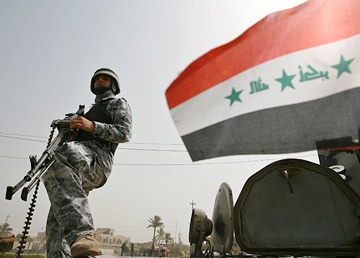
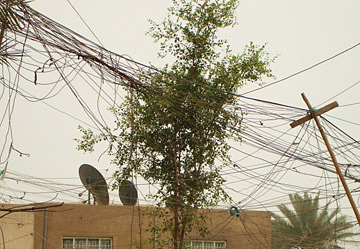
Five years after the war in Iraq began, the country’s army and police force are still not ready to effectively provide security for the country, and its government is unable to provide such basic services as power, running water, and fully functioning sewage and garbage cleanup. Hospitals are overcrowded, and many doctors have left the country. So most Iraqis look to Americans, whom they see as the source of ultimate authority.
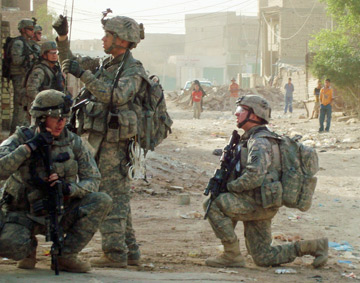
“A lot of Iraqis expect that Americans can touch something and make everything work,” says Capt. Andrew Betson, whose company patrols the streets in southwestern Baghdad.
American troops have certainly been the source of many recent improvements here. In the past year, they have spent $154 million on improving an area about the size of Orlando, Fla., and home to 870,000 people. They built a compound where the district council meets for $4 million. They have distributed scores of $2,400 grants among businesses looking for start-up capital, and given out countless school backpacks and soccer balls. They are paying neighborhood authorities and are helping them figure out how to make sure that the little electricity that their areas are entitled to — usually about four hours a day — actually gets to the people. Their medics often examine the sick when they go on patrols.
But compared with prewar life in Baghdad, the area still has a way to go, acknowledges Lt. Col. Johnnie Johnson, commander of the 4-64 battalion of the 4th Brigade, 3rd Infantry Division, which operates in the area.
“The only investment that is happening is coming from us,” he says. “It’s our investment in the security of this region, if you want to call it that. But it’s not enough to rebuild the country.”
The Iraqi government, Johnson says, has been doing a poor job of drawing investors and a poor job of distributing the resources it does have to improve the life of average Iraqis.
“I’m disappointed in the leadership,” he says. “As much as I feel sorry that you are not able to provide for your family, it is not our responsibility to provide you with your livelihood. It’s your government’s responsibility.”
Buying security in Baghdad
At a U.S. combat outpost in the Iraqi capital, money is just as important as guns. Plus: Tensions flare in a neighborhood council.
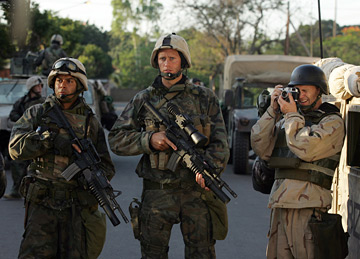
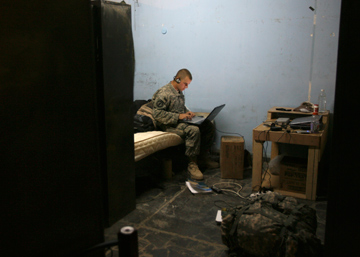
May 12: Mornings are usually slow at COP 821, the combat outpost in Baghdad’s southwestern neighborhood of Saidiyah that houses the Apache Company of the 4-64 Armor Battalion of the 4th Brigade, 3rd Infantry Division. Soldiers walk to the plywood shower shacks in their flip-flops and military-issue T-shirts and shorts, then put on their uniforms and go to the spacious mess hall, where 1st Sgt. James Braet, Capt. Andrew Betson and 2nd Lt. Chris Allen are enjoying a leisurely breakfast of cereal, defrosted and reheated steak, scrambled eggs made from powder and prefabricated French toast. No one is carrying a weapon, and even the knives in the mess hall are plastic. The only soldiers wearing body armor are the ones returning from the guard towers, or from patrol missions.
Continue Reading CloseBradleys used to be considered impregnable
As the hatch closes, I think about the four men from the platoon I'm with who were charred to death in one of these fighting vehicles.
May 9: The open hatch of a Bradley fighting vehicle gapes before me. Sgt. Justin Lee, an Iraqi interpreter named Travis, two other soldiers and I are about to take off for a patrol. Sgt. Lee commands his soldiers:
“You squash up against Travis, I squash up against you, and you squash up against Anna.
“And you,” he says to me, “squash up against that fucking thing up there.”
“That fucking thing” is the fire extinguisher and the first-aid kit. I feel a little safer.
Continue Reading CloseGuns and water coolers in Iraq
U.S. soldiers drink water, lots of it, in scorching hot Baghdad. Plus, patrolling the streets with a less than disciplined Iraqi army squad.
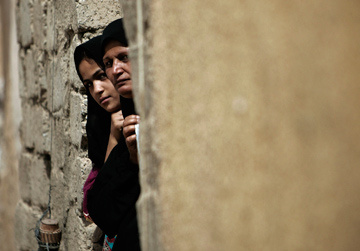
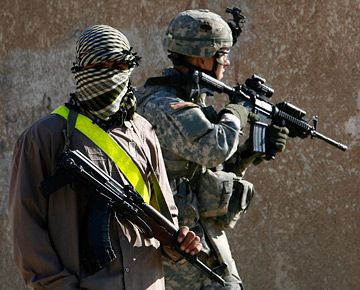
May 7: Guns at the ready (well, mostly, anyway), soldiers of the Iraqi army Muthana Brigade knocked on the door of a two-story house. “Iraqi army!” they shouted, in Arabic. A few moments later, a woman in a full-length dress and a tan scarf on her head opened the door, and the soldiers, on a routine patrol of the southwestern Baghdad neighborhood of Saidiyah, poured in and began searching the house.
Two of the soldiers walked up the tiled stairs to the second floor. Another asked the woman if she kept any weapons in the house. Another asked if he could have a drink of water. One soldier walked into the empty living room where the TV was on, slumped down on the couch, and stared at the screen, his mouth slightly open.
Continue Reading CloseHelicopter travel in Iraq
Military travel is grueling, especially for a soldier with a hole in his face from a sniper bullet who's trying to get back home to Missouri.
May 6
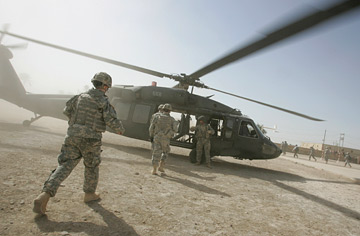
Military travel is often frustrating. I was supposed to leave the Green Zone on a Black Hawk flight bound for Forward Operating Base Falcon, just across the Tigris River. It was supposed to be a 10-minute flight, but instead the helicopter was in the air for almost half an hour and then landed in Camp Taji, a sprawling desert U.S. military base outside the city. The crew told all passengers to get off. It was hazy, there was a chance of a sandstorm and the crew decided it wasn’t safe to fly. We were stuck in Taji’s spartan helicopter terminal — a few wooden benches nailed together under a makeshift awning — and it was unclear when we were going to fly.
Continue Reading CloseBack to Baghdad
A reporter flies over the Iraqi capital on her 10th reporting trip, and sees empty swimming pools, kids playing on a grassless field, entire houses buried in trash.
Sunday, May 4
I am on board a big-bellied C-17 military airplane headed for Baghdad. A member of the crew tells me and my fellow passengers that we are about to take off, and instructs us how to use the oxygen masks. Mine, disconcertingly, is a bag that I’m supposed to put over my head and then tie tightly around my neck — sort of the opposite of what I’d expect to do if I wanted to breathe, but the Air Force guy promises that “the air will flow.” Then he warns us to stay in our seats, with our seat belts fastened, for the duration of the flight, because most of it will be “over the combat zone.” An Iraqi man sitting across the aisle from me opens the palms of his hands and mouths a silent prayer.
Continue Reading ClosePage 3 of 3 in Anna Badkhen