Ben Barber

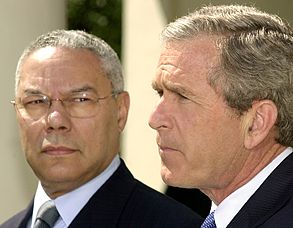
Colin Powell veers right

After conservative critics chastise him for softening sanctions against Iraq, the secretary of state hardens his line.

  • more
    • All Share Services

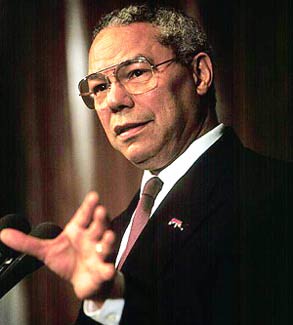
After raising hackles among conservative Republicans with his new policy of easing sanctions on consumer goods against Iraq, Secretary of State Colin Powell took a more hawkish stance Wednesday. “I would not call it an easing of sanctions,” Powell told the House International Relations Committee. He argued that easing supplies of consumer goods would remove the onus that sanctions harm Iraqi civilians. Now he plans to build Arab backing for tighter weapons and oil controls over Baghdad.

Powell has long set off fears among Republicans that the son of black, Jamaican immigrants is really too liberal for the Grand Ol’ Party. So when the new secretary of state shuttled from Egypt to Jordan, Kuwait, Saudi Arabia and Syria last week, promising to allow Iraq greater access to consumer goods, it seemed to confirm their worst fears.

On Wednesday, Rep. Benjamin Gilman, R-N.Y., former chairman of the International Relations Committee, said in public what conservatives have been saying in private all week: Powell’s proposal to ease some sanctions might give Iraqi President Saddam Hussein more money to buy weapons. Republicans remember that as chairman of the Joint Chiefs of Staff, Powell, who never forgot the lack of public support for the Vietnam War where he served as a lieutenant, opposed sending U.S. troops to oust Iraq from Kuwait in 1991. He then opposed sending U.S. troops to Bosnia and Kosovo. Some conservatives were asking if the Bush administration was saddled with a popular but pacifist secretary of state.

But Powell came out swinging, not at his critics but at Hussein, blaming him for withholding food and medicine from his own people, for seeking to build weapons of mass destruction, for smuggling oil and for trying to turn America’s Arab allies against the United States. Powell also rattled a saber when he warned that the United States reserved the right to use military force if it found Iraq was building prohibited weapons.

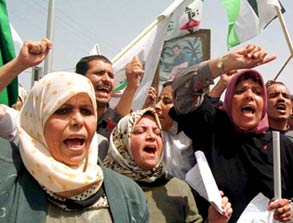
U.S. officials say Iraq has plenty of money under U.N. oil-for-food sales but simply failed to buy and distribute adequate food supplies. Nonetheless, Saddam won the propaganda war and convinced Arabs in the region that U.N. sanctions were harming Iraqi children. This came at the same time that Israel was killing hundreds of Palestinians in the intifada that began in September, leading many Arabs to demonize America, by proxy, as anti-Muslim. Powell was even burned in effigy in the West Bank the day he traveled to Ramallah to meet Yasser Arafat. Powell decided to beat a strategic retreat on consumer goods sanctions in order to win support for more targeted oil and weapons sanctions. Arab countries that had allied with the U.S. in 1991 to drive Iraq out of Kuwait have grown more sympathetic to the suffering of Iraqi civilians in recent years.

As Powell’s plane left the Middle East last week, he told reporters he had won private support from the Arab leaders for the new targeted sanctions on Iraq even though those same leaders continued in public to criticize all Iraq sanctions.

Specifically, Powell said that new Syrian leader Bashar Assad pledged to place Iraqi oil shipments through a Syrian pipeline under U.N. control. Iraq exports about 2 million barrels of oil per day through the U.N.-controlled programs, but another estimated 450,000 barrels are smuggled through Turkey, Syria, Jordan and Gulf ports. The money from those sales is unsupervised and could be diverted to weapons purchases if Saddam has a way to get them into his country. In a memoir released last year, Khidhir Hamza, who once led Iraq’s nuclear weapons program and served as a senior advisor to Saddam before defecting to the United States, described how Iraqis routinely and clandestinely purchased weapon-making materials from abroad.

Powell’s new Iraq policy calls for financial assistance to the frontline states such as Turkey, Jordan and Syria to cover the loss of cheap Iraqi oil and to cover the cost of customs patrols to stop the smuggling of oil out of Iraq and weapons materials into the Middle East nation.

Powell also reassured conservatives at the Wednesday hearing with a strong call for the return of U.N. weapons inspectors whom Iraq expelled in 1998. “The only way to get out of this regime of control of money is for us to be satisfied that no such weapons exist or are being developed — the inspectors have to go back in,” he told the committee. And the secretary of state beefed up verbal support for overthrowing Saddam Hussein even though he has previously been among many in Washington who are skeptical that Iraqi opposition groups, backed by a $95 million U.S. government aid program, have any chance of success against the totalitarian control Saddam wields.

“Last week I released more money for the [opposition] Iraqi National Congress so they can step up the level of their activity, and the administration is also undertaking a fuller review of other things that can be done to support opposition activities against the regime,” Powell said.

Powell’s efforts to reassure Republican hawks that he is not soft on Iraq were accompanied Wednesday by a sharp swing to the right on North Korea.

It was a significant shift in course from Tuesday, when Powell stated that he was satisfied with the Clinton administration’s 1994 framework accord, offering North Korea twin nuclear energy plants, fuel oil and emergency food in return for the freezing of its suspected nuclear weapons program. “We do plan to engage with North Korea to pick up where President Clinton and his administration left off,” Powell told reporters at the State Department. “Some promising elements were left on the table and we will be examining those elements,” he said.

But Wednesday, Powell shifted to the right following a meeting with President Bush and South Korean President Kim Dae Jung. He told reporters, “If there was some suggestion that imminent negotiations were about to begin, that is not the case.”

North Korea has “a huge army poised on the border within artillery and rocket distance of South Korea,” Powell said. “They still have weapons of mass destruction and missiles that can deliver those … so we have to see them as a threat.”

Washington is full of rumors of a conservative-liberal split between Defense Secretary Donald Rumsfeld and Colin Powell. When asked about this, a senior administration official scoffed: “They’re big boys. They know how to work things out.” Indeed, this week Powell began to get more in line with the Republican center of gravity.

Colin Powell rolls up his sleeves

On his trip to the Middle East next week, Bush's secretary of state will face an escalating conflict that he never intended to mediate.

  • more
    • All Share Services

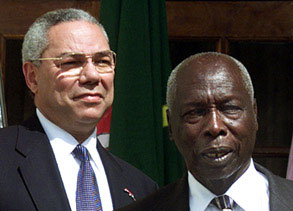
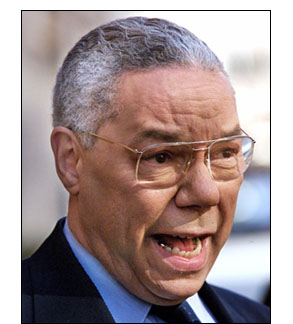
Colin Powell rolls up his sleevesSecretary of State Colin Powell talks to journalists after being interviewed on CBS's "Face the Nation" in Washington Sunday, Feb. 11, 2001. Powell spoke about his upcoming trip to the Middle East, his first trip, and said he will stop in Syria for a few hours, as Syria is an "important player" in the process. (AP Photo/Rick Bowmer)(Credit: Associated Press)

President Bush and Secretary of State Colin Powell lasted about 10 days.

That’s all it took to abandon promises to keep the Middle East’s intractable Arab-Israeli dispute at arm’s length. Like President Clinton and Secretary of State Madeleine Albright before them, Bush and Powell now burn up the phone lines to Israeli and Palestinian leaders, to the kings and presidents of the Middle East. They call for calm, for negotiations, for low oil prices, for an end to incitement and violence and for solidarity against Saddam Hussein. Plus ça change.

Powell’s solo trip overseas begins Feb. 23. He goes to Egypt, Jordan, Saudi Arabia, Israel, the West Bank and Gaza, Syria and then to Kuwait for the 10th anniversary of his victory over Iraq as chairman of the Joint Chiefs of Staff.

The new administration is already learning that you can defeat an army, you can summon peace conferences and you can even get signatures on treaties, but pinning down peace in the Middle East is like mapping the shifting desert’s dunes.

Powell even briefly tried to outlaw the term “peace process” at the State Department, in the belief it had helped drag out moves towards peace. The new administration would talk about “peace” directly and deal with the region only when the parties themselves had decided to end their 50 years of war. That approach lasted less than a week, and Sunday even Powell was back on TV talking about the peace process.

Underlying America’s mothlike attraction to the Middle East conflict is fear of things spinning out of control, of massive violence and terrorism, of instability in Egypt, Saudi Arabia, Jordan and Morocco toppling friendly regimes and cutting off oil supplies. There is fear of how Muslims in Indonesia, Chechnya, Central Asia, Algeria, France, Turkey, Iran, Nigeria and elsewhere might react to an Arab-Israeli conflict.

So the Bush administration has found the Arab-Israeli dispute at the top of its foreign policy agenda since Inauguration Day, just like every administration before it since Harry Truman’s. Bush fired the U.S. special envoys led by Dennis Ross and tossed the grenade of Middle East policy to the regular State Department desk at the assistant secretary level. It was an attempt to downgrade the attention paid to the Middle East in the belief that the parties need to work on their own, without a big brother standing by.

But the first crisis came quickly, when hawkish Likud leader Ariel Sharon won by a landslide in the Feb. 6 prime minister’s race against Ehud Barak. Sharon then said that offers made by Barak and Clinton to give Palestinians 95 percent of the West Bank and Muslim holy sites in Jerusalem were void, a view the Bush team shared. Arafat had already rejected this, demanding all the land and the return of up to 4 million Palestinian refugees. Now Sharon has said he’ll only let the Palestinians keep the 42 percent of the West Bank and portions of Gaza they already hold, Jerusalem will remain Israel’s united capital, there will be no refugee right of return and he won’t negotiate till the Palestinians halt violence.

The fear in the Middle East is palpable. On Tuesday, an Israeli helicopter fired wire-guided missiles at a car, killing Masoud Ayyad, 57, a Fatah security official who Israel says worked for Hezbollah and had planned attacks on Israeli settlers. It was the latest of about a dozen of what Palestinians called “assassinations” and the Israelis called “targeted” killings of ringleaders in anti-Israel violence.

On Wednesday, it was Israel’s turn to mourn as a Palestinian driver ran a bus into a crowd of young Israeli soldiers at a bus stop, killing eight. The whole region is worried about how Israel will react once Sharon is in control, even if his invitations to Barak and peace advocate Shimon Peres to join his Cabinet as defense minister and foreign minister are accepted.

A violent clash could drag in Israel’s neighbors. No Arab country wants to fight Israel, which has military supremacy and is believed to have nuclear weapons. But things can get out of control, especially when the impassioned issue of the Al Aqsa mosque in Jerusalem is concerned.

I saw that firsthand at the last Middle East summit Clinton called at Sharm el-Sheikh last October. A portly Egyptian press officer in his shiny gray-blue suit sweltered in the sun next to the JollieVille Golf Resort clubhouse where Clinton, Barak and Arafat finalized an emergency plan to stop the bloody new intifada in the West Bank and Gaza and put the Oslo peace process back on track.

“We, all of us in Egypt, myself included, we want war with Israel now,” the press officer said. “The Israelis are killing the Palestinians, killing children. And General Sharon started it by walking in the Al Aqsa Mosque with his shoes on.”

Sharon never entered the mosque when he visited the Temple Mount on Sept. 28. But the rumor that he did was eagerly believed by the Egyptian press officer and many others. The day after Sharon’s visit the second intifada began and the 1993 Oslo peace process was in shreds.

Oslo collapsed when hawkish Israelis dragged their feet, continued to build settlements and kept control over Arab movements between their towns and villages that had been handed over to the Palestinian Authority. Frustrated Arabs flocked to the hard-liners of Hamas and Islamic Jihad. Those groups said Israel only listens to violence, which will internationalize the conflict, stir up popular movements in moderate Muslim states and get Europe and Russia into the peace talks to dilute U.S. support for Israel.

Oslo began to die just a few yards from where it began — on the grounds outside the White House. On a gray and bitter December day in 1999, Syrian Foreign Minister Farouk Shara opened peace talks with Israel at the Rose Garden by sounding the old hard line. His face grim and set like the weather, he did not even look at Barak or shake his hand.

Shara called for return of all “occupied land” without defining which land he meant. Was it the Golan Heights? The West Bank and Gaza? Syrian government maps of the area gave an indication of what Shara meant. Where Israel’s cities and towns have grown up in the past century there is only the name “Palestine.” The name “Israel” does not appear.

Shara’s icy blast was followed by peace talks at Shepherdstown, W.Va. But Syrian journalists there refused to talk to Israeli reporters at the next table. It was as if we were back in the 1950s when many Arabs believed they would one day defeat Israel, restore Palestinian refugees to Jaffa, Haifa and Jerusalem, and send the Jews back to Europe.

During the talks, while Israel was willing to hand back the Golan Heights for a peace deal, it refused to give back the final 10 yards that would restore Syrian access to the Sea of Galilee, Israel’s largest reservoir of fresh water. The talks ended in failure, as did a Clinton-Assad summit in Geneva last spring. Soon after, Syria gave the green light for attacks by Hezbollah guerrillas on Israeli troops in Southern Lebanon, which Syria occupies.

By June, Barak decided to cut Israel’s losses and carried out a hasty, unilateral withdrawal of its 1,500 troops after 18 years in southern Lebanon. That withdrawal would prove costly.

Anti-Israel hawks throughout the Middle East hailed the Lebanon withdrawal as Israel’s first retreat under fire from Arab land. Iranian envoys traveled through the region bringing cash and promises of weapons and support for anti-Israel attacks.

“Follow the model of Hezbollah,” said the Iranians and other hard-liners. “Israelis have grown fat, lazy and weak,” gloated the statements from Hamas and Islamic Jihad. “Israelis care about the stock market but they can no longer take losses in battle.” Waving Hezbollah flags, Palestinian youths stormed Israeli checkpoints with rocks and then guns as the new intifada began Sept. 29.

Israel bears much of the blame for the derailment of the Oslo land-for-peace process signed and sealed on the White House lawn in 1993 with a handshake by Prime Minister Yitzhak Rabin and Arafat. Despite a pledge to eventually give up the West Bank and Gaza, Israeli settlers there increased since 1993 from 150,000 to 200,000 this year, infuriating the Palestinians as they witnessed their land eaten up for new houses and roads.

And although Israel did turn over 42 percent of the West Bank and most of Gaza, placing nearly all Palestinians under Palestinian Authority control, the land between the towns and villages remained under Israeli control. This created the hated “leopard’s spots” geography.

“I work for a Western news agency, I speak Hebrew and English, most of my colleagues are Israelis and Americans but I am humiliated every day coming to work in West Jerusalem from my home in Ramallah,” a Palestinian journalist told me. It takes several hours to make a trip from Palestinian-controlled Ramallah or Nablus to Hebron, less than an hour’s drive, because of the Israeli army checkpoints at the edges of the cities and towns.

I once rode in a bus full of Palestinians through one of the checkpoints. The animated chatter died into a sinister silence as a 20-year-old Israel soldier in full battle gear entered the bus and passed down the aisle looking at identity cards. “The Israeli boys pretend to be angry but are afraid inside,” said one Palestinian afterwards. “We pretend to be afraid but are angry inside.”

Since the Oslo process collapsed into violence, the Palestinians have adopted the following strategy:

  • Terrorist and guerrilla attacks on Israeli troops, settlers and civilians.

  • Provoking Israel to use excessive force and turn moderate Arabs and their allies in the United Nations against Israel. Egypt and Jordan pulled their ambassadors from Israel while Morocco and Tunisia have downgraded relations. A resumption of the Arab boycott of Israel is in the works.

  • Dividing Israel from its core ally, the United States, by inspiring wide anti-Americanism such as the attack on the USS Cole in Yemen and a possible oil boycott.

    Israel’s strategy has been:

  • Economic pressure by stopping payments of customs taxes, halting transit of agricultural and other goods out of and into Gaza and the West Bank and stopping up to 120,000 Palestinian workers from reaching jobs inside Israel.

  • Assassinations of leaders of the uprising and the use of collaborators and infiltrators.

  • Separation or disengagement from the Palestinians, as proposed by widely read author Dan Schueftan. He calls for restoring fences between Israeli and Palestinian territory; importing guest workers from Eastern Europe and Asia to replace Palestinians; and economic isolation.

    Sharon has said he opposes separation, recalling his pre-independence youth when Arabs and Jews shared the land. In a recent videoconference with Washington reporters he also said he will retain, no matter what the peace deal reached, control over the Jordan Valley to protect Israel’s eastern flank from Iraq.

    Israel has had a rude awakening and gone back to the sense of being isolated and surrounded. Even Barak, whom Sharon asked to become defense minister, took a hawkish tone in a recent teleconference with Washington reporters. “The Middle East is not America,” he said. “There is no security for those who cannot defend themselves, no respect for the weak.”

    What drags the Bush-Powell team into the conflict — and forces Israel to negotiate even with those who seek its elimination — are the new wild cards in the region: weapons of mass destruction and long-range missiles being developed by Iraq, Iran and possibly Syria.

    Some say that it was the overbearing presence of the Clinton team that inadvertently caused the peace process to collapse and that Israelis and Palestinians may find it easier to reach common ground when faced with a less intrusive American presence under Bush and Powell. But the flurry of phone calls last week and the announcement of Powell’s trip may mean the U.S. will be just as involved as before.

    And Powell’s visit to Kuwait will highlight the fact that control over the strategic region remains uncertain: Some lean toward peace, tolerance and accommodation but others listen to Saddam Hussein, Iran, Hamas and Hezbollah, believing that by violence they stand to increase their power.

    What Powell brings to the region is his legendary victory in the Gulf War, his ability to get along with military and political leaders and his supreme confidence that with goodwill he can break through hostile barriers.

    Both Arabs and Israelis believe Powell is a guy they can talk to and who understands them. So even after the personal diplomacy of Bill Clinton ran aground, the personal charisma of the new guy in town is likely to leave people in Riyadh and Damascus, as well as in Gaza and Jerusalem, with some hope of getting the peace process back on track.

  • Continue Reading Close

    Shutting down the Tehran Spring

    How religious hard-liners sabotaged reforms in Iran and earned the spite of their people.

    • more
      • All Share Services

    Shutting down the Tehran Spring

    Last spring, hopes were high that Iran’s Islamic government would end support for terrorism, make peace with its neighbors and allow greater freedom of thought and economic activity internally. Those hopes have been dashed by a series of heavy-handed moves since the summer. The hard-line mullahs who run this country of 60 million have chosen to ignore overwhelming votes and roll back any moves toward reform.

    From the universities to the bazaars to the upscale city neighborhoods to a drought-stricken village south of Tehran, signs of the losing battle for reform are ever present.

    In upscale north Tehran last summer, young men and their girlfriends walked along the streets holding hands — a display of affection that could have cost them a beating and time in jail a few years ago. A very few women dared walk the five yards from their front door to their cars without a headscarf. And while headscarves, or the more conservative head-to-toe black chador, are still required by law outside the home, increasingly women let some of their hair escape, wear colorful scarves and don short manteau coats, allowing their bare feet in dainty slippers to be seen — often with bright nail polish.

    But in the village south of the city, a few local men had just given us assurances that things were fine, when an angry woman interrupted.

    “Don’t talk to those men,” she said. “They will only tell you lies. This place is full of drugs. Everyone is using drugs or selling them to our children. Come with me and I’ll tell you what is really going on.” Up a small hill, in a neat alley off the main road, she exploded with passion. “I am not afraid. You must know what this government has done to us.” The Afghan refugees brought in hash and opium some years back and started selling it to children as young as 9 and 10, she said. The town police won’t arrest the drug pushers. There’s no work so everyone takes drugs to pass the time.

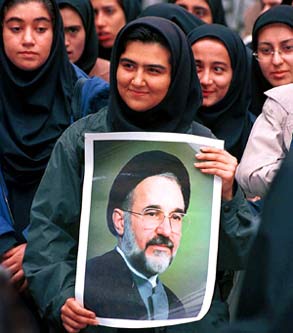
    Reform-minded president Mohammad Khatami “is not given a chance to change things,” she said. “Iranians are afraid to have riots against the mullahs. They are cruel and will kill anyone.”

    A few neighbors stopped by and listened. Sheepishly, they endorsed her complaints. “It’s all true,” said a young man. “Children of 12 and 10 are using opium. It’s cheaper than candy, cheaper than food.”

    Over a bowl of cold grapes fetched from her home, the woman unraveled a story of neglect, corruption, religious power, government indifference and drug addiction. “We hate those mullahs,” she said.

    Aside from political controls, the ruling mullahs have overwhelming control over Iran’s economy through about 100 religious foundations called bunyads, some of them centuries old, which were allowed to seize the factories and institutions of the Shah’s supporters in the revolution of 1979. “Ninety percent of the most modern industries are controlled by the bunyads — televisions, electronics, refrigerators,” said economics professor Ali Rashid, a former vice president of the Central Bank of Iran.

    The bunyads pay no tax. They control commodity sales, distribution, competition, transport, imports, exports, financing and labor issues. The Supreme Religious Leader Ayatollah Ali Khameini appoints the heads of the bunyads and some of their children are married to children of the important mullahs. One of the major bunyads, the Foundation for the Disabled and Oppressed, is worth an estimated $10 billion. Another, the Imam Reza bunyad, controls vast areas of farmland, a Coca-Cola plant, two universities and has been importing materials that could be used to make an atom bomb.

    Operating without any external audits, the bunyads provide both a source of funds to the clerics to pay off the basiji, or religious vigilantes, and the means to control the economy and reward the regime’s allies, especially merchants.

    Throughout Iran, ordinary people who meet an American begin with an effusive welcome and then shift quickly into angry condemnations of the theocracy running their country. They make a circle around their heads with one finger, miming the turbans of the mullahs who rule as an unaccountable nomenklatura. One mullah told me that he removes his turban and robe in order to get a taxi to stop for him, so great is the hostility he feels among the population.

    This seething anger has led to demands in the past three years for reforms, demands which were taken up by academics, liberal clerics, politicians and writers who launched newspapers and ran for the Majlis, or parliament, last February. Reformists swept to power in the elections for the Majlis, giving hopes that the long, green winter of the Islamists was giving way to a sort of Tehran Spring. It was a huge surprise to the Islamic Revolution hard-liners.

    Reformist cleric Khatami, elected president in 1997 by a large majority over his hard-line opponent, told the American people in a CNN interview in 1998 that he favored a new relationship based on mutual respect for each other’s civilization. He was ambiguous, however, when asked to apologize for the 1979 takeover of the U.S. Embassy in Tehran by Islamic revolutionary militants, and the 51 American diplomats they held hostage until Jan. 20, 1981.

    The rest of the world responded with optimism. U.S. Secretary of State Madeleine Albright offered a tenuous hand of friendship to reformists in the spring by dropping U.S. trade bans on Persian carpets, pistachio nuts and caviar.

    But despite Khatami’s apparent good intentions, it was never clear whether he had the power to thaw U.S.-Iranian ties. Control over the army, Revolutionary Guards, judiciary, intelligence services, economy and other power centers remained with Ayatollah Khameini, who resisted reforms that might dilute the power of the clerics to rule Iran.

    Each time Khatami made positive comments aimed at defusing Iran’s international image as a pariah state that sponsored terrorism abroad, the hard-liners would send a contrary message through their own channels. For example, they sent officials abroad to voice support and supply weapons and cash to the Lebanese Hezbollah and the Palestinian Hamas — both on the U.S. State Department terrorism list. Indeed, Iran’s hard-liners’ gloating over Israel’s withdrawal from South Lebanon in May helped persuade Yasser Arafat to refuse any negotiated settlement at Camp David and instead take the path of violence that followed. When Khatami went to Italy, Germany and France to reopen trade and diplomatic links, the hard-liners who control the Iranian television and radio broadcast service ignored the welcome he received and the oil and gas exploration contracts he signed. Instead, it reported that he had attended a reception where wine was served, which is forbidden under the Islamic Revolution.

    By spring, Iran’s movements toward reform had been neutralized, and by late summer the government went into backlash, with Khatami left essentially powerless.

    At the heart of the hard-line refusal to abide by the election results is the belief in velayat-e-faqih or rule by the jurisprudent. This is akin to the divine right once granted to medieval European kings prior to the enlightenment. It justifies any action taken by the supreme religious leader. They have essentially drawn a line in the sand saying to the majority of Iran who voted for reformists that real power will remain with the clerics.

    In early August a daring gathering of over 1,000 men and women at Beheshti University in North Tehran offered up a thunderous accolade to two heroes of the reform movement: Hojatollah Mohsen Kadivar, a liberal cleric just released from 18 months in prison for having questioned absolute religious rule; and philosopher Abdolkarim Sorush, who has endured beatings by hard-line zealots.

    Perhaps reflecting the terror instilled in many who have faced the jails of the ayatollahs, said to be as horrible as those of the Shah, Kadivar was cautious in his criticism of the government. He even admitted he was awed at the outspoken remarks of other speakers, who called openly for “the institution of religion to become separated from the institution of government.” A few months later, as the regime tightened its controls over reformists, both Sorush and Kadivar would be blocked from a reformist conference by a mob of religious vigilantes.

    Meanwhile the major battle was taking place in the media. With domestic radio and television broadcasts controlled by the regime, people have turned to Farsi language programs from the Voice of America, the U.S.-funded Radio Free Iran, the BBC and Israel Radio. Many homes in the east also bring in Turkish satellite television shows, mainly soap operas banned on Iran government stations. But in this highly literate country, the struggle for reforms has been largely fought in the print media.

    Dozens of new reformist newspapers opened up in the last year, only to be closed down by the hard-line-controlled judiciary. Many then reopened under new licenses and bearing different names, until they too were shut down. The reform papers sold well while they lasted, leaving the pro-government Resalat and Kayan unsold in tall piles at newsstands.

    “Our society is like a cage,” said a vendor at a Tehran newsstand. “Suddenly truth was poured out and people wanted to find out about the truth that was published in that cage.”

    The last pro-reform major paper, Behar, which means spring, was closed in August — an action that brought the momentum for change up against a firm, immovable wall.

    The moment of truth took place Aug. 6 in Tehran at the convening of the Majlis, dominated by newly elected reformists. A handful of Iranian reporters and myself waited in the press gallery for discussion to begin on a bill that would stop the closing of reform newspapers and magazines. The closures had been going on since April, when the outgoing Majlis amended the press law to allow the judiciary to close newspapers at will.

    Suddenly a reformist legislator took up his microphone to ask: “Why is the press law not on the printed agenda?”

    Parliament speaker Mehdi Karrubi said in response: “I thought you knew. I thought we had a deal. We have a letter from the supreme leader. We cannot discuss the press law.”

    Although the reformists appeared nervous at the mention of supreme religious leader Ayatollah Ali Khameini, a few demanded that the letter be read aloud. Some asked how it was possible for the supreme leader to change their agenda, which they said was protected by law. They carefully phrased their objections so as not to directly challenge the absolute power of the clergy, even as it was apparent that they wanted to do so.

    At this point the hard-line mullahs in the Majlis (not all mullahs are hard-liners) stood up and began shouting. “You must obey the supreme leader,” shouted one bearded and robed cleric with the bearing of an Old Testament prophet. Another, short and fat in a tan robe and white turban, was wrestled from the chamber by his allies to keep him from attacking the reformers. Finally, with the entire nation listening to the radio broadcast of the pandemonium in the Majlis, Karrubi read aloud the letter from Ayatollah Khameini.

    “If the enemies of Islam and the Islamic system take control of the press or infiltrate it, a big danger will threaten the security and faith of the people,” his letter said.

    The current law “has been somewhat able to prevent this great plague, and changing it … is not legitimate to the interest of the establishment and the country.”

    A few further squawks from the reformists, a few further putdowns from the hard-liners, and the press freedom law was history. And so was the fantasy that reformists could effect changes in Iran’s democratic system.

    The next day, Ayatollah Khameini unleashed a frightening display of raw, brutal power on the streets.

    Thousands of angry young basiji assembled in front of the Majlis with loudspeakers and banners, some of them wearing white robes indicating readiness to die in defense of the Islamic revolution.

    “We see the hidden hand of America and we don’t forget our most important enemy is America,” said an intense young man in front of the Majlis as dozens of his equally hostile colleagues circled around. “Our most important slogan is ‘Down with America.’ Why do you Americans want us to exercise your democracy? Why not let us have our own Islamic democracy?”

    The basiji, bused in for the demonstration, said that America was behind the reformist Iranian newspapers.

    “Death to America. Death to Israel,” came the shouts from thousands of basiji. They thrust their fists in the air and called for the blood of the legislators who they thought had insulted Ali Khameini by questioning his right to delete the press law from the agenda of the Majlis. “We will fight anyone who fights with our leader,” read one slogan. “The students are awake and hate the enemies,” read another.

    Inside the parliament building, the reformists tried to move ahead with their agenda, despite the ominous show of power outside. They passed a bill raising the marriage age of girls from 9 to 13. But even that small effort was simply quashed a few weeks later by the Guardian Council, which ruled that it conflicted with Islamic law.

    Two days after the press debate was silenced, officials closed the newspaper Behar for quoting a legislator as saying he would reintroduce the press bill. The Tehran Spring was officially over.

    The wave of counter-reforms that followed took such a heavy toll on the reformists that by November, even President Khatami was forced to admit defeat. He told students that he was powerless to stop constitutional violations committed mainly by the hard-line judiciary which had interrogated, arrested and imprisoned many of his reformist allies.

    “The president should be able to stop constitutional violations,” he said, while students chanted, “Political prisoners should be released.” His popularity remains high and he will likely win reelection in the spring if he runs. But the real decisions on Iran’s future do not lie with him or with the majority who still favor reform. They lie in the hands of perhaps 20 percent of the country who are with the mullahs.

    Recent events have seen the fallout continue. On Dec. 14, a key Khatami ally, Minister of Culture and Islamic Guidance ‘Ata’ ollah Mohajerani, resigned. He had been responsible for allowing reform newspapers to open, for inviting foreign reporters to visit Iran, for encouraging moderate filmmakers and intellectuals and for seeking improved ties with the United States.

    “The conditions and requirements that have taken shape in the realms of art, culture and the intellect have made it impossible for me to continue my duties,” he was quoted as saying. “We have not achieved any success worthy of our nation, artists and writers.”

    The same hard-liners who were handed a surprise defeat by the 30 million voters in February’s elections have expressed certainty that they still represent the nation’s will. Hassan Ghafoorifard, vice president of Iran under former President Hashemi Rafsanjani, blamed the defeat on economic and social problems the regime has been unable to solve. “Those who voted in the election did not vote for us. But that does not mean they are for Western culture. I believe they still believe in the Islamic Revolution,” he said.

    He summed up the views of his peers: “Religion is everything for us — the relationship between our body and soul, our body and God, the people and the country. Everything has to be taken from Islam.”

    In the village south of Tehran, which is best left unnamed, the woman and her neighbors complained bitterly that Rafsanjani and his mullah allies were making fortunes while the ordinary people were without help in the drought and lacked jobs or help in fighting the drug epidemic. In fact, if the anger of the lady in the village is any indication, Iran is heading for another explosion rather than an evolution.

    Continue Reading Close

    Page 3 of 3 in Ben Barber