Chris Colin

What else we’re reading

Western publishers veil Muslim women, a girl gang rocks Chile, a New York doctor plots the nation's first womb transplant and more.

  • more
    • All Share Services

New York Times: Journalist, feminist and cultural critic Ellen Willis died of cancer yesterday. Her writing was at once anti-authoritarian and broad-minded. During the Lewinsky scandal she was one of the first to note the wider implications for the culture, and for journalism, in particular: “Just as Victorian repression produced a thriving pornography industry, the exclusion of sex from ‘serious’ news media produced tabloidism,” she famously wrote.

Times Online: Dr. Giuseppi Del Priore of New York Downtown Hospital says he plans to perform the nation’s first uterus transplant. The news spread fast, but the procedure will be costly and dangerous — womb to spare jokes will likely be more common than actual transplants for the foreseeable future.

BBC: Police in Chile have arrested two members of the notorious all-girl burgling gang the Spider Girls. “We like to buy new clothes,” one ex-member explains.

ABC News: Former “World News Tonight” co-anchor Elizabeth Vargas describes her first week back to work after maternity leave, and ponders the “Can Working Mothers Have It All” question. (Spoiler: Not so much.)

Slate: Who’s putting Muslim women into veils in the West? The media!

The other Harold Ford Jr. race card

Forget racist whites -- did the GOP do a number on black Tennessee women?

  • more
    • All Share Services

Did the GOP’s inflammation of white bigotry in Tennessee’s Senate race work double duty on black women? Debra Dickerson picks up the thread in the Washington Monthly, wondering whether Harold Ford Jr.’s “penchant for ‘nonpartisan’ dating” became “the straw that broke Tennessee’s sisters’ backs.”

The question was ignored by the mainstream press, which fixated on the effect of the attack ad — featuring a fictional white woman inviting Ford to call her — on white voters. But Slate’s Mickey Kaus considered it two weeks ago, as did Political Sapphire and Booker Rising, a site for black moderates and conservatives.

“The extremely tense feelings that many Black women have about Black men who ‘abandon sisters’ in their dating choices is well-known — in the Black community, anyhow,” Shanikka at Political Sapphire writes. “Go to any space in which single heterosexual Black women congregate and you will likely, over time, hear examples of it. Many of whom are single — in part because they would never consider marrying a white man (history ain’t that old YET in the South) — and deeply resent Black men who date across racial lines at a time when there are only 90.1 Black men alive for every 100 Black women.”

Meanwhile, the Christian Progressive Liberal tweaks the abiding “Why couldn’t you find a good black woman to marry?” question:

“I say he should be able to date who he wants, if he’s going to become a private citizen. But since he’s an ambitious politician, my advice to him … was not to hand Bob Corker and the ReThugs ammunition to shoot him with.”

Of course, the idea isn’t that black women would decide to vote for Corker — it’s that they wouldn’t vote.

“There’s likely not a Black woman in Tennessee who would vote *for* Bob Corker solely because of an accusation that Harold Ford is hitting it — or trying to — with white girls,” Shanikka writes. “Sisters are lots of things, but politically stupid generally isn’t one of them … Instead, they just stay home.”

The central question — did Ford’s love life alienate black female voters? — remains theoretical and speculative, at least until more data comes in. But buried in a CNN exit poll is a possibly telling statistic: Though Tennessee women as a whole preferred Ford, married women went with Corker. Did marital status inform how the “jungle fever” strategy might have played out? Even less explored in all this: How did the state’s black male voters react to the issue?

Finally, because you can’t discuss charismatic black politicians without mentioning him, might Barack Obama ultimately benefit from what Booker Rising calls Ford’s “impulsive love for white women”? Many of the online discussions featured affirming references to the Illinois senator’s marriage to a black woman, and a dark-skinned black woman at that. Needless to say, the GOP has two years to spin that one into a minefield, too.

Continue Reading Close

Feminism and intervention, Part XXXVIII

How to parse another milestone in a very different war?

  • more
    • All Share Services

Ten years ago yesterday, in response to international pressure and a nagging war-crimes indictment, Gen. Ratko Mladic was fired as military commander of the Bosnian Serb army. No need for a cheap Rumsfeld comparison — there’s a clear Iraq one to be made.

Slow out of the blocks, the U.S. eventually found its compass for the Balkans wars of the ’90s, and violence against Bosnian Muslim women was something of a lodestar. Mladic, among others, came to represent the organized, systematic rape — of as many as 30,000 to 50,000 women, the American press claimed at one point — that helped instigate a humanitarian intervention movement in the West.

To spend even a little time in Sarajevo is to see that terrible things did happen to helpless civilians. Through countless fictions, this truth filtered down to a great many Americans in the ’90s. Key exceptions notwithstanding, feminists were among the first to call for airstrikes.

To truly wade into the matter of the Balkans wars would mean pulling back, looking at the myths of ancient ethnic hatreds or, say, Noam Chomsky’s position that intervention there was merely a pretext for establishing a norm for resort to force. But yesterday’s anniversary has me reflecting on our country’s more recent humanitarian intervention, and, without wanting to sound like Christopher Hitchens, I can’t help wondering: What about the Saddam regime’s own crimes against women, trotted out by the administration during the run-up to the war? By most accounts there was organized, systematic rape. How should feminists reconcile humanitarian intervention in some places and not others? Do we care more about violence against lighter-skinned women, as some have argued? Is our humanitarian impulse dwarfed by our distrust of all neocon adventures, as the right wing complains? Why did one intervention have so much more feminist support than another?

The obvious response is that Iraq and the Balkans were, well, different. Ditto the handling of the interventions, ditto the motives and the global contexts. Nevertheless, as we move toward a new chapter in the current war’s saga — rhetorically, at least — it seems worth pausing for reflection. Sad to say, future conflicts will surely bring more rape camps. The fact of these rape camps will surely be exploited by future administrations bent on other invasions. Need feminists devise some kind of universal intervention yardstick? Not to deflect tin-pot accusations of hypocrisy, but to recognize that our sanctioning of military action is powerful stuff?

But maybe talking yardsticks is accepting a fundamentally flawed premise. Universal rules are handy, but if we’ve learned anything, it’s the limits of staying any one course. Inflexibility in the foreign policy department surely causes as much harm as it thwarts.

No solutions here. Just a weird feeling as our present war turns a certain corner and other wars recede further into memory.

Continue Reading Close

New from Weber … Girls!

Barbecuing needs feminism like grilled fish needs a bicycle.

  • more
    • All Share Services

New from Weber ... Girls!

Signs that the end is near are so common that Weber can publish its “Girls’ Guide to Grilling” without anyone pausing to weep, or moan, or expedite construction on the backyard bunker, which could coincidentally go in right beside the Weber Genesis Silver gas grill, which is now “handsome, with a nice build.”

“For the first time, less than half of the Weber Grill-Line callers reported men to be the primary griller in their household,” Weber tells us in its latest marketing materials. (Weber is referring, incidentally, to the Weber Grill-Line, 1-800-Grill-Out — “the nation’s only toll-free outdoor cooking hotline” — celebrating its 10th anniversary.) Anyway, the numbers are in, and the largest-selling single brand of grills in the world has recruited “Betty, Marsha, Christina, Theresa, Edna, Jeanine, Ginger, Brooke and the other Girls of Weber” to reel in the newest demographic.

“Weber’s Girls’ Guide to Grilling,” a slim volume of barbecue basics, safety guidelines and actual recipes, is a puny, insouciant, snarky, breezy, down-to-earth little primer of a P.R. mailing. “How About a Little Grill Talk” is one section. Also “Flirting With Flank Stank” and “Practicing Safe Sizzle.” More cleverness has never gone into a booklet about barbecuing — if Lorrie Moore wrote about outdoor cooking, this would be her 40-page opus. Likewise, if opuses could make human choices, this one would choose “Ally McBeal” and then some “Bridget Jones” before bed.

Weber’s bid to get women enjoys a thoroughly female-oriented aesthetic. The ad copy no longer sounds like men imitating women, but rather women imitating women. On some pages this copy is accompanied by festive paintings of grills, dancing lime slices, or peaceful plates of summer meat cooling happily beside a healthy glass of red wine. On other pages, flowers! The flowers — Monet-style petals in pink and yellow oils — announce whimsy and BBQ flair. If grilling was once the province of dull, hulking men, well, the men had better make room for big peonies.

Do the minor calculus (there’s probably a girls’ guide to it out there), and you can get a good idea who the intended audience is. The Girls’ Guide girl, it would seem, is the famous middle-class, middlebrow, vaguely liberal female who, by most accounts, is taking over the world. Weber has her number: She’s the urban soccer mom whose college roommate read de Beauvoir, her husband burned one too many wieners last August, and her summer evenings need something between pro-choice rallies and crafting. Her politics are those of sincere logic (Girlfriend, we can grill as good as the next guy) and moderation (Girlfriend, let’s not stop shaving our legs or anything).

Betty, Marsha, Christina, Theresa, Edna, Jeanine, Ginger and Brooke are probably wondering at this point why the “Girls’ Guide to Grilling” is getting picked on, when it’s surrounded not just by “The Girls’ Guide to Hunting and Fishing,” but also “A Girl’s Guide to Clubbing,” “The Girls Guide to Elvis,” “The Girls Guide to Hong Kong Movies,” “The Girls Guide to Career Planning,” “The Girls’ Guide to Surf + Skate + Snow” and “A Girl’s Guide to Public Toilets,” to name a few. The thing is, public toilets and Hong Kong movies aren’t a $1.45 billion industry in America, as has been estimated about backyard barbecuing. In a business where penetration is said to be 80 percent — incredibly, Weber reports that four in five households own a grill — this girls’ guide is sort of meaningful.

Money aside, why does the Girls of Weber campaign matter? The mattering is in the borrowing. Like Britney Spears fans wearing “Grrrl Power” shirts, the Weber campaign borrows feminism’s vocabulary but doesn’t really feel like feminism. It doesn’t feel particularly un-feminist (although one could argue that apolitical is as unfeminist as you can get), but more like a creepy simulacrum that’s too harmless to be alarming.

The fear is not that Weber grills will directly undo women’s suffrage and inaugurate a new age of required burqas in America. The fear is that soon the spirit of taking back the ____ will belong to the realm of commerce, not revolution. We all know the appropriation concern by now (remember when everyone started wearing Che Guevara T-shirts a few years ago? What does Che Guevara mean now?), but that concern seems to get only more relevant these days.

I don’t know. Feminism is one of those movements that get obsessively protected, like a sickly child. Does it make sense to object when the language of feminism is co-opted to sell grills, but to scarcely blink when the posture of, say, masculinity is co-opted to sell trucks? Presumably our nation’s beefcakes don’t bitterly smash beer cans on their heads every time corporate America swipes a little of their identity. Maybe an ideology fragile enough to be unraveled by a marketing department needs some restructuring anyway.

Harmless or not, girls’ guide-ism appears to be spreading at Weber — even its putatively non-gendered publications are now sprinkled with playful, girlish cleverness. The 13th annual Weber GrillWatch Survey, an undeniably beautiful GrillWatch survey, handles the merchandising of outdoor cooking devices like the orchid handles spring. In folksy black-and-white photos, around tastefully blurred picnic tables, the troubles of Americans fall to the grass with the ketchup and pork drippings. Life is good in this booklet; this booklet is the feel-good promotional device of the summer. And in case we missed the larger, decidedly female point, the back-page meditation spells it out: “Grilling is unifying.”

I like grilling. I’m not sure it’s unifying or that anything, really, is unifying, but I like it. I’m receptive to pictures of it. I think it’s fun when everyone’s putting corn in the fire, and then fishing it out later and finding a place to sit. I can’t think of any substantive ideological objections to participating in this strangely enormous industry.

It’s just that we’re at a funny moment. Corporate America’s continued excursions into our emotional vernacular get deeper and deeper. Between the sass and the unification, grilling seems to have acquired a dimension I never before associated with outdoor cookery. The dimension isn’t a bad one — as the ad execs know we know, there’s nothing wrong with either playfulness or togetherness — it’s just strange to see all our light, airy things take on the heft of good marketing. First our long-distance commercials got heavy, and now this; how long until food processors are sold via full-length literary fiction?

In one final stroke of harmless evil genius, Weber gives us the contrivance that’s actually not a contrivance. For anyone thinking the Girls of Weber don’t actually exist (or that Betty, Marsha, Christina, Theresa, Jeanine, Ginger and Brooke are nothing if not the names of juicy, sizzling, mouth-watering playmates, and Edna their stern, dominatrix den mother — come on, listen to those names), I can tell you it’s not true. I called the Grill-Line.

“Do the Girls of Weber really exist?” I asked.

“Yes, they do,” said Dorothy Jones, the very nice woman on the other end.

“How do they get to be Girls of Weber?”

“A degree in home economics — some have advanced degrees in nutrition — and good experience with grilling,” she said.

That was that. And since I had her on the line, I asked about the problem steak I cooked last summer, which curled up at the sides like a fallen leaf. “Was it thin?” she asked. “Yes, and cheap,” I said. “You probably had a border of fat along the sides,” she said. “Trim off that fat edge or get a thicker steak next time.”

I will, girlfriend.

Continue Reading Close

Welcome to the occupation

Maple Razsa, an organizer from last year's living wage sit-in at Harvard, talks about his documentary on the event, snooping administrators and Oprah's take on poverty.

  • more
    • All Share Services

Welcome to the occupation

Harvard University is stunningly rich. It’s the wealthiest nonprofit in the world after the Catholic Church. It lives off the interest of its $18 billion endowment, which has doubled in the last six years. And tuition could be eliminated without harming a single leaf of the school’s ivy. But all those facts had a way of disappearing when it came time to pay campus service workers. Until this past year, the school got away with employing janitors, guards and dining hall employees at embarrassingly less than a living wage.

It was May 2001 that the Harvard Living Wage Campaign ended its 21-day occupation of the building housing the president’s office, the longest sit-in in the university’s history, and certainly one of the most effective. The campus group had been working for years to convince the school to begin paying workers a wage appropriate to living costs in the area. Over 1,000 campus employees were said to earn less than $10.25 an hour, the minimum wage in Cambridge, Mass. — in many cases much less. Despite petitions, rallies and meetings with the administration, the group saw no results.

The sit-in was supposed to last about five days. But when support began to build (parallel protests outside became a tent city; Democratic Massachusetts Sens. John Kerry and Ted Kennedy came to voice solidarity; and most importantly, campus workers disregarded threats from employers and instead came to rally with the students) the protesters hunkered down.

Police maintained a constant presence in the occupied building, waiting for the students to slip up and surrender any of their seized territory. “I will resign before I will negotiate,” said Neil L. Rudenstine, Harvard’s president at the time. Three weeks after the protest began, Rudenstine changed his mind and agreed to form a committee of students, professors, administrators and union employees to review campus labor conditions. “These movements represent a new moral consciousness,” Robert Reich said at the conclusion of the occupation.

Maple Razsa, one of the campaign’s organizers, borrowed a digital video camera for the sit-in, and in the months after the protest, he directed and co-produced “Occupation,” a documentary of the event. Narrated by Ben Affleck, whose father was a janitor and stepmother a cleaning woman at Harvard, the film has begun to attract attention. Historian Howard Zinn called it a “wonderful gift,” and scenes from “Occupation” were recently shown on “Oprah.” The film has been screened in small venues around the country, and in July will run at New York’s Pioneer Theater.

I talked to Razsa recently (full disclosure: Maple is an old friend) about the living wage movement, life inside the sit-in — there was one bathroom — and Oprah’s strange take on poverty.

How did you respond to critics who said, “These janitors don’t have to work at Harvard. If they don’t like their wages, why not let someone else take the job who actually wants the $8 an hour”?

You have to counter that by asking, why are people working two or three jobs? Are they foolish? Have they just not thought about all their options? If they thought they could get more money somewhere else, they’d have gone somewhere else.

Look at what’s happened to low-paid workers around the country over the last 15 years. The minimum wage hasn’t kept pace at all with the cost of living, so people end up working two or three jobs just to get by, whereas a single job as a janitor 15 years ago was much closer to being a professional position. You could make $40,000 a year as a janitor.

One criticism we heard was borrowed from the minimum wage debate. People would say if you start paying people more, there’ll be a different educational and racial makeup in the workforce — you’re fucking with the perfect invisible hand, and there’ll be unexpected consequences. We usually countered that Harvard is the largest employer in the state of Massachusetts. It isn’t overwhelmed by market forces — in fact, it has the power to decide who it hires, and what their educational and racial makeup is.

Where does the campaign stand now?

Right now things are fairly wrapped up in terms of the living wage campaign at Harvard. Out of the sit-in, a committee was formed that was inclusive of the students involved in the sit-in, low-paid workers, a few administrators and faculty. It took about six months to do a study of Harvard labor policies. One result of that process was that wages were renegotiated for the three unions that represent low-paid workers on campus.

It’s a significant improvement. In terms of the wage that people are at now, it’s higher than what we’d been demanding. The janitors now make a starting minimum of $11.35, and the guards make $11.15 starting, and they had made as low as $8. The thing that’s key about it is that it doesn’t only cover people directly hired by Harvard and represented by unions, but there’s a parity clause, which means anyone who’s subcontracted is required to get matching pay and benefits to those directly hired. That’s really big.

Subcontracting is way to shift responsibility for employment practices to a third party — it mirrors the use of offshore production with sweatshops, in a lot of ways. So this should undermine the incentive for hiring outsourced labor, because it’s primarily been used to leverage against directly hired people.

The exception is that these wage increases aren’t pegged to inflation — it’s essentially a one-time increase. The workers will have to start over again and negotiate with the university in three years, so it’s just going to be a constant struggle.

Given that most of the world isn’t familiar with these criticisms, was the protest viewed as a bunch of privileged whining at first?

I think some did think that before the sit-in — including Harvard workers themselves — but the direct action won workers over, as well as other people. In the making of the film, one woman I interviewed, a janitor, told me she’d said to herself, Who are these kids, they just want some excitement, they just want an issue to be concerned with. But as the sit-in developed, she said she was won over by the commitment.

Also, it helped that we’d tried everything else, prior to the sit-in. We met with the administration on 14 occasions, we’d had petitions, we’d had a dozen protests. Clearly this institution was not going to budge without direct action. So being able to argue that we’d tried everything else was essential to the success of the sit-in.

How did the school explain its resistance initially?

They claimed that other changes would be more advantageous to workers than better wages, such as free education — the claim being that people could work their way up to a better job. We agreed that education was a key component to benefits at Harvard, but they gave the impression to the public that Harvard workers had the opportunity to receive Harvard degrees, when in fact all that was offered was ESL and a few computer classes.

More fundamental, though, was the problem that the workers often worked two or three jobs, and there was never any time to take advantage of these education programs. They gave free museum passes to the Harvard Museum. Most landlords don’t accept that as a form of barter.

How does the Harvard Corporation [the school's executive governing board] fit in here?

It’s the Harvard Corporation that lies at the center of most of Harvard’s problems — issues of a lack of democratic accountability and transparency, and community responsibility reside in its governance structure.

It’s a remarkable club. It was set up by the court of the Commonwealth of Massachusetts in 1650, and has seven members, including the president of Harvard. They self-select replacements, so it’s essentially a social club that runs continuously from 1650 without any outside input. The list of overlapping corporate boards that intersect with the corporation is staggering — Exxon-Mobil, Ford, DynCorp and, until recently, Enron.

There is a board of overseers, elected by alumni, and technically it has to approve decisions by the corporation, but it has never contradicted them. It’s essentially a rubber stamp.

Tell me how the actual sit-in began.

About an hour before we went into Massachusetts Hall, we gathered one by one in a basement next door. We had been very secretive: We had a number of false communications on our university e-mail accounts, and set up Yahoo accounts to do our real planning. We had received information that the administration was reading and monitoring our e-mail. In fact at one point a school guard actually showed us an e-mail of ours that had been printed out and used in preparation for a protest we were going to have. So we were fearful that they’d discover the plan and we wouldn’t be able to get into the building.

What was it like once you were inside?

We tried to do things with a light touch. It’s a pretty conservative school, and we had to maintain the moral high ground if we were going to succeed. No smoking, no drinking — we didn’t even sit on the antique furniture.

The conditions in general were rough. We had a single bathroom for 48 people, and no shower. We slept on the floor. It was 21 days of never being by yourself. But a real feeling of camaraderie developed.

We only brought enough food for five days — we hadn’t planned to stay so long. The dining hall workers came to the door on the first night with food, and were told by police that they couldn’t deliver it. But the workers were incredibly forceful, and began chanting, and said that one way or another they were going to feed us. So the police conceded, and that’s sort of how we ended up eating. Community groups and area restaurants donated a lot of food.

The first few days felt pretty tenuous. Most workers didn’t feel safe coming to the protest — they were told they’d be fired, or deported if they were undocumented. And more subtle intimidation happened, too: not giving people overtime, or shifting them to the night shift.

What made it a success was the lesson that the way students were able to use their privilege ended up creating a stage and transforming the political atmosphere in such a way that workers started to feel empowered and emboldened to speak for themselves. They started to plan their own protests, and by the second week, they were marching on the director of labor relations’ office and delivering a list of demands. That was moving to see.

What was the relationship between the workers and the students?

It was pretty amazing. There was almost a kind of social fission as class and race lines were crossed. We had spoken with workers for a long time leading up to this, so it wasn’t like we didn’t know each other before, but being in the struggle together brought us to a new level. Not since the 1930s has there been an alliance like the kind we’re seeing now between students and workers, as far as I know.

Why did labor fall out of vogue among college activists?

I think it’s partly a product of labor’s politics during the Cold War, in that organized labor took a strong supporting role alongside the State Department. In the ’80s, they even toed the Reagan line on Central America. That’s partly a product of McCarthy-era purges that happened in the labor movement, the fear of always being attacked as a communist. A lot of activists and students felt alienated from them because of that. So I think the post-Cold War setting creates new possibilities, which might be why we’re seeing such an amazing upswing of this kind of activism.

How was “Oprah”?

“Oprah” was kind of a disaster. She was doing a follow-up on a show she’d done a year earlier on making it on the minimum wage. It was moving to see, insofar as you rarely see the daily struggle of low-paid workers on mainstream television. That said, it was politically irresponsible.

The whole show built toward finding out what happened to these two workers, a year later. We kept hearing that something had improved, and that we’d be hearing shortly what that was after the next commercial. When we finally got to that moment, we learned that when these workers were on the show last year, there happened to be a multimillionaire Wall Street financier in the audience, and he decided to give them a small stipend. So apparently the policy solution for the 30 million working poor in America is to find Wall Street financier sponsors. There was a tearful thank you to the millionaire, who was smiling in the audience. Nice.

Continue Reading Close

The ultimate weapon

Pederastic priests, molesting fathers -- charges of sexual abuse are everywhere these days. But a growing movement of aggrieved men claim the accusations have gotten out of hand.

  • more
    • All Share Services

The ultimate weapon

The Rev. John F. Barrett cried. The 69-year-old Chicago-area pastor, recently placed on temporary administrative leave for a sex abuse allegation made a decade ago, declared through tears that “there is no truth to these accusations.” Barrett has been pastor of the Mary Queen of Heaven parish since 1966, according to the Chicago Sun-Times. In the last five months, 10 priests have been removed from his parish following accusations of sex abuse.

“I am innocent,” Barrett said at a press conference two weeks ago, responding to allegations that he molested a boy 34 years ago. “My reputation has been tarnished, and I wonder how I am supposed to refute unsubstantiated and terribly false accusations.”

On the surface Barrett may be no different from the scores of other men accused of sexual misconduct each day, but his predicament couldn’t be more central or timely. Nearly 200 priests have resigned or have been dismissed since the first wave of accusations early this year, according to the Boston Globe. As this number grows in the coming months, the potential for hysteria is likely to build — and a strange, furious fellowship of false-accusation sentinels will be watching closely.

An aggressive resistance to America’s occasional panic over molestation has mounted in recent years, complete with a substantial online network; it is largely concentrated in certain men’s groups and fathers’ rights groups. The lives of too many innocent men and women, these critics say, are ruined by baseless allegations of sexual misconduct. With its roots in the original backlash against recovered memory cases in the early ’90s, this loose-knit community is intent on revising a culture its members say has overcompensated for the days when child abuse was largely ignored or underreported.

“It’s a collateral-damage issue,” says Dean Tong, a false-accusation consultant and professional forensics expert, of the unfolding Catholic Church scandal. “We’re going to see more guilty priests in the future, and therefore more falsely accused priests. The motive and the means are there.”

Tong and his allies were vocal before the priest scandal and will remain vocal long after it’s passed. As they see it, any allegation of child abuse isn’t a step toward closure, but rather a chance for an innocent man to go to jail, to lose custody of his children or to end up like Alfred Bietighofer, the priest who apparently hanged himself in a psychiatric hospital after resigning from his parish amid accusations of sexual abuse. At times they’re spot-on in their critique of a frenzied, litigious culture. At times they prove to be just as hysterical as their adversaries in what they call the “child molestation industry.” Their engagement with various child advocacy agencies has reached a standoff: Neither side — not those fighting child abuse nor those fighting the perceived preponderance of false allegations — can claim victory.

Whether or not they prevail, the so-called false abuse watchers have unwittingly shown that we are at a fundamentally murky crossroads: On the one hand, we trust kids. Having disregarded their rights in the past, we’ve since cultivated an atmosphere highly attuned to their reports of inappropriate behavior. On the other hand, Americans hate putting innocent people in jail. Our reluctance to institutionalize DNA testing in relevant murder cases notwithstanding, we can’t get enough Hollywood fare about noble men falsely accused.

Near the front of the movement is Tong. Through high-profile consulting work and an impressive online presence, the 45-year-old has emerged as one of the leading voices for the cause. As a consultant, he advises clients on beating the rap (“You must prove your innocence, which equates to psychological, and/or psychosexual testing; and you must impeach the credibility of your false accusers”). He also testifies in court as a professional forensics expert, and delivers lectures about false accusation around the country. He’s an advisory board member on the Coalition for the Preservation of Fatherhood, a member of the Children’s Rights Council and a director at the National Fathers Resource Center.

Tong clarifies the motivation for the latest of his three books, “Elusive Innocence: Survival Guide for the Falsely Accused,” in his online press kit: “American Enterprise Institute legal scholar Douglas Besharov, founding director of the National Center for Child Abuse and Neglect, says that 70 percent of child abuse cases are unfounded. A national study done in 1986 by the Child Welfare League showed that more than 60 percent of child abuse cases were proven false. Wouldn’t it make sense that a system producing a 60 to 70 percent error rate be examined for deficiencies?”

Clearly, Tong and company have the potential to be involved in a noble fight. The prosecutorial excesses of the ’80s and ’90s aren’t entirely forgotten (recall widely believed tales of underground tunnels and hot air balloon molestations) and in some cases, such allegations still happen. But unlike other noble movements in progress now — say, matching DNA samples with convicted rapists to prove their innocence — this one doesn’t always stand on solid statistics.

Jim Hopper, a researcher and therapist at the trauma center of Boston University’s School of Medicine, points out that Tong ties much of his work on the startling observation that roughly two-thirds of all child abuse accusations are “unfounded.” The truth, Hopper says, is that two-thirds are unsubstantiated. Tong dismissed this difference in semantics as “six in one, half a dozen in the other,” but the difference is huge. “Unfounded” implies allegations of abuse that simply didn’t happen; “unsubstantiated,” however, means that the relevant agency was unable to prove that the abuse happened.

The difference in the meaning of these terms is all the more significant given Tong’s own critique of the child welfare agencies as overworked. Because workers can have up to 150 cases at a time — a consequence, partly, of mandatory reporting laws — they must drop the ones with some evidence for those with overwhelming evidence, Hopper explains.

“Either he’s not thinking clearly or he’s deliberately out to deceive people,” Hopper says of Tong.

David Finkelhor, a sociology professor at the University of New Hampshire long involved with the issue, troubles Tong’s understanding of the statistics further: “Two-thirds of the suspicions reported to the agencies are not confirmed — that should be good from his point of view. It means a fairly high standard is in place.”

A major national report in 1999 from the Office of Juvenile Justice and Delinquency Prevention, a branch of the Department of Justice, brings further perspective to Tong’s arguments: While innocent men and women may indeed go to jail sometimes, we’re not so zealous that child molestation has been stopped altogether. Juveniles, like adults, only report 36 percent of all sexual assaults against them, according to the report.

But buried in Tong’s bad math is a fundamentally sound point: Innocent men (and women) do get accused, and that shouldn’t happen. There’s no shortage of heartbreaking examples, but few are as well known as the case of the late Cardinal Joseph Bernardin, once pastor to Chicago’s 2.3 million Catholics. In November 1993, a Philadelphia man named Steven J. Cook filed a $10 million lawsuit accusing the 65-year-old cardinal of molesting him 17 years earlier. Cook was a 17-year-old seminary student at the time, and through therapy and hypnosis he’d recovered memories of Bernardin — then archbishop of Cincinnati — sodomizing him.

Bernardin, himself a vocal advocate of investigating claims of pedophilia by priests, suddenly found himself accused of sexual abuse. Accusations against clergymen were already of interest — just a month before Cook filed his lawsuit, a priest named James Porter had confessed to molesting 28 children in the ’60s — and now a man eligible to become pope had been named. Long before any trial, CNN fanned the flames in its breathless “Fall From Grace” series.

Bernardin, of course, never fell. Discrepancies in Cook’s story began unraveling the accusation, and in March, four months after he filed the suit, Cook announced that his recovered memories were “unreliable,” according to the Chicago Sun-Times. “If I knew at the time I filed the lawsuit what I know now, I would never have sued Cardinal Bernardin,” Cook told the press, and he dropped his suit.

The cardinal chose not to countersue, though he said he’d been “publicly humiliated before the world.” Instead, he forgave Cook, prompting a swift about-face within the media; stories with headlines like “A Lesson in Compassion” cropped up in the papers once awash in Cook’s sordid accusations. Both men were dead two years later — Cook, of AIDS, and then Bernardin of cancer. Newspapers solemnly reported that the pair prayed together toward the end.

Of course, recantations like Cook’s are uncommon. Even when the truth does emerge, it rarely garners the same attention as the initial accusation; as dramatic as it is, vindication is largely a back-page phenomenon, and the smear never quite comes out.

Predictably, the specter of recovered memory looms over any discussion of false abuse. To those locked in permanent battle with the so-called pro-child establishment, recovered memory is their Berlin Wall. In the ’90s, at the height of its popularity as a legitimate tool of psychic excavation, abuse victims came out of the woodwork. The popular press described countless cases of adult children recalling molestation that happened decades earlier.

Eventually, researchers began to find that some of the therapy sessions designed to uncover memories of abuse were actually creating them. As quickly as recovered memory therapy came on the scene, it nearly vanished. Though many experts argue that we’ve swung too far in our disavowal of it, fathers’ rights groups largely hail the collapse of recovered memory as a colossal victory, and its failure continues to be used as ammunition in their fight.

Psychiatrist Richard Gardner’s “Sex Abuse Hysteria: Salem Witch Trials Revisited,” published in 1990, became a seminal text for the false-accusation community, laying the groundwork for an argument that widespread panic about molestation had veered into actual mass hysteria. While acknowledging that many, if not most, abuse allegations are based in fact, Gardner says this hysteria has damaged our ability to accurately evaluate abuse claims. The book is a mix of impressive scholarship and disturbing theories — at one point, Gardner suggests that molestation trials might be unduly shaped by judges who “have repressed pedophilic impulses over which there is suppression, repression, and guilt. Inquiry into the details of the case provides voyeuristic and vicarious gratifications.” Lines like that earn Gardner prime real estate on a good number of false-abuse Web sites.

Another weapon in this fight is a statistic from the National Clearinghouse on Child Abuse and Neglect Information: Between 1986 and 1993, the estimated number of sexually abused children increased 125 percent, from about 133,600 children to 300,200. To Tong and his colleagues, statistics like this demonstrate not that we’re finally tackling a problem, but that we’ve become too attentive to it.

What’s more, they say, the system provides built-in motivation to prosecute excessively. “It’s a very lucrative issue — every time a child is taken from a family, the cash register starts ringing,” Tong says. “Child Protective Services gets state and federal grant money once a child is taken. There is incentive to legally kidnap a child in America today.”

As for accusations coming from children themselves, Tong describes a norm of coercion, distortion and questionable extraction procedures. “The boy that accused Michael Jackson was given sodium amytal, which is known to create false memories,” he says at one point, referring to a 1993 GQ magazine article claiming Jackson’s accuser made his allegations after being administered the so-called truth serum drug. That the boy’s therapist actually gave him sodium amytal has never been verified.

- – - – - – - – - – - -

Some of those most concerned about false accusations of abuse have a way of letting it slip that they, too, have been falsely accused. Before getting into the case studies, data and advice that comprise “Elusive Innocence,” Tong devotes the first 15 pages to the sad, odd train wreck of his own family. As he tells it, the wife went crazy, the divorce was ugly and her anger materialized in bogus charges of Tong molesting his 3 1/2-year-old daughter.

Diane, the daughter, had allegedly complained to her mother that “she hurt down there.” This was in 1985, and the rest of the personal section of the book is devoted to a subsequent decade of hell for Tong. We follow him from accusation to denial to follow-up accusation, through suits and appeals and motions and depositions, into thousands of dollars in legal fees. In the course of his saga, Tong sees Carla get full custody of Diane, finds himself strapped in for a penile plethysmography test and even spends a week in jail (“I hadn’t even made it to my bunk when a black man growled in my face, ‘Baby Raper,’”).

The strategic pointers that make up the bulk of the book are revealing enough — “Shift the court’s focus from the alleged conduct of the accused (you) to the psychological functioning of the accuser” — but it’s the end of Tong’s own chapter that says the most: Nothing happens. Tong would seem to have beaten the rap, but as we learn, there are a number of raps in molestation cases, and a legally “innocent” man can still fail to regain custody. There’s never a McMartin-like victory, and ultimately we never really know what to make of Diane’s accusations — and actual vaginal lacerations. The abrupt ending, and the lingering unease, service Tong’s point, if only accidentally: At best, the misery of the falsely accused simply fades.

Still, it’s the process, not the conclusion, that is the main concern of “Elusive Innocence.” The details of Tong’s own story are excruciating, in a Spy vs. Spy way, and they’re presented as a study in strategy. At one point, he recalls a “major mistake” he made after an argument in his estranged wife’s house:

“A short distance from the house I realized I had left my jacket. Returning to the house, I found the front door ajar, the master bedroom door closed, and the children left unsupervised in their respective bedrooms. Taking advantage of what I thought to be the perfect opportunity to remove my children from a negative environment, I hid in my son’s bedroom. At 3:00 a.m., I packed up the children and drove north to my parents’ home.”

That Tong can be deeply unlikable shouldn’t dilute his larger message: America needs to pay attention to the problem of falsely accused child molesters. But the extent of this problem is infinitely debatable — to know who is right requires knowing the hearts of accusers, not to mention a precise definition of abuse and at least some agreement over statistical discrepancies. Still, Tong correctly argues that one innocent man in jail is too many, if it’s avoidable.

Ironically, one of Tong’s most important arguments verges on backfiring: In his efforts to expose America’s tendency to condemn as-yet unconvicted abuse suspects — “There’s always that segment of America that doesn’t see the word ‘alleged,’” he tells me — he never seems completely beyond condemnation himself. While he complains about a legal system in which a woman’s word can convict a man, he expects us to accept that a man’s word (printed, in this case) is enough to exonerate one.

Indeed, a strange convention of the allegedly falsely accused is the assumption that we’ll believe them. Beneath the surface of many online rants about society automatically believing the accuser is the faith that the best of us will automatically believe the accused. Tong does cite evidence of his innocence — normal responses to a psychosexual disorder questionnaire, for example — but never with enough detail to squelch all doubt. The outsider’s position, then, is a squirmy one: If Tong is blameless, our hesitation makes us part of the problem he writes about. If he’s guilty, we’re reading a pretty disturbing book.

When many of the men’s groups now behind Tong first came on the scene in the ’90s, they were taking back fatherhood — putatively from a variety of sexist injustices and bum raps and crazed feminists. Some of these groups turned out to be impressive, insisting that fathers be recognized as vital participants in family life. Others spun out and veered into scary territory: Briefly, these more radical guys got a pass for their apparent concern, and took advantage of a slight opening in the cultural landscape for sensitive, proactive fathers. But once they had a platform, many of them revealed themselves to be bitter, paranoid fanatics.

“We automatically presume the dad’s guilty. The fathers get cut off from all contact with the kid [after an accusation is made], giving the mom an opportunity to brainwash the kid,” Stuart A. Miller, a senior analyst with the American Fathers Coalition, said in a phone interview. An occasional writer for the Wall Street Journal and the Washington Times, Miller has been one of the more vocal advocates for fathers’ rights in recent years. “Perjury of any sort is not punished in courts of family law. I don’t know of one case where a woman was penalized for false molestation charges. There needs to be consequences for losing [the case]. The incentives [for winning] are already there.”

Miller, who survived a scandal of his own (“I went through a nasty divorce 15 years ago. My ex-wife accused my mother of abusing my son”), employs the kind of logic that degenerates into lunacy after a couple of minutes:

Miller: Most false accusations are done out of malice.

Me: I was under the impression the vast majority of accusations are made in good faith.

Miller: There’s no data on this.

Me: Then how do you know most false accusations are done out of malice?

Miller: Listen, [the police] can’t come into my home and tackle me and point a gun in my face.

In their current incarnation as false-accusation zealots, these groups anoint themselves with Truth — their literature is invariably plastered with quotations (“That this is a rebellious people, lying children, children that will not hear the law of the Lord” — Isaiah 30:9). But they’re not very adept at maintaining the facade. Inevitably, they tend to rage against women.

“Misogyny” is a word that gets hurled around indiscriminately in otherwise nuanced gender discussions; in the case of men like Stuart Miller, it’s entirely appropriate. Significant, too, is the fact that, despite all their militancy on the subject of molestation, these groups have been relatively restrained on the matter of priest accusations — without a vindictive ex-wife in the picture, it seems these men find little to sink their teeth into.

Tong, perhaps to his credit, claims to be distancing himself from these groups, if only for professional reasons. “I can’t be seen as connected with them — it affects my objectivity in court [as a professional expert],” he says. “I don’t think judges like that.”

Nevertheless, the disintegration of the American family — an obsessive theme for fathers’ groups, often pinned directly on the mother — has a place in any discussion of child abuse, according to Tong. The way he tells it, America set a course for our false-allegation problem three decades ago when we first allowed couples to divorce through mutual consent. In doing so, he argues, the law encouraged women to initiate a divorce, entangle their husbands in false accusations and walk away with everything. “No-fault catalyzed this feminist women’s movement,” he says. “There’s been an escalation of [abuse] allegations ever since.”

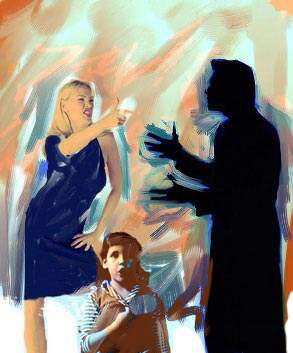
Common wisdom among the false-abuse set holds that angry wives routinely leverage molestation allegations in divorce custody cases. They call it SAID (Sex Abuse in Divorce) syndrome; Tong calls it “the ultimate weapon.” In a culture that fails to give fathers equal footing in divorce court, the false accusation is yet another tool at the mom’s disposal.

Strange, then, that research regularly refutes this thinking. Studies in the journals Child Abuse and Neglect and Child Sexual Abuse have demonstrated that allegations of molestation are not significantly more common around the time of divorce. “On the basis of research that has been conducted so far, it is difficult to support an assertion that there are high rates of false allegations of sexual abuse consciously made by mothers in divorce situations,” write Kathleen Coulborn Faller, David L. Corwin and Erna Olafson in the American Professional Society on the Abuse of Children Advisor.

Finkelhor agrees. “Most of the accusations that come out in the divorces — and that get anywhere [in the courts] do tend to have some [merit].”

It almost doesn’t matter what the data proves or the researchers say. SAID has symbolic, not statistical, currency. What it represents is standard-fare frustration about the collapse of the American family — its cousin is family values — and this always manages to bubble up to the surface in the passionate blurts of false-accusation types.

“You can see this gradual erosion of Ozzie and Harriet in this country,” Tong says. “Now it’s No-Touch-Rules America 2002.” (“‘Ozzie and Harriet’ was just a TV show,” I say. “In a lot of cases, abuse was going unreported back then.” Tong replies: “I know what it was like back then — I’m older than you.”)

But Tong and company have a way of resuscitating the discussion just when they start muttering their way toward complete irrelevance. Fathers aside, some say, false abuse takes a toll on children. They propose a legitimate, if familiar, question: Has our increasingly child-sensitive justice system actually worked against children in some ways?

“The ramifications [of so many false accusations] are not benign or innocuous,” Tong says. “We’re creating a new class of victims.”

Even experts outside Tong’s camp acknowledge the possibility that America might be cultivating a damaging sense of victimhood in anyone who ever had a hand slapped away from the stove. Hopper agrees that “it does have a certain currency and power in our culture to cry abuse, and we do sensationalize it.”

In fact, there’s a good deal of what comes out of Tong’s mouth that outside experts can agree with. Hopper — one of the saner and more balanced voices in the field of abuse studies — is willing to accept Tong’s critique of social service agencies as employers of underpaid and undertrained workers. Finkelhor takes issue with the notion that we’ve grossly overcompensated in our historically new attentions to child abuse, but he concedes some merit to the complaint that “it’s too easy to bring allegations against someone.”

Looking at the various cultural alarms about molestation, it’s not hard to see Tong’s point about fear-mongering. “Predators are everywhere and they can strike at any time,” warns Leigh Baker’s new book, “Protecting Your Children From Sexual Predators.” Baker’s camp has gotten downright theatrical on the subject at times over the years, blowing whistles about the predator next door, or in the next parish, or in the master bedroom down the hall. It’s not that child abuse isn’t as bad as they say, of course, but the panicked demands for attention tend to distract from the actual problem.

But Tong and his cohorts can be just as hysterical with their anti-hysteria — they even use the same rhetorical strategies. “Could you be next?” Tong asks, the implication being that the police might knock at any moment.

Tong is “addressing an important issue,” Hopper says, “but he polarizes the issues and exacerbates the problems he addresses.”

Yet Hopper stops short of categorically dismissing Tong. He describes a national debate where piling on has been the norm, and where the norm has resulted in few long-term solutions. Hopper proposes a rethinking of the way we handle false accusations, perhaps even hiring mediators in cases like Tong’s. “You could take care of your needs without destroying the other person,” he says. “It’s all part of a larger tragedy.”

Bernardin, and a few others like him, set a precedent for peaceful and open response to false allegations. To the extent that Tong and his colleagues add more hysteria to the molestation equation, they bury precedent under hostility and ignorance — elements that they purport to despise in the so-called child molestation industry.

“I’m a strategist,” Tong told me. “Think of this as a football game. I hand the ball to the attorney, and hopefully he runs it to the end zone.”

The problem is that Tong and his colleagues don’t seem to have figured out what the end zone looks like. If our mistreatment of the falsely accused goes as deep as they say, our larger understanding of molestation is in bad shape. But to the extent that reformers use distorted statistics to disguise a regressive, reactionary agenda, they only prolong any resolution of the child abuse problem in America.

Continue Reading Close

Page 2 of 18 in Chris Colin