Here’s how a pollster would like you to be: at home on a weeknight, patiently sitting by your land line waiting for it to ring, not screening calls, and willing to spend at least several minutes answering questions once you’ve found out it’s a pollster on the line.
Unfortunately, that’s not even close to reality. People are constantly out and about, they use caller ID mercilessly, and perhaps most important, many people are ditching land lines and becoming cellphone-only.
The cellphone issue is a particularly bedeviling one for pollsters, because the cellphone-only demographic looks quite different from people with land lines: younger, poorer, more urban, less white and more Internet-savvy, according to a Centers for Disease Control study from last year.
Response rates for 20-somethings in polling tend to be very poor, leaving pollsters to decide just how much they want to weight up their responses (in other words, how to extrapolate those few young-voter responses so they reflect their actual percentage of the voting population).
Younger, poorer voters — especially the well-educated, tech-savvy “early adopters” — also tend to be a reliably Democratic demographic, meaning that that weighting decision can make or break the effectiveness of a poll. In fact, a Pew study comparing land line and land line/cellphone samples earlier this year found that land line-only polls slightly underestimate support for Democratic candidates compared with dual-mode polls.
The issue is back on poll watchers’ minds this week because SurveyUSA, one of the so-called robo-pollsters, has started making a move to include cellphones. Many of the well-established pollsters that use live callers and take primarily nationwide samples, like Gallup and NBC News, already use dual-mode calling. But the pollsters that use auto-dialers and recorded messages — a group that includes the most prolific pollsters of races in individual states, like Rasmussen Reports, Public Policy Polling and SurveyUSA – have only called land lines in the past (which has led to a lot of criticism of these pollsters, particularly when liberals want to try to debunk Rasmussen). That’s because federal law prohibits unsolicited auto-dialer calls to cellphones, and the cost of adding live callers can triple the cost of a survey.
SurveyUSA’s new results using both cellphones and land lines — obtained in its most recent polls of the Washington and North Carolina Senate races — suggest that the effect is very slight. In Washington, for example, Democratic Sen. Patty Murray leads Republican Dino Rossi 37-33 in a combined sample and an almost identical 39-34 in a land line-only sample. Strangely, though, these polls show an oddity that has been consistent in many SurveyUSA polls: They find that the Republican candidates perform the strongest among the 18-34 set, despite exit polls consistently showing that that’s the Democrats’ strongest age bracket.
This might mean that pollsters are better able to reach young voters but that their lack of enthusiasm means they don’t fit the pollsters’ screen for likely voters. Or it could mean there’s been a sea change in the last year in the way young voters perceive the political parties. Neither of these possibilities is good for Democrats.
The other alternative, though, is that SurveyUSA — which doesn’t provide cross tabs that would tell a reader whether the age composition of the cellphone-only sample is different from the land line voters — is finding a cultural difference between generations: Younger voters may still be likely to vote Democratic, but younger voters may also be more likely to not pick up, or to hang up, when they find out it’s a pollster.
In other words, simply being able to call cellphones may be only half the battle for a pollster facing an increasingly on-the-go, not-very-civic-minded public.
West Virginia’s Democratic Governor, Joe Manchin, is sitting in the catbird’s seat these days. Even before the death of West Virginia’s longtime Senator Robert Byrd, Manchin was considered something of Byrd’s heir apparent, and that became even clearer with his announcement last Friday that he is “highly likely” to run to succeed Byrd. When and how will that election to replace Byrd be held? Well, the answer is that, as governor, it’s all up to Manchin himself.
State statute seemed to require that a special election be held this year, but West Virginia’s Secretary of State Natalie Tennant, citing case law, decidedtwo weeks ago that because the 2010 primary election had already happened, the election to fill the seat shouldn’t be until 2012 (when the seat would be up for its regularly scheduled election anyway). National Democrats heaved a sigh of relief, thinking that it would be better not to have one more seat to defend in what’s shaping up to be a difficult year.
But then Manchin started making noises that he’d prefer having a 2010 special election. This would allow Manchin to take advantage of his considerable popularity and would deny a Republican opponent the usual two-year ramp-up period that is de rigeur in today’s Senate campaigns. The legislature will ultimately have to authorize the electio — but who has the power to call the legislative special session to set the election? Manchin, of course.
West Virginia election law is decidedly vague on what shape the election might take. One option might be to skip primaries and just have all the candidates run together in one pool on the regularly scheduled Election Day in November, with the winner taking all (similar to the disastrous special election in Hawaii’s 1st Congressional District). This too, would benefit Manchin, given his name recognition advantage over all other possible candidates, especially if multiple Republicans were to run and split the GOP vote.
There’s one other decision that Manchin has to make in the coming weeks, and that’s whom to appoint on a temporary basis (either through November 2010 or November 2012), until a special election is held. Manchin might opt for an elder statesman (like former Governor Gaston Caperton, now better known as president of the College Board) or for a younger up-and-comer to build the state’s Democratic bench (like Byrd’s former state director, Anne Barth).
Much of the state’s political establishment, from the AFL-CIO to the Chamber of Commerce, has been urging Manchin to get it over with and appoint himself. But Manchin has loudly insisted that he won’t do this — a wise decision, if history is a guide. Not since Kentucky’s Happy Chandler in 1939 has a governor appointed himself to the Senate and gone on to be re-elected as a senator. The subsequent seven self-appointees all went down to defeat when first facing the voters, most recently Minnesota’s Wendell Anderson in 1977 (who tapped himself to fill the seat left behind when Walter Mondale became vice president).
Continue Reading
Close
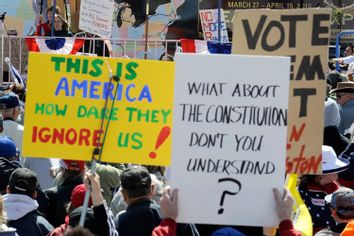
Now that the Tea Partiers claim to have rediscovered the Constitution (which could be safely ignored during the Bush years), a spotlight is suddenly shining on some of the more obscure amendments that no one has thought about in ages.
First and foremost for the right is the Tenth Amendment, a decidedly vague sentence about how the federal government has only the powers specifically given to it by the Constitution. However, they’ve reached deep into their tricorner hats to pull out a real doozy: the Seventeenth Amendment, which some of them would like to repeal.
If it’s been a while since you’ve taken high school civics, the Seventeenth Amendment, enacted in 1913, provides for direct election of U.S. senators. This was a break with the old method of having senators picked by state legislators, without public input. It recently became an issue in the Republican primary in Idaho’s 1st Congressional District, but it’s also been bubbling up into Republican state party platforms, such as in the one just ratified in Idaho this week.
The irony, of course, is that activists from a movement that seems centered around protests of “taxation without representation” are agitating for something that would significantly reduce their representation, by taking away their right (and everyone else’s) to elect 100 of the most powerful people in the country.
Their apparent rationale is that this would be a method of shifting power from the federal government to the states. The assumption (a somewhat optimistic one) is that appointed senators would be more responsive to the wishes of their state’s voters. Or something like that. But the law of unintended consequences is at work here: If their plans were somehow to succeed, the Senate would — at eleast for now — become significantly more Democratic.
Let’s assume that a state legislature in which both chambers are Democratic-controlled would select only Democrats and that a legislature where both chambers are Republican-controlled would select Republicans. There are 26 states where the Democrats control both legislative chambers, and in those states, there are 11 Republican Senators (Alabama’s Richard Shelby and Jeff Sessions, Iowa’s Charles Grassley, Louisiana’s David Vitter, Maine’s Susan Collins and Olympia Snowe, Massachusetts’s Scott Brown, Mississippi’s Thad Cochran and Roger Wicker, Nevada’s John Ensign, and New Hampshire’s Judd Gregg) who would be out of a job.
By contrast, there are only five Democratic senators (Florida’s Bill Nelson, Missouri’s Claire McCaskill, North Dakota’s Kent Conrad and Byron Dorgan, and South Dakota’s Tim Johnson) in states where Republicans control both legislative chambers. The net gain would be six Democratic seats. Granted, this is a scenario based merely on today — Democrats are likely to not only lose some Senate seats in November but also control of at least a few legislative chambers, too. But letting state legislatures pick senators seems likely to move things in exactly the opposite direction the Tea Partiers envision.
Continue Reading
Close
Both the polling business and the blogosphere — and especially the select group of nerds who dwell where the two intersect — were thrown into a tizzy on Tuesday with bombshell allegations that the polling firm Research 2000 is a sham operation.
There’s always been a great deal of smoke and mirrors obscuring the polling industry, but the revelations here go beyond mere number-massaging, possibly to the point of data actually being made up.
Until a few weeks ago, the prolific pollster was best known for its work on behalf of the liberal website Daily Kos, although it also had a number of other mainstream newspapers and TV stations as clients. Daily Kos founder Markos Moulitsas ended his relationship with the firm shortly after Research 2000 repeatedly showed Bill Halter narrowly winning the Democratic Arkansas Senate runoff (he ultimately lost to Blanche Lincoln), and, more important, after Research 2000 ranked near the bottom of numbers guru Nate Silver’s pollster ratings.
Several weeks ago, three statistics experts independently approached Moulitsas with concerns that the numbers being generated by Research 2000 weren’t the results of random polling. This was based on their reading of the cross tabs, the subsamples of different demographic groups (such as what percentage of 18-34-year-olds would vote for Candidate X or what percentage of women had a favorable opinion of Barack Obama). That this data was available was supposedly a strong suit of Research 2000 — many pollsters don’t even bother publicly releasing cross tabs. But here their disclosure may, in the end, have been their downfall.
One observation that stood out for the experts was the strange pattern of even and odd numbers in various politicians’ approval scores. For instance, in Research 2000′s June 3 sample, Obama’s favorable among men was 43 percent and among women was 59 percent (which together adds up to 102). That in itself wasn’t unusual. His unfavorable among men was 54 percent and among women was 34 percent (which adds up to 88). There’s no reason that should also add up to an even number — after all, each of the male/female variables is independent of each other and nothing compels them to add up to an even number – but twice in a row isn’t that weird. Undecideds were 3 percent among men and 7 percent among women: Three times is getting weird. But it didn’t stop there:The even-odd property matched in a total of 776 out of 778 male-female pairs in weekly polls. That would be like flipping a coin “heads” 776 out of 778 times; the odds are astronomical.
Another pattern that stood out was that there were very few weeks in which there was no change in Obama’s favorable numbers. Now, it seems intuitive that there wouldn’t be many weeks without change; poll numbers are volatile, and change a lot. However, this is another instance where the law of averages is at work. If you’re describing a trend that’s basically flat — and Obama’s approvals have been pretty flat for the last year once the initial honeymoon wore off — the most common result, out of many, many surveys, is going to be “no change.” Changes of 1 or 2 points happen less, while changes of more points are rare but not unheard of.
To see this at work, look at the graph of the normal distribution of the week-to-week changes in Gallup polls published in its report: it’s a bell-shaped curve, with the tallest bar for “no change.” Then compare the Research 2000 graph: There are lots of -1′s and +1′s, but very few 0′s, which theoretically should be the most common result. The odds of such a distribution occurring naturally, again, are astronomical.
It’s entirely possible that these unusual results aren’t the result of falsified data, but the result of some sort of weighting intended to smooth out data and make it conform better to expected turnout models (a common pollster practice). But without Research 2000’s willingness to turn over all their raw data — something they’ve said they won’t do — there’s really no way to know. With Daily Kos’ plans to file suit against Research 2000, the discovery process is likely to reveal what was happening behind the curtain. But if nothing else, this should be a spur for all pollsters to make public all of their underlying data as part of the routine disclosure process. With the previous discrediting of Strategic Vision and now, potentially, Research 2000, the polling industry’s credibility is increasingly on the line.
Continue Reading
Close
California is an incredibly expensive state in which to run a political campaign, a hurdle that multimillionaire Republicans Meg Whitman and Steve Poizner both think can be overcome with their vast personal fortunes. But history isn’t on their side: The Golden State actually has a reputation as a graveyard for high-profile self-funding political novices.
Whitman, the former CEO of eBay, and Poizner, who made a fortune in Silicon Valley before winning election as the state’s insurance commissioner in 2006, are both seeking the GOP gubernatorial nomination in the June 8 primary. Whitman has already spent $64 million of her own money, while Poizner has thrown down $17.7 million of his own.
They’re walking in the footsteps of several high-profile self-funding failures, though. Michael Huffington, then a one-term congressman, dumped $28 million of his own money in a bid to unseat Democratic Sen. Dianne Feinstein in 1994. He lost by 2 points. Four years later, Al Checchi, the former chairman of Northwest Airlines, ponied up $40 million to run for governor — only to lose in the Democratic primary to then-Lt. Gov. Gray Davis (who raised $7 million the old-fashioned way).
And the phenomenon of failing self-funders isn’t limited to California. The Center for Responsive Politics found that in the 2008 cycle 49 candidates for the Senate or House put in at least $500,000 of their own money. Of them, only six House candidates and one Senate candidate won. (The one senator is a longtime incumbent, New Jersey Democrat Frank Lautenberg, a former CEO at ADP who has long written his own checks.)
For all the money she’s spent in California this year, Whitman is struggling to keep her head above water. Most recent polls, from Research 2000, PPIC and even often-Republican-leaning Rasmussen, have her still trailing former Gov. Jerry Brown, the presumed Democratic nominee, by single digits — with Brown having spent almost nothing on his campaign yet. And that assumes she even survives her primary against Poizner, who has positioned himself to Whitman’s right and who is within striking distance in some recent polls. (Although a survey released Tuesday gave Whitman a 25-point advantage.)
Whitman and Poizner aren’t the only extravagant self-funders this cycle. Republican professional wrestling impresario Linda McMahon has plopped down $14 million in trying to pick up the Senate seat in Connecticut vacated by Chris Dodd, with plans to spend up to $50 million. But Whitman has already shattered that, and if California’s curse holds, she’ll end this campaign as the biggest self-funding flop in history.
Continue Reading
Close
There are three big contested Democratic Senate primaries on Tuesday, and two of them — in Pennsylvania and Kentucky — are looking like tossups. But in Arkansas, where two-term incumbent Blanche Lincoln is being challenged from the left by Lt. Gov. Bill Halter, one candidate seems to have a clear advantage: Lincoln.
Lincoln’s lead in the most recent polls tends to be in the 10-point ballpark. She was ahead of Halter 46-37 percent in a Research 2000 poll this week and 44-32 in a Mason-Dixon survey two weeks ago. Her real challenge on Tuesday, though, isn’t to outpoll Halter — it’s to clear the 50 percent mark, in order to avoid a runoff. (Arkansas is one of 10 states, almost all located in the South, that requires the top two finishers in a primary to go to a runoff if nobody breaks a certain percentge.)
In a two-person race, the winner would, naturally, break 50 percent. However, unbeknownst to many national observers, this is a three-person race: The other candidate is D.C. Morrison, who’s been running to Lincoln’s right and employing a variety of Tea Party-ish talking points. Morrison polled at 6 percent in the Research 2000 survey and at 7 in Mason-Dixon’s.
Two factors will decide whether Lincoln avoids the runoff.
The first is what happens with Morrison’s supporters. “Third wheels” in races usually poll much better in advance of an election than they do when the votes are actually cast. Most voters, it seems, make a last-minute tactical decision not to “waste” their vote. A recent example of this came last November in New Jersey, where independent Chris Daggett, who had often polled near 20 percent, finished with 6 percent. It seems logical to assume that Morrison’s votes will disperse to Lincoln, as she’s considered more conservative than Halter. But it also may be that Morrison’s voters are motivated less by ideology and more by anti-incumbent fervor in this agitas-filled year. Thus, they may instead gravitate toward Halter as a protest vote against Lincoln and Beltway politics in general.
The second issue involves the “incumbent rule,” which holds that those who are still undecided at the end of a campaign (11 percent of the Arkansas Democratic electorate, according to Research 2000) tend to break for the challenger. There is some validity to this, but in most cases only a majority of undecideds — not anywhere near all of them — break for the challenger. More important, analyses of the “incumbent rule” suggest that it’s weakening over time. It was, in fact, broken in both George W. Bush’s 2004 reelection campaign and in Joe Lieberman’s 2006 Senate run.
This all suggests that Arkansas will, in fact, be a nail-biter on Tuesday. Halter should finish comfortably ahead of Halter. But whether she can bump her current support past the 50 percent mark will be a game of inches.
Continue Reading
Close