
Lou Dubose
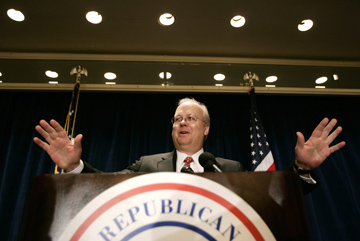
The collapse of Karl Rove
The Pygmalion strategist from Texas built up the Republican Party by exploiting the religious right -- and now his handiwork is crumbling.
A month ago, a friend who has spent his entire career working for the Republican House leadership pulled up beside me at the intersection of Seventh and Pennsylvania in Washington. A House institutionalist, and a fiercely partisan secular Republican, he was oddly cheerful. “Call me next time you’re in town,” he said. “We’ll talk about how George Bush destroyed the Republican Party.”
It will be a long conversation.
But the president doesn’t get all the credit. If Karl Rove was responsible for the remarkable ascent of the Republican Party since 2000, he is equally responsible for what is beginning to look like its vertical collapse. With the Christian right deeply disappointed at Bush and in search of a candidate for the 2008 election, economic conservatives alienated by the White House’s failure to impose fiscal discipline on the Congress when the Republicans were in charge of both houses, and congressional Republicans caught in the undertow of a failing president’s failed war, the party Rove predicted would become a permanent majority is no more. Rove could put the party together, but in the end he proved incapable of holding it together.
In Texas, we saw this modern iteration of the Republican Party come together in the summer or 1994, as Bush kicked off his first successful run for public office. (He had lost a congressional race in West Texas in 1978, in which Rove was only marginally involved.) Social conservatives had already joined together with economic conservatives when Ronald Reagan got into bed with the Rev. Jerry Falwell. But it was Rove who consecrated the union. A nominal Christian and Episcopalian, Rove had little regard for the evangelical extremists who have become essential to the success of the modern Republican Party, even cracking the occasional joke about his own lack of faith.
Then the Christian right showed up at the Republicans’ state convention in Fort Worth, in 1994, with enough delegates to seize control of the party. The dominant Christian faction tossed George H.W. Bush’s handpicked state chairman and longtime friend, Fred Meyer, out of office and replaced him with a charismatic Catholic lawyer from Dallas. It banned liquor from convention hotels and replaced hospitality-room bars with “ice cream sundae bars,” where chefs prepared designer confections. It summoned delegates to Grand Old Prayer Sessions, required Christian fealty oaths of candidates for party leadership, and made opposition to abortion the brand by which Texas Republicans would be defined.
This political great awakening was not unique to Texas. But it occurred in a context in which a brilliant, Pygmalion political consultant saw in George W. Bush a malleable idol who could be fashioned into a governor and ultimately a president. And Bush was a candidate whose genuine evangelical faith was an asset rather than a liability. After initially fighting the dominant evangelical delegation at the state convention — proposing Texas Rep. Joe Barton as a compromise candidate for state party chairman — Rove joined them.
He found religion, even if he didn’t find Jesus. And it was a foxhole conversion at best. Rove had been brought to Texas by the elder Bush in the early ’80s and devoted his energies to building a Republican Party where there was none — using direct mail, money and databases in ways that Texas Democrats never imagined. There was one statewide Republican elected official when Rove began his work, U.S. Sen. John Tower. Today, Republicans hold all 22 statewide offices. But the party Karl Rove built was based on the economic conservatism of Barry Goldwater, not the social conservatism of Jerry Falwell. Once Bush was elected governor, Rove marginalized the Christian right’s party chairman, Tom Pauken, denying him access to party money, and when Pauken ran for state attorney general, Rove quietly assisted the campaign of his primary opponent, John Cornyn, who now represents Texas in the United States Senate. Yet despite the low regard in which he held evangelicals, Rove recognized the importance of keeping them in harness with economic conservatives.
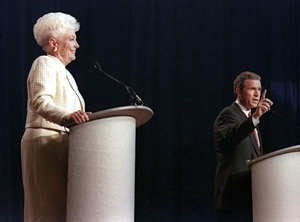
The “guns, God, and gays” campaigns that defined Texas politics and the politics of the South became the model for Republican Party campaigns across the country. It was Rove who was responsible for the whispering campaign that characterized Democratic Gov. Ann Richards, Bush’s opponent in the 1994 governor’s race, as a closet lesbian, in a successful attempt to peel away conservative Christian votes in East Texas.
Perhaps the most recent example of a successful social-issues campaign was in Ohio during the 2004 election, which provided critical electoral votes to secure George Bush’s second term. With Bush in peril of losing to John Kerry, the Republican National Committee looked to David Barton to go into Ohio and turn out the base. Barton is a former vice chairman of the Texas Republican Party and one of the founders of the WallBuilders, a Christian advocacy group working to restore God to His central position in American history, and in the history and social studies curricula of the nation’s public schools.
Barton comes straight out of the social conservative wing of the Republican Party Rove put together and then left behind in Texas when he followed Bush to Washington in 2001. And Barton represents both the success and what now might be the failure of the Republican Party Rove cobbled together. U.S. District Judge John E. Jones III mentioned Barton by name, in his 2005 opinion that declared “intelligent design” (biblical creationism dressed up as science) unconstitutional to teach in the nation’s public schools. Jones, a George W. Bush appointee to the federal bench, was particularly offended by the Dover, Penn., school board president’s stated intention to move from Christian intelligent design in biology classes to Christian social studies in history classes. The judge cited both Barton and his book, “The Myth of Separation,” as examples of a school board that was in open violation of the Constitution. (WallBuilders do not recognize the separation of church and state as defined by the First Amendment.)
In Pennsylvania, Judge Jones’ angry repudiation of the Christian majority on the school board was both a portent and part of the dissolution of the union over which Rove presided in 1994 in Fort Worth. Jones, a Tom Ridge protégé, was unequivocal in asserting the primacy of the Separation Clause over the religious interests of local governing bodies. Like this moderate judge, the larger public — and even the Republican Party, if the candidacy of Rudy Giuliani means anything — has grown weary of the Christian right. It was a marriage as unlikely as the union between an evangelical George W. Bush and Episcopalian Karl Rove.
It appears that it’s over. As Rove returns to the Hill Country home in Texas he and his wife, Darby, bought and refurbished, the party in which he invested his energy, if not his soul, is divided among social and economic conservatives. Even Texas Sen. John Cornyn, a one-time moderate who drank the Kool-Aid with the Christians in the Texas Republican Party, is in trouble with the state’s voters. Cornyn, like Bush, was a creation of Karl Rove. Maybe Rove can save a Senate seat, if not his soul, by quietly throwing in with Cornyn’s campaign, after he settles back down in the state where it all began.
The Texan who actually governed
Karl Rove's cutthroat tactics eventually defeated her, but not before Ann Richards made a huge impact on American politics.
“Welcome to the first day of the new Texas!” Ann Richards growled into a microphone as she began her 1991 inaugural address.
She had just led a parade of supporters north on Congress Avenue, something of a fifth column moving on the Capitol. She had promised them she would use a pair of bolt cutters to open the gates of the Greek-revival governor’s mansion to “the people” of Texas. “The people” were blacks, Hispanics, gays and lesbians, along with the shrinking Anglo majority, in a state that had and would again be dominated by leaders beholden to oil, gas and banking interests.
Continue Reading CloseWillie’s story
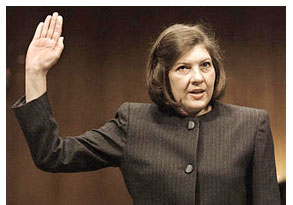
Less known but just as telling as Priscilla Owen's abysmal abortion-rights record is her unconscionable handling of a case that may have cost a young man's life.
Willie Searcy never got to meet Priscilla Owen. And that’s unfortunate. Because as an associate justice on the Texas Supreme Court, Owen once exercised almost complete control over the fate of the working-class kid who always played above his weight on the local rec-league football team — until the car accident that changed his life and crossed his path with Owen’s. The account of Willie Searcy’s experience with the Texas high court provides real insight into what sort of federal appeals court judge Owen will be if the Senate approves her lifetime nomination to the 5th Circuit U.S. Court of Appeals. But Searcy’s story has been largely overlooked.
Continue Reading CloseBroken Hammer?
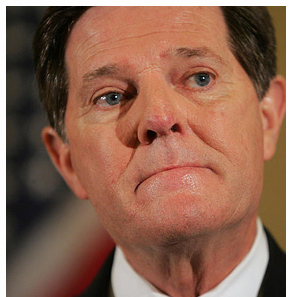
Recent revelations of huge sums paid to family members have stung the GOP majority leader. But Tom DeLay was damaged goods long before that.
The laws of political gravity don’t seem to apply to Tom DeLay. If they did, the burden of scandal he bears would have sunk him long ago — and recently things have gotten even worse for the Republican majority leader from Texas. In the week before congressional Republicans made their rash intervention in the Terri Schiavo case, the Washington Post ran no fewer than seven Page One stories about DeLay. The only story that didn’t directly connect DeLay to scandal ran under the headline “DeLay Treated for Irregular Heartbeat.” More critical reporting followed after Schiavo’s death, while DeLay and Sen. John Cornyn, R-Texas, implied that judges had killed her.
Continue Reading CloseAll about DeLay
The House majority leader's handprints figure prominently in a trial in Austin alleging the illegal use of soft money in Texas' 2002 election.
“It might surprise and even disappoint a few people to learn that this case is not about Tom DeLay.” So began Terry Scarborough’s opening argument for the defense in a civil suit against the treasurer of the political action committee Tom DeLay set up in Texas in 2001. The House majority leader won’t be in court in Austin, where a former Texas legislator who roomed with him 25 years ago, in the party house called “Macho Manor,” is defending himself in a suit filed by five Democrats who lost statehouse races in 2002. But no one looking for a DeLay connection to the proceedings could have been surprised or disappointed. In fact, after the first day in court, it’s surprising that no DeLay DNA sample was introduced into evidence and testimony that included an account of DeLay himself accepting an illegal $25,000 contribution.
Continue Reading CloseThe decay of DeLay
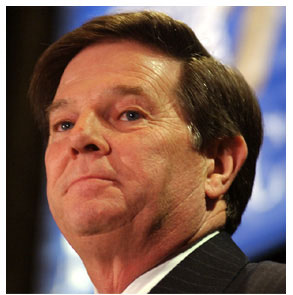
New and spreading scandals plague House Majority Leader Tom DeLay and his political empire.
September was a bad month for House Majority Leader Tom DeLay of Texas. The year to come will likely be worse.
On Sept. 30, the House Ethics Committee issued a 62-page report rebuking DeLay for trading support for the congressional candidacy of the son of retiring Rep. Nick Smith, R-Mich., in exchange for Smith’s vote on Bush’s Medicare bill. “It is improper for a member to offer or link support for the personal interests of another member as part of a quid pro quo to achieve a legislative goal,” the committee reported.
Continue Reading ClosePage 1 of 2 in Lou Dubose