Lou Dubose

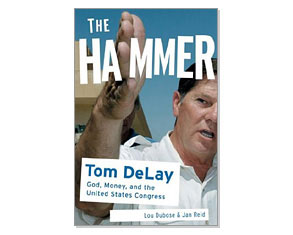
DeLay Inc.

In this exclusive excerpt from "The Hammer," Lou Dubose and Jan Reid expose how Tom DeLay turned campaign fundraising into a shadowy enterprise.

  • more
    • All Share Services

DeLay Inc.

Peter Cloeren was a virgin. At least when it came to politics. He had never participated in a political campaign. He had never written a check to a candidate for elected office. He lived in a beat-to-shit Texas Gulf Coast town abandoned first by the shipping industry and more recently by big oil.

He was CEO and majority owner of one of the remaining successful and growing businesses in Orange, Texas. Cloeren Inc. was built on the inventive genius of Peter Cloeren Sr. and expanded by Pete Cloeren’s hard work and market savvy. The company, which does more than $40 million in annual sales, designs, manufactures, and markets extrusion dies, coextrusion dies and feedblocks. In the English we speak in Texas: tools that inject color into colorless plastic.

Until he was seduced by Tom DeLay — a seduction that would cost him $37,000 in political contributions, $400,000 in fines, a two-year probated sentence, and a hundred hours in community service — politics to Pete Cloeren meant showing up to vote for conservative candidates. After his brief involvement with Tom DeLay and an East Texas dentist he was trying to get elected to Congress, Cloeren was done with politics. If Brian Babin lost the 1996 race for the second congressional district in East Texas, Pete Cloeren lost a lot more. And DeLay walked away unscathed. Actually, he flew. Cloeren picked up the $1,320 tab for the executive jet service that made the 180-mile round-trip from Sugar Land to Orange less of a burden for the congressman.

Texas songwriter James McMurtry once said he writes about small towns because they’re easier to figure out than big cities. The $37,000 contribution scheme that got Pete Cloeren crossways with the FBI used the same devices to hide and move tens of thousands of dollars that DeLay and his political PACs use to move millions. It was just done on a small-town scale. Babin needed to raise a lot of money to compete for an open seat in a district that was more Democratic than Republican. In order to circumvent federal campaign finance laws, which then limited individual contributions to $1,000 per candidate and placed restrictions on corporate contributions, he needed “vehicles.” That is, fresh names to attach to money from donors willing to donate more than the $1,000 federal max. Or the cover provided by organizations that were not corporations and could legally contribute to campaigns for federal office. That’s why he needed Cloeren, who had both the money and, as Babin and DeLay would explain to him, the “vehicles.”

Cloeren’s story (told in detail in a sworn affidavit) begins with one of his employees introducing him to Babin, a candidate in the Republican congressional primary. Cloeren was flattered. And impressed. Babin wanted his help and told him that businessmen like him were essential to expanding a conservative Republican majority in Congress. And Babin was the kind of candidate Cloeren could get excited about. A small businessman with Main Street values. A Christian. A candidate who promised less government regulation and lower taxes. A Republican running for a House seat that had been the private property of larger-than-life Democrat Charlie Wilson. When Babin asked him to help raise $50,000, Cloeren said that it was impossible to do in a rural county peopled by blue-collar Democrats. He offered to write Babin a check for $20,000 or $25,000 — a clear sign he was utterly out of touch with federal campaign finance law. Babin advised him there was a $1,000 per-person limit and suggested Cloeren “work with loyal employees.”

In other words, Cloeren should make contributions in his workers’ names, or have them make the contributions and reimburse them. Before long, Cloeren was sending his employees home on their lunch breaks to pick up their checkbooks. And Babin was swinging by Cloeren’s plant parking lot to pick up his checks. The same way Paulie Walnuts picks up the tributo payments that Jersey businessmen owe Tony Soprano. In a charmingly naove line in his congressional affidavit, Cloeren says: “Since I had never raised funds for a political candidate before, I didn’t know whether it was unusual for the candidate to pick up the checks in person.” (He would later learn why Babin avoided the mail.) When Babin made the runoff, he was back again, asking Cloeren to find more employees through which company money could be funneled to the campaign. (Like the wisecracking boys at Tony Soprano’s Bada Bing Club, Babin knew that once you get your hand into somebody’s pocket, you gotta work to keep it there.) Babin’s fundraising consultant even devised a scheme by which Cloeren Inc. employees would get bonuses from the boss — precisely the amount they were contributing to the campaign. After Babin won the runoff, House Majority Whip Tom DeLay got behind his candidacy. And Babin, who had served as mayor of the tiny East Texas town of Woodville, began to show real growth as a candidate. For example, he called Cloeren to ask if he would pick up the tab to fly the congressman in for a fundraiser.

DeLay was the talent at Babin’s campaign event at the Ramada Inn, where the congressman made his standard stump speech: conservative, family values, small government, running against a liberal professional politician. After the speech, DeLay invited Cloeren to a private lunch at the local country club. Cloeren later provided Congressman Henry Waxman’s investigator on the House Committee on Government Reform a detailed account of the lunch:

“Congressman DeLay turned to me and told me that Mr. Babin’s campaign needed more money because Mr. Babin was being out-spent by his Democratic opponent.

“Congressman DeLay told me that the Democratic candidate was receiving a lot of money from liberal interest groups like labor unions and trial lawyers. I told Congressman DeLay that I could not help Mr. Babin raise more money because I had run out of vehicles. Congressman DeLay specifically told me that it would not be a problem for him to find, in his words, “additional vehicles,” since he knew some organizations and campaigns which could serve as these vehicles. Mr. DeLay turned to his aide, Mr. [Robert] Mills and stated that money could be funneled to the Babin campaign through both Triad [a corporation that ran two nonprofit foundations] and other congressional campaigns. Congressman DeLay then specifically told me that Mr. Mills would follow up with me on the details of how to funnel additional monies to Mr. Babin’s campaign.”

After lunch DeLay and Babin held a press conference at the Cloeren Inc. plant. And Pete Cloeren was an instant political player. On the ride to the airport, DeLay told Cloeren that Babin could win if he could raise enough money. He urged Cloeren to do all he could. It was here that fundraising became more sophisticated. As Cloeren listened, DeLay explained how the money could be moved.

DeLay campaign manager Robert Mills suggested that Cloeren contribute to Strom Thurmond’s Senate campaign in South Carolina and Stephen Gill’s House campaign in Tennessee. They would, in turn, donate money to Babin’s campaign. Babin also made the “Triad connection” and Cloeren began writing checks to organizations he had never heard of: $5,000 to the Citizens United Political Victory Fund PAC, which would run issue ads supporting Babin; $20,000 to Citizens for Reform, yet another Triad operation. He also wrote checks to the Thurmond and Gill campaigns, though he had never heard of Gill.

Money was moving in circles: Cloeren wrote a $5,000 check to Citizens United and the PAC wrote a $5,000 check to Babin’s congressional campaign. And the campaign committees of a South Carolina senator and a House candidate from Tennessee were suddenly contributing to a congressional campaign committee in Texas. If the requests were unusual, Cloeren at least had convinced himself he was doing nothing wrong. “I assumed that if a senior member of Congress said to do something that it would be legal, proper, and ethical to do it,” he would later say.

According to Cloeren, Babin and his consultant Walter Whetsell used Triad, Citizens for Reform, and Citizens United interchangeably. Their comments led Cloeren “to believe that Triad might be composed of all these different groups.” It was. Triad Management Services Inc. was a queer political animal, a for-profit corporation that earned no profits, sold no goods or services, and operated two nonprofit organizations: Citizens for Reform and Citizens for the Republic Education Fund. Both nonprofits were described as nonpartisan social welfare organizations. The “nonpartisan” designation allowed the groups to meet an IRS standard and run issue ads — as long as they were not funded by or coordinated with a political candidate. Yet every dime of the $3 million that the two nonpartisan Triad organizations spent in the 1996 election cycle was spent on twenty-nine Republican congressional candidates. Neither the public nor the candidates attacked by the ads bought with Triad money knew what individuals paid for them. Because Triad was a corporation and not a political action committee, it was exempt from disclosure laws. It was a drop box where contributors who “maxed out” their federal giving could send additional money to help their candidates. And perfect cover for donors who didn’t want their names in the public record.

Triad was also one of those shadowy political organizations that will make you believe Hillary Clinton’s claim about “a vast right-wing conspiracy.” Carolyn Malenick, Triad’s sole proprietor, was a graduate of Jerry Falwell’s Liberty University and a close friend of the Falwell family. Her entire professional life had been devoted to raising money for extreme right-wing causes and candidates. She began her career with direct-mail pioneer Richard Viguerie. Then she raised money for Ollie North’s Freedom Alliance and for North’s failed campaign for the U.S. Senate. Her main funder at Triad was Pennsylvania multi-millionaire Robert Cone, a zealous anti-abortion-rights crusader — until his family toy company lost several personal injury lawsuits and he put his heart and political contributions into the tort reform movement. Cone even appeared in Triad’s marketing video (though the corporation sold nothing and served only as a political operation).

For Triad, Pete Cloeren was a perfect mark: a guy with deep pockets and a track record (albeit a short one) of contributing to conservative Republicans. Even if it was just one candidate, he did have deep pockets.

DeLay and Babin were not Triad insiders; DeLay, in fact, was beginning to build his own huge fundraising operation. But he knew that Triad along with the Thurmond and Gill campaigns were conduits through which he could maximize Cloeren’s giving. So he hooked Cloeren up with Malenick, who did for him what her corporation did for other big donors: took his money and moved it on to the candidate of his choice. A Senate committee looking at Triad found that “on occasions multiple PACs received checks from the same individual within a matter of days. All of the PACs receiving the contributions then made contributions to one candidate within days of one another.” Precisely as the $5,000 Cloeren sent to Citizens United found its way back to the Babin campaign.

As the general election campaign began, Babin’s opponent, Jim Turner, was blindsided by ads linking him to gay rights and early release of prisoners. (“God, guns, and gays” campaigns are formulaic fare in Texas; you remind voters that you favor God and guns and that your opponent is aligned with gays.) The ads attacking Turner were paid for by Citizens for Reform. Turner had no idea which “individual citizens” wrote the checks to pay for the attack ads.

To anyone reading Federal Election Commission filings, it would seem that workers at Cloeren Inc. had joined together in a rare show of support — in the form of $1,000 contributions for the congressional campaign of a dentist from a small town sixty miles away. A Beaumont Enterprise reporter looked at the list and didn’t buy it. Maybe it was the Enterprise news story that caught the attention of the FBI. Whatever did it, Pete Cloeren was suddenly the target of a criminal investigation. Cloeren cooperated, phoning Babin to discuss the campaign contributions while FBI agents recorded their conversations.

The investigation wasn’t exactly deep cover. When Cloeren called to get Babin’s comments on tape, the dentist began to grouse about the Feds coming at them, probably, he said, because one of Cloeren’s disgruntled employees tipped them off. According to Cloeren’s affidavit, Babin reassured him that at least he had picked up the checks, so they couldn’t be investigated for mail fraud. Ben Ginsberg, a lawyer who once worked for the Republican National Committee, had warned Babin about mail fraud.

Cloeren also taped conversations with Walter Whetsell, the Babin campaign consultant who steered Cloeren toward Triad. Whetsell must not have shared Babin’s concern about the FBI investigation. According to Cloeren’s sworn account, Whetsell talked freely about the conversation Cloeren had with DeLay and Babin at the country club in Orange. Whetsell also had been in touch with Ginsberg regarding possible exposure to criminal prosecution. Yet he seemed unaware the Feds were watching (and listening).

Cloeren cut himself a deal, though federal prosecutors didn’t cut him much slack. He wouldn’t do any jail time but would plead guilty to misdemeanor violations of federal campaign finance law. He paid a $200,000 fine, and his company paid another $200,000 fine. His relationship with DeLay, Babin, and Triad cost him a half million dollars if you take into account attorneys’ fees, fines, and his actual contributions. His candidate didn’t even win the election. “I presently have no business or personal relationship with Representative DeLay, Mr. Babin, Mr. Whetsell, or Mr. Mills,” Cloeren wrote at the end of the affidavit he submitted to the House Committee on Government Reform. “It seems like they really took advantage of him,” said a local businessman who knows Cloeren casually. There’s a certain journalistic economy of scale in the Triad story. Its small size makes it easier to follow the money. From Cloeren to his employees and finally to Babin. Or from Cloeren to Triad in Washington, to one of the Triad entities, then back to the Babin campaign. Or from Cloeren to the Thurmond and Gill campaigns then back to Babin. Soft money (corporate funds illegal to spend) sent to an entity not required to report it, or to a congressional campaign that could turn it around and send it back as hard money (individual, PAC, or organizational money legal to spend). This is precisely what the fundraising operation that has come to be called DeLay Inc. does on a much larger scale, and with the extra incentive a leader of Congress brings to the process of asking for money.

The Triad affair also illustrates the impunity with which campaign fundraisers operate. A Democratic member of Congress who asked that his name not be used said Clinton Attorney General Janet Reno’s lack of enthusiasm for prosecuting illegal fundraising didn’t help. Reno had put herself in a box. Once she refused to appoint a special prosecutor to look into allegations about improper fundraising in the Clinton White House, any Department of Justice enforcement action against Republicans would appear to be partisan.

Congressional oversight was equally politicized. Committees in both houses were controlled by Republicans and largely focused on Clinton’s fundraising. Democrats were pointing to Triad, arguing that there was more to investigate than the phone calls President Clinton and Vice President Al Gore made to funders, and the names of donors who had slept in the Lincoln Bedroom. Considering the magnitude of the White House fundraising operation and the serious questions raised about it, it’s not surprising that Republicans in Congress had little interest in a small-time shell game in Texas. Yet Government Reform Chair Dan Burton’s conduct was so egregious that it gave partisan excess a bad name. Burton had his sights set on ClintonGore ’96 and wouldn’t look at what Triad had done in the same year.

Not only did Burton refuse to look at Triad. He blocked committee Democrats from conducting their investigation. Burton held his ground until California Democrat Henry Waxman put him on the spot in public. Waxman made such a compelling argument at a mid-May ’98 committee hearing that Burton agreed to allow minority members of the committee to subpoena summaries of FBI interrogations of Triad subjects. Burton quickly reneged, however, implying that Waxman was coordinating his investigation of DeLay with other congressional Democrats who had filed a racketeering suit against DeLay and his fundraising operations.

Though he wasn’t able to hold hearings or subpoena witnesses, Waxman persisted, and Peter Cloeren was able to tell his story to Congress. Waxman sent a minority staff member to Texas to look into Babin, DeLay, Triad, et al. But the scope of his investigation was limited. There is no doubt that the Triad/Babin affair was dwarfed by Clinton-Gore’s fundraising. But Triad was never adequately examined by the House and Senate committees looking into fundraising irregularities. Lacking the authority to issue subpoenas and schedule hearings, committee Democrats were checkmated. (Much of the material here cited is in the public record because it was in the minority reports of House and Senate committees.)

When no one was prosecuted after Peter Cloeren cooperated with the Feds and paid a $400,000 fine, he filed a complaint with the Federal Election Commission. After conducting an investigation, the FEC legal staff recommended $4,544,000 in fines: $1,149,000 against Triad; $1,818,000 against Citizens for the Republic Education Fund; and $1,577,000 against Citizens for Reform. The commissioners, always responsive to political pressure, ignored the recommendations of their own staff, dropped the fines against the two nonprofits, and reduced Triad’s fine to $200,000.

Tom DeLay got a walk on the deal he had done on Peter Cloeren, which DeLay claimed involved no more than speaking to Cloeren for three minutes at lunch. (“I don’t know this man from Adam,” said DeLay.) Whether it was DeLay’s three minutes or the ninety minutes Cloeren swore to in his affidavit, DeLay’s visit to Orange, Texas, occurred as he was moving into major league fundraising. By the time he opened a Texas branch in 2001, DeLay Inc. was raising money in volumes never seen in the United States Congress. Nothing compares. No member of Congress — except members raising money for their own presidential Campaigns — had ever raised the amount of political money raised by Tom DeLay. The Texan elected majority leader in 2003 is in a class of his own.

Tom DeLay’s funny-money trail

The GOP strongman's political machine has stopped at nothing to extend its power. Now it's facing indictments for violating Texas campaign finance laws.

  • more
    • All Share Services

Tom DeLay's funny-money trail

The weekly pen-and-pad press briefings in the office suite of the house majority leader are almost formal events. Thirty to 40 reporters take their seats at a long table and at a second tier of chairs placed against the east and west walls. “The leader” enters, escorted by two aides, Jonathan Grella and Stuart Roy. Roy closes the door at the south end of the elegant dining room and stands beside his boss, who sits at the head of the table; Grella takes his position at the opposite end of the room. Tom DeLay takes his seat, opens with a bit of friendly banter, and begins to work through his agenda. There’s so much decorum that DeLay’s arrival and departure are almost ceremonial. And there is never any doubt about who is in control. The 56-year-old congressman from Sugar Land, Texas, is smart, authoritative and in charge.

Recently the leader’s grip has begun to slip. The first press conference in February ended with a Fox TV news reporter pressing DeLay for answers about the ethics committee’s failure to investigate allegations of bribery on the House floor. DeLay didn’t respond. The last press conference in February ended with Fort Worth Star-Telegram reporter Maria Recio asking about a campaign finance investigation in Texas. “That’s not on the agenda,” DeLay snapped.

Then he went on to answer the question with an unbidden attack on the “vindictive and partisan” district attorney in Austin.

The “vindictive and partisan” D.A. DeLay referred to is Ronnie Earle. For almost six months, Earle and a grand jury have been investigating possible violations of Texas campaign finance law in the 2002 election. Because the state capital lies within the jurisdiction of Travis County, Earle is far more powerful than the D.A.s in larger cities, such as Houston, Dallas and San Antonio. His Public Integrity Unit has a mandate and legislative funding to prosecute public officials who break the law. He’s held office for 27 years, and is the only Democrat with statewide prosecutorial authority. His ongoing investigation of two political action committees that spent a combined $3.4 million on 22 Republican Texas House races is now focused on a PAC founded by DeLay and directed by a DeLay operative. “This is an attempt to criminalize politics,” said a visibly angry DeLay. Ronnie Earle, he told reporters at his Feb. 24 press conference, is a “runaway prosecutor.”

Before Jon Grella could cut off questioning, DeLay was asked about two of his close associates billing Indian tribes a staggering $45 million in lobbying and consulting fees. DeLay said Jack Abramoff had never been on his staff. And he warned: “Anybody trading on my name to get clients or to make money, that is wrong and they [should] stop it immediately.” The warning was a little late. Mike Scanlon, the 33-year-old former press aide who helped coordinate DeLay’s impeachment of President Clinton in 1998, had pocketed a $30 million cut of the fees paid by the Indian tribes. Abramoff resigned from his lobbying position. Sen. John McCain subpoenaed Abramoff’s files. And the D.A. in Austin subpoenaed DeLay’s daughter in a separate investigation.

It will only get worse.

Now it appears that Abramoff and Scanlon are “off the reservation” for good. And DeLay can’t be much help to these associates facing a Senate inquiry. At the same time, the majority leader is confronted by grave problems in his home state. Just as he needs to distance himself from Abramoff — a close friend and longtime member of his “kitchen cabinet” — DeLay must to try to avoid the clutches of Ronnie Earle. The Travis County D.A., after all, can put him in a place and position he’d prefer to avoid: in an Austin courtroom under oath.

Prison is an unlikely fate for DeLay, though he is very close to the center of the investigation. It is equally unlikely for his daughter, Danielle Ferro. “She’s not responsible for the fact that she was paid with illegal money, assuming a court decides the money was illegal,” said an Austin attorney who asked to remain anonymous. But jail is not out of the question for DeLay’s operatives in Texas, who are looking at third-degree felony charges that carry a 10-year sentence.

According to courthouse sources in Austin, some witnesses will soon begin to roll in what is being compared to the Sharpstown scandal of the early ’70s: a banking stock scheme that sent the speaker of the house to jail, ended the career of the lieutenant governor, and fueled a reform movement aimed at curbing influence buying in the Legislature.

That’s not to say Texas is no longer the wild west of campaign finance. You can’t hand out checks on the Senate floor, as chicken tycoon Bo Pilgrim did in the late ’80s. (A senator who didn’t get a check said the $10,000 was a “poultry sum” he never would have accepted.) But when it comes to political contributions in the Great State, the only limit is the size of your bank account. Any citizen of the U.S. can give any amount to any elected official or candidate for public office. All you have to do is declare your contribution to the Texas Ethics Commission. Political action committees also are only restrained by the give-and-declare law.

There are two clear prohibitions: Corporate money and union money cannot be spent in election campaigns. The ban was passed into law in the early 1900s as a response to robber barons buying up railroads, timber, oil and legislators. A “speaker’s statute,” enacted after the Sharpstown scandal, prohibits a candidate for speaker of the house from handing checks to House members or candidates in exchange for support. It is these two state laws that have placed U.S. Majority Leader Tom DeLay and his handpicked speaker of the Texas House, Tom Craddick, under investigation by the Travis County Public Integrity Unit.

The back story is one of intrigue and power grabbing. Tom DeLay badly wanted to redraw the state’s congressional districts to add some half-dozen Republican representatives to the Texas U.S. House delegation. To do so he required a Republican majority in the Texas statehouse.

For four election cycles, Craddick had been expanding that majority. Working with an Austin political operative (one of 58 individuals subpoenaed in Austin), Craddick did it the old-fashioned way: establishing a PAC, raising huge amounts of money, and spending it where Democrats were vulnerable. He was racing against the calendar. Republicans controlled the Senate. But they needed a majority in the House by 2001, so they could redraw the state’s congressional districts after the 2000 census.

They fell a few seats short. And after the Democratic House and Republican Senate failed to reach an agreement on reapportionment in 2001, congressional district lines were redrawn by a panel of three federal judges. The Democrats had held the future at bay and it appeared that the Republicans would have to wait until the next census to redraw the lines. Or so the Democrats reasonably assumed, as reapportionment must be done in the first legislative session following the census. Republicans fell short, according to a party source quoted in the Texas Observer (which has extensively covered the story), because “the Hammer had too many balls in the air.”

The Hammer is Tom DeLay, who in 2001 stopped juggling and came home to Texas. DeLay and Jim Ellis, a political operative who had run DeLay’s Americans for a Republican Majority (ARMPAC), devised a scheme that would get DeLay the House seats he wanted in Washington by electing Republican legislators in Austin. First, they would use DeLay’s Washington contacts to raise the money to get Tom Craddick his Republican majority in Texas. Then, Craddick would deliver to DeLay an off-year redistricting plan that would add as many as seven Republican members to the Texas House delegation in Washington

They were spectacularly successful. They raised and spent $1.5 million. All but three of 21 new Republican legislators elected in 2002 were supported by Texans for a Republican Majority (TRMPAC) — the PAC DeLay and Ellis created. And after he was elected speaker Craddick delivered a redistricting plan, despite Democratic state representatives and senators fleeing the state on two separate occasions to deny the Legislature a quorum. The entire deal was done in one election and three special sessions. It was a bold and brilliant case study of DeLay’s power.

But in their grab they failed to pay close attention to bookkeeping and Texas election law. One group did: Texans for Public Justice. The Austin campaign-finance advocacy group began comparing TRMPAC’s Texas Ethics Commission filings with its IRS filings. “We found approximately $600,000 in contributions on their IRS filings that weren’t filed in Texas,” said TPJ director Craig McDonald. “It wasn’t reported in Texas. It was off the books.” It was also PAC money raised from corporate sources — in almost all circumstances a violation of Texas campaign finance law. McDonald wrote a letter to the Travis County D.A., documenting what he had found and requesting a criminal investigation.

Much of the funding McDonald turned up was from DeLay’s regular funders like Philip Morris and Bacardi. There were also contributions from corporations that had no business dealings in Texas yet were suddenly making campaign contributions there. The Washington-based Alliance for Quality Nursing Home Care contributed $100,000.

Questerra Corp., a Virginia energy company, contributed $50,000. One widely reported contribution was from Westar, a Kansas utility that has no ostensible connection to Texas. When a Westar executive asked in an internal e-mail about the $25,000 donation to DeLay’s Texas PAC, a colleague told him it was to “get a seat at the table” in Washington and ensure that a deregulation provision was inserted in a key piece of legislation. Even the Mississippi Choctaw Indian tribe kicked in $6,000. The tribe does no business in Texas, but its Washington lobbyist was none other than the ubiquitous Jack Abramoff.

DeLay political operative Jim Ellis told the Texas Observer that there is a simple explanation for the two sets of books. TRMPAC raised “hard money” from individuals and spent it on election campaigns, which no one charges is illegal. But TRMPAC had another account that included “soft money” raised from corporate donors. Those funds were reported to the IRS, not to the Texas Ethics Commission, and were spent on administrative expenses rather than direct contributions to political campaigns.

The Travis County D.A. might not buy the argument that that was legal. Texas election law “clearly defines administrative expenses as operating expenses incurred in the normal course of operation of any active organization, whether engaged in politics or not,” said an Austin lawyer who specializes in campaign finance. “The law is further defined by a half-dozen opinions from the Texas Ethics Commission.” DeLay’s PAC spent corporate funds on polling, voter identification, fundraising and candidate recruitment — hardly routine expenses that would be incurred even by businesses not involved in politics, as Texas law requires. That is, unless TRMPAC’s attorneys can convince a jury that Starbucks, say, does political polling, phone banking and candidate recruitment.

Even more explicit in Texas law is the prohibition of the use of corporate money for political fundraising. TRMPAC paid John Colyandro, a former associate of George W. Bush political advisor Karl Rove, a year’s salary with corporate funds, said a campaign finance lawyer close to the case. Also, the Texas Observer reported that the Texas PAC spent $130,000 on fundraising.

“Ronnie has a very, very strong case,” said the campaign finance lawyer. The case seems to get stronger by the week, as reporters following civil suits filed by a former state representative defeated by TRMPAC turn up documents that suggest what the grand jury must be reviewing in its criminal inquiry.

On Sept. 10, 2002, TRMPAC donated $190,000 in corporate money, which could not be legally used in Texas elections, to the Republican National Committee. On Oct. 4, the RNC sent $190,000 that could legally be used in Texas to TRMPAC’s Jim Ellis, with instructions to distribute the money to seven candidates in Texas. If the case ever gets to court, jurors will be told that the check was left blank for Ellis to fill in, which doesn’t look good. Prosecutors will allege a classic soft-money-in/hard-money-out deal, though TRMPAC attorneys contend that the $190,000 up and $190,000 back was a coincidence.

In addition, documentation of 14 TRMPAC checks totaling $152,000 that Craddick personally distributed to 14 Republican candidates has surfaced in the civil case. An e-mail from Colyandro directed TRMPAC’s accountant to send the checks to Craddick. Craddick insists that the 14 candidates were already supporting him, so he was not cultivating their favor and therefore not violating the speaker’s statute. (He has retained an Austin attorney who specializes in defending elected officials facing public corruption charges.)

On March 3, Laylan Copelin, an Austin American-Statesman reporter, found another discrepancy certain to catch the attention of the district attorney: “The Republican Majority committee has said it didn’t report the $600,000 to state election authorities because it was spent on the committee’s administrative expenses … Yet the committee’s 2002 tax return lists $1.6 million — instead of the $900,000 — as ‘activities related to support for state Legislature and statewide offices in the state of Texas.’” The numbers don’t add up and lawyers and accountants for DeLay’s Texas PAC are going to have a hard time coming up with proof they had enough legal (hard dollars raised from individuals) money to cover all they spent on the 2002 Texas election.

All of this makes the notorious Sharpstown scandal look like a parochial pissing match in the political backwater Texas of 30 years ago. Tom DeLay is the majority leader of the U.S. House. He achieved that position by using his federal PAC to elect Republican representatives indebted to him because he provided the money that put them in office. He is grooming himself to replace Speaker of the House Denny Hastert. And the House is likely to remain in Republican (read: Tom DeLay’s) control for years.

The Travis County D.A.’s investigation represents the first time any of DeLay’s fundraising operations have been subjected to legal scrutiny. An impotent Federal Election Commission makes enforcement at the federal level improbable. Democrats filed a racketeering lawsuit against DeLay in 1998 and actually got it certified by the same district judge who presided over the Microsoft antitrust lawsuit in Washington. But they quickly folded and settled. Now, Texas D.A. Ronnie Earle, with subpoena power and a staff of investigators and lawyers, is doing what no one has thus far been able to accomplish. He is investigating the Texas franchise of what in Washington is referred to as DeLay Inc. — the largest funding combine ever controlled by a single member of Congress. (It raised $12.6 million from 2000-’02.)

Earle is in no hurry and is expected to turn the findings over to a second grand jury in April, when the term of grand jurors conducting the current investigation expires. A slow and methodical investigation, if the past month suggests what’s to come, cannot serve the interests of Tom DeLay.

Compounding the majority leader’s problems is Earle’s separate, or perhaps parallel, criminal investigation of the Texas Association of Business whose PAC spent $1.9 million along with the $1.5 million TRMPAC spent on the 2002 election. There are also two civil suits filed by former Democratic legislators who have presented strong arguments that the Texas Association of Business and TRMPAC violated Texas election law. Legal pleadings, depositions and documents obtained in the pretrial discovery process for the civil suits, unlike grand jury proceedings, are public record unless sealed.

How did a bunch of supposedly shrewd political operatives make so many mistakes in one election campaign? In their arrogance they assumed no one would hold them accountable. The Texas attorney general is a former Karl Rove client, who has shown little interest in suing Republicans. The Legislature is firmly in control of the Republicans and unlikely to hold hearings on compliance with campaign finance law. And the only public statement Republican Gov. Rick Perry has made is a demand that “the appropriate authority” begin an investigation — of Travis County District Attorney Ronnie Earle.

Earle is the one variable the wiseguys from TRMPAC failed to include in their equation. His Public Integrity Unit is funded by the Legislature and mandated to prosecute public corruption. But he has done little with that mandate since his 1994 prosecution of U.S. Sen. Kay Bailey Hutchison — for official misconduct and records tampering — fell apart in the courtroom when Earle declined to go forward with the case.

Now Earle is 62, nearing the end of his career, and faces no opponent in November. TRMPAC has presented him with a case he believes he cannot ignore. “He’s really incensed about this stuff,” said Joe Crews, an Austin attorney representing a former state legislator suing ARMPAC. “He really believes that this is where you have to draw the line in a democracy, if we are going to have a democratic process.”

According to sources close to the case there is little doubt that indictments will be handed down. At the center of the investigation is John Colyandro, who showed up at a deposition for the civil suit with his criminal defense lawyer. Colyandro has reportedly been given limited immunity. Jim Ellis, who ran DeLay’s Washington PAC and is hardly naive about campaign finance law, is dangerously close to the center of the inquiry. He directed TRMPAC and called most of the shots, and e-mails turned up in the civil suit connect him to the $190,000 TRMPAC sent to Washington. Bill Ceverha, Tom DeLay’s roommate in “Macho Manor,” a legendary 1980s legislators’ party house, was the PAC treasurer and should have been aware of how money was raised and spent. Two Republican state reps served on the TRMPAC board and raised campaign money.

The majority leader himself may have enough of what Richard Nixon liked to call “plausible deniability” to avoid indictment. But he cannot claim he knew nothing, or even little, of what his PAC was doing in Texas. There are too many documents, e-mails and phone logs. Too many people are talking under oath, when the threat of going to jail for perjury encourages them to tell the truth. A Colyandro deposition in the civil suit already places DeLay squarely in the PAC’s decision-making process: in conference calls and major decisions TRMPAC made. It’s also part of the public record that DeLay was one of the founders of the PAC and served on its board.

Besieged by lawyers and investigators, Texas Republicans seem to be shifting from a litigation strategy to a legislative strategy. The state Republican Party is circulating a petition calling on the Legislature to shut down the Travis County D.A.’s Public Integrity Unit. A source close to the investigation says that the D.A. has been warned that the governor might take up the issue of funding in a special session. Should that occur, Earle will stand on his constitutional authority. The Legislature can take away his funding, but it cannot eliminate his authority to investigate and prosecute public corruption.

The district attorney will soldier on, even if his funding and staff are eliminated. Editorial boards from the state’s major daily newspapers are supporting his efforts. He seems confident that he has both the law and the facts working for him. The threat to cut his funds won’t work. “He’ll go it alone, issuing grand jury subpoenas based on newspaper clips,” the source said. “Ronnie’s in this one for keeps and these guys are in deep shit.”

Continue Reading Close

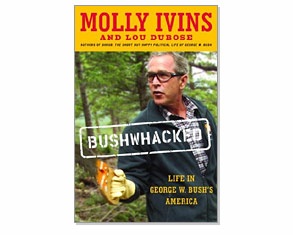
“Bushwhacked!”

A new book excerpt traces President Bush's rise from failed oil baron to wealthy Texas governor, courtesy of Daddy's friends.

  • more
    • All Share Services

In the long run, there is no capitalism without conscience; there is no wealth without character.

— George W. Bush on Wall Street, July 9, 2002

In the long run, we are all dead.

— John Maynard Keynes on the long run, 1924

There he was. On the Tuesday after a long Fourth of July weekend. In the ballroom of an ornate Wall Street hotel that once housed the New York Merchants Exchange. Standing in front of a blue-and-white backdrop with the words corporate responsibility printed over and over on it, in case you should miss the point. Promising us “a new ethic” for American business. Our president, Scourge of Corporate Misbehavior.

It was like watching a whore pretend to be dean of Southern Methodist University’s School of Theology. But as Luther said, hypocrisy has ample wages.

“Harken,” said the Bush camp over and over, “was nothing like Enron.” Interestingly enough, it was exactly like Enron in each and every feature of corporate misbehavior, except a lot smaller. A perfect miniature Enron.

By the summer of 2002, it had long been known that twelve years earlier Bush made a pile by selling his stock in Harken Energy Corporation just before it tanked. At the time, he was serving both on Harken’s board and on a special audit committee looking at the company’s financial health. As he spoke on Wall Street, stories were surfacing about Harken’s sham sale of a subsidiary to a group of company insiders. The acquisition was financed by an $11 million loan guaranteed by the seller, Harken Energy. In other words, a fake asset swap to punch up Harken’s annual profit-and-loss statement.

The “sale” of Aloha Petroleum, from Harken to Harken, was again Enron writ small and so outrageous that the SEC stepped in, declared the accounting unacceptable, and forced the company to restate its earnings. Bush unquestionably knew about the deal.

Even if he had convinced the public that earlier stories about his $848,560 insider trade, his failure to report it to the SEC, his low-interest loans from Harken to buy company stock (a practice he particularly denounced in his Wall Street speech, as though he had never heard of such an unseemly scam before), and the Enron-esque sale of Aloha Petroleum were all what he described as “recycled stuff,” he was still surrounded by bad stories about to break. Enron was ripe for federal prosecution; Bush and Enron’s CEO, Ken Lay, his single largest campaign contributor, had been tight for years. Halliburton was being investigated by the feds for fraudulent accounting practices put in place when Dick Cheney was CEO. Congress was investigating the secretary of the Army for his role in the collapse of Enron, in the fleecing of electricity customers in California, and for his failure to divest himself of Enron stock in a timely manner.

SEC chief Harvey Pitt had so many previous business connections with the firms he was now regulating, he had already had to recuse himself in twenty-nine cases being pursued by the SEC. Bush’s hard-nosed, hard-assed political adviser, Karl Rove, had owned $108,000 in Enron stock and, more important, knew the Enron CEO because he was Bush’s biggest funder. Two of Bush’s economic advisers had worked as consultants for Enron. And the newly disgraced Ken Lay had convinced Bush to dump the chairman of the Federal Energy Regulatory Commission, Curtis Hebert, and to replace him with the candidate of Lay’s choice, a Port Arthur, Texas, homeboy. Before giving Bush the word to dump Hebert, Lay had a come-to-Jesus session with Hebert himself, telling him to embrace free markets and deregulation or, Lay said, things would end badly for Hebert. They did.

Considering the circumstances, heckfire and brimpebbles were the best GeeDubya could manage as he wagged his fingers at Wall Street’s corporate criminals. What could he say about Lay: “I never had sexual relations with that man”? What he actually said, as the cock crowed, was, “He was an Ann Richards supporter.” Kenny Boy, I hardly knew ye.

The stock markets responded to Bush in July as they had to bin Laden in September. Three days after Bush’s Sermon on Wall Street, the Dow Jones had lost 7.4 percent of its value and Standard & Poor’s 500 was down 6.8 percent. Three weeks after the speech, with more Harken stuff breaking, the market fell 390 points in one day. It took a corporate-responsibility bill — written entirely by Democratic senator Paul Sarbanes and vigorously opposed by Bush almost until the day it was passed unanimously by the House — to save the president and staunch the stock market’s hemorrhaging.

The Bushies naturally would have preferred to put all this “recycled stuff” behind them and return to their agenda — including shifting Social Security funds into the stock market. But before we leave the subject, consider some wisdom from Jerry Jeff Walker, the Texas singer-songwriter. Walker met the man who inspired his first hit, “Mr. Bojangles,” when they were both in jail in New Orleans. Years later, a reporter for National Public Radio asked Walker if he had worried about winding up in a drunk tank when he was in his early twenties. “No,” Walker said. “It was just one time. You start worryin’ when there’s a pattern.”

With GeeDubya Bush, M.B.A., there was a pattern. The pattern was: after he fouled up, a friend of Daddy’s always showed up to bail him out. Either because Bush managed to seduce the press corps in 2000 or because Al Gore failed to raise the issue, the press started to notice Bush’s business pattern only in the wake of the wrecks of Enron, Tyco, WorldCom, Adelphia, etc. As the economy contracted and stock values plummeted in mid-2002, reporters began to focus on Bush’s M.O.

Bush walked away from the Texas “awl bidness” in 1990 with almost a million in cash — after a career during which he lost more than $3 million of other people’s money. Here he was advocating “a new ethic” on Wall Street despite his own business dealings, which couldn’t even pass the “old ethic” test. The earlier dealings had been the subject of a pro forma investigation directed by the man President Bush the Elder appointed head of the SEC, and the investigation itself was conducted by a man who had worked as GeeDubya’s personal lawyer before joining the SEC. A few of GeeDubya’s deals, particularly a series of critical bailouts of his ever-sinking oil-field ventures, are truly astonishing — not just because of the volume of dollars flowing out of Northeastern banks and disappearing in Texas but because the transactions made little or no economic sense.

A company balance sheet can be misleading. There was leaseholds, there was momentum.

One of Bush’s white knights, a friend of Bush family consigliere James Baker III (Maureen Dowd deserves credit for dubbing him “consigliere”), is so interesting that to leave him out is the journalistic equivalent of a breach of fiduciary responsibility. Philip Uzielli’s $1 million cash-for-trash deal in 1982 allowed GeeDubya to keep his company alive long enough to sell it to Spectrum 7, then to sell the again-sinking Spectrum 7 to Harken and then to unload his sinking Harken stock — just before the bad news became public — for a large enough profit to buy 2 percent of the ownership of a baseball franchise that made him $15 million in less than nine years. Philip Uzielli (“Uzi” to GeeDubya) is a Panamanian businessman and Princeton classmate of James Baker. In 1982 he was listed as CEO of Panama’s Executive Resources and as a director of Harrow Corporation and Leigh Products.

As we reported in “Shrub,” when GeeDubya’s company, Arbusto, was in a terminal cash crunch, Uzi showed up and paid $1 million for 10 percent of a failing company valued at $382,376, according to the company’s financial statements. In other words, Uzielli paid $1 million for $38,200 in equity. Bush had changed the name of Arbusto to Bush Exploration after his father became vice president. (GeeDubya says arbusto is the Spanish word for “bush,” although Cassell’s Spanish/English Dictionary translates it as “shrub,” the source of one of GeeDubya’s nicknames.) By the time of the corporate name change, Arbusto had drilled so many dry holes that West Texas oilmen called it “are-busted.” Mr. Uzielli lost his entire $1 million investment but later told reporters he didn’t regret it. He described his investment with Bush as “a losing wicket” but said “it was great fun.” What a sport.

Arbusto was not an oil company so much as it was a tax write-off company, taking advantage of the IRS tax-code provision that allowed investors to deduct up to 75 percent of their losses in the oil business. Bush didn’t strike oil, he struck money from friends of his daddy. After the Uzielli bailout Bush Exploration was acquired by Spectrum 7. Spectrum 7 was owned by William DeWitt, Jr., son of the owner of the Cincinnati Reds. DeWitt couldn’t pay Bush for what remained of Bush Exploration, so he sort of took him in, made him CEO and a director, paid him $75,000 a year and $120,000 in consulting fees, and gave him 1.1 million shares of Spectrum 7 stock.

Two years later Spectrum 7 had lost $400,000 in six months and was $3 million in debt. So Harken stepped in. The Texas-based company bought Spectrum 7 for $2 million in Harken stock. Of the $2 million, $224,000 in shares went to Bush, along with options to purchase more.

There was no malfeeance [sic], nor attempt to hide anything. In the corporate world, sometimes things aren’t exactly black and white when it comes to accounting procedures.

“His name was George Bush,” said Harken’s founder, Phil Kendrick. “That was worth the money they paid him.” Oil-field losses followed GeeDubya the way that cloud of dirt used to follow Pig Pen in “Peanuts.” By 1989 Harken was booking big losses but Daddy was president. In February 1990 the company’s CEO, Mikel Faulkner, warned board members that a failed deal the previous year left the company “with little cash flow flexibility.” In the months that followed, Harken’s memos and board minutes should have been written in red ink. So the management team devised a scheme to obscure these losses.

See if you can follow this bouncing ball. Harken masked its 1989 losses by selling 80 percent of a subsidiary, Aloha Petroleum, to a partnership of Harken insiders called International Marketing & Resources for $12 million. Of that sum, $11 million came from a note held by Harken. Aloha was a small chain of gas stations and convenience stores in Hawaii, originally started by J. Paul Getty and acquired by Harken in a package deal in 1986.

When Harken sold Aloha in 1989, here’s how it did the accounting. Since Harken carried an $11 million note on the $12 million sale, the only money it got up front was the first $1 million. But Harken booked $7.9 million, using the mark-to-market accounting that Enron made so fashionable in the late nineties. In January 1990, IMR in turn sold its stake in Aloha to a privately held company called Advance Petroleum Marketing, and the Harken loan was effectively transferred to Advance.

In brief, Harken insiders borrowed money from their own company to buy a subsidiary at an inflated price. Then they booked sales revenue that didn’t exist as profit. Then they got rid of the loan that had provided the revenue that never really existed. This is the kind of deal that made Enron famous. It allowed Harken to declare a modest loss of $3.3 million on its 1989 annual report, and as a result the company’s shareholders had no clue how bad things were. And we all thought the smart guys at Enron invented those clever transactions.

By 1990 Harken’s management realized that the accounting in their sale of Aloha wasn’t quite right. Their thinking on the subject had been clarified after what they described as “discussions” with the SEC. Actually, the SEC flatly declared the sale bogus. When Harken applied the standard “cost recovery” method of accounting required by the SEC, its 1988 losses suddenly became $12.57 million. It is remarkable what can be achieved by just a little attention from a federal regulatory agency. The same standard accounting practices applied to 1989 showed the company had lost $3.3 million over the first three quarters, whereas the “aggressive accounting” originally applied by Harken gave them a $4.6 million profit for the period. Harken’s accounting firm was Arthur Andersen.

Any time an officer of a publicly held corporation sells stock, we ought to know within two days. We ought to know. We being shareholders and employees.

— George W. Bush on Wall Street, July 9, 2002

Harken’s sham sale of Aloha was a shameful violation of shareholder trust, but it kept Harken’s share value up long enough to let Bush sell his stock before the corrected profit-and-loss statements were released in August. The press seemed to prefer the stock-sale story because it is easier to explain than the Aloha deal. As reporters began to press harder on the issue, even the unflappable Ari Fleischer began to flap. “The SEC has been well aware of the issue and the SEC has concluded that this is not anything that’s actionable,” said Fleischer in early July. Bush too became testy, telling reporters that if they wanted more information they should get the minutes of Harken’s board of directors’ meetings. Harken refused to release the minutes. The story might have stalled there had it not been for the work of Charles Lewis and the Center for Public Integrity. The Washington, D.C.-based public-interest group obtained Harken board minutes and correspondence through a Freedom of Information Act request to the SEC. Then they did what both President Bush and his SEC chairman, Harvey Pitt, had refused to do: they made the documents public by putting them on the center’s website (www.publici.org).

You don’t need an accountant to interpret the Harken documents. The company was in desperate trouble. At a May 1990 meeting attended by Bush, board members discussed a stock offering they hoped would bring in enough money to keep the company solvent. Bush was named to the board’s “Fairness Committee,” which was to measure the effects of bankruptcy on small stockholders. Ever the populist, GeeDubya said at this meeting “that inherent in these principles must be the interests and preservation of value for the small shareholder of the company.” A month later Bush left the small shareholders holding the bag; he dumped $848,560 of the stock without disclosing the sale to the SEC. The purpose of the SEC’s disclosure rule is precisely to inform all shareholders that something may be wrong — by letting them know when someone with inside information sells a large block of stock.

The Harken memos show just how much Bush knew about the company’s dicey finances. By late May 1990, internal company memos warned that there was no other source of immediate financing, that a cash crunch was only days away, and that loans were slipping “out of compliance.” Banks were demanding guarantees of sufficient equity to cover the notes. As chairman of the audit committee actually working with the accounting consultants called in by the board, Bush knew exactly how grim their conclusions were. He was warned, along with other directors, in a May 25 memo that it would be illegal to dump his stock. He sold in June to a private purchaser who has never been identified.

The company was kept afloat by investments from a small liberal-arts college in Cambridge, Massachusetts. This news was revealed only after a group of dogged and enterprising Harvard students at the nonprofit HarvardWatch dug into records there and turned their findings over to The Wall Street Journal in 2002.

Harvard’s Harken bailout helped salvage Bush’s last shaky oil company, at one time setting up a Harvard-Harken venture that moved $20 million in liabilities off Harken’s books. It also cost the university’s endowment more money than the young Bush ever earned in West Texas. Hooking up with Harken contributed to a record $200 million write-down for Harvard Management in 1991. Why did Harvard do it? Let us count the ways. Harvard Management exec Michael Eisenson sat on Harken’s board with Dubya Bush. George Herbert Walker Bush was vice president of the United States — and a Skull and Bones Yalie. His son held a Harvard Business School M.B.A. — and was a Skull and Bones Yalie. After Poppy became president and tiny Harken somehow secured a huge drilling contract in Bahrain, Harvard kept pouring millions into the little Texas oil company in ’89, ’90, and ’91.

In July 2002 the White House offered three explanations for Bush’s failure to report his own Harken stock sale. The first was that the filing of the disclosure form was “the corporation’s responsibility.” A letter from Harken’s general counsel dated October 5, 1989, gently reminds Bush that he had failed to file the same Form 4 when he exercised his director’s option to buy 25,000 shares of Harken stock exactly one year before he unloaded it in June 1990. The “Dear George” letter from Harken’s general counsel, Larry Cummings, made it clear to Bush that company lawyers or accountants couldn’t file the forms because they required his signature.

Turns out Bush regularly failed to report insider dealings to the SEC. On two occasions before his June 1990 stock dump, Bush had sold as a board member and failed to file the disclosure forms.

There are countless subjects on which George W. Bush might have pleaded ignorance in 1990, but a failing oil business was not one of them. At the end of 1989 Harken president Mikel Faulkner told a reporter at the Petroleum Review that Harken would book more than $6 million in end-of-the-year profits. On August 22, 1990, Harken’s second-quarter report predicted $23.2 million in losses. Once the news hit the street, the stock sank immediately from $4 to $2.37; it later bottomed out at twenty-two cents a share.

Eight and a half months later The Wall Street Journal reported that the president’s son was under investigation for failure to report the stock sales. The chairman of the SEC was Richard Breeden, who had worked for Poppy Bush as an economic adviser. The walls of Breeden’s office were so plastered with photos of Poppy and Barbara Bush that a New York Times reporter observed, “George Bush is Breeden’s Mao.” The general counsel at the SEC was James Doty, the same James Doty of the Baker Botts law firm, who represented GeeDubya when he bought his 2 percent interest in the Texas Rangers with the money he got from dumping his Harken stock. The Houston law firm was founded by the great-grandfather of James Baker III, secretary of state under Bush the Elder and the point man for Bush the Younger in Florida after the disputed 2000 election.

Breeden and Doty never asked for an interview with the subject of their investigation. Since 1993 Breeden, Doty, and other partners of Baker Botts have contributed $210,621 to GeeDubya’s political campaigns, making the firm the president’s number-fourteen career patron. They were beaten out for the number-thirteen spot by Arthur Andersen, at $220,557.

In a letter regarding “George W. Bush Jr.’s [sic] Filings,” SEC investigators observed that Bush was familiar with the SEC’s filing deadlines, having met them when he filed reports of dealings with three other companies in which he owned stock. But with Harken, Bush filed “four late Forms 4 reporting four separate transactions, totaling $1,028,935.” During his first campaign for governor of Texas, Bush repeatedly told reporters he had been “exonerated” by the SEC, and Fleischer repeated the same line in the summer of ’02. But the report issued by the SEC’s enforcement division in 1993 specifically says the investigation “must in no way be construed as indicating that the party has been exonerated.”

Just as Harken was selling itself its own subsidiary in Hawaii, it set up another corporation on another island. Harken Bahrain Oil company registered in the Cayman Islands in September 1989. The Caymans, like Bermuda, are a convenient offshore address for U.S. companies that want to do business at home but prefer not to pay U.S. taxes. After the furor over tax-dodging corporations broke, Bush made this ringing statement in August 2002: “We ought to look at people who are trying to avoid U.S. taxes as a problem.” Corporate tax dodgers now cost the country seventy billion dollars annually, according to the IRS, all of which has to be made up by average citizens who can’t acquire a mail drop in the Caymans. The Scourge of Corporate Misbehavior even daringly urged corporate tax-dodgers to “pay taxes and be good citizens.” Then the White House had to acknowledge that Harken Energy had set up an offshore subsidiary to avoid taxes. Bad timing.

Harken was not Enron, but it was certainly Enron in the making. What Bush took out of Harken was also twenty times as much as Bill and Hillary Clinton lost in a crummy Arkansas real estate deal that cost American taxpayers seventy million dollars to investigate. By the time Bush signed the Corporate Responsibility Act, Harken was selling at forty-one cents a share. Don’t put your Social Security money in it.

So who are the “regular folks” who have been affected here, and what have those effects been? In this chapter, you, dear readers, are the regular folks. Americans lost $6 trillion when the stock market collapsed after Enron, WorldCom, and Tyco. It’s your 401(k) that’s the subject here, your pension, your Social Security, your investments, your savings, and your jobs. You.

Of course George W. Bush and his petty self-dealing at Harken did not cause the collapse of Enron et al. What we are looking at is not causation but connection. If one wanted to paint with a broad brush, surely Bill Clinton, president during the enormous stock market boom of the second half of the nineties, has more responsibility for the eventual collapse than does George W., president for only eighteen months when it happened.

But an even broader brush shows a different pattern. Starting in 1980 with the presidency of Ronald Reagan (or even the 1978 deregulation of the airlines, if you’d like to include Jimmy Carter), this country has been going through a deregulatory mania. Supply-siders, Milton Friedman, free-marketeers of all stripes, “movement conservatives,” The Wall Street Journal’s editorial page — not to mention a motley assortment of anti-government cranks from militias to Republican candidates — have been trying to persuade us that government can’t do a damn thing right and that free markets are the answer to absolutely everything. There’s a true-believerism about the free-marketeers that is genuinely unsettling, as though it were a cult or a religion in which certain fundamental assumptions are never questioned. All you have to do to believe is ignore history and experience.

Capitalism is a marvelous system for creating wealth. On the other hand, unregulated capitalism creates hideous social injustice and promptly destroys itself with greed. A marketplace needs rules. From the very beginning, capitalism has required careful regulation. In the market towns of medieval England there were as many as twenty or thirty laws governing just the balance scales, and whether you could put your thumb or any other digit on the scale. Mostly what we’ve learned from the American experiment is that competition is good, but we need rules because people cheat. And there are some natural monopolies that need regulation or they end up in cartels that rip everybody off.

Government regulation and the much-maligned trial lawyers are the two instruments by which we control corporate greed. It seems to me government is neither good nor bad but simply a tool, like a hammer. You can use a hammer to build with, or you can use a hammer to destroy with. The virtue of the hammer depends on the purposes to which it is put and the skill with which it is used.

Of course government regulation is burdensome and often absurd. One famous federal form required employers to “list your employees broken down by sex.” “None,” read one reply. “Alcohol is our problem.”

What has changed in this country over the course of the past twenty-some years is that government has served less and less as a brake on corporate behavior and more and more as a corporate auxiliary, because of the corrupting effects of the system of legalized bribery we call “campaign financing.”

And here we find the root cause of the stock market collapse. During the nineties the SEC was increasingly starved for funds by the Republican Congress on the grounds that regulation is bad, and so it suffered a tremendous erosion of its authority. While the press was telling the Enron disaster story and CEOs were stepping forward like Baptists at an altar call to restate their companies’ earnings, Bush fought for a bare-bones SEC budget, recommending $576 million in July 2002. (The House authorization at the time was $776 million.) Clinton’s SEC appointee, Arthur Levitt, had struggled valiantly for such obvious reforms as expensing stock options and monitoring accounting firms, but the politicians paid no attention during the years of go-go and the all-absorbing crisis over the president’s sex life.

Phil and Wendy Gramm made a significant husband-and-wife contribution to the mess. In 1992, just a few days after Bill Clinton’s election, Wendy Gramm, in her last days as the lame-duck chair of the Commodity Futures Trading Corporation (which was short two of its five members), pushed through a federal rule that exempted energy-derivatives contracts from federal regulation (because regulation is bad). Energy derivatives were just then becoming one of Enron’s most profitable lines. According to Robert Bryce’s book on Enron, Pipe Dreams, this key piece of deregulation is what allowed Enron to become a giant in the derivatives business. The exemption not only prevented federal oversight, exempting the companies from the CFTC’s authority, it even exempted them if the contracts they were selling were designed to defraud or mislead buyers. Five weeks later Enron announced it was hiring Mrs. Gramm as a member of the Enron board, a job that eventually paid her about $1 million in salary, attendance fees, stock-option sales, and dividends. Senator Phil Gramm’s Banking Reform Act formally repealed the long-standing prohibition (which grew out of the stock crash of ’29) against merging banks, brokerage houses, and insurance companies. Then the IRS was emasculated by Gingrich Republicans on the grounds that collecting taxes is tantamount to fascism.

The whole dizzying array of corporate clout-wielders in Washington — powerful lobbyists who leave no fingerprints on curious little exemptions and special provisions that apply to only one company — gets larger and more brazen by the year.

George W. Bush didn’t invent any of this. His role is to pretty much embody it. He is what people mean when they speak of “crony capitalism.” His administration is what we mean by the cliché “setting the fox to guard the hen coop.” (Raccoons are actually far more dangerous to chickens — take our word for it.) Bush is not motivated by greed — he honestly believes government should be an adjunct of corporate America and that we’ll all be better off if it is. Thus his role has been to build upon, to extend, to exaggerate, to further privatize, to cheerlead for, to evangelize about all that the free-marketeers have been preaching over the years.

The odd thing about Bush at midterm is that most of the Washington press corps has yet to recognize just how extreme his ideology is. As governor of Texas he tried to privatize the state welfare system and considered privatizing the University of Texas; he fought for “voluntary compliance” with environmental regulations. With the power of large corporations in this country already grossly disproportionate because of their influence over politicians through money, government is the last effective check on corporate greed. To put a man in charge of the government who basically doesn’t believe it should play a role is folly.

The tragedy of having him in office at this time is that the man is congenitally incapable of checking the excesses of capitalism. No sooner was the Sarbanes bill passed than Bush’s man at the SEC, Harvey Pitt, busily began undermining it. Pitt’s claim to the title of biggest raccoon in the henhouse is rivaled only by the perfectly ludicrous appointment Bush made to the board assigned to implement the new McCain-Feingold campaign-finance reforms — a man vehemently opposed to campaign-finance reform. There are contenders at Interior, Labor, and EPA as well, but Pitt probably deserves the prize.

Pitt wanted to appoint Judge William Webster to head the new accounting firm oversight board set up by the Sarbanes bill. Webster turned out to have corporate conflicts of interest out the wazoo, and Pitt himself was fired as a result. However, he remained on the job and by January 2003 had managed to actually weaken the rules that had been in effect before the corporate scandals broke. So many fundamental reforms have not been addressed — the failure to count stock options as a business expense, which gives CEOs an incentive to run up stock prices with tricky accounting; out-of-control hedge funds; derivatives; directors with conflicts of interest; the list goes on. Less than nothing has been done about any of it, so one can guarantee this whole corporate-fraud fiasco is going to happen again.

George W. Bush should declare himself a conscientious objector in his own war on corporate crime.

- – - – - – - – - –

Copyright © 2003 by Molly Ivins and Lou Dubose. Excerpted from “Bushwhacked,” by Molly Ivins and Lou Dubose, by permission of Random House, a division of Random House, Inc. All rights reserved. No part of this excerpt may be reproduced or reprinted without permission in writing from the publisher.

Continue Reading Close

Molly Ivins & Lou Dubose

Shrub

  • more
    • All Share Services

In Shrub, Molly Ivins and Lou Dubose focus their attention on the biggest politician in their home state: George Walker Bush, or “Shrub,” as Ivins has nicknamed Bush the Younger. With wit and down-home wisdom, Ivins shares three pieces of advice on judging a politician: “The first is to look at the record. The second is to look at the record. And third, look at the record.”

Ivins takes a good, hard look at the record of a man who could be the leader of the United States. Beginning with his post-college military career, Ivins tracks Dubya’s unlikely path from a failed congressional bid to a two-term governorship and gives a perceptive and entertaining analysis of Governor George W. Bush.

Molly Ivins’s column is syndicated in over two hundred newspapers, from Anchorage to Miami, including her home paper, The Fort Worth Star-Telegram. A three-time Pulitzer Prize finalist, she is the co-editor of The Texas Observer and former Rocky Mountain bureau chief for The New York Times. She has a B.A. from Smith College and a master’s degree in journalism from Columbia University. Her first book, Molly Ivins Can’t Say That, Can She? spent more than three months on The New York Times bestseller list.

Listen to Molly Ivins read an excerpt from her important biography, “Shrub: The Short but Happy Political Life of George W. Bush.”[Random House]

Continue Reading Close

Page 2 of 2 in Lou Dubose