Spring Offer: Get 1 Year, Save 58%

Hillary Clinton announces new book as a “warning to all voters” about democracy

Hillary Clinton is releasing her new book as a collection of essays highlighting the former first lady's and presidential candidate's experiences with politics, her marriage to husband and former President Bill Clinton and her relationship to her faith.

On Tuesday, Simon and Schuster announced Clinton's book, “Something Lost, Something Gained: Reflections on Life, Love and Liberty” will be released on Sept. 17. The book is said to be a "warning to all American voters," that will discuss the long-standing Democrat's "unvarnished views on politics, democracy, the threats we face and the future within our reach.

"She takes us along as she returns to the classroom as a college professor, enjoys the bonds inside the exclusive club of former first ladies, moves past her dream of being president, and dives into new activism for women and democracy," Simon and Schuster said.

“This is the Hillary Americans have come to know and love: candid, engaged, humorous, self-deprecating — and always learning,” the statement concluded.

Clinton has written several other books detailing her experiences as a woman in politics but most famously she released the memoir "What Happened" in 2017 after she had lost the 2016 election to former President Donald Trump.


“What a loser”: Bob Good “election fraud” claims dismissed by fellow Republicans

Despite supporting a presidential candidate who claimed the 2020 election was stolen, some GOP members aren't buying the election fraud claims from their colleague Rep. Bob Good, R-Va.

The chairman of the House Freedom Caucus currently trails his Trump-endorsed opponent, state Sen. John McGuire, by a few hundred votes in a race that is still “too-close to call,” the Associated Press reported

Joining a number of Republicans who have claimed election fraud, Good said on Steven Bannon’s podcast he would challenge the result if he loses the primary. He’s already demanded a “do-over” in one county and blamed his loss on a fire that broke out at certain polling stations, he posted on X. 

Election officials clarified that fire alarms went off inadvertently in the locations Good mentioned, but no voters were turned away, MSNBC reported.

Many of Good’s Republican colleagues have openly criticized his excuses. 

'[Of] course Bob is claiming election fraud. He is grasping at straws to help save his political career,' said Rep. Derrick Van Orden, R-Wis., who endorsed McGuire," reported Axios. "If Bob had spent more time working for America and less time trying to dictate to other members of Congress how we could vote for our constituents, we would not be having this conversation. He is a bully and it is time for him to go."

Other Republicans are also telling their colleague to concede.

Rep. John Duarte, R-Calif., added: "Bob Good lost. It is very simple."

"What a loser," added Rep. Mike Lawler, R-N.Y., per Axios.

Both Good and McGuire have at some point supported Trump's claims that the 2020 election was stolen, CNN reported.

If he loses, Good would be the first member of Congress to lose a primary this election season.


Shannen Doherty is hopeful about her cancer even though it is incurable

Shannen Doherty has another update about her treatment of Stage 4 breast cancer.

The former "90210" and "Charmed" actor said on her podcast “Let’s Be Clear” that despite her cancer being incurable she is hopeful. Doherty shared that she had been given new options because of a positive development in her health.

“I got to say that there is some positivity there, and the positivity is that because my molecular structure of my cancer cells changed recently, it means that there’s a lot more protocols for me to try,” Doherty said on her podcast. “So, you know, for the first time in a couple of months, probably, I feel hopeful because there are so many more protocols now. Whereas before I was hopeful, but I was still getting prepared. Now I’m like, oh, I don’t need to be prepared. I need to go on a vacation. I need to go on a boat again and explore places.”

She continued, “So there is hope mixed with my own bit of sadness because, again, I just don’t know what all these chemos — and it’s more than one chemo that I’m going on. We’re kind of throwing the kitchen sink at it.”

Doherty was diagnosed with breast cancer in 2015 and went into remission two years later. But in 2020, Dogerty shared that her cancer had returned and was categorized as stage 4. Last year, she said on Instagram that it had metastasized to her brain.

Worried about PFAS in your drinking water? Here’s what the evidence says about home filters

Recent news about PFAS "forever chemicals" in Australian drinking water supplies has been very confronting. Many people are asking how they can remove these contaminants from their home drinking water.

In short, it is difficult and expensive to do this effectively in your home.  

The United States Environmental Protection Agency provides useful and clear advice about per- and polyfluoroalkyl substances (PFAS) and how they can be removed from drinking water.

One of the major challenges in removing PFAS chemicals from drinking water is the enormous number (more than 10,000) of individual chemicals in this group. US authorities warn these can cause cancer over a long period of time. No single filtration or treatment technology is 100% effective at removing them.

So, what are the options? And can you filter too much out of your drinking water?


Four treatment systems

US authorities have reviewed dozens of controlled studies on how to remove PFAS and other contaminants from drinking water. The costs involved in many of the treatment options that remove PFAS can be expensive. Many of the cheapest filters will not be effective.

There are four broad systems for treating drinking water to remove such contaminants in the home.

1. Activated carbon

The first two treatment systems use an adsorption process (rather than absorption) to attract and trap PFAS and other contaminants from water. Absorption is when one substance is absorbed into another, but adsorption is when particles stick onto the surface of another substance. Adsorption using "activated carbon" is a widely used industrial process for drinking water treatment to remove a range of substances.

Adsorption binds PFAS or other contaminants through ionic bonds using either negatively charged or positively charged particles. It can be used to filter water as "granular activated carbon" or as "carbon block filters". These are two broad types of water filters that use activated carbon.  

2. Ion exchange resins

This second adsorption treatment uses different formulations of resin (or polymers) to chemically attract and remove targeted contaminants in water. The ion exchange filters use very small "microbeads" that have a large surface area to attract and remove contaminants. 

3. Reverse-osmosis

This process uses electrical energy to build pressure to force water through semi-permeable filtration membranes usually made of layers of polyester material. The membrane has minute holes that only allow water molecules to pass through. This system creates a waste liquid often called "brine". It contains the accumulated chemical and other matter that could not pass through the membrane.      

Reverse-osmosis is a popular technology used on a very large scale to purify water. For example, desalination plants use this system to remove salt from sea water for drinking water supplies.

Such systems are also widely available at smaller scales for home water treatment. They are widely used across regional Australia where water supplies are often very saline or contain other impurities. They can be installed into home plumbing or smaller bench-top systems.

4. Distillation

A fourth treatment system is "distillation" of water. This process uses heat to boil water to produce steam. It then allows the steam to cool and condense, and then collects the resulting purified water.

It is not commonly used, although is one of the oldest water purification systems. It does not always reliably produce pure water as many chemicals have a lower boiling point than water. As a result, they can also be evaporated, condense and contaminate the processed water.

The process of boiling water will not remove PFAS chemicals on its own.


There is such a thing as too pure

A word of warning: drinking demineralized water produced by reverse-osmosis or distillation can have a number of adverse consequences.

People need minerals, such as calcium and magnesium, provided by drinking water. While many essential minerals come from food and a balanced diet, a lack of these in water can upset a person's electrolyte balance and can also trigger a range of health issues. If you do drink demineralized water, it would be wise to seek medical advice.  

Also, demineralized water can be aggressive to plumbing, increasing the rate of corrosion of household pipes and appliances. This can dissolve metals from the plumbing into the drinking water, as demonstrated on a very large scale when a new water supply caused corrosion and increased lead content in Flint, Michigan.      


The bottom line

Searching for information on the best system for removal of PFAS chemicals from drinking water is difficult. Guidance from Australian government agencies and the water industry seems absent or inadequate. And finding impartial advice is tough.  

My own recommendation, based on published studies, would probably be a reverse-osmosis, dual-stage filter installed "under the sink".

A detailed 2020 study investigated drinking water and PFAS in more than 60 US homes. It showed near-complete removal by reverse-osmosis, dual filtration systems for all PFAS chemicals. Carbon filters were less efficient, with a maximum of 70% effectiveness in removing these pollutants.

Householders will also need to ensure PFAS filtration systems are regularly maintained. Along with installation, this can be very expensive. The most simple bench-top carbon filter system will cost A$100–$200. All filters clog up and require cleaning or renewal. Replacement filters costs about $30 to $80.

Under-sink reverse-osmosis systems are more expensive, ranging from $400 to over $1,000. And you'll need to hire a plumber for installation. Again, the system requires cleaning and maintenance.

Australian governments should require regular testing of all town water supplies across the country. Many water supplies probably already meet the US's tough new  PFAS standards.  

Finally, seek information on PFAS in your drinking water from your water provider. Home filtration where you are might just be a waste of money!


Ian A. Wright, Associate Professor in Environmental Science, Western Sydney University


This article is republished from The Conversation under a Creative Commons license. Read the original article.

“Don’t take one second away”: Celine Dion wanted most upsetting medical moment shown in documentary

Filmmaker Irene Taylor learned a significant lesson from her mother, who is deaf, but loved to sing to her. "She didn't hit the notes, but she had a cadence and she had a rhythm that told me at a very early age that music is love." 

Her observation comes as part of the opening remarks at the Manhattan premiere of "I Am: Celine Dion," Prime Video's documentary which illuminates the professional trajectory and resilience of powerhouse performer Celine Dion, for which Taylor served as director.

"We're going to see a lot more from Celine."

"I Am: Celine Dion" comes at a unique juncture in the "My Heart Will Go On" singer's life and career. In August of 2022, she was diagnosed with Stiff Person Syndrome (SPS), a rare and progressive autoimmune neurological condition that causes muscular rigidity and intermittent spasms. The disorder has traumatized the Canadian singer's vocal abilities — in a recent "Today" interview, Dion revealed that singing with SPS feels "like somebody's strangling you."

Dion herself appeared at the screening and said that the project is meant to serve as a love letter to fans by revealing the truth of her new reality. When it came to depicting Dion's situation, Taylor strived to create something that was both relatable and understandable, a simplicity that is largely conveyed in the film's explicit focus on Dion's testimony alone, devoid of the usual documentary talking heads. That also meant showing the more distressing aspects of the singer's disease. 

"You really can do that a lot better if you aren't being so opaque and poetic about it," Taylor told Salon. "If you see it, there can be a value in that."

Check out the full interview, in which Taylor discusses her disability advocacy through film, Dion's lifelong love of singing and how that passion, despite playing out somewhat differently from how it used to, is as strong as ever.

The following interview has been edited for length and clarity. 
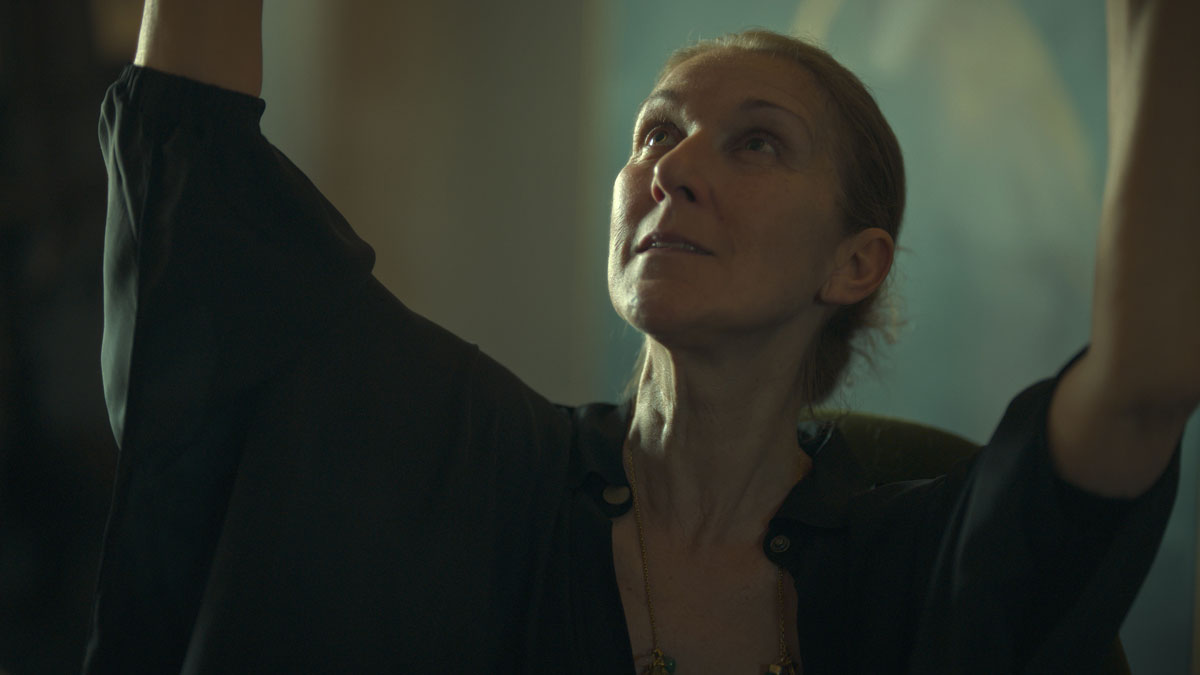
I Am: Celine DionI Am: Celine Dion (MGM/Prime Video)

Watching the documentary, I was really intrigued because I felt like I saw Celine's story very much as an athlete who is now suddenly faced with a disability.

So much of her essence is based on her vocals, but also we see all these clips of her on stage really commanding such an athletic presence. We even see that she has her sports medicine doctor, Terrill Lobo, working with her later on as she's dealing with SPS. I was wondering how that knowledge of her athleticism and her physicality as a performer affected how you approached "I Am: Celine Dion?"

That's such an astute observation, yeah. So it was very easy to think about her physicality because nearly every day I was there filming with her, at some point in the day we would film her physical therapy, because it's something she does six days a week. So it was very easy to see that she had good days and bad days. It was very easy to think about all of those archival moments in her concerts where she is just leaping across the stage and she's energetic. There are lots of little small moments I like to pull out of some of those performances, not to give you a fan moment, but to contrast the woman we're seeing now. And it's not that she looks bad or unhealthy, but she's more tentative, right? She was so commanding on stage, and I think that was very hard on her just to be less coordinated than she once was, to be less flexible than she once was. 

I think her body and her vocal cords and her diaphragm are part of that body, right? They served her well, and she took very good care of herself. She talks about her prescription drug use, but it wasn't to feel relaxed or because she has an addictive personality, I think really she was doing it to walk, to just function, and that's how bad it got, and I think that's hard on someone. We see that with athletes who, by 30, they're already having trouble and they've really got to think about what they want to do with the rest of their lives. I think it's not too different in Celine's case because she was so physical.

Totally. You have a personal relationship with disability that you shared with the audience last night. What are the misconceptions that people have about those who cannot see or hear as well in their appreciation for music and performance specifically?

Well, I think that a lot of people just — to give the greater society the benefit of my doubt — I think that a lot of people just don't realize how the senses can be. If you don't have vision, you can develop other senses that you have in a more acute capacity, and it gives what I would call a superpower.

I made one of my documentaries about my son, and my son is deaf. My parents are deaf, and also my son is deaf, and I made the film because I realized that we always say about Beethoven, for example, "Well, Beethoven was such a good musician in spite of his deafness." Well, I would say he was a great musician because he developed deafness, and that was his journey.

Your film "Moonlight Sonata," right?

This is "Moonlight Sonata," yeah. So I think we're going to see a lot more from Celine, and we're going to see more from her, not because she's going to be back to normal or back to the old Celine — it's because we are going to see a woman who has a very powerful will, a very iconic voice, a deep love for music and for singing. We're just going to see her adapt, and we're going to see what comes out of that. It may be that her repertoire changes so that her vocal range is not as great, but she's singing with more intensity and more emotion, if that's even possible for Celine, because she's already so intense and emotional. But we will see what is possible.

"You're not going to forget it."

And I think that disability is often seen on a ledger of life. It's a debit instead of a credit.  And I think that's just something that slowly, in my filmmaking, I would like to contribute to changing that perspective. And I'm not on a soapbox. I'm not trying to make issue-based films about disability, but I do like to choose my characters carefully, because I see them as a tool for us to all think about our own abilities and our own disabilities, you know, separately.

There were a range of performance clips that showed both Celine's vocal acrobatics, but also her full-body performances, as we just mentioned. There were also clips where the lyrics seemed to reflect the part of her life being described on screen when she discusses the death of her husband René Angélil. For example, we see her singing "All By Myself." How many hours were spent deciding which of these to feature and where? I thought that was really interesting, the way that you put that together.

 Well, I think that particular example, I would say, was very on the nose, right? Almost so on the nose that I wasn't sure I wanted to do it. But two things I'll say: That actual performance where she cries singing that song was the first time she went live after René died. So not everyone's going to know that. Some super fans are going to know that. But it was a real moment for her. Like, she really was expected to sing that song because it's a hit. So she's going to sing it. But of course, now it took on a whole new meaning. So that was the first reason I was OK to include something like that.

But I think if I'm going to include things that are that on the nose, they're too easy, right? They're very low-hanging fruit, you could say, creatively. But I think I tried to do the opposite, where I would show a series of pictures with no audio, with no context. And you sort of let your brain fill in the blank with your imagination. And so I really tried to just change it up a lot so that it wasn't too obvious. But I also didn't want to make a film that was so avant-garde that it wasn't relatable, right? So that's why I kind of tried to do that. And I give my editors a lot of credit. They really had just such genius ideas about how we could play with time in one single scene. And it was a way to show her [Celine's] kindness, but also a certain vulnerability, that even after 40-some-odd years, she's still spraying a little perfume on, just because it gives her a little pick-me-up even though she's just doing a virtual interview.

Celine loves shoes, as we see in the documentary. She goes on a spiel about it, which I thought was one of the funniest moments of the film. Could you discuss including that scene, along with her gigantic, motorized closet of shoes?

Well, I have to confess, I love shoes, too. So when I first saw her closet, which was that beautiful bedroom that we spent many hours in, I saw it as a still life. And then there's a funny archival scene where Celine uses a remote control to move shoes back and forth in parts of her closet. And I think that I really tried to look at this and have some compassion for someone who, OK, so she loves her shoes — but she also needs shoes that she can dance in. She needs shoes that she can feel good in. And as she puts it, "I walk the shoe, the shoe doesn't walk me." She wants to be in command, and certain shoes make her feel a certain way.

They're also a very practical thing. It was a very subtle little moment, but she says, "I have no low-heeled shoes, but I can't wear open-toed shoes because there might be paparazzi." What does she mean by that? Because she might have to run. I mean, that's the life that she was living. And so ordinary people like you and I, we don't think about things like that. We're like, "Do I want to see my toes today or don't I want to see my toes today?" (laughs) But for her, it was like a safety issue.
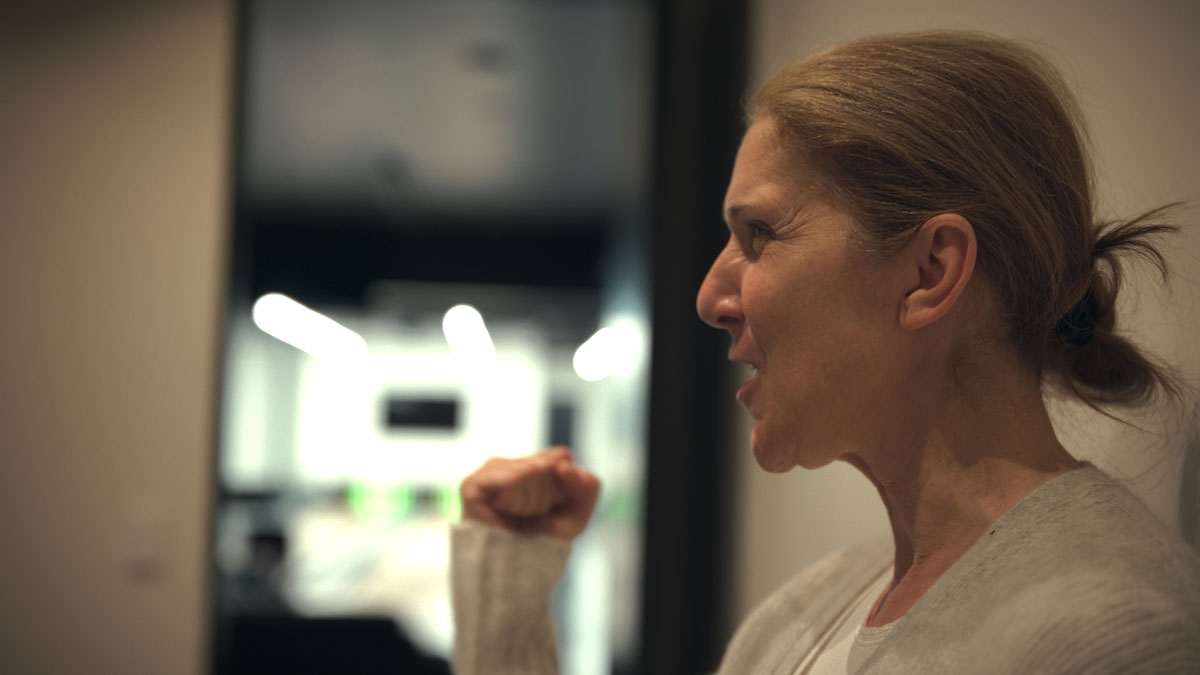
I Am: Celine DionI Am: Celine Dion (MGM/Prime Video)Toward the end of the documentary, we see Celine experience a severe spasmodic episode from SPS. That was very deeply moving. It was incredibly emotional to watch — I was crying. What were the challenges in showing such a deeply personal moment?  

Well, first of all, the challenge I had was that I was filming it with my director of photography. I was the sound person and he was the camera person, and we were two feet from her head the entire time it was happening because we were caught in the corner of her physical therapy room and we didn't want to get in anyone's way. So we pretty much just moved our perspective by 30 or 40 degrees –that's it – the whole time. And so as a human being, I first needed to make sure that she could breathe. And I wasn't even clear that she was breathing. I was pushing my headphones against my ears so that I could pick up the sound of her breath from the microphone. And I didn't hear it. And I was extremely uncomfortable and I was very upset. But the thing is, there were several other people in the room whose job it was, and they were much more qualified than me to deal with the matter at hand. They had training, they knew what to do.

So as I did with everything we filmed, I kept filming. I had been filming for eight months at that point. I kept filming. I knew she would want me to keep filming. And I knew that she would trust that if she decided that was too much, she might ask to see the footage and decide that she didn't want to see it in the film. So as a filmmaker, I didn't hesitate to film it. As a human, I hesitated to make the filming my first priority. My first priority was definitely, "Is she OK?" And if she's not, I'm going to drop the microphone and my cameraman's going to put the camera down and we are going to run to the hospital, do whatever we need to do.

"She questions who Celine Dion really is. Is Celine Dion still existing?"

But it wasn't necessary because she had people there. And I think ultimately, as a storyteller and as an advocate — getting back to the disability question — as someone who feels like I am intrinsically advocating for people to understand what it's like to live in the body of someone with a disability or with a chronic illness or with a sensory difference, you really can do that a lot better if you aren't being so opaque and poetic about it. If you see it, there can be a value in that. But seeing too much of it, I mean, I'm sorry that you said you cried. I really am. And I know that not everyone is going to feel good in that moment, but you're not going to forget it. And I could have given you 50 minutes of it and instead, I gave you five. So she was experiencing it for 50.

And I will tell you one other thing I did think about was that I know that Celine is only semi-conscious when these things happen. She doesn't know what it looks like. She can't see herself. And I thought she might just want to know. And if she doesn't, no problem. I won't show it to her. But she did not ask me to include it. She did not ask me not to include it. And so the first time she saw it was in an edited form in the film that I showed her. And she specifically said, "Don't take one second away." So we kept it in.

Celine at one point talks about her voice being the conductor of her life and taking the reins. Now her voice is being taken away from her. At what point did you know that this was a sort of rumination on identity as a project? And when was the film's title first realized?

Pretty late. I came up with the title "I Am" pretty late. But it did have to do with two moments in the film. One is when she is talking about her childhood with her family being the youngest of 14 kids. And she's basically making the point, "I didn't make this up. This is who I am. I've always been this way." And she talks about her personality as a child. And she talks about how her mother taught her to be a performer and be a professional. And she is, she was that person. She still is that person. So she literally says the phrase, "I am, I am this way. This is who I am."

There's a second thing when she, towards the end of the film, after she has this extraordinarily excruciating medical episode, she hears one of her favorite songs, which is a song called "Who I Am." And it was not lost on me that she didn't quite know all the lyrics. And it's sweet. You see her flubbing the lyrics a little bit. But man, when that refrain comes in, she knows exactly what the lyrics are. "Who I am, who I am, who I am. This is who I am."

And so I thought she also really commands a strong title of the film. And there was conversation in my brain a lot whether to include her name in the film. Because she questions who Celine Dion really is. Is Celine Dion still existing? Because her voice can no longer be the conductor. But I actually think she's realizing, and I certainly feel this way, her voice can still be a conductor. She's just going to sing differently.

"I Am: Celine Dion" is streaming on Prime Video on June 25.

A group of young people just forced Hawaiʻi to take major climate action

The government of Hawaiʻi and a group of young people have reached a historic settlement that requires the state to decarbonize its transportation network. The agreement is the first of its kind in the nation and comes two years after 13 Hawaiian youth sued the state Department of Transportation for failing to protect their “constitutional right to a clean and healthful environment.” 

The settlement, announced last Thursday, requires the department to develop a plan and zero out greenhouse gas emissions from all transportation sectors by 2045. The agency is also required to create a new unit tasked with climate change mitigation, align budgetary investments with its clean energy goals, and plant at least 1,000 trees a year to increase carbon absorption from the atmosphere. 

“It’s historic that the state government has come to the table and negotiated such a detailed set of commitments,” said Leinā‘ala L. Ley, a senior associate attorney at Earthjustice, one of the environmental law firms representing the youth plaintiffs. “The fact that the state has … put its own creativity, energy, and commitment behind the settlement means that we’re going to be able to move that much quicker in making real-time changes that are going to actually have an impact.”

According to a press release from the office of Hawaiʻi Governor Josh Green, the settlement represents the state’s “commitment … to plan and implement transformative changes,” as well as an opportunity to work collaboratively, instead of combatively, with youth plaintiffs, “to address concerns regarding constitutional issues arising from climate change.”

“This settlement informs how we as a state can best move forward to achieve life-sustaining goals and further, we can surely expect to see these and other youth in Hawaiʻi continue to step up to build the type of future they desire,” Green said in a statement.

The 13 teenagers who brought the suit, Navahine v. Hawaiʻi Department of Transportation, have cultural practices tied to the land. They are divers, swimmers, beachgoers, competitive paddlers, and caretakers of farms and fishponds. Many are Native Hawaiian. In the lawsuit filed in 2022, they alleged that the state’s inadequate response to climate change diminished their ability to enjoy the natural resources of the state. Since they filed, at least two plaintiffs were affected by the Lāhainā wildfire, the deadliest natural disaster in the state’s history.

Hawaiʻi has been a leader in recognizing the effects of climate change. The archipelago is battling rising sea levels, extreme drought, and wildfires among other climate calamities. In 2021, it became the first state in the nation to declare a “climate emergency” and committed to a “mobilization effort to reverse the climate crisis.” But the non-binding resolution did not translate directly into statewide transportation policies that reduced greenhouse gas emissions, according to the youth plaintiffs. 

Hawaiʻi has been a leader in recognizing the effects of climate change.

Between 1990 and 2020, carbon dioxide emissions from the transportation sector increased despite advances in fuel efficiency, and now make up roughly half of all greenhouse gas emissions in the state. The plaintiffs argued that the Hawaiʻi Department of Transportation is largely to blame. Instead of coordinating with other agencies to meet the state’s net-zero targets, it has prioritized highway construction and expansion. The agency operates and maintains the state’s transportation network in such a way that it violates its duty to “conserve and protect Hawai‘i’s natural beauty and all natural resources,” the plaintiffs noted. 

Other similar constitutional climate cases are pending across the country. Our Children’s Trust, a public interest law firm that represented the Hawaiian youth with Earthjustice, has also brought cases against Montana, Alaska, Utah, and Virginia on behalf of young people. Ley said Hawaiʻi is a “great model” for other states to follow. “This settlement shows that these legal obligations have real effects,” she said. 

The settlement requires the state transportation department to meet a number of interim deadlines and to set up a decarbonization unit. The agency has already hired Laura Kaakua, who was previously with the Hawaiʻi Department of Land and Natural Resources, to lead the unit. Ley said that they plan to monitor every report the agency publishes, submit comments, and educate their young clients on how they can stay involved. 

“Often in the climate field, young people feel betrayed by their government,” Ley said. “But this settlement affirms for these young people that working with the government can be effective and that this is a way that they can make a difference in their lives and in the world.”

Editor’s note: Earthjustice is an advertiser with Grist. Advertisers have no role in Grist’s editorial decisions.

This article originally appeared in Grist at https://grist.org/accountability/a-group-of-young-people-just-forced-hawai%ca%bbi-to-take-major-climate-action/.

Grist is a nonprofit, independent media organization dedicated to telling stories of climate solutions and a just future. Learn more at Grist.org


Alex Jones’ court-appointed trustee plans to shut down his conspiracy-spewing media empire

Right-wing conspiracy theorist Alex Jones’ fiction-spewing media empire Infowars will be shut down and its assets sold for parts, his bankruptcy court-appointed trustee, Christopher Murray, confirmed in an emergency court filing, HuffPost reported

Earlier this month, a bankruptcy judge ordered Jones to liquidate his personal assets to pay nearly $1.5 billion to the families of the victims of the Sandy Hook massacre. However, at the time the judge also ruled that Infowars’ parent company, Free Speech Systems, didn’t need to be liquidated because that would be costly time and money-wise. 

Now, with the dismissal of the bankruptcy case against the outlet's parent company, families have the liberty to go after assets like Infowars in state court; since Jones was the owner of the parent media company, a trustee had to be appointed by the court to take charge of it as it underwent bankruptcy proceedings, CNN reported.

In the court filing, Murray wrote that he had been "planning to wind-up (Free Speech Systems’) operations and liquidate its inventory” ever since he was first appointed. But the process was “derailed” when one of the victims’ parents filed a motion in a Texas court to turn over the assets of Infowars’ parent company. Other families

Because of this, Murray was forced to file for an emergency stay in the case so they could conduct “an orderly wind-down and sale process” of Infowars, he wrote.

Neil Heslin and Scarlett Lewis won a $50 million verdict against Jones in 2022 because of his lies that the mass shooting that killed 20 children and six adults was a staged government ploy to confiscate guns, HuffPost reported. The Texas judge had ordered the assets of Free Speech Systems to be handed over to them. But the trustee, in his filing, said that could derail the Infowars business and efforts to compensate others.

In a statement, an attorney for Sandy Hook families, Christopher Mattei, said: “This is precisely the unfortunate situation that the Connecticut families hoped to avoid when we argued that the Free Speech/Info Wars case should have remained with the bankruptcy court rather than being dismissed."

Referring to the parent’s attempt to go after Free Speech Systems, Mattei continued: “The Connecticut families are disappointed by this attempt to undercut the orderly and long overdue wind down of Alex Jones’ InfoWars platform."


“Not a single Fortune 100 chief executive has donated”: Maddow debunks Trump corporate support myth

MSNBC's Rachel Maddow on Monday debunked claims that large corporations and their executive are staunch supporters — financially and otherwise — of Donald Trump, a line the MAGA campaign has been pushing in the weeks ahead of the fast-approaching presidential debate between Trump and President Joe Biden.

Heading into the debate, she began, the press has told the public that financiers have turned against Biden on the basis of his record as an incumbent president. How could that be possible, Maddow asked, when we are presented with the "observable truth" of Biden's successes during his White House tenure?

"Under Joe Biden, we just had the best year of American job creation in the 21st century," Maddow said, before presenting a series of reports illustrating the Biden administration's wins. "The last time we had a streak this long of unemployment below four percent, it was the early 1960s."

Maddow also noted how the U.S. economy has flourished to the point of becoming the "envy of the world," even stabilizing the broader global economy. Additionally, the U.S. stock market is consistently shattering records, crime rates have reached a 50-year low, and Biden continually inks historic bipartisan legislation, such as his infrastructure initiatives. 

"This is the kind of business landscape — hellscape — that business leaders have been suffering through under Joe Biden," Maddow quipped sarcastically, before highlighting a few headlines that indicated how U.S. corporate profits have soared under Biden's leadership. 

The MSNBC host then addressed potential pro-Trump arguments grounded in a need for greater fiscal responsibility and debt relief. "Tell me what the rationale is there in reality," Maddow said, before displaying a recently published report from a nonpartisan fiscal watchdog group, the Committee for a Responsible Fiscal Budget. The report, which covered the national debt incurred during Trump and Biden's respective presidencies, showed that Trump added $8.4 trillion to the national debt compared to Biden's $4.3 trillion. The report even accounted for COVID-19-related spending; however, as Maddow observed, even eliminating pandemic funds would still show that Trump's spending was leaps and bounds ahead of Biden's. 

"Despite the massive spin generated by these high-profile, ideological Trumpy billionaires, we're starting now — as of today finally, I think — to see a corrective in that narrative about what's really happening," Maddow asserted, before displaying a recent New York Times front-page headline: "C.E.O.'s Are Frustrated. That Doesn't Mean They Embrace Trump."

We need your help to stay independent

Quoting the Times report, Maddow said, "'A number of prominent figures in Silicon Valley and on Wall Street … have grown increasingly vocal in their criticism of Mr. Biden, their praise of former President Donald J. Trump, or both. Still, that mostly reflects movement among executives who already supported Republican politicians…'"

"'There is little evidence of a major shift in allegiance among executives away from Mr. Biden and toward Mr. Trump,'' The Times piece continued. In a separate Times opinion piece, Yale School of Management's senior dean for leadership studies Jerry Sonnenfeld wrote, "Recent headlines suggest that our nation's business leaders are embracing the presidential candidate Donald Trump. His campaign would have you believe that our nation's top chief executives are returning to support Mr. Trump for president, touting declarations of support from some prominent financiers."

"That is far from the truth," Sonnenfeld continued. "They didn't flock to him before, and they certainly aren't flocking to him now. Mr. Trump continues to suffer from the lowest level of corporate support in the history of the Republican Party. Not a single Fortune 100 chief executive has donated to the candidate so far this year, which indicates a major break from overwhelming business and executive support for Republican presidential candidates dating back over a century."

The Rachel Maddow Show airs on Mondays at 9 p.m. ET on MSNBC.

“What is Indian food in America?”: Khushbu Shah on the dishes of diaspora and her new cookbook

Food writer Khushbu Shah's new cookbook "Amrikan" (pronounced Um-ree-kan) is an inventive, wholly original celebration of the foods and dishes of the Indian-American diaspora.

In the introduction of the book, Shah writes that the "main ingredient in the Indian American culinary lexicon" is adaptation, explaining how "lack of access to staple Indian ingredients" (such as khoya or mawa in the icon dessert gulab jamun) has led to clever adjustments amongst Indian cooks in America, such as Bisquick in the case of the aforementioned gulab jamun. 

Shah elaborates, noting how her mother would transform Cream of Wheat into upma, or how she first realized that peanut butter was "an easy swap-in for the specific peanuts needed to make Cilantro-Lime Chutney . . . one of my favorite condiments of all time due to its versatility." 

She notes, on the other hand, that "adaptation isn't a one-directional relationship where only Indian dishes are tweaked to accommodate American ingredients," discussing how many "Indians in America have also tweaked American foods with Indian flavors and spices to make them more palatable."

"These are the recipes that immigrant have doubled down on — the dishes that keep them connected to home and keep them whole," Shah continues. And I think that that really sums up the entire ethos of the book. Shah also speaks about immigration patterns and the way they shaped Indian food in America, as well as her family's history coming from Ahmedabad to Syracuse and Detroit. 

Unfortunately, Shah also notes how "while Chinese food has become a staple of mall food courts, Japanese food is sold in run-of-the mill supermarkets across the country, and Mexican dishes like burritos and tacos have become as American as chicken nuggets and grilled cheese sandwiches, Indian food has yet to make it into the American dining lexicon beyond a handful of British curry house staples like butter chicken, samosas, and masala chai." Ideally, though, "Amrikan" can be the start of a shift that'll signal a change going forward.

Also, I can speak to it personally. A few weeks back, I made her Butter Chicken Pizza and the Mango Pie — though I couldn't find mango pulp, so I opted for passionfruit, which is one of my favorite flavors — and let me tell you: They were both superb, and everyone who ate them with me concurred! 

Salon Food spoke with Shah further to get more into this conversation, to highlight key ingredients and dishes, to espouse the virtues of the oft-maligned freezer and to shout out Ina Garten and Giada DiLaurentiis for their contributions.

Amrikan by Khushbu ShahAmrikan: 125 Recipes from the Indian American Diaspora by Khushbu Shah (Courtesy of WW Norton)

The following interview has been lightly edited for clarity and length.

I've been such a fan of your work with "Food & Wine" and elsewhere over the years, so I was so excited to hear that you had written a cookbook — and it is terrific! I'm obsessed with the pizzas.

Something that was really important to me to cover in this book were dishes born out of the diaspora itself, and Indian pizza really represents that. I wanted to showcase a combination of toppings that I had seen around the country or ones that I wish existed. Indian pizza in restaurants right now, unfortunately, can be hit and miss when it comes to the balance of flavors and toppings and it was important to me to nail that. 

In one of your Instagram posts, you wrote “I will teach you how [to] make Indian food with peanut butter and bisquick and cereal and convince you that pickled jalapeños and Indian food go hand in hand! I will show you why you need Indian pizza! Most importantly, I will show you that Indian food is not hard to make! Just delicious as hell.” How do you see those disparate elements coming together in "Amrikan" and how does that represent your overall cooking ethos?

I really don't believe in a prescriptive approach to cooking — I think ultimately every recipe is very adaptable to what you have on hand and what your preferences are and both of those things are very valuable even if they differentiate from the author's recipe. This book, at its core, is about adaptation and that adaptation doesn't mean it is not "authentic," or "true" Indian food. Adaptation doesn't just apply to ingredients either, but also to cooking methods. We have so many tools and tricks available at our fingertips these days that make cooking faster or easier — there is no shame in utilizing them. 

Talk to me a bit about the title? I think it's such a fun "in joke." 

It always elicits immediate laughs from anyone who is South Asian — Amrikan is how South Asians say American and it very much represents the approach of the book. Unfortunately, Amazon's SEO doesn't love it and constantly corrects the name to American and shows images of flags. 

Please tell me all about how you put together that saag paneer lasagna? It sounds incredible.

I have a lot of strong opinions on lasagna — I don't love globs of ricotta, watery vegetables, or too much cheese. I do like lots of thin, tight layers, and bechamel! So I was toying around with my dream spinach lasagna recipe and the idea hit me to make one with saag paneer. I spent a few days scouring every corner of the internet to see if someone had made one yet and I couldn't find one! So I created my own version with bechamel, shredded paneer, and good lasagna noodles!

We need your help to stay independent

Tell me a bit about your "come up" in the food writing and editing world? 

A lot of hustle, a lot of pitching and a lot of self belief. 

It’s so exciting to go from reading your work in various outlets — from seeing you in "Best American Food Writing" and your Substack, to now cooking from your debut cookbook. How rewarding does the cookbook feel?

It's really wild to be able to say that I've written a book! I feel very lucky to have done so, and to have written a book that I am really proud of and really captures what I wanted to capture. I hope other people are able to see themselves in the pages of the book, too. 

Mango PieMango Pie (Photo by Aubrie Pick)

There's something about the mango pie that sounds and looks irresistible to me. The color, the simplicity, what I imagine it tastes like  would you say it’s the standout dessert of the book? 

I love the mango pie! Especially when you add cardamom to the crust. It really is so representative of the "auntie hacks" that appear throughout the book and it comes together quickly. I am also deeply partial to the candied fennel and jaggery rice krispie treats, which is a recipe I wish existed in the world, but didn't, so I made it happen. 

Deb Perelman (of "Smitten Kitchen") wrote that she would "Julie-Julia" the entirety of "Amrikan"  why do you think that is? Feel free to toot your own horn loudly, please.

[Laughs] That was very very kind of Deb to say. But I would love it if people did really cook their way through the book — it does offer real insight into the diversity of Indian food in America today. 


Want more great food writing and recipes? Subscribe to Salon Food's newsletter, The Bite.


Do you have a favorite recipe in the book? 

Hard to pick favorites, but besides the lasagna and the rice krispie treats, I really really love the biryani baked in a pumpkin, the chili cheese toast, and the vagharelo bhaath. 

What stands out for you as a formative moment that got you into cooking or food at large? 

The height of Food Network! I'd watch Ina and Giada every day after school and then go do my homework. 

Khushbu ShahKhushbu Shah (Photo by Alex Lau)

What was the development process of the book like? 

I would develop recipes in sprints (I was traveling so much in my previous job that I didn't always have access to a kitchen). So I would dream up what I thought a recipe would be, write it down and then cook it and tweak what didn't work. 

For a particularly picky eater, or someone unfamiliar with Indian flavors, what would you say is a good “gateway” recipe in the book?

The chili cheese toast is really fun and easy and mostly ingredients people know and love (bread! cheese! bell peppers!), but the malai broccoli or the mac and cheese might also be great introductions! 

How do you practice sustainability in your cooking? 

Everything in my book has a freezer note to go with it. I think the freezer is one of the most underutilized tools we have! I love cooking in batches and freezing leftover portions. Last for months, does not go bad, allows you to avoid food waste! I also don't eat a ton of meat and tend to cook mostly vegetarian. 

Do you have a favorite cooking (or eating!) memory? 

Eating Indo-Chinese food from a street stall in India with my cousin as a teenager on the side of the dusty road. Something about the environment and knowing that I probably shouldn't be eating it made it even better? I had never had anything like it before. The noodles were so fresh and fiery and ripped through my sinuses in the best way possible. 

What is the piece of writing that you're proudest of? 

Is it lame to say this book? [Laughs]

What’s your biggest tip for cutting down on food waste?

Sorry to sound like a broken record, but use your freezer! Even if you can't use up an ingredient — it can generally be frozen and thawed and used later (bits of tomato paste, diced onion, rice!) 

“It’s going to be a crime”: Trump attorney notes show ex-president tried to defy documents subpoena

Former President Donald Trump tried to obstruct the criminal investigation into the classified documents stashed at his Mar-a-Lago estate by getting his lawyers to lie about the documents that were subpoenaed in May 2022, asking them repeatedly if it would be "better if we just told them we don't have anything here," according to audio notes reviewed by ABC News.

The recording, from then-Trump attorney Evan Corcoran, could be used as evidence of the former president's criminal intent. But that is up to Judge Aileen Cannon, who could rule that the notes are subject to attorney-client privilege. Another federal judge last year ruled that prosecutors could obtain the recording as part of their effort to show Trump misled his own attorneys in an effort to effectively make them accomplices.

Corcoran’s notes detail Trump blaming his legal difficulties on his “political enemies." They may support prosecutors' claims that Trump attempted to defy the subpoena that allowed federal agents to eventually seize 102 classified documents — including 17 top secret documents — in the August 2022 on his Mar-a-Lago estate.

"Well look, isn't it better if there are no documents?" Trump asked at one point, per Corcoran's notes. The former president, who faces more than 40 felony counts, has pleaded not guilty.

Before agents stormed his Florida estate, Trump met with Corcoran and attorney Jennifer Little for an hour and a half meeting, where he brought a box filled with newspaper clippings, Post-it notes, photos and other materials.

"I don't want anybody looking, I don't want anybody looking through my boxes, I really don't, I don't want you looking through my boxes," Trump said, according to Corcoran’s notes. "Look, I just don't want anybody going through these things."

The notes show that Little and Corcoran repeatedly warned the presumptive Republican nominee about the consequences of not complying, saying “it's going to be a crime.”


Hero or villain? Reactions mixed after Julian Assange pleads guilty and secures release

The release of Wikileaks founder Julian Assange from a British prison has sparked a range of reactions worldwide, from elation to sharp criticism.

After a 14-year legal battle, the controversial Australian accepted a plea deal with the U.S. Department of Justice, freeing him from a prison outside London where he spent the last five years. He will plead guilty to one conspiracy charge under the U.S. Espionage Act.

Assange is best known for leaking U.S. military documents and videos from U.S. wars in Iraq and Afghanistan, as well as publishing private emails that the Russian government obtained by hacking the 2016 campaign of Democratic candidate Hilary Clinton. In 2019, he was evicted from Ecuador's embassy in London, where he had sought refuge after two women accused him of rape in Sweden, which led to him being in British custody.

While some view Assange as a hero, critics say his leaks were reckless and harmful. For example, he refused to redact the names of Afghan civilians who worked with the U.S. military and later suggested that the 2016 Democratic emails he published were actually leaked by a murdered Democratic staffer, Seth Rich, and not in fact stolen by Russian hackers.

Reactions to Assange's release have been mixed.

“Words cannot express our immense gratitude to YOU- yes YOU, who have all mobilised for years and years to make this come true. THANK YOU. HANK YOU. THANK YOU,” Assange’s wife, Stella, posted on X.

The current editor-in-chief of Wikileaks, Kristinn Hrafnsson, said in a statement: "I can say in earnest that without your support this would have never materialized, this important day of joy, the day of Julian's freedom. Thank you so much."

Australian Prime Minister Anthony Alabanese stated his support for Assange’s release in his country's parliament on Tuesday. "There is nothing to be gained by his continued incarceration and we want him brought home to Australia," he said, Reuters reported. 

Brazilian Prime Minister Lula Da Silva wrote that Assange’s “release and return home, albeit belatedly, represent a democratic victory and the fight for press freedom,” in a post on X.

Some journalists expressed their elation at Assange’s release, but also their concerns with his having been charged under the Espionage Act for allegedly encouraging sources to illegally obtain classified material.

“Delighted Julian Assange is free, though he has served 5 years under often unpleasant conditions for doing what journalists do every day. Great praise to his wife Stella and their legal team. But the US Dept of Justice still holds the Espionage Act over journalists worldwide,” BBC journalist John Simpson posted on X.

"I'm sorry that it's taken a plea on a charge of espionage because I don't think actually anybody thinks that what he was doing was espionage … I think if the attempt was to chill national security reporting, I fear it's probably worked,” said Alan Rusbridger, former editor of The Guardian, Reuters reported.

Others were critical of the release, like former Vice President Mike Pence, who wrote on X: “Julian Assange endangered the lives of our troops in a time of war and should have been prosecuted to the fullest extent of the law. The Biden administration’s plea deal with Assange is a miscarriage of justice and dishonors the service and sacrifice of the men and women of our Armed Forces and their families.” 

In a similar tone, Frank Fibliuzzi, former assistant director of the FBI, said of Assange: “Never a 'journalist.' Never. He did irreparable harm. He endangered lives.” 

“Frankly laughable”: Legal experts call out Judge Cannon for “always siding with Donald” at hearings

The hearing on whether Donald Trump should be allowed to continue falsely claiming that FBI agents had orders to kill him came a day earlier than initially expected. But a day earlier was still a full month after special counsel Jack Smith had first raised the prospect of modifying the former president’s bail conditions, as good an indication as any of how U.S. District Judge Aileen Cannon views the prosecution’s claim that Trump’s speech poses an imminent threat to law enforcement.

“I don’t appreciate your tone,” Cannon said Monday, scolding government attorney David Harbach when, per NBC News, he got frustrated at the judge’s insistence that the court had already done enough to protect the lives of FBI agents — who a Trump supporter earlier this month allegedly threatened to “slaughter” — by redacting their names from court documents. When Harbach said Cannon should not “wait for tragedy to strike,” she challenged the connection between Trump’s rhetoric and the actions of his followers, saying prosecutors still needed to show an “actual connection between A and B.”

“To suggest there’s not a cause and effect I think is really to ignore what several years now have shown us,” former federal prosecutor Mary McCord told MSNBC, noting also that the names of the FBI agents who raided Mar-a-Lago and confiscated Trump’s stash of national security secrets have already been leaked. “Somebody who is determined can certainly find out the identity of these agents.”

It’s not the first time Cannon has reacted poorly to a prosecutor explaining basic facts to her. Harbach, in particular, is a repeat offender. At a hearing in May, Cannon told him to “calm down” after he grew frustrated with the judge for failing to grasp the legal argument he was making, forcing him to make it over and over again; on another occasion, she accused him of “wasting the court’s time” for making a legal argument in court that was not also included in one of his briefs (The New York Times noted that Trump’s defense has done the same without comment, “let alone rebuke”).

That Cannon, appointed by Trump after he lost the 2020 election but before he incited the January 6 insurrection, might be biased in favor of the defense is evidenced in more than just her courtroom exchanges. More than a year after she was randomly assigned the case, and declined entreaties to step aside, she has indeed wasted the court’s time on arguments deemed frivolous by just about every lawyer who doesn’t work for the presumptive Republican nominee.

Before she ever got to the special counsel’s concerns about law enforcement, Cannon scheduled two days of oral arguments on the question of whether a special counsel can even exist — a question considered settled by other courts. Just Security’s Adam Klasfeld noted she made a “blockbuster remark” on Monday, just hours before the hearing on Trump’s bail conditions, questioning whether Smith’s “limitless” funding makes his position unconstitutional.

“What’s more, the judge signaled a willingness to consider that challenge seriously by allowing third parties to weigh in on the matter,” Klasfeld wrote, referring to Cannon’s highly irregular decision to let outside, right-wing attorneys make the argument against Smith, in court, on Trump’s behalf.

We need your help to stay independent

The dueling hearings — one that shouldn’t have happened, one that should have happened weeks ago — neatly distill the argument against Cannon and her handling of a case, the most straightforward of all those against Trump, that still has no trial date.

Former federal prosecutor Kristy Greenberg said it was “frankly laughable” that Cannon, in the hearing over whether to gag Trump or not, questioned whether there’s actually a connection between the accused’s rhetoric and their supporters’ actions.

“Clearly she doesn’t see an imminent threat because she didn’t deal with it right away, she sat on it,” Greenberg said. At one point Monday, she even objected to the prosecution highlighting threats by Trump supporters against those involved in the former president's other legal proceedings, exclaiming: "Are you suggesting I pull facts from other cases? Because that's not going to happen."

Instead of chastising prosecutors, who rightly believe that Trump’s words (and claims of an attempted assassination) matter, a proper judge would be reminding the criminal defendant that they shouldn’t lie about law enforcement officials involved in the case against them.

Trump “knows the effect that he has, and we know the effect that he has, and so does Judge Cannon,” Greenberg said. “Any other judge would be scolding a criminal defendant for making statements like this.”

It’s not just that Cannon appears at times inept, her handling of matters slightly unusual; it’s that her ineptness and weird rulings always seem to favor one side.

“It’s not like she’s inexperienced and sometimes gets it right for Trump and sometimes she gets its right or wrong for the government,” Andrew Weissmann, an attorney who worked for special counsel Robert Mueller, said Monday. “They’re always siding with Donald Trump and it’s very, very hard at this point to see her as being anything other than partisan.”

Don’t explain. Don’t excuse: Joe Biden’s only debate strategy is to attack Donald Trump

It’s Lee Atwater time for the Trump campaign. 

It’s understandable if the name escapes you. Atwater hasn’t been in the news much since he died in 1991, having made a deathbed apology for pretty much his entire political career as an avatar of the Republican “Southern Strategy” that used racism to strip voters away from the Democratic Party and convince them to vote for such cuddly Republican racists as Strom Thurmond. But what Atwater was most famous for, and what Republicans revere him for, was his authorship of the so-called Willie Horton ad. The 1988 George H. W. Bush campaign commercial attacked Democrat Michael Dukakis for his policy as governor of Massachusetts that allowed prisoners out for furloughs if they had records of good behavior.  Horton, in prison for stabbing a boy to death during a robbery, was released on furlough and promptly kidnapped a young couple and raped the woman repeatedly while the young man watched. Atwater declared he would “make Willie Horton Dukakis’ running mate” with the ad.  

Now there are reports that Donald Trump has a plan to do the same thing to Joe Biden during the debate on Thursday by tying him to two migrants who murdered a 12-year-old girl, Jocelyn Nungaray, after they had been released from custody on immigration holds by Immigration and Customs Enforcement. Trump has already begun his attack, telling the Christian Nationalist Faith and Freedom Conference on Saturday, “Just this week, 12-year-old Jocelyn Nungaray was found strangled to death and dumped in a creek in Houston.” Trump told the crowd that the young girl was “Allegedly murdered by two recent illegal border crossers from Venezuela, viciously murdered. These monsters should never have been in our country.”

Don’t make excuses. Don’t explain policies.

Trump has used other examples in his stump speech to crowds at rallies as he attacks the Biden administration for an increase in violent crime, especially by migrants. There has been no such increase in violent crime, however. In fact, all crime is down across the United States, and crimes by migrants have historically been lower than crimes by citizens.  A July 2023 study by the Stanford Institute for Policy Research revealed that “immigrants are 30 percent less likely to be incarcerated than are U.S.-born individuals who are white.” The study goes on to note that “when the analysis is expanded to include Black Americans — whose prison rates are higher than the general population — the likelihood of an immigrant being incarcerated is 60 percent lower than of people born in the United States.” 

We need your help to stay independent

I’m supplying the figures from the Stanford study for information purposes alone, because this is exactly the kind of facts and figures Biden should completely avoid citing in the debate on Thursday. Trump has told so many lies about migrants and crime and everything else that his base voters are immune to argument at this point, and of course, so is Trump.

So, what should Biden do? 

He should talk about the dozens and dozens of American citizens who lost their lives to mass shootings while Donald Trump was in the White House, refusing for his four years in office to do anything meaningful against gun violence.  He didn’t do anything about crimes by migrants during the same period, but that’s another argument Biden shouldn’t make.  Instead, he should list deaths by mass shootings, most of which were done by shooters using AR-15 style rifles that Trump nixed putting any sort of controls on.

For starters, here is my partial list the White House is free to use of the mass murders by firearms that took place after Trump was inaugurated on Jan. 20, 2017:

Oct. 1, 2017:  May as well get things started with the largest mass shooting in American history.  A 64-year-old gunman, using multiple AR-15 style rifles, most of them equipped with the kind of bump stocks that Trump’s Supreme Court just legalized, killed 64 people and wounded more than 400 at a music festival.

Nov. 5, 2017:  A 26-year-old man using an AR-15 style rifle killed 26 people and wounded 22 others at the First Baptist Church in Sutherland Springs, Texas.  It remains the deadliest mass killing in Texas history.

May 18, 2018:  A 17-year-old student at Santa Fe High School in Santa Fe, Texas, killed ten students and two teachers with a handgun and shotgun using ammunition he had bought online without showing proof of age.  Thirteen others were wounded.

Feb. 14, 2018:  A nineteen-year-old shooter using an AR-15 and multiple large-capacity magazines killed 17 people and wounded 17 more at Marjorie Stoneman Douglas High School in Parkland, Florida.

Oct. 27, 2028:  A 46-year-old self-described antisemite and racist walked into the Tree of Life Synagogue in Pittsburgh, Pennsylvania and killed 11 people in the congregation, including two Holocaust survivors.  He wounded six more.

Nov. 7, 2018:  A twenty-eight-year-old Marine Corps veteran killed 13 people, including a police officer, in a country and western bar in Thousand Oaks, California.  One other person was wounded and 13 more were injured in the mayhem.

May 31, 2019:  A gunman walked into a municipal building in Virginia Beach, Va., and killed 12 people, wounding four others before he was killed by responding police officers.

July 28, 2019: A young gunman left 3 people dead and more than a dozen people injured after an attack on the Gilroy Garlic Festival in California. 

August 3, 2019:  A self-described racist and xenophobe walked into a Walmart in El Paso, Texas, and killed 23 people, wounding 22 others.  Most of those killed were of Hispanic ancestry.  The gunman had announced his intention to kill Latinos on social media prior to the killings.

August 4, 2019:  A gunman armed with an AR-15 style weapon with a 100-round drum magazine killed nine people and wounded 17 others outside a bar in Dayton, Ohio.

February 26, 2020:  An employee of the Molson Coors Brewing Company killed five co-workers at the brewery before committing suicide. 

December 8, 2020:  A mother used a shotgun to kill her five children in Williamsburg, West Virginia, before setting her house on fire and killing herself.

President Biden might mention that there was a fall-off in the number of mass shootings because of the COVID pandemic in 2020, but the pandemic itself managed to take 400,000 American lives during Donald Trump’s last year in office.

Biden should study his briefing books and be up on disputes over politics and policy, but when it comes to defending himself on immigration, don’t bother.  With the exception of Native Americans, there is not a human being in these United States who isn’t in one way or another an immigrant. Don’t make excuses. Don’t explain policies. Recognize that Donald Trump’s four years in office make him the biggest target of them all. Call him a liar to his face every time he tells a lie, and attack, attack, attack.

First debate a chance for Biden to finish the Trump smackdown he started during State of the Union

Thursday’s debate gives President Joe Biden the opportunity to cash in on his challenge to Donald Trump last month to hold the earliest presidential debate in modern history. It’s a clear shot at accelerating the momentum of a three-point swing his way in the polls over the last three months, a trend registered even in the latest Fox News poll. 

The Biden campaign wants Thursday’s debate to galvanize and focus voters’ attention on an election that will determine whether our constitutional republic survives. Here’s how the president can repeat what he did in his State of the Union – go on offense, stay on message and keep “Big Mo” on his side. 

1. “A convicted criminal who’s only out for himself.”

President Biden’s campaign last week launched a $50 million TV ad buy whose key line shows how to capture two central truths about Trump. The first — that the former president is a “convicted criminal” — speaks for itself and is  hard for Trump to escape. As former Justice Department official Harry Litman has written, “Trump is an altered figure in the eyes of that law. No longer presumed innocent, he is proven guilty, a convict, a serial offender.”

This truth is already registering in a race that will be decided by independent voters. A Politico/IPSOS poll taken last week reported that more than 1 in 5 independent voters are less likely to vote for Trump after his conviction in New York on 34 felony counts. Whatever disillusionment Trump and his enablers have tried to foster in the justice system, those voters can see clearly that Trump got the verdict he deserved. 

Independents are thinking independently and that’s good for democracy. And Biden’s success in the debate depends on his ability to appeal to them as he did in 2020.

The second part of the ad – “he’s in it only for himself” is equally important. Biden can quote Bill Barr, Trump’s own attorney general, who said about Trump, “He will always put his own interests . . . ahead of everything else.” To stick the point, Biden should seize on last month’s news reporting that Trump promised oil executives that he will scrap all Biden measures to combat the climate change that produced record June heat if, and only if, those executives give Trump’s campaign $1billion. 

We need your help to stay independent

“Money for Trump,” Biden could say, “more heat waves, hurricanes and tornadoes for ordinary Americans.” 

This line of attack matters not only because the solid majority of Americans and independents do not like graft. Fighting climate change is about the future, and the future is about the young people Biden needs to go to the polls and support him. 

2. Reproductive freedom is on the ballot

Equally important to young women — indeed, to all women as well as their loving partners — is the fundamental right that Trump’s Supreme Court took away after nearly 50 years. As an NBC headline put it, “Abortion rights have won in every election since Roe v. Wade was overturned.” Twelve more states have abortion rights on the ballot or under consideration in November. 

Trump has bragged about his appointment of the three reactionary justices who tipped the balance against Roe. The former president, despite waffling about abortion now, has previously said he supports national bans and that “there has to be some form of punishment” for women who get abortions. 

So Biden should borrow the soundbite that his key ally, Rep. James Clyburn used on Juneteenth: “Freedom versus favors.” Trump, the president should remind the debate audience, is the man who wants to be a dictator on day one to grant himself and his friends favors while limiting the rights of ordinary Americans. 

3. Americans don’t want government by vengeance, violence and victimhood

During the debate, Biden must tell Americans that all of our freedoms are on the line. For more than two centuries, Americans have cherished our right to speak freely and our freedom of the press. That’s how we help keep our government honest and how we keep our leaders serving us, not themselves.

Biden should use the debate to highlight Trump’s pledge that, if given a second term, his administration will be guided by vengeance, violence and victimhood. FDR had the four freedoms; Trump has the Three Unfreedoms.

Let’s take vengeance first. Trump has repeatedly told his MAGA cult, “I am your retribution.” Biden could point out that Trump said he would terminate the Constitution. That’s where our Bill of Rights resides. Trump has also threatened to go after the press and investigate MSNBC, calling the news network an “enemy of the people.”

Trump will encourage or condone violence and use it to drop an iron curtain on our freedom. He will welcome intimidation of his opponents by his MAGA supporters. Recall that during the September 2020 presidential debate, he told the Proud Boys to “stand back and stand by.” They did as instructed on January 6, leading the violent mob that laid siege to Congress. Now Trump has embraced the January 6 insurrectionists with promises of pardons. He applauds violence done on his behalf.

“You’re not for law and order,” Biden could say, turning to Trump. “You’re for lawless disorder.”

“Thank God for our system of justice,” Biden can add. “An independent Justice Department in my administration prosecuted those Proud Boys and over 1000 more people who broke the law that day. Those prosecutions told them not to ‘stand by,’ but rather, we “can’t stand your violence – and will get you sentences of up to 22 years in prison.”

And finally there is Trump’s victimhood. Most Americans don’t want a president who still claims he won in 2020, and who says constantly that the world is against him. Biden should contrast Trump’s obsession over all the wrongs that have supposedly been done to him with Biden’s continuing commitment to the future, as he showed by enacting a $1 trillion infrastructure bill to build roads, bridges and internet groundwork – a bill that Trump kept promising but could never get done. 

The vast majority of voters, especially the crucial independents, don’t want a president who supports those who hate America, like Russia’s Putin and North Korea’s Kim Jong Un. Americans want a president who will stand tough against them and protect our freedoms.

Biden should stress Trump’s focus on vengeance, violence and victimhood and his embrace of strongmen who use those means in leading authoritarian nations. The ex-president’s focus on anti-democratic measures helps explain why Mike Pence, Trump’s own vice president, will not endorse him in 2024. It also explains why two of Trump’s former defense secretaries, two of his National Security Advisers, his chairman of the Joint Chiefs of Staff, and innumerable former senior White House aides agree that Trump is unfit for office and dangerous to the country and the world. He would be far worse than last time.

Biden should close the debate with the memorable words of General John Kelly, Trump’s longest serving chief of staff: “Donald Trump has no idea of what America stands for and no idea of what America is all about.”

From Virginia to Colorado, MAGA infighting during primaries puts the GOP into disarray

Because the MAGA movement made kookiness a competitive sport, it was inevitable that some Republican activists would turn on Donald Trump for not being unhinged enough. Trump has 34 felony convictions and three more pending criminal trials to go. He spends his time making joking threats about "the ovens" to Jewish people, fantasizing about setting "up a migrant league of fighters," and reminiscing about the "late, great Hannibal Lecter," a fictional cannibal. This behavior is still not bizarre enough for the We the People AZ Alliance, which appears largely funded by Overstock CEO Patrick Byrne, a once fierce Trump ally deeply involved with the 2020 attempted coup. Now Byrne's group, which is linked to the conspiracy theorist-turned-Republican senatorial candidate Kari Lake, has started an Arizona Republican revolt against Trump. 

According to a weekend report from the Washington Post, a faction of Arizona delegates to the Republican National Convention has concocted "a secret plan to throw the party’s nomination of Donald Trump for president into chaos." These aren't moderates worried about nominating a convicted criminal as president. Byrne has been tweeting that Trump is "surrounded by DEEP STATE nobodies." While it's not entirely clear what the anti-Trump MAGA flank wants, part of what they seem to be suggesting is that Trump needs a QAnon-level maniac like former general Mike Flynn to be his running mate — or to replace him as the presidential nominee entirely. The situation is threatening enough to Trump's campaign that they are trying to replace these faithless delegates and are sending out irate memos alleging "a multi-state conspiracy." 

It is amusing and even hope-inducing, as this infighting could undermine Trump's chances in November. It's also part of a larger pattern that Trump has created within the GOP, of Republicans getting into increasingly baroque infighting, spurred on by a radicalizing membership, conspiracy theories, and the way MAGA operates as a beacon for quarrelsome people. No one should pity Republican leadership, which brought this problem on themselves by embracing Trump instead of the GOP-controlled Senate convicting him for his role in January 6. Now they're awash in a sea of cranks and loudmouths vying for public office, which may be fun for GOP primary voters but tends to backfire in a general election. 


Want more Amanda Marcotte on politics? Subscribe to her newsletter Standing Room Only.


State by state, the battle over extremism is causing internal Republican strife. Every example would take a book to list, but some recent samples are instructive.

In Indiana, Sen. Mike Braun's race to be governor is under threat after the GOP delegates decided his choice for lieutenant governor, state representative Julie McGuire, isn't right-wing enough. Instead, they're going with Micah Beckwith, a self-described Christian nationalist who said in the immediate aftermath of the Capitol insurrection that God told him, "I sent those riots to Washington." 

As Michelle Goldberg of the New York Times reports, this is causing panic in Republican leadership who fear Beckwith's extremism means Democrats have a real chance to win the race in this otherwise reliably red state. 

Joe Fraser was the initial favorite to win the Minnesota Republican nomination to challenge incumbent Democrat Sen. Amy Klobuchar. The Navy veteran mixes plenty of MAGA nonsense, such as claiming Trump's 34 felony convictions aren't legitimate, into otherwise bland Republican talking points. Steve Bannon, the soon-to-be-imprisoned MAGA podcasting celebrity, decided that wasn't good enough, though. He's throwing his weight behind failed NBA player and current right-wing podcaster Royce White, a 9/11 conspiracy theorist who regularly uses an unprintable slur towards gay men, as well as other sexist and ableist slurs. He also tried to pass off a map of Minneapolis drinking fountains as a map of the city's crime. With Bannon's backing, White secured Republican leadership's official endorsement.

Fraser likes to say Klobuchar is not "inevitable," but if White wins the nomination, she pretty much is. 

And after being caught on tape groping her date in the audience for "Beetlejuice: The Musical," it was widely believed that Rep. Lauren Boebert's career in Colorado politics was over. Even after she moved to the more conservative District 4, her reputation as one of the biggest MAGA trolls in Congress led most observers to believe she'd be defeated in the primary and go away forever. Instead, Republicans in the district couldn't mobilize behind a single non-Boebert candidate. Now there's a six-way race between nearly identical candidates largely spouting the same MAGA radicalism about everything from immigrants to impeaching President Joe Biden.

Boebert is expected to win the primary Tuesday. In the race to the bottom, she's hard to beat. But if she does, polling suggests this once rock-solid Republican district could go blue in November. 

In Virginia, the MAGA-on-MAGA attacks have become so strange it's hard to follow what's going on in the state's 5th congressional district. House Freedom Caucus Chair Bob Good is a far-right conspiracy theorist who backed Trump's attempted coup. But because he then backed Florida Gov. Ron Desantis instead of Trump in the presidential primary, Trump endorsed Good's primary opponent, state senator John McGuire. What should have been an easy win for Good is now a race that is too close to call days after the election. But Good has learned nothing about the dangers of throwing in with Trump and his conspiracy theories. Instead, he's floating a Big Lie of his own, tweeting conspiracy theories falsely alleging the primary was rigged against him. 

"[W]e have Republicans who would rather fight other Republicans than engage in the harder work of defeating incumbent Democrats by convincing swing voters to vote Republican," complained Don Tracy, the head of the Illinois GOP, in a resignation letter he sent last week. Illinois is deep-blue, but there are districts some Republicans feel they could win if they just stopped fighting each other. Instead, arguments over issues like convention delegate seats resulted in party leaders openly threatening to physically assault one another. Now the GOP is losing experienced leaders like Tracy. 

This is, needless to say, all good news for Democrats looking forward to the November election. There are still a lot of swing and independent voters who would be open to voting for a Republican, if they thought the candidate was a normal person and not a MAGA maniac. But these shenanigans are running off anyone who is or at least could pass for a "normie." Polling after 2022 showed that when a candidate backed Trump's Big Lie, they lost gettable votes. It changed the race only by a few percentage points but ended up being decisive in battleground states and districts, turning those areas blue. Yet the GOP won't get the message. Instead, bellicose MAGA activists are getting more cantankerous, driving out more of the few less-unhinged people, and setting up Republicans to lose races they might have otherwise won. 

It's a saving grace that authoritarians hate each other almost as much as they hate liberals. Their views are unpopular, so they need to stick together if they want to win. But MAGA attracts people who are constitutionally incapable of playing nice with others, even those in their own tribe. With democracy on the line, everything helps, and this intra-GOP acrimony is a welcome self-own. 

“House of the Dragon”: Why Criston Cole has proven himself to be the most untrustworthy

In the "Game of Thrones" universe, power and trust are everything. Especially when they're in jeopardy of being thwarted. 

This has proven particularly true in "House of the Dragon," the "Thrones" prequel focused exclusively on the infighting that plagued the dragon-riding and incest-indulgent House Targaryen. Rife with feuds of all kinds — namely, the debate over whose silver-haired butt should grace the Iron Throne — the series' second season sits squarely on the precipice of an all-out civil war, as Westeros plunges into further chaos with each episode. 

Who better to facilitate the show's violence than a lineup of largely selfish, conniving and  – as Alicent Hightower (Olivia Cooke) self-referentially proclaims in Sunday's episode – sinful characters? The Dowager Queen is speaking specifically about her dalliances with Ser Criston Cole (Fabien Frankel), the Lord Commander of the Kingsguard and, as Season 2 has proven thus far, the certified worst. His "House of the Dragon" origins were seemingly benign, serving primarily as eye candy for viewers at home.

Now, Criston’s latest antics have trafficked in a level of narcissism and deceit that those who are unacquainted with George R.R. Martin's "Fire and Blood," the book upon which the show was adapted, could not have foreseen. On Sunday's episode, we see he's been named Hand of the King, after the bereaved and fecklessly impulsive Aegon II (Tom Glynn-Carney) fires his grandsire, Ser Otto Hightower (Rhys Ifans.) While Criston achieves this role after what appears to be taking decisive action in the eyes of his king, he may actually be the one most unsuited to have the king's ear. In fact, most of his actions and motivations have proven that he's not to be trusted.

Check out Salon’s take on how Ser Criston Cole has revealed himself to be the most volatile villain on "House of the Dragon."

01
His violent, unrelenting hatred for Rhaenyra

Though the particulars of his resentment for Rhaenyra are left somewhat open, Criston’s sense of vindictiveness for her is fierce. As a Kingsguard, Criston is sworn to an oath of celibacy. This oath is splintered in the first season. After a night of prancing around Flea Bottom that nearly ends in Rhaenyra (Milly Alcock) and Daemon (Matt Smith) sleeping together, the then-teenaged princess coaxes an adult Criston to come to bed with her instead. The entire night is an implosion of innocence.


When Criston, wracked with guilt, implores Rhaenyra to run away with him (presumably to ease his heavy conscience), she refuses. Later, at her wedding to Ser Laenor Velaryon (Theo Nate and John Macmillan), Ser Criston beats to death Ser Joffrey Lonmouth (Solly McLeod), Laenor’s lover. Although no reason is given, it's the first indication of the violent feelings that have been engendered in him that are related to Rhaenyra.


Her rejection continues to fester, and as the years pass, seems to grow only stronger. He routinely spews expletives when speaking about the “b***h queen” in Dragonstone, and his motivations in the impending war center around wanting to see Rhaenyra destroyed, rather than being motivated by his allegiance to Aegon and Alicent.


02
His feigned dedication to the White Cloak
It would be fair to assume that Criston’s lapse in discretion with Rhaenyra would have been a one-time violation of his Kingsguard oath, seeing how upset he was about it. But for a man of supposed integrity, this Lord Commander has a way of blurring the lines. This season so far, viewers see him getting it on with Alicent not once but twice, though we don’t yet know the contours of how this arrangement came to be and what advantages (or disadvantages) it may afford either party. 


It’s not wholly discernible whether Criston has convinced himself that he is man of upright standards or is simply a cunning schemer, but either way, his inability to stop boning royal women sets in motion catastrophic events. 


When Blood and Cheese, Daemon’s hired guns, can’t find their intended target — Aemond Targaryen (Ewan Mitchell), who ruffled some feathers when Vhagar chomped Lucerys Velaryon and his dragon Arrax to bits — they end up capturing Queen Haleana (Phia Saban) and instead decapitating Jaehaerys Targaryen (Jude Rock), Aegon’s heir. Rather than guarding the door to the nursery, Criston is in the middle of getting it on with Alicent, which Haleana winds up witnessing after she flees to her mother’s room in the midst of the attack.

03
His unwillingness to own his s**t

Rather than assume responsibility for failing to protect Haleana and her twins, Criston — who clearly feels immense guilt — decides to project blame onto another target, Ser Arryk Cargyll (Luke Tittensor). A fellow member of the Kingsguard, Arryk is minding his own business when Criston, fresh off of being flamed by Aegon, berates him over the dirtied hem of his white cloak. The two engage in a brief but loaded exchange over loyalty and oaths before Criston accuses Arryk of being at fault for the toddler’s murder. Arryk rightfully accuses Criston of being “mad,” but minds his rank, and acquiesces to Criston’s plot for him to make amends: infiltrate Dragonstone and pose as his twin brother, House Black supporter Ser Erryk Cargyll (Elliott Titensor), to slay Rhaenyra. 


The doomed plot ends in tragedy when the indistinguishable brothers duel inside Rhaenyra’s room — Erryk slays Arryk before apologizing to his queen and falling on his own sword at her feet. 


“Months she wasted”: National security lawyer says Judge Cannon’s “hubris” turned case into a “mess”

With no trial date in sight for Donald Trump’s classified documents case, U.S. District Judge Aileen Cannon is holding another round of pre-trial hearings to hear out the former president's complaints about special counsel Jack Smith’s authority and proposed gag order.

The latest pre-trial hearings will continue Tuesday and come as the trial remains stuck in limbo after Cannon – a Trump appointee – indefinitely pushed the trial date back in May. Trump pleaded not guilty last year to 40 criminal charges stemming from the discovery of classified documents at Mar-a-Lago after he left office.

D.C.-based national security attorney Bradley Moss pointed out that the late June hearings come months after Trump began filings such complaints.

“The key isn’t that she ultimately rejects the motion, it is the months she wasted sitting on the issue that matters,” Moss said.

Moss pointed to a recent article by The New York Times, which found that two more experienced judges urged Cannon to hand off Trump’s classified document cases to another jurist. 

“She is inexperienced, had already made an egregiously flawed ruling in the pre-indictment phase that resulted in an appellate court thrashing, and appeared in over her head,” Moss said. “It would have been easy to reassign it to another judge but she refused, and the result has been the administrative mess in which that case now finds itself.”

In court Friday and Monday, Trump’s lawyers argued that Attorney General Merrick Garland lacks power under the Constitution to appoint a special counsel – and that the Senate should have confirmed Smith instead.

“The text of these statutes really matters,” Trump lawyer Emil Bove said Friday, according to The New York Times. 

According to federal statute, “grounds for appointing a special counsel” include when:

“(a) That investigation or prosecution of that person or matter by a United States Attorney's Office or litigating Division of the Department of Justice would present a conflict of interest for the Department or other extraordinary circumstances; and 

(b) That under the circumstances, it would be in the public interest to appoint an outside Special Counsel to assume responsibility for the matter.”

Trump’s lawyers are pointing to another federal statute that says:

“The Attorney General or any other officer of the Department of Justice, or any attorney specially appointed by the Attorney General under law, may, when specifically directed by the Attorney General, conduct any kind of legal proceeding, civil or criminal, including grand jury proceedings and proceedings before committing magistrate judges, which United States attorneys are authorized by law to conduct…”

We need your help to stay independent

Trump’s lawyers argue that means only Senate-confirmed U.S. attorneys can be appointed as special counsel.

But in filings entered on Sunday, the special counsel pointed out that when Trump’s former Attorney General William Barr served under former President George H.W. Bush, Barr appointed non-U.S. attorneys including former circuit and district judges.

Moss said Trump’s arguments are both expected and have long failed for other defendants.

“Virtually every criminal defendant indicted by a special counsel challenges the lawfulness of the appointment, and since the 70s those challenges have failed over and over again,” Moss said. “That Judge Cannon decided she needed two days of hearings on the subject is within her discretion but arguably an act of considerable hubris.”

Also on Monday, Trump’s lawyers continued to argue that Smith’s appointment violates the Appropriations Clause of the Constitution, which says in part: “No Money shall be drawn from the Treasury, but in Consequence of Appropriations made by Law.”

Trump’s lawyers have argued that Smith’s “permanent indefinite appropriation” for “politically-motivated work” is unconstitutional and outside the Congressional budget process.

"Is there any cap to the funding?" Cannon asked, according to ABC News

"No, and I think that is part of the reason … to be very wary of who can access it and why," Bove said. "There is no check on the scope of what's going on here."

Meanwhile, prosecutors said that long-held court precedents have upheld the special counsel’s appointment. In their Sunday filing, prosecutors included a 1993 report by former special counsel and U.S. District Judge Nicholas J. Bua, who said his team had “devoted considerable resources to investigating the myriad allegations.” 

Moss said he expects Cannon will reject Trump’s motions about the lawfulness of Smith’s operations. “But I also fully expect her to take various potshots at the entire setup, just as she has done in prior rulings,” he predicted.

According to ABC News, Cannon asked assistant special counsel James Pearce about potential constitutional concerns with the special counsel’s budget.

"When it's limitless, I think there is a separation of powers concern,” Cannon said.

Pearce said the DOJ budget could fund Smith’s case if necessary – even though that wasn’t the case for the previous eight U.S. special counsels. 

Trump’s lawyers have said it’s unlikely there is “any source of funding at DOJ that could have funded” Smith’s work.

Bove said that again Monday, according to ABC: "It is difficult for me to imagine how that resolves the motion here. I think there would be a very strong political response."


Want a daily wrap-up of all the news and commentary Salon has to offer? Subscribe to our morning newsletter, Crash Course.


Also on Monday, Cannon was set to hear arguments about the prosecution’s proposed gag order for Trump.

Smith filed a motion asking Cannon to modify Trump’s conditions of release to ensure he cannot “make statements that pose a significant, imminent, and foreseeable danger to law enforcement agents participating in the investigation and prosecution of this case.”

Smith’s motion stated that some of those law enforcement agents “will be witnesses at trial.” 

Smith referenced Trump’s comments concerning the Mar-a-Lago raid – claims which have included that President Joe Biden was “locked & loaded ready to take me out." 

But there is no evidence of a plot to kill Trump, as The Associated Press reported. Trump was pointing to boilerplate language about “use of deadly force” in the operations order for the Mar-a-Lago raid. It’s standard to include that language – which sets out Department of Justice use-of-force policy – in those orders.

Still – some experts have questioned the constitutionality of such a gag order. Syracuse University law professor Gregory Germain has told Salon that "free speech cases make it pretty clear that you can't restrict someone's speech because of how someone else might respond to it.”

In a Friday filing, prosecutors said Trump’s statements – including threatening public statements and promises of vengeance – pose an “imminent threat” to law enforcement.

According to prosecutors, a Trump supporter “armed with an AR-15 and a nail gun” tried to attack an FBI office in Ohio three days after the Mar-a-Lago raid. 

Prosecutors allege that hours after Trump posted about the raid, the supporter posted: “Kill F.B.I. on sight” and advocated “combat” against the FBI.

And prosecutors said this month that a Trump supporter was charged with making threats by calling an FBI agent’s phone number and claiming that FBI agents will be “hunt[ed] down” and “slaughter[ed] in their own homes.”

Moss said Cannon will likely want to avoid denying the governor’s proposed gag order – with a denial meaning an automatic appeal. 

“I expect she will try to find a middle ground that recognizes the seriousness of the allegations while not quite giving the government the sort of speech restriction that courts in New York and DC authorized,” Moss said. 

On Tuesday, the judge will hear arguments from Trump lawyers and prosecutors about the F.B.I. raid itself and whether to exclude Trump's communications with his lawyers as evidence.

Trump lawyers want the court to suppress that evidence and dismiss the indictment.

"Only biased agents on a politically motivated mission to raid President Trump’s residence could have regarded the document as providing adequate limitations and guidance," his lawyers said, referring to the warrant authorizing the search, in a May filing.

Prosecutors say the warrant to search Mar-a-Lago was "valid and lawful."

And while Trump's lawyers argue that the government improperly obtained evidence from his lawyers, prosecutors pointed out that the government obtained it following a grand jury subpoena. 

"Trump was informed of the motion so that he could participate in the litigation, and the district court ordered Trump’s lawyers to provide the evidence under the crime-fraud exception," reads the government's May filing. "Those steps were not 'extraordinary,' let alone 'unlawful.'"

Carol Burnett hands bartenders an “incredible card” with the precise recipe for her go-to drink

Just a week ago — in what certainly feels like a belated move — living legend  Carol Burnett imprinted her hands and feet in the ground outside the iconic TLC Chinese Theatre in Hollywood. While attending the ceremony, actress Laura Dern revealed a charming detail about Burnett: She actually presents bartenders with a little card that specifically outlines her precise cocktail order. "She has an incredible card that she gives to bartenders for the 'Carol Burnett cosmopolitan,'' Dern told PEOPLE,

"Carol gives it to all the bartenders," producer Jayme Lemons noted. "It has a little caricature of herself." 

According to the publication, Dern and Lemons were so inspired by the card, they created a nearly identical version featuring "an image of the star standing in front of the famed Hollywood attraction" instead of Burnett's customary drink order. 

"Jayme and I are together, one virtually and one in person, and said, 'we made up this card because you've inspired us so much as producers and everything you've done, and we love the card you've done for bartenders, so we wanted to give you one of our new cards," Dern said. "She takes it, and she's like, 'Wait, what?' And it was the card with her likeness." 

Burnett supposedly then "burst into tears" after being told about the upcoming ceremony, which reportedly came together all in under two weeks.The storied "hand and footprint" ceremony was held last week in Hollywood. Along with Dern and Lemons, Dick Van Dyke and many other actors and Hollywood personalities were also in attendance, as well as family and friends. 


Ex-Trump doctor Ronny Jackson may have broken federal law by spending campaign cash on a dining club

Rep. Ronny Jackson, R-Texas, may have used campaign funds to pay for a private dining club membership, the Office of Congressional Ethics (OCE) found on Monday.

In a recent investigation, OCE found that there is “substantial reason to believe” the Texas lawmaker converted campaign funds from his campaign committee “Texans for Ronny Jackson” not for “political purposes.” 

Jackson’s campaign committee reportedly used campaign funds to pay for unlimited access to the Amarillo Club, a private dining club located in Amarillo, Texas, that describes itself as a place of “romantic evenings, life event celebrations, business meetings, special receptions.”

According to OCE, Texans for Ronny Jackson repeatedly made payments to the Amarillo Club between October 2020 and September 2021, which would put him in violation of House rules and federal law.

Jackson’s membership at Amarillo Club provides him with “unlimited access to the club’s dining rooms, gym, banquet and meeting rooms, club events," the report states.

OCE defines personal use as “any use of funds in a campaign account of a present or former candidate to fulfill a commitment, obligation or expense of any person that would exist irrespective of the candidate’s campaign.” 

Jackson, who is also a physician, served as the White House doctor under both Obama and Trump. He is most recently under fire for requesting that President Biden take a “clinically validated drug test” before the upcoming presidential debate.

The physician-turned-lawmaker refused to interview with OCE staff or provide information it requested.


Celebrating the Black history of oysters with chef Jasmine Norton

In the mid-19th century, most oysters consumed in the U.S. came from the Chesapeake Bay: the teeming estuary shared by Maryland and Virginia where people have been harvesting these bivalves for thousands of years. And many of those who helped make the era’s Chesapeake oyster industry the largest in the world — working the boats, gathering the shellfish with long tongs, shucking the catch and processing and packing the meat — were Black.

In an 1880 census of York County, Virginia, writes Ki’Amber Thompson for the Ocean Conservancy, “Black oystermen outnumbered White oystermen by four to one.” In fact, there is a long history of Black watermen in the oyster industry all along the Eastern Seaboard and Gulf Coast, though those contributions to the U.S. food system have been largely overlooked. Often, the work was grueling: The first Black oystermen in this country were enslaved, and after Emancipation, sharecropping-style arrangements were common. Workers often faced unfair wages, dangerous conditions and racist laws that inhibited their ability to work for themselves. But oystering was long one of the main industries where free Black people could find employment — even providing a path to “official” citizenship at a time when the designation was legally restricted to white people — and some went on to captain ships or own processing plants and oyster bars.

Oystering was a way of life in Black communities from New Orleans to New Jersey, where towns with names like Bivalve and Shellpile sprang up to accommodate migrant workers relocating to the North. One of the oldest continuously inhabited communities founded by free Black Americans is Rossville, New York, on nearby Staten Island — once an oystering haven called Sandy Ground. These days, however, Black involvement in the oyster industry is on the decline, and there are efforts to make sure this storied history is documented and disseminated: organizations like Blacks of the Chesapeake, filmmakers like “Vanishing Pearls” director Nailah Jefferson and projects undertaken by the Virginia Department of Historic Resources, New Jersey’s Bayshore Center at Bivalve and other researchers and institutions.

The Black history of oysters is also top of mind for many chefs, like Jasmine Norton, chef-owner of The Urban Oyster in her native Baltimore. Norton grew up eating oysters, and she learned to shuck them herself at a young age — but she also noticed that, though Chesapeake shellfish remains famous, many in her hometown found it inaccessible or unfamiliar. In 2017, she founded The Urban Oyster as a roving raw-bar pop-up, to her knowledge the first Black woman-owned oyster bar in the country; her brick-and-mortar restaurant opened in the neighborhood of Hampden early 2024. On the menu: fried oysters in tacos or atop deviled eggs; chargrilled oysters, a New Orleans special with roots in the region’s Black culinary traditions; and, of course, a rotating raw-bar list.

We spoke with Norton about her project, her love of oysters and building a more inclusive oyster industry.

I'm curious to hear from you, first, how you got interested in oysters and what your relationship is to them?

I don’t, to my knowledge, have any specific connection to oysters down my family lineage or anything like that — but I come from a major high consumption of seafood and oysters family. My dad is who introduced me to oysters, when I was about seven. And that was kind of like a bonding experience for him and I.

Have you always worked with oysters, as a chef?

I’ve never worked in anyone else’s kitchen. I started my journey at The Urban Oyster, and I chose oysters because of the history in African American culture — many oystermen were African American, even [going back to] the slavery era. So for me, it didn’t really make a lot of sense to me that so many African Americans lack the appreciation for oysters. Most people, even. There’s always been this air about raw food, raw oysters, and how slimy they look, the texture.

So I wanted to pique people’s interest. I wanted them to be a little more open minded about their palates when it comes to food. Because there’s so much labor that came behind it. Have the appreciation, as the consumer, for the journey of how it is harvested and brought to us. We certainly should at least explore the idea of it given the [issues of] equity in the labor space.

Have you learned anything about the role of oysters in Black cooking traditions?

Oysters were kind of regarded as this poor man’s food, right? Years ago, people would eat them when they didn’t have a lot of money — like lobster or undesirable pieces of meat. So there were a lot more people, African Americans, consuming them back then. Most people are now, or even decades ago, no longer depending on them.

But then oysters transition to this delicacy — and that’s where the access point comes back, with them being in places that we may not have access to, like a fine dining space. And so I think that’s where we’re now trying to balance this thing between access and approachability.

a variety of oyster preparations

A variety of chargrilled oysters prepared by chef Jasmine Norton. Photo courtesy of The Urban Oyster

How are you working on that approachability aspect? 

With trying to address the reservations that I mentioned — they’re textural and slimy and all these sorts of things — we borrow from the cooking technique of charbroiled oysters in New Orleans, cooking them and putting toppings that we eat on other things, and in other cuisines, just to make them more approachable. And I think that’s definitely worked.

When I started The Urban Oyster, you really couldn’t go a lot of places to get chargrilled oysters. You had to go out of your way and go to New Orleans — which is always a great time, but it’s nice to be able to experience it in Baltimore and not have to wait so long for your family vacation so you can say, like, “I finally tried oysters because I went to New Orleans and had them chargrilled, because that’s the only way I would eat them.”

What's been the response from the community in Baltimore? Are people getting excited about oysters through what you're doing? 

Oh, absolutely. I think it just really comes down to — and that’s what we try to do with our full-on menu, not even just oysters — we try to make sure that we have a balance of ingredients that are unfamiliar as well as familiar, because there has to be a way to bridge the gap, to actually have a person be inclined to try something they’ve never experienced. And [for the chargrilled oysters], it’s very enticing and intriguing for people to wait and see what our next flavor is going to be.

Where do you source your oysters from?

The majority of our oysters come from the [Chesapeake] Bay. It’s our goal to contribute to the local ecosystem. But we also have some oysters that come from Massachusetts, we have some that come from Prince Edward Island — just so that we can have a well-rounded oyster bar.

Chef Norton behind the grill. Photo courtesy of The Urban Oyster.

You mentioned that historically oystering was very diverse, that there were a lot of black folks involved. Is that still he case with aquaculture os it a very white industry at this point?

I would say that it is not as diverse, and I think the reason why it was more diverse then is because, in all honesty, [a lot of] it was most likely forced labor. Whereas today, you know, you have a choice in the matter — but also, going back to that access conversation, a lot of us didn’t necessarily own boats and whatever else that was required to be an oysterman. We may own the skill and the trade, but we don’t own the materials, we don’t own the land.

And so [the oyster industry] is just a hard thing to come into, frequently. Definitely with African Americans, there are some out there, but it’s not a lot. We’re actually in the process of trying to find a way to have our own farm or partner with a farmer ourselves, and you know, it’s not a lot of them out there.

If readers were interested in supporting Black folks in the oyster space, is there anyone who you'd want to shout out?

I would definitely tell people to follow Minorities in Aquaculture [@mia_npo on Instagram]. There’s a woman named Imani who runs that organization and she is phenomenal, and definitely one trying to establish and grow the roots for minorities, but also women, in this space.

Netanyahu backtracks, says he remains commmitted to US-endorsed ceasefire deal in Gaza

Israeli Prime Minister Benjamin Netanyahu said on Monday that he is committed to a proposal crafted by members of his own government for a hostage and ceasefire deal in Gaza, after previously disavowing it as not favorable enough for Israel.

Earlier in June, President Joe Biden announced a three-phase proposal, later endorsed by the United Nations Security Council, that he said was outlined by Israeli negotiators and passed to Hamas via Qatari intermediaries. According to the stated proposal, Israel would withdraw all military forces from Gaza while Hamas returned women and children hostages as a six-week ceasefire took effect. A full ceasefire would follow, resulting  in the release of all Hamas-held hostages and Israeli-held Palestinian political prisoners taken before and after the October 7 attacks.

While Netanyahu acknowledged that the outline was authorized by his war cabinet, he also distanced himself from it, insisting that a ceasefire was not possible without first effecting the "complete destruction" of Hamas. Senior Israeli officials characterized Biden's statements of Israel's position as "inaccurate," while Israeli forces continued to assault and bombard Rafah, where many Palestinian civilians had sought refuge.

Hamas signaled guarded openness to the deal, but proposed numerous changes and stressed that they would only countenance an agreement that guaranteed a permanent ceasefire and a full Israeli withdrawal from Gaza. Israeli officials have said that Hamas' counter-offers are unacceptable and unreasonable, arguing it is effectively a rejection of the ceasefire proposal.

Netanyahu's refusal to endorse the deal pleased his right-wing coalition partners, who had threatened to leave the government if it was accepted, while frustrating US officials and further inflaming opposition at home and abroad. Israeli protesters, including family members of hostages, have accused Netanyahu and the Israeli government he leads of slaughtering Palestinian civilians and endangering the lives of the remaining hostages by further delaying a ceasefire.

As late as Sunday, Netanyahu was hardening his stance, expressing interest only in a "partial deal" that would free some hostages but allow Israel to keep fighting and "mowing the grass" in Gaza. Hamas responded that this was proof of US and Israeli insincerity and Netanyahu's intention to continue the war.

US and Israeli officials have told news outlets that Netanyahu's remarks on Sunday were a mistake, and that the prime minister himself agreed that a clarification was in order. By Monday, Netanyahu appeared to have softened his opposition, while insisting that his position had always been consistent.

"I promise you … we will not end the war until we return all of our hostages — 120 hostages, the living and the deceased," he said before the Israeli Knesset. "We are committed to the Israeli proposal, which President Biden has welcomed. Our position has not changed." In the same speech, however, Netanyahu maintained that Israel would not end the war until Hamas was destroyed.

The trip that changed D.C. for me: Where to eat, stay and play in the city

I visited Washington, D.C., for the first time as a kid. No, it wasn’t on a patriotic school trip or anything like that, but I mostly left unimpressed. Maybe it was because we were keeping strict kosher at the time and I didn't have a chance to try the food. Or perhaps it was because my dad heard we were at the World War II museum with my grandmother and scolded us. It could have been something else entirely.

Adulthood has a funny way of changing your perspective on things—perhaps because you get to choose what to do and how to do it, so every trip is just a little more exciting than it was back then. Either way, heading to D.C. as an adult changed my perspective.

The weather was wonderfully hot in July. We had missed the cherry blossoms by a few months which might have been a bummer if not for the beautiful breeze on the water, delicious food that just kept coming and the warm hospitality that we felt at every turn.

Here's what we ate , what we did and where we stayed, so perhaps your next trip to Washington, D.C. is a little more colorful and a hell of a lot tastier. 

Where to Eat

Federalist Pig: I don’t know about you, but I’m a brisket girly through and through. But the folks at the Federalist Pig served up a tray with a little bit of everything, leaving us with unexpected favorites. The ribs were exceptional, and I don't usually like ribs! We put the sticky garlic sauce on everything, and it just took all the smoked goodness to the next level. The sausage and chicken were deciduous, too.

Oyster Oyster: If you turn your nose up at a vegetarian restaurant, trust me when I tell you that you must try Oyster Oyster. This Michelin-starred restaurant makes vegetables simply shine. Every bite has so much thought put into every detail, from the English peas with kohlrabi and vegan bread made with beets and served with a marigold “butter” to my favorite dish of the night, a crunchy fried graffiti eggplant topped with eggplant stew and fennel, Be sure to make your reservations well in advance, as this popular DC restaurant fills up quickly, and you definitely don’t want to miss your chance to fall in love with vegetables. Oyster Oyster offers a vegetarian and vegan menu, with or without an oyster course.

Ilili: The vibes at Ilili are immaculate! Located at the Warf, my wife, Morgan, and I had brunch at the Lebanese restaurant while we were in DC. The customer service was top-notch, and the food was a great alternative to the more typical “American” brunch. Our brunch order included hummus topped with lamb confit and served with pita, fatayer stuffed with akkawi and feta cheese, served with a pear salad, and green and black Lebanese olives with citrus and thyme. Whatever you do, be sure to end your meal with a scoop of black sesame ice cream. It’s so good. 

Bresca: If you love French food, be sure to dine at Bresca, a contemporary French Bistro with regional influences. As you might expect at a French restaurant, the fluffy brioche loaf served with butter was a showstopper and shouldn’t be missed. The service at Bresca stood out in all the right ways. I'm not really a fan of French food, and while Bresca didn't change my opinion, the thought and creativity that went into every bite were crystal clear. Note that if you’ll be dining on a Saturday, Bresca strictly serves its tasting menu, which is what we enjoyed. 

Cranes:Barcelona-born Chef Pepe Moncayo turned his passion for Spanish and Japanese food into Cranes, a fusion restaurant marrying the two cuisines — quite successfully, I might add. From tempura-battered fish to local morels, every dish was interesting, challenging your perception of what should be any specific way. Get the “omakase” tasting menu and try a little bit of a lot of dishes. And the desserts, balancing texture and complex flavor, are simply perfect. 

We need your help to stay independent

Hotels

Eaton Hotel: If you’re looking for a sterile hotel that does nothing more than serve as a place for travelers to lay their heads, then the Eaton Hotel probably isn’t for you. While you’ll certainly find the rooms comfortable and the hospitality admirable, where the Eaton Hotel shines is in its activism and community programming. Katherin Lo, founder of the D.C. and Hong Kong-based Eaton, envisioned the hotels to function as a third space.

At least from the outside, their business model is admirable — a focus on creating a space for the D.C. community to gather, create and be authentically themselves. 

Grab an iced coffee from Baker’s Daughter and one of the yummy jam bars for the perfect midday pick-me-up. The hotel is home to the Allegory, a unique speakeasy where the very drinks and walls tell a story. But our favorite bar functioned as a waiting room for the Alagory, called the Library. The music was incredible, people were dancing, and it was an all-around good time.

Four Seasons: As you would expect from a Four Seasons, the service at the Georgetown hotel was top-notch. Beds are always my nemesis (mostly because a crappy bed can easily ruin my vacation if I just can’t sleep) but our bed at the Four Seasons was super comfortable, and the water pressure was enviable. It was a lovely stay. For some reason, we struggled to find good oysters in DC, but the steakhouse at the Four Seasons  delivered! We ordered them with the duck fat fries, which were a home run, too. 

Things to Do

U.S. National Bonsai & Penjing Museum at the National Arboretum: Can I admit I’m not the biggest fan of museums? Between the stolen artifacts and questionable historical information, I just can’t enjoy the experience. But an outdoor museum featuring Bonsai and Penjing? Sign me up! You might catch the caretakers tending to the trees and a little frog here and here. Be sure to leave time to explore the Arboretum as well, something we wish we did. Oh! There are koi fish, too. 

Shop Made in DC:Trying to squeeze some shopping into your vacation? Definitely stop by the Shop Made in DC, which has four locations in the DC area. The shop features over 200 creators and 5,000 items, all made by artisans, small businesses, artists, and creators in the DC area. 

Get on the Water – Some folks are beach people, and some, including myself, are water people. Get me on the water in a boat, canoe, tube, or literally anything else that floats, and I’m a happy camper. Sea Suite Cruises offers many different ways to get on the water, from pontoon paddle boats and Tiki boats, which are good for a group, to retro boats with an electric engine you can man all on your own,perfect for couples. The customer service is phenomenal, and it’s just a lovely way to spend an afternoon.

ARTECHOUSE: Need to get out of the rain or hide from the sun for a little while? Stop by ARTECHOUSE for a mesmerizing experience, mashing art and technology. Entering the exhibit, you find yourself in a room blanketed with a digital screen that doesn’t stop moving. You’re literally in the middle of the art, and your perspective changes a bit, and you shift where you’re looking. People sit on the floor, walk around, lie down like they’re sunbathing, and just take in the experience. It’s a little hard to explain, but if you like immersive experience, tech, and art, give ARTECHOUSE a try. 

Supreme Court agrees to hear challenge to state laws that ban gender-affirming care for trans youth

For the first time, the Supreme Court will issue a ruling in the divisive debate over transgender rights for teens. On Monday, the Supreme Court agreed to hear an appeal from the Biden administration that seeks to block state bans on gender-affirming health care.

The case challenges a law in Tennessee that restricts puberty blockers, hormone therapy and surgery for minors. Violators of the law can face up to $25,000, professional consequences and potential civil liability. 

Plaintiffs in the case- three transgender teens, their families and a doctor who works with transgender patients- said the law violates the Constitution’s 14th amendment, which requires that the law apply equally to all. President Joe Biden’s administration joined the case. 

“Without this Court’s prompt intervention, transgender youth and their families will remain in limbo, uncertain of whether and where they can access needed medical care,” lawyers for the teens told justices, the AP reported.

The case comes as dozens of Republican-led states have enacted a variety of bans restricting trans rights, leading to courtroom battles across the country. In May, South Carolina became the 25th state to adopt a law restricting gender-affirming medical care for transgender minors. Six of these state bans have made it a felony crime to provide certain types of best medical practices for transgender youth, according to the Movement Advancement Project (MAP), a LGBTQ rights organization.

Amidst controversy, many medical organizations, including the American Academy of Pediatrics, have stated their support for gender-affirming care for youth, which they say rarely includes surgery. 

Arguments will be heard in the fall, with a decision likely to be made in June of next year, according to SCOTUSBlog, an independent news outlet.

Death is cheap on “House of the Dragon”

House of the Dragon” sets the tone for its second season by closing its first episode with an assassination. “A son for a son,” as the terms are described, and the premiere is titled. Daemon Targaryen (Matt Smith) gives the order to a Gold Cloak in King's Landing who remains loyal to him and Rhaenyra Targaryen (Emma D'Arcy) – but mainly to Daemon, who is a doer and not a thinker.

Daemon tells the soldier to kill his nephew Aemond (Ewan Mitchell) as payback for Aemond murdering Rhaenyra’s son Luke. But to the brute and the rat catcher he employs to guide him through the palace to the royal quarters, any prince will do – and so the two murder and behead the young heir to the throne in his tiny bed. We don’t see the gruesome deed, only hear a small yelp and the awful, horrid sound of a blade sawing through flesh. The idea of it is horrifying enough.

But that approach only works to a point. The second episode begins with Aegon II (Tom Glynn-Carney) raging at his son’s murder and his mother Alicent (Olivia Cooke) curbing the urge to ugly cry at the loss of “the child.”

This is how the decapitated boy is called by those discussing his fate, except when Aegon calls him his son, his heir. “My son is my legacy!” Aegon screams, and that’s true. But the kid had a name. Didn't he?

A full nine minutes and 45 seconds pass, along with lengthy discussions about what is to be done about the murder of “the child,” before the king’s Hand, Otto Hightower (Rhys Ifans) finally says, “Jaehaerys was my grandson. I loved him. I will not have him die in vain.”

Ah, yes. Jaehaerys. That’s what he was called.

Some of you may read a bit of codger’s crankiness into any griping over an inability to remember who is called what in this series. Any unsteady hold on the who’s who of the Targaryen age didn’t stop 7.8 million viewers from watching the second season debut – a drop from the series premiere, but still impressive.

As I previously pointed out, if you’re still with “House of the Dragon” then you’re in it for the dragons. Otherwise, we only need to identify with D’Arcy's, Cooke's and Smith’s characters. Eve Best’s Queen That Never Was, Rhaenys, never fails to make an impression, that's true. And maybe we’ve noticed Fabien Frankel’s DTF Ser Criston Cole and Mitchell’s Aemond, who is basically Daemon except younger and bitterer.

Death guarantees something will happen each hour that we don't get a dragon battle.

Everyone else is expendable in that view. We already know how this ends, especially if you’ve read George R.R. Martin’s “Fire & Blood” which, based on a level of character development we’ll generously call breezy, the writers must be assuming the audience has.

But when a dead Boy King That Never Will Be isn’t named even by those closest to him, that explains what death is in this story – a propulsive device, and little else. We didn’t know Luke either. But Luke’s death begets Jaehaerys’ which leads to two more at the end of the second episode that were senseless and designed not to make any sense.

Death guarantees something will happen each hour that we don't get a dragon battle, although more thoughtful exposition devoted to political engineering would be preferable. That worked wonders in “Game of Thrones," ensuring we'd remember so many names. Valar Morghulis means "All men must die" in High Valyrian, the language of the Targaryens. True enough, but can't the writers share a few of their distinct traits and behaviors before that happens? 

In King’s Landing, the traitorous Gold Cloak that murdered the royal boy was caught and confessed but couldn’t identify the rat catcher who assisted him. So Aegon in his rashness hangs all the castle’s rat catchers and displays their bodies on the walls by the gate. The horrendous sight moves a woman to gaze upward at one of the unfortunates and wanly say, “Oh no. My son.”

Olivia Cooke as Alicent Targaryen and Phia Saban as Helaena Targaryen in "House of the Dragon" (HBO) (HBO)War looms closer in the second episode thanks to Daemon’s blunder. Otto Hightower persuades Aegon to allow his child’s body to be paraded through the streets with his head sewn back on, and Alicent and his mother Helaena (Phia Saban) sitting quietly behind him. A crier walks with them, announcing the boy’s death as Rhaenyra’s work, which wins the Greens the people’s sympathy . . .

. . . until Aegon hangs a slew of other mothers' innocent sons. Death can be a potent display of political might. Until it isn’t.

We need your help to stay independent

On Dragonstone, Rhaenyra and her small council are desperate to figure out how to recover from this P.R. nightmare. With the great houses wavering in their support, being branded a child murderer is the last thing she needs. But the campaign to restore her image is backburnered when she realizes Daemon ordered the hit.

This finally reveals what’s been eating at Rhaenyra. She accuses Daemon, correctly, of not marrying her out of love but to get close to the throne. Daemon barely denies it, but admits he never respected her father. Then, before he exits to parts unknown, Daemon spitefully tells her that Viserys’ naming of Rhaenyra as his heir was not a testament to her capability but a means of getting back at him. This is not what a girl wants her loving uncle-husband to say to her in her darkest hour!

The road to war can’t become a funeral cart stuck in a pothole before the massive destruction begins. Some action must urge the story onward, which is where the tragedy of Ser Erryk Cargyll (Elliott Tittensor) and Ser Arryk Cargyll (Luke Tittensor) enters.

The Tittensors don’t play the only twins in the court; the Lannisters have a pair in Jason and Ser Tyland (both played by Jefferson Hall). But the Cargylls were written to be doomed figures whose purpose is primarily metaphoric: Two knights not simply from the same family but who shared a womb, divided by the royal family’s rift. For that you need two actors who probably should have been utilized more extensively before now.

"All men must die," but can't the writers share a few of their distinct traits and behaviors before that happens? 

Erryk and Arryk each took an oath to serve King Viserys, but could not agree on the politically suspicious interpretation of his will after he died, so Erryk pledged his loyalty to Rhaenyra, as Viserys decreed.

Woe unto Arryk, then, for being a convenient patsy when Aegon tears into Criston Cole for his failure to prevent his son’s death. Criston was boning Aegon’s mom, so that’s not a good look. It’s also shameful – and in his guilt, he turns on Arryk, blaming him for allowing a killer to get past him even though Arryk was with Aegon, at his command.

To restore the Kingsguard’s honor, Criston orders Arryk to infiltrate Dragonstone and, posing as Erryk, kill Rhaenyra.

He would have gotten away with it too if Rhaenyra hadn’t agreed to free Daemon’s jilted and jailed lover Mysaria (Sonoya Mizuno), who recognizes Arryk approaching the castle from a boat. She warns Erryk, who confronts his twin in time to stop him from slicing Rhaenyra open in her bedchamber.

This culminates in a battle where no one can tell who is who – not Rhaenyra, not the captain of the guard who comes in to help and probably not the audience. (Except, maybe, for mothers of twins?) Like the realm itself, brother attacks brother with blades until Erryk kills Arryk and then, in his sorrow, falls on his own sword.

I think that’s how it went down.


Want a daily wrap-up of all the news and commentary Salon has to offer? Subscribe to our morning newsletter, Crash Course.


A heartbreaking scene that would have been doubly so if the Tittensors had been granted any hint of interiority to individualize them beyond their duties. When differentiating between two knights comes down to a vowel, there isn’t much one can wring from their demise.

The Targaryens’ downfall, according to “House of the Dragon,” erupts as a matter of confusion. In Season 1 Viserys shares with a young Rhaenyra the secret of the blade the king carries by telling her of Aegon I’s prophecy of the Song of Ice and Fire and the Prince That Was Promised.  This secret handshake equivalent was never passed to his son Aegon II, who was named after the greater Aegon. But since Viserys dropped that name in his dying words and failed to specify who he was talking about, Alicent interprets the deathbed reference to mean he selected their son.

The petulant Aegon tries to remind Otto Hightower of that when the elder chastises him for hanging innocent men by snarling that Viserys was right about him.

“He made me king,” Aegon says, which makes Otto laugh and respond, “Is that what you think?”

The old man knows better. And that’s probably why his grandson fires him as his Hand and awards those duties to the entirely unsuitable Criston Cole. The King’s new advisor celebrates by waiting for Alicent in her bed chamber and allowing her to slap him around before they have grief sex. We know that's how these two relate to each other, which doesn't necessarily make them more likable. Instead it makes them more real, giving us something to miss when the inevitable comes for one or both of them. Some day.

New episodes of "House of the Dragon" premiere at 9 p.m. Sundays on HBO and on Max.