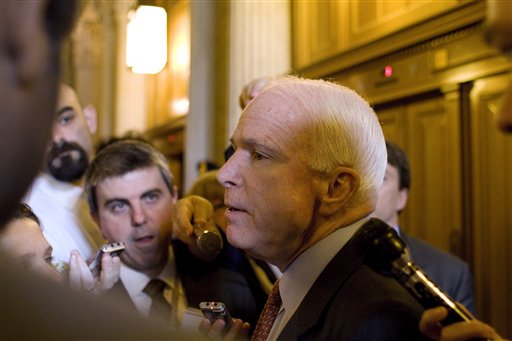
John McCain, R-Ariz.
Santorum: What does McCain know about torture?
The presidential hopeful claims torture survivor John McCain simply doesn't understand how torture works
Possible 2012 presidential hopeful, former Republican U.S. Sen., Rick Santorum of Pennsylvania speaks during a We the People candidates forum, Saturday, April 30, 2011 in Manchester, NH (AP Photo/Jim Cole)(Credit: Jim Cole) (UPDATED) John McCain has been on something of a crusade this week on the question of how we found Osama bin Laden, giving speeches and writing Op-Eds outlining his position that it was not torture of detainees that led the U.S. to its man.
Now comes presidential candidate and “enhanced interrogation” supporter Rick Santorum arguing on Hugh Hewitt’s radio show that McCain simply “doesn’t understand how enhanced interrogation works.” Yes, he’s talking about the same John McCain who, in his five and a half years as a prisoner of war in North Vietnam, was interrogated during a program of beatings and torture.
Here’s Santorum:
HH: Now your former colleague, John McCain, said look, there’s no record, there’s no evidence here that these methods actually led to the capture or the killing of bin Laden. Do you disagree with that? Or do you think he’s got an argument?
RS: I don’t, everything I’ve read shows that we would not have gotten this information as to who this man was if it had not been gotten information from people who were subject to enhanced interrogation. And so this idea that we didn’t ask that question while Khalid Sheikh Mohammed was being waterboarded, he doesn’t understand how enhanced interrogation works. I mean, you break somebody, and after they’re broken, they become cooperative. And that’s when we got this information. And one thing led to another, and led to another, and that’s how we ended up with bin Laden.
Santorum is wrong on the facts about Mohammed (more on this below). But what about his assertion about McCain?
Here’s a passage from McCain’s memoir in which he describes being subjected to beatings and telling his interrogators false information in response:
Once my condition had stabilized, my interrogators resumed their work. Demands for military information were accompanied by threats to terminate my medical treatment if I did not cooperate. Eventually, I gave them my ship’s name and squadron number, and confirmed that my target had been the power plant. Pressed for more useful information, I gave the names of the Green Bay Packers offensive line, and said they were members of my squadron. When asked to identify future targets, I simply recited the names of a number of North Vietnamese cities that had already been bombed.
I was occasionally beaten when I declined to give any more information. The beatings were of short duration, because I let out a hair-raising scream whenever they occurred.
In one four-day period, McCain says he was beaten “every two to three hours,” and his arm was broken and ribs cracked. So if nothing else, this is a man who can be said to know how enhanced interrogation works. (Santorum, as far as I can tell, has never been tortured, nor did he serve in the military.)
Khalid Sheik Mohammed, like McCain, also gave bad information after being tortured — a point that McCain himself made in a recent Op-Ed:
“In fact, the use of ‘enhanced interrogation techniques’ on Khalid Sheik Mohammed produced false and misleading information. He specifically told his interrogators that Abu Ahmed had moved to Peshawar, got married and ceased his role as an al-Qaeda facilitator — none of which was true,” McCain wrote. “I know from personal experience that the abuse of prisoners sometimes produces good intelligence but often produces bad intelligence because under torture a person will say anything he thinks his captors want to hear — true or false — if he believes it will relieve his suffering.”
(Hat tip: Elon Green)
UPDATE: Greg Sargent asks McCain’s spokeswoman for a response to Santorum, and she emails a single word: ”Who?”
Justin Elliott is a reporter for ProPublica. You can follow him on Twitter @ElliottJustin More Justin Elliott.
McCain: Torture didn’t lead us to bin Laden
He refuses to join fellow Republicans who say bin Laden's death represents the triumph of "enhanced interrogation"
A young McCain being interviewed for U.S. News, April 24, 1973. Did enhanced interrogation techniques — “torture” — lead us to Osama bin Laden?
The question has been addressed frequently in the past week and a half, by everyone from John Yoo to Glenn Greenwald. The latest public figure to express his opinion on the matter is Arizona Senator John McCain.
Continue Reading CloseEmma Mustich is a Salon contributor. Follow her on Twitter: @emustich. More Emma Mustich.
So this is John McCain’s reward
Never let it be said that the Arizona senator has nothing to show for behaving like a sore loser
U.S. Sen. John McCain, (R-Ariz.) speaks to volunteers at his campaign headquarters Monday, Nov. 1, 2010 in Phoenix. (AP Photo/Matt York)(Credit: Matt York) The man who once voted against George W. Bush’s tax cuts for the wealthy, teamed up with Chuck Schumer on gun legislation, demanded that patients be given wide latitude to sue health insurers, and called Jerry Falwell and Pat Robertson “agents of intolerance” has just been crowned … the most conservative member of the United States Senate.
Well, OK, technically the venerable National Journal’s annual rankings produced an eight-way tie for the honor, but John McCain can still claim a piece of the crown (along with Jim DeMint, Mike Crapo, Saxby Chambliss, John Cornyn, John Thune, Jim Risch and John Barrasso).
Continue Reading Close
Steve Kornacki writes about politics for Salon. Reach him by email at SKornacki@salon.com and follow him on Twitter @SteveKornacki More Steve Kornacki.
McCain says the time for Mubarak to leave has come
Arizona senator urges free elections and transparency in Egypt, but worries about extremist organizations
Sen. John McCain, R-Ariz., and wife Cindy arrive at a memorial service for the victims of Saturday's shootings at McKale Center on the University of Arizona campus Wednesday, Jan. 12, 2011, in Tucson, Ariz. (AP Photo/Chris Carlson)(Credit: AP) Sen. John McCain says the United States has to do “a better job of encouraging democracy” in the Middle East in light of the public uprising in Egypt.
The Arizona Republican tells CBS’s “The Early Show” that U.S. officials have correctly called for an orderly transition away from President Hosni Mubarak. McCain said the situation in Egypt is “fraught with danger” and said he worries about “the influence of extremist organizations.”
The Republican, who met with Obama at the White House Wednesday, said nevertheless that Washington must push for free elections, even if they result in lifting Islamist elements. McCain said that American officials also have to be concerned about “the threat of a repeat of the election in Gaza,” where Hamas, considered a terrorist organization, emerged with newfound powers.
Continue Reading CloseMark Salter, embittered McCain aide with “writer’s block,” wrote “O”
The man who invented the Maverick myth is the "Anonymous" behind the not-well-reviewed campaign novel
Mark Salter, the man who invented the myth of John McCain, wrote the book “O,” according to people who care about who wrote the book “O.”
“O” is an anonymous political novel about Barack Obama running for reelection in 2012. The book is a dramatic, insider’s account of how the people who run presidential campaigns find Arianna Huffington annoying.
Continue Reading Close
Alex Pareene writes about politics for Salon and is the author of "The Rude Guide to Mitt." Email him at apareene@salon.com and follow him on Twitter @pareene More Alex Pareene.
Gays cheer ‘don’t ask, don’t tell’ repeal
Activists commend the advancement of civil rights
Sen. Barbara Boxer, D-Calif., hugs "Don't Ask Don't Tell" supporter Eric Alva, a former Marine, near the floor of the Senate on an unusual Saturday session on Capitol Hill in Washington Saturday, Dec. 18, 2010. (AP Photo/Alex Brandon)(Credit: AP) Word that the world’s top military power will allow gays and lesbians to serve openly in the military is bringing strong and swift reaction across the country.
Supporters say the Senate vote repealing the 17-year-old policy known as “don’t ask, don’t tell” signals a historic civil rights milestone.
Detractors insist it could weaken the armed forces.
In New York City’s Times Square, 28-year-old public health researcher Cassandra Melnikow (MEHL’-nih-koh) is praising the repeal and says, “It’s about time.”
But Kris Mineau (MEE’-noh) of the conservative Massachusetts Family Institute says Congress is “gambling with our national security over political correctness.”
The measure now goes to President Barack Obama for his signature.
Page 2 of 225 in John McCain, R-Ariz.