NEW YORK (AP) — An artist who was setting up an “I Love New York”-themed public art display in Brooklyn was arrested after the wired contraption was mistaken for an explosive device.
Takeshi Miyakawa, a visual artist and furniture designer, was arrested Saturday after placing the installation in two separate areas of the same New York City neighborhood. His lawyer and employer both called the arrest a misunderstanding.
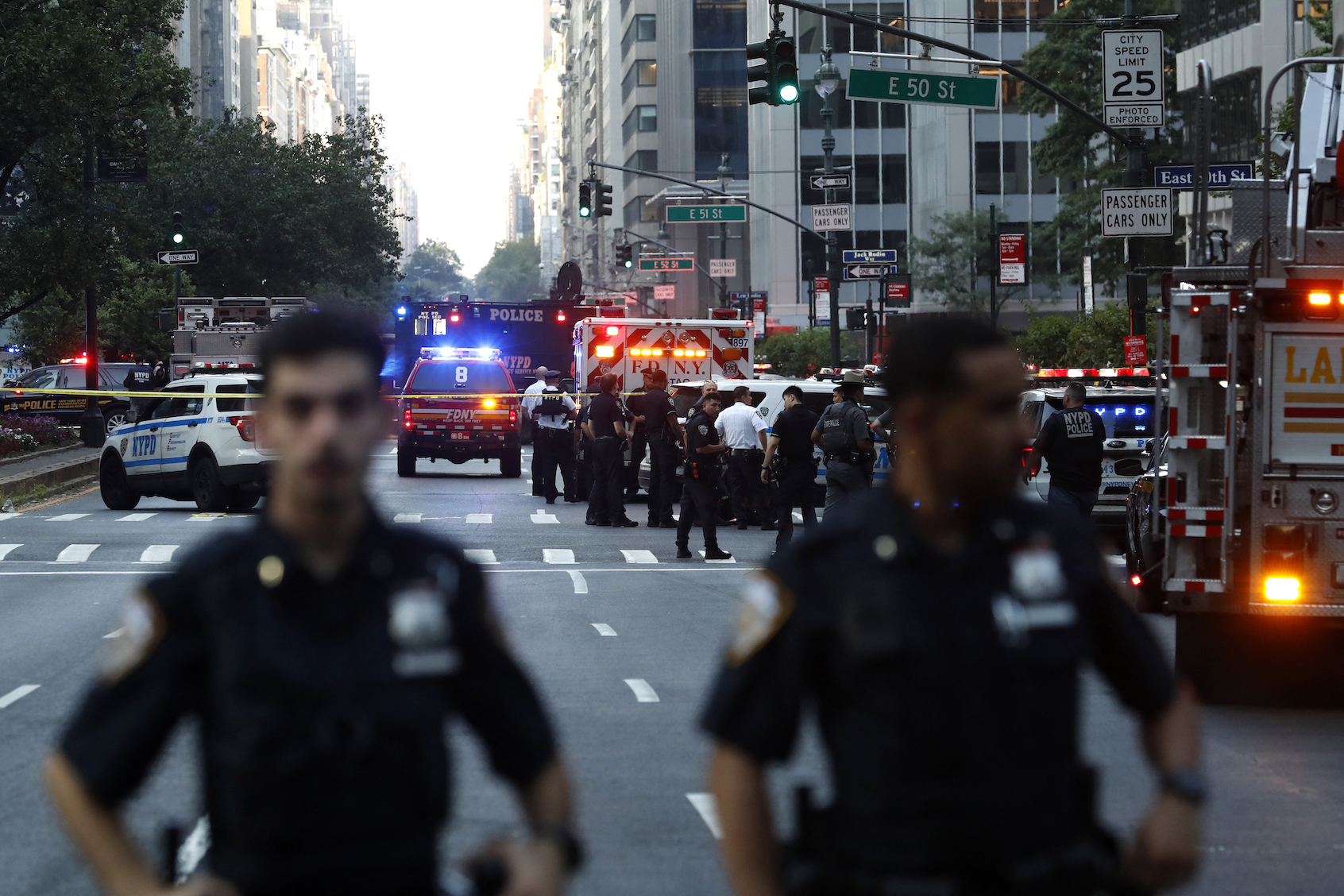
The first apparatus was found Friday morning after a caller reported a suspicious package to police. It consisted of a plastic bag that contained a battery and was suspended from a metal rod attached to a tree. The bag, which had the classic “I Love New York” logo printed on it, was connected by a wire to a plastic box that contained more wires.
The area was evacuated for two hours until a bomb squad determined that the device was not dangerous.
At about 2 a.m. Saturday, a police officer discovered Miyakawa on a ladder not far from where the first contraption was found. Police said he was tying a similar “I Love New York” bag to a public lamp post.
Miyakawa was charged with two counts of first-degree reckless endangerment, two counts of placing a false bomb or hazardous substance in the first degree, two counts of placing a false bomb or hazardous substance in the second degree, two counts of second-degree reckless endangerment and two counts of second-degree criminal nuisance.
A judge ordered him held pending a psychiatric evaluation. His lawyer, Deborah J. Blum, said Monday that she is filing for emergency relief to have Miyakawa released. A court date was set for June 21 to review the results of the evaluation.
“He’s still being held,” Blum said Monday. “I believe that it was a gross misunderstanding and other than that I don’t have any other comment.”
Miyakawa, who was born in Tokyo and is about 50 years old, has worked for a New York-based architect Rafael Vinoly for the last 20 years and also has an independent design practice.
Vinoly’s firm released a statement Monday praising Miyakawa for his “extraordinary brand of professionalism” and said he has been a mentor to generations of young architects.
“Takeshi is a fabulous human being and a person of extraordinary talent,” Vinoly said. “We hope this misunderstanding is cleared up as quickly as possible.”
New York Civil Liberties Union Executive Director Donna Lieberman said in a statement that the charges sounded “like a wild overreaction.”
“It’s hard to understand why a light-up bag in a tree would be treated as an attempted terrorist act unless there’s more to the story than has been reported in the press thus far,” she said.
In 2007, an artist touched off a terror scare in Boston by placing electronic devices around the city as part of a marketing stunt for Cartoon Network. The city closed bridges, roads and public transit before authorities realized the signs were not bombs.
On an average day, the NYPD receives nearly 100 reports of a suspicious package. Last year, there were more than 4,000 such reports. The number generally rises following any word of terror threats in New York and around the world.
Attitudes toward the police are the source of innumerable disagreements and divisions between those who’ve participated in Occupy-related actions in the past half year. From Oakland, Calif., to New York “Fuck the Police” marches regularly snake through the streets, while in early encampments chants of “We are the 99%, and so are you!” would ring out invitingly to surrounding police officers. (Unsurprisingly, anti-police sentiment increasingly outweighed support for police as more and more Occupy participants felt the jab of billy clubs and the sting of tear gas.)
It’s beyond the purview of these paragraphs to explain the many reasons someone might take to the streets and shout “fuck the police!” However, as a new report from the New York Civil Liberties Union confirms, the consistently racist practices of the NYPD should make fierce anti-police sentiments understandable, even for those who find such an attitude unpalatable.
Using the NYPD’s own statistics, the NYCLU report highlights what they describe as a “two-tiered” policing system, in which black and Latino New Yorkers receive very different treatment from whites. Perhaps the most shocking finding of all: There were more stops of African-American young men in 2011 than there are African-American men living in the city — and nine out of 10 of those stopped had committed no crime.
In nearly half of New York’s 76 police precincts, black and Latino New Yorkers accounted for more than 90 percent of those stopped; in almost all precincts black and Latinos accounted for more than half of stops. Furthermore, frisks, which are only supposed to take place if police suspect someone is carrying a weapon, occurred far more often if the person stopped was black or Latino, even though white people were found more often to be carrying weapons. The report also notes that despite the 600 percent increase in stop-and-frisks under Mayor Bloomberg, the number of guns recovered has not increased proportionately.
“This cannot stand. Real people’s lives are in the balance. Whole generations of boys and girls are growing up afraid of the very people that are supposed to be keeping them safe,” Donna Lieberman, executive director of the NYCLU, told press on Wednesday.
Is it a surprise, then, that in a march of 5,000 predominantly non-white New Yorkers organized to call for justice for the murdered Trayvon Martin, with Occupy support, that chants moved smoothly from “We are Trayvon Martin!” to “Fuck the Police!”? The greater surprise should perhaps be why more people don’t feel angry at the NYPD. Of course, many will continue to disagree with anti-police marches. However, when statistics on policing show what the NYCLU’s Lieberman called “a tale of two cities,” disagreements should only arise over tactics to redress this system; it seems there’s an overwhelming case for fury at the police.
In a statement, NYPD spokesman Paul Browne defended police practices, saying that “stops save lives” and that New York has this year seen a record low for murders. He said that it is “the safest big city in America,” which prompts the question: safe for whom? When vast swaths of New York’s population live in constant fear of being harassed by a well-armed, uniformed gang — and that this fear is largely contingent on a person’s skin color — this strikes me as the sort of safety I have no interest in maintaining.
Continue Reading
Close
A number of reports have pointed out that the Occupy calls for a May Day general strike drew tens of thousands in the street Tuesday — with actions from the militant to the family-minded — in cities across the country, particularly in New York and Oakland, Calif. The culmination of scheduled action in New York — a mass march of around 30,000 union workers, immigrant workers and OWS supporters that descended (with a permit) on Manhattan’s financial district — felt powerful from within, as chanting bodies jostled south. But I jumped over the barricades, which hemmed in the crowd, and walked a few blocks away. Only a muffled din signaled the crowd’s presence nearby; that and the constant flow of riot cops flooding past me and the police vans lining the street as far as the eye could see.
Ample ink has already been spilled (outside the mainstream press, that is) about May 1, some praising Occupy’s success in staging events like teach-ins and the permitted solidarity march, which garnered a diversity of support from union and community groups; some point out the obvious — that no May Day actions actually shut down any of America’s vast metropolises; some have decried the property damage carried out by participants in Seattle; Reuters first reported the day as a “dud” and then recanted, noting it “far from a dud.” We could debate forever, using different, incommensurable metrics, as to whether May Day was or was not successful. But when I think about my Tuesday on strike, my memory is of New York City shrouded in an impenetrable blanket of police.
Having reported on, and participated in Occupy actions for seven months, heavy police presence is by no means unusual. Cops routinely flank banks when protests are called outside, they surround squares where Occupy groups gather, and are swift to disperse any attempts (even when legal) to assemble against capitalism in New York’s public spaces. But on Tuesday, I left downtown Manhattan shell-shocked.
It began on Monday night, when the NYPD, aided by the FBI, raided the homes of prominent activists in New York. Following these preemptive, unwarranted visits — during which activists were questioned about May Day plans – the police presence throughout Manhattan on May 1 was incomparable to anything I’ve seen in my three short years in the city. Friends, whose time in New York and its radical subcultures far predate mine, agreed; they’d never seen anything quite like it.
Notably, the unpermitted “Wildcat March,” called by New York anarchists and anti-authoritarians, was surrounded by hundreds of police before the 300-strong crowd could even leave its rallying point at Sarah D. Roosevelt park. Barely reaching the sidewalk from the park’s steps, a line of cops stormed into the march’s front banner, snatching and grabbing three participants. I joined a running splinter group as the crowd was chaotically dispersed into smaller marches; we then proceeded, almost one cop to every striker, as we made our slow way to regroup at Washington Square Park.
I didn’t head to the Union Square rally to join crowds swelling to over 10,000; I missed the hundreds of guitarists marching alongside Rage Against the Machine’s Tom Morello in a “guitarmy”; I missed musical performances, free food and free lectures from prominent thinkers like Francis Fox Piven and David Graeber. Instead I wandered around Manhattan in shock and awe with a handful of co-strikers, counting as I passed every block: at least four cops per corner. The buzz of a police helicopter overhead continued all day; I couldn’t count the number of police vehicles.
Writing for In These Times, Rebecca Burns points out that the police have changed their tactics since the early days of Occupy. Although on May 1 Oakland police once again deployed tear gas, we did not see the mass arrests or large crowd kettles typical of police responses in previous months. Burns notes: “Unlike the now-familiar Occupy scene of demonstrators being arrested en masse in dramatic, late-night evictions, May Day protesters in many locales were arrested individually throughout the day, in some cases for crossing over onto sidewalks or, according to local media on the scene in Oakland, seemingly at random.” There were only a reported 97 arrests in New York relating to May Day activity.
Snatch-and-grab police tactics intimidate crowds, but do not lead to the sort of dramatic mass arrest scenes that capture national headlines; it’s a more insidious form of crowd control. It is worth adding, however, that there was no shortage of police aggression: At one point I saw firsthand as a marcher was grabbed by police in the Lower East Side, his face slammed to the street. When pulled up and taken away, officers covered his face with his T-shirt so onlookers could not see the blood.
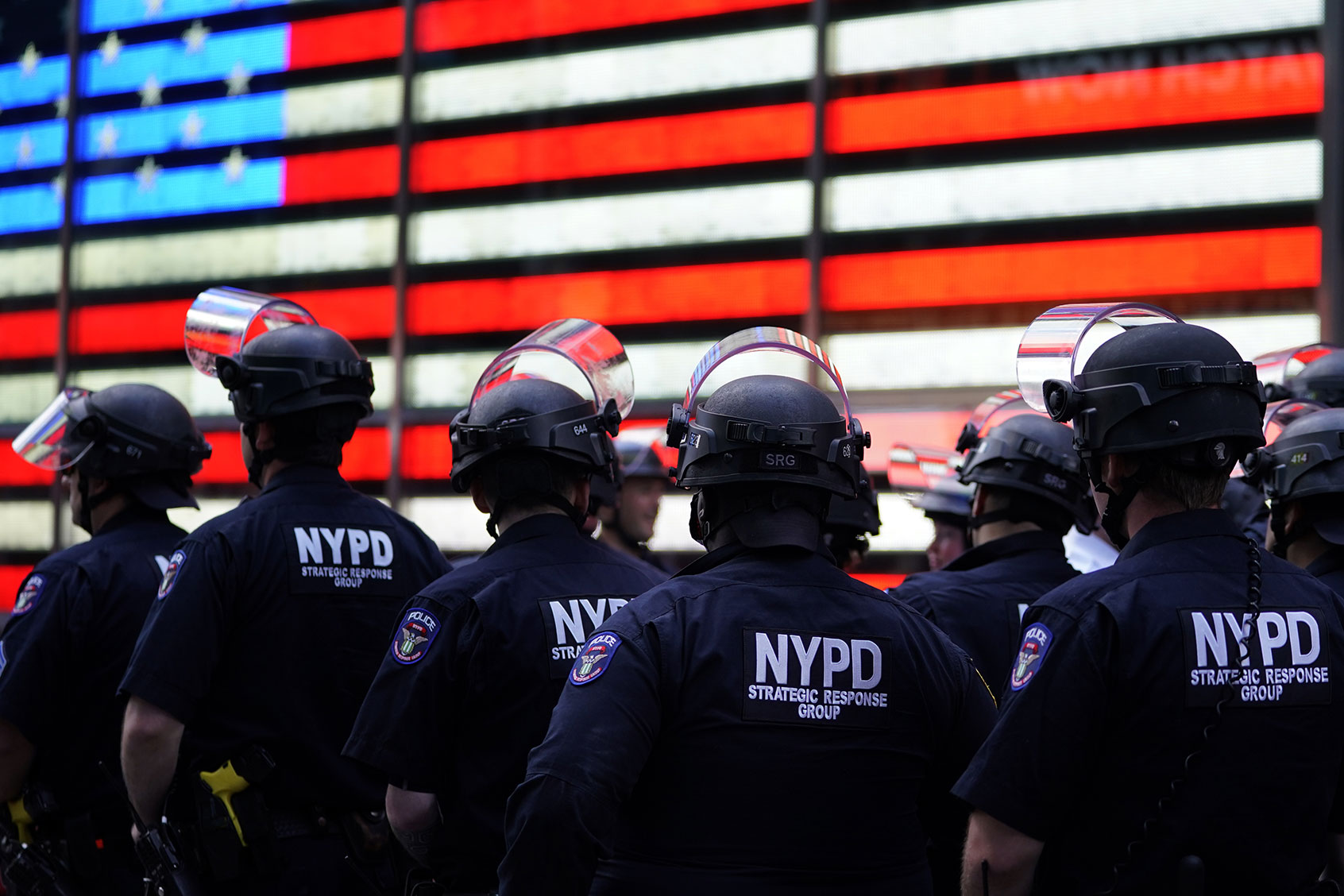
Then, after the mass evening march in New York had finished and no more than a thousand people had moved to the Vietnam Veteran’s Memorial park at Manhattan’s southerly tip, the NYPD once again covered the area. Some remaining hundreds of the May Day participants had gathered for a mass general assembly; others milled around, sharing stories about the day or dancing to the ever-present drumbeats. The police encircled the small concrete park in time to disperse the relaxed crowd at 10 p.m., when the park closes. Clad in riot gear, the number of officers kept growing; hundreds and hundreds on foot and in vans surrounded the memorial park and every office building, street and corner. The NYPD is a standing army of around 35,000, and on the evening of May 1, New York felt like a city under military siege — it was terrifying.
Those of us who have been inspired by Occupy over the past year, those who see the importance of reclaiming and repurposing space (for public use that is not commerce), and who see the necessity of manifesting in the streets, are not fizzling or losing momentum. We are, however, being trampled, pushed, threatened and dispersed at every turn by well-armed, militarized police forces who once again made clear: We are not allowed to assemble on our own terms in this country.
Continue Reading
Close
The NYPD is less a “police department” than a secretive and unaccountable international intelligence-gathering organization with a large minority-frisking division and the firepower of a mid-sized army. Lately they have been facing a bit of criticism for their style of intelligence-gathering, which seems to be done with more gusto than concern for civil liberties or… accuracy. Sometimes the NYPD’s muscular-but-stupid approach to spying gets them in trouble with the FBI. And when the organization that fights terror by recruiting shady weirdos to try to trick random Muslims into saying “jihad” into tape recorders says your practices are counterproductive and out of line, they are probably pretty counterproductive and out of line.
But the NYPD’s “covertly follow every single Muslim in the tri-state area” approach to counter-terrorism has its defenders. Like Mayor Michael Bloomberg, who believes Americans Muslims have the right to worship wherever they see fit so long as they don’t pay any attention to the unmarked vans parked across the street.
And the department argues that it is allowed to carry out surveillance wherever it chooses, because there’s no law against just going around looking at things and taking some pictures, right? No, of course not, unless you look sort of Middle Eastern.
The NYPD earlier this week announced that they had totally caught some people who were almost definitely probably Iranian spies. These spies were caught red-handed spying all over the place!
Authorities have interviewed at least 13 people since 2005 with ties to Iran’s government who were seen taking pictures of New York City landmarks, a senior New York Police Department official said Wednesday.
The NYPD’s Mitchell Silber told Congress that Hezbollah and Iran definitely want to blow up New York, and the proof is three incidents of people “associated with the Iranian government” getting caught photographing things, in New York. (I am not much of a terrorist, but if you want pictures of New York City landmarks in order to figure out how best to blow them up why not try Flickr? There are hundreds of thousands of photos of every landmark in the city already online!)
While other so-called intelligence experts say ” there are no known or specific threats indicating Iranian plans to attack inside the U.S.,” Long Island-based Islamaphobe Republican Congressman Peter King and documented supporter of terrorism wants us all to be on high alert, because Hezbollah is everywhere:
Opening the hearing, King said, “We have a duty to prepare for the worst,” warning there may be hundreds of Hezbollah operatives in the United States, including 84 Iranian diplomats at the United Nations and in Washington who, “it must be presumed, are intelligence officers.”
Stop telling the NYPD not to spy on all the Muslims, everywhere! If they don’t keep tabs on all of them, the Iranians will get us!
Continue Reading
Close
The game of cat and mouse between the NYPD and Occupy supporters over New York space continues. Early Wednesday morning, police ousted around 300 people from the Southern end of Union Square Park, where an occupation had been gathering numbers since the weekend after Occupy Wall Street was once again evicted from Zuccotti Park in Downtown Manhattan in an aggressive police sweep.
Since Saturday night, the impromptu Union Square occupation swelled from 70 people to around 300 on Tuesday night. In line with park rules, no tents had been set up, with only blankets used for comfort during the past few mild, early-spring evenings. Police only interfered with the occupation as the numbers grew. Just after midnight, they forced the crowd onto the sidewalk on 14th Street.
The standoff between police and protesters was briefly interrupted, according to firsthand accounts on Twitter, when a woman in the crowd went into labor and had to be taken to an ambulance. And according to Occupy Wall Street’s liveblog, the scene turned ugly at around 4.00am on Wednesday: “Police rush the crowd, shoving and attacking people. Livestream briefly down, back up now. At least one person reported badly injured, now unconscious, after being grabbed and thrown to the ground by cops. Medics on the scene,” the blog noted. A reported six people were arrested over the course of the night. There has been no further news to date on the condition of the woman reportedly knocked unconscious.
The ousting from Union Square came as a surprise to many. The Gothamist notes that although Union Square Park officially closes between one and six a.m., “this curfew has almost never been implemented.” Beyond this, the atmosphere in the park had been relaxed and festive since the weekend, with Occupy supporters and their multiple signs and banners happily coexisting with the street performers, skaters and passersby who usually inhabit the concrete space outside Union Square station. The area was fast replacing Zuccotti Park as the assumed staging ground for Occupy Wall Street actions.
As dawn broke on Wednesday morning, and cops gradually peeled away from Union Square, some people edged back into the park from the sidewalk to lie down. Despite police action, Occupy Wall Street is not finished with the park: on Wednesday evening at 6 p.m. the “One million hoodie March for Trayvon Martin” will leave from Union Square. Marchers (albeit likely far fewer than 1,000,000) have been asked to turn up in hooded sweatshirts to highlight issues of racial profiling which underpin the recent murder of 17-year-old Martin in Florida by a security guard.
Whether another standoff with police is in the cards is yet to be seen — the game of cat and mouse (or “pig and mouse” as those harboring anti-NYPD sentiment are calling it) will no doubt continue as Occupy actions in New York are once again a daily occurrence.
Continue Reading
Close
New York City Police Commissioner Ray Kelly and Sanford, Fla., police chief Bill Lee have both “come out” as victims of insidious prejudice. Speaking to New York Daily News sports columnist Mike Lupica, Kelly had a bit of a laugh at how upset people get over his department’s policy of constant harassment of black men.
The other day, Kelly started to hear it from City Council members about his department’s aggressive efforts to reduce the ridiculously high numbers of minorities in the city being victimized by gun crimes. You probably know that fight ended quickly when Kelly went back at them asking for their own solutions.
Talking about all of it Sunday, he said, “Sometimes it sounds sometimes like people are more comfortable stereotyping me.”
Haha, it’s funny because the NYPD has a policy of specifically targeting, stopping, interrogating and frisking black and Latino New Yorkers, many of whom are then arrested for petty drug crimes. And I guess liberals think Ray Kelly thinks that is OK because he is a rich and privileged white man who doesn’t have to deal with that constant harassment, which is “stereotyping” him as an officious prick on a raging decade-long power trip.
But Kelly’s slightly acerbic statement is small potatoes compared to the incredible claim made by Sanford police chief Lee. Lee’s force has been the target of some criticism lately, because it appears that they don’t consider shooting unarmed young black men a crime. Seventeen-year-old Trayvon Martin was walking home from the store when a 28-year-old self-proclaimed “neighborhood watch” captain named George Zimmerman chased him and shot him for being suspicious. The police did not arrest Zimmerman or check and see if he was maybe high or drunk or anything, because they took his word for it that it was “self-defense” when he chased and then shot this kid.
A Ta-Nehisi Coates reader highlighted this amazing line from Lee:
Our investigation is color blind and based on the facts and circumstances, not color. I know I can say that until I am blue in the face, but, as a white man in a uniform, I know it doesn’t mean anything to anybody.
Oh, woe is Bill Lee. No one — no one! — ever takes the word of a white man in uniform at face value. The claims of white men in uniform are never — absolutely never! — accepted without question as the gospel truth by local news stations and newspapers and politicians.
As we all know, in 2012 America, white men in positions of authority are constantly the victims of racially motivated abuse, like when people criticize them in blogs. It has been proven again and again that the only racism that still exists is the racism of accusing white people of racism, and this racism plagues our once-great nation.
I hope all of you people are ashamed of yourselves for being so racist against Bill Lee and Ray Kelly.
Continue Reading
Close