Patti Smith
Patti Smith wins National Book Award for nonfiction
The rocker's nonfiction win takes her by surprise, while Jaimy Gordon's "Lords of Misrule" is an upset in fiction
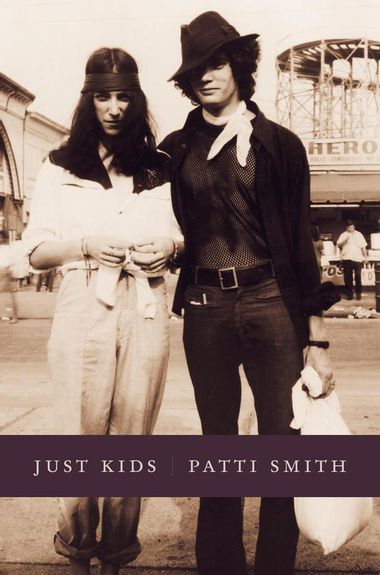
Patti Smith and Robert Mapplethorpe on the cover of her National Book Award-winning "Just Kids" The winners seemed stumped at the National Book Awards.
There were few prepared speeches on Wednesday night as most recipients managed few words beyond thanking the usual suspects. Patti Smith, who has some experience before audiences, became tearful as she accepted the nonfiction prize for “Just Kids,” a bittersweet look back to New York City in the 1960s, when anything really could happen and Smith and photographer Robert Mapplethorpe were just a couple of young artists out to break the rules. (Read Laura Miller’s review of “Just Kids” here.)
Smith became the rare rock star to win a competitive literary award (Bob Dylan has win an honorary Pulitzer) and the one-time punk rocker offered an old-fashioned tribute to books. She begged publishers not to let the printed page die in the electronic age and recalled working decades ago at a Scribner’s bookstore, stacking the National Book Award winners and wondering how it would feel to win one.
“So thank you for letting me find out,” said Smith, 63, who now claims an award previously given to Rachel Carson, Gore Vidal and Joan Didion.
The fiction prize Wednesday night was a surprise, Jaimy Gordon’s “Lord of Misrule,” a wry, hard-luck racetrack comedy chosen over such better known works as Lionel Shriver’s “So Much for That” and Nicole Krauss’ “Great House.”
Gordon herself is a story of luck turning. For years, she has written books released by small publishers, most recently, McPherson & Company, based north of Manhattan in Kingston, N.Y. She spoke briefly, acknowledged she had not expected to win and mentioned friends who told her that she had given them hope just by being nominated.
Gordon’s fate has already changed. The paperback of “Lord of Misrule” has been acquired by Vintage Books, an imprint of Random House, Inc. Her next novel will be published by another Random House imprint, Pantheon. Meanwhile, the head of McPherson, Bruce McPherson, handed out business cards after the ceremony and remembered meeting Gordon when both were studying at Brown University in the early 1970s.
“She certainly stood out,” McPherson said.
Kathryn Erskine’s “Mockingbird,” inspired in part by “To Kill a Mockingbird” and by the Virginia Tech shootings, was cited for young people’s literature. Awarded for a story featuring an 11-year-old girl with Asperger’s, Erskine praised parents who encourage their children to ask questions and teachers who inspire students to read and to “think for themselves.”
Terrance Hayes, whose “Lighthead” won for poetry, thanked his wife and editor Paul Slovak at Penguin for being “the best kind of partner,” one “who lets you be imperfect.”
Winners in the competitive categories for the 61st annual awards each received $10,000. The black-tie ceremony was hosted by humorist Andy Borowitz and held under the towering columns of Cipriani Wall Street.
Honorary medals were presented to “Bonfire of the Vanities” novelist Tom Wolfe and to one of the creators of “Sesame Street,” Joan Ganz Cooney. Smith did not sing Wednesday, but there was music on stage, as the white-suited Wolfe crooned a few lines from “The Girl of Ipanema,” part of a long, leisurely talk that made up for the brevity of the other winners. He shared memories of his early newspapers days and of the party thrown by Leonard Bernstein and attended by members of the Black Panthers, a gathering immortalized by Wolfe as “radical chic.”
The celebrated “New Journalist” well exceeded his declared deadline of six minutes to tell his story. Midway through his speech, the last before dinner was served, waiters began approaching tables and some of his words were hard to hear over the clatter of plates being set down.
The last bohemian
Patti Smith's memoir of her youth with Robert Mapplethorpe testifies to a rare and ferocious innocence
When Patti Smith first began to release albums in the late 1970s, she seemed to have magically eluded all of the shackles imposed on women in the rock ‘n’ roll world. She was neither angelic muse nor bad-girl sexpot, a tomboy willing to be photographed in a pale peach slip, flashing a patch of unshaven armpit hair that shocked the record-store boys I knew more than just about anything any girl had ever done. Rumors went around that she claimed to masturbate to photographs of herself, a concept that baffled me; I was so naive I didn’t understand yet that people (i.e., men) masturbated to photographs, and the idea of being sufficiently aroused by one’s own image to do so was unfathomable. Fascinated, I turned out to see this intimidating person at an in-store appearance, only to have my copy of “Easter” signed by a soft-spoken urchin with a luminous smile.
Continue Reading Close
Laura Miller is a senior writer for Salon. She is the author of "The Magician's Book: A Skeptic's Adventures in Narnia" and has a Web site, magiciansbook.com. More Laura Miller.
Jesus died for somebody’s sins … but not hers
A dazzling, dizzying documentary captures rock pioneer Patti Smith during her comeback years, surrounded by death and life.
Steven Sebring
Patti Smith
Almost at the beginning of Steven Sebring’s documentary “Patti Smith: Dream of Life,” a film and art installation and photography book that have been 12 years in the making, we hear a narration from the eponymous rock goddess-poet, declaiming a short version of her life story in her husky, incantatory contralto. As Sebring shows us black-and-white images of a train journey, perhaps suggestive of the journey Smith once took from rural southern New Jersey, where she grew up, to New York, where she would make her name — and perhaps suggestive of the journey from birth to death — Smith breaks it down.
Continue Reading CloseBlue Glow
Salon's TV picks for
Tuesday, April 11, 2000
Series
Buffy the Vampire Slayer (8 p.m., WB) has another rerun; it’s the one in which Buffy and Riley try to deal with each other’s secret identities. Biography (8 p.m., A&E) has a new profile of George Carlin. Will & Grace (9 p.m., NBC) reruns the episode in which Grace and Jack get their knickknacks appraised on “Antiques Roadshow.” Angel (9 p.m., WB) is a rerun, too; Cordelia has one date with a guy and wakes up hugely pregnant. The new sitcom Talk to Me (9:30 p.m., ABC) stars Kyra Sedgwick as a kooky New York radio personality. Beverly D’Angelo costars as a Dr. Laura knockoff named Dr. Debra. A job-related tragedy pushes the fragile Danny’s buttons on NYPD Blue (10 p.m., ABC).
Continue Reading CloseJoyce Millman is a writer living in the Bay Area. More Joyce Millman.
Real Life Rock Top 10
April 3, 2000
1) Lou Reed “Possum Time” from “Ecstasy” (Reprise)
It’s 18 minutes long and you can play it all day long. A huge fuzztone that sounds more like a construction site than a guitar sets an implacable, unsatisfiable zigzag line in play. “It’s possum time!” a slightly demented, definitely pleased man announces. “I feel like a possum in every way!” In fact he sounds like a man who won’t back down, and you follow him, at a distance, on a nighttown walk. When it ends it’s as if the sun is coming up — so soon? Already? You’ve seen nothing that isn’t ugly, but the walk has its own rewards. “The only one left standing,” Reed says, sounding tired. He’s grown all the way into his role as bad conscience — his own and the nation’s. He may even grow out of it, but not yet. When, in the Velvet Underground, in another era, a young man who sounded old sang with fright and nausea of “all the dead bodies piled up in mounds,” who’d have thought that more than three decades later he’d still be prowling the streets looking for more of them, more bodies, more mounds, like a detective of the obvious?
Continue Reading CloseThe Rude Mechs' theatrical adaptation of Greil Marcus' book "Lipstick Traces" will play Jan. 30-Feb. 1 at DiverseWorks in Houston. For more columns by Greil Marcus, visit his column archive. More Greil Marcus.
Sharps & Flats
Patti Smith explodes on "Gung Ho," the best record since she returned to rock. Joni Mitchell, meanwhile, collapses under jazz pretense and a ravaged voice.
Joni Mitchell and Patti Smith were born three years apart, Mitchell in 1943 and Smith in 1946. Their debuts were separated by seven years: Mitchell’s flowery, eponymous first album was released in 1968; Smith’s fiery “Horses,” in 1975. Both have grown into roles as elder stateswomen of rock, with Smith serving as den mother for angry, young post-punks and Mitchell’s “Blue” acting as a cornerstone for successive generations of waifish songwriters.
Continue Reading CloseSeth Mnookin is a writer living in New York. More Seth Mnookin.
Page 1 of 3 in Patti Smith