Aaron Kenedi

America’s forgotten Buddhist superhero

A New York gallery pays homage to a 1940s pulp magazine hero, the Green Lama

This article originally appeared on Imprint.

ImprintSunday afternoons in New York can lead to all sorts of odd discoveries. This most recent one brought me to the Rubin Museum of Art on 17th Street and into an arts mashup the likes of which I have never seen and probably would not have believed if someone were to tell me about it.

First of all, you should know that the museum (my new favorite as it turns out; just spend five minutes in the serenity of the cafeteria to understand why) has an ongoing exhibition called Hero, Villain, Yeti!: Tibet in Comics. Reason enough to explore. But Sunday’s particular multi-pronged program featured an original commission by the acclaimed visionary composer Paul Haas. For this event, Haas created a synchronized work to accompany the panels of the 1940s cult classic comic book hero the Green Lama. “Part radio-play, part light show, part silent film, part concert, this unique offering by Sympho and the musical trio MAYA,” provided a narrative score for the sequential projections of panels from Episode 2 of the Green Lama comic book series. Hosted and narrated by WNYC’s Elliot Forest, the event featured noted actors Linus Roache (“Law & Order”) and Brian Cox (“X-Men,” “Troy,” virtually everything else) voicing the characters. I mean, really, with that setup, how could you lose?

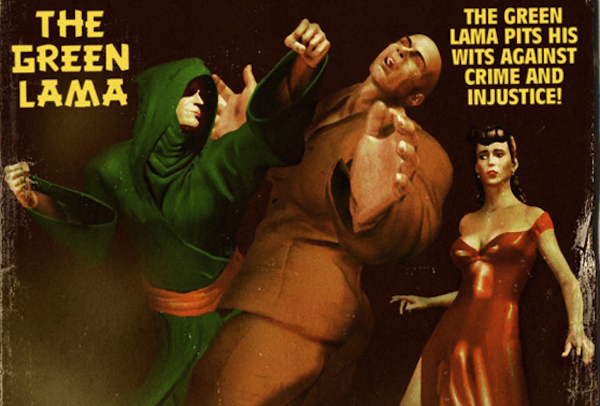
If you have never heard of the Green Lama (and I admit, even as a comic book nerd, I hadn’t) apparently he was an American pulp magazine hero of the 1940s whose superpower was imparted by, of all things, Buddhism. Om mani padme hum. Such is the mantra of billionaire playboy Jethro Dumont (best billionaire playboy superhero name ever) when he wants to magically turn into his crime-fighting alter ego, the Green Lama. With his trusty sidekick Tsarong, Dumont/Lama battles evildoers like Willie the Sleeper and the Mad Magi.

While the premise of the Green Lama’s power purports to be divined by the enlightened, the writing is pure pulp and camp (as evidenced by the panels included here).

But discovering a long lost superhero was really just part of the fun. Surreal as it was, the combination of the excellent music by MAYA (harp, flute and percussion), along with the spirited voice-overs, and the lighting/synth/background artistry by Haas himself, created a mixed-media sensory experience that was like nothing I’ve seen before and, dare I say it, it even bordered on the spiritual.


Copyright F+W Media Inc. 2011.


Salon is proud to feature content from Imprint, the fastest-growing design community on the web. Brought to you by Print magazine, America’s oldest and most trusted design voice, Imprint features some of the biggest names in the industry covering visual culture from every angle. Imprint advances and expands the design conversation, providing fresh daily content to the community (and now to salon.com!), sparking conversation, competition, criticism, and passion among its members.

The new artistic force behind Brooklyn Brewery

An up-and-coming designer talks about collaborating with two graphic legends and the importance of pro-bono work

ImprintNot many young designers can boast a pedigree as impressive or as diverse as Jee-eun Lee’s. From Mirko Ilic to Milton Glaser, Lee has had the rare good fortune to begin her already promising career by collaborating with two of the more accomplished and respected names in the industry.

Brochure for Tihany Design

The daughter of a Korean diplomat, Lee grew up moving from country to country: Korea, Portugal, India, Switzerland, Bulgaria. This unique and invaluable experience taught her to speak three languages, but perhaps more important, she says, it instilled in her an easy ability to relate to different people and cultures around the world.

At 17, Lee decided to get her college degree in the United States. She first pursued politics, earning a BA in International Political Economy & Diplomacy at the University of Bridgeport, Conn. It was only after some serious introspection that she decided to change course and pursue a BFA in graphic design at the Fashion Institute of Technology in New York.

I was most happy doing creative things growing up, but didn’t give it a serious chance when it came time to choosing a “path.” Upon finishing my studies and a year of soul-searching I decided that I needed to give it a shot. It’s better to try something and regret it than regret never even trying it for the rest of your life. No regrets so far.

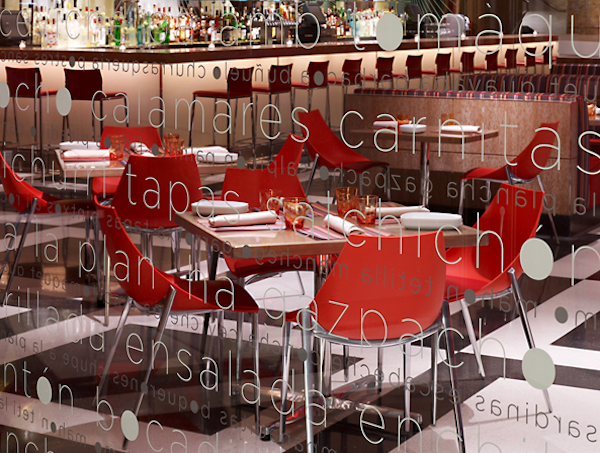
After FIT she briefly worked for the American Institute of Graphic Arts, then became a designer at Mirko Ilic Corp. where she was in charge of managing the studio and various accounts, as well as designing for projects with a special attention to hospitality design. With Ilic, former art director of the New York Times Op-Ed Pages and Time magazine, she worked on several high-end restaurants and hotel projects such as the Joule hotel and La Fonda Del Sol restaurant.

Said Ilic:

If one offers a decent amount of money today in the midst of economic problems and shortage of jobs, one is sure to get a talented and excellent designer. But when running a small studio such as mine, one needs to spend a third of the day with the designer. All the talent and excellence is not enough. The person must also be pleasant, funny, flexible, tolerant, especially working with me, and get used to bad Eastern European jokes. Jee turned out to fulfill all those categories. I don’t know why she’s so self-abusive but I’m grateful for her.


Identity and collateral for the Joule hotel.

Identity and collateral for La Fonda Del Sol restaurant

Lee now works with Milton Glaser in his studio just two floors down from Ilic, where she is responsible for what many might consider a dream account: Brooklyn Brewery. She also regularly collaborates with Yona Lee Design in Switzerland, where she has created many award-winning logos for various companies. Keeping busy with client work has not stopped her from also doing pro-bono work for nonprofit organizations such as Sarvodaya USA (an organization dedicated to helping disaster-stricken areas), for which she continues to create and lead strong visual campaigns.

We sat down with Lee to talk about her work and her inspiration (and also to try to get her to stir things up between Ilic and Glaser. (In true diplomatic form, she didn’t bite.)

How do you think your upbringing impacted your design work?
I think the experience has helped me to relate easily to people from different cultures, religious backgrounds and nationalities. I feel like a world citizen before anything else. Growing up in several countries has also helped me to understand design as a universal language that is “borderless” — it can reach people regardless of what language they speak, from New York to Timbuktu.

You have worked with both Mirko and now Milton. That’s a pretty impressive resume. Without getting into too much trouble, can you describe the differences working for them both?
Great minds think alike. They have a lot more in common than not — for starters, both their names begin with M-i. I’m fortunate to have the opportunity to work with them, and feel that every day is an education, both in design and in life.

Catalog cover design for Davor Vrankic's exhibition Let Me Make You Real

You’ve worked on quite a number of different kinds of design and branding projects, from hotels to beer to logos. What is your preference and where do you see your career heading in the future?
Each type of design is challenging and fun in its own way, so I enjoy the unique problem-solving aspect of all of them. I would like to continue doing a variety of work and take on new challenges, not limit myself to one type of design.

Various logo work by Jee-eun Lee

Obviously there is a huge movement in design toward the digital side of things. Is that something you have explored and are you interested in working in a more digital medium down the line? If so, which one?
I believe good taste and design principles can be translated from one platform to another, with some adjustments and considerations. I would like to expand my comfort zone from print to include digital media — whatever may come tomorrow.

You’ve participated in quite a few projects with a social responsibility message (breast cancer and hunger awareness, to name a couple). Is bringing attention to civil and social issues something you’re passionate about? Do you think it’s the responsibility of the design community to bring attention to these matters?
I think every person takes from the world around them, so it makes sense to give back. It does not necessarily have to be through design, or money, as long as what they do comes from the heart and is a genuine attempt.

Urgent humanitarian issues such as hunger do strike a chord with me because I have seen firsthand how some people struggle to have the most basic things we take for granted daily in this part of the world.

What is one project you created that Mirko claims he did? Milton?
They’re both more than generous with sharing credit.

What is your take on the present state of design in America? Abroad?
Question: What is a camel?  Answer: A horse, designed by a committee. There are too many camels (no offense to camels).

You do some work with Milton on the Brooklyn Brewery account. Are you, in fact, paid in beer?
If they like the designs, they fill my bathtub with Brooklyn Lager.

Click here to see more of Jee’s work.

Copyright F+W Media Inc. 2011.

Salon is proud to feature content from Imprint, the fastest-growing design community on the web. Brought to you by Print magazine, America’s oldest and most trusted design voice, Imprint features some of the biggest names in the industry covering visual culture from every angle. Imprint advances and expands the design conversation, providing fresh daily content to the community (and now to salon.com!), sparking conversation, competition, criticism, and passion among its members.

Continue Reading Close

Yoko Ono narrates an animated short

John Lennon's widow collaborates with my friend on "My Hometown" VIDEO

A few years ago I had the good fortune to edit a lovely little book called “I Met the Walrus,” based on an Oscar-nominated short animated film of the same name. Set in 1969, both tell the story of Jerry Levitan, a precocious 14-year-old who was a huge Beatles fan and wanted nothing more than to meet his hero, John Lennon. When he heard that Lennon and Yoko Ono were visiting the city he concocted one of the more daring and implausible plans to meet them. The film and book, which detail that adventure, are each artistic achievements on their own (wonderfully illustrated by James Braithwaite), and tell a fascinating story about youth culture in the late ’60s as well as the result of determination in the face of great odds.

While working together, Jerry and I both hoped to entice Yoko to write an introduction or foreword to the book. When she offered a very short (but very sweet) quote instead, I think we both had a bittersweet feeling, like that was all we were going to get from Yoko. Of course, we were thrilled, but …

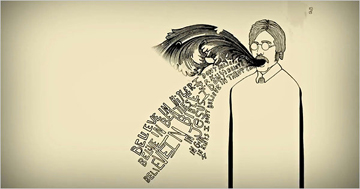
A still from the Oscar-nominated short film,

Jerry and I lost touch a bit after the book came out. But I had no doubt he was doing grand things. After all, this is a man who literally talked his way into John Lennon’s hotel room at 14. Since then, he had become a lawyer, an Oscar-nominated filmmaker, and a fine musician and entertainer in his own right named Sir Jerry.

So imagine my surprise when I heard about the new animated short film, “My Hometown.” Not only was it produced and directed by Jerry Levitan (and Emmy-winners Terry Tompkins and the Eggplant) but it was written and narrated by none other than Yoko Ono.

“My Hometown,” a timeless message of home, peace and love, is now an acclaimed animated short that is also in the running for the Oscars. As usual, I was impressed but not all that surprised by Jerry’s tenacity and drive. He had a vision and didn’t let anything stand in his way. A good lesson for all of us, kids and adults alike.

“It’s been totally nuts,” Jerry recently told me. “We just made it to the first cut of Oscar shortlist. By [the first week of] December we should know if we are in the official shortlist of 10. To think that my meeting with John Lennon and Yoko Ono back in 1969 when I was 14, has taken me to the Oscars, the Emmys and now a project based on Yoko’s work is simply incredible.”

Knowing Jerry, even a little, it’s actually not that incredible at all. I wish Jerry and Yoko all the best.

Copyright F+W Media Inc. 2011.

Salon is proud to feature content from Imprint, the fastest-growing design community on the web. Brought to you by Print magazine, America’s oldest and most trusted design voice, Imprint features some of the biggest names in the industry covering visual culture from every angle. Imprint advances and expands the design conversation, providing fresh daily content to the community (and now to salon.com!), sparking conversation, competition, criticism, and passion among its members.

Continue Reading Close

A twisted way to kick off 2012

A new calendar illustrates 12 gruesome, fascinating and bizarre tragedies VIDEO

(Credit: Abbey Luck)
This article originally appeared on Imprint.

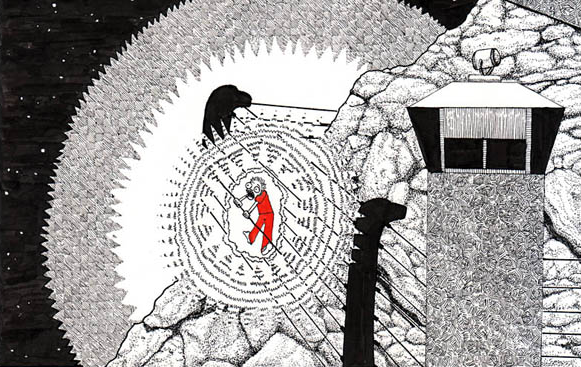
ImprintIt’s end-of-the-year, new-calendar time again. You might be tempted by cats wearing silly hats, or hot girls on the hood of cars, or fast airplanes or cute babies. Or, if you want to try something completely different, you could go with artist Abbey Luck‘s little twisted gem, “Death on the Mountain,” a collection of sad, gruesome and (depending on your sense of humor) often hilarious anecdotes of bizarre tragedies that took place on mountains all over the world. Each sob story is accompanied by (though not always directly related to) Luck’s whimsical and graphic watercolor illustrations. Let this be a cautionary tale and have a safe 2012!!

Front Cover Image - Banana Peel on Black Cliff

January 2012 - Siberian Tiger Attack on Snow Mountain

In January 2002, a Siberian tiger attacked a poacher named Qu Shuangxi on a mountain road in China. The tiger broke free from the snare, and though severely injured, waited for Qu to return and ambushed him. Qu survived the attack, but over the next several days the wounded, frightened tiger charged a TV crew and later killed a woman who happened upon the road. The weakened tiger was captured and it died in an animal hospital eight days later. Qu served two years in prison for poaching an endangered species. When released he became a tiger conservationist and worked to clear forests of old snares.

February 2012 - The Dyatlov Pass Incident

On the night of Feb. 2, 1959, nine Russian skiers died in the Dyatlov Pass Incident. Investigators could only conclude that a “compelling unknown force” had killed them, due to the lack of witnesses. The skiers tore out of their tent, stripped their clothes, and took off barefoot into the snow. Most died of hypothermia. Some had broken bones, fractured skulls, and one woman was even missing her tongue. There were no signs of struggle or wild animals. Sources say their clothing contained high levels of radiation, and many suspect a secret nuclear testing cover up.

March 2012 - Death by Firing Squad on Mountain Military Base

On March 23, 1877, influential Mormon leader John Doyle Lee was executed by firing squad at the age of 64 in Utah. He was sentenced to death for his involvement in the Meadow Mountain Massacre. In 1857, a group of Native Americans and Mormon militiamen dressed as Natives killed 120 immigrants from Arkansas, leaving only 17 small children from their party alive. The immigrants were suspected of an absurd cattle-poisoning conspiracy that can only be attributed to wartime hysteria. Lee’s role was to offer them Mormon community protection from Indian hostility if they surrendered their weapons, but after the immigrants complied, the militia swooped in and attacked. Lee had 19 wives and 67 children.

April 2012 - High Powered Electric Fence on Maximum Security Mountain

On April 10-12, 1815, the largest volcanic eruption in recorded history occurred at Mount Tambora in Indonesia. The explosion could be heard over 1,200 miles away. Over 11,000 people were killed by the eruption, and the death toll climbed to 71,000 due to starvation and disease. Enough ash was projected into the atmosphere to cause a “volcanic winter,” and 1815 became known as the “Year Without a Summer.” The devastation to agriculture spread to Europe and North America, resulting in the worst famine of the 19th century.

May 2012 - Missed Turn on Winding Road

The Bolivian Andes is home to the most dangerous road in the world. North Yungas Road is a winding nightmare of cliffs, curves and abysses. The carcasses of wrecked cars and trucks make it look like a battlefield. This “Road of Death” claims about one life every couple of weeks and up to 200 a year.

June 2012 - Boy Scout Mutiny on Forester Pass

In June of 1924, George Herbert Leigh Mallory and Andrew “Sandy” Irvine made the first attempt to climb Mount Everest. It remains unknown whether they actually  reached the top, as they were last seen just a few hundred meters away from the summit. Their bodies  were discovered in 1999, remarkably preserved due to the conditions near the peak.

July 2012 - Exhaustion on Mont Ventoux in the Tour De France

On July 13, 1967, world-class cyclist Tom Simpson died of exhaustion on the climb of Mont Ventoux in the Tour De France. A brilliant and charismatic man, his death was infamous for the post-mortem discovery of amphetamines and alcohol in his system, a deadly combination in the mid-summer heat. The BBC produced a program called “Death on the Mountain” detailing the highlights of his career.

August 2012 - May Contain Peanuts: Allergic Reaction to Energy Bar on Mountain Trail

August 25, 1921, marked the beginning of the Battle of Blair Mountain, a large civil uprising of coal miners in West Virginia. Coal miners and their families suffered severe bullying by coal operator-backed police and strikebreakers for forming unions to improve the dangerous conditions of the mines. Somewhere between 10 and 15 thousand armed coal miners marched upon the better-armed deputies of Logan County, and over the next 8 days over 100 people lost their lives.

September 2012 - Caught in a Bear Trap on Stony Mountain

On September 5, 2003, the Big Thunder Mountain Railroad roller coaster at Disneyland derailed due to improper maintenance. While entering a tunnel the locomotive at the front of the train became unfastened, went airborne, hit the ceiling of the tunnel, and flipped back on the passenger cars. One person died and 10 others were injured.

October 2012 - Asteroid Collision at Cabin Retreat

On October 13, 1971, a plane with 45 people crashed in the Andes Mountains. There were 16 survivors, the others dying in the crash, from hypothermia, or in an avalanche that killed 8 people. To avoid starvation, the survivors were forced to eat some of the frozen dead passengers until they were rescued two months later.

November 2012 - Devoured by Wolves

In November 1846, a group of pioneers called the Donner Party was trapped by early snowfall in the Sierra Nevada. Rescuers were unable to reach them for over four months, and only 48 of the original 87 travelers survived. Their makeshift cabins became engulfed by incessant blizzard. They faced starvation, sickness, frostbite, blindness, insanity, murder, and cannibalism in the most famous and shocking tragedy in American history.

December 2012 - Hunting Accident on Wintry Slope

The honor of the world’s most dangerous mountain goes to Annapurna, a section of the Himalayas in Nepal. It is so difficult to climb that very few make the attempt. Only 153 summit ascents have been achieved, with 58 deaths on the mountain, a mortality rate of 38 percent. Compare that to Mount Everest which has 4,102 successful summit climbs and a 10% death rate.

Back Cover - Died of Embarrassment: Caught in the Same Dress on Red Carpet Mountain


You can pick up a copy of the calendar at Etsy, just in time for the holidays.

We would like to thank Abbey for sharing her calendar with us. And Abbey would like to thank her friends and blog followers for the idea (and Wikipedia for the fun facts).

Copyright F+W Media Inc. 2011.


Salon is proud to feature content from Imprint, the fastest-growing design community on the web. Brought to you by Print magazine, America’s oldest and most trusted design voice, Imprint features some of the biggest names in the industry covering visual culture from every angle. Imprint advances and expands the design conversation, providing fresh daily content to the community (and now to salon.com!), sparking conversation, competition, criticism, and passion among its members.

Continue Reading Close

The Marlins’ bizarre new look

The team's revamped logo involves a whimsical rainbow swoosh. The effect is anything but intimidating

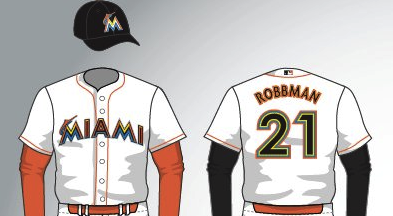
So far the biggest story to come out of baseball’s early off-season isn’t some splashy free agent signing or the abrupt retirement of St. Louis Cardinals manager Tony LaRussa, but that of the logo and uniform redesign of the Florida Marlins. The new look was officially announced on Friday, and if you haven’t seen them already, you might not believe your eyes. In fact, when some of the images of the new logo were leaked there was such shock and disbelief by the baseball world, most people assumed it was a farce, calling the look everything from “Hawaiian Shaved Ice” to “Push-up Pop” to “Rainbow Bright.”

Florida Marlins

The rebrand was planned as part of the team’s big move to their new stadium, New Marlins Ballpark (which also sports a logo with a rainbow motif), a baseball-only park with a retractable roof to keep the tropical rains away. With a name like New Marlins Ballpark, the powers-that-be decided the team needed a new identity as well. So not only are the uniform colors radically different, but the team will now be called the Miami Marlins.

Gone is the teal, silver and black color scheme the team has worn since its inception in 1993 (and in which it won two World Series), and in its place, as you can see, is a curious combination of oranges, yellows, blues and assorted other bright hues. Gone too is the detailed illustration of the eponymous fish, bursting around and through the logo with furious determination. Instead there is now a whimsical suggestion of a marlin swooshing from some unclear source out of the Aztec-influenced M letterform. Whatever its origin, one thing is sure: The overall effect is anything but intimidating.

In addition to the new logo and color scheme, new uniforms will also be revealed. Again, this look isn’t certain to be the one unveiled on Thursday (and in light of all the backlash, it’s entirely possible the Marlins’ design team has gone back to the drawing board) but this is what has been floating around the ether and seems to make sense based on the logo. White home jerseys with black caps. Away grays with a radically out of place blue cap (that strangely echo the original Tampa Bay Devil Rays uniforms). And some assortment of combinations for Fridays and other games.

Apparently the team’s (and stadium’s) colorful new look is meant to reflect the multicultural heritage of the many diverse ethnic groups living in the area. But you have to wonder if the Marlins’ head honchos learned nothing from the atrocious Houston Astros uniforms of the mid-1970s (known as the “rainbow era”) that made even Nolan Ryan and J.R. Richard, at left (two of the era’s most dominating pitchers), look a tad sheepish.

Not to say orange is a bad choice for a sports team (the Giants, Orioles and Tigers pull it off pretty well), but it does require some tasteful design skill and a healthy grasp of workable color palettes.

Perhaps it’s not the worst logo ever (for some ideas on that front click here); there are always the Chicago White Sox shorts and collared unis from the ’80s to claim that distinction. But if this is indeed the look of the new Miami Marlins, my guess is it won’t be around long.

Copyright F+W Media Inc. 2011.

Salon is proud to feature content from Imprint, the fastest-growing design community on the web. Brought to you by Print magazine, America’s oldest and most trusted design voice, Imprint features some of the biggest names in the industry covering visual culture from every angle. Imprint advances and expands the design conversation, providing fresh daily content to the community (and now to salon.com!), sparking conversation, competition, criticism, and passion among its members.

Continue Reading Close

How to create an iconic trademark

The designers behind the logos for NBC, Chase and Showtime talk about what makes a visual identity memorable


Identify Book Cover

This month Print will release its first book under the newly established Print Publications line. “Identify: Basic Principles of Identity Design in the Iconic Trademarks of Chermayeff & Geismar” looks back at the last half-century of work by Chermayeff & Geismar, the design studio behind many of the world’s most recognizable trademarks: Chase Bank, the Library of Congress, NBC, National Geographic, PBS, Showtime and many others. Established in 1957, the firm helped pioneer the modern movement of idea-driven graphic design, and its projects span every discipline, including visual identities, exhibitions, print and motion graphics, and art in architecture. In the spirit of Print’s October “Identity” issue (out now), we talked to the firm’s partners, Ivan Chermayeff, Tom Geismar and Sagi Haviv, about swooshes (never!), whether Paul Rand shares responsibility for Enron (no), and who is really the boss (none of them). identity for the Library of Congress

Chermayeff & Geismar, identity for the Library of Congress (2008).

Aaron Kenedi After being in business for 55 years, why did you decide to write a book on identity design now?

Sagi Haviv There is not much written about identity design from the standpoint of practitioners. We felt that through the stories of how these enduring trademarks came to be, people could learn a lot about the topic.

Tom Geismar For the first time, to try to explain some of the issues and the thinking that led us to develop the wide range of marks we’ve designed over the years.

Chermayeff & Geismar, logo and identify for the cable channel Showtime (1997).

Aaron Kenedi What makes a memorable identity?

Ivan Chermayeff A memorable identity is one that is appropriate, flexible, and distinguished by its originality. Further, a good trademark, whether a word mark or a symbol, is devoid of fashion or trend, which makes it potentially iconic if it’s seen for long enough in the right places.

Sagi Haviv It has to be unusual in some way, even awkward sometimes, in order to “hook” the viewer and persist in the mind. It nevertheless has to be simple and uncomplicated in form. This dichotomy — between simple shapes on the one hand, yet distinctive ones on the other — is what we work with every day. logo for the search engine Do@

Chermayeff & Geismar, logo for the search engine Do@ (2010).

Aaron Kenedi At a time when companies’ images are more dispersed over more media than ever before, is the era of what you call “simple, focused, concept-driven” identity design over?

Tom Geismar No, just the opposite: “Simple, focused, concept-driven” graphic identities, if done well, work best in a wide range of media. It’s the ones that rely on details of shading and other graphic niceties that have a hard time.

Sagi Haviv In this supersaturated visual environment, simplicity and consistent application of a brand identity are even more valuable because they naturally make the company or institution stand out in the crowd of busier, more complicated visuals.

Ivan Chermayeff  There is no “era” of simple, focused, concept-driven identity design. There is only design that grows out of understanding audiences for specific problems, and that evolves from an idea. This is an approach that does not depend on any specific time period or its technology. logo for New York University

Chermayeff & Geismar, logo for New York University (1972).

Aaron Kenedi A trademark often becomes the public face of a company. Among the companies you have worked for, some inevitably have gotten black eyes, most recently in the financial crisis. When you see your logo for a client like Chase (now J.P. Morgan Chase), do you feel a sense of responsibility because, in a sense, you vouched for them? Or do you think the design work can be separated from the actions of the client?

Ivan Chermayeff Good graphic design is not tarnished by the greed or the illegal or other self-imploding acts of clients. We do not feel responsible for the character of those we work for. Good design should follow looking into the products and reputation of clients who approach you, but this does not mean you have to follow them into bed.

Tom Geismar We have always been concerned not to work for companies and institutions that we can’t feel positive about, and we have refused various assignments over the years. But we don’t feel that doing work for a particular client means that we have “vouched for them.” Obviously we have no say over what they may or may not do in the future, and in any case what people think of a company or institution is determined by their experience with and the actions of that entity, and has little to do with the logo. Should Paul Rand have some measure of responsibility for the Enron debacle?

Sagi Haviv When we create a great logo for an environmental organization, we do not see ourselves as saving the planet. In the same way, we cannot take responsibility for the “evil” actions of corporations we brand. All we can hope is that by doing good work for visible companies and organizations, we can have some positive effect on the visual environment. brand update for National Geographic

Chermayeff & Geismar, brand update for National Geographic (2002).

Aaron Kenedi What logo would you redesign? Is there one you wish you had designed yourselves?

Tom Geismar I wish I had designed the CBS eye and the ABC sphere. They’re both brilliantly concise, powerful, and memorable.

Ivan Chermayeff  McDonald’s would be great to redesign, as they are so much in the landscape and contribute so little to its quality. logo for Chase Manhattan

Chermayeff & Geismar, logo for Chase Manhattan (1955)

Aaron Kenedi How do the three of you collaborate? Who has final say?

Ivan Chermayeff Tom, Sagi, and I all put forward ideas or make comments, which include additions, subtractions, or alternatives to one another’s work. We discuss all the options (as there are always choices to be made), pick the best by common agreement, and throw out the seconds. It’s a democratic process, without too much fighting, and no one has the last say. No one is boss. Sometimes, by the way, good ideas come from the staff in support below, and we try not to be deaf to them. logo for Public Broadcasting System (1984)

Chermayeff & Geismar, logo for Public Broadcasting System (1984).

Aaron Kenedi You say you design a logo today in the same way as you always did. Haven’t leaps in technology and the media changed how you work?

Tom Geismar Do authors today write differently because their words may appear in digital form, and because they use computers rather than typewriters or pencil and paper? I don’t think so, although it’s now much easier for them to make changes, edit, print drafts, and, where appropriate, take advantage of the potential provided by digital media.

Sagi Haviv As someone who grew up during the rise of the digital era, I’ve been astonished to see how these simple marks, conceived before this technology, thrive in the new visual environment — tiny sizes on the web, as favicons and mobile-device application icons. identity for Armani Exchange (2008)

Chermayeff & Geismar, identity for Armani Exchange (2008), and application in advertising campaign.

Aaron Kenedi What advice would you give to young designers who have all the necessary technology at their disposal?

Sagi Haviv To treat the technology as a tool but not as the generator of ideas. The technology of today will facilitate anything your mind can dream up — but first you have to dream it up in your mind. Only then should you go and execute it on the computer. identity for NBC

Chermayeff & Geismar, identity for NBC (1980), shown in television studio.

Aaron Kenedi Looking through “Identify,” there is a noticeable lack of drop shadows, bevels, and swooshes.

Tom Geismar Most of our clients are looking for a graphic identification that can work successfully for many years without becoming stale or dated. We consciously try to avoid graphic trends and can proudly say we’ve never done a swoosh.

Sagi Haviv We find that as long as we create something simple and distinctive, it can then take on any “fashionable” treatment when necessary, such as 3-D rendering, drop shadows, and so on, without losing its basic recognition.

Ivan Chermayeff Show us a current trend, and its death will not be far behind it. Once a trend is “current,” it is in fact already dead. No point in starting out at the finish line. The Print Publishing logo

The Print Publishing logo designed by Chermayeff & Geismar, 2010.

Copyright F+W Media Inc. 2011.

Salon is proud to feature content from Imprint, the fastest-growing design community on the web. Brought to you by Print magazine, America’s oldest and most trusted design voice, Imprint features some of the biggest names in the industry covering visual culture from every angle. Imprint advances and expands the design conversation, providing fresh daily content to the community (and now to salon.com!), sparking conversation, competition, criticism, and passion among its members.

Continue Reading Close

Page 1 of 2 in Aaron Kenedi

www.salon.com/writer/aaron_kenedi/index.html