Buzz Poole

The genius pencil

From "Lolita" to "Looney Toons," the Blackwing has been used to create some of the world's most memorable art

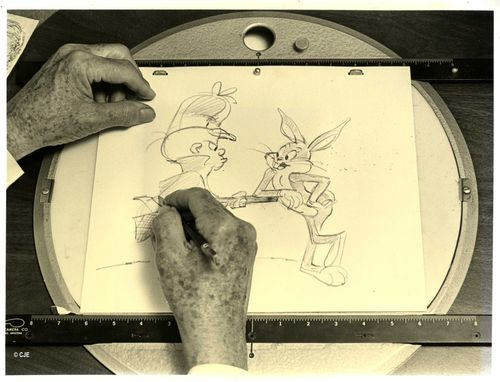
(Credit: via Chuck Jones)

Imprint“I have found a new kind of pencil ― the best I have ever had. Of course it costs three times as much too but it is black and soft but doesn’t break off. I think I will always use these. They are called Blackwings and they really glide over the paper.” So said John Steinbeck, according to a Paris Review article (PDF) that pulled together quotations from the author over the course of his career. Steinbeck’s high praise for the Blackwing is just one notable voice in a choir of legendary figures.

In his autobiography, “Q,” Quincy Jones explained how he composed “Suite to the Four Winds” by running all over Seattle, “working it out bit by bit on every piano I could find. That piece was the most valuable thing I owned. I carried it around with me every day, like money, scrawling on it, fixing it, changing it, carrying it under my sweater with a Blackwing No. 2 pencil in my pocket to make continual fixes.”

Discussing a stay in Los Angeles, converting “Lolita” from a novel to a screenplay, Vladimir Nabokov wrote of his days: “After a leisurely lunch, prepared by the German cook who came with the house, I would spend another four-hour span in a lawn chair, among the roses and mockingbirds, using lined index cards and a Blackwing pencil, for copying and recopying, rubbing out and writing anew, the scenes I had imagined in the morning.”

Igor Stravinsky at work, via Blackwing Pages

Add to this list of luminaries dedicated to a specific pencil the likes of composers Duke Ellington, Johnny Mercer, Igor Stravinsky, Nelson Riddle, Stephen Sondheim and Leonard Bernstein, writers Truman Capote, E.B. White and Eugene O’Neill, and perhaps the most renowned Blackwing user of all, Chuck Jones of Looney Tunes fame.

via Chuck Redux

So what’s the story behind this fabled writing utensil? According to Charles Berolzheimer, the CEO of CalCedar and the primary instigator behind the pencil being relaunched, “It had two distinctive features compared to most other graphite pencils used for art and writing purposes in its era. It had a special formulation for its graphite core, which provided for a very smooth writing performance that was marketed with the slogan “Half the Pressure, Twice the Speed.” The graphite performance was similar to Eberhard Faber’s premium Microtomic range of graded leads for artists and technical drawing purposes, but available only in one grade, which was never imprinted on the pencil or commonly disclosed. Additionally the Blackwing features a distinctive ferrule and eraser design with a removable and extendable block eraser that offered some improved utility vs. standard cylindrical erasers permanently fixed to the pencil.”

The new Blackwing, via Palamino

Eberhard Faber’s product left its mark, literally, on some of America’s most iconic 20th-century creative output, scrawled and smudged across scores, sketches and manuscripts. The company was bought and sold a couple of times starting in 1988 and while the Blackwing survived these transactions it eventually went off the market in 1998. On eBay, however, the pencils started selling for as much as $40. Fast-forward a few years: Enter Berolzheimer and Palomino, a division of CaliforniaCedar Products Co., “the world’s largest producer of wooden pencil slats,” according to the Palomino website.

Daniel Joseph, via Palomino

Copyright F+W Media Inc. 2012.

Salon is proud to feature content from Imprint, the fastest-growing design community on the web. Brought to you by Print magazine, America’s oldest and most trusted design voice, Imprint features some of the biggest names in the industry covering visual culture from every angle. Imprint advances and expands the design conversation, providing fresh daily content to the community (and now to salon.com!), sparking conversation, competition, criticism, and passion among its members.

Reading, revolutionized

A poet/book artist and a programmer team up to create a book that unites the traditional and the electronic

(Credit: via Between Page and Screen)
This article originally appeared on Imprint.

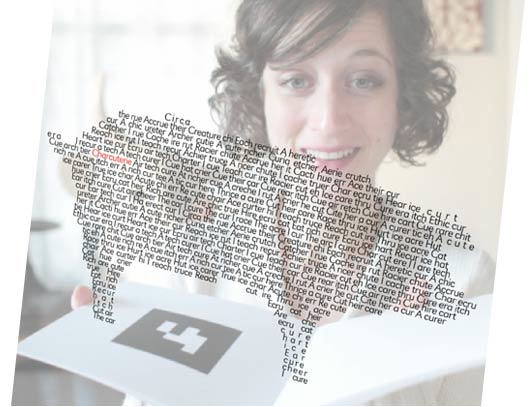
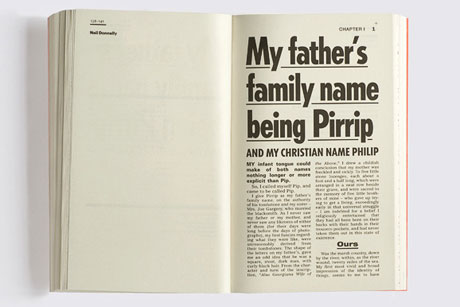
Imprint“Between Page and Screen,” a groundbreaking collaboration between poet and book artist Amaranth Borsuk and programmer Brad Bouse, is truly a first: a book that only can be read when simultaneously using a codex book and a computer’s webcam. When placed in front of a webcam, the black shapes printed on the pages, sans words, trigger animated text on the screen, revealing a correspondence between characters P and S.

via Between Page and Screen

As e-readers continue to gain market share within the publishing industry and the “future of the book” remains a much bandied about phrase among publishers, writers, agents, booksellers and readers, “Between Page and Screen” has embraced the what-ifs and used them to achieve their true potential, an astoundingly realized book that shuns either/or designations. It champions both the book’s esteemed history by valuing ink printed on the page and also celebrates the potential of digital technologies that are resulting in all of us, no matter our preferences, having to change how we read.

via Between Page and Screen

“Between Page and Screen” is an entirely new reading experience, and no matter if you favor codex books or e-readers, reading this book makes you acutely aware of the act of reading it. Properly situating the book in front of your computer’s webcam takes a bit of practice but once you get the hang of it the pun-rich missives between P and S are unleashed. Certain entries initially show up on the screen as if you are reading them in a mirror, and it takes some maneuvering to arrive at that aha moment when you realize you just need to turn the page around to invert the text. Soon enough, the reading experience pulls you in like any other. Word-play animations splice up the word “hear” into “he” and “ear.” The letters between P and S speak to the project’s larger themes, making assertions like “page don’t cage me in” and “a screen is a shield, but also a veil,” asking questions like “What are boundaries anyway?”

Clearly, for the authors, boundaries are little more than challenges, which they have met head on, daunted not in the least, creating a reading experience unlike any other. Innovators like Borsuk and Bouse prove that the future of the book should be something we all consider with optimism provided we think beyond current expectations and strive to build new ones.

The authors were kind enough to answer the following questions via email.

via Siglio Press

How did the project take shape? Did the two of you set out to make the book as it exists or did it grow out of various other projects and interests?

We did set out to make the book as it exists. The content and the construction arose together out of our conversations about augmented reality (AR) and the way it puts text between the page and screen. In thinking about the relationship this sets up between print and digital objects, we got the idea for an artist’s book that explores that between space. We had been talking about collaborating on a project for some time, but we didn’t want the digital aspect, which is Brad’s specialty, to seem simply “added on” to the poems, which are Amaranth’s specialty. We wanted there to be a reason to use new media, and AR provided us the perfect marriage of print and digital that wouldn’t privilege one over the other, and that would highlight the importance of the reader in activating any book’s text.

What do you mean in saying that augmented reality “puts text between the page and screen”?

We mean that the text is not available on one or the other platform, but in the between space opened up by the reader who has access to both. On its own, the book provides only minimalist grid shapes and the screen provides only the reader/viewer’s image. But when the two are paired, the text appears – and it’s at that very juncture where the reader’s image and the book object meet that the words arise.

Had you already written the exchanges between P and S?

Once we had the idea for an exploration of the relationship between page and screen, the “relationship” began to take shape in relation to a number of literary forebears that use the conceit of letters, from Ovid to “Griffin and Sabine.” Amaranth then started to write the letters P and S trade back and forth.

Is this project a natural evolution in your background as a poet and book artist, Amaranth, or is it a result of feeling unfulfilled by traditional codex books as they exist in today’s screen-based culture?

I see it as a natural evolution. I’m not dissatisfied with codex books at all – I think there are certain things they do incredibly well, and other things that e-books and electronic literature works do well. I am, however, interested in our changing relationship with book objects and the way the shape of the book is changing in response to the proliferation of screen-based reading devices. For me, the most important thing is that the book has some reason for the form it takes. “Between Page and Screen” simply wouldn’t be the same book if the poems were printed on the page or at a website. It needs the “between” in order to make sense. I don’t think all books need to go that route, and I’m ready to turn to whichever apparatus best helps me tell the story I want to tell or explore the themes I want to explore.

via Between Page and Screen

More and more I’m convinced that the essence of a story is indifferent to technological developments. What changes is how the story is told or delivered, enhanced or altered by cultural shifts, from how the oral tradition faded away with scrolls and the printing press, etc. What would you say to that?

If you mean that the hallmarks of engaging writing remain largely unchanged despite technological shifts, I would say there’s some truth in that. But I do believe that the experience of reading a story changes with the medium through which we receive it. “Between Page and Screen” wouldn’t be or do exactly the same thing if the poems were printed in a book. Primacy would be given to the page.

I do think that where poetry is concerned technological shifts can have a dramatic effect on the shape and content of the work (the impact of the typewriter on the “look” of 20th-century poetry is well-established, for example). And ideological shifts in what writers want to do with poetry influence its shape as well. I don’t know that there’s a single “essence” of poetry that remains unchanged over time, unless we talk about it as an engagement with language. But there are so many different kinds of poetry that it becomes difficult to generalize, I think.

In setting out to create “Between Page and Screen” were you aware of early experiments in electronic/digital books and their presentation, like Robert Coover’s Cave and Bob Stein’s Institute for the Future of the Book?

Very much so! Amaranth is a member of the Electronic Literature Organization, and has been studying new media writing since she was in graduate school at USC (coincidentally, that’s where she learned of Stein’s work with if:Book). Her dissertation on poets’ use of writing technologies that allow for a distributed idea of authorship spanned from modernism to contemporary digital poetry, and she has studied and written on interactive text works from early hypertexts, to Flash animations, to crowd-sourced poems.

Amaranth, in your dissertation what sorts of “writing technologies” are you referring to in terms of modernist poets? I’m imagining Pound in his cage in Italy, watching birds and scrawling Chinese characters in the dirt with eucalyptus nibs. Is that what you mean, or is it more about carbon copies and linotype?

My dissertation primarily concerned Swiss poet Blaise Cendrars’s use of the typewriter (he had lost a hand in the First World War and it facilitated his writing greatly, but also served as a kind of muse and musical instrument) and American poet H.D.’s use of projective mediumship (the figure of the medium who can project images out of her body and into the room around her recurs in her WWII writings). I connect these poets to contemporary writers for whom technology offers access to a world of language outside the poet and a kind of collaborator in putting words on the page (both writers suggest that the words are being channeled through them thanks to the machine). Pound was highly skeptical of what H.D. was doing in the war years, especially her spiritualism.

via Siglio Press

What books, films and/or artworks do you count among your favorite in terms of helping to inspire “Between Page and Screen?”

Dieter Roth’s artist’s books, particularly his die-cut books, were definitely an influence on the shape of the book and the cover. The poems were heavily influenced by concrete poetry, particularly the work of Emmett Williams (whose “Sweethearts” is one of Amaranth’s favorite books), Mary Ellen Solt and Decio Pignatari, among others. In the electronic literature world, Camille Utterback’s “Text Rain” is also an inspiration. The epistles themselves are influenced by and draw heavily upon the “American Heritage Dictionary of Indo-European Word Roots.” I’m sure there are more that we’re forgetting!

Would you expand a bit on how the Indo-European word roots play into the letters?

The letters are full of puns, homophones and word play using words that share the Indo-European roots of “page” and “screen.”

Page comes from the roots pag- and pak-, which means to fasten or join together. It gives us words about connection, like “pact,” “peace,” “appease,” “pacify,” “pawl,” “pole” and “peasant.” The Latin root of page, pagina, means trellis (so at its heart, the page is metaphorically a trellis to which lines of writing are affixed).

Screen’s root (s)ker-, means to shine, and it develops from a form that means to cut (the metonymic connection is that many cutting implements have a sheen). That root gives us words about protection and defense like “scabbard,” “shield,” “skirmish,” “shear,” “score,” “carnage,” “carrion” and even “charcuterie” (from the Latin root caro, for flesh).

While the two different roots, one peaceful, the other militaristic conjure up two different personalities, there are points of connection between them “Screen” gives us a few connecting words, too: “share” and the other “sheer,” as in translucent, also “incarnate.” Peace loving “page” gives us the violent “fang,” “impale” and “impact.”

The poems play with those etymologies, giving the two bits of banter about their romantic compatibility.

Copyright F+W Media Inc. 2012.

Salon is proud to feature content from Imprint, the fastest-growing design community on the web. Brought to you by Print magazine, America’s oldest and most trusted design voice, Imprint features some of the biggest names in the industry covering visual culture from every angle. Imprint advances and expands the design conversation, providing fresh daily content to the community (and now to salon.com!), sparking conversation, competition, criticism, and passion among its members.

Continue Reading Close

The impatient illustrator

A 22-year-old artist's disarming drawings are already gracing the pages of Wired and the NYT Book Review

Illustration for Bloomberg View, 2011 (art director: Vance Wellenstein) (Credit: Kelsey Dake)
This article originally appeared on Imprint.

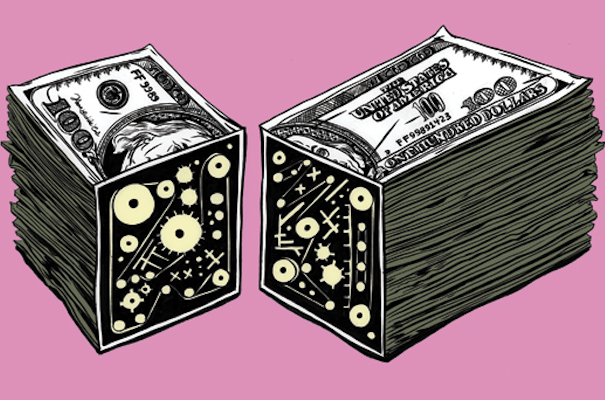
ImprintKelsey Dake doesn’t like to submit sketches, prefers conceptual assignments to literal ones, is bored by long deadlines, and loves same-day turnarounds. Her talent is apparent, but her impatience has served her well as a young illustrator. She moved to New York after graduating in 2010 from the Art Center College of Design, in Pasadena, Calif., a woman on a mission. “It was all a matter of pounding the pavement and having zero shame,” she says. “I would call art directors on the phone, or email them, or leave them voice mails telling them my email address. And whoever was interested in meeting me I would go and see!” The assignments started rolling in, from Wired (an endearing Woody Allen) to Bloomberg Businessweek (a geoduck-cleaning guide).

Age: 22
Illustrator
From: Phoenix
Lives in Phoenix
Website: kelseydake.com

“There was about a week where all I would hear about was Kelsey Dake,” says Walter Green, a designer at McSweeney’s and the co–art director of Lucky Peach. “I first remember this very strange illustration she did of a hot dog that was also a subway car. Within two days, I saw a drawing of hers in the New York Times Book Review.” Dake did work for the Believer and Grantland Quarterly before Green had a chance to commission her for Lucky Peach. “The piece called for illustrations that would show ripeness and rotting, that would be sweet but also kind of dark,” he says. “We immediately thought of Kelsey.”

Illustration for Bloomberg View, 2011 (art director Gary Fogelson)

Illustration for Maxim (art director: Drue Wagner)

Illustration for Bloomberg Businessweek (art director: Sean Hastol), 2011

Illustration for Bloomberg View, 2011 (art director: Vance Wellenstein)

Dake’s work unpacks the underside of naturalism, playing up corporeality in ways that charm (as when she somehow made Mitt Romney seem vulnerable) or disarm, as with her frequent use of animal heads, which, in section, often reveal more than expected. She credits this quality to the screen prints she makes, which “have far more colors going on than most of my drawings do,” she says. “But at the same time, my prints have informed my drawings in that they taught me economy. Being selective with how many lines, colors, and textures I use really dictates how strong a piece can be.”

Copyright F+W Media Inc. 2012.

Salon is proud to feature content from Imprint, the fastest-growing design community on the web. Brought to you by Print magazine, America’s oldest and most trusted design voice, Imprint features some of the biggest names in the industry covering visual culture from every angle. Imprint advances and expands the design conversation, providing fresh daily content to the community (and now to salon.com!), sparking conversation, competition, criticism, and passion among its members.

Continue Reading Close

The morphing visual landscape of Dubai

A new book explores the reinvention of the city's art and architecture

brusselsprout

ImprintWhen, oh, when will someone invite me to Dubai? I’ve read about it, watched reports and talked to plenty of people who have spent time there. It’s a long flight from New York and unless someone was to send me, I’m not sure I’d ever choose just to go. Perhaps if I had a layover on my way to Australia I’d carve out a day or two, because the emirate fascinates me. My yearning to be the beneficiary of such a generous invitation has been renewed of late by Brusselssprout, a Dubai-based arts organization.

Even for someone who spends his days poring over books of all sorts, from time to time one lands on my desk and I’m not quite sure what to make of it. Such was the case with Brusselssprout’s first book, “Dubai Graphic Encyclopedia.” The title is straightforward enough, as is the content – scores of alphabetically arranged monochromatic images commonly associated with Dubai. But with hardly any descriptive text and the simplicity of the illustrations, what is one to make of this book?

Seeing in Dubai the 18th century English aesthetic ideals of the beautiful, sublime and picturesque, the people behind Brusselssprout first started out with magazines (free to download here) that graphically reinvent the city of Dubai, citing the likes of Andy Warhol and Rem Koolhaas. In issue one, they dubbed Dubai “as the first genuine work of art in the 21st century” – hyperbolic to be sure. The past 12 years have indeed yielded beastly development there, though the real changes started in the late 1960s with the discovery of oil and the eventual forming of the United Arab Emirates in 1971. But there is no doubt that recent building projects in Dubai, beholden to global economic booms and busts, have, from an outsider’s point of view, morphed it into a locale that makes Las Vegas seem quaint.

the Burj al dubai

Leafing through this catalog of Dubai’s visual touchstones and tropes – from aircraft to camel, henna to skyline – becomes an exercise in pattern recognition, which is equal parts brusque and appropriate. Yes, there are the remnants of the region’s distant history seen in minarets and gutrah (traditional cotton head wraps worn by men) but the buildings, cars, traffic signs and Western logos of today’s Dubai dominate this visual landscape. This dominance of the contemporary does not diminish the past, it simply equalizes everything, which is disturbingly reassuring, and ultimately very telling.

burka

In the April 2008 issue of Print, I reviewed “With/Without,” a book published by the incomparable magazine Bidoun. This anthology dedicated to Dubai focused on how the emirate functions by virtue of a complicity that makes it impossible for the past and present to fuse, resulting in free zones where anything goes, regardless of religion, nationality, sexual preference or personal taste. Like that volume, the “Dubai Graphic Encyclopedia” provokes thought, though in this case with far less direction, which is the point, I think. What do I know? I’ve never been there. Someone invite me!

I’ll give Brusselssprout the final word on the book’s aim: “What the first edition Dubai graphic and visual encyclopedia presents is a reality that acts as a counterpoint to all the excess of attempts to decipher and understand Dubai.”

Copyright F+W Media Inc. 2012.

Salon is proud to feature content from Imprint, the fastest-growing design community on the web. Brought to you by Print magazine, America’s oldest and most trusted design voice, Imprint features some of the biggest names in the industry covering visual culture from every angle. Imprint advances and expands the design conversation, providing fresh daily content to the community (and now to salon.com!), sparking conversation, competition, criticism, and passion among its members.

Continue Reading Close

Inside the ultimate subway graffiti project

An exhibit uses an abandoned tunnel as its canvas -- and shows just how much street art has changed

(Credit: The Underbelly Project, We Own the Night, Rizzoli, 2012)
This article originally appeared on Imprint.
We Own the Night cover

via Rizzoli

On the copyright page of “We Own the Night: The Art of the Underbelly Project,” curators Workhorse and PAC include on their thank you list “all the people who know how to keep a secret and keep their mouths shut!” I’m one of these people, having been shown an early proposal for the book version of this extraordinary undertaking. An agent clued me in; a few days later I was at photographer Martha Cooper’s apartment and asked if she’d caught wind of “Underbelly.” She’d heard all about it and was hoping to receive an invitation to the underground gallery. It was summer 2010 and the project was wrapping up. In late October of the same year, the secret was out when the New York Times ran a feature about an art installation that very few people would ever see.

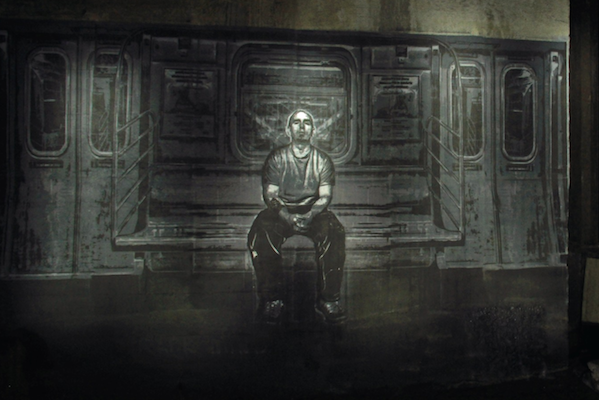
I’m not sure if Cooper ever made it down to the abandoned New York City subway station, but between May 2009 and August 2010 Workhorse and PAC escorted 103 street artists four stories beneath street level and unleashed them in an empty space big enough to fit six subway trains. Jim and Tina Darling, the first artists to get up on the grimy, barren walls, describe it as “an industrial version of an orchard with its rows of concrete and steel beams, stretching on forever and fading into darkness. The air… thick enough to see in our lights.”

We Own the Night subway

The Underbelly Project, We Own the Night, Rizzoli, 2012

PAC first discovered this space in 2005, taken there by a stranger. On subsequent visits, he always left “with an inexplicable sense of calm.” Having been abandoned for 80 years, only a handful of visitors had entered this subterranean cavern, and none of them had been graffiti artists. Legendary old-school graffiti writer HAZE reminds readers that since the early 1970s, train tunnels and ghost stations have been galleries for New York City graffiti. Back in the day, 12-year-old HAZE and his crew ran roughshod through the abandoned 91st station on a now defunct Broadway IRT line. So the fact that PAC had been ushered into an area undiscovered by graffiti artists was auspicious to say the least. After meeting Workhorse through an art gallery connection, the makings of a singular endeavor were in place.

Able to reach out to a stunning array of international graffiti and street art talent, Workhorse and PAC assembled an impressive cast of contributors, many of them able to make livings off their work. This is a result of individual talent, of course, but also a number of cultural circumstances that have come to pass over the past few years, raising graffiti and street art out of the low-culture gutters and into the lofty high-culture strata of museum exhibits, glitzy fashion runways and global advertising campaigns. But as Workhorse points out, this bubble is “starting to burst.”

We Own the Night bench

The Underbelly Project, We Own the Night, Rizzoli, 2012

The roll call of acclaimed artists who participated in this project is staggering. Ranging from graffiti writers like SABER, REVOK, CEAZE, and STASH to street artists like Know Hope, SWOON, Flying Fortress, FAILE, and Ron English, the logistics of organizing so much talent is dizzying. These artists are no strangers to acting covertly and breaking the law, but even by their standards the Underbelly Project possessed an aura of a covert operation akin to some sort of special-ops mission.

The result of everyone’s work is a gallery of contemporary graffiti and street art on par with the recent “Art in the Streets” exhibit at the Museum of Contemporary Art, Los Angeles, or any high-profile gallery group show. But the venues couldn’t be any more different. Workhorse admits that in thinking about this undertaking he and PAC asked themselves “If no one will see it, will it still be important?”

Such a question strikes at the heart of why the street art bubble is beginning to burst. Unlike the original graffiti writers, and even the first wave of street artists like Shepard Fairey, kids running around today with aerosol cans, stencils and wheat paste have it in the back of their minds that they might have a shot at becoming rich and famous. This is a far cry from the get up for the sake of getting up credo that inspired kids in the ‘70s, ‘80s and ‘90s.

We Own the Night tunnel

The Underbelly Project, We Own the Night, Rizzoli, 2012

If there is anything to criticize about “We Own the Night” it’s that there are too many photographs of the artists. I said as much to the agent when I first saw the proposal and seeing the finished book, which is big and brimming with photographs of the phenomenal artwork, I feel the same. Many of the featured artists have played a role in how the world views this art form, and if you look at their work you can see why.  As Harlan Levey writes in the book’s most insightful piece, no matter where you look on this particular art history timeline, the movement has been spurred by action. But the remnants of these actions, the actual art, have been noticed by surprise – the hilariously appropriate placement of a sticker, the delicate latticework of a stencil sprayed on a sidewalk, the precision of a gravity-defying tag proudly trumpeting from a highway overpass. The how did they do that? awe and mystery matters. Museums usually don’t exhibit photographs of artists next to their work; I don’t see the need to feature photographs of street artists next to their pieces.

In the scheme of how popular culture has embraced graffiti and street art the idea of separating the art from the artists merits a stand-alone essay, but within the context of “We Own the Night” it is a minor, though thought-provoking, critique. On the whole, the book is mesmerizing thanks to Workhorse and PAC’s collective vision, which is as perceptive about the past as it is in looking toward the future, and accepting that a change is in the air. As Levey suggests, “It is the action that connects all of the participants, and as an action, the Underbelly Project seems to appear right before the closing of a chapter.”

We Own the Night altar

The Underbelly Project, We Own the Night, Rizzoli, 2012

Joe Iurato’s striking “The People Upstairs Are CRAZY” shows a boy using a drainpipe like a periscope; the letters in the word “crazy” appear in circles made to look like letters identifying subway lines. It’s a fitting sentiment. It’s clear that the artists who contributed to the Underbelly Project conjured a realm of sanity beneath the streets, a return to the essence of the art form: creating in the moment and not worrying or thinking about what comes of what is left behind.

Copyright F+W Media Inc. 2012.

Salon is proud to feature content from Imprint, the fastest-growing design community on the web. Brought to you by Print magazine, America’s oldest and most trusted design voice, Imprint features some of the biggest names in the industry covering visual culture from every angle. Imprint advances and expands the design conversation, providing fresh daily content to the community (and now to salon.com!), sparking conversation, competition, criticism, and passion among its members.

Continue Reading Close

The beautiful evolution of maps

From ancient Egypt to modern America, these artifacts are a hallmark of civilization

This article originally appeared on Imprint.

ImprintI’ve got maps on my mind again, having recently found W.W. Jervis’ “The World in Maps: A Study in Map Evolution,” published by Oxford University Press in 1937. I discovered this book quite unexpectedly one recent afternoon, running errands in my Queens neighborhood. New York’s mild winter has teased out the book vendors who usually wait until spring before returning to the sidewalks with their tables. With an emphasis on Spanish-language titles and genre fiction, at first glance the books on offer appear mundane. But if you take the time to really look, something of interest is sometimes dug out of a box.

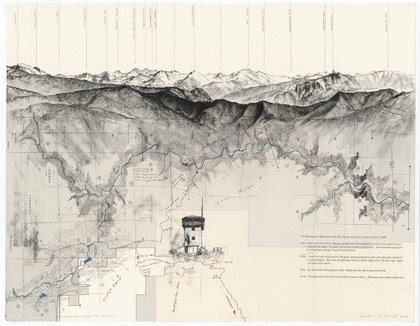
"Due East Over Stokes Mountain"

The book, on the whole, is a droll history of maps, from Herodotus’ rendering of the world in 450 BC to topographical maps being able to represent a location’s scenery. Jervis picks apart the development of map making with a dash of subtle Colonial snobbery. In examining the issues involved with determining distance, for example, he cites the “krosh” a unit of measurement in India defined as “two statutory miles, there or thereabouts.” Apparently, “in the jungly parts of Bengal,” branches torn off trees were used to measure a krosh; once the branch wilted, a krosh had been traveled. As Jervis points out, this is a very subjective measurement in which seasonal factors and just how quickly someone walks come into play. He concludes this section by taking a swipe at the idea of a krosh, and India, by writing, “This is also the reason why the most perfect forms of early maps were restricted to areas of higher civilization – Egypt, Babylon, Greece and China.” In this sense, the book serves as an interesting historical document that reflects a broader cultural attitude.

Ultimately, however, Jervis loves maps, as this passage indicates: “Maps are inventions, and like other inventions that have complicated life and made civilization, they have grown and developed. They started, like the motor-car, crude, comic and almost useless. They have developed in two or three thousand years as the motor-car has developed in twenty. Both are now things of beauty, of perfection almost, and of abiding utility.”

"Due East Over Shadequarter Mountain"

Over the course of leafing through the Jervis books, I also happened to stumble upon the map-based art of Matthew J. Rangel. In “a transect – Due East” Rangel uses the foothills of the Sierra Nevada Mountains, rising from California’s San Joaquin Valley, to explore “the ways in which human constructs of land influence our experience of place.” Between 2006 and 2008, Rangel walked a combined 200 miles, documenting the landscapes he encountered by fusing his vision of nature, sublime in the tradition of Romantic landscape painting, with the bureaucratic and commercial boundaries that delineate and define today’s idea of wilderness. Layering his drawings and field notes on top of photographs and government-commissioned maps, the series forces viewers to consider the complex implications of human limits and expectations being imposed on the majesty and uncontrollable force of nature, as seen in jagged mountain peaks and tumbled boulders.

"Due East Through Elliot Ranch"

“The aim of the cartographer is to give a graphic expression to the features of the landscape.” This is Jervis again, but his definition certainly applies to Rangel’s work. You wouldn’t want to use his maps to trek through the Sierras, but in recognizing how our understanding of the natural world is intimately and inextricably linked to the confines of our manmade constructs, Rangel’s work strikes me as true, which might not be as practical as a traditional map, but it certainly might be more useful.

Copyright F+W Media Inc. 2011.

Salon is proud to feature content from Imprint, the fastest-growing design community on the web. Brought to you by Print magazine, America’s oldest and most trusted design voice, Imprint features some of the biggest names in the industry covering visual culture from every angle. Imprint advances and expands the design conversation, providing fresh daily content to the community (and now to salon.com!), sparking conversation, competition, criticism, and passion among its members.

Continue Reading Close

Page 1 of 3 in Buzz Poole