The announcement Sunday that the company calling itself AT&T has reached a deal to buy T-Mobile’s U.S. arm was a no-brainer. Rather than building out its own network, it covets the network — and more — of a competitor that offers lower prices and better customer service. It’s a great deal for AT&T, and barring a sudden awakening of the Obama administration to the benefits of competition in telecommunications, this buyout will go forward — to the huge benefit of two telecom giants and the detriment of everyone else.
Let’s be clear. If the Obama administration fails to block this deal, it will be setting the lowest possible bar in approving mergers and buyouts. This buyout could not be more obviously bad for competition — and therefore bad for customers — and antitrust enforcement is designed precisely for protecting competition.
When I said there would be two major winners in this deal, I was referring to Verizon, the largest mobile carrier in the nation, as the other one. AT&T is currently second largest, with Sprint and T-Mobile trailing. A combined AT&T and T-Mobile would be a bit larger than Verizon, with Sprint in a very distant third place.
We’re talking about creating an effective duopoly, or something not too short of that. Business history shows no case in which a duopoly proved beneficial to competition, or to customers.
AT&T wants us to believe there’s plenty of competition. This is sophistry. A few regional and tertiary players do exist, but they have none of the reach, and not nearly the same level of capabilities and service, that you can get from today’s Big 4. They would be utterly dwarfed by the Big 2 plus Sprint in the new world.
Consider the airline business. Today, we have three major carriers left: Delta, American and United-plus-Continental (the latter two are in a merger). A host of smaller carriers, including the increasingly beefy Southwest, keep the big ones mostly in line on price on most routes. But does anyone believe we’d be better off with just two mega-airlines, other than some industry executives and shareholders? This is plainly not a perfect analogy, but it gives you a sense of what’s at stake.
More important, T-Mobile has offered competitive service plans including my ability to bring my own phone and get a discounted monthly rate. All of the other carriers force customers to pay the same rate whether they buy a supposedly subsidized phone or bring their own — an outrageous policy that, if we had actual regulation to ensure consumer fairness, would not be permitted. (We have no serious regulation in America, of course.)
T-Mobile’s customer service people are unfailingly polite and knowledgeable. That’s unique among U.S. carriers. It has by far the best privacy protection of any mobile data provider.
T-Mobile puts as much crapware — unwanted applications that are difficult to remove — on the phones it subsidizes as anyone else. But unlike AT&T (and the rest), it cheerfully unlocks its phones after a reasonable period. This is important mainly for people who travel abroad; we can buy local SIM cards (only works for GSM phones, and AT&T blocks this anyway by refusing to unlock the phones its customers have paid for) for lower-cost service in other countries.
Om Malik makes a persuasive case that Google is a major loser in this deal. He writes:
In T-Mobile, it has a great partner for its Android OS-based devices. Now the company will be beholden to two massive phone companies — Verizon and AT&T — who are going to try to hijack Android to serve their own ends.
Don’t be surprised if you see AT&T impose its own will on what apps and service are put on its Android smartphones. I wouldn’t be surprised to see the worst phone company in the U.S. (according to Consumer Reports) tries to create its own app store and force everyone to buy apps through it.
The biggest losers, of course, are all of us who want to see actual competition in an increasingly restrictive marketplace. This is not a good deal for anyone but AT&T and its shareholders, and it should be stopped in its tracks.
I owe an apology to Steve Kroft and his colleagues at the CBS newsmagazine “60 Minutes” — and want to congratulate them for performing a genuine public service last night.
As you may know, the program featured a long interview with WikiLeaks founder Julian Assange. My initial reaction was incredulity, at what seemed like an amateurish if not downright embarrassing performance by the interviewer. In particular, I was astonished at the tone and substance of some of the questions, which seemed at times to come out of the “old media sucking up to power” school of which CBS often seems to be a proud member. Here’s one of the exchanges:
Kroft: There’s a special set of rules in the United States for disclosing classified information. There is long-standing …
Assange: There’s a special set of rules for soldiers. For members of the State Department, who are disclosing classified information. There’s not a special set of rules for publishers to disclose classified information. There is the First Amendment. It covers the case. And there’s been no precedent that I’m aware of in the past 50 years of prosecuting a publisher for espionage. It is just not done. Those are the rules. You do not do it.
At first, this sounds like an interviewer simply parroting the establishment media’s sense of what is “allowed” and what isn’t. It reflects an inside-the-Beltway echo chamber of insiders protecting each other.
But then, the genius of the interview becomes clear. These are not hard questions. In fact, they’re pure softballs. Again and again, Julian Assange swats them out of the park. In the above example, he points out that the rules, such as they are, are about the people with immediate access to classified and/or secret information, not the journalists who receive information and then publish it.
What I’ve concluded is that “60 Minutes” has deep sympathy for Julian Assange, and did its best to give him the kind of platform that would, first, make him seem much less threatening to the United States audience that has been so thoroughly propagandized by the government and other major media; and second, reinforce the value of journalism in general, and investigative journalism in particular.
Is CBS that subtle? I sure hope so.
If you haven’t already seen the interview, you should. Here’s the first segment:
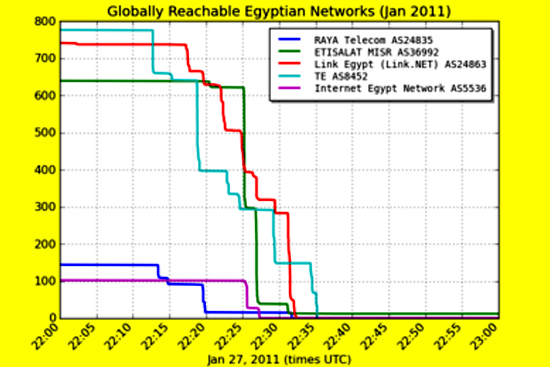
The Egyptian government’s move to shut down Internet access, among other communications, amid the escalating protests is nearly unprecedented—and it foretells a future, unless we work hard to prevent it, of centralized information control. And before we Americans get smug about our freedoms in the information sphere, we should recognize that what Egypt is doing is exactly what authoritarians in our own government want the ability to do here.
This isn’t the first time government has shut down access to the Internet during a national crisis, or ordered mobile phone companies to stop letting customers make calls and send text messages. Burma largely succeeded in closing off its media borders several years ago, and regimes around the planet have created harsh censorship systems that prevent the majority of their people from seeing information deemed unacceptable by the people in charge.
Now, the shutdown isn’t absolute. Some data is still getting in and out of Egypt, and circulating within the country. The reports are so sketchy, even from experts in the field, that it’s hard to know precisely what is happening. But Egypt’s shutdown of most communications to the outside world, and communications inside the country, is the most blatant abuse yet of this kind by a large power. And it’s Exhibit A in how the modern Internet, despite its heritage as a system where information would find its way around outages, has become increasingly vulnerable to choke points that governments and their corporate partners/subjects have become adept at using to restrict the flow of information.
The Internet isn’t the only way people use digital communications, of course. But most phone service in Egypt is mobile. So it’s trivially easy, unfortunately, to take mobile phone service off the air. In Egypt’s case, it simply ordered the providers—which operate at the government’s sufferance—to stop providing service. Vodafone and other mobile carriers, having no real alternative, complied–though we still might wish for an example of corporate guts in the face of dictatorial abuses. Oligopolies and monopolies are easy to tame.
In theory, the Internet should be a little bit harder to shut down due to its decentralized nature. In practice, as we’re seeing, the chokepoints work. A major one this time is the DNS system. This is the collection of servers that tell people, or rather their computers, requesting information from various sites on the Internet specifically where they can find it. Egypt has gateway (border) computers handling this task, and it apparently ordered most of them off-line, telling the companies providing them to stop answering requests. (More details here at GigaOm.) This is why I put “kill switch” in quotation marks; what seems to be happening is a series of government phone calls to entities that feel they have no alternative but to comply with orders, or lack the courage to challenge them. (UPDATE: Supporters of the protesters have set up dial-up lines outside the country, but this is hardly an answer to the larger problem.)
One of the most important questions yet to be answered in the Egyptian crisis is what will happen to the nation’s economy if communications are thoroughly restricted over a long period of time. It may not be a coincidence that the government shut down communications on the eve of the Muslim Sabbath; people are doing some business today in Cairo and other cities, but not as much as they’d normally be doing tomorrow and in the coming days. Egypt’s economy is not the most modern in the world, but it’s fair to say that its digital component has been growing rapidly.
This is one of the questions Americans (and others in highly developed nations) should be asking themselves, especially given the desire among some in government to have “kill switch” capabilities for the Internet here. As CNET reported several days ago, a much-derided plan floated by—unsurprisingly—US Sen. Joe Lieberman looks like it’s getting new life in Congress. Among the more alarming elements of the proposed legislation is that it removes judicial review from executive decisions.
(UPDATE: Talking Points Memo disputes the CNET story, saying among other things that there would be judicial review. But the TPM piece isn’t entirely clear, either, on several issues. The Obama administration has already used questionable tactics to take down websites based solely on allegations, not proof, of activities the entertainment industry claims to be illegal. And Congress may soon push through an outrageously anti-freedom bill that would give the executive the authority to order US network companies to shut down access to foreign sites it deems unacceptable. Add these examples, among others, to the ongoing campaign against WikiLeaks, and it’s entirely clear that government and corporate interests in America are ardent to put some kind of lid on our Internet freedom.)
America’s battle over “network neutrality” has been an argument over whether our broadband duopoly—phone and cable companies that provide almost all access in most communities—should have the right to decide what information gets delivered at what speed to customers. Not enough attention has been given to another element of the duopoly control: the ease with which government, given the legal tools (not that recent governments have cared much for legalities), could order a shutdown.
Other kinds of centralization are proceeding, meanwhile. As Andrew Blum writes at the Atlantic magazine, Google and Verizon recently bought some real estate containing two of the most important network operating centers in the world. Can we trust them, as their ties to government grow stronger all the time? The answer is obvious.
What’s becoming increasingly clear is the need to create new ways to route around censorship. The Internet still does a decent job of this in many circumstances, but not all. As governments and their corporate handmaidens race to lock down a medium they desperately want to control, the rest of us need to get on with the job of A) fighting to keep the medium free of their interference; and B) working on new technologies and systems that defy central control.
Egypt is a wake-up call. Are we hearing it?
(Apologies for the typos that appeared in the first version of the story. Due to an injury I’m using voice dictation software, and while it’s good it’s not perfect. Many thanks to @PKtm on Twitter for pointing out several of the typos.)
Talk about symbolism. Check out the photo, taken today at Google headquarters, of the company’s three top executives: CEO Eric Schmidt and co-presidents/co-founders Larry Page and Sergey Brin.
Page is in the driver’s seat. Brin is in the back seat. Schmidt is outside the car, a specially modified Toyota Prius that drives itself.
The photo is part of a blog post announcing a move that took everyone outside the company by surprise; Schmidt is kicking himself (or was kicked) upstairs into the role of executive chairman, and is being replaced as chief executive by Page. Brin’s new role will be simply co-founder.
This is a big deal. Changes in Google leadership — the Schmidt-Page-Brin troika has been intact for the past decade — are exceedingly rare. What this one means for the long run is unclear, obviously, though that isn’t stopping a torrent of speculation and instant analysis.
Schmidt came to Google to provide what everyone called, only partially in jest, adult supervision. He’s done a remarkable job by any reasonable account: moving the company forward, initially in its buildup as the powerhouse Internet advertising business it became and still remains. He guided Google through an initial public offering that broke almost every rule that Wall Street wanted the company to follow. In particular, Google sold its initial stock via a Dutch auction, and it explicitly told investors that it was in business for the long term, with long-term thinking, not quarterly knee-jerking, central to everything it did. Under Schmidt, Google created two classes of stock that ensured the founders’ ability to make strategic decisions, as opposed to the expedient ones.
In one sense Google is going back to the future. Page was the initial CEO before Schmidt came aboard as chairman and then later as CEO. It’s important to remember, however, that Page’s days in the top job were nothing like what he’ll face now.
Google faces serious pressure on several fronts. One is its unpersuasive responses to Facebook and Twitter, among other more recent and powerful entrants in the Internet space. Another may be even more important: the growing perception among search users that Google search results are not as good as they used to be. (In my own recent searches, I found that Microsoft’s Bing search engine sometimes gives me better results in areas where Google used to be a default choice.)
Founders rarely return to the role of CEO, though it’s happened several times in prominent Silicon Valley companies. Most famously, Steve Jobs took back the reins at Apple in the 1990s; he’s moved since then from triumph to triumph. It didn’t work as well when Jerry Yang took over as Yahoo CEO several years ago, when the company was moving deeper and deeper into trouble, and his tenure did Yahoo little good.
Can Page lead this company? Clearly Schmidt believes so, and so does the board of directors. Investors in after-hours trading boosted the stock price, but whether that had more to do with Google’s blockbuster earnings report today remains to be seen. It has to be somewhat unsettling for investors to see any change of this magnitude.
For his part, Schmidt plans to spend more time on business development, governmental and other affairs for which he is especially well-suited. He’s always seemed more comfortable in a business suit in the halls of power, corporate and government, than either of the two founders. I won’t be surprised if he takes a formal government role in the relatively near future.
Brin won’t be lounging around. He’s always seemed the more visionary member of the team, and maybe his change in role will give him more time to think strategically.
Google matters. It’s central to so much of what so many of us do in our online work and play that any move like this is noteworthy.
Companies evolve, and people change. Whether there’s an as-yet-untold back story to today’s moves — and one almost can’t help believing there must be — Google’s future has been growing more murky in recent times. It will be Larry Page, more than anyone else, who decides whether the company’s best days are ahead.
A man walks past a display of Sony's products near its headquarters in Tokyo May 14, 2009. Sony Corp promised on Thursday to halve this year's losses, but the electronics to entertainment giant's better-than-expected outlook offered little solace to markets vexed by glum U.S. retail sales. REUTERS/Kim Kyung-Hoon (JAPAN BUSINESS)(Credit: Reuters)
I go out of my way not to buy products from Sony. I occasionally regret this because some of Sony’s hardware is best-of-breed. But there are alternatives, and I do my best to find them, because Sony is Exhibit A in the abuse of intellectual-property laws by corporations that believe they have all the rights — including how products may be used after sale — with users and purchasers having no rights at all.
In the latest case, as the Electronic Frontier Foundation explains, Sony has sued computer security researchers:
for publishing information about security holes in Sony’s PlayStation 3. At first glance, it’s hard to see why Sony is bothering — after all, the research was presented three weeks ago at the Chaos Communication Congress and promptly circulated around the world. The security flaws discovered by the researchers allow users to run Linux on their machines again — something Sony used to support but recently started trying to prevent. Paying lawyers to try to put the cat back in the bag is just throwing good money after bad. And even if they won — we’ll save the legal analysis for another post — the defendants seem unlikely to be able to pay significant damages. So what’s the point?
The real point, it appears, is to send a message to security researchers around the world: publish the details of our security flaws and we’ll come after you with both barrels blazing. For example, Sony has asked the court to immediately impound all “circumvention devices” — which it defines to include not only the defendants’ computers, but also all “instructions,” i.e., their research and findings. Given that the research results Sony presumably cares about are available online, granting the order would mean that everyone except the researchers themselves would have access to their work.
It’s not just an abuse of the Digital Millennium Copyright Act, which (to be fair) was designed to be abused. Among other freedom-limiting provisions, the DMCA makes it illegal to circumvent digital restrictions that companies put into their products to prevent you using them the way you see fit. The Library of Congress has granted some exceptions, including permission to jailbreak mobile phones like Apple’s iPhone, but the exceptions mean that the vast majority of electronic products really belong to the companies that sell them, not to the people who buy them.
Sony is also attempting to misuse another law in the current matter, the Computer Fraud and Abuse Act, by essentially claiming that the researchers are breaking the law by violating the endlessly worded terms of service that accompany all such products. As legal blogger Orrin Kerr writes, Sony’s stance is tantamount to saying, “You’re guilty of felony computer hacking crimes if you access your own computer in a way that violates a contractual restriction found in the fine print of the licensing restriction of the product imposed by the manufacturer.”
Of course, Sony is not the only technology company to abuse the legal system. But Sony has shown deeper disrespect for its customers than most others. Recall the scandal a few years ago when the company installed dangerous rootkit software on CDs, in an attempt to prevent copying, and tried to brazen its way out of an absolute scandal with trademark bluster and deceptions.
I hope the EFF and other legal organizations will help the researchers in this case. I especially hope this case will help wake people up to the dangers that corporate abuses of copyright and other laws represent to your rights in the Digital Age.
What I don’t expect, unfortunately, is for Sony to ever remotely understand how loathsome its behavior continues to be. So I will do the little I can to fight back — namely, donating to the EFF and other such organizations, and buying none of Sony’s gear, no matter how good it is, until the company stops treating the rest of us like chattel instead of customers.
I’m writing this post with the help of some software I never wanted to buy but which is proving quite useful under the circumstances. For at least the next several months, I’ll have one working arm, so I’m learning how to use voice dictation software–or perhaps more accurately it’s learning me.
On a trip to Washington last week, I had a mishap that resulted, among other things, in a broken arm. This is a pain both literally (physically) and figuratively (various hassles to deal with). But as I keep reminding myself, but it could’ve been much worse, and lots of other people have many more difficult situations than mine.
The software is called Dragon Dictate, and it works with my Mac computer. It’s hardly perfect, but the more I use it the more I realize that it will be a great help in restoring at least part of my ability to do my work.
I’ve only scratched the surface of what the program can do, and have decided not to even try to plumb its depths. In fact I’m going to break the cardinal rule the program sets out: don’t mix speech with the mouse and keyboard. What seems to work fastest for me is to dictate what amounts to a first draft and then turn off the software while I edit, one-handed, what I dictated. If both of my arms were out of commission, of course, I’d make a different decision.
Some years ago, I looked at voice dictation in its earlier forms. I was unimpressed. But as processing power, memory, and software sophistication have improved, these kinds of products have made immense strides. (Update: I find I have to close and restart the application from time to time; if I don’t it slows to below a crawl, lagging way, way behind my voice.)
The main reason I was in Washington was to visit the New America Foundation, a think tank I greatly respect and which has ties to my university, to have a conversation about my new book, Mediactive. Here’s the video they made of the event:
Now if I could only figure out a good sleeping position…