Debra J. Dickerson

Don’t be black on my account

A black mother's gift to her biracial children.

  • more
    • All Share Services

Don't be black on my account

Out of the blue last week my son, who is 5, asked me if I’d ever been “burned.” I thought he was referring to the tattoos that I always tell him and his sister are boo-boos (how else to justify voluntary scarring when I won’t even let them use a butter knife?), so I repeated my usual lie and added that “Mommy would never play with fire.” I thought this was a safety discussion. He looked confused.

“Oh. I thought that was why you were brown.”

My biracial, white-looking baby is discovering race. Granted, both of my children think my nappy, unprocessed, Sideshow Bob hair looks that way simply to entertain them, and never understand why everyone asks if I’m their nanny. I can’t say I wasn’t on notice. But I’d envied them their racial innocence. Too bad them days are over.

My son first brought up the subject of race two months ago. I took him and his 3-year-old sister to a concert at an inner-city elementary school right before Christmas. There were lots of cornrowed kids singing “Jingle Bells.” My own child, as he sat fidgeting in my lap, stared at the crowd around him goggle-eyed and perplexed.

“Mommy,” he said, craning his neck to scan the room, just so he could be certain, “everybody’s brown. Really, look! They’re all brown.”

We live in snow-white upstate New York, but was he really so clueless?

“Why is everybody brown, Mommy?”

Yup. He was. Caught unawares, I just gulped for air. But he was waiting for an answer.

“Really, Mom. Everyone’s brown. Everyone. Why?”

Finally, I responded. “Mommy’s brown, honey,” I said, and I covered his hand with my own. “See?”

This did not compute. He blinked at me a few times and went back to squirming around and checking out all the brown people in the room.

The music was playing but his questions continued. I talked about how, like Mommy, these people had two brown parents while he and his sister had a brown mom and a … “not brown” dad. (My kids are not brown at all; homie’s blond and his sister has waist-length ringlets with natural blond highlights.) I told him that he and his sister would likely get “browner” as they got older and talked about variety being the spice of life. I analogized from the many colors in his paint box and reminded him that his Grandma Johnnie was brown but that his Grandma Ruth was … not brown. Then, I took a deep breath and laid it on him.

“Honey. You’re black. Did you know that?”

And even as the words left my mouth, I knew they made no sense. He was talking skin color, I was talking politics.

Hopelessly lost now, he just gaped up at me. Then he pulled his black clip-on tie from his sweater and said, helpfully, “My tie is black.” Still wriggling on his brown mommy’s lap, he went back to staring in confused wonderment at all the Negroes.

Now, two months later, he has come up with an explanation. “They” are all brown because “they” are irresponsible with flammables. I know I need to nip this in the bud. But how on earth do you explain things as complicated as race and blackness to creatures who believe that the police will know when we need help because they all have baby monitors in their cars? They’re so young; I’m still in the gooey, overprotective stage of motherhood wherein I shield them from knowing about crime, homelessness, war, rape, pedophilia and the horrors of capitalism. But I’m supposed to tell them that white people, their father’s people, enslaved, raped, sold and Jim Crow’d us simply because we look burned all over? And I’m supposed to tell them now, when my 3-year-old daughter is still oblivious to the whole subject of race, that racism is far, far from over? Even if I wanted to tell them all this, I’m not sure where I’d start.

And then, last night, while still meditating on my son’s burn theory, I located the true source of my ambivalence about helping my children discover their blackness.

Like most kids, mine love to “give me five” to signal any sort of triumph. Last night, I realized that I’d stifled a reflexive impulse to teach them part of the high-five — “on the black hand side.” Back in the militant ’60s and early ’70s when I was a kid, black men would often slap each other five, then flip their hands over and do it again on “the black hand side” or “the black man’s side.” Now it’s rarely done and only then as kitsch, but what explains my hesitance, my refusal, to initiate my children into the club when this relic of my identity formation naturally surfaced? As I thought about that, all at once it hit me that I never “talk black” with my kids either. None of the “used ta coulds” and “mighta woulds” and “he be’s” that I slip into so comfortably with my Miss’ippi mama and relatives back home. Without realizing it, I had made Chez Debra Ebonics-free when the kids were in earshot, even though my bilingualism has been the key to my mainstream success. So why wasn’t I teaching them to be bilingual? Why was I refusing them their ghetto pass?

If I’m honest, I know why. It’s because I know they’re not black. I am but they’re not. They’re biracial.

I lived blackness. All they can do is study and perform blackness. My parents were Mississippi sharecroppers who became part of the Great Migration north. My great-grandfather, who lived well past 100 and was still kicking when I was a child, had been born a slave. His son, my grandfather, got a “Klan escort” out of Mississippi. I saw “Whites only” signs when we went visiting down south and remembered white cops coming to my A’int Mazelle’s to “urge” her to teach her kin from up north in St. Louis “how to behave.” Clueless, I hadn’t yielded my place in line to whites at the country store. At my own home in Missouri I knew not to enter South St. Louis after dark, and I grew up sharing my World War II combat veteran father’s bitterness at the racism of the Marine Corps. Segregation made black culture pervasive in our lives; the same oppression that so limited our options gave us all a common frame of reference. My kids can only study that in books.

I never make them the soul food I grew up eating — it’s so unhealthy, however heavenly. Besides, I only know how to make cornbread and cabbage for eight. I live far, far from my relatives; my kids have spent far more time with their relatives on their father’s side because travel is foreign, and too expensive, for my working-class family. I lasted only a few Sundays taking my kids to a black Southern Baptist church like the one I attended growing up because I couldn’t, in good conscience, give my implicit stamp of approval to all that drove me away in the first place. We belong to a Unitarian church now, though I deeply miss gospel music. Had the kids and I stayed in D.C. things might be different, but now that we live in upstate New York, we encounter very few black people and even fewer who are not mainstream professionals, with all the requisite class implications that follow (affluent, private-school educated, i.e., not very culturally black).

I can’t bring myself to turn my kids into cultural tourists of their mother’s people by, for example, sending them to black church camps during the summer, like some of my bougie black friends have done. Blacks are not exotic creatures to be visited on brief safaris. How could I ever make my daughter understand why I wept through “The Color Purple” on Broadway a few weeks ago? Truth be told, I don’t even want her to understand how cathartic that was for someone born a poor and very black woman. I don’t want to force experiences on my son and daughter just to make them feel black. And that’s not because they look white. It’s because they’re half-white, features be damned.

As much as blacks bemoan the “one drop rule,” no one works harder to enforce it and keep it alive. See: blacks’ attitude toward Tiger Woods. I thought he was as much a self-hating sellout as most blacks did with his “Cablinasian” routine. Then, I heard him say that he didn’t consider himself solely black because it was an insult to his mother. That nearly blew a hole in my brain. He’s absolutely right — it is an insult to the mother who carried him, birthed him in agony and raised him. Why on earth should her Thai heritage count for nothing and his dad’s black heritage count for everything? If my children ever self-identify as “white” I’ll be crushed. That would be tantamount to saying all my love and sacrifice and devotion meant nothing. Mrs. Woods is not a brood mare and neither am I. If my kids end up identifying as “black” rather than white or biracial, I’ll be secretly pleased. But in the end, if they can go toe to toe with me, they can consider themselves whatever they like.

Given the level of intellectual and moral rigor to which I plan to hold my children, I can’t in good conscience as a human being tell them which category to pick, if any. If that means they prefer sushi to fried catfish, so be it. If they prefer Europe to Africa, if they’re consumed by environmentalism but not civil rights, fine. Since my son recently whined about wanting a bigger house and blithely opined that “everyone has a car,” I’m more focused on teaching them about class and injustice than race right now. Still, I dug out all the old family photos of my Jim Crow ancestors to teach them about their forebears as individuals, not via their relationship to whites (that will come later). I’ve also invested in books like “I Like Myself,” “The Skin I’m In” and “The Colors of Us” to teach them about all the variations in the human race and among people of color. I want them to understand that their lives will be enriched by diversity, not by forced field trips to where the Negroes live. We break out the globe frequently and I teach them about Africa and England, the two places I know figure in my bloodline. I ask them to get Daddy to tell them about their Scottish and Norwegian heritage, but I doubt he does. No matter, the world will teach them about their whiteness.

My attitude on all this will undoubtedly evolve with time and my kids will come home with more and more questions about being black. I still don’t know what to do with the more exclusionary facets of our culture, like Ebonics or “on the black man’s side.” I don’t know whether I’m begrudging them their blackness or sparing them baggage that might hold them back, but we’ve got time. I look forward to it, because, like the T shirt says, if you love something, set it free. I grew up black. They’re growing up multiracial citizens of the world, born to two cultures, neither more worthy or intrinsically interesting than the other. Because passing for black is no better than passing for white.

It’s hard out here for an entourage

I'd like to thank my agent, my accountant and my therapist. No, really.

  • more
    • All Share Services

It's hard out here for an entourage

Every awards season, we’re treated to waves of bawling starlets, foreheads immovably Botox’d, clutching figurines and sputtering out their interminable thanks to the overpaid teams of lackeys and hangers-on who keep them airbrushed and opiated to perfection. At last weekend’s Grammys, Tony Bennett pushed this icky envelope to a new extreme by thanking “Target, the best sponsor I ever worked for in my life.” Mary J. Blige had to be surgically removed from the Grammys stage, she weepily thanked so many folks. They almost had to break out an oompah band to shut up the Queen of Pain. Next week’s Oscars may well last till the next Super Bowl if this over-the-top, overdone gratitude continues.

Like clockwork, every awards season, we snicker at these narcissistic “shout-outs” to rent-a-friends and engage in vigorous eyeball rolling at the climate-controlled money-fame bubble these celebrity androids must inhabit. “I’d like to thank my attorney,” indeed. How about a standing ovation on behalf of all A-list felons for the entire criminal defense bar of Los Angeles County?

Well, I’m going to take my latest brave stand. Those obscure folks who get red-carpet “thank-yous”? They deserve ‘em. They earned them the old-fashioned way: with loyalty and hard work often far beyond the monetary call. When I say I’m pro-entourage I’m not defending the army-size posse of homies who drink all your Cristal, then get you shot at, sued, arrested and herpes-infected. I’m defending the professionals who take their work every bit as seriously as the artists they serve.

I always go squint-eyed at the snarking these podium thank-yous elicit because anybody in a position to feed said snark to a mass audience (like, say, a columnist) has almost certainly hired and depended on somebody in this supposedly tacky category. The ones who haven’t thanked a long list of retainers wish they had — hence the gotchas launched at those long-winded artistes who’ve actually grabbed a statuette at award time. If you don’t have an agent to thank, that’s only because you can’t get arrested in the artistic field into which you’re trying so desperately to sneak. If you do have an agent, it means someone believes in you and your work, in which case you need to thank that heifer because, without him or her, there would have been no movie/CD/book/stupid sitcom for which to receive an award. Movie studios and record labels (and let’s not forget newspapers, magazines and publishing houses) don’t hand out gigs via lottery or grade-point average; you kinda have to compete for them.

Imagine Carrot Top (or me) in a room full of suits. They’re talking about secondary rights and first serials, I’m scrawling filthy haiku on my wrist, waiting for the boring meeting to be over (Carrot Top, I guess, would be smashing stuff with mallets. Or is that the other guy?) Guess what my agent’s doing. She’s such a pro, the suits never even know when she’s kicking me under the table. They don’t know how many times she has diagrammed, with Germanic precision, the exact construction of the publishing business (who owns whom, who publishes what, etc.) only to have me forget.

But now that I’ve found an agent I can trust with my work (and, more important, my potential), I don’t have to worry about that stuff, or that other stuff I went to law school for. It’s a lovely little division of labor; I make it, she rakes it. Agents, lawyers and accountants live in the real world so we doofus artists can live in our heads and make art. I’ve lost count of the number of bone-headed book proposals she has read and edited and talked me out of with such grave concern. I know how many we’ve sold, though: two. Given all the hand-holding, two-hour phone calls and rehab-facility-picking that agents/lawyers/accountants will have to engage in when you’re between movies/records/books/stupid sitcoms, an “Atta girl” doesn’t seem like much to ask.

Wait — you don’t have an accountant? Then you must be pulling in nothing but predetermined, slaving-on-the-plantation paychecks. Who you gonna thank? The coin of the realm for us artistic/entrepreneur/self-employed types is pure 1099-MISC, baby. I average about 18 of these “miscellaneous income” statements from different publications and speaking gigs every year and accumulate a six-inch stack of expenses. Without my accountant, my financial records would be mounds of coffee-stained receipts, all illegibly scrawled with middle-of-the-night dialogue drafts. You don’t just FedEx receipts to accountants, you spend a hell of a lot of time talking with them about your life, which, for a writer like me, is inextricable from my work. An artist is an ecosphere; if one part gets out of balance, so do all the others (see: Britney‘s singing career these days).

As a freelance writer, I’m an entrepreneur. A bad one. I never know how much I’ll make from month to month. The accountant you thank from the podium is the one who sweats the details of both your professional and personal lives (see: divorce, college funds, beer money) as valiantly as you sweat your art. The other kind, you fire, as did Sarah Michelle Gellar when her agents broke the code and sniffed to the New Yorker that a hit movie, “The Grudge,” had taken “our client Sarah Michelle Gellar, who now is nothing at all, and … ma[de] her a star, potentially. Suddenly, the Sarah Michelle Gellar space is meaningful.” Not cool.

My nerdy, heroic accountant has made it his personal mission to keep me from ending up in the streets and even reprimands his assistant for sending me reminder bills when I’m in a slump. He’s in for the long haul. He believes in me. The accountant you thank talks you out of “diversifying” into used cars, mall kiosks and the millions you know you could make in real estate, according to that late-night infomercial. Then he doesn’t bill you for talking you down off those particular ledges. The kind you fire (or at least snub from the podium) just processes the paperwork for your latest gold mine and makes jokes about you on Bloodsucker.com.

I couldn’t do what I do without my agent, accountant, doctors and therapist and neither could an actual, millionaire celebrity like Charlize Theron. Imagine what a mess she was while making “Monster.” The ones we thank publicly (check my book acknowledgments) are the ones who invest in us (and probably all their “high maintenance” clients) emotionally, not just financially. They believe in us through all the hate mail and the hideous reviews and the never-ending rejection. They stay by our sides. They do their best to protect us. It’s a calling, not just a job. Hell, if I ever got the change I’d even thank the folks at my local Starbucks, who let me bring my own brown-bag lunch and camp out for hours for the price of a single Americano Grande. Were I at home (isolated and talking to myself) I’d never get my work done. They could go all corporate on me and pat me down for bootleg PB&Js, but instead the Starbucks baristas help make my work possible.

How could you not thank the stylist who shops for you and makes your stomach pouch disappear, the assistant who slips past the paparazzi and fetches your TrimSpa? The makeup artists who spent four hours every day Norbit-ing Eddie Murphy for his latest movie? (OK. Maybe not them.) These are the most intimate relationships possible without the exchange of bodily fluids. Remember how the only part of her life Madonna didn’t allow filmed in “Truth or Dare” was the money meeting? Pap smear? Sure. Tax-return preparation? Not so much.

I cannot wait till I have a nanny to thank. And a housekeeper. And a “pool boy.” And, oh yes, a personal trainer. Thank you in advance for coming to my house every morning at 5:30 a.m. In a good mood. Thank you for making me quit Snickers and smoking, and thank you for knocking my body-mass index down to 18. Paid or not, that takes a commitment. To my money, yes, but also to me. And for that, I would be publicly grateful.

So when Forest Whitaker, Oscar in hand, is stammering out his half-hour of thank-yous to his dog sitter and his hedge trimmer and his life coach a week from Sunday, hold the snark. Instead, show his entourage some respect.

Continue Reading Close

Colorblind

Barack Obama would be the great black hope in the next presidential race -- if he were actually black.

  • more
    • All Share Services

Colorblind

I am confident that I have held out longer than any other pundit to weigh in on both the phenomenon that is Barack Obama and the question of whether race will trump gender as America looks toward election 2008.

I had irritably avoided columnizing on these crucial topics (though I have been quoted by others) for several, somewhat unorthodox, reasons. First, because the Clinton-Obama stand-off has been more than well-covered — and in an overly simplistic, insubstantial, annoyingly celebritized way. (Horrors, Obama smokes! But isn’t he hot in his swim trunks?) I was waiting for the discussion to get serious and, at last, it has. Finally, we’re asking the tough questions; instead of just crowing that he’s raised $20 million, we’re starting to wonder where it came from and what will be asked for in return for that much sugar. Why is the supposedly eco-friendly New Age senator supporting coal, however liquefied, as a way to wean ourselves off foreign oil? Wouldn’t be his home state’s powerful coal lobby, would it? And then there’s his support for ethanol, which, strangely enough, comes mainly from corn-rich Iowa — site of the first presidential caucus, if I’m not mistaken. All much more important than why he doesn’t wear a tie.

I had also held off from writing about Obama because the tsunami of attention and adulation this son of a Kenyan goat herder has had to navigate is just too much, too soon. One would think learning to be a senator might keep a person occupied for a while. My hopes for Obama are as high as anyone else’s, but what person so young in public life could survive being shot from the planet’s biggest cannon at this velocity? And what, exactly, qualifies him to be the most powerful man in the world? Hopefully, he will mature into a truly viable leader, but I’m of the camp that says he isn’t quite soup yet. Joining me in that camp are black elected officials and powerful ministers and others closely allied (i.e., receiving Democratic money and position through years of loyalty and activism); sexy Obama might be, but officials like majority whip Jim Clyburn and others who came up through the Democratic ranks won’t quickly allow an upstart to upset the apple cart of allegiances won, favors traded and known quantities like Hillary Clinton and John Edwards.

It’s good, it’s great, that Obama toiled in the state and local vineyards of Illinois before winning a U.S. Senate seat. God spare us another narcissist millionaire buying his way into office from nowhere but his offshore accounts. Not only did Obama learn that his calling was true, but he also learned the tedious minutiae of governing, legislating and wending one’s way through the thicket of interest-group politics on a small but crucial scale. These are important dues that any good politician should pay. Now, he’s ready to apply those lessons learned to the massive scale of national politics, but we’re not giving him the time to do that.

I cringed as the entreaties for him to run for the presidency became impossible to ignore; intoxicating as it must be to see that office offered on a silver platter, what are four or eight years to a newbie 45-year-old? A lifetime, seemingly. But in reality, they’re all that might save him from being crushed under the wheels of a brakeless bus abandoned by the clamoring throngs once the newness of respecting a black guy wears off.

In part, this is why those in the civil rights machine are putting the brakes on Obama-mania and feigning objectivity when it comes to his candidacy. Surely they’re worried that the early jabs being aimed at superstar Obama (his admitted past drug use, the quibbles about the possible Frey-ing of his autobiography, his dastardly smoking, and the importance of his Muslim background) might grow in significance; race schmace, no way they’re willing to go down with the brother if skeletons pop out of the closet. And either way, they win; they can force themselves on him as mentors/gatekeepers or stand aside while he goes down in ignominy, tut-tutting speeches at the ready for a man they knew better than to embrace simply because of his race.

Without a doubt, though, the Reverends Jackson and Sharpton’s main reason for giving him the faux high hat is a determination to potty-train the upstart, flex their own muscles, and ensure that there will remain a place for them at the power broker’s table. Perhaps most important, they’re no doubt waiting for his reverse Sister Souljah moment. Just as the Negro-friendly Bill Clinton had to gamble on retaining that base while reassuring whites that he knew how to keep blacks in line, so Obama has to reassure blacks he is unafraid to tell whites things that whites decidedly do not want to hear. Never having been “black for a living” with protest politics or any form of racial oppositionality, he’ll need to assure the black powers that be that he won’t dis the politics of blackness (and, hence, them), however much he might keep it on mute. He didn’t attain power through traditional black channels (not a minister, no time at the NAACP) so, technically, he owes the civil rights lobby nothing, but they need him in their debt. Homie has some rings to kiss and a kente-cloth pocket square to buy. Still, the overtures he needs to make are purely symbolic; he’s irresistible, and the black bourgeoisie won’t be able to keep their hands off him. For all his bluster, even Jackson recently admitted to CNN that “all of my heart leans toward Barack.” The black embrace is Obama’s to lose.

Also, and more subtly, when the handsome Obama doesn’t look eastern (versus western) African, he looks like his white mother; not so subliminally, that’s partially why whites can embrace him but blacks fear that one day he’ll go Tiger Woods on us and get all race transcendent (he might well have never been in the running without a traditionally black spouse and kids). Notwithstanding their silence on the subject, blacks at the top are aware (and possibly troubled?) by Obama’s lottery winnings: “black” but not black. Not descended from West African slaves brought to America, he steps into the benefits of black progress (like Harvard Law School) without having borne any of the burden, and he gives the white folks plausible deniability of their unwillingness to embrace blacks in public life. None of Obama’s doing, of course, but nonetheless a niggling sort of freebie for which he’ll have to do some groveling.

Which brings me to the main reason I delayed writing about Obama. For me, it was a trick question in a game I refused to play. Since the issue was always framed as a battle between gender and race (read: non-whiteness — the question is moot when all the players are white), I didn’t have the heart (or the stomach) to point out the obvious: Obama isn’t black.

“Black,” in our political and social reality, means those descended from West African slaves. Voluntary immigrants of African descent (even those descended from West Indian slaves) are just that, voluntary immigrants of African descent with markedly different outlooks on the role of race in their lives and in politics. At a minimum, it can’t be assumed that a Nigerian cabdriver and a third-generation Harlemite have more in common than the fact a cop won’t bother to make the distinction. They’re both “black” as a matter of skin color and DNA, but only the Harlemite, for better or worse, is politically and culturally black, as we use the term.

We know a great deal about black people. We know next to nothing about immigrants of African descent (woe be unto blacks when the latter groups find their voice and start saying all kinds of things we don’t want said). That rank-and-file black voters might not bother to make this distinction as long as Obama acts black and does us proud makes them no less complicit in this shell game we’re playing because everybody wins. (For all the hoopla over Obama, though, most blacks still support Sen. Clinton, with her long relationships in the community and the spillover from President Clinton’s wide popularity.)

Whites, on the other hand, are engaged in a paroxysm of self-congratulation; he’s the equivalent of Stephen Colbert’s “black friend.” Swooning over nice, safe Obama means you aren’t a racist. I honestly can’t look without feeling pity, and indeed mercy, at whites’ need for absolution. For all our sakes, it seemed (again) best not to point out the obvious: You’re not embracing a black man, a descendant of slaves. You’re replacing the black man with an immigrant of recent African descent of whom you can approve without feeling either guilty or frightened. If he were Ronald Washington from Detroit, even with the same résumé, he wouldn’t be getting this kind of love. Washington would have to earn it, not just show promise of it, and even then whites would remain wary.

I’ll go so far as to say that a white woman will be the Democratic nominee for president before a black descendant of American slaves. Even if Obama invokes slavery and Jim Crow, he does so as one who stands outside, one who emotes but still merely informs. One who can be respectfully tolerated because there’s a limit to how far he can go in invoking history. He signals to whites that the racial turmoil and stalemate of the last generation are past and that with him comes a new day in politics when whites needn’t hold back for fear of being thought racist.

To say that Obama isn’t black is merely to say that, by virtue of his white American mom and his Kenyan dad who abandoned both him and America, he is an American of African immigrant extraction. It is also to point out the continuing significance of the slave experience to the white American psyche; it’s not we who can’t get over it. It’s you. Lumping us all together (which blacks also do from sloppiness and ignorance, and as a way to dominate the race issue and to force immigrants of African descent to subordinate their preferences to ours) erases the significance of slavery and continuing racism while giving the appearance of progress. Though actually, it is a kind of progress. And that’s why I break my silence: Obama, with his non-black ass, is doing us all a favor.

Since he had no part in our racial history, he is free of it. And once he’s opened the door to even an awkward embrace of candidates of color for the highest offices, the door will stay open. A side door, but an open door. Yet until Obama survives the scourging he’s about to receive from Hillary Clinton (God help him if he really did lie about his Muslim background) and the electoral process, no candidate of color will ever be taken seriously. Clinton isn’t about to leave the stage in the name of racial progress, and the pundit class has only just begun to take apart the senator’s record, associates and bank accounts. Still, this is progress. A non-black on the down low about his non-blackness is about to get what blacks have always asked for: to be judged on his merits. So let’s all just pretend that we’ve really overcome.

Continue Reading Close

To grandmother Pelosi’s house we go

More power to the first female speaker for using her grandkids as props. But what's Jim Clyburn's problem?

  • more
    • All Share Services

To grandmother Pelosi's house we go

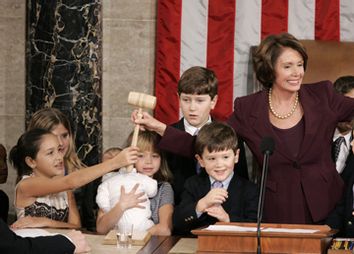
It is unsurprising that the two most potent acts of political symbolism during last week’s official Democratic takeover of Capitol Hill came from a white woman and a black man. Nancy Pelosi, first woman speaker of the House and, as Wonkette so perfectly put it, a mere two indictments away from the Oval Office, filled the well of the Congress with children. If congressional kids are anything like mine, members will be finding Hot Wheels, snotty Kleenex and half-gnawed pb&j’s in their overcoat pockets for weeks. Still, whether it’s true that it was an impromptu “Italian grandma” gesture in response to repeated squeals to touch the honored speaker’s gavel, or a canny, cynical political stunt, it doesn’t matter. It was perfect.

Infant grandchild in one hand, herding five more with the other, nattily dressed nanny discreetly within hand-off distance, the new speaker was the picture of the kind of woman with whom America ought to feel an immediate affinity. The daughter of a political dynasty and a longtime party insider, Pelosi ignored her own electoral urges until the youngest of her five kids was a senior in high school and all but ordered Mom to go for it. (“Get a life” was what the angelic teen said when Pelosi broached the subject.) Pelosi was 46. Because of my own ambivalence about motherhood, I have something near reverence for this type of female selflessness, whether forced on her by custom and family pressure or freely chosen. Pelosi proves that women can have it all. Just not all at once. And also that motherhood doesn’t have to calcify your spirit, your brain, your looks, your intellect or your drive.

I began my college career at community college in the late 1970s and my only competition there was housewives rejoining the world after raising their kids. They were focused, organized and calm no matter what the professors, the weather or the campus cops threw at us. They also always had extra tampons, change for the meters, and snacks in their purses. In the same way that I look to flight attendants for reassurance in turbulent weather, I looked to those moms to see if the term-paper particulars flustered them. If they didn’t (and they never did), I just took a deep breath and stalked them for pointers. As one told me once as I moaned over the syllabus, “Three kids with chicken pox and a husband on the night shift is hard. Five double-spaced pages on Maslow’s Hierarchy is just typing.”

Far be it from me to reduce Nancy Pelosi to merely the sum of the carpool miles she drove, but it took an extraordinary woman to do that and move on to become speaker of the House. To object to Pelosi’s inclusion of children in politics is to presume that an erstwhile stay-at-home mom brings nothing with her to public life from that experience, that she gained nothing from it, that child rearing is mere baby sitting, only keeping children alive till they can take care of themselves. In fact, it is an art and a science and it changes you. It grows you up. At a minimum, it teaches you just how many supposed grown-ups only need a good, long nap to be decent neighbors and co-workers.

Every time I hear of Pelosi’s threat to use her “mother of five” voice to quiet ill-behaving alpha males on the Hill, I look for someone to high-five, even though Salon’s own Broadsheet has expressed mild queasiness at the tactic and the mind-set behind it. Sports metaphors, but no invoking of the lessons learned from an experience that is the great leveler among women the world over? Washington, D.C., my adopted hometown, is nothing so much as High School Hell, a playground for overgrown, over-indulged, sneaky, backbiting children who need a good spanking and a looooong time out (another 12 years sounds about right). There’s no doubt that Pelosi is a canny politician, but I applaud her for wearing her motherhood so proudly and sending the message that career women can include children in our professional lives. It’s risky, but so is motherhood.

As happy as I was about the way the first female speaker took charge, however, I was ambivalent, trending toward annoyed, about the symbolism chosen to represent the black ascent to power. Without a doubt, this one was carefully considered and engineered. Incoming (black) House Majority Whip Rep. Jim Clyburn, D-S.C., chose not to receive the ceremonial whip — an actual leather horsewhip — from the outgoing (white) whip, Rep. Roy Blunt, R-Mo. Instead, he preferred to receive it from former Rep. William Gray, who had become the first black majority whip in 1989. Massa and the whipping post, you understand.

As this bit of blackface kabuki was taking place in D.C., I was rereading David Levering Lewis’ exquisite W.E.B. DuBois: Biography of a Race 1868-1919. I came across this passage about DuBois’ habit of carrying a cane while he walked the grounds at Atlanta University, the all-black school where he was a professor: “[J]auntily wielding his walking stick about campus, [DuBois] was oblivious to the fact that many of the high school students and even a few of the older ones backed away or reflexively flinched when he approached.” Some of the students from the rural South, it was finally explained to DuBois, “were used to the white folks using canes” on them.

DuBois might well be surprised that more than a century later, blacks are still flinching from the tools of subjugation. Tools that have been silenced for a generation, and have now been confiscated. For once, I’ll choose my words carefully and just say that Clyburn’s squeamishness strikes me as overwrought. And wrong. Clyburn doesn’t seem to understand what it would have meant to grab that whip from Blunt. What could be a more official, public, international castration than the Man having to voluntarily hand his pecker to a brother in ignominious defeat? Doesn’t Clyburn know whom he’s going to be whipping? The Man, that’s who! Personally, I’d love to have 10 minutes with that cowhide and my neatly alphabetized list.

Continue Reading Close

Not in my backyard, either

After the poor kids next door took advantage of me, I felt sympathy for the people of Houston, who've suffered crime and violence because of struggling Katrina exiles.

  • more
    • All Share Services

Not in my backyard, either

Sixteen months after Hurricane Katrina opened America’s eyes about just how fragile the poor are and just how black and brown poverty remains, it’s hard to figure out what the public thinks about the hundreds of thousands of victims who are still displaced. It’s hard for me to figure what I think. Two different story lines battle it out in the media. One is about the hardships the New Orleans exiles face, the other is about the hardships the refugees themselves are inflicting on the cities where they now live.

These largely poor, largely black refugees face the end of free housing and other post-disaster public assistance. At the same time, they are being blamed for crime and social dysfunction in their new homes. Just as unsurprising as the racist fables about bestial black hordes running amok in the SuperDome after the storm are the more recent stories from Houston, where 100,000 refugees have worn out their welcome.

Houston is now experiencing a crime wave and a surge in murder, allegedly presided over by lawless, rampaging “Katricians.” Katrina evacuees were either suspects or victims in 59 killings in the first eight months of 2006, or one in five Houston homicides. They have become the poster people for fear-mongering Houston gun dealers and the subject of much public debate. Kinky Friedman, erstwhile Texas gubernatorial candidate and supposed political maverick, dismissed them as “thugs and crackheads.” I am surprised and chagrined to say that I can relate to the people of Houston.

As much as racism created and sustains this situation, the fact is, poor folks can seem like unreachable creatures, ever needy, inscrutable and impervious to uplift, from another planet. I know because I come from the inner city, because I am very involved in community work, but also because, until recently, the equivalent of Katrina evacuees lived next door to me. Much as I didn’t want to admit it that first year, they were a blight on our middle-class neighborhood and simply did not belong there. I’m glad (and unsurprised) that they were evicted. Relieved. And sadly sure that, absent concerted and sustained intervention, they are doomed to go on living as they always have — like perpetual evacuees, dependent on the largesse of others, defeated by America’s cutthroat capitalism and blind to its well-disguised avenues of escape.

Neighborhood gossip, to which I was necessarily not privy until it was too late, was that the “Smiths” were living in the house via Catholic Charities. Maybe it was Catholic Charities, maybe it was Section 8 — who knows and what’s the difference? In any event, and given the blur of any move, it took me a few days to notice that black people lived next door (we were the only two black families) and that a never-ending stream of children ebbed and flowed from their house at all hours of the day and night. After two weeks or so, I calculated that there were seven kids (plus one mom and four surnames) next door. Their house, like mine, has three bedrooms, one bath. It was, of course, the male teenagers that most caught my eye.

As a single mom of two tots, the young men worried me, mostly because they were so idle, sauntering aimlessly down the center of our busy street, lolling on their tiny porch, riding seatless bicycles in languorous, unpredictable, traffic-snarling circles. They were going nowhere very slowly. The yard overgrown, untended and strewn with litter in a neighborhood where the men often came home for lunch to tend already manicured lawns and plant new shrubbery. Why no team uniforms on these kids, no backpacks, no school projects carted home in cardboard boxes?

Unsmiling, they watched me, never crossing the driveway to help with my packages like the other families did, hip me to the garbage schedule, introduce themselves. Growing up, I learned the primary lesson of inner-city survival: Never show fear. Grown, I also knew that ghetto toughness is a necessary mask its purveyors are all too ready to shed; I made eye contact and was proactively nice from Day One. If I didn’t give them the benefit of the doubt, who would?

I learned all their names and gave each a friendly smile — Mom, too, when she took her rare TV breaks for air. Surprised and grateful, whenever they saw my soccer mom minivan pull up (carless, they were ferried about by a succession of white ladies with the lanyards of various social service agencies dangling round their necks), whoever was lolling about greeted me warmly. I thought we were off to a good start when they called me “Miss Debra” unprompted. Ah, I thought. Poor, but with home training, just as I had been. I can work with this. And the youngest two became instant playmates with my own. Alas, I relaxed too soon.

Quickly, my fears of violence, crime or drugs emanating from their home were squashed, but I was there less than two weeks before receiving the first of several visits from the police investigating child neglect claims from next door. Still, that first year, I said nothing when they ran about shoeless and coatless in the frigid winter; I knew they had ragged outerwear and their mother was always home. I said nothing when they hit each other in the head with the huge plastic soda bottles they were never without and yelled so loudly at each other that heads popped out of doors for half a block in each direction — they were playing.

I took them with us to the park, to baseball games, and to most of the cultural events my family attended. Their mother always said yes before I could even finish the offer and never wrote down my offered cellphone number. Before I accepted that Sam’s Club’s offerings were more than my small family could efficiently consume, I took a chance on sharing my extras with “Mary” and she gratefully accepted. So gratefully that, before long, she was sending the kids over with requests: “Mama say we need sugar.” I sent over a 5-pound bag. A week later: “Mama say we need sugar.” “Mama say we need orange juice.” “Mama say, we hungry.” Each request came complete with prolonged, drug-bust-style banging on my window though the doorbell is brightly illuminated. “Mama say we need meat.” “No, she say we need four rolls of toilet paper. And soap.” “You don’t got no sour cream chips?”

They had no tools, no salt for the sidewalks, no batteries for the broken toys that littered their yard and which the kids hopefully offered in exchange for the use of mine’s Toys “R” Us bonanza. When the child I sent home to be bandaged (they played so roughly) came back still bleeding and undisinfected, I left a Megalo-Mart, industrial-size box of bandages and a four-pack of Neosporin on the broken porch chair I used as the drop site for my donations. The next few days, I watched the Smith kids run about festooned head to toe in Winnie the Pooh steri-strips. The next time “Mama said we need Band-Aids” I said I was all out.

It was this summer, though, that I reached my tolerance limit. I learned that they were using my kids to score free snacks at the corner gas station. My kids. Begging. I nearly broke my ankle stepping into a foot-deep hole they’d dug in my front lawn. I found my son playing with a claw hammer lying abandoned in their junkyard of a backyard and my daughter trying to heft a 12-pound bowling ball. But the kicker was the youngest two’s increasing demands that I be their mother. When I rubbed sunscreen on mine, it wasn’t enough that I offered it to them — big-eyed and pleading, they begged me to rub it on them, too. They peremptorily ordered cones when I took mine to meet Mr. Softee. Seeing me strap the kids into their car seats, they flew outside saying, “Mama say we can go, too.”

They insisted on equal access to my kids’ bikes and toys; I’d come home to find them playing on my porch and in my backyard, asking when dinner was. They strew their garbage everywhere like birds molting feathers; Mary would wave at me from her filthy couch when I couldn’t stand the trash in her yard anymore and would pick it up. I offered to pay her teenagers $10 an hour to do yard work but “it’s too hot.” Just as well, because when one finally accepted the offer, he quit after an hour and left my lawn mower and supplies where he dropped them, without a word to me. Last Fourth of July, they were in the backyard blowup pool with my kids from 8 a.m. til 8 p.m. I gave them breakfast, snack, lunch, snack, dinner, snack. When I sent them home for towels, they came back with ragged sheets and grimy curtains to dry off with. Never a sighting of Mom. As I forced them to go home so we could all get some sleep, I decided I’d had enough.

If I’d wanted nine kids, I’d have had nine kids.

I remained friendly, but I disengaged. No more donations, no more trips. Just a friendly neighbor, no more a resource. No more surrogate mom.

Soon afterward, they were evicted, and left behind a house so filthy and battered, it has taken contractors four months to repair the damage. They left the door hanging open and when I stepped in to close it, the stench nearly made my knees buckle. Junk was everywhere. The basement was flooded, food was stuck to the floor and walls, every kitchen surface was scorched and blackened. Mouse droppings made a carpet. As well, they’d vandalized my backyard and garage and keyed the entire driver’s side, the side nearest them, of my car. Windows, mirrors and finish.

Wherever they went, I know it wasn’t under their own power, arrangement or dime. No doubt those energetic, well-meaning white ladies with their social services lanyards worked their paperwork magic to save the Smiths for another year, another resentful neighborhood, another step down, or at best sideways, on the ladder of hope. Events like Katrina, and programs like Section 8, make the poor visible to us but they don’t make them any easier to reclaim. Or to love. Most of the Katrina evacuees who remain displaced are the hardcore, long-term, helpless poor, like the Smiths, and God only knows what will become of them when our patience wanes. However many begrudged millions we pour into the welfare system, the fact is that we abandoned these folks at birth and they know it. We shower them with Winnie the Pooh Band-Aids when they need heart transplants and, like Houston, we just wait to see which will drag themselves to success, which we’ll dump elsewhere, which we’ll bury, and which we’ll incarcerate.

The poor will always be with us but I’m glad the Smiths are gone. My heart breaks for them, but also for their new neighbors.

Continue Reading Close

Raising Cain

When I found out I was having a boy, I wondered: How can a feminist raise a man without becoming a hypocrite or a castrator?

  • more
    • All Share Services

Raising Cain

When I was pregnant with my first child, who is now 5, I was ecstatic to learn he was a boy. This was odd, since I did not much like those of the male gender. Little boys even less, because I’d seen the center-of-the-universe process by which they become men.

I might have been equally happy to learn he was a girl (as I was with my second, who is 3). I was just plain happy to know more, anything, about this mysterious new presence that was dismantling my carefully constructed life. Yet, from the beginning, I wondered how I would reconcile my feminism with raising a son. How could I do it without becoming either a castrating mother straight out of O’Neill or an ovo-hypocrite who talks woman power but raises her own precious boy to be no more enlightened, and no less entitled, than any Promise Keeper?

Black people always demand that I focus only on the holy calling of raising a black man, period. But it seems to me that if I get the manhood part right, the black part will take care of itself. If he earns my respect by becoming a moral, hardworking, courageous humanist who shoulders his responsibilities, he can be as ‘incognegro’ as Wayne Brady. Race schmace: His blackness is his to define. My dilemma is raising a man when he’s the only one of his gender to whom I give the benefit of the doubt.

I should explain: When I say I don’t like little boys, I mean that, before I had kids, all children annoyed me, albeit boys in particular because of their penchant for a mayhem that left obedient little girls ignored. When I was growing up in the inner city, children were the A-No. 1 way to ruin your life and guarantee that you’d be broke and tied to one loser or the other for the rest of your life. Once I was grown, and single till 40, children became the whining pests who kept my friends from being able to carry on a conversation for more than five minutes or who kept insisting that I exclaim over their crayon scrawls and stuttered nonsense.

While my own childhood was wonderful in some ways, it was so much grimmer than that of the privileged children I’ve encountered as an adult that I found myself resenting them both their freedom to be children and the unceasing stream of nurturing adult attention they received. Poor kids have to fend more for themselves emotionally; it makes us strong but it also makes us sad.

Putting the mourning of my own childhood aside, I just mean to say that children primarily meant to me that I’d always be taking care of someone, a fate too many women accept as given. When you grow up a poor black girl in a huge family you spend your life caring for the whole world. Children, I knew, meant that I’d be a human mop and short-order cook forever (see Katherine Newman’s “A Different Shade of Gray” for an excellent, if depressing, look at how most inner-city grandmothers never get to retire, since they have to pick up everybody’s slack). I wasn’t always sure I’d escape poverty but I was damn sure I could escape parenthood.

So having children, while always a leap of faith, was especially hard for me because I knew there was a strong chance that the same fear of losing control that led me out of poverty might well keep me from surrendering myself to those walking little need-bags. Here’s what I mean: for decades, I was the living embodiment of delayed gratification. I had something like a phobia of indulging myself, as people from my background understandably did with sloth, crime or drugs. The first time it ever occurred to me to lie down with a nasty cold was my first year of law school. I actually stared, appalled at what I was thinking, at the bed in my dorm room like a thief looking at an open bank teller’s drawer. I was 33. That was also the year I took my first aspirin. I was afraid that if I weakened for even one moment the downhill slide might never stop.

The poor have no backup system, and I worried where such self-indulgence might lead. And what are children but the ultimate self-indulgence, the perfect monkey wrench thrown into even the most together woman’s life? I knew women who kept their children at arm’s length and it broke even my heart. At 41, I was less afraid of miscarriage or birth defects than of being a cold, distant mom too neurotic to surrender to her own babies. But when I found myself constantly stroking the same spot on the right side of my belly as my son grew, exulting in every blurry ultrasound of his huge head and tiny little spine, I was pitifully grateful. Thank God, my fears about not being able to love him were easily squashed.

Two kids later, I know my fears about kids being the perfect trap were justified because I have completely “mommed out.” Though even before I conceived I told anyone who would listen that I was going to hire a nanny and get right back to my work and travel, now I get teary because my daughter insists on dressing herself and my son no longer accepts being called Boo Boo. (“That’s not my name, Mom.”) Now that he’s past the androgynous baby stage my dilemma is how to be true to my feminist principles and true to my son’s needs. In my community, it is often noted that black mothers raise their daughters but merely love their sons. How do I raise them both?

My unapologetic, “bite me” feminism was formed as I grew up in the fundamentalist Christian black working class, where I was supposed to be seen working and not heard questioning. I’m still pissed off about it. However much racism a black man encountered in the outside world, he always had his women folk to come home to and lord over, however benignly he might choose to do so. When my handyman, truck-driving father returned from a grueling day’s work, he filled his time as he chose. I have few memories of my mother when she wasn’t still in her pink waitress uniform cooking, cleaning, doing laundry or tending to one of her six kids until long past my bedtime. As soon as each girl was old enough to reach the stove, we joined her on the bucket brigade while my brother idled. I was raised to be such a rough-knuckled chambermaid, I thought the hospital corners and tongue lashings of Basic Training and Officer Training School were a respite.

When I was 16 and he was 12, my brother and I had the same curfew. My father actually punished him the few times he helped us girls, so we didn’t have the heart to keep making him help. When we feminists go on about institutionalized sexism, this is what we mean; thanks, Dad, for making me complicit in my own subjugation. There’s nothing lower than a black woman who keeps a dirty house or neglects her kids (except a lesbian), but a happily unemployed black man shuffling between his mama’s, his big mama’s and his latest girlfriend’s house? It’s hard out there for a brother. Spending 12 years in the military, where the black men worked just as hard to keep the women in their place as did Mr. Charlie, sealed the feminist deal.

So what to do with this son of mine? How to love him? How to raise him? How to mold him into a manly man but not a bruiser? And most of all, how not to interpret his every troubling move (e.g., refusing to wait to be called on, hitting a classmate who was uninterested in being his girlfriend, torturing his little sister) as a harbinger of a male chauvinist pig in the making?

But, adding another princess costume to my daughter’s cache the other day, it occurred to me that I was a hypocrite, just not the kind I had so feared. I have no doubt that indulging (OK, creating) my daughter’s Cinderella fascination is but one, far from definitive layer in her development as a woman. With something like evil satisfaction this summer, I feigned deafness when her princess regalia repeatedly got caught in her trike’s wheels. When I finally came to help, I told her, “Princesses sit on thrones, honey. They can’t ride bikes. So I think you’ll have to choose either the ball gown or the bike.” She chose the ball gown and we sat on the porch together while her brother NASCAR’d up and down on his bike. I wasn’t the least bit concerned. “We got nothing but time,” I thought happily as I watched her watch her brother’s freedom.

So why no patience with, or confidence in, my son?

I see now that it’s my anger, however justified, and not my feminism, that clouds this particular issue. There’s no inherent difference between either my daughter or my son’s interrupting class, hitting classmates, abusing the weak. The problem is my having read gender in, making it worse for a boy, my boy, any boy, to do those things. If I stay focused in the now and in transcendent principles — pacifism except in self-defense or in protection of others, good citizenship, empathy, tolerance, fairness, responsibility — I can stay focused on my kids’ actual needs and not their amorphous future potential to be either victim or victimizer. My goal is to raise two feminists too smart and too honest to either accept or perpetuate gender-based unfairness. Now I have a story to tell them about how easy it is to fall into those traps.

Continue Reading Close

Page 1 of 2 in Debra J. Dickerson