Ed Kilgore

Why immigration won’t go away in 2012

The crackdown in the states hits hardest among the Hispanic voters who are key to his reelection hopes

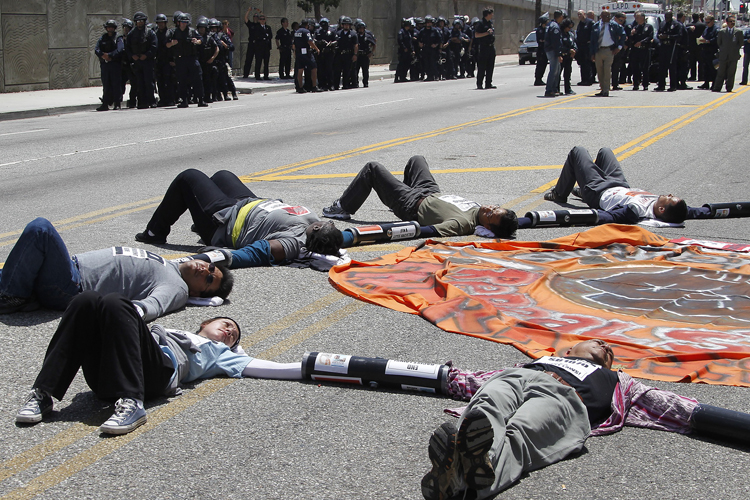
Protesters against Arizona's anti-immigration law SB 1070 lie on a street with their hands linked together. (Credit: Fred Prouser / Reuters)

According to the chattering classes, 2012 was supposed to be the election year when the “culture wars” of recent decades faded into unimportant skirmishes, as candidates and voters alike focused exclusively on economic and fiscal issues. But at least one culture war issue, immigration, has already shaken up the Republican presidential contest and is key to Barack Obama’s success in winning the Hispanic votes he desperately needs to get reelected.  With Congress missing in action, it is the battle over punitive new state immigration laws, in the legislatures and in the courts, that keeps this issue in the national spotlight.

The enduring potency of the immigration issue has been apparent since Arizona’s Republican Gov. Jan Brewer signed Senate Bill 1070 in April of 2010. The measure signaled the intention of conservatives at the state and local levels to protest what they considered lax federal enforcement of immigration laws by inducting regular police officers into the unaccustomed role of harassing, detecting and arresting people without citizenship documents.  Though portions of the law were immediately struck down by lower federal courts, the measure became a litmus test issue in 2010 congressional and gubernatorial contests around the country, particularly among Republicans.

Copycat legislation was introduced in a host of states, with Utah, Georgia, Indiana, South Carolina and Alabama enacting harsher laws and experiencing mixed results in court challenges. Alabama’s 2011 law, which goes well beyond the Arizona template by seeking to use school officials to identify “illegals,” has attracted national attention by spurring an exodus of undocumented people from the state and damaging the state’s agriculture industry as unharvested crops rot in the fields (as is also occurring in Georgia).

Until the federal courts sort out the various lawsuits and begin to define a permissible state role in the enforcement of federal immigration laws, the furor will mainly serve to keep pressure on Republican politicians to display their “toughness” on the issue. It will also draw fresh attention to the collapse of Bush-era efforts to enact comprehensive immigration reform that includes a path to citizenship for the roughly 11 million undocumented people already in the country.

In the crossfire of this controversy are Hispanic Americans, who are alternating between fearful rejection of Republican anti-immigrant rhetoric and deep frustration at the failure of the Obama administration and the Democratic Party to promote comprehensive reform.

The firestorm set off by Arizona showed that the grass-roots conservative rejection of prior Republican support for a “path to citizenship” — known simply and bitterly as “amnesty” on the right — associated with both George W. Bush and Arizona’s own John McCain, has if anything intensified despite the recession, the drop-off in the number of illegals entering the country and stepped-up federal enforcement measures.

If there was any doubt that comprehensive immigration reform had joined other elements of Bush’s “compassionate conservatism” on the dustbin of political history, it should have been laid to rest by the recent experience of one-time GOP presidential front-runner Rick Perry of Texas. Perry’s support for what was once a non-controversial program that enabled undocumented immigrant children graduating from Texas high schools to obtain in-state tuition rates at public colleges destroyed much of his base of support among conservative voters.  The fact that Perry’s  attempt at a comeback began with a harsh attack on Mitt Romney’s alleged employment of undocumented workers in a landscaping project at his own home shows the Texan’s tardy understanding that the immigration issue was his most important albatross.

This passion play over immigration on the right is occurring in a larger context where Republican efforts to deny Barack Obama reelection may well depend on the size and direction of the Hispanic vote.  According to exit polls, Obama won 67 percent of the Hispanic vote in 2008, and a record turnout among Hispanics lifted them to 9 percent of the electorate.  As is usually the case, the Hispanic share of the midterm electorate dropped significantly, to 6.9 percent in 2010, with the Democratic share dropping to 60 percent.   A return to something approaching 2008 levels in both turnout and support levels could be crucial to Obama’s prospects in 2012.

But early measures of Hispanic enthusiasm for voting in 2012 are down significantly. Obama’s job approval rating among Hispanics (according to the latest Gallup weekly tracking poll) is at an anemic 49 percent, not much above Obama’s overall rating of 42 percent  Certainly the intensity of support for Obama has declined along with the approval ratings. A recent Latino Decisions survey showed the percentage of Hispanics “strongly approving” of Obama dropping from 41 to 28 percent just between June and August of this year.

With the unemployment rate for Hispanics standing about 2 percentage points above the level for the population at large (with home foreclosure rates a lot higher), some of the unhappiness simply represents the same economic factors that have drained Obama’s support in all elements of the electorate. But aside from the administration’s failure to revive comprehensive immigration reform legislation, its policy of stepped-up enforcement — nearly 400,000 undocumented immigrants were deported in the fiscal year that ended on Sept. 30 — has drawn fire from Hispanic political activists.

The Justice Department’s recent interventions in support of legal challenges to the new state immigration enforcement laws provide an important point for Democrats seeking to buttress Hispanic support heading into 2012, but at the cost of some political peril in the broader electorate.  Polls taken last year in the wake of publicity over Arizona’s law consistently showed comfortable majorities supporting Arizona’s efforts, along with eroding support for “path to citizenship” initiatives.

More recent negative publicity from states like Alabama about panicked families fleeing their homes, struggling legal Hispanic businesses, and wasted crops are likely to undermine general support for more aggressive anti-immigrant measures, while raising Hispanic ire toward the (almost universally) Republican politicians promoting this legislation. Add in the Republican presidential candidate debates featuring competing and ever-escalating attacks on anyone who would defend undocumented workers or offer their children any benefits, and it’s no surprise that flagging Hispanic support for Obama has yet to benefit Republicans.

Even Rick Perry, who has suffered mightily for his relatively moderate position on immigration, registered only a 37 percent approval rating from Texas Hispanics in a recent survey (as compared with a 49 percent disapproval rating).  Since the usual benchmark for the percentage of Hispanic voters needed by a Republican to win a presidential election is 40 percent, that is hardly a comforting sign for the GOP.

One thing is certain. The slow but steady progress through the federal courts of lawsuits involving state immigration laws (federal appellate courts have already issued conflicting decisions involving the Arizona and Alabama laws) will continue as the 2012 election cycle intensifies, possibly concluding with a landmark Supreme Court decision.  As conservative Republican primary voters beg for anti-immigrant rhetoric from their candidates, and the Hispanic vote begins to take form in the swing states of the general election, we are likely to learn that reports of the demise of cultural issues in 2012 were wildly premature.

November ballot is a death match for Ohio unions

Labor goes all out to repeal law gutting collective bargaining rights

Union supporter Tom Ullom, of Westerville, watches a broadcast of the Ohio House debate on Senate Bill 5 at the Ohio Statehouse in Columbus, Ohio, March 30, 2011. (Credit: Matt Sullivan / Reuters)

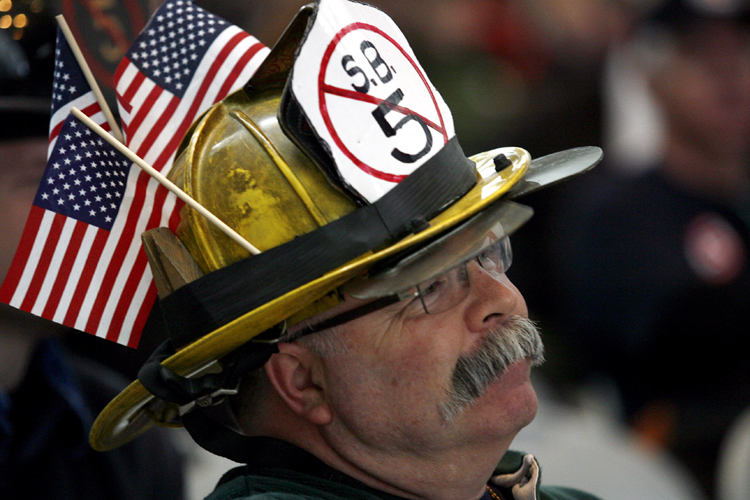
After fierce but inconclusive battles in Wisconsin, the great labor struggle of 2011 is now centered in that ultimate swing state of Ohio. A richly funded national right-wing effort to break the economic and political power of the labor movement in its Midwestern heartland is now facing a ballot test in a Nov. 8 referendum to affirm or overturn a union-busting law, known as Senate Bill 5.

As in Wisconsin and other states, conservatives in Ohio have focused their fire on public-sector unions, which are easy to identify with unpopular levels of government spending and taxation. But just as there is little doubt the assault on public-sector unions this year is part of a broader effort to weaken collective bargaining rights and undermine labor’s political strength, efforts to repeal Senate Bill 5 will depend on the solidarity of private-sector union members who are not directly affected by the legislation, but can see the handwriting on the wall.

The heart of Senate Bill 5, as enacted by the Republican-controlled Legislature and signed by GOP Gov. John Kasich, is a set of provisions limiting collective bargaining by public employees to wage and hour issues. Strikes by public employees (who constitute nearly half the state’s unionized workforce) would be banned, as they already are for police and fire department employees. Pensions and benefits, and a variety of ancillary issues affecting conditions of employment, such as class sizes for teachers, would be permanently off the table.

Of equal importance is a provision banning “fair-share” assessments from non-union members who benefit from union collective bargaining efforts, a step that would seriously damage incentives to join public-sector unions. This is perhaps the most obvious feature of Senate Bill 5 that might set a precedent for future attacks on private sector unions in Ohio and on unions in other states. Nationally, the conservative American Legislative Exchange Council (ALEC) is pushing state right-to-work laws banning “union shops.” Some, including, so far, at least two Republican presidential candidates, are even promoting a national right-to-work law.

Proponents of SB 5 are trying mightily to claim the legislation is mainly about “runaway” pensions and benefits, and often tout a provision requiring public employees to pay at least 10 percent of the cost of pensions and 15 percent of the cost of healthcare premiums. Unfortunately for this argument, many if not most public employees already contribute to pensions and benefits at this level or more. Just as important, public employee unions in Ohio and elsewhere have traditionally sacrificed wage increases to pension and benefit needs. Indeed, in 2008 alone, Ohio public-sector unions made $250 million in wage and benefit concessions to state and local governments.

The conservative talk about disparities between public and private-sector employees is a transparent ploy to drive a wedge between the two wings of the labor movement, while distracting attention from the more egregiously anti-union provisions of the SB 5. Polling has shown the benefit and pension issues are the only provisions of SB 5 that are reasonably popular.

These efforts certainly have not worked at the level of union or political-party leadership. The drive to repeal SB 5, spearheaded by a union-funded umbrella group called We Are Ohio, has conspicuously featured private-sector union leaders. This weekend, a Columbus-area phone-bank and door-to-door canvassing effort was personally led by Communications Workers of America president Larry Cohen, with strong participation from other private-sector unions ranging from the Steelworkers to the Plumbers & Pipefitters to the Food and Commercial Workers.

Mike Gillis of the Ohio AFL-CIO told me that building trades unions, who fear an effort to kill Project Labor Agreements ensuring union jobs for major public works projects, are also very active in the repeal campaign. A recent Quinnipiac poll showed Kasich’s approval ratings among voters in union households to be deeply “underwater” with 27 percent positive and 68 percent negative. And beyond the union ranks, the Ohio Democratic Party has been an unambiguous opponent of SB 5 from the beginning.

The apparent strategy of conservative anti-union activists to target public-sector employees as a less-popular “weak link” in the union ranks is based on questionable assumptions. Though there is little in the way of public polling on this subject, a February 2011 Pew survey showed public- and private-sector unions having almost identical favorable/unfavorable ratings from the public at large. The poll found 48 percent have favorable view of private-sector unions with 37 percent negative. For public section unions, the figures were 48 percent favorable, 40 percent unfavorable.

These sentiments, along with a broad perception that Kasich and Republican legislators had overreached with SB 5, generated strong initial support for the effort to repeal the legislation. Indeed, Kasich and Republican legislators made a brief and unsuccessful bid to head off the referendum by suggesting negotiations to modify the legislation. A July Quinnipiac survey showed repeal favored by a robust 56-32 margin, a figure made more formidable by the tendency of ambivalent voters to cast “no” votes on ballot measures. (Although opponents of SB 5 placed the measure on the ballot via voter petitions, a “yes” vote, under an Ohio practice designed to avoid confusion, would sustain the law while a “no” vote would repeal it.)

After a period of extensive partisan polarization on SB 5 and publicity over similar battles in other Midwestern states, along with the first big series of pro-SB 5 ads, the margin of support for repeal had dropped to 51-38. Since this is an off-year election in Ohio, turnout patterns could be as important as public opinion in determining the result. The ultimate outcome, then, may still depend on stretch-drive campaigns by both sides. The repeal-SB-5 forces are relying heavily on the kind of grass-roots effort that collected an impressive 1.3 million signatures — a new record for Ohio — on petitions to put the measure on the ballot. We Are Ohio is testing out its ground game in early voting, which began on Oct. 4.

The pro-SB-5 forces, organized under the leadership of a group calling itself Building a Better Ohio, have little in the way of a ground game, other than local Republican organizations and Tea Party groups. The Koch brothers’ favorite project, Americans for Prosperity, has been training Tea Partyers in mobilization efforts for the referendum. But supporters of SB-5 do have money, most of it from the same shadowy national conservative groups who have exploited the loose campaign finance rules introduced by the Supreme Court’s Citizens United decision to spend vast sums on the 2010 midterm elections and the battles in Wisconsin and other states since then. And while the pro-repeal We Are Ohio campaign has fully disclosed its funding sources and expenditures, the finances of the anti-repeal campaign remain largely a matter of conjecture.

Clearly both sides have devoted significant resources to the airwaves. Just last week, a consortium of Ohio newspapers released a partial analysis of TV ad spending that suggested We Are Ohio has outspent Building a Better Ohio by a 5-2 margin. According to the same news story, We Are Ohio’s own figures indicate a closer money battle, with the pro-repeal group registering $5.4 million in ad buys compared to $2.8 million for Building a Better Ohio, supplemented by another $1.2 million in ads bought by Make Ohio Great, a group set up by the Republican Governors’ Association and featuring more general “reform” appeals by Kasich.

But pro-repeal forces legitimately fear a last-minute infusion of out-of-state money supporting a “yes” vote, with Karl Rove’s Crossroads GPS — which played a major role in the 2010 elections — being a particular suspect, especially given the strong incentive it has under federal tax laws governing nonprofits to spend as much as possible on non-candidate elections like ballot initiatives.

Indeed, for all their efforts to frame the Ohio referendum as a struggle between budget-conscious Buckeye officials against union bosses, it’s clear that the Nov. 8 balloting, no matter which way it goes, will be a major landmark in a national anti-union effort that began in Wisconsin and will reach its apex in November of 2012. A political spokesperson for the national AFL-CIO, Jeff Hauser, put it this way in an interview:

It is critical that working people respond vigorously to this significant attack on their rights orchestrated by the shadowy ALEC and backed by Karl Rove’s secret sources of corporate cash. Fortunately, Kasich, like Scott Walker before him, has galvanized working people into action, union and non-union, private sector and public sector alike.

That’s how opponents of SB 5 hope the issue will be understood by 50 percent-plus-one of Ohioans voting on Nov. 8.

Continue Reading Close

The truth about voter suppression

The GOP is pushing restrictive voting legislation unlike anything since the Voting Rights Act of 1965

(Credit: AP/Mary Altaffer)

The national trauma of the 2000 presidential election and its messy denouement in Florida and the U.S. Supreme Court made, for a brief moment, election reform a cause célèbre. The scrutiny of election administration went far beyond the vote counting and recounting that dominated headlines. The Florida saga cast a harsh light on the whole country’s archaic and fragmented system of election administration, exemplified by a state where hundreds of thousands of citizens were disenfranchised by incompetent and malicious voter purges, Reconstruction-era felon voting bans, improper record-keeping, and deliberate deception and harassment.

The outrage generated by the revelations of 2000 soon spent itself or was channeled into other avenues, producing, as a sort of consolation prize, the Help America Vote Act (HAVA) of 2002, an underambitious and underfunded law mainly aimed at preventing partisan mischief in vote counting. The fundamental problem of accepting 50 different systems for election administration, complicated even more in states like Florida where local election officials control most decisions with minimal federal, state or judicial oversight, was barely touched by HAVA. As Judith Browne-Dianis, of the civil rights group the Advancement Project, told me: “The same cracks in the system have persisted.”

But most politicians in both parties paid lip service to the idea that every American citizen had a right to vote, and that higher voting levels of the sort taken for granted in most democracies would be a good thing. “Convenience voting” via mail and early on-site balloting, or simply liberalized “absentee” voting, spread rapidly throughout the last decade, often as a way to minimize Election Day confusion or chicanery. In Florida itself, Republican Govs. Jeb Bush and Charlie Crist relaxed and then abolished the state’s practice of disenfranchising nonviolent felons for a period of time after their release.

No more. In the wake of the 2010 elections, Republican governors and legislatures are engaging in a wave of restrictive voting legislation unlike anything this country has seen since the Voting Rights Act of 1965, which signaled the defeat of the South’s long effort to prevent universal suffrage. This wave of activism is too universal to be a coincidence, and too broad to reflect anything other than a general determination to restrict the franchise.

Millions of voters are affected. In Florida new Republican Gov. Rick Scott signed legislation reversing Crist’s order automatically restoring the voting rights of nonviolent ex-felons. In one fell swoop, Scott extinguished the right to vote for 97,000 Florida citizens and placed more than a million others in danger of disenfranchisement. In a close contest for the Sunshine State’s 29 electoral votes, such measures could be as crucial to the outcome as the various vote suppression efforts of 2000.

As Ari Berman explained in an excellent recent summary of these developments for Rolling Stone, restrictive legislation, which has been introduced in 38 states and enacted (so far) in at least 12, can be divided into four main categories: restrictions on voter registration drives by nonpartisan, nonprofit civic and advocacy groups; cutbacks in early voting opportunities; new, burdensome identification requirements for voting; and reinstitution of bans on voting by ex-felons.

While new voter ID laws have clearly been coordinated by the powerful conservative state legislative lobbying network ALEC (American Legislative Exchange Council), other initiatives have spread almost virally. Virtually all of these restrictions demonstrably target segments of the electorate — the very poor, African-Americans and Hispanics, college students, and organizations trying to register all of the above — that tend to vote for Democrats.

Virtually all have been justified by their sponsors as measures to prevent “voter fraud,” a phenomenon for which there is remarkably little evidence anywhere in the country. As Tovah Andrea Wang, an election law expert at Demos, has concluded: “[L]aw enforcement statistics, reports from elections officials and widespread research have proved that voter fraud at the polling place is virtually nonexistent.” The Bush administration’s Justice Department tried to a scandalous degree to find cases of voter fraud to prosecute, and failed.

But as Marge Baker, executive vice president of People for the American Way, observes:

So-called anti-fraud laws are almost always thinly veiled attempts to prevent large segments of the population from making it to the ballot box … low-income voters, college students, people of color, the elderly. The people behind these laws know that there is no “voter fraud” epidemic. They just want to make it as difficult as possible for certain types of people to vote.

If so, is the motivation simply and purely partisanship? That’s the conclusion reached by former President Bill Clinton, who told a Campus Progress audience in July: “They are trying to make the 2012 electorate look more like the 2010 electorate than the 2008 electorate.”

The prevalence of restrictive measures in key 2012 swing states certainly reinforces this impression. With Scott’s order Florida rolled back the early voting that played a key role in Obama’s 2008 victory. New voter ID laws were pioneered in Indiana, the red state most famously carried by Obama in 2008. A voter ID bill passed in the Legislature in North Carolina, but was vetoed by the governor, a Democrat.

Cynical as such actions may seem, they do reflect an ideology. For some conservatives, however, there is a deeper motive than partisanship that helps explain the rapid proliferation of restrictive legislation. It hearkens back to much older debates over the franchise that raged from the mid-19th to the mid-20th centuries: the belief that voting is a “privilege” rather than a right, and one best exercised by “responsible” or “productive” members of the community. And it’s not really surprising that old-school doubts about the very concept of “voting rights” have accompanied the dramatic rise to power of “constitutional conservatives” who strongly believe that no popular majority should have the power to modify fixed concepts of property rights and limited government as handed down by the Founders, who themselves acted (according to many Tea Partyers) according to a divine mandate.

You hear echoes of this ancient anti-democratic conviction scattered all across the Tea Party Movement and among many state legislators active in voting for restriction legislation. Tea Party Nation president Judson Phillips created a furor in November of 2010 by suggesting that voting should be restricted to property owners, as it often was prior to enactment of the 15th Amendment.

Minnesota House Speaker Kurt Zellers flatly claimed voting was “not a right” during debate over a photo ID bill (a statement he later partially walked back). So, too, did Florida state Sen. Mike Bennett in a similar debate. Republican legislators and party leaders in Wisconsin, Maine and New Hampshire said all sorts of disparaging things about the civic qualifications of college students in the process of seeking to keep them from voting on campus.

Suffusing much of this sentiment is the pervasive Tea Party fear that voters without “skin in the game,” that is, “property ownership or significant tax liability,” will be prone to voting for big government and “welfare” at the expense of “productive” citizens. Few would publicly go so far as right-wing author Matthew Vadim, who briefly became a Fox celebrity for his argument that registering poor people to vote is “like handing out burglary tools to criminals,” since they “can be counted on to vote themselves more benefits by electing redistributionist politicians.”

But throughout the conservative and Tea Party subculture you find countless people who subscribe to the “Cloward-Piven Strategy” (popularized by Glenn Beck) that liberals have been engaged in a deliberate effort for decades to buy votes with expanded welfare benefits. And from practically the moment the financial crisis exploded, a preferred conservative-activist interpretation (advanced most aggressively by presidential candidate Michele Bachmann) has involved an elaborate variation on the Cloward-Piven Strategy.

The story is that the obscure community organizing group ACORN utilized the provisions of the Community Reinvestment Act to destroy the housing and banking industries with mortgages for shiftless poor and minority borrowers who were then encouraged to elect “socialist” politicians like Barack Obama to bail them out. This particular conspiracy theory has been especially potent since ACORN’s often-clumsy voter registration efforts also happen to be at the very center of Republican claims of widespread voter fraud.

Conservative suspicions that letting poor people vote leads to “socialism” have been most evident in the strange furor among tax-hating Republicans about the number of Americans who do not have net federal income tax liability. These “lucky duckies” (as the Wall Street Journal famously called them in a 2002 Op-Ed deploring the low taxes paid by the poor) have no “skin in the game.” Thus, as the Journal put it, “can hardly be expected to care about tax relief for everybody else … [and] are also that much more detached from recognizing the costs of government.”

While it’s unlikely Republican politicians will come right out and advocate higher taxes on the poor (although some “fair tax” schemes calling for a shift to consumption taxes would have the same effect), the resentment of them as freeloaders who get to “vote themselves welfare” probably does operate as a fine rationalization for placing landmines on their path to the voting booth.

All in all, the conservative commitment to full voting rights, which used to be a bipartisan totem that Republican operatives undermined in the dark and out of sight, is probably dead for the foreseeable future. And the war on voting will continue.

Continue Reading Close

An absurd, candidate-killing spectacle returns

The Iowa straw poll gave life to Pat Robertson, George W. Bush and Mike Huckabee -- and took it from Dan Quayle

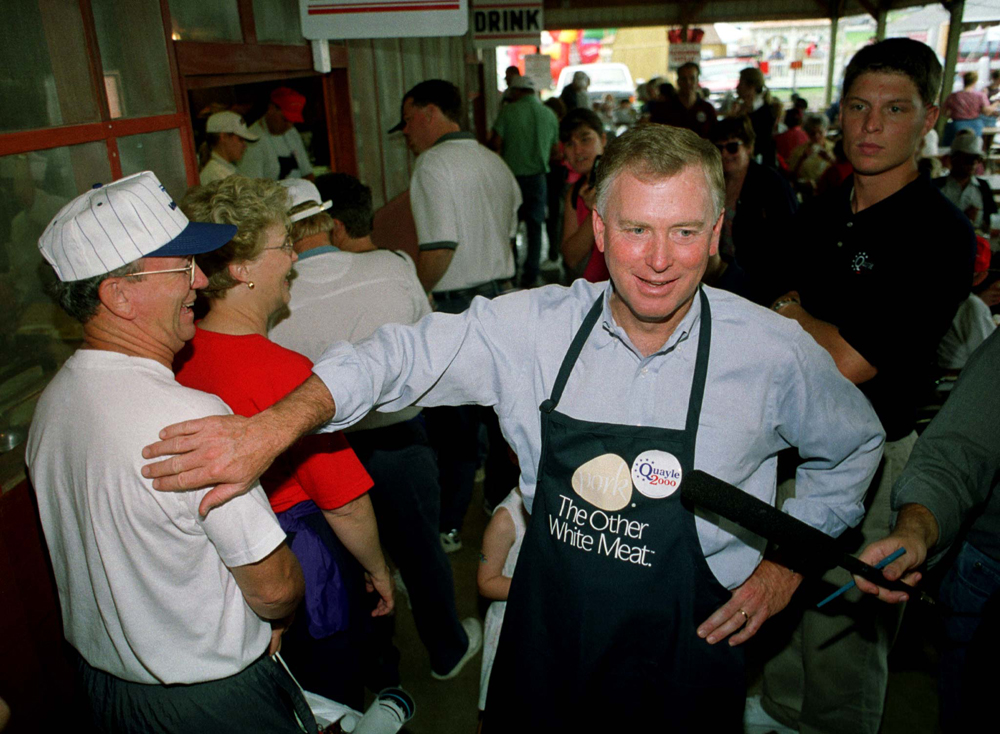
Republican presidential hopeful Dan Quayle greets people at the Iowa State Fair while campaigning August 12 in Des Moines. Presidential hopefuls from both parties are criss-crossing Iowa campaigning before the annual Iowa Straw Poll on August 14. JM/TB(Credit: © Reuters Photographer / Reuters)

In the college town of Ames on Saturday, the American political calendar will once again intersect with the arcane folkways of Iowa, as the state GOP’s much-derided, much-anticipated presidential straw poll kills off a few candidacies and perhaps gives fresh life to others.

Held only in competitive presidential cycles, the straw poll began as a publicity stunt in 1979 (following the precedent of a Democratic straw poll that had been held in 1972 and 1975, but that was then discontinued), quickly became the Iowa GOP’s major fundraising event, and assumed gigantic proportions as the first formal test of the nominating process by the mid-1990s.

Those who deplore Iowa’s outsize (but zealously defended) role in presidential politics often point to the straw poll as a monstrous extension of the distortions and parochialism imposed on the rest of the country by Heartland Hegemonism. The event has lengthened the campaign season, made ethanol subsidies a crucial issue in Republican presidential politics, increased the already formidable power of the Christian right, and in general complicated the lives of candidates and their strategists, who are forced either to propitiate or defy the Corn Idol months before the first real votes are cast.

The straw poll itself is a far simpler event than the Iowa caucuses (just as the Republican version of the caucuses, in which participants show up and vote for a candidate, is far simpler than the byzantine vote-swapping exercise used by Democrats) — a rolling single ballot held during a day of speechifying and, this year, after an earlier candidate debate in Ames, which was held Thursday night and was sponsored by Fox News and the Washington Examiner.

The straw poll’s reputation for corruption was once based on the absence of any requirement that voters prove Iowa residence. This was corrected after Sen. Phil Gramm allegedly bused in vast numbers of interlopers in 1995 to stuff the ballot box (he succeeded in tying Bob Dole for first place).

Nowadays the stench of malfeasance emanates from the basic structure of the straw poll: The $30 tickets required for voting privileges can be (and usually are) purchased by campaigns, along with transportation to the event (a big deal since parking is limited) and lunch. Well-heeled campaigns can also secure an advantage by bidding high during an auction for headquarters sites (the source, along with ticket sales, for the state party’s haul from Ames), where huge air-conditioned tents can be erected and hospitality can be extended. Ron Paul secured the choicest site this year, for a bid of $31,000. Michele Bachmann appears to be offering the most in the way of bread-and-circuses, with a country-and-Christian musical lineup featuring Randy Travis. Only those candidates who bid for headquarters sites will be allowed to speak inside the voting site, the Hilton Coliseum.

Inherently, then, the straw poll is a test of money and organization as much as voter support or enthusiasm. Voting attendance is expected to be under 15,000 — not a big number considering the event’s impact, but also not a completely unrepresentative slice of Iowa GOP activists (118,000 total votes were cast in the 2008 Republican caucuses). Efforts to “buy” the straw poll (aside from Gramm’s cross-border raid) haven’t generally been successful. Steve Forbes spent an estimated $2 million on Ames in 1999, and while he and George W. Bush managed to boost attendance to an all-time high of 23,000, Forbes finished a relatively weak second. Mitt Romney won in 2007 after an extravagant investment of time and money, but the real news was the second-place finish of the grotesquely underfunded Mike Huckabee. Huck, however, took advantage of a preexisting organizational infrastructure of evangelical churches and allied social conservative organizations, just as televangelist Pat Robertson did when he shocked everyone by winning the 1987 Straw Poll (a much less visible event back then).

In this year’s straw poll field, the “book” is that Tim Pawlenty has the best organization, Michele Bachmann the most enthusiasm, and Ron Paul perhaps the best combination of the two. Among the candidates with a significant following, Herman Cain has suffered most from a poor organization-to-enthusiasm ratio (a problem compounded by his oddly light Iowa campaign schedule up until the final days), while Rick Santorum has rivaled Pawlenty in building a statewide organization and campaigning everywhere. It’s not clear any one candidate has a decisive advantage among the politically mobilized evangelical churches, though Bachmann recently released a long list of clerical endorsements.

The value of a straw poll win or high placement is debatable, and usually depends on expectations and context. Three of the five straw poll winners (George H.W. Bush in 1979, Bob Dole in 1995, and George W. Bush in 1999) have gone on to win the caucuses; Dole and Bush 43 went on to win the nomination the next year. Another straw poll winner, Robertson in 1987, was the big story in the caucuses when he finished second, ahead of eventual nominee Poppy Bush. And Huck’s the obvious example of how someone beating expectations in the straw poll can get a leg up in the caucuses. The only “winner” who went on to bomb was Gramm, who after tying Dole in Ames in 1995, actually neglected Iowa for Louisiana (which held its caucuses before Iowa that year), where he lost to Pat Buchanan and soon went belly-up.

What’s clearer is that Ames can be a candidate-killer. In 1999, Dan Quayle, Lamar Alexander and Liddy Dole began the cycle as very serious candidates. Quayle and Alexander bombed entirely in the straw poll, and Dole fell short of expectations; all three candidates were soon out of the race. In 2007, Tommy Thompson and Sam Brownback (Huckabee’s main rival for hardcore social conservative support) dropped out after poor showings in Ames. Nowadays hopeless candidates sometimes hang on in order to get free exposure for their causes and personal projects in candidate debates, but aside from the already-left-for-dead Newt Gingrich (who is not even competing in the straw poll), Cain, Santorum and, most of all, Pawlenty, are the candidates most in danger of running on fumes if they perform poorly on Saturday. Even Bachmann is under a lot of pressure; her momentum would be stopped if she doesn’t win in Ames. And the whole field is operating under the shadow of two Big Dog candidates who aren’t showing up for the straw poll, Mitt Romney and Rick Perry.

The Conventional Wisdom (and the explicit advice of the cash-hungry Iowa GOP) is that candidates who don’t compete in Ames should probably forget about competing in the caucuses. Romney, for whom Iowa turned out to be a money pit and a momentum-killer in 2008, is still remaining ambivalent about whether he is skipping Iowa entirely (like John McCain in 2000); making a minimal effort and keeping expectations low (like John McCain in 2008); or abruptly going for broke in the caucuses, hoping for an early knockout win (despite his coolness to the state, he’s still running well in the polls there). Perry, meanwhile, upset some influential Iowans by scheduling an apparent announcement of candidacy in South Carolina on the very day of the straw poll, but is racing up to Iowa the very next day to pay his respects to the Corn Idol (creating a potential mega-event at a county GOP fundraiser where Bachmann is also going to appear), and could be very competitive, particularly if T-Paw and/or Bachmann are damaged by their straw poll showings.

If that’s not distraction enough, Sarah Palin will apparently be making a sudden trip to the Iowa State Fair, just 30 miles south of Ames, on Friday. Yes, it’s the time of the cycle when there are so many presidential candidates in Iowa, actual or potential, that you can’t stir ‘em with a stick.

Continue Reading Close

The hypocrisy of “states’ rights” conservatives

The 10th Amendment is sacred to the right -- except when it comes to fighting abortion and gay rights

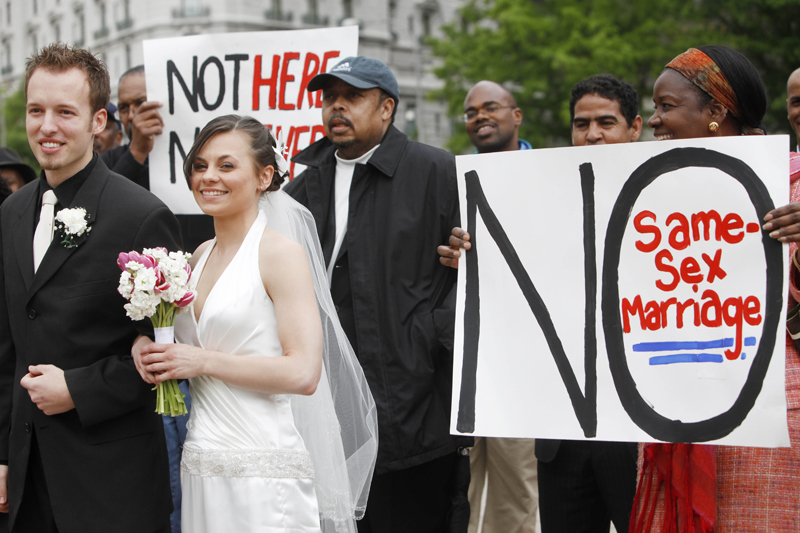
Jonathan Paul Ganucheau, 24, left, and, Denise Buckbinder Ganucheau, 26, both of Dallas, Texas, have a religious wedding ceremony performed as part of a protest against same sex marriage

During the last two weeks, Texas Gov. Rick Perry, by most accounts on the brink of a presidential candidacy, has reversed himself on the question of the proper venue for dealing with the two of the hoariest cultural issues in American politics, same-sex marriage and abortion.

First, at a Republican governors meeting on July 22, he referred to the recent decision by the New York legislature to legalize gay marriage as something that was “fine with me,” and said further: “That is their call. If you believe in the 10th Amendment, stay out of their business.” But then, in a matter of days, he was performing what can only be described as a public act of penance on Christian right potentate Tony Perkins’ radio show, trumpeting his support for a constitutional amendment to ban same-sex marriage nationally.

Meanwhile, on July 27, Perry took another hard-line states’ rights position, this time on abortion:

Despite holding personal pro-life beliefs, Texas Gov. Rick Perry categorized abortion as a states’ rights issue today, saying that if Roe v. Wade was overturned, it should be up to the states to decide the legality of the procedure.

“You either have to believe in the 10th Amendment or you don’t,” Perry told reporters after a bill signing in Houston. “You can’t believe in the 10th Amendment for a few issues and then [for] something that doesn’t suit you say, ‘We’d rather not have states decide that.’”

By August 1, though, after public criticism of Perry from anti-abortion leaders, he backtracked again and made clear his support for a federal constitutional amendment banning abortion as well.

Aside from making Perry look like a flip-flopping pol who is afraid of conservative activist groups, these incidents probably confused some folks about what the authorized “true conservative” position on these issues actually is. Do they favor states’ rights or federal domination of state policy-makers on cultural issues? And if it’s the latter, how come so much recent conservative activism on abortion and same-sex marriage has played out on the state level?

The history of cultural conservatives on these issues is very clear: They favor the maximum legal heft the political market can bear in support of their views. From their point of view, a federal constitutional ban is ideal; federal statutes would be less effective but better than state action; and state action (via either state constitutional amendments or statutes) is a useful fallback position if national bans aren’t practical. Though conservatives often vary in their sense of whether federal or state efforts are most effective at any given moment, it is hard to find conservative activists who actually think the 10th Amendent’s reservation of non-enumerated powers to the states should be dispositive on these issues, which they consider a matter of fundamental, global, eternal issues of right or wrong.

Same-sex marriage is a relatively recent issue that first exploded into the national political arena in 1993 when Hawaii courts appeared to be moving towards a ruling banning discrimination against same-sex couples in the issuance of marriage licenses. The ensuing agitation led to the enactment of the federal Defense of Marriage Act by Congress in 1996, which supposedly protected states (and the federal government) from any obligation to recognize same-sex marriages performed legally in other states, and then to a vast array of politically-driven state-level statutes, ballot initiatives and constitutional amendments banning such marriages or even civil unions and domestic partnership arrangements.

While some conservatives appeared to be happy with the idea of same-sex marriage being confined to a few liberal states, the steadily proliferation of states allowing gay marriage, along with court decisions undermining DOMA (followed by the Obama administration’s announcement that it wouldn’t pursue DOMA enforcement), has helped “traditional family” groups crack the whip among Republicans on behalf of a federal amendment. The 1996 and 2000 Republican Party platforms did not mention a federal amendment but instead simply endorsed DOMA and its enforcement. But the 2004 and 2008 platforms did endorse a federal amendment. With public opinion rapidly trending in favor of marriage equality, it has become far more common to hear Republican politicians argue against a big effort to enact a federal marriage amendment on practical grounds. In the current presidential cycle, Republican candidates Mitt Romney, Tim Pawlenty, Michele Bachmann, Rick Santorum and Newt Gingrich all favor a federal marriage amendment; only Ron Paul and Herman Cain have said they are opposed.

On the abortion front, the obvious difference is that federal constitutional law currently protects (to a greater or lesser degree) abortion rights, circumscribing the opportunities for anti-abortion activism. The fundamental position of the right-to-life movement, which has been enshrined in every national Republican platform since 1984 (the 1976 and 1980 platforms endorsed a constitutional amendment, but with ambiguous language about its scope) is in favor of a Human Life Amendment that would not only overrule Roe v. Wade and Planned Parenthood v. Casey, but would establish fetal rights from the earliest moments of pregnancy (perhaps even prior to implantation of a fertilized ovum in the uterine wall, threatening many popular contraceptive methods) as a matter of federal constitutional law. There is sometimes confusion on this point, since the only constitutional amendment calling itself a “Human Life Amendment” that obtained a congressional vote, a 1983 measure that failed in the Senate, merely denied a constitutional right to abortion, which would have effectively reversed Roe and turned the issue back to the states. But the term now clearly refers to the more sweeping variety of amendment banning abortion nationally.

While the ultimate position of the anti-abortion movement and the GOP as a party (with fewer and fewer dissenters each year) couldn’t be much clearer, there has been an explosion of state-level anti-abortion activity during the last few years, much of it stimulated by the first real crack in the wall of Supreme Court protection of abortion rights, the 2007 Gonzalez v. Carhart decision that validated a federal ban on so-called “partial-birth abortion.” By expressing a tolerant attitude toward restrictions that don’t directly ban abortions, and by stipulating that lawmakers (presumably at either the state or federal level) could make factual determinations about the actual necessity of certain post-viability abortions to protect the health of women or the interests of the fetus, the decision seemed to open the door to a variety of restrictions, some aimed at procedures, some at abortion providers, and some at women seeking abortions.

Very recently, conservatives in a number of states have pursued “personhood” bills, ballot initiatives and constitutional amendment proposals that would test the limits of the federal courts’ deference to legislative policy-makers on abortion, and/or set the table for total abortion bans in the case of a hypothetical future reversal of Roe. (Most conspicuously, a 2010 ballot initiative in Colorado pursuing a “personhood amendment” was routed at the polls, but another will appear on the ballot in Mississippi this November).

With much greater success, anti-abortion activists have been promoting “fetal pain” bills that seek to ban abortions after 20 weeks of pregnancy (a standard that flatly contradicts Roe’s prohibition on bans prior to the third trimester of pregnancy) on the highly questionable grounds that this is the point at which the fetus can experience pain. Such bills have been enacted in Nebraska, Idaho, Kansas, Oklahoma, Indiana and Alabama. Legal challenges to these laws will eventually emerge, though some pro-choice advocates fear a rollback of federal constitutional abortion rights and note that only 1.5 percent of abortions occur after 20 weeks.

Lest anyone think the fetal pain bills reflect a retreat from the right-to-life movement’s commitment to a national “solution” to abortion, it’s noteworthy that the pro-life group the Susan B. Anthony List recently pressed on presidential candidates a pledge that included support for a federal fetal pain statute. Candidates Bachmann, Pawlenty, Santorum, Gingrich and Paul signed on to it while Romney, Huntsman and Cain declined. (Romney, for his part, did not mention the fetal pain issue in his objections to the pledge.)

Since he is not a candidate just yet, Rick Perry hasn’t had to make up his mind about a federal fetal pain law. But given his recent experience, he is likely to deal with future demands from the Christian right and other cultural conservatives by simply saying: “Where do I sign?”

Continue Reading Close

The Tea Party is bigger than the South

Movement conservatism's conquest of the GOP is a national story, not a regional one

People hold signs during a "tea party" protest in Flagstaff, Arizona August 31, 2009. Organizers say the event is an effort to work against members of Congress who voted for higher spending and taxes. REUTERS/Joshua Lott (UNITED STATES BUSINESS IMAGES OF THE DAY CONFLICT POLITICS) (Credit: Reuters)

Michael Lind is a very smart and wonderfully erudite writer with a bit of an obsession. His understanding of the deeper cultural wellsprings of American history and politics has left him, as a sort of side effect, with an abiding fearful hostility toward a particular group of people, the “Anglo-Celtic” Southerner. Lind sees them everywhere in our politics as a baleful, disturbing presence spreading bacilli of violence, bigotry and religious fanaticism. And in his recent Salon essay arguing that the Tea Party movement is an essentially Southern phenomenon, his prejudices blind him to a rather important and unprecedented phenomenon: the virtual disappearance of geography as a significant factor in the ideological character of the Republican Party.

To put my own cards on the table, I come from a Scots-Irish Southern background, and perhaps naturally resist Lind’s perpetual suggestions that coursing through my veins is an indomitable temptation to handle snakes, start wars and hire myself out to rich people to oppress minorities. As it happens, I’m too much of a scalawag to dispute the atavistic tendencies of my native region. But even though white Southerners tend to be conservative culturally, economically and politically, it’s no longer true that cultural, economic and political conservatives are likely to be Southern. And while you can make the argument (as Lind surely would) that the “movement conservative” (the broader group of which the Tea Party movement is merely a noisy and radicalized segment) takeover of the Republican Party has its roots in the South, or at least the Southern and Western “Sun Belt,” it hardly seems that relevant anymore. Today’s “movement conservatism” speaks with so many accents and “moderate Republicans” everywhere have been all but hunted to extinction.

Lind’s argument that “the Tea Party faction that has used the debt ceiling issue to plunge the nation into crisis is overwhelmingly Southern in its origins” is based almost entirely on his regional breakdown of the membership of the House Tea Party Caucus. (He seems to think it is particularly striking that there are no New Englanders in the Caucus, which might be true if not for the fact that there are only two Republicans from the region in the entire House.)

Unfortunately, Lind is about the only person in either party who believes that membership in the Caucus is the gold standard of Tea Party ideology, even in Congress. It was controversial at its founding in part because it includes members seeking to identify themselves with the Tea Party to insulate themselves from primary challenges, and in part because some Tea Folk want no formal representation within either party, while others think the GOP actually is the Tea Party. And despite Lind’s lurid hint that maybe Midwesterner Michele Bachmann’s prominent role in the Caucus is some sort of front for its actual Cracker power brokers, accounts of its founding make it clear it was very much, for better or worse, her personal project, probably related to her unsuccessful post-2010-election bid for a House leadership post and/or her eventual presidential campaign.

More to the point, since Lind’s argument ultimately leads to the contention that crazy Southerners caused the debt limit crisis, Tea Party Caucus members were hardly at the front of the barricades on that issue. Of the 66 House members who voted against the final compromise measure — undoubtedly the best measure of debt limit extremism — only 29 were members of the Tea Party Caucus, and conversely, that’s less than half the membership of the Caucus. Overall, Southern House Republicans favored the final bill by a 63-31 margin, supplying less than half of the “no” votes.

Moving beyond Lind’s own narrowly defined “proof” for Southern domination of the Tea Party, the whole idea is preposterous if you look at the actual spread of the Tea Party in its 2009-2010 heyday. Tea Party-affiliated candidates won heavily contested Republican Senate nomination contests in Alaska, Utah, Colorado, Nevada and Delaware; gubernatorial primaries in New York, Colorado and Maine; House primaries in Idaho, Michigan, Ohio, Kentucky, Delaware, Maryland, New York and New Jersey. Notable Tea Party political heroes include Bachmann of Minnesota, Sarah Palin of Alaska, Mike Lee of Utah, Scott Walker of Wisconsin, Pat Toomey of Pennsylvania, and Chris Christie of New Jersey. The crucible of Tea Party influence over the 2012 Republican presidential nomination process is in Iowa. Even some ostensibly Southern or quasi-Southern Tea Partyers aren’t Southern in any cultural sense, including the Cuban-American Marco Rubio of Florida, and the Pauls, father and son, from Pittsburgh, Pa.

And lest we forget, the whole Tea Party phenomenon began with the famous CNBC “rant” by an Italian-American from Chicago named Rick Santelli, and has been fed by vast sums of money from the Dutch-American Koch brothers of Kansas and the media empire of the Australian-American Rupert Murdoch.

Perhaps Lind thinks circularly of conservatism, or such cultural phenomena as evangelical Protestantism, as inherently “Southern” and thus irrelevant to the actual location or background of its advocates. But that sort of exercise becomes quickly meaningless. Yes, cultural and political ideas born or nurtured in the South, from Jeffersonian anti-government sentiment to country music to NASCAR, have spread throughout the country. But that is part of the same nationalization of culture that has made the South a lot less “Southern” than it used to be, as anyone spending time in the vast generic suburbs of Houston or Atlanta or Orlando can tell you.

The “movement conservative” conquest of the Republican Party is a big and important story in which the South has played a major and perhaps formative role. But it no longer plays that distinctive a role. If there are “villains” in this story, and certainly all progressive Americans think there are, it’s a mistake to keep looking for them exclusively in the land of cotton.

Continue Reading Close

Page 1 of 9 in Ed Kilgore