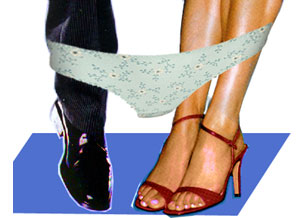
President Clinton dropped his pants in the Oval Office. Bill Buckner let a routine ground ball roll beneath his careless glove — an error that ultimately cost the Boston Red Sox the 1986 World Series. A few years ago at a Florida hospital, a medical professional (his name was probably Bill) pulled the plug on the wrong life-support system. At some point in life, each and every one of us have screwed up big time. Anyone who claims otherwise is lying, living in denial or suffering through the first cruel phase of Alzheimer’s. The rest of us fess up to imperfection and pray that when the big inevitable blunder descends upon us, our ass doesn’t end up in a big proverbial sling.
At 7 a.m. one bright and cheerless morning, my ass was in such a sling. But when airline management came to castigate me, when the cold iron hand of guilt snatched me by the neck, I protested innocence with the skill of an indicted politician: “I am not aware of, nor have I ever been aware of, any wrongdoing on my part.”
It happened before takeoff, on a Boeing 757 destined for Mexico City. The plane was packed with the usual cast of characters: bilingual businessmen wearing dark suits and darker dispositions; unwitting vacationers headed for a week of Montezuma’s revenge; a group of snobs who were beside themselves, literally, after being denied a first-class upgrade; and a Salma Hayek wannabe with sculpted nostrils, collagen-injected lips and surgically enhanced breasts that protruded from her torso like Tomahawk cruise missiles set to launch.
Shortly after the agent closed the aircraft door and passengers began to nod off in their seats, our flight attendant purser made the “prepare for departure” announcement over the intercom. This announcement does to flight attendants what Pavlov’s bell did to dogs. But instead of salivating with the expectation of food, we stop whatever we’re doing and move, as if under hypnosis, toward the emergency doors. There, beneath the conspicuous gaze of passengers, the designated attendant engages a door-arming mechanism.
When an armed door is opened (ideally, this should happen only in the event of an emergency evacuation), a canister of compressed air is punctured and the emergency slide/chute unfurls. The slide stiffens within seconds like a huge, incredibly excited penis, then angles toward the ground, providing a lifesaving escape route for passengers and crew.
Door arming is of tantamount importance among crew members. Failure to do so could jeopardize the safety of everyone on board. We might forget to deliver that drink you asked for a half-hour earlier. We might give you chicken instead of the beef you desire. Hell, we might even forget the names of crew members we’ve been working with for the previous month. But the arming of emergency doors is one of two things flight attendants never forget. The other is disarming the doors upon arrival.
Imagine what would happen if a crew member failed in this regard. After positioning the jet bridge and opening the door to welcome passengers, the unsuspecting agent would be greeted by the inflating emergency slide/chute and sent ricocheting down the jet bridge like a pinball. A multimillion-dollar aircraft would be temporarily put out of service while mechanics worked feverishly to repack the slide. Hundreds of passengers would be inconvenienced. Anarchy would ensue.
The flight attendant responsible for this fiasco — a blabbering simpleton reduced to tears by the magnitude of such an unforgivable blunder — would be snatched from the trip, dragged before a tribunal of snarling, mustache-twisting supervisors and berated, mocked and sent home to bathe in the sweat of irresponsibility, and maybe, just maybe, if a history of screw-ups cluttered his personnel file, the guilty flight attendant would have his wings clipped.
None of this entered my mind until seconds before departure to Mexico City.
My door-arming responsibilities were 4-Left and 4-Right. These two doors, located off the aircraft’s aft galley, are hidden from passengers by bulkheads behind the last row of seats on both sides of the aircraft.
Having heard the “prepare for departure” announcement, my Pavlovian conditioning kicked in. I ripped my eyes from Salma Hayek’s chest and found myself standing in the aft galley, in front of the 4-Right emergency door. I lifted the clear plastic cover and pushed the metal lever to the “armed” position — all the while wondering how such a tiny body managed to support such enormous breasts. The woman was less than 5 feet tall.
A cavalcade of questions began marching through my brain. Do newly implanted C-cups affect a petite woman’s balance? Might the added weight cause lower back trouble later in life? Do plastic surgeons prescribe special exercises to the artificially endowed?
Preoccupied by these mammary thoughts, I moved across the galley to the 4-Left door. But when I tried to push the lever to the armed position, it only moved a couple of inches, about a fourth of the required distance. At first I thought I had done something wrong. I tried again. Still, the lever barely budged. Perhaps something was stuck in the door — a stray strap, a forgotten blanket, an uncooked steak dropped by a careless caterer. I stepped back, surveyed the door seal and found myself locked in an inner debate about real breasts vs. fake breasts, silicone vs. saline, size vs. quality.
I called the captain on the interphone.
“Hey, captain,” I said, realizing I had failed to introduce myself to either of the two pilots. (Occasionally, I’ll fly across the Atlantic without seeing a pilot’s face until the aircraft lands and we find ourselves seated together in the van on the way to the layover hotel.)
After a quick introduction, I told the captain about the problem with 4-Left.
“I can’t arm the door.”
“Ahhhhhh,” he said, in the all-too-familiar jargon known as pilot talk. “Ahhhhhh.” He was apparently checking the instrument panel. “Ahhhhhh … yeah. Four-Left is definitely disarmed.”
“Want me to open the door and see if something’s stuck inside?” I asked.
“Ahhhhhh … yeah, why don’t you do that.”
Strictly speaking, flight attendants aren’t supposed to open doors except in an emergency. I knew this. The captain knew this as well. But the clock was ticking; it was a few seconds after departure time. It would be easier for me to open the door and remove the obstruction than to have the captain leave the flight deck and trek to the rear of the plane. Besides, I’ve opened doors many times before. Not just during annual emergency training drills, but while the plane was parked at the gate without air conditioning, or when galley straps were caught inside, or when catering needed to reenter for one reason or another. We never open doors without first informing the captain, and most of the time it’s not a problem. But this time it was.
After first making sure the arming lever was pushed to the “disarmed” mode, I grabbed the long silver door handle and rotated it clockwise.
In the split second in which the galley filled with sunlight, I entered a Salvador Dali-like world of incongruity. There was an improbable ripping noise, and the gnashing of iron teeth upon metal. My heart beat a wicked conga rhythm against my chest — something by Gloria Estefan and the Miami Sound Machine. Then I heard a hard, flat thud from far away.
Suddenly, there were voices from below. I looked down and saw half a dozen ramp workers standing in a circle. In the middle of the circle was a large, square, heavy-looking object that looked somewhat out of place, lying still and bleak, smack-dab in the middle of the airport tarmac. In my gut I knew what had happened, even before it registered in my brain. It was the slide pack. The big canvas sack containing the emergency slide/chute: Somehow, it had ripped from the door and fallen 20 feet to the tarmac.
My ass was most definitely in a sling.
As I peered down from the open doorway, the stiff morning breeze was like a slap on my cheek. I felt my mouth opening, my eyes bulging in their sockets, a freight train of stupidity bearing down on me. Had someone been standing beneath the door when the slide pack was ejected, had some unsuspecting baggage handler been driving past in a tug, he might have been severely injured or maybe even killed. This fact was not lost on the crowd of eight or nine ramp workers who stared up angrily at me.
“What the fuck!” someone shouted.
Perhaps, while distracted by thoughts of saline and silicone, I forgot to make sure the lever was in the “disarmed” position. Maybe I’d left the handle partially engaged. Maybe a couple of inches were not enough to engage the slide, but enough to yank the slide pack from its hinges. Or maybe the door had simply malfunctioned.
Within minutes the galley filled with airline personnel: the captain, flight attendants, a couple of gate agents, numerous supervisors, a customer service agent — even a wheelchair operator who was wedged in one corner, watching the circus with a smirk on her face.
“You the one who blew the slide?”
I turned to answer, focusing on a gray-haired supervisor, wondering what President Clinton would say in this predicament.
“No, I did not blow a slide,” I said, pointing to the slide pack on the ground. “Do you see an inflated side? No, you see a slide pack. The door was stuck. I tried to open it so I could remove the obstruction. The captain gave me the OK. Somehow the door malfunctioned and the slide pack was ripped off its hinges. There is no blown slide. What you see is a slide pack that has fallen from the door.”
He rolled his eyes and grunted.
Unbeknown to me, arrangements were being made for my removal from the flight. A standby flight attendant was preparing to take my place. This was standard company procedure.
In the six-month period preceding this incident, flight attendants at one major airline were responsible for 20 “inadvertent slide deployments.” These are embarrassing, dangerous and extremely expensive screw-ups. It can cost more than $28,000 to install a new slide on a 757 aircraft. A 767 slide goes for as much as $60,000.
But in breaking the plane, I had entered new territory. This particular slide/chute was detached, not inflated. And technically speaking, I did not open the door in the armed mode. After a 30-minute delay, during which mechanics reattached the fallen slide pack, the plane took off for Mexico City.
On board was the usual cast of characters: bilingual businessmen, unwitting vacationers and a Salma Hayek wannabe with Tomahawk cruise missiles that almost blew up in my face.
Smart, funny and far too good looking to have picked me up in a New York nightclub, Tanya looked into my eyes, took a sip from her salted margarita and quick as a ninja in a bad karate flick, she snatched my heart from my chest and tucked it in her clutch bag.
She was eroticism personified, an angel with wicked predilections. But when we flew to Jamaica two weeks later, when her conflicting personalities came at me like a three-headed beast, I realized our getaway had gone a bit too far.
For all intents and purposes, Tanya and I were still strangers when we checked into the Tree House Hotel in Negril. I knew that she was a struggling New York actress, that she rarely wandered north of Greenwich Village, that she wore a Hefty garbage bag upon her exquisite head whenever she walked alone in Manhattan (she claimed it kept away weirdos) and — not a surprise — that she’d been under the baffled eye of a psychotherapist.
She was beautiful, I kept telling myself. I was lonely. Who cared if she was a little strange?
We changed into swimwear and ran like giddy schoolkids down the flight of stairs, through the courtyard, past the tiki bar and onto Negril’s famous Seven-Mile Beach. There are no big resorts cluttering the area, no hordes of tourists basking in Bermuda shorts. Just clusters of lodges that sit stolid and lonely, their backs forever turned to the sea.
It was January. Having just arrived from New York, where the temperature was cold enough to freeze thought, we lay on the beach like survivors from a shipwreck. We frolicked in the water like the quintessential couple in a four-color tourism industry brochure: She threw back her head, laughing affably; I held her hand and sucked in my gut, trying to look manly and prosperous.
She was happy. I was happy. I thought I was falling in love.
When we returned to the room that afternoon, Tanya jumped me like a horny leopard. We got busy in the lounge chair. We worked up a lather in the shower. And later that night, just when I thought she’d used up her last drop of passion, Tanya did things to me than no woman had done before.
With the eyes of a voyeur, I watched her move beneath me. She was oiled with perspiration, and her hot skin glistened in the soft moonlight filtering through a swaying sea grape tree. Eyes shut, face contorted in a rictus of delight, her hips bucked in violent spasms, faster, faster still, lifting both our naked bodies from the sweat-soaked sheets peeling back from the corners of the groaning queen-size bed.
Hands against the wall, she steadied herself, hurling her crotch against mine, swallowing me in wet pelvic slurps that sent blood rushing to my loins like fire down a trail of gasoline.
Oh … Oh, Tanya!
In a daunting display of female virility, she slipped from underneath and slammed me on my back with a force that bent the metal bed frame. She then looped one leg across my twitching torso and mounted like Annie Oakley on a mission. Strands of damp black hair lashed against her face, in tune to the gallop of her passion.
When she finally reached her destination, when every muscle in her body tensed from sudden impact, her head fell backward, her arms flew sideways in a vibrating T and she let loose a witch-like shriek.
Before the beastly sound subsided, an angry voice flew in from the window, pleading that she “Shut the fuck up!” Tanya just laughed. For five eerie, ball-shriveling minutes she laughed.
Blinded by beauty, mesmerized by her appetite for intense commando sex, I refused to accept the naked truth: Tanya wasn’t boffing with a full deck.
The next day reality hit me like a Tyson punch. While lounging on the most perfect white sand imaginable, my not-so-normal lover turned to me and said, “I can’t relax.” I gazed along the seven-mile strip of powder, then to the turquoise sea and giant popcorn clouds that danced on the blue horizon. “This isn’t relaxing?” I asked, somewhat sarcastically.
With that, she announced her return to the hotel room.
I trudged beside her in the tropical heat, stealing glances at the Cindy Crawford/Tyra Banks-like face that held within it all the loveliness and mystery meant to befuddle man.
When we reached the door Tanya was eerily quiet. Looking into her faraway eyes, I could see that she was in pain. At this point I didn’t know it was deep, untreatable, psychological pain. I thought maybe she had gotten too much sun. Nevertheless, I apologized for being sarcastic, kissed her on the cheek, then retreated to the beach, thinking she needed some time alone.
There, while staring absently into the clouds, I saw an image of Tanya’s shaved V-shaped intersection, where I’d spent two glorious weeks caught in orgasmic gridlock. Overcome by a sudden need, I bolted from the water, ran past the tiki bar, through the courtyard, up the steps and stood panting like a felon in front of our hotel room.
When I opened the door, maniacal laughter knifed through air that suddenly seemed too thin to breathe. The laughter was not unlike the creaky “Hee, hee, hee … ” of the Wicked Witch of the West. Waves of gooseflesh rolled from my belly to the tips of my limbs. The ghostly glee was severed by a disembodied voice that said, “Shut up, silly!” A third voice, paternally harsh in nature, quipped, “You’re a bad, bad girl.”
I prayed that Tanya was playing some new Jamaican word game, though deep down inside I knew the truth. Following the voices, I crept past the broken bed to the partially open bathroom door. She was standing in front of a full-length mirror in all her naked splendor. A river of toothpaste foam ran from her mouth, down her chin and neck, between perfect silicone-less breasts, and dripped from her crotch into a frothy white pool that spread slowly between her feet.
I watched in horror while she blurted out that spooky laughter again, while those libidinous lips spat self-incriminations of silliness, while a third voice scolded the bad girl she believed herself to be. My mouth fell open. My heart hammered against my chest. Instead of being on a dream vacation, I had plunged into psycho hell with Sybil.
I tried easing away from the door, but in a panic I pushed against it. The door swung open. Sybil spun around, fell to the floor and screamed. She lay there, quivering, covered in Tartar Control Crest.
“What the hell is wrong with you?” I pleaded in a shaky voice.
She looked up at me with brown eyes as big as Nebraska, white foam leaking from one corner of her mouth. When the spooky laughter started again, I went loose in my flip-flops.
I stumbled backward, convinced not only that Tanya was certifiably whacked, but that my safety was suddenly in jeopardy.
“Come to Tanya,” she demanded, rising slowly, a specter of deluded eroticism in a cheap Jamaican hotel room. Her voice shook with the power of a baritone, and in her eyes there was a gleam that could have been lust or murder.
Tanya pursued me across the room with cat-like quickness that reduced me to tremors. With toothpaste foam slithering along the dangerous curves of her body, with evidence of homicide in her eyes and in her stiffening nipples, she pushed me onto the broken bed and grinned. It was a nasty grin. The grin of a porno star, preparing to unleash a triple whammy.
This was all very exciting, of course. As I lay there on my back I felt a pounding in my chest, a sudden tingling in the testicles. Despite lingering concerns about my safety, my penis swelled like a limp balloon filled with a colossal burst of helium.
Annie Oakley saddled up once more, but this time her mission was more urgent. She rode with single-minded intensity, bounding over hills, charging through valleys and galloping across the great Serengeti plain of madness and desire. She seemed driven by the thrill of sexual domination, compelled to go faster, ride harder, plunge deeper every time I cried out her name.
“Tanya … Tanya … Tanya … ”
She was a bad, bad girl, all right. But there was nothing silly about her. This time when she tensed from sudden impact and let loose that witch-like shriek, I shrieked right along with her. Again and again and again.
Good sex makes you crazy, they say. Or maybe crazy makes good sex.
Continue Reading
Close
Alas, a solution to air rage.
Roger Fuller, a former police sergeant, has developed a device to help airline crews subdue violent passengers. Equal parts straitjacket and medieval torture instrument, the “Body Restraint Package” is designed with the most serious offenders in mind.
This is no joke.
When violence erupts at 30,000 feet, passengers and crew can’t dial 911. They’re temporarily cut off from society — forced to deal with the problem on their own inadequate terms — until the captain diverts the aircraft to the nearest airport and authorities gain entry to the cabin.
Airline crews are not properly trained to subdue in-flight attackers. Most flight attendants are not physically equipped for the challenge. Pilots are less willing to abandon two-person cockpits and risk injury while settling disputes. All that’s left is a pair of plastic flex-cuffs, and the willingness of able-bodied passengers and crew.
Bring on the Body Restraint Package.
Employing a hodgepodge of handcuffs and restraints, the BRP is designed to lock down aggressors by clamping them to their seat. The device is made up of five components: An upper-body restraint, waist-restraint belt, handcuffs, lower-arm restraint and leg restraints. When a passenger goes ballistic at 30,000 feet, crew members would approach the offender from behind and lasso him like a rodeo steer, using the strap attached at the end of the upper-body restraint. When the restraint is pulled tight, the offender is effectively immobilized.
For total lock-down, handcuffs and additional devices can be engaged. All that’s needed is a Hannibal Lecter-like facemask that will silence aggressors. This would have come in handy with the out-of-control passenger who spat blood and cursed after being subdued on Delta Airlines Flight 64, which diverted to Bangor, Maine, on June 6, 1999. The mask would also aid crew members by stifling threats of “I’ll sue you, bastards!”
A number of airlines, including British Airways, are now testing the BRP — and not a moment too soon.
Earlier in April, a British court sentenced a 56-year-old grandmother to six months in prison for punching a flight attendant. According to news reports, Doris Healy drank duty-free rum and inhaled amyl nitrate (“poppers”) with a drag queen she met on a holiday flight to Florida. Healy “lashed out” three times at a flight attendant. She was so drunk, reports claim, that she had to be carried off the plane in a wheelchair. Even then, she managed to curse and kick out at crew members and U.S. customs officials.
Healy was a prime candidate for BRP lockdown.
One month later, a British woman went bonkers during an Airtours flight from Florida to Manchester, England. The 26-year-old, believed to have been traveling with her child, allegedly head-butted a flight attendant after being asked to stop smoking in the lavatory. After the attack, the woman was restrained in a cubicle. But she broke loose and had to be wrestled to the floor by crew members and passengers. During the ruckus, the pilots aborted landing and flew in a holding pattern until the woman settled down. The victim, flight attendant Vanessa Martinez, was later treated for a suspected broken nose.
The 26-year-old mom is another nominee for the BRP.
Then there’s Patrick Connors, 36, who was convicted of endangering an aircraft during “a barroom brawl at 36,000 feet.” Connors and 11 friends and family were traveling on July 21, from London to Jamaica on an Airtours flight to Montego Bay, Jamaica. Already smelling of alcohol when they boarded the plane at 9:25 a.m., the group reportedly began to demand beer and liquor shortly after takeoff. They sang Irish songs, argued passionately among themselves and with other passengers, then screamed obscenities and threw objects after flight attendants refused to serve them more alcoholic drinks.
The brawl began when a Jamaican passenger refused to tolerate further buffoonery. According to the U.K.’s Daily Telegraph, he threw beer on Connors. While three flight attendants attempted to restrain him, Connors shouted: “I am going to have you. You are mine,” while lunging at the Jamaican man. The captain diverted the plane to Norfolk, Va., where 10 uniformed FBI agents boarded the aircraft. Amid cheers and applause from many of the 326 passengers, agents removed the 12 troublemakers, many of whom live together back in Lewisham, England, in a caravan park. (That’s British for trailer park.)
Airtours could have used 12 BRPs in that case.
With these and other recent incidents aboard British aircraft, it’s not surprising that England has come up with the Body Restraint Package. Perhaps U.S. airlines will consider testing the device. After all, there’s plenty of air raging on this side of the pond too.
Just this past March, Peter Bradley — a 6-foot, 2-inch, 250-pound madman (who later blamed his actions on a reaction to prescription drugs) — broke into the cockpit of an Alaska Airlines jet and attacked the copilot. Before the break in, reports claim Bradley told passengers: “I’m going to kill all of you; keep away from me.” After attempting to open an exit, he entered the cockpit and fought with the copilot who had armed himself with an ax. At least six passengers responded to the captain’s call for help. They subdued Bradley using plastic restraints, but would have been much better off with a trusty BRP.
So too would the captain of a July 12 America West flight. But this time he would have had to BRP one of his own. According to the Associated Press, Brantley Meyers, an off-duty America West pilot traveling as a passenger, flew into a rage 10 minutes into the flight from Phoenix to Austin, Texas. “I guess he was yelling and screaming and throwing things,” said Shellie Croft, one of the arresting officers. “The whole aircraft could hear him. He was very loud.”
The captain diverted the flight to Tucson, Ariz., where Myers was taken into custody. “He didn’t help and he didn’t resist,” Croft said. “We practically had to carry him off.”
The Body Restraint Package — something truly special in the air.
Continue Reading
Close
Last Tuesday’s Air France disaster brings to mind a painfully blunt reality in the aviation business: Accidents happen. They always have; they probably always will.
For the past 15 years, I’ve earned a living as a commercial flight attendant, and having worked nearly 6,000 flights, I’ve had my fair share of scary moments:
Once, our 727 lost both hydraulic systems while attempting to land in Puerto Rico. The flight engineer had to rip up the carpet in the aisle, pry open a manhole cover and check for the proper indicator while the captain tried to manually crank down the landing gear. In another incident, our captain aborted two consecutive landings during rough weather in the Ecuadorian Andes. He landed on the third try, but later confessed that it was the most perilous landing of his 17-year career.
These were scary moments, to be sure. But I’ve never come face to face with disaster. Neither have 99 percent of the world’s nearly 1 billion annual airline passengers. We expect commercial airplanes to fly safely. Most of the time our expectations are met. Commercial aircraft aren’t supposed to fall out of the sky — they’re flown by professional pilots, maintained by professional mechanics, guided by professional air-traffic controllers and monitored by government agencies. But on those rare occasions when things go wrong, the results make international headlines.
Since Feb. 2, 1998, no fewer than 12 fatal air crashes have shattered lives around the world. Airlines from the United States, China, India, Kenya, Egypt, Thailand, Switzerland, Taiwan, the Philippines — and now France — have lost a combined total of 1,465 passengers and crew. Fifteen additional lives were lost on the ground.
Supersonic, subsonic or otherwise, airplanes are machines made up of wires, screws, computer chips and metal. They are equipped with buttons, switches and levers designed to initiate performance.
History reminds us that machines don’t always perform correctly. Sometimes they malfunction; other times they break down. Sometimes machines aren’t maintained properly. Sometimes machines get the best of the people they’re built to serve.
My buddy Greg died because his bicycle chain slipped. He flew over the handlebars, hit his head on a curb in New York and fell into a coma from which he never emerged. The doctors pulled the plug on his respirator a few days after he was pronounced clinically brain-dead.
My cousin Andrelle died in a car crash. She was driving along an expressway with her husband and newborn baby. A speeding car — traveling in the opposite direction — lost control, jumped the median and collided head-on into her car. Andrelle’s husband suffered serious injuries. The baby survived without a scratch.
My friend Jacques died in an airplane crash. On Feb. 16, 1998, he was traveling from Bali on a China Airlines flight. As a result of heavy fog and rain, the plane crashed on approach to Taipei’s Chiang Kai-shek Airport. All 196 passengers and crew perished. Seven people on the ground were killed as well.
An airplane crash is a scary possibility that haunts thousands — maybe millions — of nervous fliers. I often see the fear on their faces as we take off. But the numbers prove that airplanes are still the safest way to travel.
Each year, more than twice as many people die in automobile accidents than have died in airline crashes throughout the entire history of air travel. Temple University mathematics professor John Allen Paulos addressed this point in a New York Times article: “The statistics that really matter on the safety of air travel are reassuring. We have one chance in 7 million of dying in any given domestic jet flight.” A passenger, Paulos says, who takes a daily flight between American cities could go 19,000 years before dying in a crash. For international flights (on American-owned airlines) the chances are one in 1.5 million.
I spent the day of the crash glued to the television screen or searching the Internet for bits of information about the Air France accident. In the process, I learned that the Concorde cruises at an altitude of 60,000 feet — twice as high as subsonic aircraft. I glimpsed a lifestyle of high-altitude wealth and privilege. (For around $10,000 round trip, passengers sip fine champagne and dine on caviar and gourmet meals while dashing between Paris and New York in three hours and 45 minutes.) Yet, with every audio transmission, every Concorde-related word that flashed across the computer screen, I felt my heart grow heavier. Like millions of people around the world, I wondered how this horrible accident could have occurred. And then I remembered. Despite its grandiose stature, the Concorde is just a machine.
I thought of Andrelle in her car, Greg on his bicycle, imagined Jacques sitting in his seat on the ill-fated China Airlines flight. “Accidents happen,” I said quietly, while watching yet another CNN special report. Mostly, they happen to people I don’t know. But when accidents happen to friends and relatives, you begin to take a special interest in accidents that happen to strangers. I thought about the families, wondered where they were when the terrible news arrived.
Air France’s stock dropped by 10 percent in the hours following the plane crash. Aviation experts are now pondering the fate of the aging supersonic fleet. In the months to follow, insurance companies will begin to calculate the lifetime earning potential of 113 unfulfilled lives. Arguments will ensue. Lawsuits will materialize. Attorneys will battle over money.
While the bottom line is measured, airline crew members focus on the positive. Flying, after all, is our livelihood. We put on our uniforms, our smiles, and go to work with a business-as-usual attitude.
As crash investigators begin the slow pursuit of truth, an equally difficult search is being conducted by friends and relatives. They’re searching for ways to deal with pain, something we hope the victims of Air France Flight 4590 never had to experience.
Continue Reading
Close
Having faced a multitude of employee-related cancellations since May, United Airlines passengers have the right to feel angry and frustrated.
I know exactly how they feel.
I’m a flight attendant who works for a competing carrier. A couple of years ago, my airline experienced a similar rash of cancellations due to pilot slowdown.
As is the case with United, our pilots were angry about contractual issues. In protest, they refused to fly overtime — a tactic that forced the cancellation of countless flights. As is the case with United, our management should have had the foresight to employ an adequate number of pilots.
The world’s largest airline has been feeling the pilot squeeze for three long months. With the recent announcement that 2.5 percent of all flights will be canceled in August, there may be no end to the frustration. Thousands upon thousands of pissed-off passengers are spewing venom at the ticket counter, vowing to never fly United again.
The central problem seems to be communication, or the lack thereof. Passengers want to know what’s going on. Why is the plane late? Why is the flight being canceled? Why have we been waiting on the runway for two hours? People can deal with the truth. The truth, as they say, will set you free. It may also send you scampering to another airline. Consequently, management occasionally tells little white lies when the situation requires.
Case in point: In the mid-1990s, flight attendants at my airline went on strike. Our labor union devised a work stoppage that would last a specified number of days. Under provisions of the Railway Labor Act, the rule of law governing employees within the transportation industry, the airline could not hire replacement flight attendants until they’d been properly trained — a process that would take exactly one day longer than the term of our strike.
On the eve of the strike, airline management flexed its media muscle. In a nationally televised statement, a company spokesperson promised to fire any flight attendant who failed to show up for work (a legal impossibility set forth by the terms of the Railway Labor Act). The lie didn’t stop there, however. In the next breath, the spokesperson told passengers not to worry about canceled flights. “We have ample replacement flight attendants waiting in the wings,” he said. “If employees decide to strike it will be business as usual.”
This was a baldfaced lie.
The airline had not begun training replacement workers. There was a small group of flight attendant supervisors, no more than 100 at best, who were qualified by the FAA to work the next day. The airline was bluffing. The hope was that we would blink. We didn’t. The next day the strike took hold.
Thousands of flight attendants around the system walked off airplanes or refused to report for work. The airline was effectively shut down. But passengers were told otherwise. Airline spokespersons appeared on television, lying to the public once again. This time, they claimed most flights were operating normally.
As an airport picket coordinator, I had access to a hotel control room set up by our pilots. The room resembled a military operation: A guard checked identification cards at the door; grim-faced flight attendants buzzed in and out; pilots made radio contact with nearly all departing flights.
I listened attentively while the radio transmissions flew. For two hours, nearly every departing pilot claimed to be flying an empty airplane. There were no flight attendants, and therefore no passengers. Later that afternoon, however, I watched a local news report. An airline spokesperson claimed that some of the very same flights had taken off with a full load of passengers.
The lie was the aviation equivalent of “I have never had sexual relations with that woman.”
As is the case with politicians embroiled in a scandal, airlines often get away with their transgressions. The boys in the executive suite may not always be veracious, but they understand the industry’s most important truth: Passengers have extremely short memories.
Once this particular labor dispute is settled, United will no doubt offer discount fares to lure back alienated passengers. A New York/Los Angeles round-trip will suddenly drop to $119. You’ll be able to fly from Denver to Chicago for less than the price of a nosebleed seat at a Bulls game. Like a jilted lover begging to come back, the very same passenger who was cussing about cancellations in May will be whispering plans into a United reservationist’s ear.
It happened at my airline and it will happen at United. As is the case with airline management, passengers always succumb to the bottom line.
Continue Reading
Close
Last week, like a scene out of a John Woo action movie, a group of armed bandits robbed a commercial jetliner as it prepared to take off from the international airport in Brasmlia, Brazil. They escaped with 132 pounds of gold. Value: about $500,000.
According to news reports, as many as 15 men were involved in the July 6 heist. Armed with machine guns, they overpowered guards at the VASP Brazilian Airlines cargo terminal and drove two vehicles onto the tarmac. Not far away, three suitcases filled with gold were being transferred from an armored car to a VASP airplane bound for Ptrto Alegre. The precious metal was the property of a mining company and had been flown to the airport by helicopter.
The robbers approached the plane, overpowered workers and snatched the three heavy suitcases. During the getaway, they exchanged gunfire with federal police who had arrived at the scene. Though none of the 70 passengers was injured during the shootout, a bullet struck the airplane’s wing, missing a fuel tank by inches.
In all the confusion, the gang left behind one suitcase containing 50 pounds of gold. They escaped in stolen vehicles with one hostage, who was released the next morning.
“This was a very rapid operation, very well-planned,” said a spokesman for the Federal District Military Police. “They certainly spent a lot of time reviewing how to do it.”
In contrast to this orchestrated ground attack, the May 25 robbery aboard a Philippine Airlines jet was a poorly planned in-flight affair that ended in disaster.
With 278 passengers and 12 crew members onboard, the Airbus 330 had just taken off from Davao, Philippines, for a 90-minute flight to Manila. After the cabin crew completed the snack service, a man wearing a blue ski mask suddenly appeared near the cockpit. With a pistol in one hand and a grenade in the other, the man, later identified as Reginald Chua, seized flight attendant Meg Bueno. He said, “This is a holdup! This is a holdup!” He then forced Bueno to open the cockpit door.
Once inside, Chua told the pilots to return to Davao. When they said there wasn’t enough fuel, he demanded cash. Reports say Emmanuel Generoso, the senior pilot, offered his own money. “He was very angry, very temperamental,” Generoso said. “The man said, ‘If you do not do what I say, we will die together.’”
At some point the gun fired, but no one was hit.
Still, Chua wanted more money. Ida Marie Bernasconi, a local TV news reporter, was a passenger on the flight. “He collected all the money he could from the passengers,” she said. Bernasconi said she assisted the crew in the collection process. After the money was gathered, it was placed in a small plastic bag and given to the hijacker.
At Chua’s insistence, the pilot descended to 6,000 feet and the cabin was depressurized. While the plane circled Manila, the hijacker donned a homemade parachute, which he produced from his backpack. He then told a crew member to open the rear door. Despite the powerful gust of wind that initially blew him backward, he astonished everyone onboard and jumped.
An on-ground witness reported seeing someone parachute out of the Philippine Airlines jet. But the homemade parachute did not remain intact. Chua plummeted to a gruesome death. “I saw the parachute separate from the person,” said Basilio Gesmundo, chief of Liabac, a small village east of Manila.
National police chief Panfilo Lacson told reporters, “The body was embedded in the ground with only the hands protruding.”
D.B. Cooper — the infamous hijacker who parachuted from a commercial jet with $200,000 in ransom money strapped to his body — may have suffered a similar fate. On Nov. 24, 1971, the night before Thanksgiving, he hijacked Northwest Airlines Flight 305, bound to Seattle from Portland. Claiming to have a bomb, Cooper demanded the ransom and four parachutes. When the plane landed three hours later at Seattle-Tacoma Airport, he received the money and the parachutes; in exchange, he released the passengers but kept four crew members on the aircraft.
After refueling, the Boeing 727 took off for Mexico. Cooper instructed the pilot to fly no higher than 10,000 feet with the landing gear down — a ploy designed to slow down the plane and make it easier for him to jump. At approximately 8:13 p.m., 30 minutes after takeoff, he opened the jet’s rear stairway and parachuted out. Tied around his waist was a 21-pound bag stuffed with 10,000 $20 bills.
Unlike in the Chua case, Cooper’s body was never found. As a result, he has evolved into a sort of aviation folk hero. The town of Airel, Wash., close to where authorities believe the hijacker landed, still holds an annual D.B. Cooper ceremony to commemorate the event. Robert Duvall and Treat Williams starred in a 1981 movie about him (“The Pursuit of D.B. Cooper”), and former FBI agent Ralph Himmelsbach wrote a book about the ordeal (“NORJAK: The Investigation of D.B. Cooper”). Himmelsbach believes the hijacker died not far from where he touched down.
The case remains the only unsolved domestic airplane hijacking in U.S. history.
These airplane-related incidents bring to mind a daring heist that hit close to home. This one happened on Feb. 17, 1997. To the best of my knowledge, the robbery failed to appear in U.S. news reports. But it happened. I should know — I was one of four flight attendants working aboard the aircraft.
A few moments before the plane departed Curagao for Miami, I performed my part of the routine safety demonstration and then headed for my seat. Of the four flight attendants onboard, two were assigned to the jump seat near the forward entry door. The other attendant and I were to occupy the seat attached to the emergency door at the rear of the 727 aircraft.
The plane was full of suntanned vacationers, their smiles fading as the realities of the real world began to creep into their thoughts. None of them knew they were about to witness one of the boldest robberies in aviation history.
After the captain made his departure announcement, the engines roared, the plane lurched forward and the aircraft began to roll down the taxiway. Some passengers dozed; others flipped impatiently through magazines. I talked quietly with Amy, the flight attendant seated beside me.
Suddenly, the aircraft came to a halt. From my seat at the rear of the aircraft, I saw the cockpit door swing open. Our captain — a no-nonsense, ex-military type — marched down the aisle at a gait that made everyone nervous. His face was expressionless, a mask of professional indifference that aroused more suspicion than it averted. I turned to Amy. She threw a look at me. Something was terribly wrong.
As the captain approached, we unbuckled our seat harnesses and stood nervously. By now, the passengers were stirring in their seats. Like waves closing behind the wake of a passing speedboat, a splash of worried faces filled the aisle.
In a hushed voice, the captain spoke to Amy and me. “The cargo door indicator light came on,” he said. “I’m going to go check it out.”
He opened the aft emergency door, pulled a lever that lowered the stairs and a moment later was gone. Just then, I noticed a passenger with both arms flailing. Apparently, he’d been trying to get our attention for a few seconds. He was seated next to a window on the left side of the aircraft. As I approached the passenger began pointing out the window. “Just before the plane stopped, we saw a guy run underneath the airplane,” he said. “He just ran underneath and disappeared.” Several passengers nodded their heads in agreement.
A gentleman sitting on the opposite side of the plane chimed in. “Yeah, and we saw a guy come from under this side of the airplane. He ran off carrying a bag.”
Were we in danger? Was this some kind of terrorist act? Amy stared at me, but before I could run to the cockpit and alert the first officer, a first-class passenger came running down the aisle. Behind the thick lenses of his black-framed glasses, his eyes were wide with panic. They were also vaguely familiar.
“Someone ran off with my bag,” he told me in a winded voice. “It was in the cargo bin. I … I just looked out the window and saw someone running away with it.”
I grabbed the man by his shoulders in an attempt to settle him down. That’s when I remembered who he was. Over the years I’d seen him on one flight or another, sitting in a first-class seat, chatting with flight attendants he knew by name. He was an air courier for one of the best-known companies in the money transportation business. Air couriers like him are responsible for accompanying large sums of cash and negotiable bonds. But the money is stowed in the cargo hold, not in the airplane cabin.
Here’s how large sums of cash are flown from one location to the next: Moments before an airplane departs, an armored truck pulls alongside the aircraft. Gun-toting officers dump the bags of cash into the cargo hold, then watch carefully as the airline ground crew closes the hatch and the aircraft pulls away from the gate. The operation runs in reverse at the point of arrival.
The situation was suddenly crystal-clear.
The captain came back up the stairs with a puzzled look on his face. “The cargo door is wide open,” he said. “How the hell could …”
I interrupted him, relaying the new facts. His eyes narrowed, and he rushed down the stairs again. I went after him. The courier followed. The three of us stood beneath a smoldering Caribbean sun, mouths open, heads shaking, unable to believe our eyes. We were staring into an open cargo compartment that was missing one rather important piece of luggage.
According to the courier, there were two money bags. One was filled with unmarked bills in small denominations; the other held negotiable bonds and other monetary instruments. Apparently, the thief crept onto the taxiway and ran alongside the aircraft as it rolled down the taxiway. There were two cargo compartments, both on the right side of the aircraft. He knew exactly which one to open and exactly how to open it. He also knew which of the two bags to take. It was definitely an inside job, and the suspect was long gone.
After reporting the incident to airport authorities, the crew readied the airplane for a somewhat late departure. Realizing the plane would not wait, and knowing there was nothing he could do in Curagao, the courier decided to join us. He had some very bad news to share with his superiors in Miami.
“Exactly how much money was in the bag?” I whispered while escorting the courier back to his seat. His heavy gaze fell upon me. In that one dismal moment I felt almost as bad as he looked.
“Almost $500,000,” he said.
The Curagao bandit, along with two accomplices — one of whom was an airport employee — were caught within a month, after they went on a conspicuous, on-island spending spree. They remain in prison to this day.
Continue Reading
Close